
Night Vision Best Buys: A 2026 Professional’s Guide
Darkness changes everything fast.
A field edge that looked simple at dusk turns into a wall of shadows. A fence line disappears. A trail that felt obvious an hour ago starts pulling left and right. If you are tracking game, working a perimeter, moving around a property, or trying to identify movement without broadcasting your position, your eyes stop being enough.
That is usually when people start searching for the night vision best option and run straight into a mess of half-explained specs, recycled buying guides, and marketing copy that treats every device like it was built for the same job. It was not. A hunter scanning brush, a patrol officer moving through mixed lighting, and a preparedness-minded landowner all need different answers.
Modern night vision is not fantasy gear anymore. It came a long way from the first battlefield systems used in World War II, which were bulky, active infrared setups that gave militaries a first taste of low-light advantage. Today’s gear is lighter, far more capable, and available to regular buyers who need performance instead of novelty.
The hard part is not finding products. The hard part is avoiding the wrong purchase.
Most guides stop at sticker price and a few headline specs. That leaves out the part that matters after the box arrives. How long will the system last? Can it be repaired? Is the vendor still useful after the sale? If the unit goes down, are you looking at a fix or a dead investment?
Seeing in the Dark Is No Longer a Superpower
A lot of buyers hit the same point before they act. They have one bad night where they realize white light is the wrong answer.
Maybe it is a hog hunter trying to scan a tree line without blowing out the entire field. Maybe it is a property owner hearing movement past the barn and realizing a handheld flashlight turns him into the most visible thing on the property. Maybe it is a patrol officer stepping from a lit street into a dark lot and needing to keep detail, depth, and awareness all at once.

That moment is where night vision stops being a cool accessory and starts being a working tool. The value is not just “seeing in the dark.” The value is moving, detecting, and identifying with less guesswork.
What changed
The old image many have is outdated. Early systems were huge, clumsy, and tied to active infrared illumination. Germany fielded practical night vision devices during World War II, introducing infrared devices as early as 1939 and using systems like the Zielgerät 1229 Vampir and Panther tank setups in combat from mid-1943. Those Generation 0 systems weighed over 30 pounds, amplified light about 1,000 times, and relied on large illuminators that could expose the user’s position, according to this history of night vision development.
What you can buy now is a different world. If you want the plain-language version of the basics first, this breakdown of how night vision works is a useful starting point.
What matters to buyers now
The buying question is simpler than people think.
You are not choosing a gadget. You are choosing a system for a job:
- Movement: Helmet-mounted navigation and hands-free use.
- Detection: Finding animals, people, or heat through clutter.
- Identification: Confirming exactly what you are seeing.
- Longevity: Making sure the purchase still makes sense years later.
Buy for the environment you work in, not the one shown in product photos.
A good setup gives you a repeatable advantage. A bad one gives you one impressive demo and a lot of regret.
Decoding the Core Night Vision Technologies
Most confusion starts because buyers lump every low-light optic into one bucket. That is a mistake. Image intensification, digital night vision, and thermal imaging solve different problems.
If you understand that, most of the market gets a lot easier to sort.
Image intensification
Traditional night vision uses image intensification, often shortened to I². The easiest way to think about it is a microphone for light. It takes weak available light and amplifies it into something your eye can use.
That available light can be moonlight, starlight, or other ambient illumination. Good I² gear feels natural compared to digital alternatives. The scene keeps shape, depth, and texture in a way that makes movement and identification much easier.
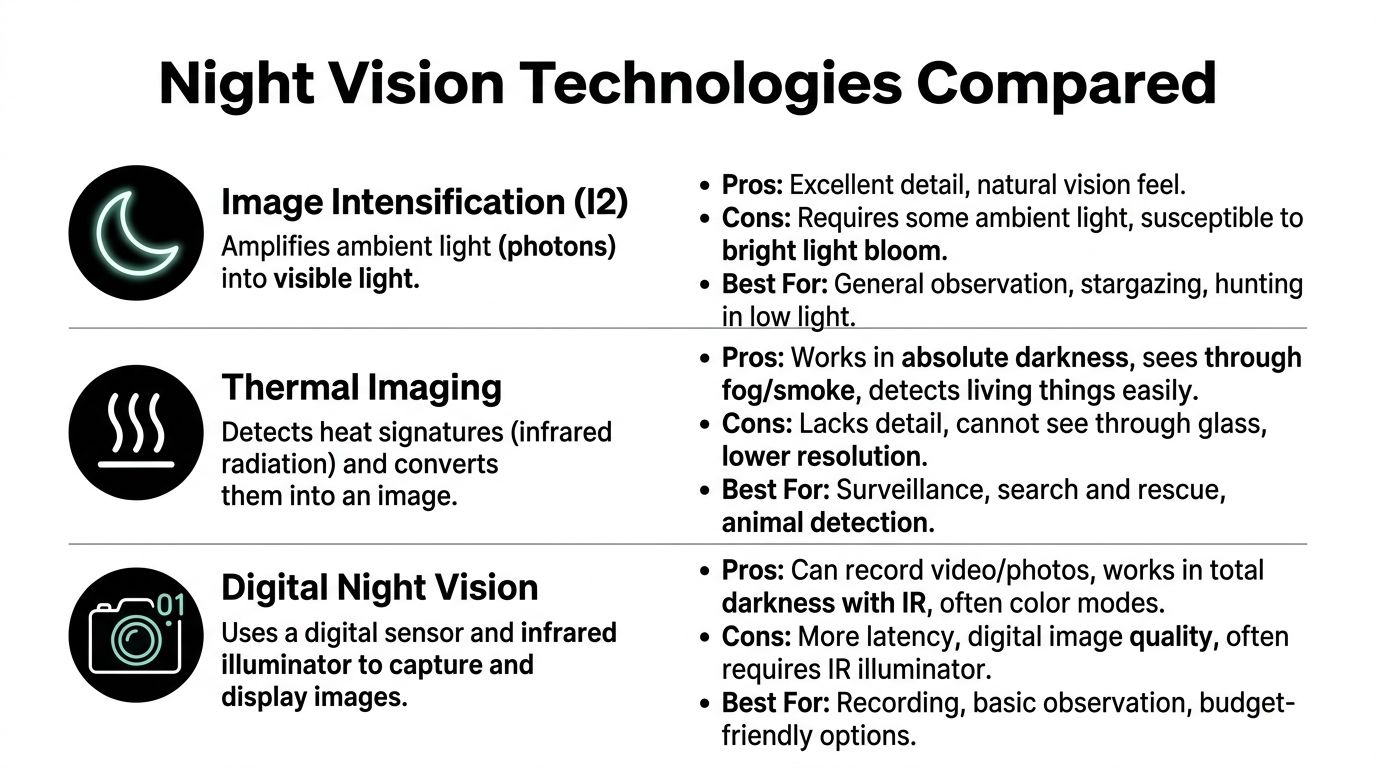
The infographic below gives the quick side-by-side:
The technology evolved in clear stages. The major jump came with Generation 1 in the mid-1960s. During the Vietnam War, devices like the AN/PVS-1 and AN/PVS-2 Starlight scopes gave troops passive night capability without the external infrared illuminators required by earlier systems. Those Gen 1 tubes amplified light about 1,000x and changed night surveillance and combat by using ambient starlight and moonlight instead of a visible support system, as described in this history of night vision.
From there, Gen 2 improved brightness and clarity with microchannel plates. Gen 3 pushed sensitivity further with gallium arsenide photocathodes. That is the performance tier most serious tactical users still focus on.
Digital night vision
Digital night vision works more like a low-light camera. It uses a sensor, software processing, and often an infrared illuminator.
That brings some practical benefits:
- Recording: Digital units often capture photos and video.
- Day use: Many can operate in daylight without the same concerns tied to analog tubes.
- Price access: Entry-level options are easier to reach.
The trade-off is equally real. Digital can show latency, can feel less natural through the eyepiece, and often leans harder on an IR illuminator once ambient light drops off. For casual observation, property checks, and buyers who want recording built in, digital has a place. For serious movement under low light, analog I² still holds ground for a reason.
Thermal imaging
Thermal does not see light. It sees heat signatures.
That makes it the strongest choice for one job in particular. Detection. If an animal, person, or vehicle is hidden in darkness, brush, or weather that degrades visible detail, thermal often finds it first.
A short comparison helps:
| Technology | What it sees | Strength | Weakness |
|---|---|---|---|
| Image intensification | Ambient light | Natural detail and navigation | Needs some light |
| Digital NV | Sensor-processed low light | Recording and entry-level access | More latency, often more IR dependence |
| Thermal | Heat | Fast detection in darkness and clutter | Less scene detail for identification |
If your priority is moving safely and identifying detail, start with image intensification. If your priority is finding living things fast, start with thermal.
A lot of buyers need both functions. That is why hybrid setups make sense for many users. If you want a practical category overview before comparing models, this guide to types of night vision lays out the roles clearly.
Evaluating Specs That Matter
Spec sheets confuse buyers because sellers mix useful performance data with a lot of noise. The fix is simple. Separate the numbers that change what you see from the numbers that mainly help a listing look impressive.
If I am evaluating an analog tube, I start with FOM, then I check the specs underneath it.
FOM and why it carries weight
Figure of Merit, or FOM, is resolution multiplied by signal-to-noise ratio. That calculation combines detail and image cleanliness into one quick indicator. According to Steele Industries’ guide to spotting high-quality night vision devices, military-spec Omni VIII minimums call for 1600+ FOM, such as 64 lp/mm resolution with 25 SNR.
That source also notes that higher FOM above 1800 tends to deliver a clearer image with less visible grain. In field terms, the scene stays more usable when ambient light drops and cheaper tubes start to look dirty.
FOM still has limits. A single headline number can hide weak halo control, poor EBI, or inconsistent tube cosmetics. Buyers who stop at FOM often overpay for a tube that looks good on paper and disappoints under real use.
A practical read looks like this:
- Resolution shows how much fine detail the tube can separate.
- SNR shows how well the useful image stands above background noise.
- FOM gives a fast summary of how those two interact.
The specs behind the performance
Good night vision is a stack of tolerances, not one magic number. The same Steele Industries source says Gen 3 auto-gated white phosphor systems worth close attention often show:
- Photocathode sensitivity above 2000
- Gain from 25,000 to 110,000
- Halo at or below 1.0
- Equivalent background illumination at or below 3.0
- Tube life above 10,000 hours
Those numbers matter because they show up immediately in use.
Higher SNR usually means less sparkle, less snow, and a calmer image in poor conditions. Higher resolution helps separate shapes, edges, and small details. Lower halo keeps bright points from blooming as badly around streetlights or headlights. Lower EBI helps preserve image quality in warm weather and very dark scenes. Auto-gating improves control in changing light, and manual gain lets the user tune brightness instead of accepting whatever the tube gives them.
Auto-gating earns its keep fast in mixed lighting. Without it, urban use gets ugly in a hurry.
Steele Industries also states that Gen 3 white phosphor can provide 20/25 visual acuity in good conditions and a 40-50° field of view. It notes that PVS-14 monoculars can achieve detection ranges exceeding 100m in starlight. Those are useful reference points, but they should not be treated as purchase guarantees. Housing quality, lens quality, tube consistency, and the light available in your actual environment still decide whether the device feels worth the money.
That point matters for long-term value. A unit with a strong tube but weak assembly, poor collimation, or no service path can become an expensive headache. The spec sheet does not show turnaround time for repairs, parts availability, or whether the vendor will still answer the phone two years from now.
White phosphor versus green phosphor
Buyers get distracted here.
White phosphor is popular because many users find it easier to interpret and less fatiguing during long sessions. Green phosphor still works well and has a long service history. Neither phosphor color fixes weak performance.
I would take a cleaner, higher-performing green tube over a mediocre white tube every time. Color preference comes after image quality, build quality, and support.
A fast filter for buyers
For a smart purchase, rank the decision in this order:
- Tube quality first
- Auto-gating if the environment includes changing light
- Manual gain if the user works mixed terrain or urban clutter
- Housing quality, mount compatibility, and repairability
- Vendor support, warranty terms, and service reputation
- Phosphor color after the performance and ownership issues are settled
That order keeps buyers from spending premium money on a trendy feature while ignoring the costs that show up later. The right unit is not just the one with the nicest numbers today. It is the one you can keep running, get serviced, and trust after hard use.
Matching the Device to Your Mission
The right answer changes with the job. A monocular that makes sense for a hunter may be the wrong call for an officer moving through alleys, parking lots, and interiors. A thermal scope that is excellent for finding hogs may be the wrong tool for someone who needs scene detail and navigation.
That is where most “night vision best” advice falls apart. It talks about products without talking about missions.
Law enforcement and security work
Urban and mixed-light environments punish weak gear fast. Streetlights, headlights, handheld lights, and indoor transitions all stress a device.
For that user, priorities usually look like this:
- Auto-gated Gen 3 I²: Better control under changing light.
- Helmet-mounted setup: Hands-free movement matters more than bench-style viewing comfort.
- Dual-tube goggles: Better depth cues and faster scanning for movement-heavy work.
- Durable housing and mount ecosystem: Hard use exposes weak mounting choices quickly.
Thermal still has a role. It is useful for perimeter scans, tracking, and initial detection. But if the task is moving through a structure or positively identifying what a person is doing, image intensification usually carries the load better.
Hunters and land managers
Hunters often need two separate answers. The first is finding animals. The second is confirming what they are looking at before the shot.
That is exactly where thermal earns its keep. According to Pulsar’s guide to the best scopes for night hunting, thermal imaging outperforms image intensification for detection in total darkness, heavy fog, and dense brush because it reads heat signatures in the 7-14μm long-wave infrared range. That same source states that Pulsar Thermion 2 and Trail 3 LRF models offer detection ranges of up to 2km for human-sized targets, with recognition at 500m+ and identification at 200m+.
That is a great advantage for spotting through foliage and poor visibility. It is why thermal is so effective for hogs and other animals that disappear visually but still radiate heat.
The same source also notes practical trade-offs:
- Thermal power draw is higher, often requiring battery changes in the 8-12 hour range.
- Digital IR can be more budget-friendly but trails thermal in hard detection problems.
- Multispectral fusion combines thermal detection with digital visual detail for all-conditions use.
For many hunters, the cleanest answer is split by role. Thermal for scanning. I² for movement and confirmation. The Pulsar article specifically recommends pairing a thermal optic with a Gen 3 PVS-14 for a hybrid setup.
Preparedness and rural property use
This buyer is usually trying to do several things with one purchase. Check a property line. Move around at night. Watch for animals. Keep cost under control.
That mission usually rewards restraint. A good monocular often makes more sense than overbuilding the setup on day one. A PVS-14 style monocular is practical because it can be helmet-mounted, handheld, or integrated into a broader kit later.
A thermal handheld can also make sense as a first detection tool if the property has brush, livestock risk, or long sight lines. The question is whether the user needs to move under the optic or just scan with it.
Dealers and unit buyers
Departments, retailers, and team purchasers have another layer to think through. Standardization matters. So does support. One practical option in this space is Superior Tactical LLC, which offers Gen 3 systems with a 10-year warranty, nationwide shipping, and in-house repair support according to the publisher information provided for this article.
That does not mean every buyer needs the same product. It means fleet buyers should care about parts, diagnostics, warranty handling, and what happens after a hard season or heavy training cycle.
The wrong optic for your mission does not become a good buy just because the sticker price was lower.
Budgeting Beyond the Initial Price Tag
Buyers either make a smart purchase or buy the same lesson twice.
Most buying guides talk about upfront price and stop there. That misses the part that determines long-term value. Maintenance, repairability, warranty support, and system accessories decide whether the optic stays useful or turns into an expensive box item.
According to Pew Pew Tactical’s night vision buying guide, current night vision content largely skips total cost of ownership. The same source notes that guides compare Gen 3 devices starting at $2,000 versus Gen 4 at $4,000+, yet do not address tube replacement costs, repair timelines, or how warranty coverage affects real-world economics over 5-10 year service cycles.
The hidden costs new buyers miss
The optic is only part of the spend.
A complete working setup often includes:
- Helmet and mount: Critical if the device will be used for movement.
- Protective lens accessories: Small add-ons that can save more expensive components.
- Power planning: Spare batteries and charging routine if the system needs it.
- Training time: Not a retail line item, but still part of ownership.
- Storage and care: Night vision rewards owners who treat it like precision equipment.
A buyer who spends less on the core unit and ignores the rest often ends up with a setup that is technically functional but not field-ready.
Why durability changes the math
A more capable unit can cost less over time if it stays in service longer and can be fixed when something goes wrong.
That is especially true in professional use. Teams do not just need equipment that performs on day one. They need equipment that can survive regular use, be inspected, and return to service without starting the purchasing process from scratch.
One of the few clear long-term indicators buyers do get is tube longevity. As noted earlier in the article, quality Gen 3 tubes can offer 10,000+ hour tube life in the cited specifications. That shifts the value equation away from sticker shock and toward service life.
Budget as a system, not a line item
I tell buyers to divide the budget into three buckets:
- Core device
- Support gear
- Long-term support
That third bucket is often skipped. The better approach is to plan the purchase around the full lifecycle. This budgeting guide for finding the right balance is useful if you want to think through the trade-offs without reducing the decision to a single price number.
Cheap gear that cannot be serviced is often the most expensive option in the room.
Choosing Your Vendor and Ensuring Long-Term Support
A lot of buyers put all their effort into choosing the device and almost none into choosing the seller. That is backwards.
Night vision is not a throwaway consumer electronic. It is closer to buying precision gear that you may depend on in rough conditions. The vendor matters because the sale is only the beginning. If the unit arrives with questions, needs diagnostics later, or has to be serviced after hard use, the quality of the seller becomes part of the product.
Why the vendor matters more than most reviews admit
A general marketplace can list night vision. That does not mean it can support night vision.
The bigger problem is that public buying content still leaves out a lot of real-world guidance. According to Outdoor Life’s roundup of night vision goggles, real-world environmental and situational performance data is largely missing from search results. The same source points out that claims about humid environments, all-around use, or digital alternatives often lack comparative testing for urban light pollution, dense forest canopy, maritime use, vehicle exhaust bloom, humidity, or cold.
That gap matters because lab specs do not answer practical ownership questions:
- How does the unit behave in your environment?
- Who helps you if performance seems off?
- Can the seller explain trade-offs without hiding behind jargon?
- Is there a service path if something fails?
What to look for in a specialist vendor
A solid vendor should offer more than inventory.
Look for these signs:
- Real warranty terms: Long coverage is useful because it changes the ownership risk.
- Diagnostics and repair path: If the optic has issues, there should be a known next step.
- Spec transparency: Serious buyers should be able to evaluate what they are paying for.
- Mission-based guidance: Recommendations should start with use case, not margin.
- Compliance awareness: Buyers need a seller who understands the rules around restricted equipment.
The warranty benchmark worth noting here is straightforward. The publisher information for this article states that Gen 3 night vision systems are backed by a 10-year warranty, and that the company performs in-house repairs with free diagnostics. Those are the kinds of support details buyers should compare across vendors, whether they buy from this publisher or someone else.
Questions worth asking before you buy
The fastest way to vet a seller is to ask blunt questions.
Try these:
- What happens if the unit needs service?
- Do you handle diagnostics directly or outsource everything?
- Can you explain why this tube or housing fits my use case?
- What support exists after delivery?
- If I am building a system over time, what expands cleanly later?
A vendor who cannot explain long-term ownership clearly is asking you to take the risk they should be helping reduce.
A strong buying decision is not just the right optic. It is the right optic from the right place, with a support path that still makes sense after the sale.
Your Next Step Into the Night
If you want the short version, use a simple filter.
Start with the mission. Decide whether you need movement, detection, identification, or some mix of all three. That answer tells you whether image intensification, thermal, digital, or a hybrid setup belongs on your shortlist.
Then read specs with discipline. For analog night vision, focus on tube quality first. FOM, SNR, resolution, halo, EBI, and auto-gating tell you more than polished product copy ever will.
After that, budget for the whole system. The optic is not the whole purchase. Mounting, support gear, care, warranty coverage, and repair options all belong in the total cost. Buyers who ignore that usually end up paying more later.
Finally, choose the seller with the same care you use to choose the device. Support after the sale is part of the value, especially for gear that may see rough conditions, long nights, and years of use.
The night vision best choice is not the most expensive optic on the page. It is the setup that fits your environment, holds up over time, and comes with a support path that keeps it working.
If you are serious about buying once and buying smart, slow down just enough to get those pieces right.
If you are ready to compare real night vision and thermal options, talk through your use case, or learn more about warranty and repair support, visit Superior Tactical LLC.
