
Thermal Imager for Hunting: Top Picks 2026
You hear brush popping off the tree line. Something heavy is moving. You know it is close, and you know it is active right when the light is gone. Then you put glass on it and see nothing useful. Black timber, dark pasture, a little moonlight if you are lucky, and an animal that might as well be invisible.
That is the problem a thermal imager for hunting solves.
For hogs, predators, and recovery work, thermal changes the hunt in a way standard optics do not. You stop guessing where the movement came from. You start finding heat signatures quickly, sorting animals from background, and working with a tool built for darkness instead of fighting against it.
A lot of hunters hit the same wall on their first purchase. Product pages throw around resolution, NETD, lens sizes, digital zoom, base magnification, refresh rate, and dual FOV. Some of that matters a lot. Some of it matters only in specific terrain. And some of it looks great on a spec sheet but helps very little once you are tired, cold, and trying to make a clean decision in the field.
Thermal is no longer niche gear. The global thermal imager for hunting market was valued at USD 0.1 billion in 2024 and is projected to reach USD 0.3 billion by 2033 at a 12% CAGR, which reflects its move from specialized use into mainstream hunting equipment, according to this thermal hunting market analysis.
The End of Hunting in the Dark
A failed night hunt usually does not fail because animals were not there. It fails because the hunter could not turn sound, movement, and suspicion into a usable sight picture.
That happens all the time with hogs. You hear rooting in a field edge, or catch a quick silhouette crossing a sendero, but by the time you raise a standard optic the animal is gone into grass, shadow, or brush. Coyotes do the same thing in open country. They appear, pause, then vanish into terrain that looks flat in daylight and turns into one dark sheet at night.
Thermal fixes that specific problem. It does not make you a better woodsman by itself, but it does remove the blindness.
Where thermal changes the game
A good thermal unit helps in three places that matter most:
- Detection: You spot the heat signature before you ever see body detail.
- Tracking movement: You keep up with an animal crossing grass, creek bottoms, or cut fields.
- Recovery: You can often relocate downed game or wounded pests when visual contrast is poor.
For predator control and hog work, that matters more than people realize. A lot of missed opportunities happen between “something is out there” and “I can confirm what it is.” Thermal closes that gap fast.
What new buyers usually get wrong
Most first-time buyers chase magnification first. That is backwards.
In real hunting, a thermal imager that finds animals quickly and gives you a stable, readable image is usually more useful than one that promises huge zoom numbers. If the field of view is too tight, you spend the night searching through a straw. If the image washes out when you zoom, the extra magnification does not help.
Practical takeaway: Buy for your terrain first. Dense woods, bait sites, crop fields, and wide-open predator country do not reward the same optic setup.
The right thermal lets you work from detection to decision without losing the target. That is the difference between hearing an animal in the dark and getting a legal, ethical shot opportunity.
How Thermal Imagers See the Unseen
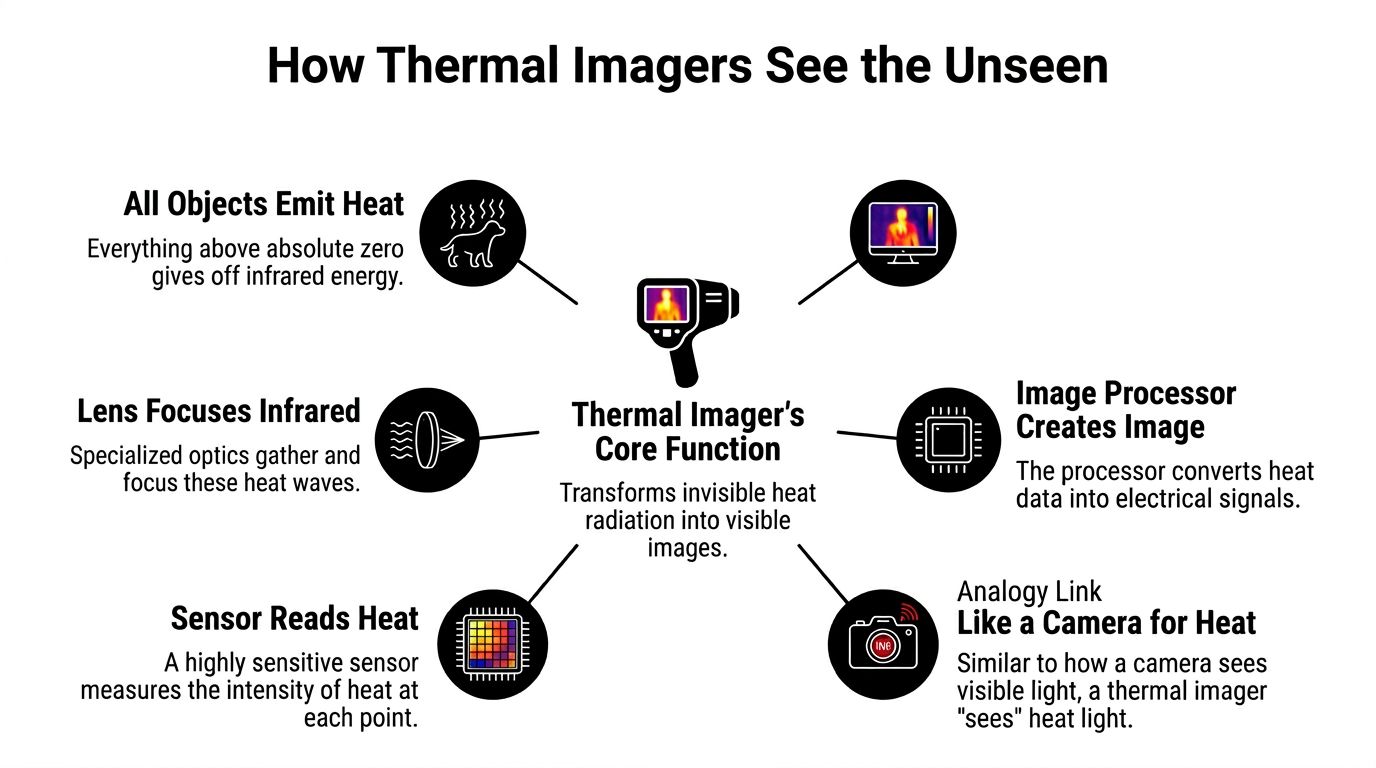
A thermal imager does not “see in the dark” as it is commonly understood. It reads heat energy.
Consider it a camera that sees heat-light instead of visible light. A deer, hog, coyote, person, rock, fence post, and truck all give off infrared energy. The thermal sensor reads those differences and turns them into an image you can use.
Thermal versus night vision
Thermal versus night vision. Buyers often get crossed up by this distinction.
Night vision amplifies available light. Moonlight, starlight, and ambient light become a brighter image. It works well when some light exists, but it still depends on light.
Thermal ignores visible light and reads heat contrast. That is why it can pick out warm animals in total darkness, through brush gaps, and in conditions where conventional optics are useless.
If you want a clean primer on the basics, this overview of what thermal vision is covers the fundamentals in plain language.
What thermal does well
Thermal is strongest when the job starts with detection.
A hog in tall grass may disappear to your eyes, but its heat signature can still stand out. A coyote crossing a field edge often shows up as a bright moving target long before you could identify it with standard glass. For recovery, thermal can also help separate a warm body from a cooler background after the shot.
That is why thermal moved from military roots into practical hunting use. The technology goes back to World War II-era active infrared riflescopes developed by German, American, and British forces, and modern high-end models now reach detection ranges exceeding 2,800 meters, as outlined in this history of thermal and infrared hunting equipment.
What thermal does not do well
Thermal is not magic. It does not give you X-ray vision.
Heavy cover still blocks line of sight. Rain, fog, humidity, warm ground, and cluttered backgrounds can flatten contrast and make the image less crisp. You may still detect an animal but struggle to identify exactly what you are looking at if the environment is working against you.
Thermal also does not replace judgment. Heat tells you something is there. It does not always tell you enough, by itself, to make a shot decision.
Why the image looks strange at first
New users expect a daylight-style picture and get disappointed. That is the wrong expectation.
A thermal image is all about contrast. You are reading hot and cool shapes, edges, and movement patterns. After a few hunts, your brain gets faster at it. You stop looking for “fur” and start reading posture, gait, head carriage, spacing, and behavior.
Tip: Spend time observing with thermal before you hunt with it. Watching livestock, pets, and known landmarks teaches your eye what useful thermal detail looks like.
Once that clicks, the device stops feeling like a gadget and starts feeling like a field tool.
Decoding Thermal Specs That Actually Matter
Spec sheets are full of noise. A hunter only needs to focus on the handful of specs that change what happens in the field.
The biggest ones are resolution, NETD, lens and field of view, and refresh behavior under movement. If you understand those, you can ignore most of the marketing fluff.
Resolution tells you how much detail survives
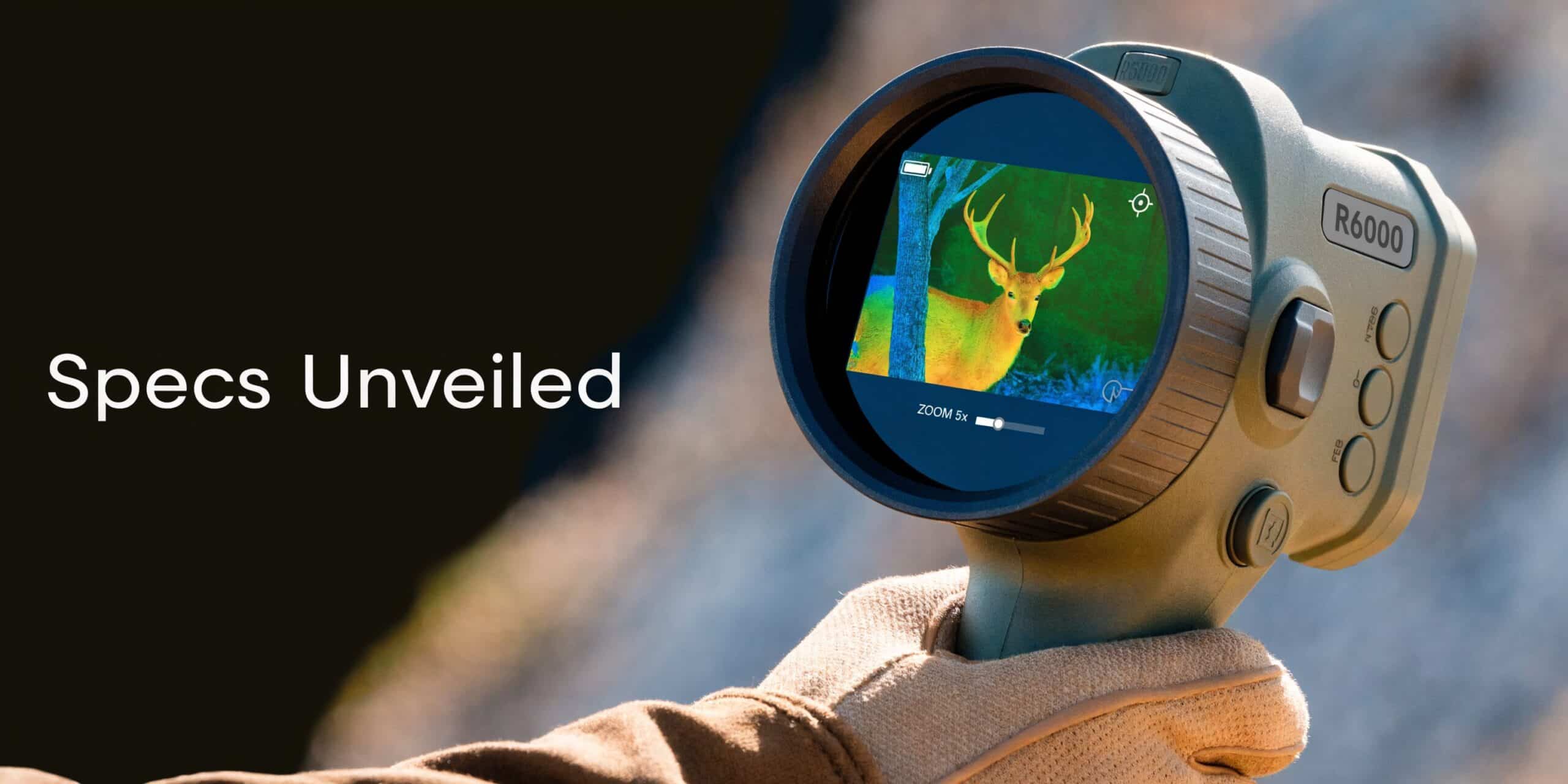
Resolution is the difference between “there is a hot blob out there” and “I can tell what I am looking at.”
For hunting, 640×480 resolution with NETD below 25mK is the sweet spot for balancing image clarity, detection range, and positive identification. That spec level can allow hunters to spot and identify game like deer at 1,800 to 2,800 meters, and it holds detail better during digital zoom, according to this breakdown of thermal camera specs for professional hunters.
That matters because digital zoom always asks the image to do more with the same base data. A higher-resolution sensor gives you more to work with before the picture gets mushy.
If you want to compare the kinds of thermal and night vision scope options available, this category page for thermal night vision scopes is a useful place to sort through form factors and intended use.
NETD tells you how well the sensor separates small heat differences
A lot of buyers ignore NETD because it sounds technical. They should not.
Think of NETD as the unit’s ability to see subtle heat contrast. Lower is better. In practical hunting terms, lower NETD helps when the night is humid, the background is messy, or the temperature spread between the animal and the environment is smaller than you want.
That is why a lower NETD unit tends to give a cleaner, more readable picture in hard conditions. It is not just about raw range. It is about how much useful separation the image gives you.
Lens choice decides whether you hunt wide or hunt far
Lens size changes how the optic feels more than many buyers expect.
A wider field of view helps in woods, feeder work, close hog setups, and any situation where animals can appear from different directions quickly. A tighter field of view is more comfortable when you are watching long lanes, crop fields, or open country where early detection at distance matters.
Here is the trade-off in plain language:
| Spec choice | Helps most with | Gives up |
|---|---|---|
| Wider view | Fast scanning, close encounters, moving groups | Less detail at distance |
| Narrower view | Long-range detection and better target size on screen | Slower scanning, easier to lose moving animals |
This is why some people hate a thermal that other hunters love. They are using it in different terrain.
Refresh behavior matters more than brochure zoom
When animals move, lag kills confidence.
A thermal that pans smoothly lets you track a coyote quartering across a field or hogs breaking from cover. A unit that stutters or smears under movement makes everything harder. The picture may look fine standing still and become frustrating the second you try to follow live targets.
What works and what does not
For most buyers, these rules hold up in the field:
- Works well: Higher native resolution, lower NETD, honest base magnification, and a field of view matched to terrain.
- Usually disappoints: Overhyped digital zoom, ultra-tight field of view for close woods work, and buying solely on max detection claims.
- Worth paying for: Better image quality before zoom, cleaner image in humidity, and controls you can operate with gloves.
- Often overrated: Fancy menu systems you never touch once the hunt starts.
Key takeaway: Buy the thermal you can read quickly under stress. The one that looks great only on a product page is usually the wrong one.
Choosing Your Thermal Form Factor
The right specs are only half the decision. The other half is choosing the right form factor.
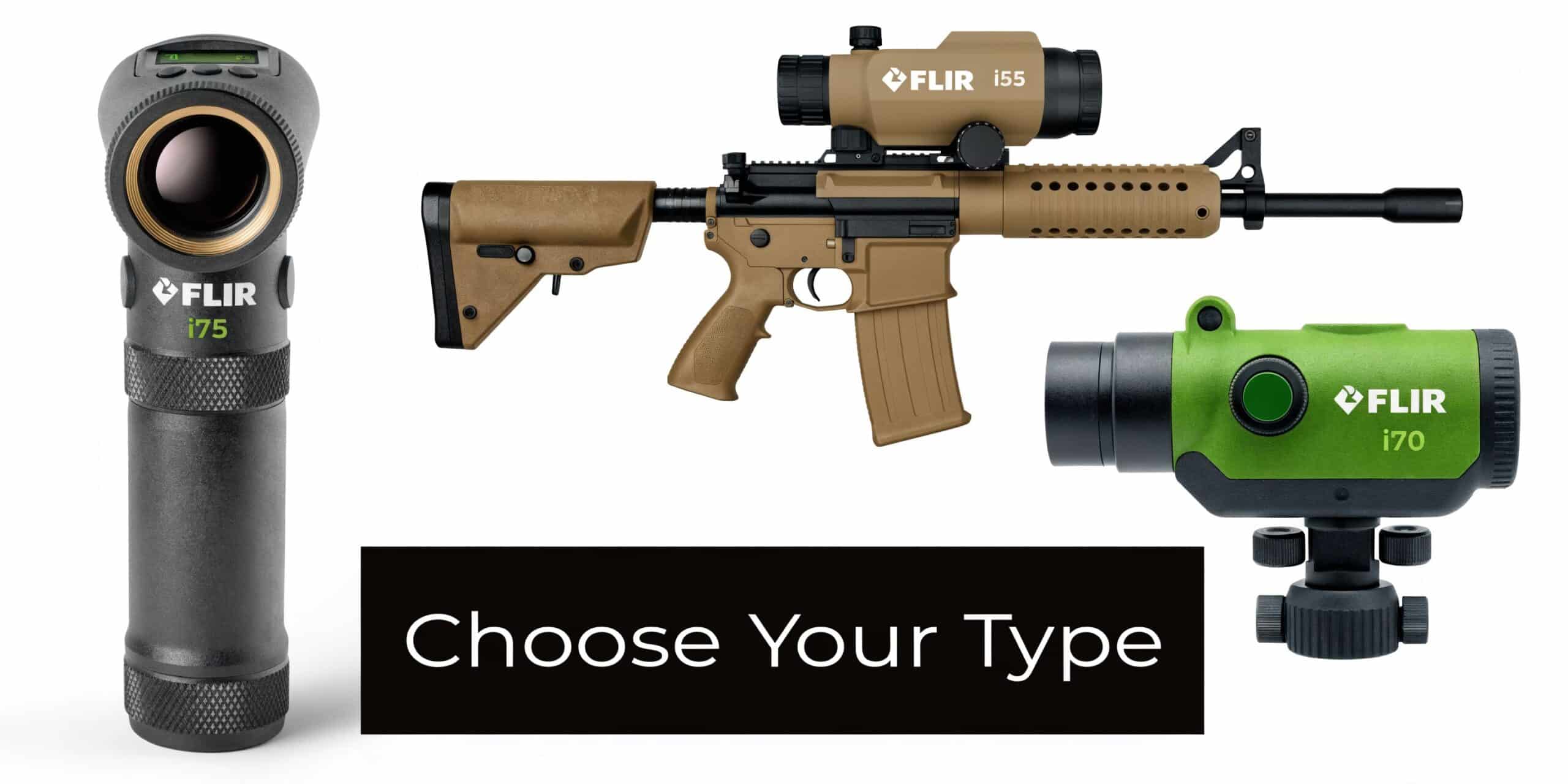
Most hunting setups fall into three lanes. A handheld monocular for scanning. A dedicated thermal riflescope for aiming and shooting. A clip-on for hunters who want to keep a day optic and add thermal capability.
Handheld monoculars for finding animals
Most smart systems start with this option.
A handheld keeps the rifle down while you scan. That matters for safety, fatigue, and speed. It is also the easiest way to cover ground without pointing a muzzle at every heat source you find.
For hog and predator work, a handheld often does the heavy lifting. You locate first, then move to a shooting optic only when you need to confirm and engage.
Some hunters also prefer binocular-style thermal for long observation sessions. If that format appeals to you, these thermal night vision binocular options show how two-eye observation changes comfort and situational awareness.
Dedicated thermal scopes for taking the shot
When shooting at night, a dedicated thermal riflescope is the most straightforward answer.
It is built for aiming, recoil, zero retention, and repeatable shot placement. You are not trying to adapt one system into another. That simplicity matters in the dark.
The downside is cost and weight. A dedicated scope can also be slower for broad-area scanning if you try to use it as your only thermal device.
Clip-ons for flexibility
Clip-ons make sense for hunters who already trust a day optic and want to preserve a familiar rifle setup.
That flexibility is useful, but clip-ons are less forgiving if the rifle, optic height, mount quality, and user expectations are not sorted out. They can be excellent in the right hands, but they are not always the easiest first thermal purchase.
Where dual FOV earns its keep
Some of the most practical thermal design gains come from dual-field-of-view optics.
A dual FOV system lets you scan wide and then switch narrower for identification. On paper that sounds convenient. In the field it is a real advantage. According to this review of dual-FOV thermal monocular design, setups such as 20/40mm lenses can effectively multiply range by 2 to 2.5 times, cutting time between detection and shot setup.
That feature makes the most sense for mixed terrain. If you hunt creek bottoms, edges, fields, and brush pockets in one night, being able to switch from broad scanning to tighter identification without changing devices is useful.
Quick comparison
- Handheld monocular: Best for scanning, stalking, and recovery.
- Dedicated scope: Best for repeatable nighttime shooting.
- Clip-on: Best for preserving a familiar day-optic setup.
- Dual FOV unit: Best when your terrain changes fast and you need both width and reach.
The wrong form factor makes a good sensor feel clumsy. The right one makes average specs feel far more usable.
Matching Your Optic to Your Hunt
A thermal imager for hunting should match the animal, the terrain, and the way the shot develops. If any one of those is off, the optic will feel wrong no matter how strong the marketing sounds.
Hogs in tight cover do not ask the same things from an optic that coyotes do in open country. A recovery setup does not need the same priority list as a dedicated night rig. In this context, buyers should stop thinking in terms of “best thermal” and start thinking in terms of “best thermal for this hunt.”
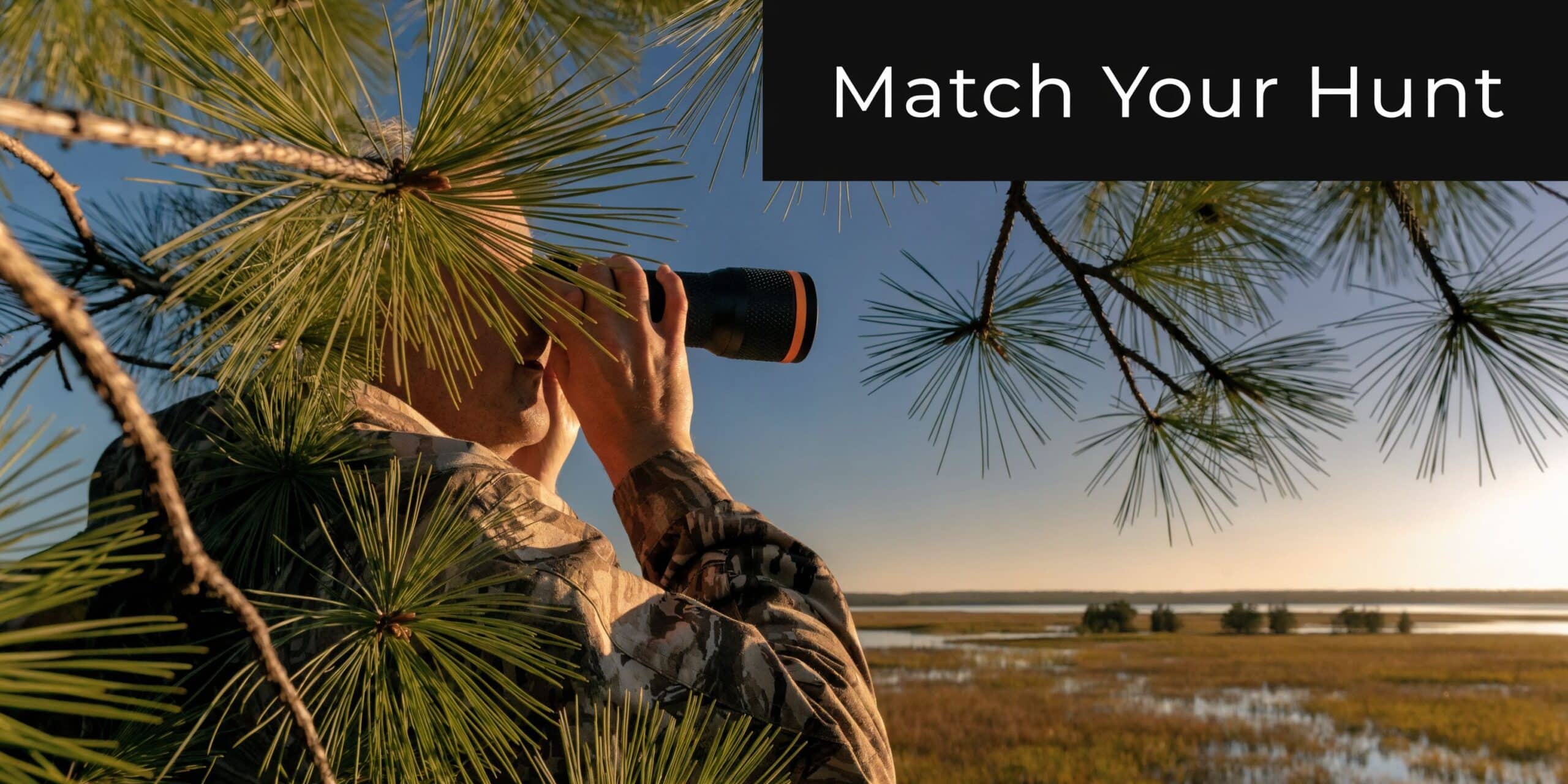
Hogs in woods, fields, and bait setups
For hogs, the job usually starts with fast detection at moderate distance, often in clutter.
A wide field of view matters more than extreme magnification because hogs travel in groups, change direction fast, and often appear near cover. If your optic is too tight, you will spend time relocating animals that were already on the screen.
In that situation, prioritize:
- Wide viewing comfort
- Clean image in humidity
- Fast target reacquisition
- Handheld scanning paired with a shooting optic if possible
A monocular plus thermal scope is often the most efficient hog setup. Use the handheld to find the sounder, then transition to the rifle only when the shot is about to happen.
Coyotes in open country
Coyotes expose weak optics quickly.
They hang up. They move at odd angles. They stop just long enough to force a decision. In open country, image detail and confidence at distance become more important than the broadest possible field of view.
That pushes you toward higher native resolution and a lens setup that gives better target size on screen without relying too heavily on digital zoom. You still need enough width to track movement, but here detail starts to beat raw scanning comfort.
Mixed farms and edge country
Many hunters operate in this kind of terrain. One property can include timber, creek drains, pastures, crop edges, and longer lanes.
That kind of hunting rewards versatility. Dual FOV starts making real sense here. So does a balanced handheld with enough reach to scan open ground but enough width to stay useful near cover.
If you want one setup that handles the most scenarios reasonably well, avoid extremes. Do not go too narrow, and do not go too cheap on image quality.
Recovery and observation first
Some hunters are not buying thermal for night shooting first. They want it for locating game, checking fields, finding animals in brush, or recovering after a shot.
That buyer can often lean toward a handheld first. It gives immediate utility, teaches thermal interpretation faster, and does not lock the whole budget into a weapon-mounted unit on day one.
Thermal Spec Recommendations by Hunting Style
| Hunting Style / Target | Recommended Resolution | Recommended NETD | Key Form Factor |
|---|---|---|---|
| Hogs in dense cover | 384×288 or 640×480 | Lower NETD preferred for clutter and humidity | Handheld monocular or wide-FOV scope |
| Coyotes in open country | 640×480 | Lower NETD preferred for cleaner long-range contrast | Dedicated thermal scope |
| Mixed farm hunting | 640×480 if budget allows | Lower NETD preferred | Dual-FOV monocular or balanced thermal scope |
| Recovery and scouting | 384×288 or 640×480 | Lower NETD preferred | Handheld monocular |
| Property surveillance and observation | 384×288 or 640×480 | Lower NETD preferred | Handheld or binocular-style thermal |
A simple way to decide
If your shots happen close and fast, buy width first.
If your animals hang up at distance, buy detail first.
If you do both, buy balance and accept that no single optic dominates every use case. That is also where a retailer with hunting-focused categories, such as Superior Tactical LLC’s thermal monocular and spotting options, can be helpful for narrowing the form factor before you get lost in model names.
Practical rule: Match your first thermal to the hunt you do most often, not the hunt you imagine doing once or twice a season.
Field Skills Legalities and Ethics
A thermal optic is only useful if it is mounted right, zeroed right, powered right, and used legally.
That sounds obvious, but a lot of frustration comes from simple field mistakes. The hunter blames the optic when the underlying problem is loose mounting hardware, a rushed zero, a dead battery, or using thermal in a place or for a species where it is not legal.
Field habits that prevent bad nights
Start with the basics every time:
- Mount carefully: Use a solid mount, proper torque, and witness marks if that fits your system.
- Confirm zero again: Any bump, travel, mount change, or rifle change means checking zero.
- Carry power smart: Bring spare batteries where you can reach them without digging through a pack.
- Manage lens condition: Dust, moisture, fingerprints, and rain on the lens will hurt the image quickly.
- Practice menu use in daylight: You do not want to learn brightness, contrast, palettes, or reticle changes in the field.
Most thermal problems I see are not sensor problems. They are setup problems.
Zeroing without wasting time
Keep the process boring and repeatable.
Use a target you can clearly read in thermal. Make deliberate adjustments. Confirm after the optic settles. Then confirm again from the position you actually hunt from, not just the bench.
For a dedicated thermal scope, zero confidence matters because thermal images can make distances and target edges feel different than daylight glass. If your rifle and optic combination is trustworthy, your shot decisions get calmer.
Tip: After zeroing, spend some time tracking known objects and shooting from realistic field support. Thermal sight pictures can feel different from conventional optics, especially at night.
Battery and weather reality
Cold weather is hard on batteries. Long sits are harder than quick checks from a vehicle or stand.
Keep spare batteries warm if possible. Start with a full charge. If your unit uses removable batteries, organize them in a way you can manage by touch in the dark. Do not wait for the screen to warn you when you are already in the middle of an opportunity.
The legal part too many hunters skip
This is the most ignored part of thermal hunting content, and it is the part that can cost you the most.
Regional laws vary by state, species, season, weapon type, and whether the device is used for observation or for taking game. One state may allow thermal for predators and prohibit it for big game. Another may allow night use only under narrow conditions.
That confusion is real. As noted in this discussion of thermal device regulations and legal gaps, some states such as California ban thermal for big game hunting while allowing it for predators, and penalties in some U.S. jurisdictions can reach $10,000.
A practical compliance checklist
Before any hunt, verify these points yourself with current regulations:
- Species legality
Predator rules, hog rules, and big game rules may be completely different. - Device legality
Observation may be legal where weapon-mounted use is not. - Season and time-of-day restrictions
Night use often changes the answer. - Land status
Private-land rules and public-land restrictions can differ. - Method-of-take rules
Thermal, artificial light, suppressors, and electronic aids may interact in complicated ways.
Ethics matter even when the law says yes
Legal and ethical are not always the same thing.
Thermal makes detection easier. That puts more responsibility on the hunter, not less. Positive identification still matters. Backstop still matters. Property boundaries still matters. Fair chase matters too, especially when hunting shifts from pest control into sporting contexts.
For hog eradication and predator control, thermal is a strong tool. For other game, use it with restraint and according to both regulation and local hunting culture. A clean, legal decision in the dark is worth far more than forcing a shot because the technology gave you the opportunity.
Your Investment and The Superior Tactical Advantage
A thermal purchase is not just a gear buy. It is a systems buy.
You are paying for image quality, usability in bad conditions, durability, and confidence under pressure. The cheapest route often gets expensive when the optic cannot hold up, cannot deliver a readable image, or cannot be supported after the sale.
What budget really changes
As you move up in thermal, the improvement is usually not flashy. It is practical.
You tend to get a cleaner image, better detail retention, more useful performance in difficult weather, stronger controls, better housings, and features that save time instead of adding menu clutter. The difference shows up when the target is partly screened by brush, when humidity flattens contrast, or when you need to decide quickly whether the animal on the screen is one you can legally take.
That is why many hunters are happy with a modest unit for close-range woods work and frustrated by the same unit in open-country predator hunting. Budget should follow the hardest condition you expect the optic to handle well.
Where buyers should spend first
If the budget is limited, spend on the features that affect image interpretation most:
- Native resolution
- Lower NETD
- A field of view that matches your terrain
- Controls you can run in the dark
- Mounting and support equipment that does not introduce problems
Features like onboard recording, app pairing, and extra palettes can be nice. They are not the core of the purchase.
Support matters more than people think
Thermal is not disposable gear.
Sooner or later, most serious users need advice on fit, mounting, expected performance, batteries, compatibility, or repairs. That is where the seller matters. Good support helps you choose the right category before you overspend or undershoot. It also matters if the unit needs service or troubleshooting after real use.
Superior Tactical LLC is a U.S.-based retailer focused on night vision optics, thermal imaging, and related tactical gear. The company states that it offers straightforward guidance, same-day shipping, responsive support, in-house repairs with free diagnostics, and a 10-year warranty on Gen 3 night vision systems.
The practical advantage
For a buyer, that kind of support reduces risk in two ways.
First, it helps narrow the choice before purchase. A hunter deciding between a handheld scanner, a dedicated scope, or a bino-style unit often needs use-case advice more than another spec list.
Second, it matters after the transaction. Thermal buyers are usually building a longer-term kit. They add accessories, refine the setup, and eventually want maintenance or upgrades handled by people who understand low-light gear.
The best thermal imager for hunting is not the one with the longest brochure. It is the one that fits your terrain, lets you identify what you are seeing, stays dependable when conditions get ugly, and comes from a seller who can still help you after the box is opened.
If you are sorting through thermal options and want help matching the optic to your terrain, hunting style, or rifle setup, Superior Tactical LLC is worth a look. Their catalog covers thermal and night vision gear for hunters, officers, and low-light users, and their team focuses on straightforward product guidance rather than pushing a one-size-fits-all answer.
