
Lasers
Showing all 5 resultsSorted by price: high to low


IR and Visible Laser Buyer’s Guide
For anyone running night vision in a tactical or hunting context, an IR aiming laser is the next purchase after the optic itself. Night vision lets you see in the dark; an IR laser lets you aim. Without one, you’re either using your day-iron sights through a tube (works, but slow), or mounting the optic in front of an existing red dot (also works, with a different set of compromises). An IR laser sidesteps both — you put a dot exactly where the bullet will land, visible only through night vision, and shoot from any position you can hold the rifle.
This guide walks through visible vs. IR lasers, the civilian vs. mil-spec power class distinction that defines what you can legally buy, the major manufacturers, and what you actually need based on your use case.
Visible vs. IR Lasers
Visible Lasers
A standard red or green laser dot — the kind you’ve seen on a pistol or carbine for daytime use. Visible to the naked eye, no night vision required. Useful as a quick aiming aid, for low-light situations where you don’t have NV, or as a training tool. Not what most buyers are after when they’re shopping a “tactical laser” for an NV setup, but a legitimate purchase for daytime applications.
IR (Infrared) Lasers
The aiming dot you actually want for night vision. The laser emits light in the near-infrared spectrum (typically around 850 nm), which is invisible to the naked eye but glows brightly through any NV device. Point the rifle, see the dot through your monocular or goggles, pull the trigger — that’s the entire workflow. IR lasers are the dominant tactical laser format and the answer for any serious NV-paired build.
Combo Units (Visible + IR + Illuminator)
Most premium tactical lasers combine three functions in one housing: a visible laser (for daytime), an IR laser (for NV-aided shooting), and an IR illuminator (a flood light visible only through NV, for lighting up dark interiors and shadowed areas where ambient IR isn’t enough). The PEQ-15, DBAL-A2/A3, and MAWL series are all combo units. One mount, one set of controls, three capabilities — the standard for any serious build.
The Major Manufacturers
L3Harris (PEQ-15 / ATPIAL)
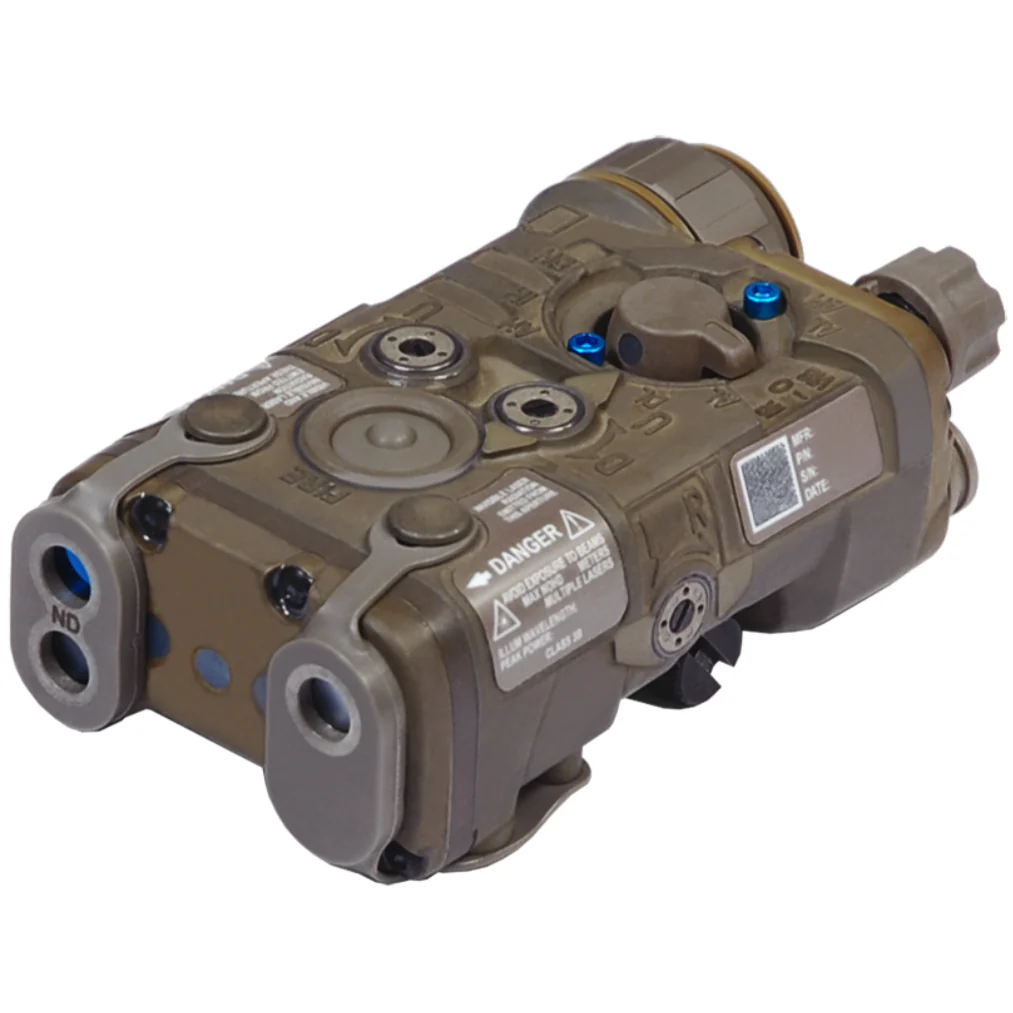
The military standard. The PEQ-15 (Advanced Target Pointer Illuminator Aiming Laser, ATPIAL) is the U.S. military’s issued IR laser and the reference design for the entire category. Built like a brick, mature feature set, and the unit most operators have run at some point. The civilian version (ATPIAL-C) is functionally identical but with output power reduced to Class 1 (eye-safe). Full-power ATPIAL/PEQ-15 units are restricted to verified LE and military buyers.
Steiner DBAL Series
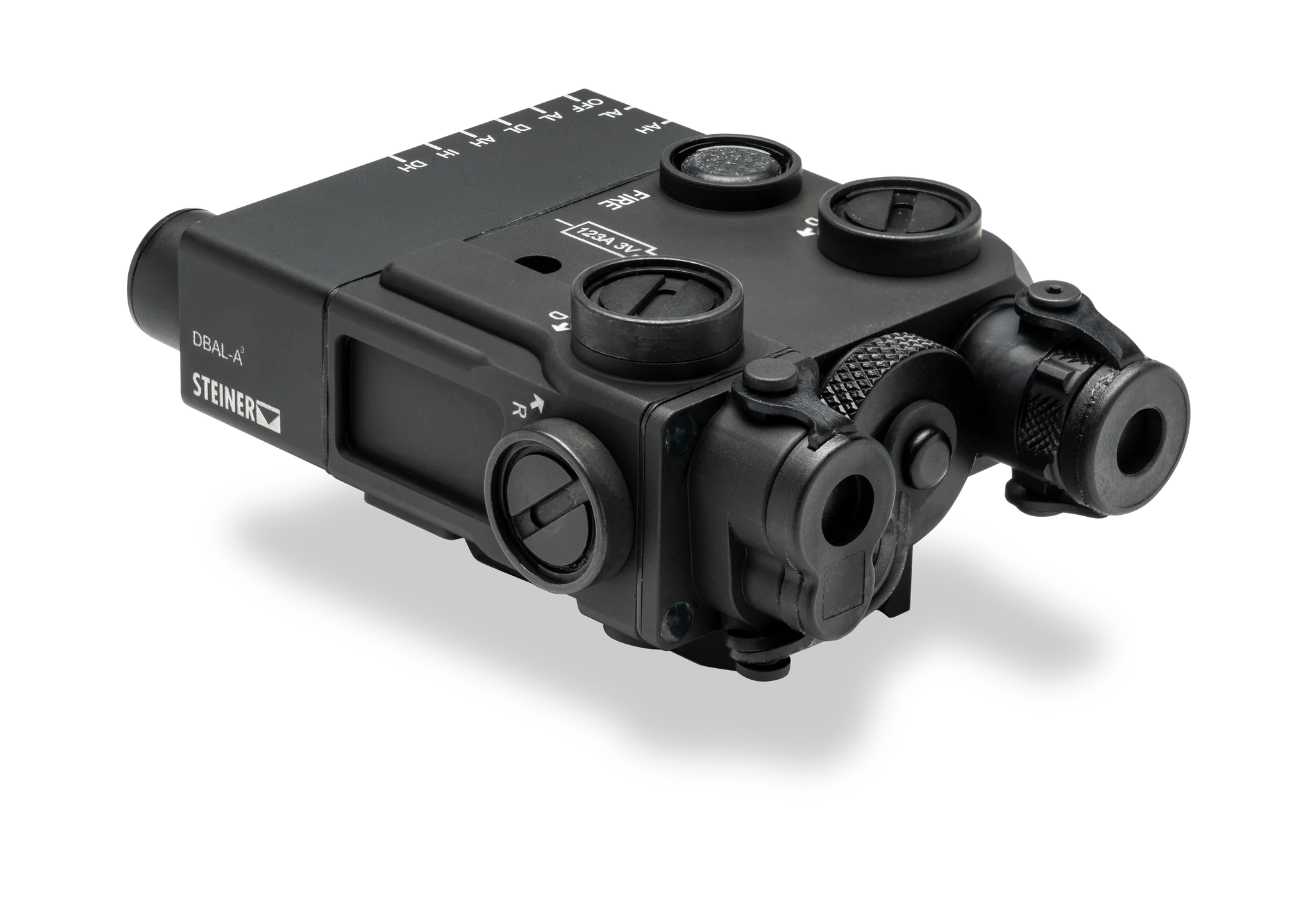
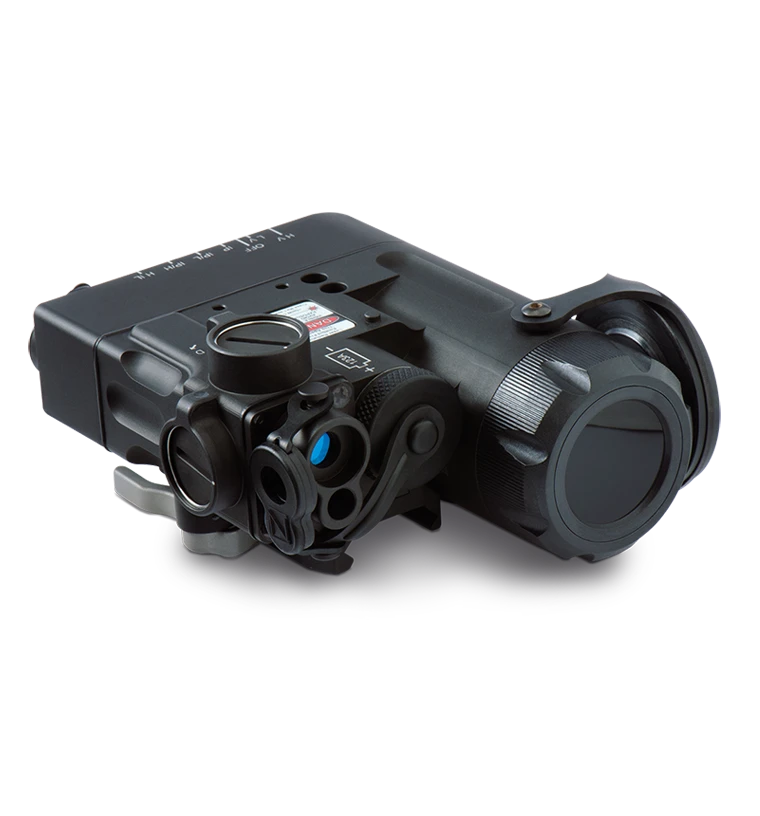
The DBAL-A2, DBAL-A3, and DBAL-D2 are the most common premium IR/visible/illuminator combo units in the U.S. civilian market. The A2 is the workhorse — visible green laser, IR laser, IR illuminator, robust controls. The A3 adds focusable IR illuminator and improved features. Civilian versions are Class 1 (eye-safe IR); LE/military versions are higher-power. Strong build quality, well-priced for the feature set, widely supported.
B.E. Meyers MAWL
The MAWL (Modular Advanced Weapon Laser) series — MAWL-DA, MAWL-C1+ — represents the premium end of the category. Designed with significant input from end-users, it features ergonomic controls, refined IR illuminator quality, and an adjustable beam divergence that’s regarded as best-in-class for both close-range work and distance precision. Available in both Class 1 (civilian) and full-power (LE/military) variants. Premium pricing reflects the design and performance.
Wilcox RAID
The Wilcox RAID family delivers premium IR/visible/illuminator combos with excellent build quality and the Wilcox engineering reputation. A strong alternative to the DBAL series for buyers who prefer Wilcox.
Holosun LS321
An affordable visible + IR + IR illuminator combo unit that’s brought serious capability into a price range most civilian buyers can hit. The LS321 (and similar Holosun models) doesn’t match the build quality or refinement of premium units but delivers genuine functionality for budget-constrained builders. A reasonable starting point.
Other Quality Brands
Sightmark and similar value-tier brands produce functional combo lasers at low price points — useful for training rigs and budget builds. Streamlight TLR-VIR series combines a white light with visible and IR lasers in a single weapon-light housing for buyers who want a unified light/laser solution.
Laser Classes — The Civilian vs. Mil-Spec Distinction
This is the most important regulatory concept in the laser category. The FDA regulates laser output power, classified by the risk to human eyes:
- Class 1: Eye-safe at any exposure duration. The legal output ceiling for civilian-sold IR aiming lasers (and most visible lasers in this space). Output is typically <0.7 mW for IR lasers.
- Class 3R / 3B (also written IIIa / IIIb): Higher output, potentially eye-damaging on direct exposure. Restricted to verified law enforcement and military buyers. Output for mil-spec PEQ-15 is typically around 5 mW or higher.
The practical impact: a civilian Class 1 IR laser is fully usable at typical NV engagement distances (out to several hundred yards) but the dot becomes harder to see at long range, especially in environments with ambient IR (urban areas, partial moonlight). A full-power Class 3B unit pushes well past those distances and is dramatically brighter. Civilian Class 1 is the right answer for almost all civilian use cases; full-power is restricted regardless of what you’d prefer to own.
If you’re a verified LE or military end-user, full-power versions of the PEQ-15, DBAL, and MAWL are available — contact us with documentation and we’ll process the order.
IR Illuminator vs. IR Laser
These are two different things on the same housing. The IR laser is a tight beam — a single dot, used for aiming. The IR illuminator is a flood — like a flashlight that’s visible only through night vision, used to light up dark interiors, shadowed cover, or anywhere passive NV doesn’t have enough ambient IR to work with. Quality combo units have a focusable illuminator (wide flood for close-range, tighter beam for distance), and on premium units (MAWL, DBAL-A3) the illuminator quality is one of the things that justifies the price difference over budget options.
If your use case is purely outdoor under starlight or moonlight, a separate illuminator isn’t critical. For indoor/CQB work, building clearing, or any scenario where you’ll be working in spaces with limited ambient IR, the illuminator is what makes the device usable.
Mounting and Zeroing
All modern tactical lasers mount via Picatinny rail and clamp directly to the rifle’s top rail. Most lasers have integrated co-witness or quick-detach mounts; aftermarket mounts (Wilcox, ADM, LaRue) are also widely available for users who want a specific position or quick-detach option.
Zeroing an IR laser requires night vision and a properly lit (or illuminated) target. The standard approach: zero the rifle’s day optic at your chosen distance (50, 100, or other), then under NV, adjust the IR laser windage and elevation until the IR dot lands on the same point of impact. Most users zero IR lasers at 50 yards (works well for most rifle-cartridge trajectories within typical engagement distances). The process takes 30 minutes to an hour with the right setup; we can also zero a laser for you as part of our service work.
Use Cases
- Tactical / CQB: IR/visible/illuminator combo (DBAL-A2, MAWL-DA, ATPIAL-C, or PEQ-15 for verified LE/mil). The illuminator matters for indoor work; the IR laser is your aiming primary; the visible is a backup for daytime transitions.
- Hog and predator hunting: IR laser combo, often with a focusable IR illuminator for lighting up brush and timber. Visible green laser as a secondary option for daytime stalks.
- Long-range precision under NV: Higher-end combo units with adjustable beam divergence (MAWL, premium DBAL variants) for tight beam at distance.
- Daytime-only or training: Visible-only laser is sufficient and significantly cheaper. A budget visible laser pairs well with a daytime red dot for fast-shooting drills.
- Pairing with night vision: An IR laser is essentially required equipment for serious NV use. See our Night Vision Optics guide for the optic side; this guide handles the aiming side.
Price Tiers
- Budget visible-only lasers: $50-$300. Functional for daytime use and training rigs.
- Budget IR/visible combos (Holosun LS321 and similar): $400-$700. Serious capability at an accessible price point. The right entry to NV-paired aiming.
- Mid-premium combos (Steiner DBAL-A2, DBAL-D2): $1,200-$2,000. Premium build, mature feature set, civilian Class 1.
- Premium combos (Steiner DBAL-A3, L3Harris ATPIAL-C, B.E. Meyers MAWL Class 1): $1,800-$3,500. Top-tier civilian builds, focusable illuminator, refined ergonomics.
- Mil-spec / LE-restricted full-power (full-power PEQ-15, MAWL-DA, DBAL): $1,800-$4,500+. Higher output, restricted to verified buyers.
ITAR and Export Considerations
IR aiming lasers are ITAR-controlled, particularly mil-spec full-power units. Civilian Class 1 versions are still subject to export restrictions even though they’re freely sold to U.S. persons. We sell only to verified U.S. customers and do not ship internationally. For LE or military buyers needing full-power versions, we require end-user documentation before processing the order.
Warranty and Support
Premium laser manufacturers (L3Harris, Steiner, B.E. Meyers, Wilcox) typically offer multi-year or lifetime warranties on their IR/visible combo units. Battery doors and switches are the most common failure points; the laser diodes themselves are generally robust on quality units. We’re a full service facility and can help with warranty claims, mount installation, and zeroing. All units ship within 1-2 business days.
Frequently Asked Questions
Do I need night vision to use an IR laser?
Yes. The IR laser dot is invisible to the naked eye — without a night vision device (monocular, goggles, or thermal in some cases), you can’t see where the dot is pointing. An IR laser without NV is useful only for telling other NV-equipped users where you’re aiming. If you don’t have NV yet, see our Night Vision Optics guide first.
What’s the difference between ATPIAL-C and the full-power PEQ-15?
Same housing, same controls, same form factor. The civilian ATPIAL-C is Class 1 (eye-safe, lower IR output) and the full-power PEQ-15 is Class 3B (higher output, restricted to LE/military). Effective range and dot brightness differ meaningfully at distance; for most civilian use cases, Class 1 is sufficient. Full-power requires verified end-user documentation.
DBAL or PEQ-15 — which should I get?
Both are excellent and either is a defensible choice. The PEQ-15 is the original mil-spec design and the format most operators have used. The DBAL-A2 is widely considered to offer better ergonomics, switch design, and value for the civilian Class 1 market. For most buyers, the DBAL-A2 is the better practical purchase; the PEQ-15/ATPIAL-C is right if you specifically want the mil-pattern device.
Is the MAWL worth the price premium?
For users who’ll spend serious time behind the rifle and want the best ergonomics, illuminator quality, and beam adjustment available, yes. The MAWL is a refinement of the category — better controls, better illuminator, better divergence range — and the price reflects that. For occasional users or buyers entering NV for the first time, a DBAL-A2 or ATPIAL-C delivers most of the capability at a fraction of the cost.
Can civilians legally buy full-power IR lasers?
Generally no. Full-power IR aiming lasers (Class 3B and above) are restricted by FDA regulation to law enforcement and military end-users. Civilians can purchase Class 1 (eye-safe) versions of all major combo lasers — the ATPIAL-C, civilian DBAL variants, and MAWL Class 1+ are all available without restriction.
Do I need both a visible and an IR laser?
Combo units include both, so for most builds you don’t need separate units. If you’re building a daytime-only rifle, a visible-only laser is sufficient. If you’re building a NV-paired rifle, get a combo unit and you have both functions in one device.
What’s the difference between an IR laser and an IR illuminator?
The IR laser is a tight beam — a single dot for aiming. The IR illuminator is a flood — a wide cone of IR light for lighting up dark interiors and shadowed areas. Quality combo units include both, in one housing, with separate switches.
How do I zero an IR laser?
Zero the rifle’s day optic first, then under NV, adjust the IR laser’s windage and elevation until the IR dot matches the day-zero point of impact. Most users zero at 50 yards. The process takes 30 minutes to an hour with the right setup. We offer zeroing as part of our service work.
Can I mount these on a pistol?
Most full-feature tactical combo lasers (DBAL, PEQ-15, MAWL) are sized for rifle rails and aren’t practical for pistol use. Pistol-sized lasers (Streamlight TLR-VIR, Surefire X400V series, dedicated pistol lasers) are available — generally with reduced feature sets compared to rifle-pattern combo units.
Are IR lasers ITAR-controlled?
Yes. IR aiming lasers, particularly mil-spec full-power units, are ITAR-controlled. Civilian Class 1 versions remain subject to export restrictions. We sell only to U.S. customers and do not ship internationally.
How long does shipping take?
All units ship within 1-2 business days. Full-power LE/mil versions require end-user documentation before shipment.
Trying to spec the right laser for your NV setup? Contact us or call (888) 330-7057 with what optic you’re running, what rifle you’re mounting on, and your use case — we’ll spec the right unit.