
Night Vision Scope Amazon: Expert Buying Guide
Amazon makes people comfortable. That is the first problem.
If you are buying batteries, gloves, or a cleaning mat, that comfort usually helps. If you are buying a night vision scope amazon listing for serious use, the same habit can cost you real money, a voided warranty, or a device you cannot trust when conditions get ugly.
Night vision is not normal consumer electronics. It sits in an awkward category that mixes optics, recoil, low-light performance, export controls, battery management, and seller legitimacy. The market itself is expanding fast, with the night vision scope market valued at US $3.94 billion in 2024 and projected to reach US $6.57 billion by 2031 according to Report Prime's night vision scope market overview. More demand means more listings, more resellers, and more chances for buyers to confuse convenience with safety.
A good listing can still hide a bad seller. A decent product can still arrive through a gray-market channel. A strong feature sheet can still tell you almost nothing about long-term survivability.
Why Buying a Night Vision Scope on Amazon Is Not Like Buying Books
A book is easy to authenticate. A night vision scope is not.
A book does not need to hold zero under recoil, survive weather, maintain image quality in low light, or come from a seller who understands warranty rules. A night vision optic does. That difference changes how you should shop.
Why the marketplace model creates risk
Amazon is built to make many sellers look interchangeable. For tactical optics, that is dangerous. The listing page can make a legitimate dealer and an unknown third-party look nearly the same, even when the after-sale experience will be nothing alike.
When the product category is simple, that may not matter. With night vision, it matters immediately because buyers often cannot verify authenticity, support status, or legal compliance from the first page alone.
Why specs alone are not enough
Plenty of shoppers focus on the headline features. Magnification. battery life. video recording. range claims. Those details matter, but they do not answer the harder questions:
- Who sold it: Authorized dealer or random reseller?
- What channel it came through: Factory distribution or gray market?
- What support exists later: Real warranty path or dead end?
- What use it can survive: Casual demo use or field use?
A night vision optic is closer to a duty tool than a casual gadget. Buy it like a tool that may need service, not like an impulse purchase.
The right mindset
Treat every Amazon listing as an investigation. Read the product page, but spend equal time on the seller, support path, and warranty terms. If a listing leaves basic questions unanswered, that is not a minor issue. It is the issue.
The practical divide is clear. Cheap mistakes in this category do not stay cheap. They become downtime, failed hunts, training interruptions, or a scope that lives in a drawer because you no longer trust it.
Decoding Night Vision Generations From Gen 1 to Digital
Buyers get misled when they treat every night vision device as if it belongs in one neat ladder. It does not. Some products use image intensifier tubes. Others are fully digital. Some sellers lean hard on the word "Gen" even when the product's real performance depends on much more than a label.
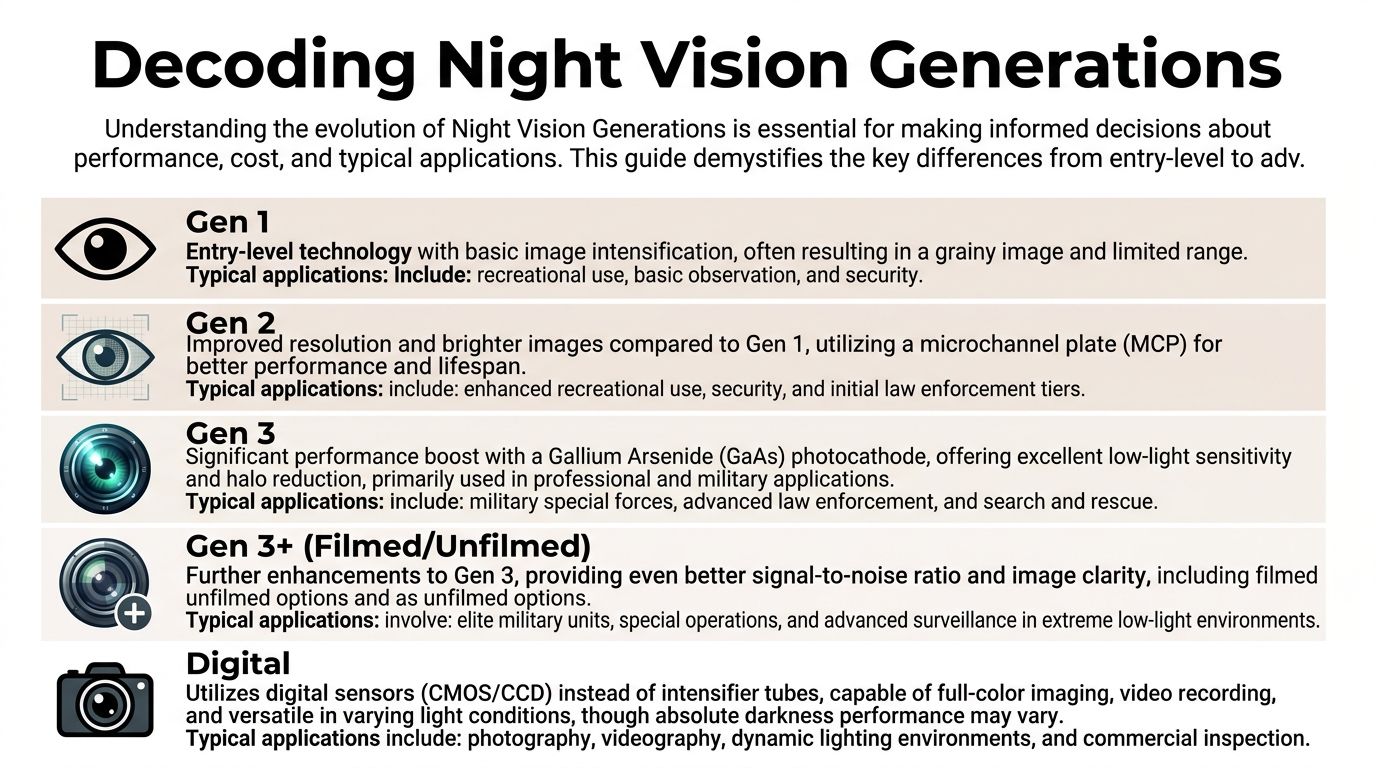
A useful starting point is to understand the basic categories, then compare them to your use case. If you want a more technical breakdown, this guide to night vision generations is a solid companion.
Gen 1
Gen 1 is the entry point many people imagine when they think "old-school night vision." It amplifies available light, but usually with more distortion, more edge blur, and less useful detail in hard darkness.
In real use, Gen 1 tends to fit low-budget experimentation more than serious field work. It can be enough for casual observation in favorable conditions. It is not what most professionals want when identification matters.
Gen 2
Gen 2 improves image quality and low-light performance through a microchannel plate. The practical result is a cleaner image, better brightness, and a longer service life than Gen 1.
For many users, Gen 2 is where night vision starts feeling legitimately capable instead of merely interesting. It is still a compromise tier, but it is a much more usable one.
Gen 3
Gen 3 is where professional buyers spend serious attention. It offers much stronger low-light sensitivity and generally better clarity in demanding environments.
The difference between Gen 1 and Gen 3 is not subtle. Think of the jump as the difference between an old low-resolution screen and a modern display that reveals details you could not see before. That does not mean every Gen 3 device is equal, but it does explain why the price gap exists.
Gen 3 plus variants
Sellers may describe filmed, unfilmed, or "Gen 3+" configurations. Those labels point to refinements in performance rather than a completely separate class of technology.
For buyers, the practical lesson is clear. Do not assume the plus sign tells the whole story. Ask what tube, what build, what support, and what intended use the device is built for.
Digital night vision
Digital night vision does not use a traditional intensifier tube. It uses sensors and onboard processing. That changes both the strengths and the weaknesses.
Digital systems often appeal to Amazon buyers because they package familiar consumer-style features:
- Recording tools: Video capture and streaming
- Integrated utilities: Ballistic calculators and rangefinding on some models
- Day and night flexibility: Useful for users who want one optic to do both jobs
- Lower entry cost: Easier to access than premium tube-based systems
The trade-off is that digital performance in very dark environments can disappoint buyers who expected true high-end night vision behavior. Some digital scopes are excellent within their lane. Their lane is not everything.
The label should match the mission
A hunter dealing with moderate distances and some ambient light may be perfectly happy with a digital unit. A patrol officer, security contractor, or buyer who needs stronger low-light capability will judge the device by a harsher standard.
That is why "best" on Amazon is often meaningless. The better question is, "Best for what, and bought from whom?"
How to Diligently Vet a Night Vision Listing on Amazon
An Amazon page can look polished and still be a bad purchase. The right way to evaluate a night vision scope amazon listing is to inspect the seller and the support path before you get impressed by features.
Amazon carries recognizable models. For example, the ATN X-Sight 4K Pro is commonly listed from $800 to $1,200 and features 18+ hour battery life according to Accio's summary of best-selling night vision rifle scopes. That same marketplace visibility is exactly why vetting matters. Good products sit beside unverified sellers.
Start with the seller, not the star rating
Click into the seller profile. Then leave Amazon for a minute and verify that the company exists in a meaningful way.
Look for signs of a real dealer:
- Independent business presence: A working website, not just a storefront shell
- Clear contact details: Phone, email, business identity
- Category focus: Tactical optics and related gear, not random unrelated inventory
- Support language: Warranty help, returns process, service guidance
For a broader process, this article on how to buy night vision binoculars online safely maps out the same due-diligence mindset.
Read the photos like an investigator
Product images tell you a lot if you slow down.
A strong listing usually shows the optic from multiple angles, control layout, accessories, packaging, and mounting details. Weak listings often rely on generic manufacturer art and very little else.
Watch for these red flags:
- Only stock photos
- No clear photos of markings or included accessories
- No packaging shots
- No evidence the seller has physically handled the item
That does not automatically prove fraud. It does mean you still know almost nothing.
Reviews need filtering
Do not read Amazon reviews as one crowd opinion. Separate them into categories.
Useful reviews
These mention recoil, zero retention, real low-light use, battery behavior, menu quirks, and customer service after the sale.
Weak reviews
These say the unit "looks great," arrived fast, or worked during a backyard test. Those comments may be sincere, but they are weak evidence.
Warning reviews
These mention repeat failure, moisture issues, inability to get warranty help, or support channels that stop responding.
If many reviews discuss setup and very few discuss months of field use, assume you are seeing first impressions, not long-term reliability.
Check what is missing
A high-value optic listing should answer ordinary buyer questions without evasiveness. If the listing does not clarify warranty validity, included accessories, model variant, or seller authorization, ask why.
A missing answer often matters more than a flashy spec.
Evaluating Key Features Beyond the Generation Level
Generation tells you the broad family. It does not tell you whether the optic is well built.
That is why buyers get tripped up by price shock. The gap is real. Budget digital scopes with integrated laser rangefinders can sit around $700, while premium military-grade clip-on systems such as a PVS-30 can cost over $10,000, as discussed in this night vision pricing and capability comparison video. That spread is driven by more than a Gen label.
What drives the difference
A more useful way to compare optics is to ask what the device must do under stress.
| Factor | Why it matters in real use |
|---|---|
| Optical quality | Better glass and cleaner image delivery make target identification easier, especially in low contrast conditions. |
| Thermal stability | A system that shifts with temperature changes becomes frustrating fast. |
| Recoil durability | A scope that works on a bench but drifts on a rifle is not a serious rifle scope. |
| Mounting quality | A weak mount can make a good optic act like a bad one. |
| Power system | Runtime means little if the battery setup is awkward or unreliable in the field. |
The YouTube source above also notes that cost differences reflect optical quality, thermal stability, and durability under recoil. Those are not luxury details. They are field-use details.
Digital features can help or distract
Many Amazon-friendly models win attention because they bundle attractive extras. Ballistic calculators, recording, WiFi, and integrated rangefinding can all be useful. The problem is that buyers sometimes treat feature count as performance.
That is the wrong hierarchy.
A scope that records video but has weak image clarity in your conditions is still the wrong scope. A ballistic calculator does not fix mediocre optical performance. A low price does not compensate for a device that cannot tolerate recoil or weather.
Match features to the job
The right feature set changes by mission.
- Hunting: You may care about target detection, practical ergonomics, and battery runtime more than recording.
- Security use: Identification and reliability under repeated use usually outrank novelty features.
- Preparedness or recreation: Day-night flexibility may matter more than peak low-light performance.
- Professional use: Durability, repeatability, support, and legal sourcing move to the top.
For buyers sorting through options, a practical framework like how to choose the right night vision device for your needs helps keep the comparison grounded.
Price without context is a trap
A cheaper optic can be smart. A cheap optic that creates uncertainty is expensive in a different way. The useful question is not whether a model is affordable. It is whether the construction, support path, and intended use all line up with the money being spent.
Recognizing Critical Risks and Red Flags on Amazon
Buyers worry about overpaying. The larger risk is buying a unit that was never a safe purchase in the first place.
General marketplaces compress trust. That is fine for low-risk products. It is not fine for regulated or high-value optics.
Counterfeit and gray-market problems
A counterfeit optic is the obvious danger. The less obvious problem is a real product sold through the wrong channel.
Gray-market sales can create a situation where the hardware looks legitimate, but the manufacturer will not support it. That matters because many buyers do not discover the problem until the optic fails, or until they need service and learn the serial path does not qualify.
Some products in this category also raise export-control concerns. That does not mean every Amazon listing creates an ITAR problem. It means buyers should not assume marketplace convenience equals clean compliance. If the seller cannot clearly explain channel legitimacy and applicable restrictions, do not volunteer to figure it out after the purchase.
The warranty trap
A big lesson from field use is that initial function proves less than people think. Plenty of budget optics perform well enough for a first impression. The harder question is what happens after months of recoil, travel, weather, and storage.
That is where the hidden cost shows up. A commonly overlooked issue with budget Amazon night vision purchases is long-term durability. User forum data cited in a YouTube discussion indicates return or failure rates as high as 40 to 60 percent within the first year for some digital models, while professional-grade systems from specialist retailers often carry 10-year warranties, as summarized in this discussion of budget night vision durability issues.
That difference changes the value equation immediately.
What a bad warranty situation looks like
- Unauthorized seller: Manufacturer declines coverage
- Short store window: The problem appears after the easy return period
- No diagnostics path: You cannot get a credible assessment of the failure
- Seller disappears or deflects: You get bounced between platform and vendor
A valid warranty is not just a piece of paper. It is a support chain you can use when the optic stops performing.
Red flags that should stop the purchase
Some warning signs deserve immediate skepticism:
- Price that undercuts the market without explanation
- Seller inventory that has no tactical focus
- Sparse product details on a complex optic
- Confusing model names or variant descriptions
- Warranty language that sounds vague or absent
- Customer complaints centered on failure, not preference
The practical rule is clear. If you cannot verify authenticity, channel legitimacy, and support before checkout, you are not getting a deal. You are accepting uncertainty.
The Case for Buying From a Specialist Night Vision Retailer
Specialist retailers exist because this category punishes shallow transactions.
That does not mean every specialist is automatically excellent. It means the business model itself is better suited to products that need real guidance, real sourcing discipline, and real post-sale support.
What a specialist changes before the sale
A specialist retailer should know the difference between a feature that photographs well and a feature that matters in the field. That matters when you are comparing digital scopes, clip-ons, monoculars, helmet-mounted systems, and rifle-rated optics.
The practical benefits usually show up in a few areas:
- Curated inventory: Fewer random listings, more intentional product selection
- Better fit guidance: Advice based on use case, not just margin or algorithm ranking
- Cleaner product data: Less guesswork around variant, included accessories, and compatibility
- Channel confidence: A clearer path on legitimacy and manufacturer support
That kind of buying process saves people from the most common category mistake, which is purchasing to the spec sheet instead of purchasing to the mission.
What matters after the sale
The strongest argument for a specialist often starts after delivery.
If a night vision device develops a problem, buyers need more than a return button. They need a knowledgeable support path. They need diagnostics. They need somebody who understands whether the issue comes from the mount, the optic, the power setup, the recoil environment, or user setup.
That is where general marketplaces become thin. Their main advantage is transaction speed. Their weakness is ownership support.
Compare the support experience
| Buying channel | What you often get |
|---|---|
| General marketplace | Fast checkout, mixed seller quality, uncertain support depth |
| Specialist retailer | Product guidance, clearer sourcing, stronger warranty handling, service-oriented follow-up |
A serious buyer should also care about legal cleanliness. Specialist dealers are generally better equipped to handle restricted-product rules, channel controls, and the paperwork mindset that surrounds sensitive optics.
Long-term value is usually not the cheapest cart total
People often treat price as if it is the complete cost. It is not.
A lower upfront number can become the more expensive choice if the unit arrives from the wrong seller, fails early, or creates warranty friction. A specialist retailer earns its value by reducing uncertainty at each stage: selection, purchase, setup, ownership, and repair.
That is why experienced users often stop asking only, "What does it cost today?" and start asking, "Who will stand behind this six months from now?"
Your Mission-Ready Buying Checklist
Use this checklist before you buy any night vision optic from Amazon or anywhere else.
Pre-purchase checks
Confirm the device type
Know whether you are looking at Gen 1, Gen 2, Gen 3, or digital. Do not let marketing language blur that line.Verify the seller
Check whether the seller operates as a real optics business with visible contact information and category expertise.Confirm warranty legitimacy
Ask whether the manufacturer will honor support for that exact sales channel.
Listing checks
- Study the photos: Real unit images beat generic promo art.
- Read reviews for field use: Focus on recoil, battery behavior, support, and long-term reliability.
- Check what is omitted: Missing accessory details, vague model language, and absent warranty language all matter.
Value checks
A lower price is only better if the optic is authentic, supportable, and suited to your use. If any one of those three is shaky, the "deal" is weak.
The safest purchase in this category is usually the one with the clearest support path, not the one with the most exciting listing page.
Final decision rule
If you cannot explain, in plain language, who sold the unit, where warranty support comes from, and why the optic fits your mission, stop and keep shopping.
Frequently Asked Questions
Can I return a night vision scope to Amazon if I use it and do not like it?
Sometimes, but that is not a dependable buying strategy. Return outcomes can depend on the seller, the product condition, and how the item is classified. With optics, the bigger problem is that true weaknesses may not appear during a brief indoor test. Recoil issues, battery frustrations, zero shift, and support problems often show up later.
Are Amazon prices always the lowest?
No. Some listings look lower because they strip away service value or come through questionable channels. In this category, the cheaper cart total can hide weaker support, warranty problems, or uncertainty about authenticity. Compare the full ownership picture, not just the checkout number.
Is digital night vision good enough for serious use?
It can be, depending on the job. Digital units often make sense for hunters, recreational shooters, and buyers who want day-night flexibility plus onboard features. They are not automatic replacements for higher-end tube-based systems in every environment. Use case decides that, not hype.
How do I know if a seller is legitimate?
Look for a real business identity outside Amazon, category focus, accessible contact information, and clear warranty language. If the seller appears to move a little bit of everything and offers no useful support detail, assume you will be on your own after delivery.
What is the biggest mistake buyers make?
They evaluate the product and ignore the seller. In this category, the seller is part of the product. The support path, warranty status, and sourcing channel directly affect what your money buys.
Do I need to worry about ITAR as an individual buyer?
You should at least understand that some night vision and tactical optics products involve export-control rules and channel restrictions. The exact legal details depend on the product and transaction, but the safe move is clear. Buy through a seller who can clearly explain what they sell, where it can ship, and what restrictions apply. If the answers are vague, do not assume the risk away.
If you want help from a retailer that focuses on night vision, thermal optics, legal compliance, and post-sale support, talk with Superior Tactical LLC. Their team specializes in mission-ready gear, same-day shipping, in-house repairs with free diagnostics, and Gen 3 systems backed by a 10-year warranty.
