
Red Dots & Magnifiers
Showing all 11 resultsSorted by price: high to low


Red Dot Sights Buyer’s Guide
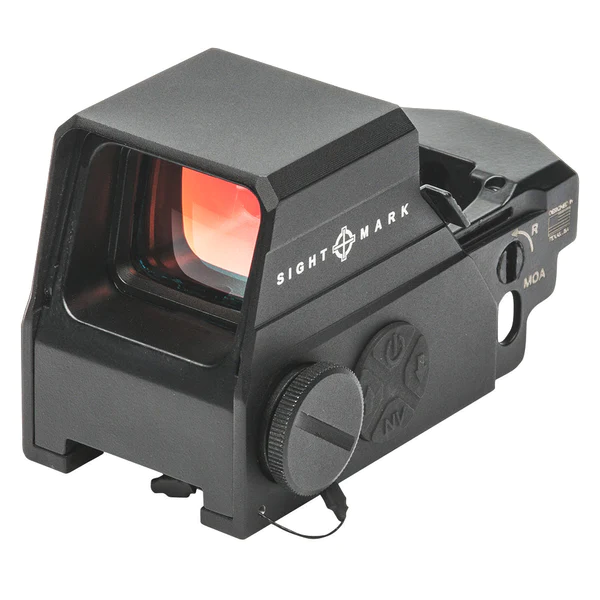
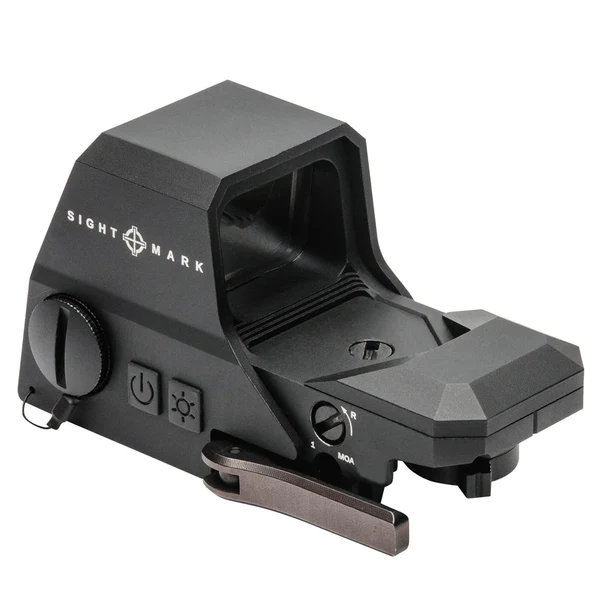
Red dots are the most popular optic format in modern shooting for good reason: fast target acquisition, both-eyes-open shooting, simple aiming reference, and increasingly affordable at every quality tier. They’re also the optic most often paired with night vision — a quality red dot mounted in front of a NV monocular gives you a working night-shooting setup before you even add an IR laser.
This guide walks through the dot types, the specs that matter, the major brands, and how to pick the right red dot for rifle, pistol, or NV-paired use.
Tube vs. Open-Emitter — The Foundational Decision
Tube Sights
A traditional sealed tube design with a front lens and rear eyepiece — looks like a small rifle scope. The Aimpoint CompM4, Aimpoint PRO, EOTech (technically holographic, similar form factor), and similar designs are tube-style. Strengths: durable, weather-sealed, robust against impact, longer battery life on simple optics. Weaknesses: heavier, larger, narrower field of view, more expensive than equivalent open emitters.
Open-Emitter Sights
A reflector lens on a low-profile housing with no rear glass — the Trijicon RMR, Holosun 507/510, Aimpoint ACRO, and similar designs. Strengths: lighter, lower profile, wider field of view, dominant choice for pistol mounting. Weaknesses: emitter exposed to debris and water (less sealed), some designs vulnerable to moisture or dust occlusion of the dot, generally shorter battery life.
For rifles intended for hard use or extreme weather, tube sights remain the standard. For pistols, modern open-emitter designs are the dominant choice. For NV-paired rifles, either works — many users prefer compact open emitters because they leave more rail space for laser, light, and mount components.
True Red Dot vs. Holographic vs. Prismatic
Red Dot (Reflex) Sights
The most common type — a small LED projects a dot onto a coated lens, which reflects it back into the shooter’s eye. Cheap, simple, reliable. Most “red dot” optics in the market are this type.
Holographic Sights
EOTech and a few competitors use a laser-illuminated holographic film to display the reticle. Different optical principle than a reflex sight, with claimed advantages in reticle precision, eye-relief flexibility, and the ability to have complex multi-element reticles. See our EOTech category for the holographic lineup.
Prismatic Sights
Use a prism instead of a reflective lens, with an etched reticle that’s visible without batteries. Useful for shooters with astigmatism (where standard red dots can appear distorted) and for backup-zero scenarios where battery failure would otherwise eliminate the reticle. Trijicon ACOG and Sightmark Wolfhound are the dominant prismatic lineups.
The Specs That Actually Matter
Dot Size (MOA)
Measured in minutes of angle (MOA), the dot size determines how much of the target the dot covers at distance and how precise your aiming can be. Common sizes: 1 MOA (precision, harder to find quickly), 2 MOA (the modern standard, good balance), 3-4 MOA (fastest acquisition, less precise at distance), 6+ MOA (close-range only, like pistol or shotgun work). For a general-purpose rifle red dot, 2 MOA is the right answer for most shooters.
Brightness Levels and NV Compatibility
The number of brightness settings and whether the optic includes NV-compatible (low-brightness) settings that work behind night vision without blooming the tube. Quality optics typically offer 8-12 daylight settings plus 2-4 NV-compatible settings; budget optics may have fewer NV options or none. If you’ll pair the red dot with NV, NV-compatible settings are essential.
Battery Life
Modern quality red dots offer 1,000-50,000+ hours of battery life on a single CR2032 or AAA cell. Aimpoint’s Micro line is known for 30,000-50,000+ hour ratings (years of “always on” use). Holosun adds solar power on many models for effectively unlimited run time. If “always on, always ready” matters, longer battery life is the practical priority.
Reticle Type
Beyond the basic single dot, many optics offer reticle alternatives: circle-dot (small dot inside a larger ring, useful for fast close-range and precise distance), reticle with bullet drop compensator, chevron, or multi-reticle switching (Holosun’s solar-powered models often offer multiple reticle options). For most users, a simple 2 MOA dot is sufficient; for shooters wanting more, circle-dot or BDC reticles add capability.
The Major Manufacturers
Aimpoint
The military and LE standard for tube-style red dots. The CompM4, PRO, Micro T-2, and ACRO P-2 cover rifle and pistol applications. Aimpoint optics are known for legendary durability (battle-tested in extreme conditions for decades), 30,000+ hour battery life, and uncompromising build quality. Premium pricing reflects U.S. military issue and the deepest reliability track record in the category.
Trijicon
Premium American optics manufacturer producing the RMR (Ruggedized Miniature Reflex) — the original pistol open-emitter red dot and still the standard. The MRO covers the rifle tube space; the SRO is the larger-window pistol optic. Trijicon optics carry the same premium reputation and price point as Aimpoint and EOTech.
EOTech
The dominant holographic sight brand. The EXPS3 family is widely issued in U.S. SOF and LE. Distinct holographic reticle, reticle precision at distance, and the ability to pair with EOTech magnifiers for variable-magnification. See our EOTech category for the full lineup.
Holosun
The dominant value-premium brand. Lineup spans tube and open-emitter for both rifle and pistol use, with solar power on many models, multi-reticle switching, and competitive prices that have reset expectations across the category. The 507C, 509T, 510C, AEMS, and HE503R are widely used. Strong choice for buyers who want quality without premium-tier pricing.
Sig Sauer
The Romeo line covers rifle and pistol applications across multiple price tiers. Romeo5 and Romeo MSR at the budget end, Romeo7 and ROMEO Zero at mid-tier, and the Romeo X / Echelon optics targeting premium pistol use. Solid build, competitive pricing, broad availability.
Vortex
Strong value brand with the StrikeFire, Sparc, Crossfire, Razor, and AMG lines covering everything from $150 budget rifle dots to premium pistol optics. Vortex’s lifetime VIP warranty is notable — they replace damaged optics with fewer questions than most competitors.
Other Quality Brands
Sightmark (see our Sightmark category), Primary Arms, Steiner, and Burris produce capable red dots across various tiers.
Pairing Red Dots with Night Vision
Red dots are commonly paired with NV in two configurations:
- Red dot + monocular (PVS-14) behind it: The standard “passive aiming” setup. Mount a quality red dot at typical eye-relief height; mount the PVS-14 helmet-mounted; you look through the PVS-14 at the red dot. The red dot’s NV-compatible brightness setting prevents blooming, and you can shoot from any position you can hold the rifle.
- Red dot + IR laser: Many users run both. The red dot is for daytime use; the IR laser (see our Lasers guide) is for night use. Faster than passive aiming through the optic, but requires the laser purchase.
For NV-paired use, prioritize: NV-compatible brightness settings, dot brightness consistency at low settings, and a small dot size (2 MOA is preferred over 4 MOA for distance work through NV).
Use Cases — Picking the Right Red Dot
- General-purpose rifle: Aimpoint PRO or Micro T-2, Holosun AEMS, EOTech EXPS3, Vortex Sparc / Razor. 2 MOA dot, NV-compatible settings.
- Pistol: Trijicon RMR, Holosun 507C / 509T, Aimpoint ACRO P-2, Sig Romeo X. Open-emitter with appropriate footprint for your slide cut.
- Hard-use rifle (military / LE): Aimpoint Micro T-2 or CompM5, EOTech EXPS3. Tube design, NV-rated, premium build.
- NV-paired rifle: Aimpoint Micro T-2, Holosun AEMS, EOTech EXPS3 — anything with strong NV-compatible brightness settings. Pair with monocular or laser per workflow preference.
- Budget build: Holosun HS503R, Sig Romeo5, Vortex Sparc. Real capability at $150-$300.
- Astigmatism shooters: Prismatic optics (Trijicon ACOG, Sightmark Wolfhound) eliminate the dot distortion that affects some shooters with astigmatism.
Price Tiers
- Budget rifle red dots (Vortex Sparc, Sig Romeo5, Holosun 503): $150-$300.
- Mid-tier (Holosun AEMS, Vortex Razor, Sig Romeo MSR): $300-$500.
- Premium (Aimpoint Micro T-2, EOTech EXPS3, Trijicon MRO): $500-$900.
- Pistol optics (Trijicon RMR, Holosun 507/509, Aimpoint ACRO): $250-$700 depending on tier.
- Premium prismatic (Trijicon ACOG): $1,000-$2,000+.
ITAR and Warranty
Red dots are not ITAR-controlled. We sell only to U.S. customers and do not ship internationally to keep our compliance posture consistent. Premium brands (Aimpoint, Trijicon, EOTech) offer multi-year or lifetime warranties; Vortex is notable for its no-questions-asked VIP lifetime warranty. We’re a full service facility and can help with mounting, zeroing, and pairing. All units ship within 1-2 business days.
Frequently Asked Questions
Aimpoint or EOTech?
Different technologies. Aimpoint is a tube-style true red dot — simpler, longer battery life, robust. EOTech is holographic — different reticle precision and eye-relief characteristics, more complex internally. Both are mil-issued and battle-tested. Many shooters prefer the EOTech reticle for fast acquisition; many prefer Aimpoint for battery life and simplicity. Either is a defensible choice.
What’s the best dot size?
2 MOA for general-purpose rifle use. 1 MOA for precision shooting. 3-4 MOA for fast close-range work or shooters with vision issues that make a small dot harder to pick up. 6+ MOA for shotguns and CQB-only use.
Is Holosun as good as Aimpoint?
Close, at a fraction of the price. Holosun build quality has improved dramatically and many models compete directly with Aimpoint and Trijicon on features and reliability. For premium-tier durability under sustained hard use, Aimpoint still has the longer track record. For most shooters, Holosun delivers 90%+ of the capability at 30-50% of the cost.
Can I use a red dot with night vision?
Yes — but the optic must have NV-compatible (very low) brightness settings to prevent the dot from blooming and washing out your tube. All quality modern red dots include NV settings. Budget optics may not — verify before buying for NV use.
Tube or open-emitter for a rifle?
Tube for hard use, weather extremes, and military/LE applications. Open-emitter for civilian and tactical use where weight and profile matter. Both work; preferences vary widely.
Do I need a magnifier?
For shots past 100 yards, a magnifier dramatically improves precision. The standard setup is a 3x or 5x magnifier behind the red dot, often on a flip-to-side mount. If you’ll engage past 100 yards regularly, yes; if not, you can skip it.
What about astigmatism?
If a red dot looks like a starburst, comma, or double image to you, you have astigmatism affecting the dot. Two solutions: (1) use a smaller dot (1 MOA), which often appears cleaner; (2) switch to a prismatic optic with an etched reticle, which doesn’t suffer from the issue.
How long do batteries last?
Quality modern red dots run 30,000-50,000+ hours on a single battery — multiple years of “always on” use. Budget optics typically run 1,000-10,000 hours. Solar-powered Holosuns are effectively unlimited.
How long does shipping take?
All units ship within 1-2 business days.
Trying to spec the right red dot for your rifle, pistol, or NV-paired build? Contact us or call (888) 330-7057 with your platform, use case, and budget — we’ll spec the right optic.