
Best Thermal Imaging Binoculars of 2026: An Expert Guide
You’re probably shopping for thermal binoculars because ordinary optics already failed you.
That usually happens in the same kind of moment. The moon is gone, the tree line is flat black, and movement that should be obvious in daylight disappears into brush, fog, or smoke. On a hunt, that means wasted time and bad target confidence. On a perimeter check, it means you’re guessing at shapes when guessing isn’t acceptable. On a search in heavy cover, it means every extra minute matters.
That’s why thermal isn’t a novelty purchase. It’s a capability purchase. The best thermal imaging binoculars don’t just help you see at night. They change how you scan, how long you can stay on glass, how well you sort false alarms from real targets, and how much confidence you have before you ever transition to another tool.
A lot of buyer guides stop at a spec race. Bigger range. Higher resolution. More features. That’s useful, but it’s not enough for a serious purchase. Professionals and committed hunters need to know what works in the field, what specs matter most, what trade-offs show up after the first few trips, and which units hold their value over years of hard use.
Seeing Beyond the Dark
A moonless field is where thermal starts making sense fast.
A coyote hunter knows the feeling. You hear movement beyond a fence line, but through conventional glass there’s nothing to confirm. A patrol officer checking a large property edge in cold weather runs into the same limit. Shapes blend. Shadows stack up. Light discipline matters, so blasting the area with white light isn’t the answer.
Thermal binoculars solve a different problem than standard night vision. They’re built to detect heat, not rely on available light. If you need a quick refresher on that distinction, this overview of what thermal vision is and how it works lays out the fundamentals clearly.
A key shift happens in workflow. Instead of hunting for contrast with your eyes, you scan for heat signatures and then decide what deserves more attention. That changes pace and confidence. It also reduces the temptation to use an aiming device for observation, which is one of the more common gear mistakes people make when they try to economize their setup.
The best thermal imaging binoculars earn their price by doing three things well:
- They shorten search time. Heat stands out faster than shape in low visibility.
- They reduce fatigue. Two-eye viewing is easier to live behind during long glassing sessions.
- They support better decisions. You spend less time wondering if you saw something and more time confirming what it is.
That matters whether you’re covering acreage, running a night hunt, or building out a duty-ready low-light kit.
Decoding Thermal Binocular Specifications
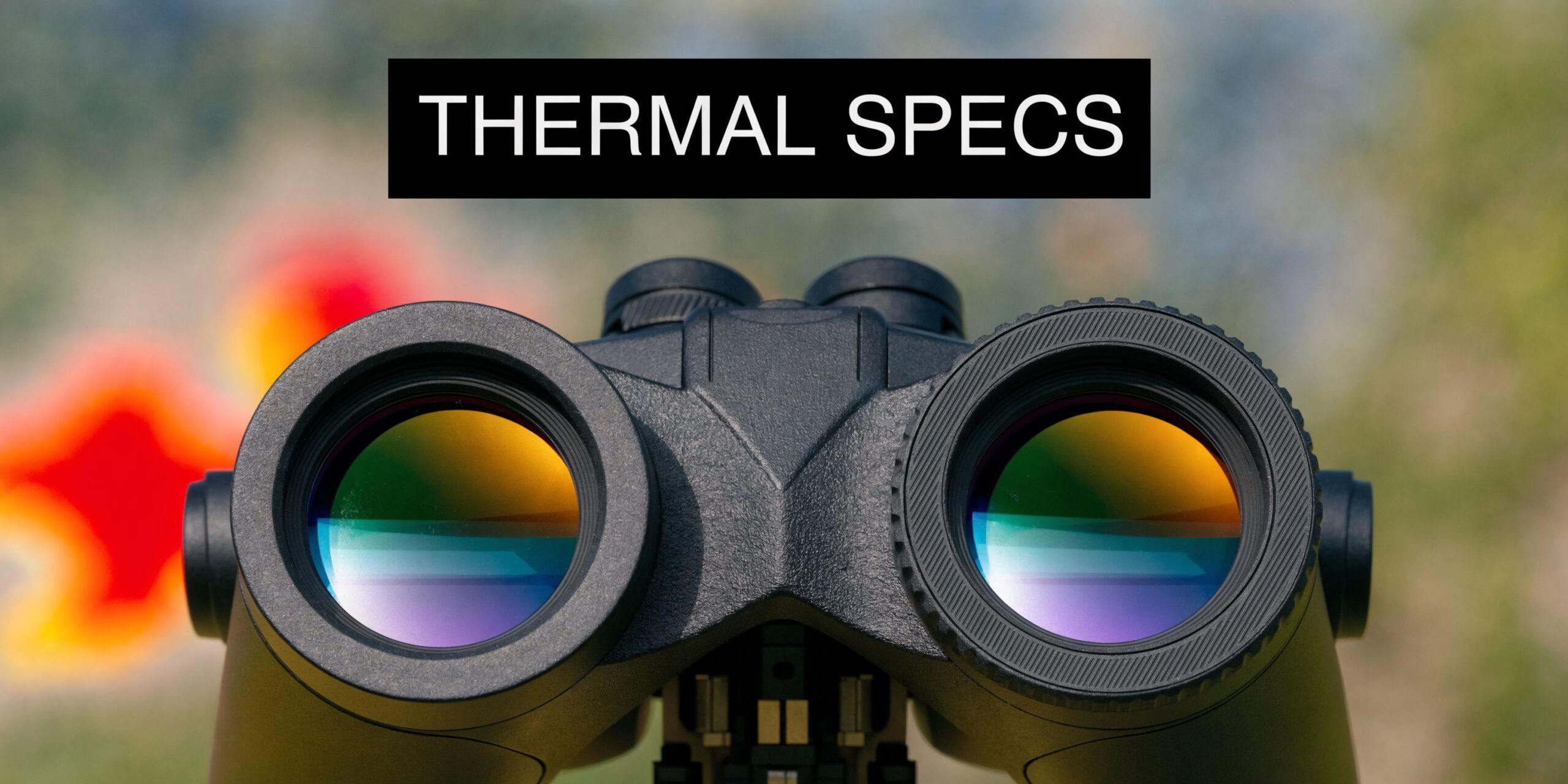
Specs matter, but only if you know what each one changes in use.
A lot of buyers fixate on one number and ignore the rest. That’s how people end up with an expensive optic that looks strong on paper but doesn’t match the terrain, mission, or observation style they use.
Resolution and what detail really costs
Sensor resolution determines how much image information the optic can present. In practical terms, higher resolution gives you a cleaner image and better target detail at distance.
You’ll see common tiers like 640×480, 640×512, and 1280×1024 in premium units. That jump matters most when you’re trying to move from simple detection to confident identification. A distant heat source is easy to spot. Confirming whether it’s a person, a deer, or a hog is where better resolution starts paying off.
If you scan open ground or mixed terrain and need more than “something warm is out there,” don’t treat resolution as a luxury spec. Treat it as an identification spec.
NETD and why low numbers win
NETD stands for Noise Equivalent Temperature Difference. It’s one of the most important thermal sensitivity metrics, and too many buyers overlook it.
Lower NETD means the optic can separate smaller temperature differences. In field terms, that gives you better image clarity when the scene is low contrast, such as dense foliage, adverse weather, or cluttered backgrounds. A strong example is the Hikmicro HQ50L at NETD <15 mK, which outperforms devices listed at <18 mK or <25 mK for teasing out subtle heat signatures in difficult conditions, as outlined in this NETD comparison of thermal imagers.
Practical rule: If your use case includes fog, brush, humid nights, or cluttered backgrounds, prioritize lower NETD before you chase extra digital features.
A buyer who hunts in open, cold conditions can sometimes tolerate a weaker sensitivity spec. A buyer working mixed weather or dense cover usually can’t.
Detection, recognition, and identification
These three get blurred together in marketing copy, but they’re not the same.
- Detection means the optic can tell you something is there.
- Recognition means you can classify the target more generally.
- Identification means you can make a confident call on what it is.
A thermal binocular with huge detection numbers may still leave you short on identification if the image lacks detail. That’s why long advertised range can be real and still not answer the question you care about in the field.
Refresh rate, lens, and field of view
Refresh rate affects how smooth the image looks when you pan or track movement. A stronger refresh rate generally feels more natural when scanning large areas or following moving targets.
Lens focal length and field of view work together. Longer lenses help with reach, but they narrow what you see. Wider fields of view make it easier to scan timber edges, fence lines, or broad sectors without constantly repositioning.
That’s the trade-off many buyers underestimate:
- Wide field of view works better for searching and situational awareness.
- Longer reach works better for picking apart distant targets in open country.
A thermal bino that’s excellent from a fixed hide can feel slow and cramped in rolling terrain if the field of view is too narrow for the job.
Battery life and support features
Battery life sounds secondary until you’re halfway through a night operation.
Premium thermal binoculars commonly include onboard recording, WiFi streaming, rangefinding, and app connectivity. Those features can be useful. They also add complexity and power draw. If you need them, they’re worth paying for. If you don’t, they can become menu clutter.
The cleanest buying approach is simple. Start with image quality, sensitivity, and viewing geometry. Then decide whether recording, streaming, or rangefinding improves your mission or just adds cost.
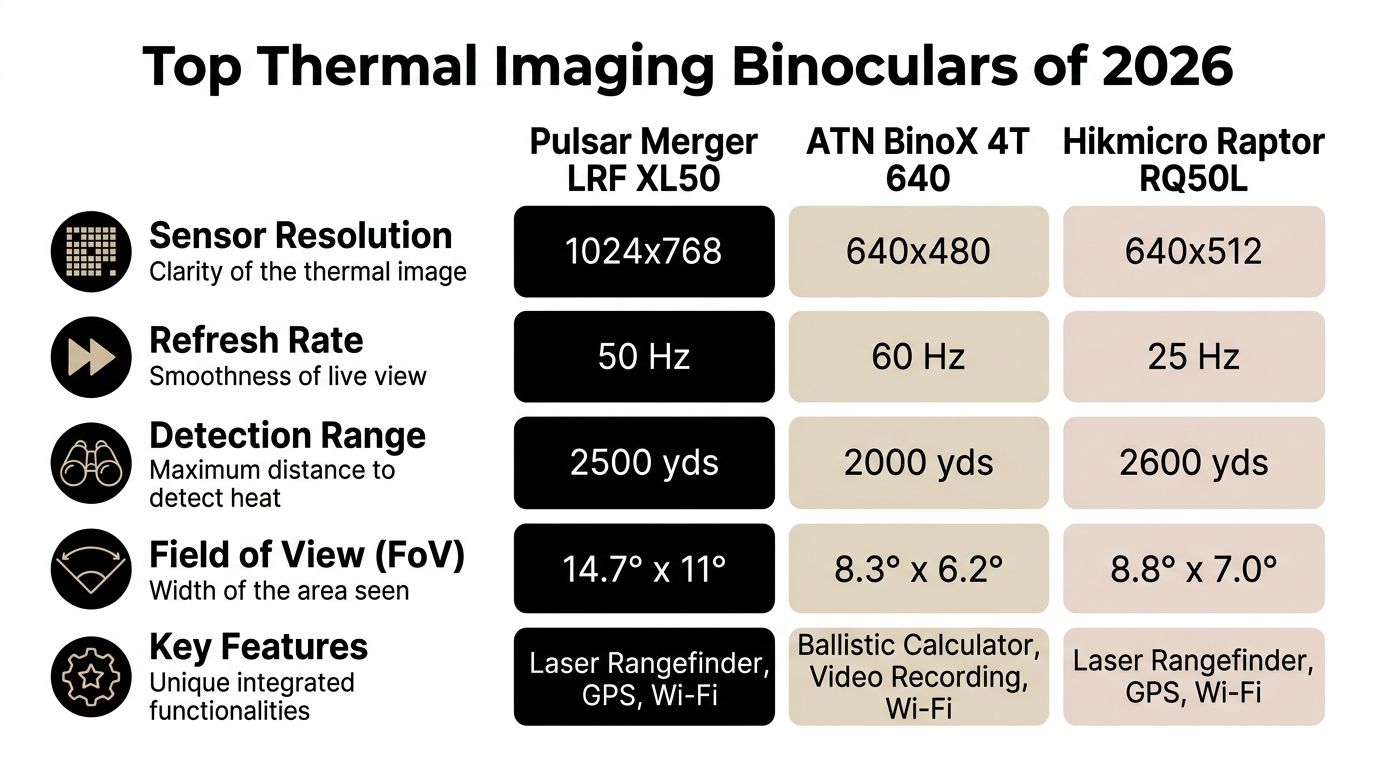
Top Thermal Imaging Binoculars of 2026 Compared
You are on hour six of a cold night, scanning a wide property line, and the optic in your hands needs to do more than post a good spec sheet. It needs to hold zero on its promises. Clear detection, dependable runtime, controls you can run with gloves, and support that still matters a year after the invoice is paid.
That is the frame I use when comparing thermal binoculars. The right unit is the one you can afford to own, maintain, and trust over time. If you need a broader view of how these devices perform across different jobs, this guide to thermal imaging applications in the field helps put the use case before the purchase.
| Model | Best fit | Key strengths | Watch-outs |
|---|---|---|---|
| Pulsar Merger LRF XP50 | Long-range observation and professional field use | Detection beyond 2,300 meters, built-in laser rangefinder to 1,500 meters, premium-class image quality, per Best Binoculars Reviews | High buy-in. Makes sense only if you will use the range and ranging |
| ATN BinoX 4T 640 | Buyers who want one unit for hunting, property security, and general tactical observation | 640×480 sensor, long battery life, onboard recording, broad magnification range | Digital features add complexity, and long-range identification is not its strongest lane |
| ATN BinoX 4T 384 | Users who want integrated ranging without stepping into flagship pricing | 1,800m thermal detection, 4.5-18x magnification, laser rangefinder from 5-1,000 yards with 1m accuracy, according to Field & Stream’s thermal binocular guide | Lower sensor class than premium 640 units |
| Hikmicro HQ50L | Users working in humidity, brush, and low-contrast conditions | NETD <15 mK and 640×512 resolution. Strong heat separation when conditions get difficult | Support access and service turnaround deserve close scrutiny before you buy |
| Pulsar Trionyx T3 | Surveillance users who need thermal and night vision in one package | Multispectral setup with thermal detection past 1,000 yards and night vision to 450 yards | More controls, more training time, more system to manage |
Pulsar Merger LRF XP50
The Merger LRF XP50 belongs in a serious observation kit. Buyers choose it when missed detail at distance carries a real cost.
The appeal is straightforward. You get long reach, integrated ranging, and a housing style that is easier to live behind for extended glassing than many compact thermal units. For land managers, guides, and professional users covering large sectors, that matters more than novelty features.
It also tends to hold value better than lower-tier units, which changes the math if you upgrade every few years.
The downside is simple. If your work rarely stretches into true long-range observation, a lot of the purchase price sits unused.
ATN BinoX 4T 640
The BinoX 4T 640 is the practical all-rounder in this group. It appeals to buyers who want one thermal bino to cover multiple jobs without climbing all the way into premium European pricing.
Long battery life is a real advantage in the field, not a convenience bullet. Add recording, streaming, and a sensor class that still gives a useful image, and it becomes a flexible tool for hunting, patrol, and property overwatch. Buyers who use thermal often but not exclusively usually see the value here.
There is a trade-off. A feature-heavy unit gives you more menus, more settings, and more chances for software quirks to matter. That does not make it a poor choice. It makes dealer setup help and warranty support part of the buying decision.
ATN BinoX 4T 384
The 4T 384 fills an important slot. It gives buyers rangefinding and respectable detection performance without forcing them into top-shelf pricing.
That makes it attractive for hunters and rural users who need distance confirmation and enough magnification to work mixed terrain. It covers a lot of ground for the money, especially if your main question is target location and distance rather than the cleanest image in the category.
I usually caution buyers on one point here. Mid-tier units save money on the front end, but they can get replaced faster if your work becomes more demanding. That is part of total cost, too.
Hikmicro HQ50L
The HQ50L earns attention from users who care about image separation in bad conditions. Fog, humidity, background clutter, and weak temperature contrast expose mediocre thermals fast.
A unit with very strong sensitivity can outperform a feature-rich competitor when the weather turns or the terrain gets messy. That is the HQ50L's case. Buyers who spend real time in timber, crop edges, and changing weather often appreciate this class of performance more than onboard media tools.
Before buying, check who services it, where repairs go, and how long you can expect to be without it if something fails. Ownership friction matters on optics in this price band.
Pulsar Trionyx T3
The Trionyx T3 is built for users who need thermal detection and visual context from the same device. That is a specific workflow, and for the right user it solves a real problem.
Thermal helps you find heat quickly. Night vision helps you read terrain, structure lines, and movement with more environmental detail. Surveillance teams, security users, and anyone working around buildings or mixed backgrounds can benefit from that combination.
You pay for it in complexity. More modes mean more training, more button memory, and more opportunity for the optic to slow you down if you only use half its capability.
The short version is this. Buy the flagship if range, image quality, and resale matter most. Buy the all-rounder if you need one unit across several roles. Buy the multispectral model only if your workflow uses both systems.
Matching Features to Your Mission
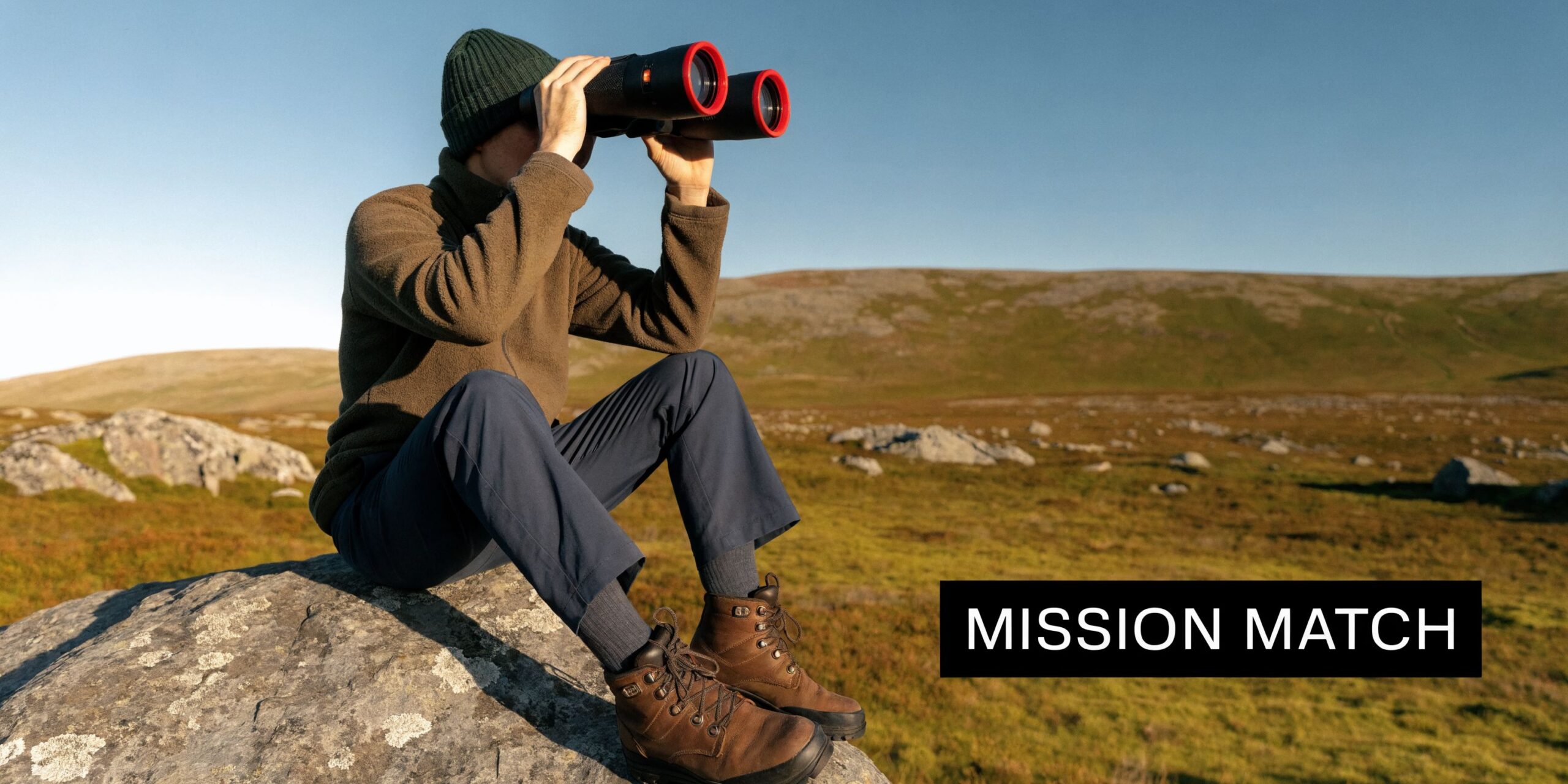
A bad match shows up fast in the field. A ranch manager scanning fence lines at 2 a.m., a hog hunter covering a wide sendero, and a surveillance team working around vehicles and buildings do not need the same bino, even if they share a budget.
Buy for the job you repeat, not the feature list that looks best on a product page. That approach usually saves money twice. First at checkout, then again later in training time, battery spend, downtime, and resale.
For the long-range hunter
Open-country hunters need more than heat detection. They need enough image detail to sort animals cleanly at distance, plus dependable ranging so the bino supports the rest of the shooting workflow instead of slowing it down.
The ATN BinoX 4T 384 fits that use case on paper because it combines longer-range detection, higher usable magnification, and an integrated laser rangefinder. In practice, that matters most on open fields, senderos, cutovers, and long fence lines where target confirmation takes longer and bad distance calls cost opportunities.
There is a trade-off. More magnification and more onboard features can mean more menu work, more battery dependence, and more points of failure over time. If the unit will live in a truck through a full season, service turnaround and battery availability matter almost as much as image performance.
For law enforcement surveillance
Surveillance work usually favors identification workflow over headline range. Detecting a subject is only the first step. Teams often need to read movement against terrain, structures, and vehicles without swapping devices.
A multispectral unit like the Pulsar Trionyx T3 can make sense here because thermal helps locate heat quickly, while night vision gives more scene context. That combination is useful around buildings, mixed backgrounds, and partial cover where thermal alone may show presence but not enough environmental detail to support a clean decision.
Agencies comparing roles and environments can use this guide to thermal imaging applications across field scenarios to map features to actual deployment patterns.
If the job requires both detection and scene interpretation, a multispectral bino can reduce gear changes and speed up decision-making. It also adds training load, more battery planning, and more maintenance considerations.
For ranch and property security
Property security is repetitive work. You check the same gates, tree lines, barns, water points, and approach routes night after night. That changes what matters.
For this role, I would take simple controls, predictable runtime, and a stable image over extra recording features every time. The optic needs to come out of a vehicle, power up fast, and work without hunting through menus in the dark. Over a year of regular use, that kind of simplicity lowers ownership friction and makes handoff to another employee much easier.
Prioritize these traits:
- Long runtime so routine patrols do not turn into battery drills
- Good thermal sensitivity for humidity, brush, and low-contrast nights
- Comfortable housing and controls for repeated scanning over long shifts
- Accessible service support in case the unit goes down during calving, harvest, or security incidents
For tactical operations
Tactical users need a bino that supports the team’s observation phase. Comfort, speed to target, and clarity in clutter matter more than buying the unit with the longest advertised detection figure.
The mistake is buying around maximum range alone. In real use, teams spend more time scanning than engaging, and a bino that handles movement, thermal crossover, and long observation periods with less fatigue often delivers better outcomes. It also tends to hold value better because the next buyer cares about the same field realities.
A good purchase here is the optic your team can run confidently under stress, maintain without drama, and keep in service without long outages. That is a mission fit decision, not a spec-sheet win.
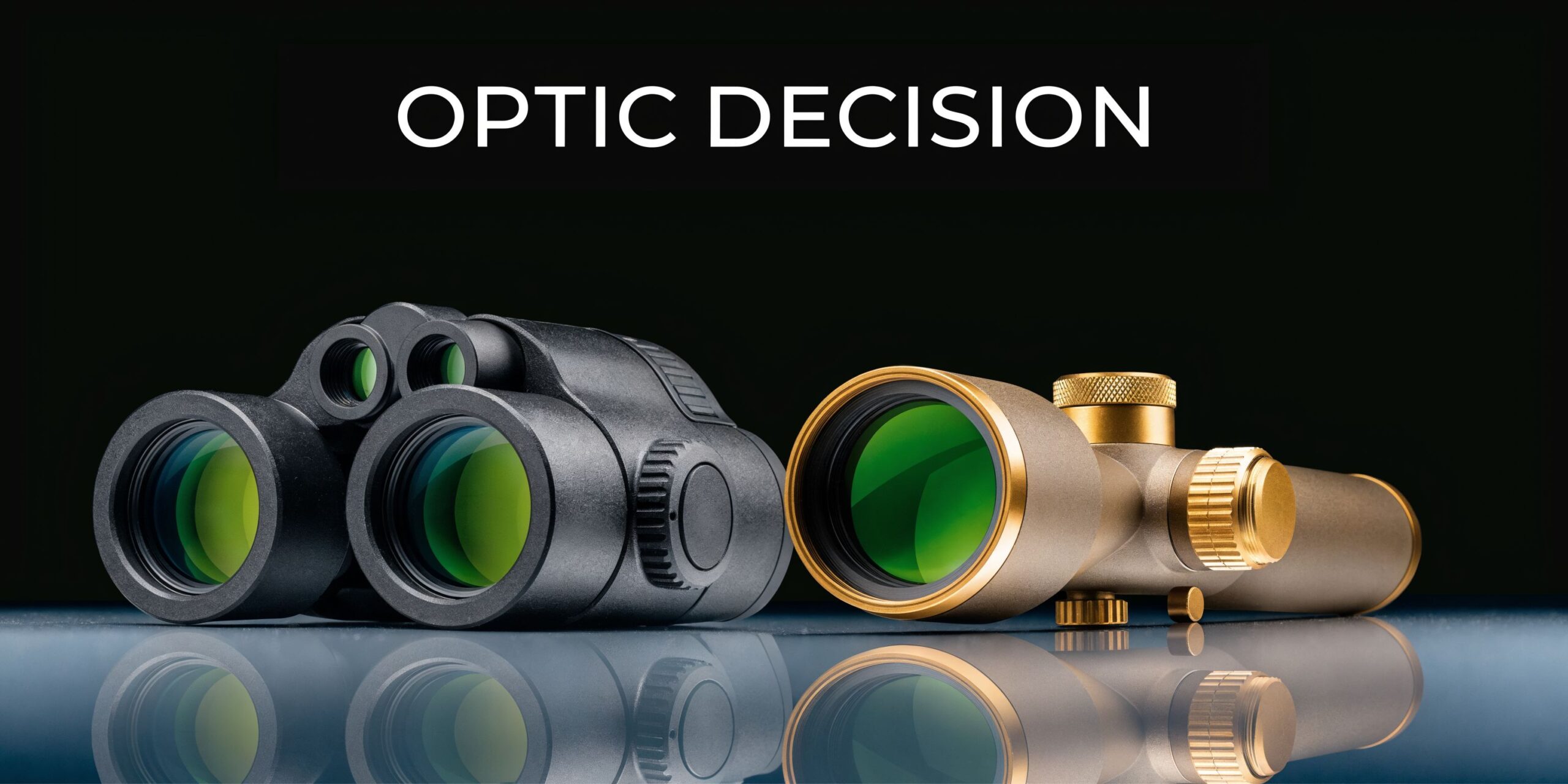
Binoculars vs Scopes A Critical Workflow Decision
A lot of buyers ask the wrong question. They ask whether thermal binoculars are better than thermal scopes.
The right question is which tool handles which phase of the job better.
When binoculars are the better primary tool
Binoculars are built for reconnaissance and scanning.
That matters because observation takes longer than engagement. If you spend extended periods behind an optic, two-eye viewing helps with comfort, awareness, and image processing. Buyer guidance on this decision is often thin, but the core advantage is clear. Binoculars offer better depth perception and reduced eye strain for reconnaissance, while scopes favor speed for engagement, as discussed in this thermal binoculars versus other thermal devices comparison.
Use thermal binoculars first when:
- You’re scanning large areas before committing to any other tool
- You need safer observation without pointing a weapon at everything you inspect
- You expect long sessions on glass and want less fatigue
When a scope should carry the load
A thermal scope is the stronger dedicated engagement tool.
It simplifies the final stage of the workflow. Once a target is found and confirmed, the scope is already in the place where an aiming solution matters. If your mission is short-duration target engagement and only light observation, a scope-first setup may be enough.
That said, many users force a scope into a scanning role because they’re trying to save money up front. That usually works poorly. It’s slower, less comfortable, and often less safe.
A scope can find targets. That doesn’t mean it’s the best tool for searching for them.
For a broader equipment planning discussion, this guide on thermal scope versus night vision choices helps frame where each technology fits in a complete low-light setup.
The practical answer for most serious users
If you glass first and act second, binoculars should lead the workflow.
If you rarely scan and mostly need an aiming optic, a scope may be enough. But for hunters, surveillance teams, and security users who spend serious time searching before doing anything else, thermal binoculars usually make the cleaner first investment.
Analyzing Total Cost of Ownership and Long-Term Value
A thermal bino that fails during season, during a contract, or in the middle of a security rotation is no longer a price problem. It becomes a downtime problem, a replacement problem, and sometimes a liability problem.
That is why the sticker price should never be the only number in the decision.
Thermal binoculars sit in the same category as other hard-use electronics. They live in vehicles, get bounced around in packs, run in cold and heat, and depend on software, batteries, housings, and service networks as much as they depend on sensor quality. Buyers who treat them like a simple consumer gadget usually pay for that mistake later.
What total cost of ownership includes
For thermal optics, total cost of ownership is the full bill over the years you expect to run the unit, not just what clears your card on day one.
Look at these factors together:
- Service life. How long the optic stays relevant and fieldworthy before repair costs or performance limits force replacement.
- Warranty terms. Coverage length matters, but exclusions, transfer rules, and turnaround matter just as much.
- Repair path. Factory-only service, dealer support, and in-house repair capability lead to very different downtime.
- Parts and battery support. A good optic becomes a bad investment fast if parts, chargers, or battery systems are hard to get.
- Firmware and product support. Devices with active updates and responsive support tend to age better.
- Operational downtime. If the unit is mission gear, every week in service has a real cost.
As noted by Digital Camera World’s thermal binocular buying guide, premium models can carry a 2-3x price premium over lower-cost options. That gap makes warranty depth, repair support, and long-term parts availability part of the buying decision, not an afterthought.
Where higher-priced units earn their keep
A more expensive bino only makes sense if it saves money, time, or replacement headaches over its working life.
The better units usually justify their price in four practical ways:
- They survive hard use better. Housing strength, controls, sealing, and lens protection hold up longer in real field conditions.
- They stay useful longer. Better image quality and better thermal sensitivity delay the need to upgrade.
- They spend less time out of service. Strong dealer support and repair access reduce dead time.
- They carry less procurement risk. Agencies and professional users need predictable support, not just impressive launch specs.
I have seen cheaper optics turn into expensive fleet decisions. One unit goes down, the turnaround drags, a loaner gets bought, then a second unit from the same line starts showing problems. The original savings disappear fast.
Questions to press before you buy
Ask the seller direct questions and do not settle for vague answers.
- What does the warranty cover, and what is excluded?
- Who performs repairs, and where are they done?
- What is the typical turnaround if the unit fails during peak season?
- Are batteries, eyecups, chargers, and other wear items easy to replace?
- Does the manufacturer still support older models with firmware and parts?
- If this unit is down for 30 days, what is the backup plan?
Those answers matter more than a minor spec advantage on paper.
A low upfront price can still produce the highest ownership cost if the unit is unreliable, hard to service, or obsolete too early. For agencies, contractors, and anyone outfitting multiple users, that is standard capital planning.
Your Practical Decision Checklist
When you’re ready to buy, use a short checklist and force yourself to answer each point clearly.
Ask these in order
Define the primary job. Hunting, surveillance, property security, and tactical observation don’t reward the same feature set.
Map the terrain and conditions. Open country, heavy brush, humidity, fog, and mixed backgrounds change what matters most.
Prioritize image performance first. Resolution, thermal sensitivity, and useful field of view should come before convenience features.
Separate detection from identification. Don’t buy on headline range alone if your need is confident target identification.
Decide whether you need integrated extras. Laser rangefinders, video recording, and wireless sharing are valuable only if they support your workflow.
Think through ownership. Warranty, service access, repair turnaround, and long-term support should influence the final pick.
Match the optic to the whole system. If you already run a thermal scope, the bino should improve observation, not duplicate the same role poorly.
A disciplined checklist keeps you from buying the most exciting option instead of the right one.
Frequently Asked Questions About Thermal Binoculars
What is the key difference between thermal and night vision
Thermal detects heat signatures. Night vision amplifies available light. Thermal is usually better for finding living targets or heat-producing objects in darkness, brush, or obscured scenes. Night vision is often better for reading environmental detail and navigating with more natural scene context.
Can thermal see through glass
No. Thermal generally won’t give you a useful view through glass the way many first-time buyers expect. You’ll usually be reading surface temperature effects instead of seeing through the pane.
Can thermal see through fog or smoke
Thermal often performs better than conventional optics in fog or smoke, but performance still depends on the unit and the conditions. Thermal sensitivity plays a big role here. Lower NETD helps separate subtle heat differences when contrast is poor.
How does weather affect thermal performance
Weather changes image contrast. Humidity, rain, heavy thermal crossover conditions, and cluttered backgrounds can make targets harder to separate. That’s why sensitivity and image quality matter more than headline range in many real-world environments.
Are thermal binoculars legal for hunting
That depends on your state, your species, and the season. Don’t assume legality based on what another hunter uses. Check your state wildlife agency rules before you buy or hunt with thermal gear.
If you’re choosing among the best thermal imaging binoculars and want help matching the optic to your mission, Superior Tactical LLC is a strong place to start. They specialize in thermal imaging, night vision, and tactical optics, offer same-day shipping, and provide responsive support for buyers who need more than a product listing. For long-term ownership, their in-house repairs with free diagnostics and Gen 3 system coverage with a 10-year warranty make them especially useful for serious users who care about support after the sale.
