
Your Guide to IR Helmet Light Systems
Picture this: a flashlight beam that cuts through the darkness, but only you and your team can see it. That, in a nutshell, is an IR helmet light. It’s a hands-free illuminator that throws out a beam of light totally invisible to the naked eye, yet shines like a spotlight when you're looking through night vision goggles (NVGs).
What Is an IR Helmet Light?

An IR helmet light is a purpose-built tool that solves a huge problem for anyone running night vision. Your NVGs are fantastic at amplifying tiny amounts of ambient light—like from the moon or stars—but they're pretty much useless when there's no light to amplify at all.
Think of your night vision device like a super-sensitive microphone. In a quiet room, it can pick up the faintest whisper. But in a completely soundproof room, there's nothing for it to amplify. Your IR helmet light is the "whisper" in that analogy; it projects infrared light that gives your NVGs something to see and work with.
The Primary Role of Supplemental IR Light
The whole point of an IR helmet light is to give you that critical supplemental illumination when the ambient light just isn't cutting it. This happens more often than you'd think, both in tactical situations and out in the backcountry.
Here’s where it really earns its keep:
- Navigating Dark Spaces: It’s what lets you move confidently through a pitch-black building, a dense forest on an overcast night, or a tunnel with zero natural light.
- Identifying Threats: In those zero-light scenarios, an IR light can turn a sketchy, grainy blob in the distance into a clear image, which is absolutely crucial for positive identification.
- Covert Signaling: Since the beam is invisible, you can use it to signal teammates or mark objectives without giving away your position to anyone not equipped with night vision.
An IR helmet light fundamentally changes your night vision from a passive, light-gathering tool into an active illumination system. It puts you in control of your environment, no matter how dark it gets.
Without an IR helmet light, you're at the mercy of your surroundings. With one, you can basically create your own "moonlight on demand," guaranteeing you have a clear sight picture and the tactical upper hand. To go deeper, you can learn more about infrared illuminators for night vision in our full guide on the subject. For any serious low-light work, it's a non-negotiable piece of kit.
The History of Night Vision and Infrared
To really get a handle on the incredible tech inside a modern IR helmet light, it helps to know where it all came from. The idea of seeing in the dark isn't new—its story begins on the battlefields of World War II, with the very first, and very clumsy, attempts to own the night.
These early devices were a far cry from the sleek gear we have now. They were known as "active" systems, which means they couldn't just work with the light that was already there. They had to create their own by blasting a powerful, invisible beam of infrared light, kind of like a giant searchlight no one could see.
The Dawn of Active Infrared Systems
The groundwork for this tech was laid in the late 1930s by German scientists. By mid-1943, the German Army was putting active infrared night-vision devices on their Panther tanks. A famous example was the Sperber FG 1250, or "Sparrow Hawk," which paired a massive 30-centimeter infrared searchlight with an image converter, allowing a tank commander to spot targets up to 600 meters away. You can discover more insights about these pioneering systems that set the stage for modern optics.
American forces developed similar gear, which they nicknamed "snooperscopes" and "sniperscopes." These also needed a separate, bulky IR searchlight tethered to a heavy backpack power source. They were game-changers for their time, but they all had a fatal flaw.
These early active IR systems had a massive tactical flaw: their powerful infrared beams were easily detectable by anyone else with an IR viewer. Using one was like turning on a giant, invisible beacon that shouted, "Here I am!"
This wasn't just a minor issue; it was a glaring vulnerability. Sure, you could see the enemy, but they could see your IR beam just as easily. It turned night operations into a deadly game of electronic cat and mouse, where being seen first almost always meant you were targeted first. This problem became the driving force for decades of innovation.
The Shift to Passive Systems and Supplemental Light
The obvious danger of active IR systems pushed military research in a new direction: "passive" night vision. This technology, which really came into its own during the Vietnam era with the first starlight scopes, worked differently. It amplified tiny amounts of ambient light—from the moon, the stars, or even distant city glow—without giving off any detectable energy signature of its own.
This was a huge leap forward for stealth operations. But it also brought back an old problem: what do you do when there's no light to amplify? An operator clearing a pitch-black building or caught under a moonless, overcast sky was effectively blind again.
This is exactly the gap that the modern IR helmet light is designed to fill. It's the sophisticated, low-signature descendant of those old, clumsy searchlights. It’s not meant to be an always-on primary system. Instead, it’s a supplemental tool, providing a controlled burst of IR light only when you need it, perfectly bridging the gap between passive night vision and true zero-light environments.
How IR Lights Enhance Night Vision Goggles
Your night vision goggles are incredible light amplifiers, but they can't create light out of thin air. Think of them like a high-gain microphone in a soundproof room—if there's no sound to amplify, all you get is silence. The same thing happens to your NVGs in total darkness, like a windowless building or a moonless, overcast night. With no ambient light to intensify, they're effectively blind.
An IR helmet light is the solution. It acts like a flashlight that’s completely invisible to the naked eye. By projecting a focused beam of infrared light, it gives your NVGs a powerful light source to work with, turning a grainy, unusable picture into a sharp, detailed image.
Passive Capability Meets Active Illumination
This blend of passive and active systems is what makes modern night operations so effective. Early night vision setups were clunky, active-only systems that constantly blasted out a detectable IR beam. The switch to passive technology was a game-changer, allowing operators to move covertly by just amplifying the available light.
This shift from active to passive IR was a massive leap. By the mid-1960s, the first passive starlight scopes were in the field, getting rid of the tactical risk of a constant IR signature. Later, in the 1980s, Gen 2 devices with microchannel plates (MCP) made it possible to shrink these systems down for helmet mounting. You can discover more about the history of night vision equipment and how far it's come.
But passive systems have always had an Achilles' heel: absolute, pitch-black conditions. Today's IR helmet lights provide the perfect answer, giving you on-demand active illumination without the liability of older, always-on systems.
A modern IR illuminator gives you the best of both worlds. You get the stealth of passive night vision with the power to instantly "paint" a dark environment with invisible light. This dramatically boosts your detection range and overall awareness.
Near-Infrared Versus Far-Infrared
It's critical to understand that the light from your helmet illuminator is very different from thermal imaging. Your IR helmet light works in the near-infrared (NIR) spectrum, using specific wavelengths like 850nm or 940nm. This is the exact type of light your NVGs are designed to see. For a deeper look at the science, check out our guide on how night vision goggles work.
Far-infrared (FIR), on the other hand, is all about heat. This is what thermal optics detect. Instead of seeing reflected light, thermal devices see the heat signatures that objects naturally give off. While the two technologies are often used together to build a more complete operational picture, your IR light is built specifically to work with your image-intensified NVGs, not your thermal imager.
Key Features to Look For in an IR Helmet Light
When you’re ready to buy an IR helmet light, it's easy to get lost in marketing buzz. The real story is in the specs. Understanding what those numbers and terms actually mean is the only way to get the right tool for your specific needs. Let's break down what truly matters.
At its core, an IR illuminator is your personal, portable moon for when the ambient light just isn't enough for your night vision. This flowchart nails the basic decision-making process.
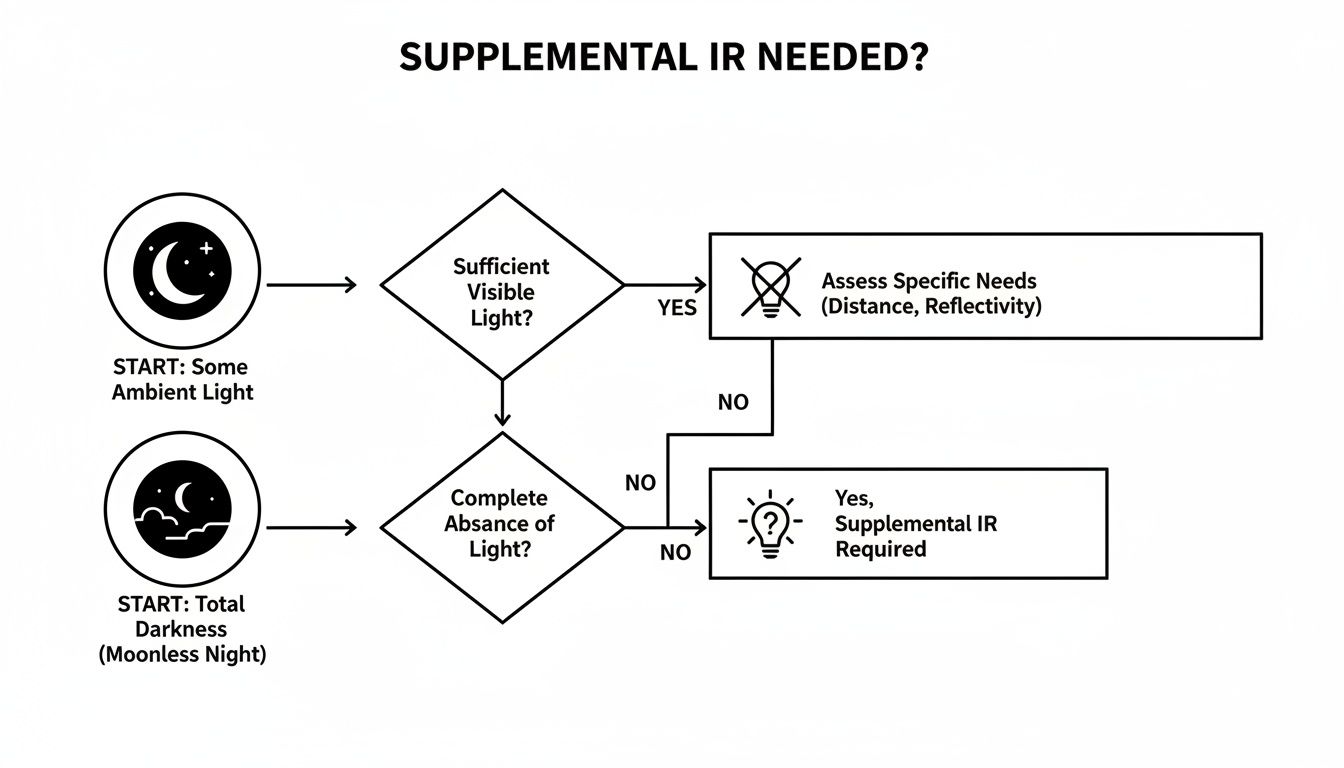
Think of it this way: if you're in a pitch-black building with no windows, your NVGs have no light to amplify. You need to bring your own. In a field under a half-moon, you might be fine without one.
Output Power and Beam Pattern
The first spec you’ll see is output, measured in milliwatts (mW). This tells you how much raw power the light is pushing out, which directly translates to how far the beam can reach. A higher mW rating means more throw, letting you see further into the darkness.
But raw power is only half the story. A high-output beam can drain your batteries in a hurry and create a blinding "splash" off nearby walls, completely whiting out your tubes. The goal is to find a light with enough reach for your mission without being overkill.
Just as important is the beam pattern. This is all about how that light is shaped. You’ll generally find two types:
- Flood Beam: Think of this like a lantern. It casts a wide, soft cone of light that's perfect for navigating, working on tasks up close, and keeping your peripheral vision illuminated.
- Spot Beam: This is your flashlight. It punches a tight, focused beam deep into the distance, ideal for positively identifying a shape a hundred yards away.
Many of the best lights today give you both. They let you switch from a wide flood for walking around to a focused spot for investigating something specific, giving you incredible versatility from a single device.
Wavelength and Covertness
An IR light’s wavelength, measured in nanometers (nm), determines how stealthy you are. The two main options you'll see are 850nm and 940nm, and the choice is a direct trade-off between performance and signature.
An 850nm IR light gives you better range and brightness through your NVGs, but the emitter itself gives off a faint red glow that can be seen with the naked eye. A 940nm light is nearly invisible, offering true covertness, but you sacrifice a noticeable amount of illumination distance.
Which one is for you? If you're in a situation where any visible signature could give you away, 940nm is the only real choice. If you prioritize maximum range and performance, and a tiny red dot is an acceptable risk, 850nm will serve you better.
Activation and Durability
When the pressure is on, fumbling with your gear is not an option. Your light's controls need to be dead simple. Look for large buttons or rotating bezels you can find and use with gloves on, without having to take your eyes off what's in front of you. Many lights also have ports for remote pressure pads, which let you activate the light from your rifle's handguard.
Finally, any piece of kit on your helmet has to be bombproof. Look for an IP (Ingress Protection) rating like IP67 or IPX8, which tells you how well it stands up to dust and water. You also need to make sure the light's mount is compatible with your helmet, whether you’re using an ARC rail, M-LOK, or another system. A wobbly light is a useless light.
Proper Setup and Operational Discipline
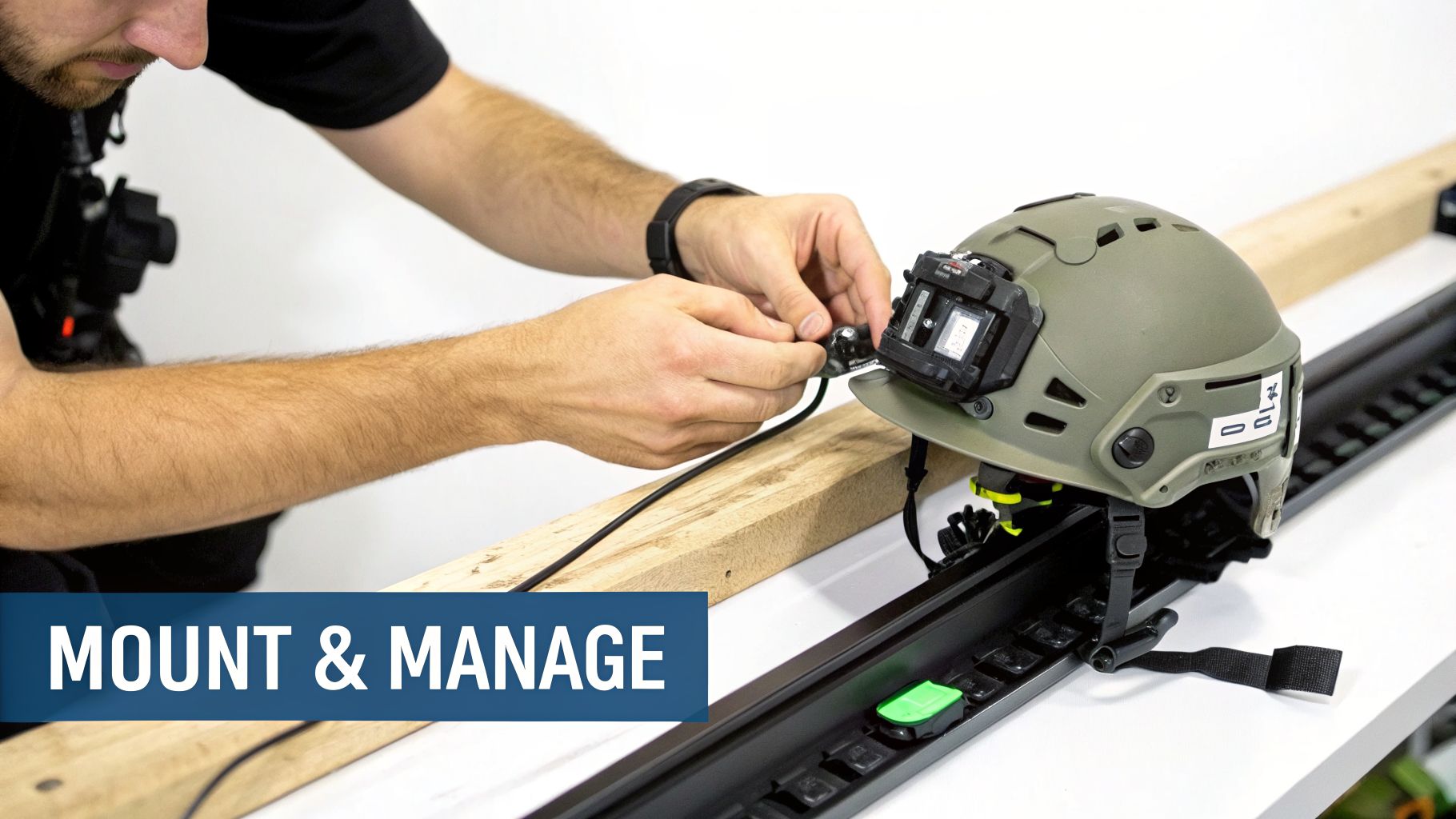
Getting a top-tier IR helmet light is only half the battle. True effectiveness comes from smart setup and disciplined use—this is what separates the pros from the amateurs. How you mount, wire, and actually run your light can make it either a game-changing tool or a clumsy liability.
Your primary goal is to get a clean, unobstructed beam. A badly positioned illuminator creates two major problems: distracting "gear splash" where IR light bounces off your rifle and suppressor, and a massive "helmet shadow" that creates a dark void exactly where you're trying to look. The best practice is to mount your light as high and as far forward on your helmet as you can, usually on the side opposite your shooting hand. This helps the beam clear all your other equipment, giving you a much cleaner view through your NVGs.
Cable Management and Light Discipline
Once your light is in position, cable management is not optional. It’s a critical task. A single loose wire is a snag hazard waiting to happen, ready to catch on a branch or a vehicle door and take your entire night vision system down at the worst possible moment.
Seriously, lock those wires down. Use zip ties, dedicated helmet cable clips, or even high-quality tape to secure every inch of wire flush against the helmet shell. Route them under your rail accessories or a helmet cover to keep them completely snag-free and out of mind.
The real mark of a professional is operational discipline. Your "momentary-on" switch is your best friend. Instead of leaving the light running, you use quick, controlled bursts of IR to scan a new area or positively identify something. This simple habit drastically shrinks your infrared signature.
This practice is known as "light discipline," and it stops you from being a constant, glowing beacon to anyone else who has night vision. It also keeps you from blinding your own teammates. If one person floods an area with IR, it can cause the tubes in nearby NVGs to "gate down" or dim so much that they become useless. A solid mount is the foundation of any good setup, and you can learn more by exploring our guide on choosing the right helmet night vision mount.
Coordinating light use within your team and using it with intention are the hallmarks of an advanced operator. And for those running an IR laser, taking the time to zero your illuminator's beam so it converges with your laser at a set distance makes for unbelievably fast and precise target engagement in complete darkness.
Common Questions About IR Helmet Lights
Diving into the world of night vision gear can feel like learning a new language. When it comes to something as specific as an IR helmet light, a few questions always seem to pop up. Let's get you some straight answers from the field.
Can My Naked Eye See the Beam?
Not really. The actual beam of infrared light is totally invisible to you. But—and this is a big but—if you look straight into the LED emitter on an 850nm IR light, you’ll spot a faint, dull red glow. It’s a dead giveaway that can get you noticed when you’re trying to stay hidden.
For maximum stealth, a 940nm light is the way to go. Its glow is virtually non-existent. The trade-off is that you typically get a bit less illumination distance and clarity through your NODs (Night Observation Devices).
IR Light Versus IR Laser
These two are often confused, but they do very different jobs. It's best to think of them as a team.
- IR Light (Illuminator): This is your invisible flashlight. It throws out a wide cone of infrared light to "paint" the environment, letting you see everything through your NVGs. It’s for navigation, searching an area, and general awareness in complete darkness.
- IR Laser: This projects a single, tight IR dot. Its only job is to give you a precise aiming point for your weapon or to designate a specific target for others on your team who are also using night vision.
Many of the most effective units out there actually combine both an illuminator and a laser into a single device, giving you the best of both worlds.
The bottom line is simple: an illuminator helps you see, while a laser helps you aim.
Will Any IR Light Work with My NVGs?
Pretty much, yes. All modern IR helmet lights operate in the same near-infrared spectrum as every generation of night vision goggle (Gen 1, 2, and 3). So, you don't have to worry about basic compatibility.
The real difference comes down to performance. A high-quality, powerful IR illuminator can make a world of difference, boosting the clarity and effective range of any NVG setup. It can turn a pitch-black, zero-light environment into a crystal-clear picture.
Ready to take control of the dark? At Superior Tactical LLC, we stock a curated selection of battle-tested IR helmet lights and night vision systems. Equip yourself with the best gear by visiting us at https://superiortac.com.
