
Calling in Coyotes at Night A Hunter’s Guide
Calling in coyotes after dark is a different beast entirely. It all boils down to a few core principles: hunt when they're most active, use their own language against them, and own the night with the right technology. Most of my best nights have been between 10 PM and 3 AM. That's their prime time for traveling and hunting, and if you're set up right, you're putting yourself directly in their path. Success is all about stealth and thinking like a coyote under the cover of darkness.
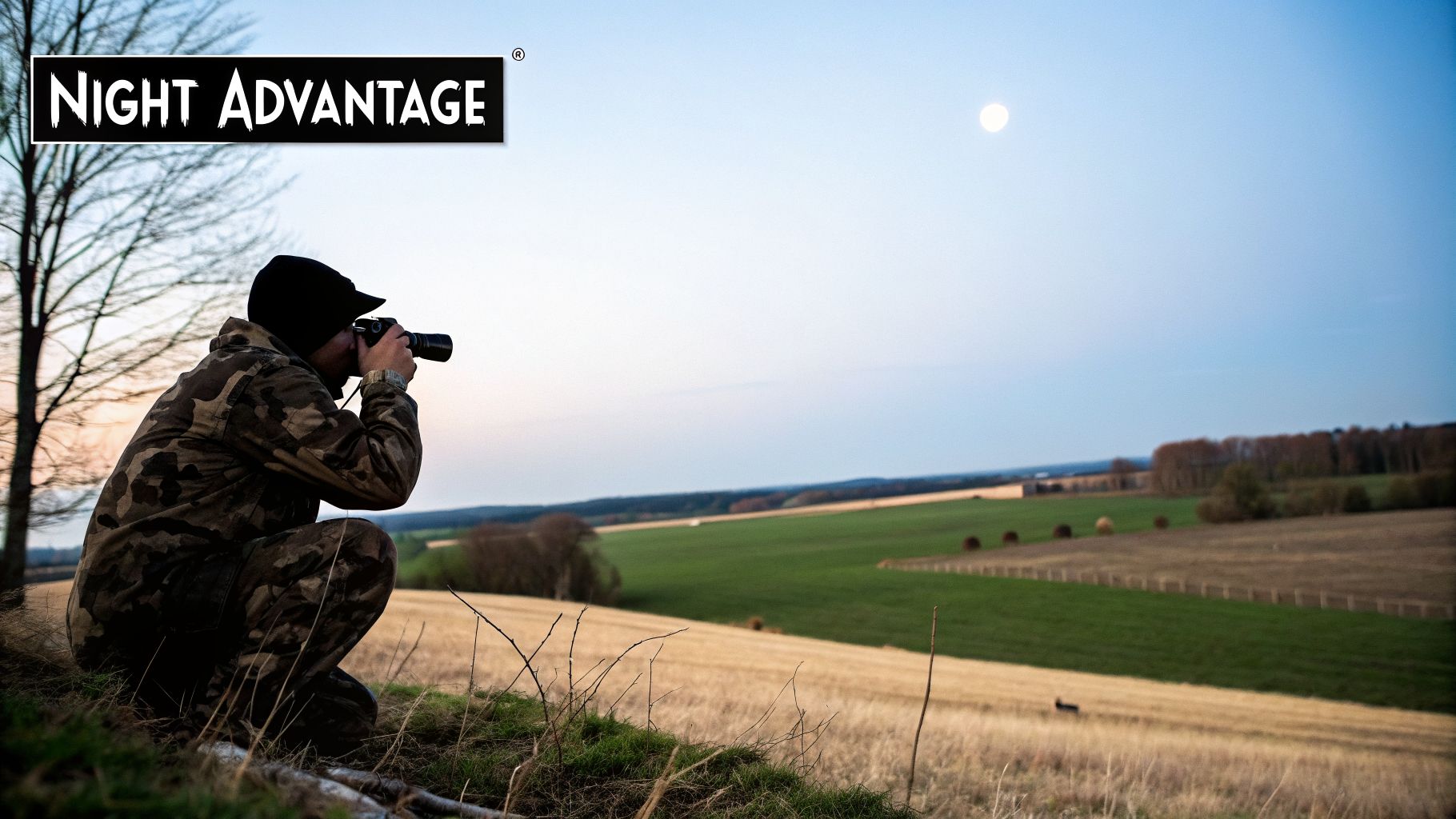
To really understand the shift, it helps to see the strategies side-by-side. Daytime hunting and nighttime hunting are two completely different sports.
Day vs. Night Coyote Calling: A Tactical Comparison
| Factor | Daytime Hunting | Nighttime Hunting |
|---|---|---|
| Coyote Confidence | Extremely wary and cautious. Often hang up out of range. | Bold and confident. More likely to commit fully to the call. |
| Movement | Mostly bedded or moving through thick cover. | Actively traveling, hunting, and patrolling territories. |
| Approach | High risk of being spotted. Requires meticulous use of cover. | Low risk of being spotted. Darkness masks your setup and movement. |
| Call Response | Slower and more hesitant. Often circle downwind to scent check. | Faster and more aggressive. Often come straight to the call. |
| Primary Senses | Heavily reliant on sight, then smell and sound. | Heavily reliant on sound and smell. Sight is less of a factor for them. |
This table just scratches the surface, but it highlights the core reason we hunt at night: we're meeting them on their turf, in their element, and that gives us a distinct advantage.
Why Night Hunting Gives You the Edge
When the sun goes down, the whole world changes for a coyote. They aren't the same cautious, skittish animals you see during the day. Darkness is their security blanket, and it makes them bold. This is the single biggest reason why night calling is so effective.
Think about it. In daylight, a coyote might hear your call, but it will hang up 400 yards out, circle downwind, and use its eyes to pick apart the landscape. At night, that same coyote feels safe. It's more likely to throw caution to the wind and charge in to investigate a sound. That perceived invincibility is what you're exploiting.
Capitalizing on Natural Coyote Behavior
The strategy here is simple: you're not trying to coax a coyote out of its bed. You’re setting up an ambush along its nightly route. Studies have shown these animals can travel over four miles in a single night looking for food or defending their turf. Your calls are just an interesting stop along their way.
This is especially true during certain windows of the year:
- The Breeding Season (Late Winter): From about mid-January through March, things get loud. Males are on the move looking for mates, and they are incredibly territorial. A challenge howl can bring them in on a string.
- The Lean Months: When the dead of winter hits and food is hard to come by, hunger takes over. The sound of a dying rabbit is an invitation to an easy meal that a calorie-starved coyote can rarely pass up.
The real magic of night hunting is that you meet the coyote on its own terms. Instead of fighting their instincts, you use their nocturnal confidence against them, making them more likely to investigate your calls without the extreme caution they exhibit during the day.
The Technological Advantage
Let's be honest, modern optics have completely changed the game. The days of fumbling with red-lensed flashlights and hoping for a full moon are long gone. High-quality thermal and digital night vision are what make this so effective.
- Thermal Optics: These are my personal favorite. They read heat signatures, so a coyote’s warm body glows against the cool night landscape. You can spot them hundreds of yards out, long before they have any clue you're there.
- Night Vision: This gear works by amplifying tiny amounts of ambient light. When paired with a good infrared (IR) illuminator—which is invisible to the coyote's eye—it can light up a pitch-black field like it's daytime.
With this kind of gear, you can watch a coyote's entire approach, read its body language, and get ready for a clean shot, all while you remain a ghost. If you're trying to decide between the two, it’s worth digging into the key differences between thermal and night vision for hunting. This ability to see without being seen is the absolute foundation of successful night hunting.
Scouting and Selecting Your Hunting Grounds
Your success calling coyotes at night is often sealed long before you even power on your call. It all comes down to smart, thorough planning and knowing exactly where to post up for the night. The entire hunt really boils down to one simple truth: you can't call in a coyote that isn't there. That’s why scouting and picking the right property is, without a doubt, the most critical part of the whole process.
The main objective is to pinpoint areas with a healthy coyote population. Sure, beautiful terrain is nice to look at, but population density is what puts fur in the truck. I think of it like fishing—you don't cast your line in the prettiest part of the lake; you go where you know the fish are stacked up. It all starts with doing your homework.
Digital Scouting and Map Reconnaissance
Before my boots ever touch the dirt, I spend hours behind a screen. Modern mapping tools like onX Hunt or even Google Earth are your absolute best friends for this phase. I’m not just looking for a big piece of land; I’m dissecting the landscape for specific features that coyotes use as their personal highways after the sun goes down.
Here’s what I’m always on the lookout for:
- Creek and River Bottoms: These are natural superhighways for predators. Coyotes will almost always use these low-lying areas for concealed movement.
- Field Edges and Fence Lines: Think of these as guardrails. Coyotes love to patrol the edges of ag fields or follow old fence lines—it’s an easy, defined path through their territory.
- Saddles and Funnels: Pay close attention to low spots in a ridge (saddles) or narrow strips of cover connecting two larger blocks of timber. These features naturally "funnel" wildlife into very predictable travel lanes.
The single biggest lesson I've learned over the years is that density trumps everything. You have to hunt where the coyotes are thick. An ugly, scrubby piece of property that's crawling with coyotes will out-hunt a gorgeous, sprawling landscape with just a few resident dogs every single night.
This is especially true for nighttime hunting. The local coyote population dynamics have a massive impact on your calling success. Early in the season, experts figure that 40-70% of the local coyotes are young, naive pups that are incredibly responsive to calls. But as the season wears on and hunting pressure mounts, those numbers can drop off fast. This makes finding those high-density pockets even more crucial for consistent action. You can dig deeper into how populations affect calling by reading expert takes on coyote hunting across the USA.
Ground Truth and Securing Access
Once you've marked a few promising spots on your map, it's time to get out and burn some boot leather—or at least some gas. This next step is all about confirming what you saw online and, most importantly, getting legal access to hunt.
Start by driving the public roads around your target properties, especially around dusk and dawn. Glass the fields with good binoculars and stick around after sunset to listen for howls. Keep an eye out for tracks, scat, and well-worn crossing points along the roads.
Getting permission is an art form, and how you approach it matters. I always try to meet landowners face-to-face. Be professional, be respectful, and be crystal clear about what you're asking to do. Explain that you're a dedicated predator hunter, you'll be focusing on coyotes at night, and that you are fully equipped for a safe, ethical hunt. Mentioning that you carry liability insurance can also do wonders for a landowner's peace of mind.
After you get that handshake, know the property lines like the back of your hand. Your mapping app is essential here, because a fence line in the dark might not be the actual boundary. For a complete rundown on setting up safely at night, take a look at our guide on hunting coyotes with night vision.
Planning Your Entry and Exit Routes
The final piece of this strategic puzzle is mapping your approach. The best-scouted, most coyote-rich spot on the map is completely worthless if you blow every coyote out of the county on your way in. For every single stand location I choose, I have a dedicated, stealthy entry and exit route planned out.
Your route needs to account for a few key things:
- Wind Direction: This is non-negotiable. Always plan your approach so the wind is in your face, coming from the direction of the property's core bedding and travel areas.
- Noise Discipline: Stay off crunchy gravel roads and avoid busting through noisy brush. I stick to soft field edges, grassy two-tracks, or even dry creek beds whenever possible.
- Visual Cover: Even in total darkness, use the terrain. Walk on the backside of a hill or down in a ditch to keep your silhouette from being skylined.
The goal is to slip into your stand like a ghost. This level of meticulous planning is what separates the hunters who are consistently successful from the ones who just get lucky every now and then.
Mastering Your Night Calling Sequences
Your calling strategy is the absolute heart of the hunt. The sounds that bring a coyote charging in during daylight—like a frantic rabbit distress—can still work after dark, but the game completely changes once the sun goes down. Night hunting calls for a smarter, more subtle approach, one that plays on a coyote's territorial and social instincts.
The biggest mistake I see new night hunters make is relying solely on prey distress calls. Sure, a cottontail squeal might pull in a young, naive coyote, but the real magic happens when you start speaking their language. Under the cover of darkness, howls, yips, and barks are often far more effective. You're no longer just ringing the dinner bell; you're challenging a dominant male, impersonating a rival pack, or mimicking the social chatter they expect to hear at night.
Before you even think about which call to use, your success starts with picking the right spot. I use a simple mental checklist for scouting to make sure I'm not wasting my time.
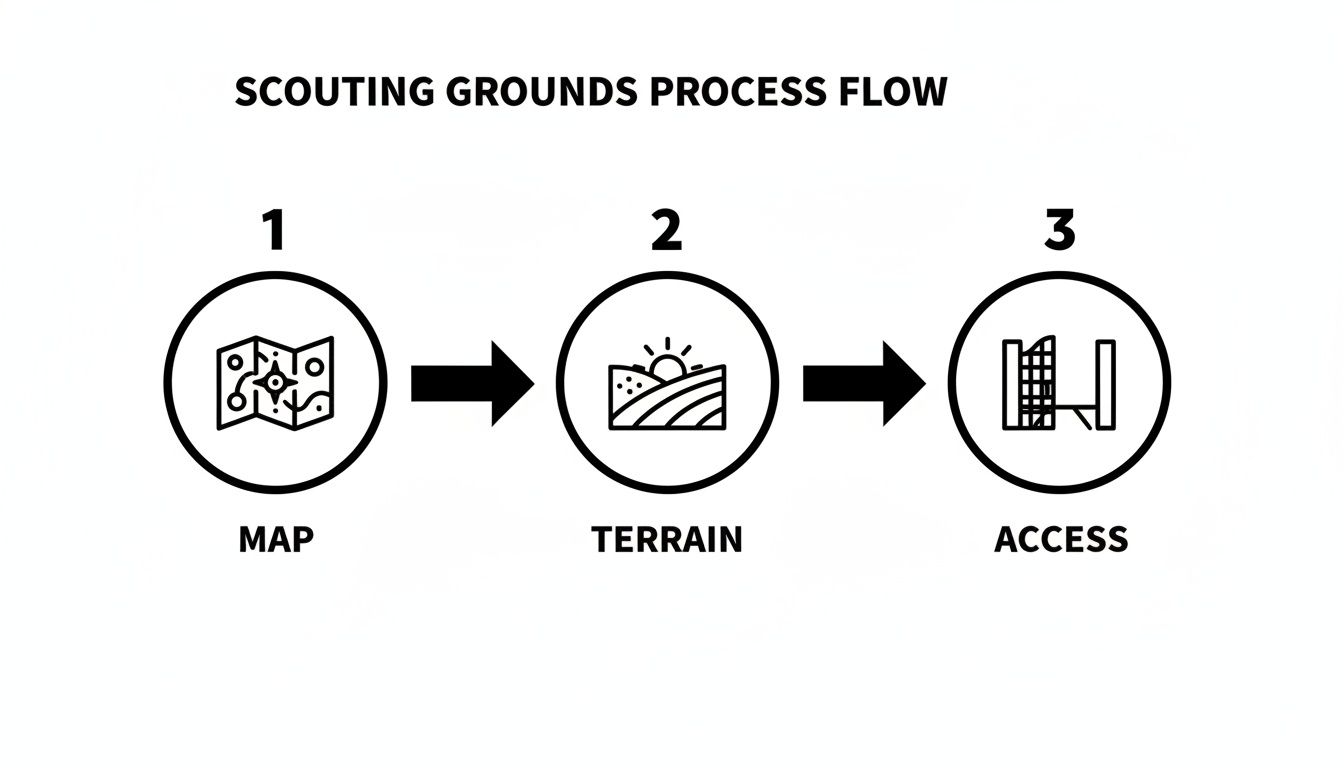
Drilling down on your map recon, terrain features, and access points ensures you’re setting up in a high-percentage area from the get-go.
Prey Distress vs. Coyote Vocalizations
Knowing when to use each type of sound is what separates the pros from the amateurs. Think of them as two different tools in your kit.
Prey Distress Sounds: These are your rabbit screams, rodent squeaks, and fawn bleats. They appeal directly to a coyote's stomach and are fantastic for seeing if a hungry, opportunistic coyote is lurking nearby. I find they work best in the dead of winter when food sources are scarce.
Coyote Vocalizations: This is where you get into lone howls, group serenades, sharp barks, and challenge calls. These sounds tap into a coyote's social hierarchy and territorial aggression. They are absolutely lethal during the breeding season, which typically runs from late January through March, when coyotes are on high alert for intruders.
My go-to strategy is almost always a mix of both. I’ll often open a stand with a soft, lonely howl to locate any coyotes in the area. If I get a response, I know where they are. After a good long wait, I might switch to a prey distress sound. This paints a picture of an intruder stealing a meal, triggering both a hunger and a territorial response.
Building an Effective Calling Sequence
The key to calling in wary coyotes at night isn't just what you play, but how you play it. Blasting calls non-stop is a rookie move that gives a coyote way too much information, allowing it to pinpoint your location from a safe distance. The real secret is intermittent calling.
This means you use short bursts of sound followed by long periods of absolute silence. On a typical 20 to 30-minute stand, my sequence might look something like this:
I'll start with just 30 to 45 seconds of sound—maybe a lone howl or a quiet cottontail distress. Then, the hard part: I go completely silent for 3 to 5 minutes. This is when you need to be glued to your thermal, scanning constantly. Coyotes love to slip in without making a sound, and this pause gives them the confidence to close the distance.
Next, I’ll offer another 30-second sequence. If I started with a howl, I might now try something with more energy, like a rabbit fight or pup distress calls. Then, it's back to silence, but for a little longer this time, maybe 5 to 7 minutes. You have to be patient and keep scanning.
For my final sequence, I might get aggressive with a group howl or some challenge barks. This is designed to infuriate any dominant dog that’s been hanging up just out of sight, trying to figure things out. This methodical approach sounds far more realistic and creates the curiosity needed to draw a cautious coyote into the open.
Strategic sound selection and timing are everything when calling in coyotes at night. Field data shows that coyote vocalizations can outperform rabbit distress calls by as much as 40% in response rates during the peak activity hours between 10:00 PM and 3:00 AM.
This is especially true on those cold, still nights in February when breeding pairs are most vocal and territorial. Adopting an intermittent calling protocol—using 30-45 second call sequences followed by 3-5 minutes of disciplined silence—is the professional standard. It masks your exact position and respects the fact that coyotes move more cautiously in total darkness. You can dive deeper into how these sounds transform a hunt by reviewing what predator hunting experts have to say on MossyOak.com. Once you master these sequences, you'll be using a coyote's own instincts against it.
Crafting the Perfect Ambush
I’ve seen more night hunts blown by a bad setup than by a bad call. You can have the best gear and sound like a dying rabbit from heaven, but if your ambush isn't right, all you'll see is a coyote's tail disappearing over the horizon. Setting the stage is a delicate dance of wind, sound, and sight, and it all happens before you ever make a peep.
Wind is everything. It’s the one absolute, unbreakable rule of predator hunting. If a coyote gets your scent, the hunt is over before it even starts. They live and die by that nose, and one whiff of you is enough to send them into the next zip code. You absolutely have to set up with the wind in your face or blowing across your front.
Don't just check it once and forget it, either. Wind swirls and eddies, especially in hills or on still nights. I’m constantly puffing a wind checker or even just watching the fog from my breath drift through my thermal scope. A coyote will try to use the wind to circle downwind of the call, and your setup has to be ready for that.
Building Your Triangle of Death
One of the biggest rookie mistakes I see is hunters plopping their e-caller right at their feet. That's a surefire way to have a coyote’s laser-like focus pointed directly at you. The real trick is to create what I call a "triangle of death" by separating yourself from the sound and any motion.
This simple tactic works by creating a powerful diversion. The coyote's eyes and ears become completely fixated on the source of the distress, giving you the freedom to breathe, adjust, and prepare for the shot without getting busted.
- Your Hide: Get comfortable in a spot with good cover, positioned downwind of where you expect the coyote to show up.
- The E-Caller: Place your electronic caller 30 to 75 yards away from you, ideally upwind or crosswind. This distance is critical—it pulls all the attention away from you.
- The Decoy: A motion decoy near the caller is the final piece of the puzzle. The combination of sound and movement can be irresistible, gluing a coyote’s attention to that one spot.
The perfect ambush manipulates a coyote's senses. By placing the caller and decoy away from you, you create a "stage" for the action. You remain an unseen observer in the "audience," forcing the coyote to expose itself as it focuses on the performance.
With this setup, a coyote trying to circle downwind of the sound will walk right into your shooting lane, often giving you a perfect broadside shot. It's a simple, deadly effective strategy for calling coyotes at night.
Picking Your Stand
Where you decide to sit is just as crucial as managing your scent and sound. The terrain you're hunting will usually present a classic trade-off: do you want a better view or better cover?
The High-Ground Advantage
Setting up on a high point—a small knoll, the shoulder of a ridge—gives you a commanding field of view. This is a massive plus when you're scanning with thermal, as you can spot a heat signature approaching from a long way out. The risk, of course, is silhouetting yourself against the sky. If you go high, you absolutely need a solid backdrop like a thick cedar tree, a rock outcropping, or a dark hillside to break up your outline.
Low-Ground Concealment
On the other hand, tucking into the low ground offers incredible concealment. By setting up in a ditch, a dry creek bed, or at the foot of a hill, you can practically disappear. The major downside is your field of view can be severely limited. You're betting on the coyote following a predictable path right into your lap.
My choice always comes down to the landscape. In wide-open cattle country, I’ll take a high point overlooking a big pasture. But in the rolling hills or thick timber, I almost always prioritize the superior concealment of the low ground. And while it's tempting to scan with a light, remember that many coyotes have grown wary of them. It's an interesting debate, and you can learn more about whether coyotes can see red light and how it affects their behavior.
Owning the Dark: Your Essential Night Optics
When the sun drops below the horizon, the entire game of coyote hunting changes. Success after dark isn't just about calling; it’s about your ability to see a predator that’s perfectly adapted to the night. This is where your optics come in, and for any serious night hunter, that means two things: thermal imaging and digital night vision.
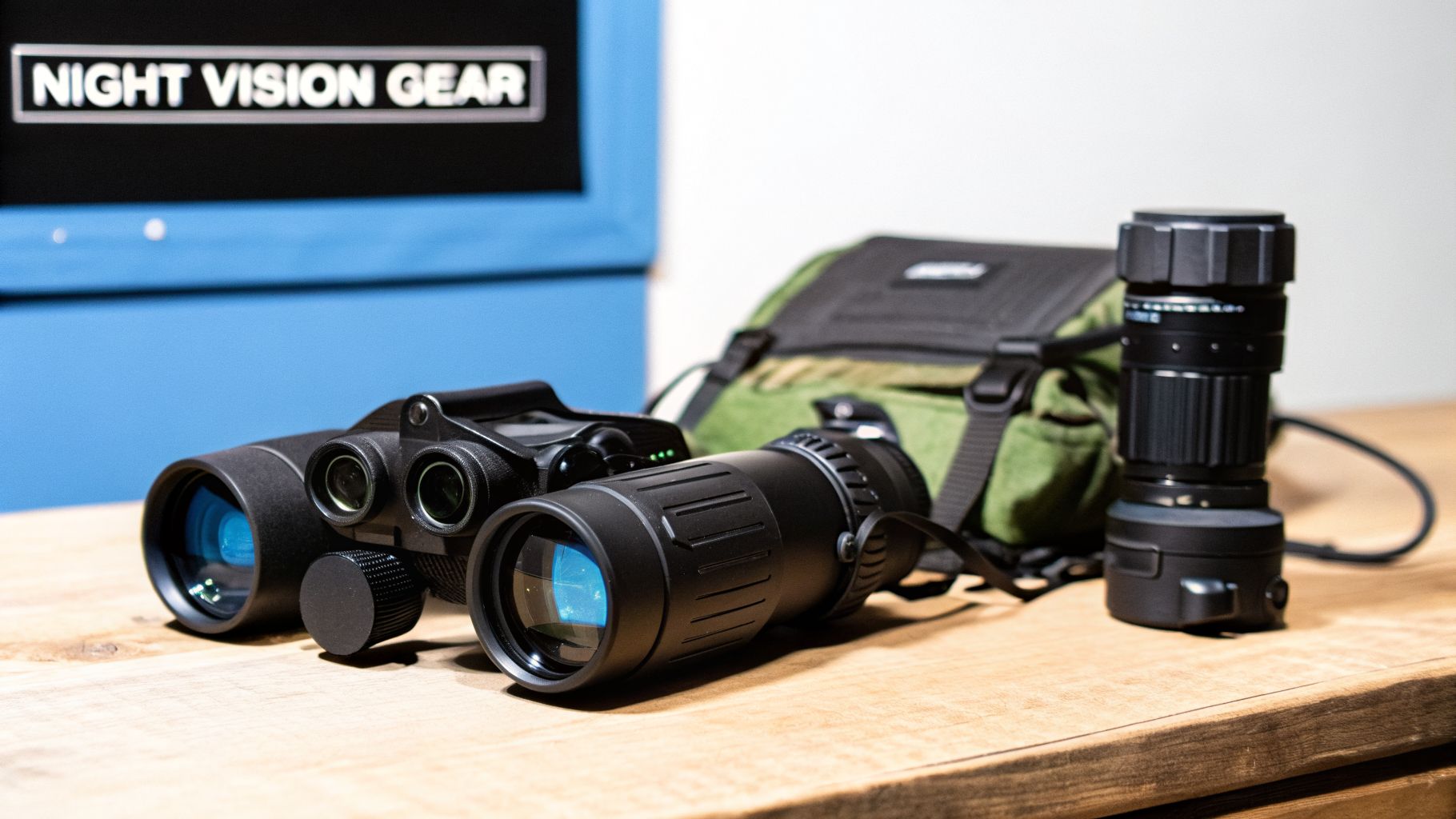
It's easy to lump these two technologies together, but they couldn't be more different. They both pierce the darkness, but how they do it—and what each is best for—is something you need to understand before you invest.
Thermal Imaging: The Predator’s Eyes
Thermal doesn't care about light. At all. Instead, it sees heat. It builds a picture by detecting tiny differences in the thermal energy that everything gives off. That means a coyote's warm body stands out like a bright beacon against the cooler ground, whether it's glowing white-hot or jet-black, depending on your palette setting.
This is what makes thermal an absolute game-changer for finding animals. You can pan across a completely dark field and instantly spot a coyote trotting in from hundreds of yards away.
In my experience, thermal is king for:
- Scanning: A handheld thermal monocular is the single most valuable tool for locating coyotes. You can sweep huge areas quickly without making a sound or emitting any light. It’s pure, passive observation.
- Seeing Through Cover: A coyote’s heat signature will often bleed through light grass, fog, or brush that would make it completely invisible to the naked eye or even standard night vision.
- Quick Confirmation: There's no mistaking the shape and gait of a coyote on a thermal screen. You get positive ID in a heartbeat.
Digital Night Vision: Lighting Up the Scene
Digital night vision works on a different principle. It takes whatever ambient light is available—from the moon, stars, or even distant city glow—and electronically amplifies it to create an image.
When it's truly dark, like under a thick canopy of trees or on a new moon with heavy clouds, you'll need an infrared (IR) illuminator. Think of it as a flashlight that shoots a beam of light completely invisible to a coyote’s eyes but perfectly visible to your scope.
A good digital scope paired with a powerful IR illuminator can produce an incredibly sharp, detailed image. You can see fur, whiskers, and other details that make final identification and precise shot placement much easier. The catch? Its performance is directly tied to the power of that IR light.
The most effective strategy I've found is to use both technologies together. I use a handheld thermal monocular to scan for incoming coyotes. Once I spot one, I switch over to my weapon-mounted digital or thermal scope for final identification and the shot.
This two-optic system gives you the ultimate advantage. You have the unmatched detection power of thermal for finding the animal and the crystal-clear detail of digital NV (or the precision of a thermal scope) for finishing the job. You can scan passively for minutes on end, only turning on your IR illuminator for a few seconds right before the shot.
And you'll need that time. Coyotes are constantly on the move after dark. GPS collar studies have shown that while a coyote might travel only 2-3 kilometers during the day, that number jumps to over 7 kilometers at night. This means you have to be more patient. Forget the 15-minute daytime stands; at night, you need to give it 20-30 minutes to allow those far-off, traveling coyotes time to hear your call and commit. You can dive deeper into these nighttime coyote hunting findings from Pixfra to better understand their behavior.
Common Questions About Calling Coyotes at Night
No matter how well you plan, questions are bound to pop up out in the field. This isn't just a casual pastime; hunting coyotes after dark is a technical game where the smallest details can make or break your night. We’ve gathered the questions we hear most often from fellow hunters to give you clear answers based on years of real-world experience.
Think of this as the stuff you learn after countless hours behind the scope. Every hunter has been there, wondering if they’re doing it right. Let’s get some of those common hurdles out of the way.
What Is the Best Time of Night to Call Coyotes?
This is the million-dollar question, isn't it? While you can certainly call in a coyote anytime after dark, there’s absolutely a "golden window" you should target. I've had my best luck—and GPS collar studies back this up—between 10:00 PM and 3:00 AM. This is primetime, when they're most actively patrolling their territory, hunting for a meal, and checking for intruders.
That said, don't sleep on the edges of the night. That first hour of true darkness right after dusk can be electric as coyotes get up and start moving. The same goes for the hour just before the sun starts to crack the horizon; it’s their last chance to grab an easy meal before they den up for the day. You want to be set, silent, and waiting for them during these peak movement times.
Calm, cool nights are your best friend. For the highest probability of a response, focus your efforts in that 10:00 PM to 3:00 AM window when coyotes are naturally most active and receptive to your calls.
How Long Should I Stay at One Stand?
Patience is a virtue, but it's a necessity for night hunting. During the day, you might get away with a quick 15-minute stand. At night, you need to slow things down. My personal rule of thumb is a bare minimum of 20 to 30 minutes per stand.
The reasoning is simple: coyotes are far more cautious in the dark. A coyote that hears you from half a mile away isn't going to come sprinting in. It’s going to take its time, use the terrain, and try to circle downwind. An intermittent calling sequence with long periods of silence gives that wary coyote the time and confidence it needs to commit. If a full 30 minutes goes by without seeing or hearing anything, it’s time to quietly pack it in and move to the next spot.
Is Hunting Without Night Vision or Thermal an Option?
Technically, yes, but it’s a recipe for frustration and, more importantly, can be unethical. Trying to hunt with just your naked eye, even with a full moon and a fresh blanket of snow, is a massive handicap. You’re banking on perfect conditions that almost never happen.
A lot of guys starting out try to use handheld red or green lights. The problem is, in many areas, coyotes are now completely wise to lights. The second that beam hits them, they're gone.
Here’s the hard truth:
- Night Vision: Works by amplifying any available ambient light. It lets you see in the dark, but you'll almost always need an IR illuminator for a clear picture.
- Thermal Optics: This is the real game-changer. It detects heat signatures, making an animal pop against a cold background, no matter how dark it is.
Modern optics are essential for effective and safe night hunting. They let you spot an animal, positively identify it as a coyote (and not the farmer's German Shepherd), and make a clean, ethical shot. For anyone serious about this pursuit, they are non-negotiable.
What Are the Most Common Mistakes to Avoid?
Success at night is often less about what you do right and more about what you don't do wrong. I’ve seen these same few mistakes cost hunters countless opportunities over the years. Get these fundamentals locked down, and you'll be way ahead of the game.
More hunts are ruined by these blunders than anything else:
- Ignoring the Wind: Your scent is the ultimate deal-breaker. If a coyote gets downwind of you, the hunt is over before it even began. Always, always have a plan for the wind.
- Calling Too Much: A non-stop, blaring call sounds completely unnatural. It screams "danger" and lets a coyote pinpoint your exact spot from a safe distance. Silence is one of your best tools—use it.
- Getting Impatient: Leaving a stand after just 10 or 15 minutes is a classic rookie move. You have to give that distant, cautious coyote time to make its way to you.
- Making a Racket: This one seems obvious, but it happens all the time. A slamming truck door, talking while walking to your spot, or crunching on gravel can alert every coyote within a half-mile. Move with purpose and be quiet.
- Failing to ID Your Target: This is the cardinal sin of hunting. You must be 100% certain of what you're aiming at. No exceptions. If there is any doubt, you don't shoot.
At Superior Tactical LLC, we know that owning the night starts with having gear you can trust. Whether you're buying your first thermal scope or looking to upgrade your NVDs, our team has the field experience to help you get properly equipped. Check out our curated selection of top-tier optics and hunting accessories at https://superiortac.com.
