
Binoculars with Night Vision and Camera A 2026 Buyers Guide
You’re shopping for this category because daylight is no longer the limiting factor. Your mission is.
A hog moves at the edge of a field after legal light. A patrol officer needs to hold visual control on a dark lot without broadcasting position. A security team has to document movement on a fence line when the human eye can only separate shadows from more shadows. In every one of those situations, cheap optics and inflated product listings waste time you don’t have.
That’s why binoculars with night vision and camera attract so much attention. They promise two things at once. First, the ability to see in low light or no light. Second, the ability to record what happened. Those are not the same capability, and serious buyers get into trouble when they treat them as interchangeable.
The demand is real. The global night vision device market was valued at $7.02 billion in 2022 and is projected to reach $16.32 billion by 2030, growing at a CAGR of 11.5%, driven by law enforcement, military, hunting, and security use, according to Grand View Research’s night vision device market analysis. That growth isn’t happening because the gear looks cool. It’s happening because low-light capability changes outcomes.
Why Seeing in the Dark is a Non-Negotiable Advantage
Darkness strips away detail first. Then it strips away confidence.
A hunter can still hear movement after sundown, but hearing alone doesn’t confirm species, direction, or distance. A security officer may detect motion on a perimeter, yet still have no clean visual for documentation. A law enforcement officer clearing a dim structure needs to identify what’s in a subject’s hands, not just confirm that a shape is present.
That gap often leads buyers to make expensive mistakes. They assume any device labeled night vision will solve the problem. It won’t.
What the naked eye loses first
The eye does poorly when contrast collapses. You stop reading terrain correctly. Brush, fence wire, debris, and people begin to blend together. Depth judgment gets worse. Recognition lags behind detection.
In practical terms, that means:
- Detection isn't enough: Seeing that something is there doesn’t tell you what it is.
- Identification matters more than marketing: A bright screen and a long spec sheet don’t equal usable detail.
- Recording changes the job: Hunters want proof. Security teams want documentation. Officers may need evidence.
Practical rule: If the job requires both observation and proof, the camera function matters. If the job requires passive performance without broadcasting your position, the night vision system matters more.
Why this category creates confusion
Most buyers in this space are comparing radically different technologies under one search term. A digital binocular with a recording menu and built-in IR illuminator sits in the same online results as a professional-grade Gen 3 system or a multi-spectrum thermal unit. On a retail page, they can look surprisingly similar.
In the field, they don’t behave the same way.
Some models are perfectly serviceable for casual observation, property checks, and short-range recording. Others are built for people who can’t afford bloom, lag, weak housings, or legal mistakes around controlled equipment. The difference isn’t academic. It affects whether you can spot, identify, record, and move without giving yourself away.
Understanding the Core Night Vision Technologies
The phrase binoculars with night vision and camera covers three different families of technology. If you don’t separate them, the rest of the buying process gets sloppy fast.
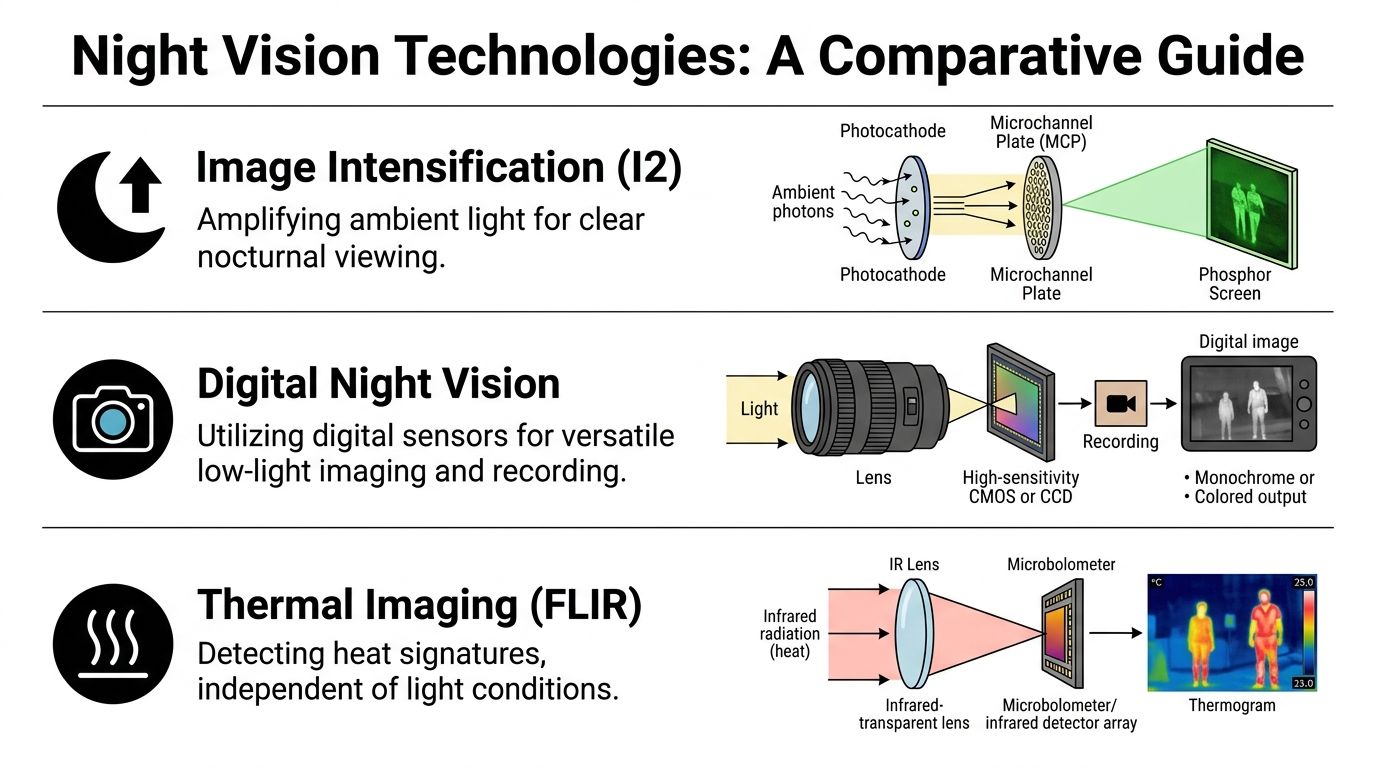
Image intensification
Image intensification is the classic analog night vision path. It takes faint ambient light and amplifies it into a visible image. The easiest way to explain it is with audio. It functions like a very sensitive microphone and amplifier. There may be only a whisper of available light, but the tube boosts it into something usable.
This category evolved from early active infrared systems in the 1930s to modern professional-grade analog optics. The jump matters. The history of night vision development documented by Boson Systems traces the path from 1930s Gen 0 active IR systems to 1980s Gen 3 devices with gallium arsenide photocathodes, representing a leap from 1x to over 50,000x light amplification.
That’s the foundation behind why Gen 3 still holds its place for serious low-light work.
Digital night vision
Digital night vision works more like a highly sensitive camera. It uses a sensor, display, and image processing instead of an analog intensifier tube. That gives digital units a built-in advantage for recording because they’re already operating as an imaging system.
Digital night vision can be useful. It’s often easier to live with in daylight use, menu navigation is familiar, and recording features are usually more straightforward. But it often depends heavily on sensor quality, processing, and active IR support when ambient light falls off. In such situations, many buyers get seduced by headline features. A digital unit may offer 4K recording, still photos, WiFi-style convenience on some models, and user-friendly controls. None of that automatically makes it the right tool for a tactical role.
Thermal imaging
Thermal imaging doesn’t care about visible light. It reads heat differences.
That means thermal solves a different problem. It’s exceptional for finding a person, animal, or vehicle-sized heat source when the scene is visually cluttered or when obscurants wreck conventional viewing. It’s often the fastest way to detect that something is present. It is not always the best way to positively identify exactly what that thing is.
That distinction matters in legal hunting scenarios, perimeter security, and law enforcement decision-making.
What each technology does well
The cleanest way to think about it is this:
| Technology | How It Works | Best For | Key Weakness |
|---|---|---|---|
| Image intensification | Amplifies available ambient light through an analog tube | Passive low-light observation and identification | Restricted access at higher performance levels and less native recording convenience |
| Digital night vision | Uses a digital sensor and display to render low-light scenes | Recording, casual to moderate low-light use, general observation | Often relies more on IR support and can degrade when conditions get difficult |
| Thermal imaging | Detects heat differences instead of light | Fast detection through darkness and visual clutter | Less natural scene detail for positive identification |
Where Gen 3 changes the conversation
A lot of consumer content flattens the difference between digital night vision and analog Gen 3. That’s a mistake.
Gen 3 was not just another small product revision. It was the point where image intensification became a professional standard for users who need strong passive performance. In practical use, that means working in very low ambient light without leaning as hard on an active illuminator that can compromise your position.
If you want a broader breakdown of where analog, digital, and thermal separate in real use, this guide on night vision technology explained, thermal imaging vs digital night vision vs analog night vision is worth reading alongside any product comparison.
If your primary problem is “find it,” thermal leads. If your primary problem is “identify it without broadcasting IR,” Gen 3 analog usually leads. If your primary problem is “record it affordably,” digital often gets the nod.
Key Specifications That Define Field Performance
Spec sheets hide weak gear behind big numbers all the time. The field doesn’t care what looked impressive on a product tile.
Magnification and field of view
Magnification sells because it’s easy to understand. But more isn’t always better.
Higher magnification narrows field of view. That can make scanning slower and target reacquisition clumsy. In a hunting or surveillance role, a wide enough view to search terrain often matters more than headline zoom.
Digital zoom deserves extra skepticism. It can be usable in moderation, but once you push it too far you’re not seeing more optical detail. You’re enlarging what the sensor already captured.
Sensor quality and recording resolution
Digital binoculars live or die by sensor and processing quality. The stronger units in this class use starlight-grade CMOS sensors and can deliver native 4K video resolution at 3840×2160, according to this hands-on review of advanced digital night vision binoculars.
That matters because resolution affects how well you can review footage, crop evidence, and separate real features from noise. A device that only shows a bright blob at distance may be fine for curiosity. It’s weak for documentation.
IR illumination and what it costs you
That same review notes that adjustable IR illuminators can extend effective identification of targets to 300 to 500 meters in total darkness. That’s useful. It also comes with trade-offs.
Active IR is support, not magic. In the right environment, it helps a digital unit produce a far better image than it could passively. In the wrong environment, it can create washout, harsh reflections, and a signature problem. Serious users need to think about what happens when the target area contains fog, dust, reflective surfaces, or other observers.
For a deeper look at how supplemental IR affects actual use, this page on the infrared illuminator for night vision is a practical reference.
Detection, recognition, and identification
Manufacturers often collapse these into one marketing claim. They shouldn’t.
- Detection means you know something is there.
- Recognition means you can classify it broadly, such as human, animal, or vehicle.
- Identification means you can say what it is with confidence.
That’s why long-range claims need context. A unit may detect well beyond the distance at which it can identify. Buyers who skip this distinction often end up with gear that seemed powerful online but doesn’t solve the actual problem in the field.
Field note: If you need court-worthy footage or clean after-action review, buy for identification quality, not just detection distance.
Battery, controls, and bad-weather reality
Runtime matters differently depending on the mission. Static observation, property checks, and vehicle-supported work can tolerate onboard rechargeable power more easily. Long foot patrols, extended hunts, and cold weather use punish battery systems fast.
What matters most is predictability:
- Power management: Simple controls and realistic power draw beat bloated feature sets.
- Glove usability: Buttons need clean tactile separation.
- Weather resistance: Rain, mud, and temperature swings expose weak seals and consumer-grade housings.
- Startup speed: If the unit takes too long to become usable, you miss what mattered.
Recording features also deserve discipline. Higher-resolution video gives you more detail, but it increases storage demand and power use. Audio may matter in a documentation role, but it also adds one more variable to manage. Buy for the job. Don’t buy for menu bragging rights.
Matching the Technology to Your Mission
The right optic is never “best” in the abstract. It’s best for the job in front of you.
Law enforcement
For law enforcement, the biggest question is usually passive performance under pressure. An officer working dark urban spaces, rural approaches, or structure exteriors needs identification without announcing position with unnecessary IR splash.
That’s where professional-grade analog night vision stays relevant. If the mission includes covert observation or movement, passive capability matters more than flashy recording features. Camera integration can still be valuable, but not if it comes at the cost of delay, awkward controls, or dependence on active illumination.
Law enforcement buyers should prioritize:
- Passive low-light strength: Especially where IR signature discipline matters.
- Durability: The housing and controls must survive hard use.
- Simple operation: Complex menu trees don’t belong in time-compressed decisions.
Hunters
Hunters often need two separate jobs done well. First, detect game in complex terrain. Second, identify it cleanly and legally.
This is why multi-spectrum systems are gaining attention. According to Digital Camera World’s guide to binoculars with cameras and advanced sensors, multi-spectrum binoculars can integrate 4K color, CMOS-based night vision, and thermal imaging, such as a 640×480 microbolometer, to detect a human-sized heat signature at over 1000m in zero visibility conditions like fog, where standard IR night vision fails.
For hunters, the practical takeaway is simple. Thermal is often the fastest detection tool when game blends into vegetation or when visibility is ugly. Night vision or daylight-capable digital view then helps with scene interpretation and recording.
Security professionals and contractors
Security teams usually live closer to the documentation side of the equation than most hunters do. They need to see, track, and often preserve a record of what happened.
That can make digital or multi-spectrum devices appealing, especially for static posts, property surveillance, and vehicle-supported work. But the usual consumer mistake still applies. Recording features do not compensate for weak nighttime performance.
A security buyer should think in layers:
- What am I trying to prove later
- What conditions are common on this site
- Can I accept active IR in this environment
- Do I need one device or two complementary devices
Thermal finds. Night vision clarifies. Recording preserves. The mission decides which one has to lead.
Preparedness and general outdoor users
This group often gets pulled toward inexpensive digital models first, and sometimes that’s appropriate. If your use is observation, casual recording, property checks, and occasional nighttime navigation in controlled conditions, digital can be a sensible entry point.
The mistake is expecting entry-level digital binoculars with night vision and camera functions to perform like professional Gen 3 or thermal gear under stress. They won’t. If the mission includes pressure, liability, or concealment, buy accordingly.
Navigating Legal and Operational Restrictions
A lot of buyers spend hours comparing resolution, zoom, and video menus, then give almost no attention to the part that can create the biggest headache. Compliance.
ITAR is not a fine-print issue
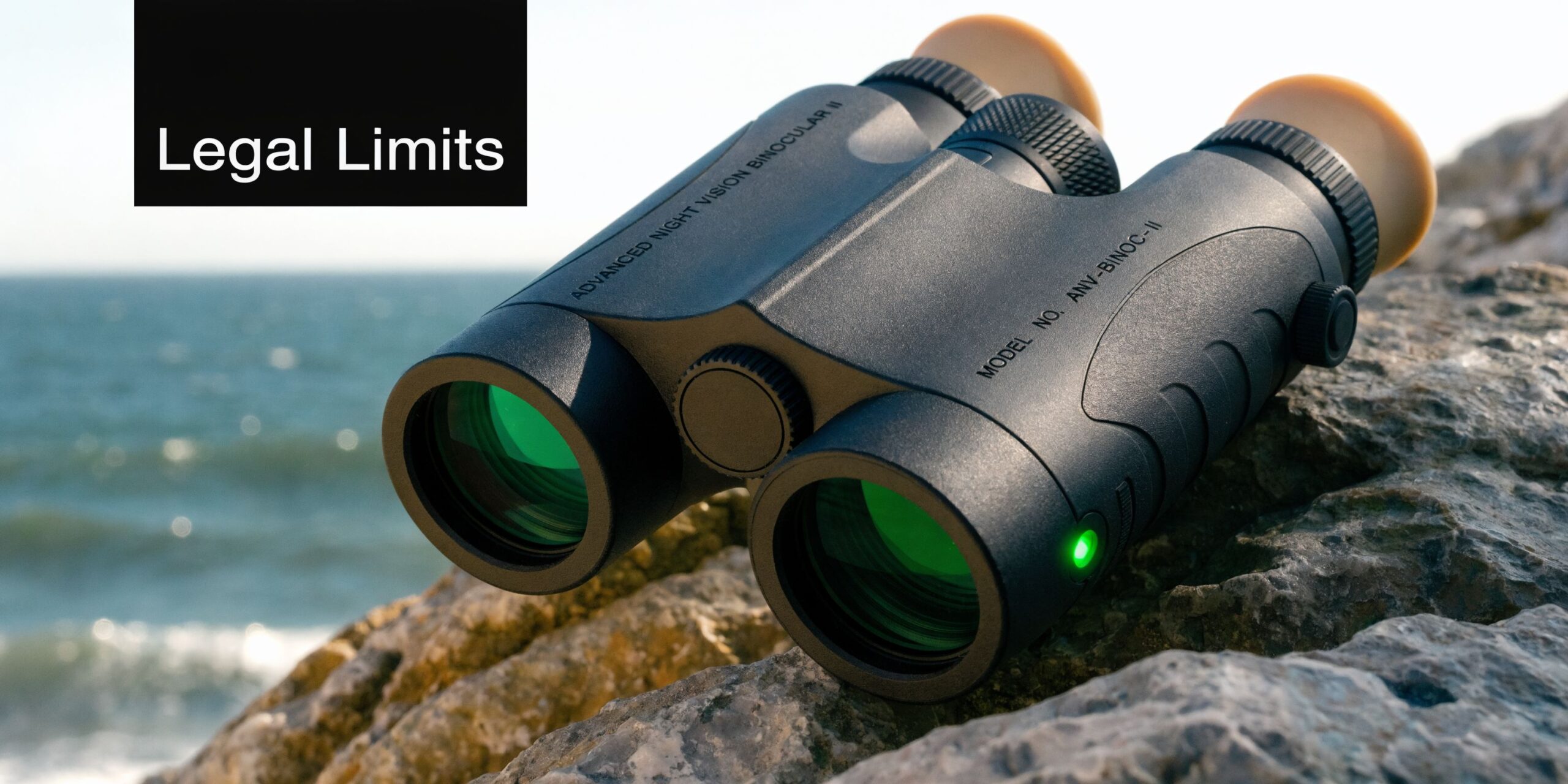
For professional-grade night vision, especially higher-end analog systems, the legal environment matters. Digital Camera World’s overview of night vision goggles and restrictions notes that U.S. ITAR regulations classify Generation 3 and higher night vision devices as defense articles, strictly controlling their export and access.
That affects more than international sales. It affects who can receive, transport, access, or take possession of certain equipment. Serious buyers need to understand that top-tier Gen 3 isn’t just another consumer electronics category.
Why procurement source matters
If you buy from a questionable marketplace seller, you may get more than a bad tube or fake warranty. You may get documentation gaps, poor chain of custody, or a product listing that ignores the legal status of the equipment entirely.
Professional procurement should stay disciplined:
- Buy domestically through a legitimate dealer: Especially for controlled analog systems.
- Ask about restrictions before travel: Don’t assume a lawful domestic purchase is simple to transport internationally.
- Clarify who will have access: Agencies, contractors, and teams should account for access control.
Digital and thermal are not a free pass
Digital and thermal devices are often easier to acquire than restricted Gen 3 systems, but “easier” doesn’t mean consequence-free. Buyers still need to understand local rules, travel implications, and how added features can affect use in certain jurisdictions or organizational policies.
Operationally, the legal side also intersects with field discipline. A unit that records, transmits, or uses supplemental emitters may create policy issues even when purchase itself is straightforward. For agencies and contractors, procurement should include legal review, not just technical review.
Compliance belongs in the buying decision from the first conversation. It’s not something to sort out after the optic arrives.
Building Your Complete Low-Light System
The optic is only one part of the answer. The rest is how you support it, carry it, maintain it, and recover from failure.
The binocular is not the whole system
A low-light setup starts to make sense when you stop viewing the optic as a standalone purchase.
A complete working package may include mounting solutions, power management, storage habits for recorded media, protective transport, and a plan for repair. If the device will be used on long shifts or extended hunts, ergonomics start to matter almost as much as raw image quality.
That’s especially true when users start integrating helmet setups, shrouds, mounts, counterweight solutions, and other equipment that affects comfort and stability over time.
Durability separates hobby gear from hard-use gear
Here, the gap between consumer digital products and professional systems becomes hard to ignore. The relevant issue isn’t only image quality. It’s survivability, repeatability, and support.
A review comparing digital night vision and military-grade Gen 3 systems highlights a stark performance and durability gap between consumer digital NV binoculars and military-grade Gen 3 systems, noting 20,000 to 50,000x light amplification and 10-year warranties on professional-grade gear.
That warranty piece matters because serious users don’t just buy capability. They buy continuity.
What to build around the optic
Some accessories are convenience items. Others directly affect usable performance.
- Mounting hardware: If the optic will be helmet-supported or integrated into a broader headborne setup, stable mounting matters as much as tube quality.
- Power planning: Rechargeable convenience is fine until you’re in the field longer than expected.
- Protective carry and storage: Dust, moisture, lens abuse, and impact kill performance long before electronics fully fail.
- Recording discipline: If your binoculars with night vision and camera will be used for evidence or review, media handling has to be consistent.
If you’re evaluating camera-capable night gear as part of a larger observation package, it helps to compare broader options in dedicated night vision cameras as well, especially when your mission is more about recording than helmet-borne movement.
Maintenance is part of readiness
Professional users should ask three questions before buying any low-light optic:
- Who repairs it
- How support is handled when performance drifts
- Whether diagnostics are practical and timely
Those questions matter because low-light gear often fails in gradual ways first. Controls loosen. Battery compartments become inconsistent. Seals age. Image quality drifts. A weak support path turns a good purchase into a dead asset.
Buy the support structure with the optic. If the repair path is unclear, the mission risk is clear.
How Superior Tactical Keeps You Mission-Ready
Serious low-light buying comes down to discipline. Match the technology to the mission. Read past marketing language. Treat legal restrictions as part of procurement, not as an afterthought. Build around reliability, not novelty.
That approach is exactly where a specialized dealer earns its place. Superior Tactical LLC focuses on the categories that matter to serious users, including Gen 3 night vision, thermal imaging, mounts, lasers, optics, and supporting accessories. The team works from a practical understanding of what holds up in the field and what usually disappoints once conditions get rough.
The difference shows up after the sale too. Strong support matters in this category because night vision and thermal gear aren’t impulse gadgets. They’re working tools. Superior Tactical backs Gen 3 night vision systems with a 10-year warranty, offers in-house repairs, and provides free diagnostics, which is the kind of support structure serious buyers should look for when uptime matters.
That matters for officers, hunters, contractors, and prepared civilians alike. You need gear that arrives quickly, performs as expected, and can be kept in service without guesswork. You also need straight answers when comparing analog night vision, digital systems, thermal, and camera-equipped binocular platforms.
A specialist should make the buying decision clearer. Not louder. That’s the standard serious buyers should hold.
If you’re ready to compare binoculars with night vision and camera, Gen 3 systems, thermal optics, or the mounts and accessories that complete a dependable low-light kit, talk to Superior Tactical LLC. Their team offers straightforward guidance, same-day shipping, trusted brands, and long-term support that helps keep your equipment mission-ready.
