
ACOG or EOTech The Ultimate Tactical Optic Choice
When you're trying to decide between a Trijicon ACOG and an EOTech, you’re not just picking an optic—you’re choosing a philosophy. This is one of the oldest debates in the firearms world for a good reason. These two optics are giants in the industry, but they were built to solve completely different problems on the battlefield and in the field.
The core of the decision is simple: Do you need to hit targets with precision at a distance, or do you need to get on target instantly up close? Your answer points you directly to one or the other.
Deciding on Your Tactical Optic

Let's break down what each optic really brings to the table. The choice isn't about which one is "better" overall, but which one is the right tool for your specific needs.
The Trijicon ACOG (Advanced Combat Optical Gunsight) is a legend for a reason. It’s a fixed-power prism scope known for its incredible durability. Its real strength is giving you the magnification needed to positively identify and engage targets at intermediate ranges, think 100 to 600 yards. This makes it an absolute workhorse for anyone operating in open country, from a patrol officer on a rural beat to a hunter or a designated marksman.
The EOTech, on the other hand, is a true holographic weapon sight (HWS) built for one thing: speed. It's a 1x (non-magnified) optic that projects a reticle onto a huge, forgiving viewing window. This design gives you an unmatched field of view and allows for lightning-fast target acquisition, especially when you're moving. It’s the undisputed king of close-quarters battle, making it the top pick for SWAT entry teams, home defense, or any scenario where threats appear suddenly and at arm's length.
Quick Decision Matrix ACOG vs EOTech at a Glance
Before we dive deep into the nuances, this table gives you a high-level look at where each optic shines. Think of this as your starting point to see which design philosophy aligns with your primary mission.
| Feature | Trijicon ACOG | EOTech Holographic Sight |
|---|---|---|
| Optical Technology | Fixed-Magnification Prism Scope | Holographic Weapon Sight (HWS) |
| Ideal Range | Mid-Range (100-600 yards) | Close-Quarters (0-100 yards) |
| Magnification | Fixed (e.g., 4x) | None (1x) |
| Battery Dependency | No (Fiber Optic & Tritium) | Yes (Typically CR123) |
| Primary Strength | Durability & Mid-Range Precision | Speed & Situational Awareness |
| Reticle | Etched BDC, Always On | Holographic, Requires Power |
This quick comparison makes the trade-offs clear. You're essentially choosing between the ACOG's fail-proof reliability and mid-range capability versus the EOTech's raw speed for dynamic, close-in work.
The ACOG is an "always-on," bomb-proof solution for engaging targets with precision at a distance. In contrast, the EOTech is purpose-built for speed, giving you the edge in chaotic environments where getting shots on target a split-second faster is what matters most.
Optical Technology and Real-World Performance
To get to the heart of the "ACOG or EOTech" question, you have to look past the housing and at the science inside. These optics aren't just different models; they represent two fundamentally different philosophies for aiming a rifle. Each one’s core technology creates distinct advantages that show up loud and clear out in the field.
The Trijicon ACOG is a prism scope. It ditches the complex lens systems of traditional scopes in favor of a single, compact prism to bend light and magnify your view. This design is the secret to the ACOG's legendary toughness and surprisingly small footprint for a magnified optic.
What truly sets it apart, though, is the brilliant dual-illumination system. That famous fiber optic tube snaking along the top soaks up ambient light to power the reticle by day, automatically adjusting brightness. When the sun goes down, an internal tritium lamp kicks in, providing a steady glow with zero reliance on batteries.
Because the reticle is physically etched into the prism glass, it's always there. Even if the illumination somehow failed entirely, you're left with a sharp black reticle. This makes the ACOG a truly bomb-proof, "always on" tool for mid-range shooting.
The ACOG Advantage: Distance and Clarity
The ACOG’s crystal-clear glass gives you a bright, crisp sight picture, which is critical for positive target identification at range. This optical quality works hand-in-glove with its most celebrated feature: the bullet drop compensating (BDC) reticle.
These reticles are precisely calibrated for specific ammunition types and barrel lengths, giving you built-in holdover points for different distances. Instead of fumbling with turrets under pressure, you simply line up the right hash mark to engage targets at 300, 400, or even 500 yards with surprising speed and accuracy.
For close-range encounters, ACOG shooters can use the Bindon Aiming Concept (BAC). With both eyes open, your brain merges the wide, unmagnified view from one eye with the brightly lit reticle from the other. It takes some practice to get the hang of, but it makes the ACOG usable up close—even if it’s not quite as fast as a true 1x sight.
The EOTech Advantage: Speed and Awareness
The EOTech is in a class of its own—it isn't a prism scope or a simple red dot. It’s a true Holographic Weapon Sight (HWS). It uses a sophisticated laser and mirror system to project a 3D holographic reticle that appears to float downrange on your target. This is the source of its dominance in close-quarters combat.
Since you're looking through a hologram instead of at a light reflected off glass, the reticle is genuinely parallax-free. It doesn't matter where your head is behind the optic; if you can see the reticle on the target, that's where the bullet is going.
The ACOG’s etched, battery-free reticle provides unparalleled reliability for precision at range. In contrast, the EOTech’s holographic reticle delivers unmatched speed and forgiveness for dynamic, close-quarters engagements where every split-second matters.
This forgiving eye box and massive window translate directly into raw speed. The procurement history tells the story: the USMC's adoption of over 115,000 ACOGs between 2005-2007 for standard rifleman kits shows its value for general infantry roles, a number that dwarfed EOTech's initial contracts at the time.
EOTech's signature reticle—a 68 MOA ring surrounding a 1 MOA dot—is engineered for the human eye to acquire instantly. The big ring is perfect for framing targets in fast, close-up work, while the tiny center dot provides a precise aiming point for careful shots. It's also a godsend for shooters with astigmatism, who often see a smeared or starburst reticle in traditional red dots; the holographic image almost always appears cleaner and sharper.
You can learn more about how to use this unique reticle for different shooting scenarios in our guide on mastering EOTech's dual functionality.
Durability and Reliability Under Fire
When you’re betting your life on a piece of gear, "tough" isn't just a feature—it's everything. Both the Trijicon ACOG and the EOTech were born from the demands of military and law enforcement, and their reputations for durability were hammered out over decades of hard use in the field.
The ACOG’s toughness is legendary, and it all comes down to its beautifully simple design. Trijicon builds these optics from a single piece of forged 7075-T6 aluminum, the same stuff your M4 receiver is made of. This creates a housing that’s ridiculously strong and resistant to impacts.
But the real secret to the ACOG's bomb-proof reputation is its complete lack of electronics. There are no batteries to die, no wires to chafe, and no circuits to fry. As long as the housing and the glass are intact, that etched reticle will be there when you need it. It’s a purely mechanical system, and that simplicity is its greatest strength.
The ACOG: A Legacy of Proven Toughness
The ACOG isn’t just tough in theory; it has the service record to prove it. After its introduction in 1987, it went on to be formally adopted by the U.S. military, earning designations like the Army’s M150 Rifle Combat Optic and the Marine Corps’ AN/PVQ-31.
This wasn't a casual adoption. After brutal trials in 2005, the USMC put their full faith in the optic, ordering a staggering 115,000 units. That’s a massive vote of confidence. Field reports confirmed the decision, showing the ACOG maintained zero retention rates well over 99% even after being banged around in combat. Its military adoption and performance metrics are well-documented and speak for themselves.
Because of this history, many seasoned shooters still see the ACOG as the absolute gold standard for a rugged, magnified combat optic. It just works.
The EOTech: A Rebirth of Resilience
The EOTech’s journey to becoming a top-tier durable optic was a bit rockier. Early on, the company ran into a major, well-documented issue with thermal drift, where significant temperature changes could cause the point of impact to shift. This led to a huge recall and forced the company to take a hard look at its engineering.
To their credit, they didn't just patch the problem—they owned it and completely re-engineered their sights from the ground up. EOTech was transparent about the failures and implemented stringent new manufacturing processes and internal components to fix the thermal drift issue for good.
Today's EOTech sights are a different breed entirely. They're now built to pass demanding military standards like MIL-STD-810G, which involves a gauntlet of tests for everything from drops and shocks to extreme temperatures and water immersion. The result is a holographic sight that has earned back its trust and is now a go-to for elite SOF units around the world.
The ACOG's durability is born from its elegant mechanical simplicity. The modern EOTech’s resilience comes from sophisticated engineering specifically designed to make an electronic sight nearly indestructible.
So, how does this shake out in the real world?
- ACOG: Inherently tough thanks to its battery-free, forged design. Its main point of failure would be a direct, catastrophic impact that physically breaks the housing or the internal prism.
- EOTech: Its toughness is engineered in. While it's an electronic sight, its beefy protective hood and shock-isolated internals are designed to absorb incredible abuse, making it one of the most resilient red dots available.
Ultimately, both of these optics can take a beating and keep on running. Your choice really hinges on your philosophy: do you prefer the guaranteed, fail-safe nature of the ACOG’s battery-free design, or do you trust the engineered ruggedness of a modern EOTech that has more than proven its mettle?
Matching the Optic to Your Mission
All the technical specs in the world don't mean a thing until you apply them to your reality. This is where the rubber meets the road. Choosing between an ACOG and an EOTech boils down to one simple question: what is my most likely engagement? The "best" optic is just the right tool for the job you need to do, so thinking hard about your environment, typical target distances, and the speed you'll need is the most important part of this decision.
This simple decision tree gets right to the heart of the matter: are you prioritizing up-close speed or mid-range precision?
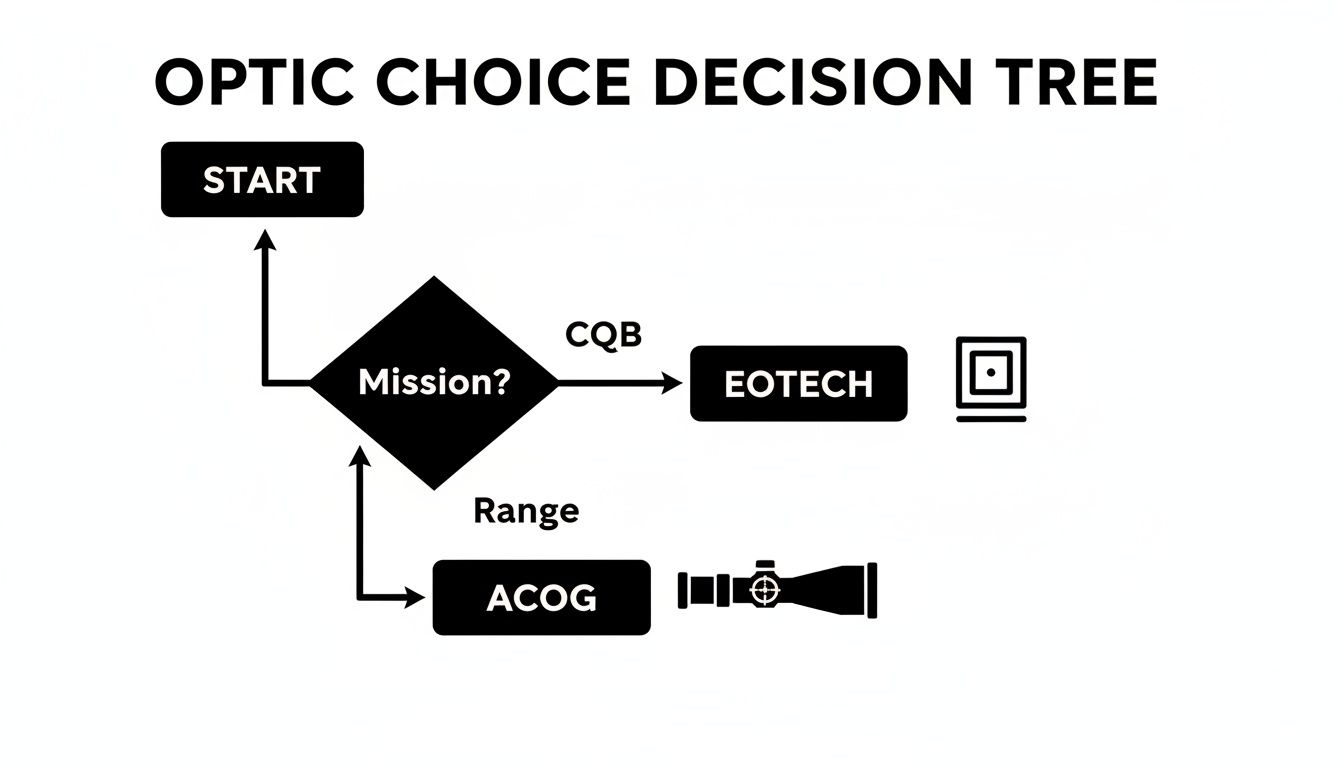
As you can see, it's a fundamental trade-off. Your choice hinges on whether your primary mission is lightning-fast, close-in target acquisition (CQB) or if you need to positively identify and engage threats at a distance (Range).
Law Enforcement Scenarios
For cops, the choice between these two optics is almost always defined by their specific assignment and the area they patrol.
Patrol Officer (Rural/Suburban): An officer covering wide-open country needs to see what's happening from a distance. An ACOG's fixed 4x magnification is a massive force multiplier here. It lets you safely assess a situation from cover, read a license plate, or make a precise shot if the worst happens. Plus, its always-on, battery-free illumination means it's ready to go even if the rifle has been sitting in a patrol car rack for weeks.
SWAT Entry Team Member: When you're the first one through the door, speed is everything. The EOTech, with its giant, forgiving window and iconic "speed ring" reticle, was practically born for the chaos of a dynamic entry. An operator can keep both eyes open, maintaining total situational awareness and snapping onto targets instantly without having to worry about perfect head alignment.
An ACOG gives a patrol officer the ability to control a scene from a distance, while an EOTech gives a SWAT operator the speed to dominate a room up close. Your role dictates your tool.
Hunting Applications
Hunters run into the same exact dilemma, but the variables are terrain and game. Picking the right optic can be the difference between a clean, ethical harvest and going home empty-handed.
Open-Country Deer Hunting: If you're chasing mule deer or pronghorn across the plains of Wyoming, your shots can easily push out to several hundred yards. The ACOG, with its built-in magnification and Bullet Drop Compensating (BDC) reticle, really shines here. It gives you the confidence to make an ethical, one-shot kill at those longer ranges.
Dense-Brush Hog Hunting: On the flip side, hunting hogs in the thickets of Texas or Florida is a fast, close, and messy business. Hogs pop up without warning and move fast. An EOTech's true 1x perspective and huge field of view are perfect for this, letting you get the rifle up and on target in a split second for reactive shots. If you're getting your rifle set up for this, our guide on mounting an EOTech will get you squared away.
Civilian and Security Use Cases
For civilians focused on self-defense or those in private security, the mission can change daily. That means flexibility is king.
Imagine a private security contractor in a mixed urban setting. One day they might be on a static perimeter post, and the next they could be running a close protection detail. This is where an EOTech paired with a flip-to-side magnifier, like the G33, is the clear winner.
With the magnifier flipped out of the way, you have a true 1x holographic sight for any close-quarters work. If a threat appears at distance, you can slam that magnifier into place in less than a second. Now you've got the magnification to ID and engage targets hundreds of yards out. It's this modularity that makes the EOTech/magnifier combo so dominant in unpredictable scenarios.
Expanding Capabilities with Magnifiers and Night Vision
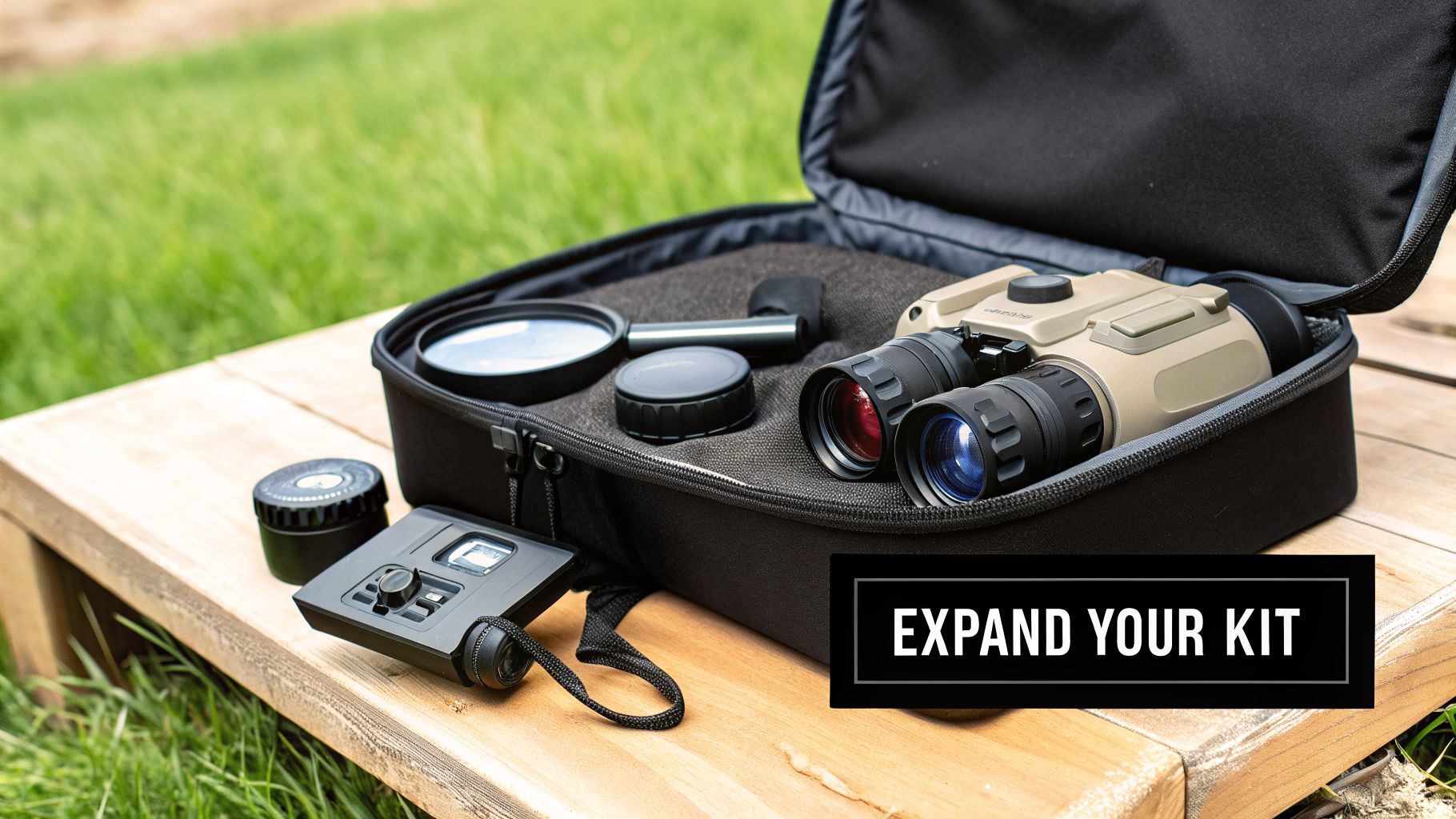
A modern rifle is far more than just the gun itself; it’s a complete system. An optic is a major part of that, but the real story often unfolds when you start adding mission-critical accessories like magnifiers and night vision. This is where the core design philosophies of the ACOG and EOTech really show their colors, forcing you to think about your rifle as a total package.
The choice between an ACOG or EOTech sharpens considerably once you factor in these force multipliers. They don't just add capability—they expose the inherent strengths and trade-offs of each platform.
EOTech Versatility with Magnifiers and NV
The EOTech holographic sight was practically born for a modular setup. Its native 1x view is unmatched for close-quarters speed, but its true genius is revealed when paired with a flip-to-side magnifier. This combination creates one of the most adaptable rifle setups you can build.
Slap a magnifier like the EOTech G33 or G45 behind the HWS, and you can snap between 1x and 3x (or 5x) magnification in less than a second. It's the "best of both worlds" realized: the reflexive speed of a red dot for navigating tight spaces and the precision of a magnified scope for identifying and engaging threats hundreds of yards out. The evolution from the older G23 to the modern G33 showcases a clear refinement of this concept, which you can explore in our deep dive on EOTech magnifiers.
This modularity is a game-changer for low-light operations. EOTech produces specific night vision (NV) compatible models with a dedicated setting that dims the reticle to a pinpoint. This crucial feature prevents the reticle from "blooming" into a blinding glare that would otherwise wash out the image seen through an NV device like a PVS-14.
An EOTech paired with a magnifier offers incredible flexibility, allowing a shooter to seamlessly shift from CQB to mid-range work. Its dedicated night vision setting makes it a premier choice for professionals operating in low-light environments.
EOTech’s path to becoming a go-to for professionals wasn't always smooth. The company faced a major lawsuit in 2016 over performance issues, but what followed was a remarkable comeback. They re-engineered their optics from the ground up, with a heavy focus on specialized capabilities like thermal and NV integration. Today, their optics are trusted by an estimated 70% of U.S. law enforcement, and sales surged 45% in key markets after the fixes were made—a powerful testament to their resilience.
The ACOG Hybrid Solution
As a fixed-magnification scope, the ACOG requires a totally different approach to achieve similar versatility. You can't just "turn off" its magnification, so adding another magnifier behind it is out of the question. The established solution is to mount a micro red dot sight (MRDS) directly on top of it.
By piggybacking a small optic like a Trijicon RMR or a Holosun 507c, you create a hybrid system with two distinct aiming solutions:
- ACOG (4x): Your primary optic for mid-range engagements where positive target identification and precision are critical.
- Micro Red Dot (1x): Your backup optic for close-quarters threats, accessed by simply raising your head slightly to find the dot.
While effective, this setup has a learning curve. The red dot sits high above the barrel, creating a significant height-over-bore offset. You have to train extensively to master this holdover for accurate shots up close.
When it comes to night vision, the ACOG's performance gets a bit more complicated. While its tritium-illuminated reticle is technically NV-compatible, trying to use a monocular behind it is awkward and results in a very unforgiving eye box. The more practical—but far more expensive—solution is to run a clip-on night vision device (CNVD) in front of the ACOG. This preserves your zero but adds significant weight and cost to your rifle.
ACOG vs. EOTech: Answering the Tough Questions
When you're weighing an ACOG against an EOTech, the spec sheets only tell part of the story. It’s the small, practical details that really make the difference out in the field. Let's break down the common questions that pop up when shooters are trying to make that final call.
These aren't just minor points; they get to the heart of what it’s like to actually run one of these optics. Understanding these real-world differences is what separates a good choice from the right choice for you.
How Does Eye Relief Differ Between ACOG and EOTech?
Eye relief is a huge deal, and it's one of the clearest distinctions between these two optics. It's the distance you can hold your eye from the scope and still see a full, clear picture.
The EOTech has unlimited eye relief. That’s a massive advantage in any dynamic shooting scenario. It means you can get on target fast, even from awkward positions or while on the move, without worrying about a perfect cheek weld. It's incredibly forgiving.
On the other hand, the Trijicon ACOG has a notoriously short and specific eye relief, usually just 1.5 to 3 inches. This demands disciplined training. You have to build the muscle memory to get your head in the exact same spot every single time. It rewards consistency, but there's no room for error.
Can You Use an ACOG for Close Quarters?
You absolutely can, but it’s a learned skill, not an intuitive one. The technique is called the Bindon Aiming Concept (BAC), where you shoot with both eyes open. Your non-dominant eye tracks the target in real-time, while your dominant eye sees the illuminated reticle. Your brain then merges the two images, superimposing the reticle over your target.
While the Bindon Aiming Concept makes an ACOG usable up close, it’s a workaround. It’s never going to be as fast or as natural as a true 1x optic like an EOTech, which was designed from the ground up for speed in close-quarters battle.
Mastering BAC takes practice, and even then, it can't quite match the raw speed and seamless situational awareness you get from an EOTech's big, open window. If your primary mission is CQB, the EOTech is the clear winner.
Which Optic Is Better for Astigmatism?
This is a critical question for a lot of shooters, and the good news is that both optics are fantastic choices for people with astigmatism, just for different reasons.
- ACOG: Because the reticle is physically etched into the prism glass, it can't "bloom" or "starburst." You're looking at a physical marking, not a projected light, so it will always appear perfectly sharp and defined, no matter how bad your astigmatism is.
- EOTech: Its holographic reticle is created by a laser, which appears as a cloud of thousands of tiny points. For many users with astigmatism, this holographic projection looks significantly cleaner and less distorted than the simple LED emitter found in a standard red dot sight.
Ultimately, if you have astigmatism, your choice between an ACOG or EOTech will come down to your personal preference for a perfectly crisp etched reticle versus a very clean, usable holographic one.
Whether you’re setting up a rifle for duty, the hunt, or home defense, your optic is one of the most critical decisions you'll make. At Superior Tactical LLC, we focus on getting you the right gear for your objective, specializing in top-tier optics and night vision from proven brands like EOTech. Our team is here to offer straightforward, experience-based advice.
Check out our handpicked collection of EOTech sights and magnifiers at https://superiortac.com and get your kit ready for what's next.
