
Where to Buy Night Vision Glasses: 2026 Guide
Most advice on where to buy night vision glasses points buyers in the wrong direction.
Search results are flooded with yellow-tinted driving glasses that cut glare a bit and look tactical in product photos. That is not the same thing as a real night vision device. If you want low-light capability for hunting, patrol work, navigation, observation, or preparedness, those products are a dead end.
The confusion is widespread. Existing content on this topic overwhelmingly pushes inexpensive night driving glasses, and 90% of top results ignore issues like export restrictions, ITAR compliance, and vendor warranty comparisons according to Zenni Optical’s night driving glasses category context referenced in the verified data. That is exactly why serious buyers end up frustrated. They search for “night vision glasses” and get glare-reduction eyewear instead of image-intensified optics.
If your goal is real nighttime performance, stop thinking in terms of fashion eyewear and start thinking in terms of night vision devices, image intensifier tubes, support, and legal purchase channels. If you are also comparing adjacent categories, it helps to understand how thermal vision glasses differ from analog night vision before spending money in the wrong lane.
The Truth About "Night Vision Glasses"
The term night vision glasses is mostly a retail shortcut. In consumer channels, it usually means yellow or amber driving glasses marketed for glare reduction. Those products may help some people with headlight glare, but they do not create a usable image in dark woods, unlit fields, or a blackout environment.
That distinction matters because buyers often expect movie-style low-light vision and get a tinted lens instead.
What most stores are selling
Cheap “night vision glasses” usually do one thing. They filter light.
That can slightly change contrast and reduce glare from headlights or reflective surfaces. It does not intensify faint ambient light. It does not give you true observation capability in very dark conditions. It does not replace a PVS-14, dual tubes, or any other genuine night vision setup.
What professionals use instead
Real night vision comes from a device with an image intensifier tube. That tube gathers available light, amplifies it, and presents a visible image through a phosphor screen. This is the category used by law enforcement, military users, hunters, landowners, and serious night shooters.
Buyer rule: If the product looks like ordinary glasses and the listing talks mostly about glare, driving comfort, lens tint, or fashion styling, it is not true night vision.
A lot of frustration in this market comes from buyers using the wrong search term. They ask where to buy night vision glasses, but what they need is one of these:
- A monocular for movement, scanning, and helmet mounting
- A binocular or dual-tube goggle for more natural depth perception
- A digital or thermal device if their use case is detection rather than classic analog night vision
Why the language matters
The wrong category creates the wrong expectations. If a person needs to identify terrain, move under canopy, scan property lines, or work around structures at night, glare glasses are not “entry-level night vision.” They are just eyewear.
The smart move is to separate consumer driving aids from real low-light equipment before comparing sellers. That one step prevents most bad purchases.
Understanding What You Are Buying
A simple way to think about this is the difference between filtering light and amplifying light.
Sunglasses, including yellow night driving glasses, only change the light that already reaches your eyes. True night vision devices do something very different. They collect scarce ambient light and convert it into an image you can use.
Mass retail channels add to the confusion. Walmart and Amazon dominate the “night vision glasses” category with hundreds of SKUs of driving aids, and this consumer-grade market accounts for an estimated 60% of non-military night vision purchases globally according to Spektrum Glasses. That scale is why bad terminology persists.
How image intensification works
A real night vision device uses an image intensifier tube. In plain terms, the process works like this:
Ambient light enters the device.
Moonlight, starlight, or other available light reaches the tube.The tube converts light into electrons.
This is the first big step that separates real night vision from tinted eyewear.Those electrons are multiplied.
The device boosts a weak signal into something much more usable.The output becomes a visible image.
The user sees that image through a phosphor display, typically green or white.
That is why a true night vision unit can function in conditions where tinted driving glasses become useless.
What fake marketing usually sounds like
Listings for pseudo night vision products tend to repeat the same cues:
- “HD night vision glasses” with no mention of an image intensifier tube
- Driving-focused copy that talks about glare instead of observation
- Lifestyle photos instead of technical specifications
- No tube manufacturer listed
- No mention of phosphor, gain control, or generation
If a seller avoids the technical core of the device, there is usually a reason.
A practical comparison
| Product type | What it really does | Where it works | Where it fails |
|---|---|---|---|
| Yellow driving glasses | Filters glare and shifts contrast | Roads with oncoming headlights | Dark fields, tree cover, no-light environments |
| Digital low-light optic | Uses a sensor and screen | Some observation use cases | Often weaker in very dark conditions than analog NV |
| Analog night vision device | Intensifies available light | Navigation, observation, tactical movement | Still depends on some ambient light and proper setup |
Quick screen test: If the product page reads like eyewear retail and not like precision optics retail, move on.
What a serious buyer should expect to see
A legitimate night vision listing usually includes real hardware details. Not buzzwords. Not vague promises.
Look for items such as:
- Tube type
- Generation
- Phosphor color
- Housing
- Mounting compatibility
- Warranty terms
- Service or repair policy
That is the baseline. Without those details, you are not evaluating a night vision device. You are evaluating marketing.
Key Performance Metrics That Matter
Once you move past fake night vision glasses, the next problem appears. Many buyers look at spec sheets and still cannot tell what matters.
Start with the tube. The image intensifier tube determines most of the performance that matters in the field.
According to Hard Head Veterans, the core tube manufacturers are L-3, Harris, and Photonis. That same source notes that high-end Gen 3 MIL-SPEC tubes can reach a Figure of Merit of 2,376+, while Gen 2+ systems may be described by resolution such as 55-57 lp/mm, which reflects a major performance and price divide.
Generation matters, but it is not the whole story
Buyers often ask for “Gen 3” as if that alone settles the question. It does not.
Generation is useful as a broad category, but it does not replace reading the device details. Two units can both be called Gen 3 and still serve different users very differently depending on tube quality, housing, controls, and support.
A practical hierarchy looks like this:
Gen 2+
A possible fit for entry-level use, some observation, and buyers with a tighter budget. Expectations need to stay realistic.Gen 3
The category most serious tactical and professional buyers focus on. Better low-light capability, better signal quality, and stronger overall field performance.Digital night vision
Not the same as analog image intensification. It has uses, but it should not be confused with true analog NODs.
Figure of Merit and why people care
Figure of Merit, usually shortened to FOM, is one of the most important shorthand indicators of tube performance. When buyers compare premium systems, FOM often becomes a deciding factor because it helps reflect image quality and low-light capability.
Higher FOM is generally better. But do not reduce the whole purchase to one number.
A high-FOM tube inside the wrong housing, from the wrong seller, with weak support, can still become a bad purchase. Specs matter. So does the company standing behind them.
White phosphor and green phosphor
Most buyers will eventually choose between green phosphor and white phosphor.
Green remains familiar and proven. White phosphor has become popular because many users find it easier to interpret for detail and contrast over long sessions. That does not make green obsolete. It means personal preference and use case still matter.
A few practical notes:
- Green phosphor is familiar to many long-time users and still widely trusted.
- White phosphor often appeals to buyers who want a more modern viewing experience.
- Tube quality matters more than phosphor color alone.
Field of view and system style
You also need to think about how the device will be used.
Some buyers need a compact PVS-14 monocular. Others need dual tubes for more natural movement and better situational awareness. Panoramic systems exist for highly specific needs, but they are a different class of purchase.
Here are the trade-offs in plain language:
| Configuration | Good fit for | Trade-off |
|---|---|---|
| Monocular | Versatility, lower entry cost, simpler setup | Less natural depth perception |
| Dual-tube goggle | Movement, navigation, broader operational use | Higher cost and more setup considerations |
| Panoramic systems | Specialized professional use | Very expensive and not necessary for most buyers |
Practical advice: Ask what task the device must handle on its worst night, not its easiest night. That answer usually narrows the field fast.
Red flags in spec sheets
A bad listing often reveals itself quickly. Watch for these:
- No tube manufacturer disclosed
- No FOM or meaningful tube data on a premium-priced unit
- Only lifestyle claims and no operational specs
- Confusion between digital, thermal, and analog night vision
- No mention of warranty, repair path, or seller support
Good sellers know serious buyers read specs carefully. Weak sellers try to avoid that moment.
Legitimate Channels for Purchasing Night Vision
When buyers ask where to buy night vision glasses, they usually need a more precise answer. Not just a store name, but a purchase channel that matches their budget, risk tolerance, and support needs.
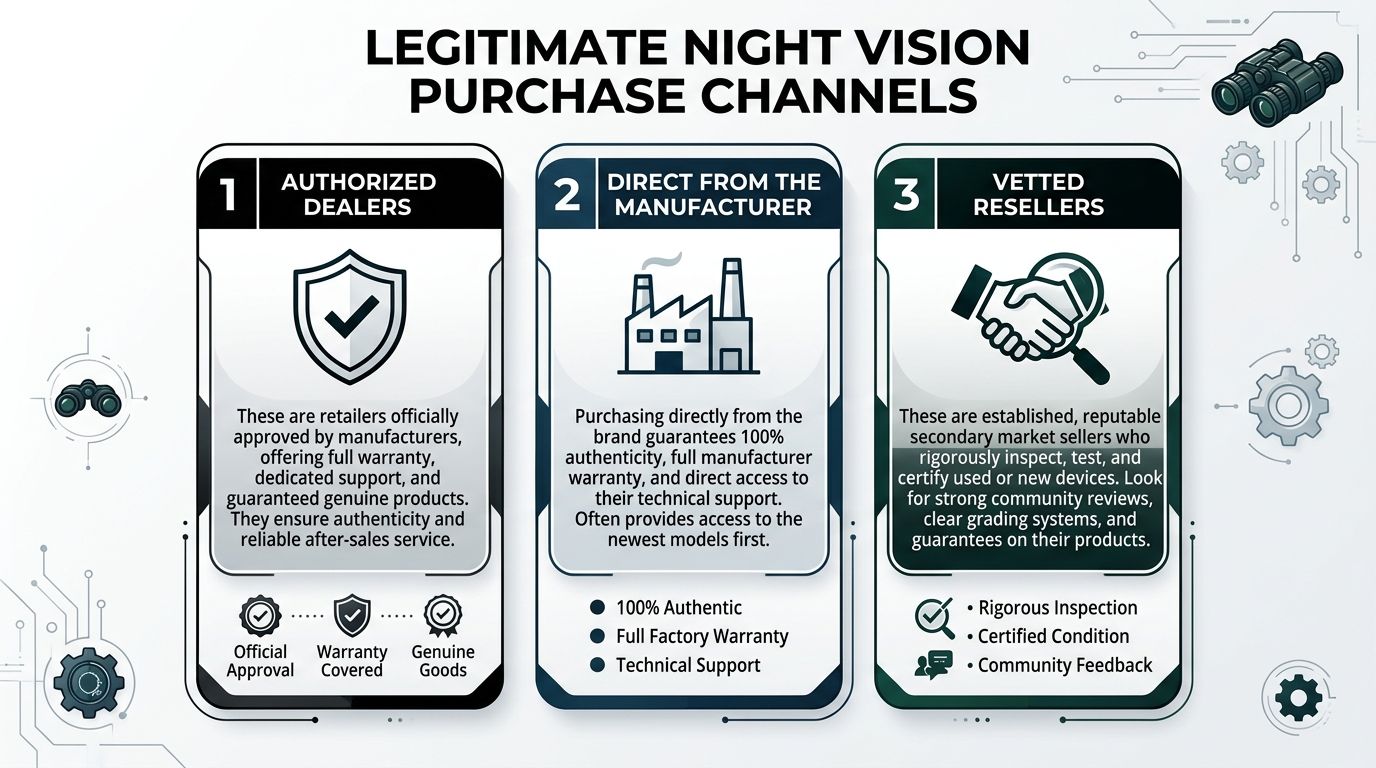
There are three legitimate paths worth considering.
If you want to compare current inventory across a specialist retailer category, this overview of night vision equipment for sale online is the kind of browsing environment that makes more sense than general marketplaces.
Authorized dealers
Authorized dealers are usually the safest default for most buyers.
They tend to offer manufacturer-backed products, better technical guidance, and clearer support after the sale. The purchase is not just about getting a box shipped to your door. It is about getting the right tube, the right housing, and a real service path if something goes wrong.
Best fit for:
- Buyers purchasing their first serious unit
- Agencies and departments
- Hunters and landowners who need dependable support
- Anyone spending enough money that warranty terms matter
The downside is simple. You may pay more than you would in the second-hand market.
Direct from the manufacturer
Buying direct can make sense when the manufacturer offers the exact model you want and a straightforward warranty path.
That route can be attractive for experienced buyers who already know the platform they want and do not need much hand-holding. It can also help if you want the cleanest possible chain of custody.
The limitation is selection. Manufacturers usually focus on their own catalog, not on comparing multiple housings, tube options, or adjacent accessories across brands.
Vetted resellers and secondary sellers
This path can work well, but only if the reseller is vetted.
Used and resale night vision can be a smart buy when the device has been inspected, tested, and represented accurately. It can also be a bad buy if the tube has issues, the seller does not understand specs, or there is no protection after the sale.
A careful buyer should ask for:
- Clear tube information
- Photos through the tube
- Return terms
- Serial or provenance information where appropriate
- A realistic explanation of blemishes or wear
Comparison at a glance
| Channel | Main upside | Main risk |
|---|---|---|
| Authorized dealer | Strong support and authenticity | Higher upfront cost |
| Direct manufacturer | Clean warranty path | Narrower selection |
| Vetted reseller | Potential value | More buyer diligence required |
What to avoid
There are also channels that serious buyers should treat cautiously or avoid outright.
General marketplaces with vague listings
Fine for commodity gear. Risky for high-value night vision.International sellers with unclear compliance language
Legal risk and authenticity risk can stack quickly.Listings that bury the technical details
If the seller will not tell you what is inside the unit, that is your answer.
The right buying channel should reduce uncertainty. If the channel adds confusion, keep shopping.
Why Superior Tactical Is a Reliable Choice
A serious night vision buyer is not only buying a device. The buyer is choosing who will answer the phone, who will diagnose issues, and who will still be useful after the honeymoon period ends.
That is where specialist retailers separate themselves from anonymous storefronts.

The broader market supports that shift toward specialist buying. The U.S. night vision market was valued at about $212 million in 2020 and projected to grow at an 8.5% CAGR through 2027, and within that market, retailers such as Superior Tactical stand out by offering 10-year warranties and in-house repairs for long-term ownership support according to ATN Corp.
What matters in real use
A night vision seller becomes valuable when the buyer needs more than a checkout page.
The practical advantages are straightforward:
A curated catalog
Serious buyers benefit when a retailer focuses on night vision, thermal, housings, mounts, and related accessories instead of mixing them into a giant generic catalog.Repair path
In-house diagnostics and repairs matter because downtime matters. That is true for officers, contractors, landowners, and hunters alike.Long warranty coverage
A 10-year warranty changes the risk profile of an expensive purchase.Domestic shipping and support
Faster fulfillment and easier communication reduce friction when timing matters.
Why that changes the buying decision
A cheap listing can look attractive until the buyer needs service. Then the full purchase cost shows up.
Specialized support helps with issues such as:
- matching a monocular versus dual-tube setup to actual use
- understanding accessory compatibility
- sorting through repairs instead of replacing the entire unit
- avoiding mismatched expectations on digital versus analog systems
Field reality: The seller that helps before the sale often saves more money after the sale.
Who benefits most from this type of retailer
This kind of support is especially useful for buyers who cannot afford guesswork:
| Buyer type | Why support matters |
|---|---|
| Law enforcement | Equipment downtime affects operations |
| Hunters | Wrong setup means poor field performance |
| Preparedness buyers | Need a dependable, maintainable system |
| Dealers and volume buyers | Need consistency, availability, and service |
A strong retailer does not just move inventory. It reduces avoidable mistakes.
That is the part many “where to buy night vision glasses” articles miss. They focus on the click. Serious buyers should focus on the relationship behind the click.
Your Final Pre-Purchase Checklist
Before you buy, strip the decision down to a few hard questions.
If the product is really just tinted eyewear, it does not belong in the same conversation as analog night vision. Once you have that distinction clear, the rest of the process gets simpler.
Ask these questions before checkout
Is this a true image intensifier device?
If not, you are shopping in the wrong category.Do I understand the core specs?
Generation, tube data, phosphor type, housing, and intended use should all make sense.Who is selling it, and what happens after the sale?
Support matters because high-end Gen 3 systems can range from $12,399 to over $40,000, and established vendors differentiate themselves with 10-year warranties and in-house repairs according to Steele Industries.Is the seller built for this category?
A true specialist should be able to answer detailed questions without dodging them.
The short version
Night vision is not a novelty purchase. It is a capability purchase.
That is why the smartest buyers put equal weight on the device and the seller. If you need help narrowing the field, this guide on how to choose the right night vision device for your needs is a useful next step.
Frequently Asked Questions About Buying Night Vision
Legal confusion causes as many bad purchases as bad specs.
That is especially true when buyers search for where to buy night vision glasses, land on consumer eyewear pages, then jump into overseas listings for “real” devices without understanding the rules around regulated equipment.
According to TNVC’s night vision category context in the verified data, recent 2025 ITAR amendments changed requirements for civilian Gen 3 purchases in some states, and DHS reports from 2025 show that 25% of intercepted gray-market NVG imports were mislabeled. That alone should make buyers slow down before ordering from unvetted foreign sellers.
Is it legal to own real night vision as a civilian
In many cases, yes. Civilian ownership of night vision devices is possible in the U.S.
The problem is not simple ownership in the abstract. The problem is that specific products, state-level requirements, export restrictions, and buyer status can change what is allowed or how the purchase must be handled. A serious buyer should confirm the current rules with the seller before purchasing, especially for Gen 3 systems.
Can I buy from an overseas seller if the price looks better
That is where many buyers get into trouble.
A low price from an unvetted international seller can bring several risks at once:
- you may receive a mislabeled or misrepresented unit
- you may not have a realistic warranty path
- the item may create compliance issues
- returning or servicing the device may be difficult or impossible
That does not mean every foreign listing is fraudulent. It means the buyer carries much more risk.
Practical safeguard: If the seller cannot clearly explain legality, origin, and warranty support in writing, do not send money.
Are DIY build kits legal
DIY builds sit in a category where buyers need to be careful.
The hardware side of a build may be straightforward, but legality can depend on what is being purchased, how the tube is sourced, and whether the parts or finished system trigger regulated handling requirements. If you are considering a build, ask direct questions about compliance before buying components. Do not assume that “parts” automatically means “no restrictions.”
Can I travel internationally with night vision
International travel is one of the fastest ways to turn a legitimate purchase into a legal problem.
Real night vision devices can fall under export controls. That means a unit that is legal to own domestically may still be restricted from international shipment or travel without proper authorization. Buyers who expect to travel with night vision should verify those rules before the trip, not at the airport and not after booking.
What should I ask a seller before buying
Keep it simple and direct.
Ask for:
- Exact device type and tube details
- Warranty length and who performs repairs
- Whether the product is subject to special restrictions
- Shipping limitations
- Return policy
- Whether the unit is new, used, or rebuilt
A good seller will answer clearly. A bad seller will pivot back to marketing language.
Are night driving glasses ever worth buying
They can be worth buying for glare reduction if that is all you want.
They are not worth buying if your goal is true night observation, navigation, hunting, patrol work, or any task that requires genuine low-light capability. Those are different product categories with different performance ceilings.
If you want a U.S.-based source for real night vision gear, thermal optics, parts, and support after the sale, take a look at Superior Tactical LLC. The catalog is built around night vision equipment rather than consumer glare glasses, and the company offers nationwide shipping, in-house repairs, and long-term warranty support on Gen 3 systems.
