
Your 2026 Guide to Thermal Camera Hunting
Imagine peering into what looks like total, absolute darkness, only to see the world come alive in a vibrant display of heat. That’s the core of thermal camera hunting. This technology gives you the ability to see an animal’s heat signature, making it stand out as a clear, often glowing shape against a cooler background. It’s an incredible advantage, especially when standard optics are completely useless.
Seeing Heat Instead of Light
Your eyes see reflected light. A thermal optic sees emitted heat. Think of it as a sixth sense that allows you to perceive a world of infrared energy that’s completely invisible to us. Every single thing out there—trees, rocks, dirt, and most importantly, animals—is constantly giving off heat. A thermal camera captures this invisible energy and turns it into a picture you can see.
This simple shift from seeing light to seeing heat completely changes the playbook for a hunter. It lets you cut right through obstacles that would normally end a hunt.
- Complete Darkness: Unlike traditional night vision that needs some ambient light to work, thermal functions in zero-light environments. A moonless, overcast night in the deep woods is no problem. It sees heat, not light.
- Camouflage and Concealment: An animal's perfectly evolved camouflage means nothing to a thermal imager. That buck you'd walk right past in a thicket during the day becomes a bright, unmistakable object on a thermal display.
- Poor Weather Conditions: Heavy fog, smoke, and even pouring rain can make a traditional scope worthless. Thermal imaging, on the other hand, can often punch through these conditions to detect the strong heat signature of an animal on the other side.
The Tactical Advantage in the Field
Using a thermal isn't just about spotting game in the dark; it's about gaining a level of situational awareness that helps you make smarter, safer, and more ethical decisions. The amount of information you can gather is simply on another level. If you want to get into the nitty-gritty of how the technology works, check out our detailed guide that asks: what is thermal vision?
This technology has proven to be a game-changer for managing nocturnal predators and invasive species.
For animals like coyotes and feral hogs that are most active well after sunset, thermal imaging is the great equalizer. It gives hunters the ability to effectively spot, identify, and track these animals, which is a massive help for wildlife and land management efforts.
This isn't just talk. The real-world data shows a dramatic leap in performance. Studies have found that thermal optics can increase your detection efficiency by 65-78% compared to traditional methods in low light. The difference in range is even more stark. In dense brush where a standard scope might fail you at 30-80 meters, a good thermal can help you detect targets out to 500-900 meters or more.
That’s a massive increase in your effective range, and it’s a sentiment echoed by countless hunters in the field who report much higher success rates after investing in quality thermal gear. According to reports on sites like Pixfra.com, this ability to see what is physically hidden from your eyes provides an undeniable edge.
Thermal vs Traditional Hunting at a Glance
To put it in perspective, here’s a quick look at how thermal changes the approach in common hunting situations.
| Scenario | Traditional Optics | Thermal Imaging Advantage |
|---|---|---|
| Night Hunting | Requires moonlight/starlight (for NV) or spotlights (where legal). | Works in total darkness. Sees heat, not light. |
| Spotting in Fog | Vision is heavily obscured or completely blocked. | Can often see through fog, smoke, and rain. |
| Camouflaged Game | Relies on spotting movement, shape, or color contrast. | Camouflage is irrelevant; the animal's heat signature stands out. |
| Blood Trailing | Following a faint trail on the ground, often difficult at night. | A fresh blood trail and the downed animal will glow with heat. |
| Surveying Land | Time-consuming scan with binoculars, easy to miss bedded animals. | Quickly scan large areas and instantly spot warm bodies. |
Ultimately, thermal imaging gives you more information, and in hunting, information leads to better, more successful outcomes.
When you first dive into the world of thermal optics, the spec sheet can feel overwhelming. It’s a wall of numbers and acronyms that looks more like a physics textbook than a hunting gear catalog. But here's the secret: you only need to truly understand a handful of them to make a smart buy.
Get these right, and you’ll have a unit that performs when that trophy animal finally steps out. We're going to cut through the noise and focus on the three specs that make or break a thermal optic in the field: sensor resolution, refresh rate, and NETD.
Sensor Resolution: The Key to Positive Identification
Think of sensor resolution just like the pixel count on your TV or phone. More pixels mean a sharper, clearer picture. For a hunter, that clarity is everything. It’s the difference between seeing a vague heat signature and confidently identifying your target.
A higher resolution, like 640×480 pixels, gives you a crisp, detailed image. You can actually see the shape of an animal, which is critical for telling a big coyote from a farmer's calf hundreds of yards away. A lower resolution, such as 384×288, is still great for spotting heat, but the image will get grainy faster, especially when you start using digital zoom.
For a hunter, higher resolution means better identification. It's the difference between seeing a "hot blob" and seeing a "mature boar." This clarity is essential for making safe and ethical shot decisions.
This is the core advantage of thermal technology. You're moving from a world of limited information in the dark to one of complete strategic awareness.
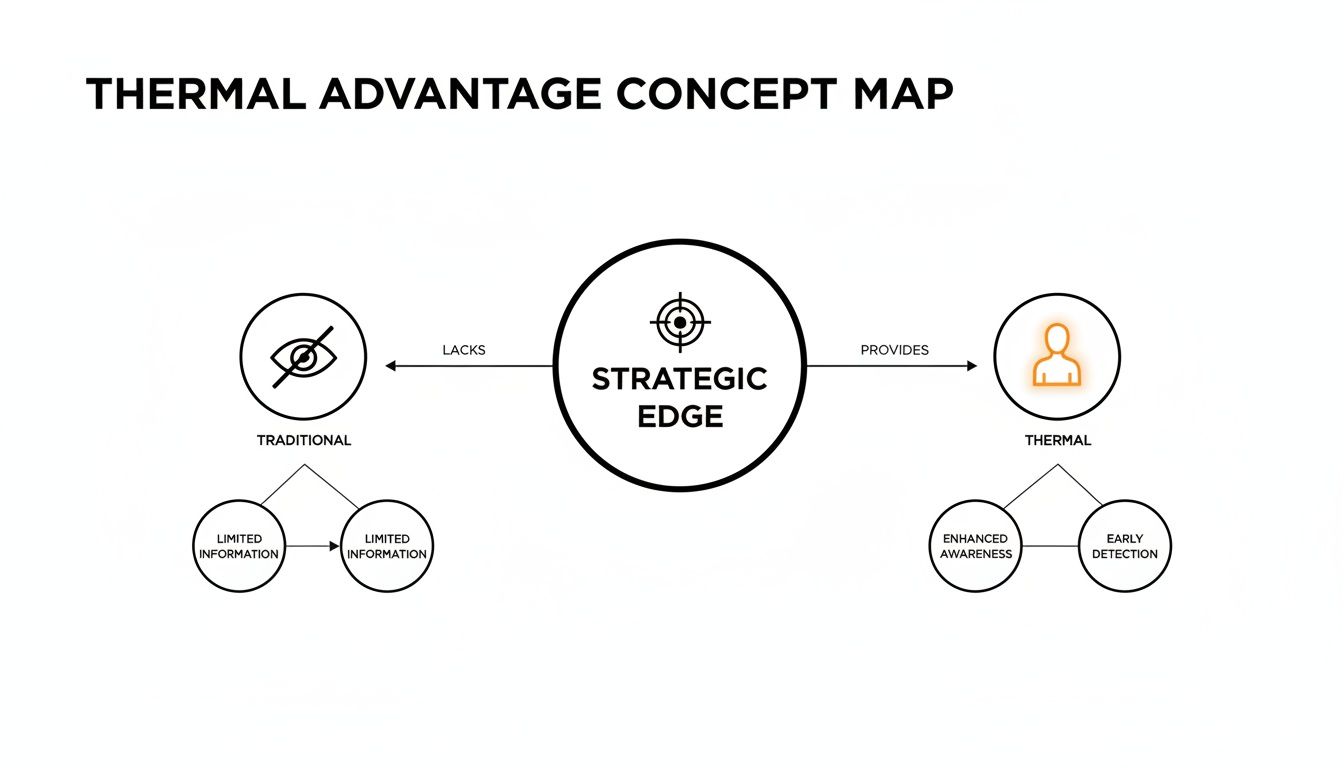
As the visual shows, you gain the upper hand with early detection and a much clearer picture of your surroundings, something the naked eye simply can't provide.
Refresh Rate: How Smooth is the Action?
The refresh rate, measured in Hertz (Hz), tells you how many times per second the image updates. The best way to think about it is comparing a smooth, fluid video game to a choppy, stuttering one. That's the difference a high refresh rate makes.
- 60Hz: This is the gold standard for hunting. It gives you a buttery-smooth image, making it easy to track a running hog or a quick-moving coyote without any lag.
- 30Hz or Lower: When you pan a scope with a lower refresh rate, you'll notice a distinct choppiness. It’s fine for scanning a static field, but it makes following a moving animal much more challenging.
If you’re hunting predators or hogs—animals that rarely stand still—a 60Hz refresh rate is a game-changer. It’s an absolute must-have if you plan to mount your thermal on a vehicle for scanning, as it keeps the image clear while you're in motion. For those who mostly use a handheld for spotting, you can get a better sense of the options by checking out our guide to the best thermal monocular for hunting.
NETD: Seeing Clearly in Tough Conditions
Noise Equivalent Temperature Difference (NETD) sounds complicated, but the idea behind it is simple. Think of it as the thermal's ability to "hear" tiny whispers of heat. It measures how sensitive the sensor is to minute temperature variations.
NETD is measured in millikelvins (mK), and with this spec, the lower the number, the better. A low NETD number (like <25 mK) means your optic is incredibly sensitive.
This sensitivity really shines on those miserable, humid nights with fog or rain. In those conditions, the temperature difference between an animal and the wet ground is minimal. A thermal with a low NETD will cut right through the haze and give you a sharp, high-contrast image. One with a higher, less sensitive NETD will struggle, producing a washed-out, blurry picture.
Having a top-tier NETD rating gives you a serious edge when the weather turns sour, ensuring you can still hunt effectively when others are forced to pack it in.
Detection, Recognition, and Identification Ranges
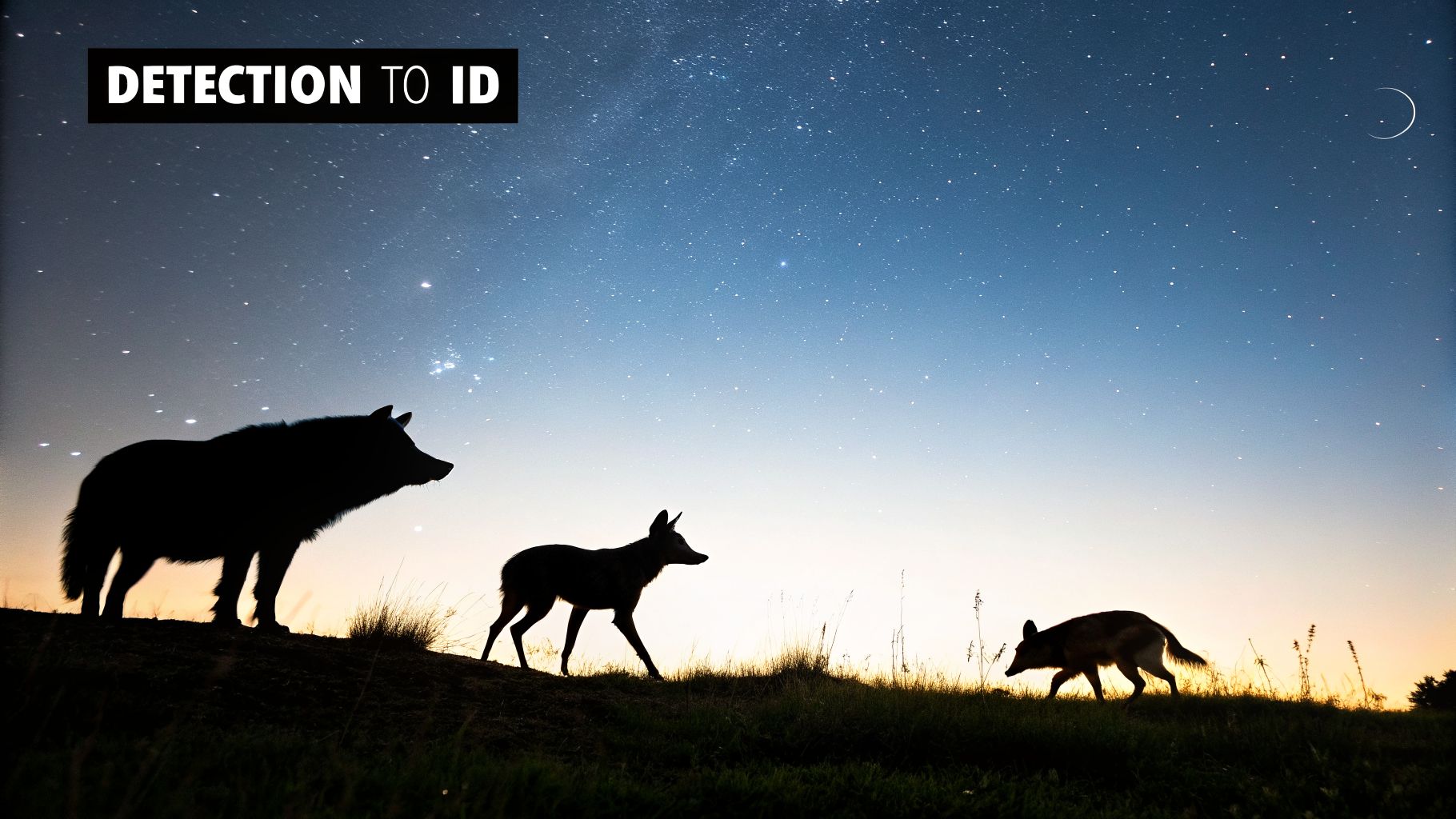
You’ve seen the impressive specs on the side of the box: "2000-yard detection range." It sounds incredible, but anyone who has spent serious time behind a thermal knows that number is just the beginning of the story. To really understand what your optic can do in the field, you need to get familiar with three little words: Detection, Recognition, and Identification (DRI).
These aren’t just marketing terms; they represent the entire process of sighting a target, from a faint glow on the horizon to a confirmed, ethical shot. Getting this wrong can mean a frustrating night of missed chances or, far worse, a mistake you can't take back.
Think of it this way: you’re driving down a dark country road. Way off in the distance, you see a pair of lights. That's detection. As they get closer, you can tell it's a truck, not a small car. That's recognition. A few moments later, it passes under a streetlight and you can clearly see it's a Ford F-150. That's identification.
From Hot Spot to Confirmed Target
That same exact progression happens in your thermal scope. Every step requires more pixels and more detail on your target, which means the effective range gets shorter and shorter as you move through the stages.
Detection: This is simply the farthest distance your scope can pick up a heat signature. On your screen, it might be nothing more than a few glowing white or black pixels—a "hot spot." You know something is out there, but you have no clue what.
Recognition: Now you're getting closer. That blob of pixels starts to take shape. You can tell it has four legs and the general body shape of an animal. You can recognize it's a potential game animal and not a person walking their dog.
Identification: This is the moment of truth for every hunter. You have a clear enough picture to positively identify the species. You can confidently say, "That's a mature wild boar," and distinguish it from a farm hog or a young buck you don't have a tag for.
For any ethical hunter, your absolute maximum shooting distance is your identification range, period. A responsible shot is only taken after you are 100% certain of your target.
Real-World Ranges and Environmental Factors
DRI ranges aren't set in stone. They change dramatically based on your gear and, most importantly, the weather. A high-end 640 sensor will give you a much clearer image at a distance than a 384 sensor, extending your ID range. And obviously, a big-bodied elk is a much easier thermal target to identify than a small coyote.
The environment is the great equalizer. Thick fog, high humidity, and driving rain will absolutely slash your thermal’s performance, as the water vapor in the air absorbs infrared radiation. A crisp, cold, and dry night is your best friend, creating high contrast and letting you see for miles. A warm, humid evening after a rainstorm? That’s the tough stuff.
Hunters using top-tier equipment in open country can see some amazing performance. It's not uncommon to detect large game at distances over 1,800 meters. Since thermals read heat, not light, they can punch through haze, light fog, and foliage in ways night vision never could. We've heard countless reports from hunters using their optics to cut through dense mist at 700 meters to clearly identify the sex of a deer—a critical capability for proper herd management. You can explore more stories from hunters who depend on this technology night after night.
Understanding DRI helps you hunt smarter. Don't get tempted by that "hot spot" you detected at 1,500 yards. Use it as a starting point. That initial detection is your cue to start a stalk, close the distance, and work your way toward that positive ID for a safe, clean, and ethical harvest.
Choosing Your Thermal Optic Setup
Once you’ve decided to get into thermal hunting, you'll hit your first major fork in the road. This isn't about which brand to pick, but a more fundamental choice about your system in the field. Are you going to run a dedicated thermal riflescope, a handheld thermal scanner, or a combination of both?
How you answer that question will shape everything from your safety rules to how successful you are on a hunt.
A dedicated thermal riflescope seems like the simplest route. You spot the heat and take the shot all through one optic. It’s a very direct, one-step process that feels fast.
But there’s a massive problem with that approach. To scan the terrain, you have to point your loaded rifle at everything you want to look at. Not only is that a cardinal sin of firearm safety, it's also exhausting. Swinging a heavy rifle around for hours is a quick way to wear out your arms before you even spot an animal.
The Handheld Scanner Advantage
This is exactly why a handheld thermal scanner, or monocular, is an absolute game-changer. These little units are light, compact, and built for one job: scanning your surroundings quickly and safely.
You can pop one in a jacket pocket and spend hours sweeping fields and treelines without ever having to lift your rifle. This lets you be far more thorough and discreet. More importantly, it allows you to detect and recognize a heat signature before you ever point a firearm in its direction. You can confirm you're looking at a coyote and not a calf, all while your rifle is pointed safely at the ground.
Only after you’ve made a positive ID with your scanner do you get behind your weapon, find the target in your main optic, and prepare for the shot. This two-step method is the bedrock of safe and effective thermal hunting.
The Hybrid Approach: The Hunter's Combo
For most experienced hunters, the solution isn't picking one or the other—it's using both. This setup, which we call the "hunter's combo," pairs a good handheld scanner with a dedicated riflescope. That scope could be thermal, digital night vision, or even your favorite traditional glass.
The combo is the professional standard for a reason. You get the best of both worlds: the lightweight, wide-view scanner for tireless spotting and the precise, magnified riflescope for an ethical shot.
This approach also lets you be smart with your money. You can get an effective, more affordable monocular to do the heavy lifting (scanning) and put the bigger investment into your riflescope, where accuracy really counts. Many hunters pair a thermal scanner with their high-end daytime scope, a perfectly viable setup for night hunting. If you're thinking about adding a thermal unit to your current scope, you can learn more about how a thermal attachment for a scope works in our detailed guide.
To make the choice even clearer, it helps to see a direct comparison of the two main options.
Thermal Riflescope vs. Handheld Scanner
Deciding between a dedicated scope and a handheld scanner comes down to understanding their specific jobs. The table below breaks down their primary roles and trade-offs.
| Feature | Thermal Riflescope | Handheld Scanner (Monocular) |
|---|---|---|
| Primary Use | Aiming and shooting targets. | Scanning and detecting heat signatures. |
| Safety | Requires pointing a rifle to scan terrain. | Allows safe scanning without aiming a weapon. |
| Field of View | Typically narrower, optimized for aiming. | Generally wider, better for covering large areas. |
| Fatigue | High; holding and pointing a rifle is tiring. | Low; lightweight and easy to hold for hours. |
| Best For | The "shooting" part of the hunt. | The "spotting" and "identifying" parts. |
| Ideal Strategy | Works best when paired with a separate scanner. | Essential for safe detection and situational awareness. |
Ultimately, while a thermal scope is what you shoot with, the handheld scanner is the tool that finds you the targets. Using them together is the safest and most effective way to hunt in the dark.
Mastering Your Gear in the Field
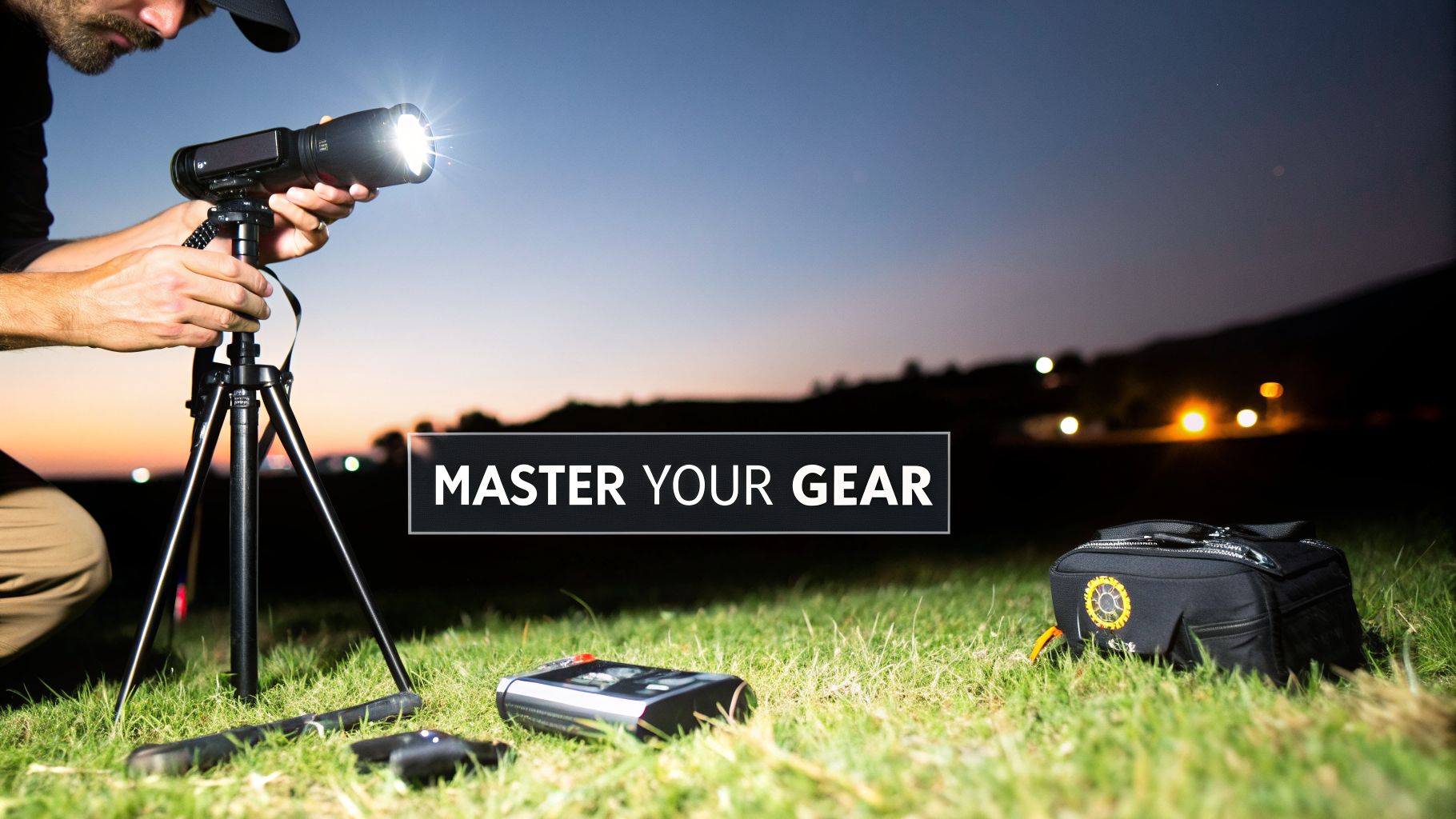
Having a top-tier thermal optic in your hands is one thing; knowing how to make it sing in the field is another entirely. This is where the spec sheet ends and your real skill as a hunter begins. It’s about making that piece of technology a true extension of your own senses.
First things first, you have to get your thermal riflescope zeroed. Forget what you know about punching holes in paper with a day scope. With thermal, you’re aiming at a heat signature, not a visual bullseye, so your target needs to be warm.
You can buy specialized thermal zeroing targets, but honestly, a simple hand warmer taped to a piece of cardboard works just as well. Many of the newer scopes also have a "one-shot zero" feature. You take a shot, then just move a cursor on the screen to where the bullet hit. It’s a huge time and ammo saver.
Choosing the Right Color Palette
Once you're dialed in, it's time to think about color palettes. This isn't just a cosmetic choice—the right palette gives you a tactical edge, and knowing when to switch is a game-changer.
White Hot: This is the go-to for a reason. It shows the warmest objects as bright white, which creates a stark, high-contrast image against most backgrounds. It’s perfect for sweeping a field to quickly spot any heat source.
Black Hot: This simply inverts the image, making heat signatures appear black. I, along with many other hunters, find that Black Hot is much easier on the eyes during long nights of scanning. It causes far less eye fatigue, which is critical when you’re pulling an all-nighter.
Color Palettes (Red Hot, Fusion, etc.): These palettes use vibrant colors to show fine temperature differences. A mode like "Red Hot" might show the scene in grayscale but paint the hottest object—your target—in a bright, impossible-to-miss red. This is incredibly effective for pulling an animal out from a confusing background, like rocks that are still warm from the day's sun.
The best advice? Play with them all. You'll quickly figure out which ones work best for your eyes and the specific country you're hunting.
The real power of thermal imaging is its ability to spot heat through concealment. Whether it's deer, hogs, or coyotes, their heat signatures make them visible in total darkness, even when hidden by tall grass or along brushy edges where they would otherwise be completely invisible.
Battery Life and Scanning Techniques
Nothing ends a hunt faster than a dead battery. It’s a rookie mistake. Most thermal units will give you 4-8 hours of run time, but that number can drop fast depending on the temperature and your settings. Cold weather is a battery killer, so always keep your spares in a warm pocket close to your body.
For any hunt that goes past a few hours, an external USB power pack is non-negotiable. It’s a small, lightweight piece of insurance that can keep your optic running all night. You can also stretch your battery by turning down the screen brightness and using the standby or sleep mode whenever you're not actively glassing.
Finally, effective scanning isn't about wildly swinging your optic around. You'll miss things. Instead, be methodical. Use a slow, deliberate grid pattern, just as you would with a good pair of binoculars. Scan from left to right, then drop your view down a bit and scan back from right to left. This disciplined approach is what ensures you won't miss the faint heat of a bedded-down hog.
This is how technology transforms a hunt, especially for farmers who need clean, effective harvests of invasive species to protect their crops. You can discover more insights about thermal technology from professional hunters who depend on these skills night after night. Getting this stuff right ensures your investment pays off every time you head into the dark.
Frequently Asked Thermal Hunting Questions
Even after you get a handle on the technology, a lot of practical questions pop up the first time you take a thermal optic into the field. This is where all the specs and theory run headlong into reality. We've compiled the most common questions we hear from hunters—both new and seasoned—to give you straightforward answers you can actually use.
Think of this as your go-to guide for those "what if" moments in the dark. Our goal is to get you comfortable with the gear so you can focus on the hunt itself, not the hardware. Let's dig into the details that truly matter when you're out there.
Can You Use a Thermal Scope During the Day?
Absolutely. This is probably the biggest myth we have to bust, and it usually stems from confusion with old-school night vision. Unlike a light-amplifying night vision scope, which can be fried by daylight, a thermal optic is 100% safe to use 24/7.
Thermal imaging doesn't see light; it sees heat. That means it works just as well at high noon as it does in a pitch-black forest. In fact, it can be an incredible advantage for daytime hunting. A deer bedded down in thick brush or a coyote standing in deep shadows might be invisible to your eye, but they’ll stick out like a sore thumb on a thermal screen.
Now, the image contrast can sometimes feel a bit flatter during the day, especially when the sun has been baking rocks and dirt all afternoon. But a quality thermal will still have no problem making a warm-blooded animal pop from that background. It’s a phenomenal tool for spotting game you would have otherwise walked right past.
What Is the Difference Between Thermal and Night Vision?
The simplest way to think about it is this: night vision needs a little bit of light to work, while thermal sees heat and needs no light at all.
Night Vision: This tech gathers tiny amounts of ambient light—from the moon, stars, or even distant city glow—and multiplies it thousands of time to create a visible image. You'll typically see that classic green-and-black picture. It can't see in total darkness and gets washed out by bright lights.
Thermal Imaging: This tech builds a picture using only infrared energy, or heat. It’s completely self-sufficient and doesn't care if it's a sunny afternoon or a moonless night. This makes it far superior for pure detection.
If your main goal is simply finding animals, thermal is the undisputed king. It punches through foliage, fog, and smoke where night vision just gives up. Night vision, on the other hand, can sometimes offer a more detailed, natural-looking image for navigating or identifying an animal at very close range.
At the end of the day, thermal is for detection, while night vision is for observation and moving around in certain conditions.
Is Thermal Hunting Legal in My State?
This is a huge one, and the answer is complicated: it depends entirely on your location and what you're hunting. There is no single federal law in the U.S. that governs using thermal optics for hunting.
Regulations change dramatically from one state line to the next. For example:
- Many states, like Texas, are very permissive, allowing thermal and night vision for hunting invasive species like feral hogs and coyotes, often year-round.
- Other states completely ban any electronic scope for hunting game animals, especially deer.
- Some fall in the middle, with rules that might allow thermal only on private land or during specific seasons.
These laws are always in flux. It is 100% your responsibility as a hunter to check the most current regulations from your state's wildlife agency before you even think about heading out. Don't rely on word of mouth—always look up the law for the specific animal you plan to hunt in your specific area.
How Do I Clean and Care for My Thermal Optic?
Treating your optic right is key to protecting your investment. The germanium lens on the front is the most critical—and most delicate—part of the whole unit.
The number one rule is to never touch the lens with your fingers. The oils on your skin can eat away at the special anti-reflective coatings over time and permanently degrade your image quality.
Here’s a safe and simple cleaning process:
- Clear the Debris: Use a photographer's air puffer or a very soft lens brush to gently remove any loose dust, grit, or dirt. This keeps you from grinding it into the lens and causing a scratch.
- Wipe It Down: If you have smudges or water spots, put a drop or two of an approved lens cleaning solution on a clean microfiber cloth (never a t-shirt or paper towel). Gently wipe the lens in a circular motion, starting from the center and working your way out.
- Store It Smart: When you're not using it, keep the lens cap on and store the scope in its protective case. This is your best defense against drops, dust, and moisture.
Don't forget about the batteries, either. Following the manufacturer’s instructions for charging and storage will make them last a lot longer and prevent a dead battery from cutting your hunt short.
Ready to gain the ultimate advantage in the field? At Superior Tactical LLC, we provide top-tier thermal and night vision gear backed by expert knowledge and a commitment to customer success. Whether you're managing predators or planning your next big hunt, we have the tools and expertise to ensure you're mission-ready. Explore our curated selection of thermal optics at https://superiortac.com and see the night in a new light.
