Night Vision Monocular
Showing all 5 results

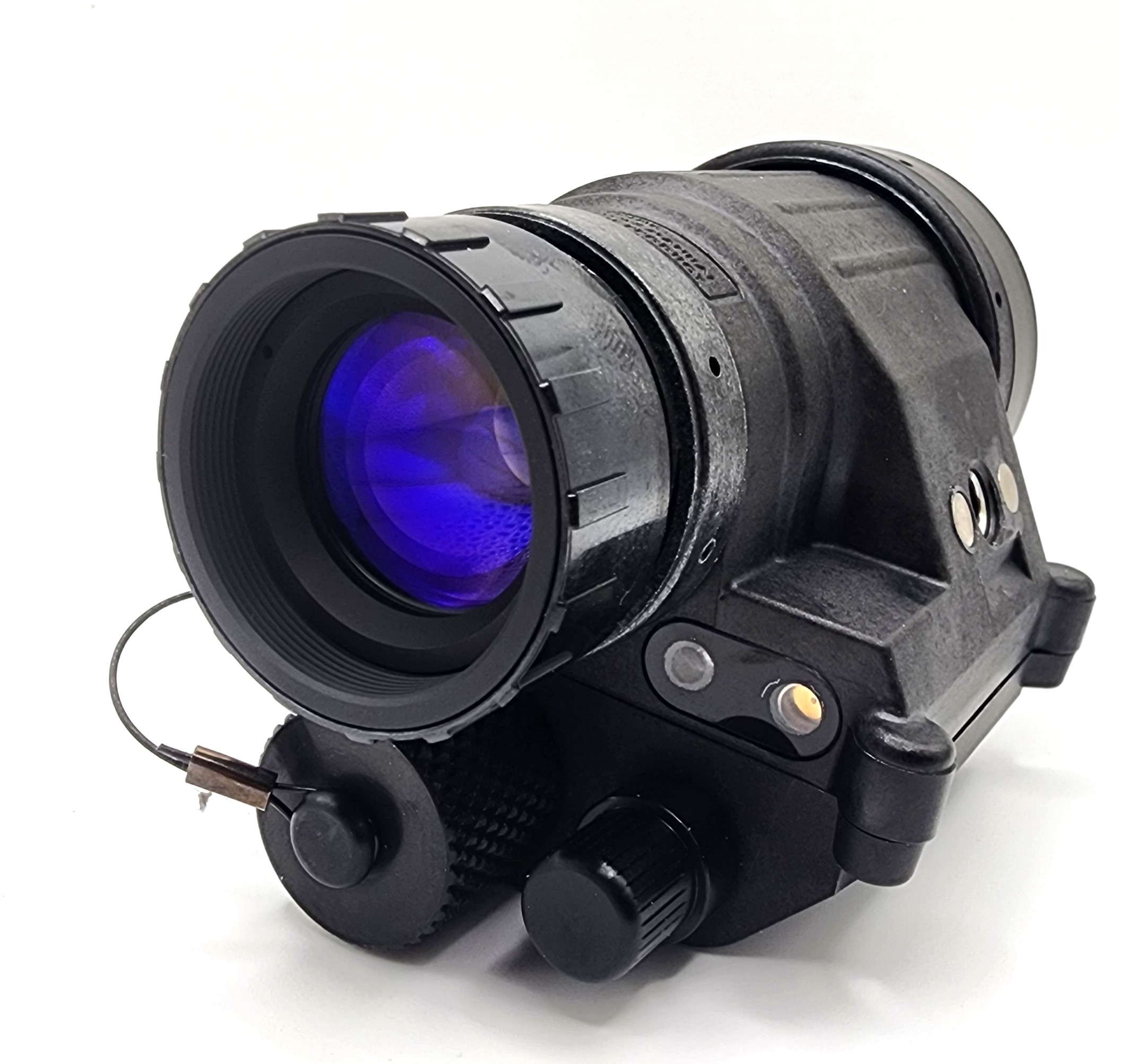
Night Vision Monocular Buyer’s Guide
A night vision monocular is a single-tube image intensifier designed to be worn helmet-mounted, used handheld for scanning, or carried as a backup to a goggle setup. For most operators, an officer building out a low-light kit, or a serious enthusiast, a quality Gen 3 monocular is the most versatile entry point into the night vision world — lighter, less expensive than dual-tube goggles, and capable of being used with both eyes open for full situational awareness.
This guide walks through what actually matters when choosing a unit: generations, tube specs, mounting, and what to expect at each price tier. If you’ve never bought night vision before, start at the top. If you know what you’re looking for, jump to the section you need.
What Is a Night Vision Monocular?
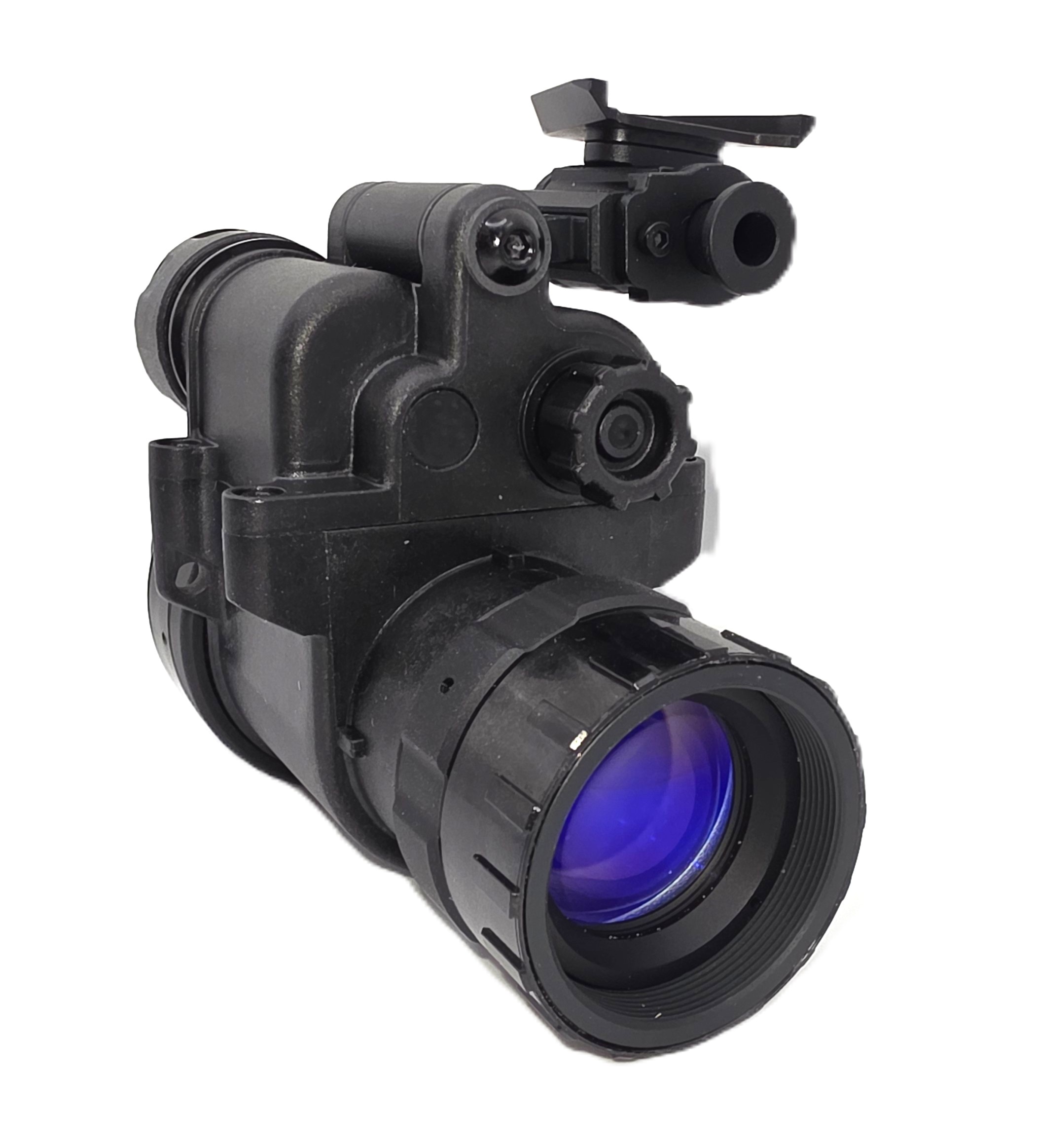
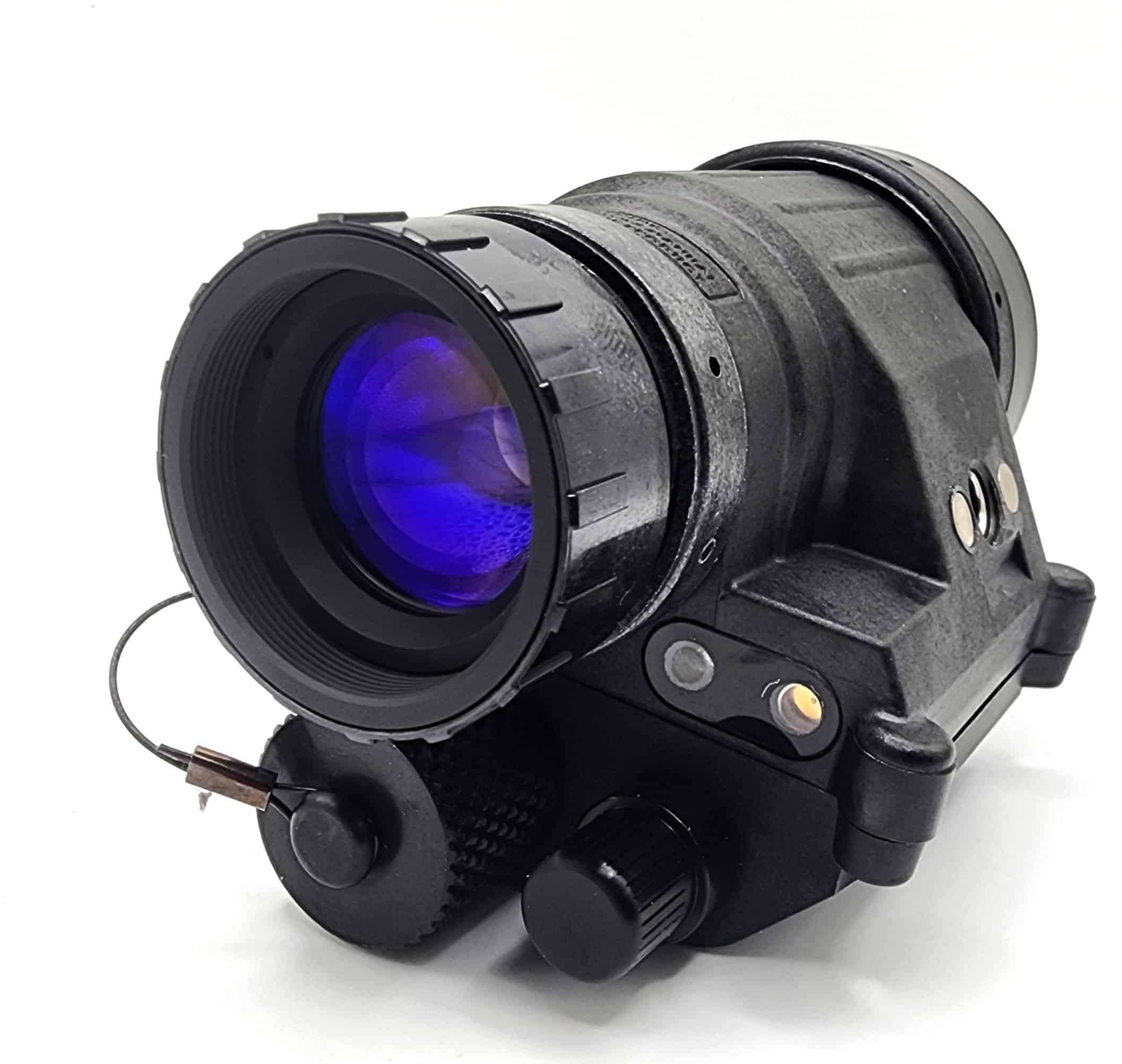
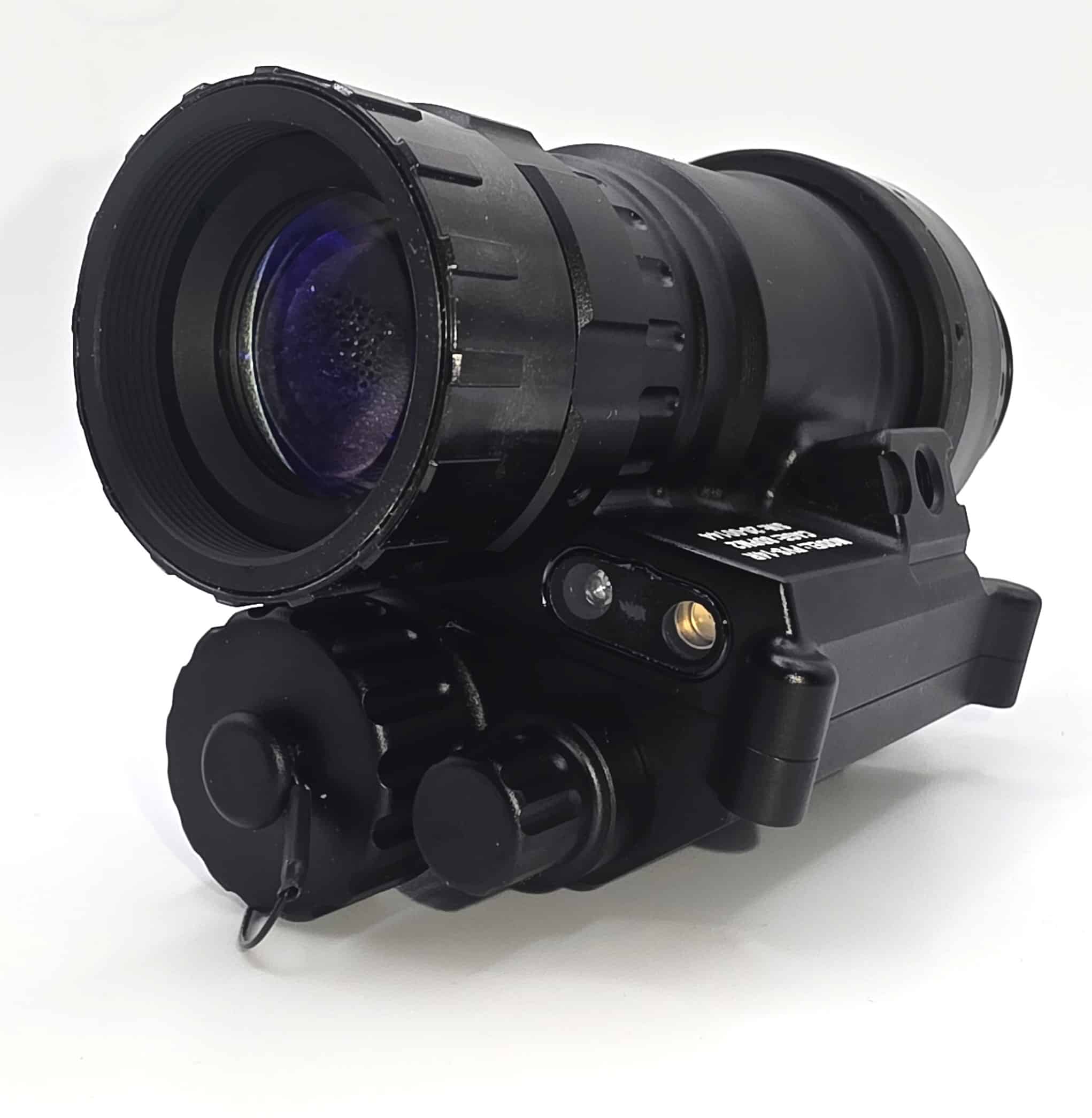
A monocular uses a single image intensifier tube to amplify available light — starlight, moonlight, near-infrared — thousands of times, producing a usable image in conditions where the unaided eye sees nothing. The dominant form factor is the PVS-14, a U.S. military-standard housing that can be hand-held, head-mounted with a skull crusher, or helmet-mounted via a J-arm and dovetail shroud.
Compared to dual-tube goggles like the RNVG, ANVB, or DTNVG, a monocular is roughly half the weight and roughly half the cost. The trade-off is no depth perception under night vision — but you keep your unaided eye open, which many experienced users actually prefer for extended use and situational awareness.
Generations: What They Mean and Why It Matters
Gen 2+ (Entry-Level Performance)
Gen 2+ tubes use a multi-alkali photocathode and microchannel plate to amplify light. Modern Gen 2+ is dramatically better than the cheap Gen 1 you may have seen on consumer-grade night vision — useful resolution, decent low-light performance, and operational life around 5,000 hours. A good fit for budget-conscious buyers, recreational use, and as a first piece of night vision. Our Superior Tactical Gen 2+ PVS-14 sits in this tier.
Gen 3 (Military Standard)
Gen 3 uses a gallium arsenide (GaAs) photocathode that’s roughly 3-4x more sensitive than Gen 2+. The result: a clearer, brighter image in lower light, significantly less grain, and a tube that lasts 10,000+ hours. This is what’s issued to U.S. military and used by serious LE units. Every PVS-14 in our lineup beyond the Gen 2+ uses Gen 3 tubes from L3Harris or Elbit — the two domestic tube manufacturers serving the U.S. civilian market.
The Tube Specs That Actually Matter
When you buy a quality Gen 3 unit from us, it ships with a tube data sheet showing the actual measured performance numbers for that specific tube. Here’s what to look for:
FOM (Figure of Merit)
FOM = SNR × Resolution. It’s the single number most buyers focus on. Civilian-available Gen 3 tubes generally fall between 1350 and 2800+. Higher is better, but more importantly: higher FOM means better performance in lower-light conditions. A 2000 FOM tube will perform noticeably better under heavy overcast, deep woods, or no-moon conditions than a 1500 FOM tube.
SNR (Signal-to-Noise Ratio)
How clean the image looks — specifically, the ratio of useful signal to scintillation (the “snow” or grain you see). Quality Gen 3 tubes run 25-32+. Higher SNR means a cleaner image, especially in low light.
Resolution
Measured in line pairs per millimeter (lp/mm). 64-72 lp/mm is the typical Gen 3 range. Higher resolution means sharper detail at distance.
Halo
The “bloom” you see around bright light sources — a porch light, a flashlight, a street lamp. Lower halo (measured in mm) is better. Modern thin-filmed tubes have minimal halo, which makes urban or partially-lit environments far more usable.
EBI (Equivalent Background Illumination)
How dark the image is when no light is present. Lower is better, especially for use in pitch-black interiors or deep cover.
White Phosphor vs. Green Phosphor
Traditional night vision is green because the human eye is most sensitive to green wavelengths. White phosphor produces a black-and-white image that many users find less fatiguing for extended use, with better contrast on natural terrain — grass, foliage, skin tones. Both are excellent. White phosphor is the modern preference for new builds; green phosphor remains in heavy use and is sometimes available at lower cost. Most of our PVS-14 builds offer both options at the configuration step.
L3Harris vs. Elbit Tubes
These are the two U.S.-domestic tube manufacturers serving the civilian market. Both produce military-grade Gen 3 tubes that meet or exceed mil-spec performance.
- L3Harris (formerly ITT/Exelis): Highly regarded filmless and unfilmed designs. Known for very low halo and high SNR.
- Elbit (Elbit Systems of America): Excellent spec-matched tubes, often with strong availability and competitive pricing for a given FOM.
For most buyers, the right answer is “whichever quality tube hits your FOM target and budget.” If you’re comparing two units, look at the data sheet numbers — not the brand on the housing.
Hand-Select Service
Tubes from the factory come in a range of performance bins, with different FOM, SNR, resolution, and cosmetic profiles. With our hand-select service, instead of getting whichever tube ships next from stock, we send you the data sheets for the tubes we currently have available — and you pick the specific tube you want based on actual measured specs and cosmetic profile. Superior Tactical offers hand-select service across every tube level we sell, Gen 2+ included.
Mounting and Setup
A monocular by itself is just the device. To use it head-mounted or helmet-mounted, you’ll need supporting hardware:
- J-arm: Connects the monocular to a helmet mount or skull crusher. Standard PVS-14 dovetail interface.
- Dovetail shroud: Installed on a helmet (Ops-Core, Team Wendy, Crye Precision). Common brands include Wilcox and Norotos.
- Helmet mount: A mechanical interface (Wilcox G24/G36, Norotos INVG/Tilt, Ops-Core VAS shroud) that locks the J-arm and allows flip-up/flip-down operation.
- Helmet: A bump helmet (lighter, no ballistic protection) or ballistic helmet, with a shroud installed.
Browse our Night Vision Mounts and Shrouds and Helmets categories to complete your setup.
Price Tiers and What You Get
- $2,000-$2,300 (Gen 2+): Entry-level performance. Good for recreational use, training, and budget-first buyers.
- $2,500-$3,000 (Gen 3, standard tubes): Solid mil-spec Gen 3 in a PVS-14 housing. Strong all-around performer.
- $3,000-$4,000 (Gen 3, high-FOM): Higher SNR and resolution numbers. Visibly better performance in marginal conditions.
- $4,000+ (Gen 3, top-spec / premium tubes): Top-bin performance, low halo, premium cosmetic standards. The best you can get in a PVS-14 form factor.
Legal and Export Considerations
Gen 3 night vision is ITAR-controlled: U.S. persons can purchase and own it freely, but it cannot be exported, taken out of the country, or sold to foreign nationals without specific government licensing. We sell only to verified U.S. customers and require a signed end-user statement on Gen 3 purchases. If you have questions about your eligibility, contact us before ordering.
Warranty and Support
All Superior Tactical PVS-14 builds include our standard warranty on the housing and electronics. Tube warranties vary by manufacturer and tube grade — typically 2-10 years on Gen 3 tubes. We’re also a full repair facility and can service most monoculars, including warranty work and tube upgrades down the road.
Frequently Asked Questions
What’s the practical difference between Gen 2+ and Gen 3?
Gen 3 is significantly more sensitive in low light, has cleaner image quality, and lasts twice as long. In a moonlit field, both will work fine. In deep woods on a no-moon night, Gen 3 will give you a usable image where Gen 2+ may struggle.
What’s a good FOM number to target?
For a quality build, 1800+ is solid mid-tier, 2000+ is high performance, and 2400+ is premium hand-select territory. Don’t chase numbers past what your use case actually needs — a 1800 FOM tube is more than capable for the vast majority of users.
Can civilians legally buy Gen 3 night vision in the U.S.?
Yes — U.S. persons can legally purchase and own Gen 3 night vision. The restriction is on export, not ownership. You cannot take it out of the country or transfer it to non-U.S. persons without specific licensing.
White phosphor or green phosphor — which should I pick?
If you have no preference and budget allows, white phosphor is generally easier on the eyes during long use and gives better contrast on natural backgrounds. Green is the traditional choice and works just as well; many users actually prefer it. There’s no wrong answer here.
How long does a Gen 3 tube last?
Gen 3 tubes are typically rated for 10,000+ hours of operation. For most users, that’s effectively a lifetime device.
Can I use a monocular with eyeglasses?
Yes. The PVS-14 has a focusable diopter that adjusts for most prescriptions, so many users wear it without glasses. If you wear glasses with strong correction, the eyepiece can be set to compensate.
What’s hand-select service?
Hand-select means instead of getting whichever tube ships next from stock, we send you the data sheets for the tubes we currently have available so you can pick the specific tube you want — higher FOM, lower halo, fewer cosmetic blemishes, whatever criteria matter most to you.
How long does shipping take?
All units ship within 1-2 business days.
Can I get my unit serviced or upgraded later?
Yes. We offer repair and upgrade service on PVS-14 housings — including tube swaps if you want to upgrade later, housing repairs, and warranty work.
Have a question we haven’t covered? Contact us or call (888) 330-7057 — we’re happy to help you build the right setup.
Night Vision Monocular Buyer’s Guide
A night vision monocular is a single-tube image intensifier designed to be worn helmet-mounted, used handheld for scanning, or carried as a backup to a goggle setup. For most operators, an officer building out a low-light kit, or a serious enthusiast, a quality Gen 3 monocular is the most versatile entry point into the night vision world — lighter, less expensive than dual-tube goggles, and capable of being used with both eyes open for full situational awareness.
This guide walks through what actually matters when choosing a unit: generations, tube specs, mounting, and what to expect at each price tier. If you’ve never bought night vision before, start at the top. If you know what you’re looking for, jump to the section you need.
What Is a Night Vision Monocular?
A monocular uses a single image intensifier tube to amplify available light — starlight, moonlight, near-infrared — thousands of times, producing a usable image in conditions where the unaided eye sees nothing. The dominant form factor is the PVS-14, a U.S. military-standard housing that can be hand-held, head-mounted with a skull crusher, or helmet-mounted via a J-arm and dovetail shroud.
Compared to dual-tube goggles like the RNVG, ANVB, or DTNVG, a monocular is roughly half the weight and roughly half the cost. The trade-off is no depth perception under night vision — but you keep your unaided eye open, which many experienced users actually prefer for extended use and situational awareness.
Generations: What They Mean and Why It Matters
Gen 2+ (Entry-Level Performance)
Gen 2+ tubes use a multi-alkali photocathode and microchannel plate to amplify light. Modern Gen 2+ is dramatically better than the cheap Gen 1 you may have seen on consumer-grade night vision — useful resolution, decent low-light performance, and operational life around 5,000 hours. A good fit for budget-conscious buyers, recreational use, and as a first piece of night vision. Our Superior Tactical Gen 2+ PVS-14 sits in this tier.
Gen 3 (Military Standard)
Gen 3 uses a gallium arsenide (GaAs) photocathode that’s roughly 3-4x more sensitive than Gen 2+. The result: a clearer, brighter image in lower light, significantly less grain, and a tube that lasts 10,000+ hours. This is what’s issued to U.S. military and used by serious LE units. Every PVS-14 in our lineup beyond the Gen 2+ uses Gen 3 tubes from L3Harris or Elbit — the two domestic tube manufacturers serving the U.S. civilian market.
The Tube Specs That Actually Matter
When you buy a quality Gen 3 unit from us, it ships with a tube data sheet showing the actual measured performance numbers for that specific tube. Here’s what to look for:
FOM (Figure of Merit)
FOM = SNR × Resolution. It’s the single number most buyers focus on. Civilian-available Gen 3 tubes generally fall between 1350 and 2800+. Higher is better, but more importantly: higher FOM means better performance in lower-light conditions. A 2000 FOM tube will perform noticeably better under heavy overcast, deep woods, or no-moon conditions than a 1500 FOM tube.
SNR (Signal-to-Noise Ratio)
How clean the image looks — specifically, the ratio of useful signal to scintillation (the “snow” or grain you see). Quality Gen 3 tubes run 25-32+. Higher SNR means a cleaner image, especially in low light.
Resolution
Measured in line pairs per millimeter (lp/mm). 64-72 lp/mm is the typical Gen 3 range. Higher resolution means sharper detail at distance.
Halo
The “bloom” you see around bright light sources — a porch light, a flashlight, a street lamp. Lower halo (measured in mm) is better. Modern thin-filmed tubes have minimal halo, which makes urban or partially-lit environments far more usable.
EBI (Equivalent Background Illumination)
How dark the image is when no light is present. Lower is better, especially for use in pitch-black interiors or deep cover.
White Phosphor vs. Green Phosphor
Traditional night vision is green because the human eye is most sensitive to green wavelengths. White phosphor produces a black-and-white image that many users find less fatiguing for extended use, with better contrast on natural terrain — grass, foliage, skin tones. Both are excellent. White phosphor is the modern preference for new builds; green phosphor remains in heavy use and is sometimes available at lower cost. Most of our PVS-14 builds offer both options at the configuration step.
L3Harris vs. Elbit Tubes
These are the two U.S.-domestic tube manufacturers serving the civilian market. Both produce military-grade Gen 3 tubes that meet or exceed mil-spec performance.
- L3Harris (formerly ITT/Exelis): Highly regarded filmless and unfilmed designs. Known for very low halo and high SNR.
- Elbit (Elbit Systems of America): Excellent spec-matched tubes, often with strong availability and competitive pricing for a given FOM.
For most buyers, the right answer is “whichever quality tube hits your FOM target and budget.” If you’re comparing two units, look at the data sheet numbers — not the brand on the housing.
Hand-Select Service
Tubes from the factory come in a range of performance bins, with different FOM, SNR, resolution, and cosmetic profiles. With our hand-select service, instead of getting whichever tube ships next from stock, we send you the data sheets for the tubes we currently have available — and you pick the specific tube you want based on actual measured specs and cosmetic profile. Superior Tactical offers hand-select service across every tube level we sell, Gen 2+ included.
Mounting and Setup
A monocular by itself is just the device. To use it head-mounted or helmet-mounted, you’ll need supporting hardware:
- J-arm: Connects the monocular to a helmet mount or skull crusher. Standard PVS-14 dovetail interface.
- Dovetail shroud: Installed on a helmet (Ops-Core, Team Wendy, Crye Precision). Common brands include Wilcox and Norotos.
- Helmet mount: A mechanical interface (Wilcox G24/G36, Norotos INVG/Tilt, Ops-Core VAS shroud) that locks the J-arm and allows flip-up/flip-down operation.
- Helmet: A bump helmet (lighter, no ballistic protection) or ballistic helmet, with a shroud installed.
Browse our Night Vision Mounts and Shrouds and Helmets categories to complete your setup.
Price Tiers and What You Get
- $2,000-$2,300 (Gen 2+): Entry-level performance. Good for recreational use, training, and budget-first buyers.
- $2,500-$3,000 (Gen 3, standard tubes): Solid mil-spec Gen 3 in a PVS-14 housing. Strong all-around performer.
- $3,000-$4,000 (Gen 3, high-FOM): Higher SNR and resolution numbers. Visibly better performance in marginal conditions.
- $4,000+ (Gen 3, top-spec / premium tubes): Top-bin performance, low halo, premium cosmetic standards. The best you can get in a PVS-14 form factor.
Legal and Export Considerations
Gen 3 night vision is ITAR-controlled: U.S. persons can purchase and own it freely, but it cannot be exported, taken out of the country, or sold to foreign nationals without specific government licensing. We sell only to verified U.S. customers and require a signed end-user statement on Gen 3 purchases. If you have questions about your eligibility, contact us before ordering.
Warranty and Support
All Superior Tactical PVS-14 builds include our standard warranty on the housing and electronics. Tube warranties vary by manufacturer and tube grade — typically 2-10 years on Gen 3 tubes. We’re also a full repair facility and can service most monoculars, including warranty work and tube upgrades down the road.
Frequently Asked Questions
What’s the practical difference between Gen 2+ and Gen 3?
Gen 3 is significantly more sensitive in low light, has cleaner image quality, and lasts twice as long. In a moonlit field, both will work fine. In deep woods on a no-moon night, Gen 3 will give you a usable image where Gen 2+ may struggle.
What’s a good FOM number to target?
For a quality build, 1800+ is solid mid-tier, 2000+ is high performance, and 2400+ is premium hand-select territory. Don’t chase numbers past what your use case actually needs — a 1800 FOM tube is more than capable for the vast majority of users.
Can civilians legally buy Gen 3 night vision in the U.S.?
Yes — U.S. persons can legally purchase and own Gen 3 night vision. The restriction is on export, not ownership. You cannot take it out of the country or transfer it to non-U.S. persons without specific licensing.
White phosphor or green phosphor — which should I pick?
If you have no preference and budget allows, white phosphor is generally easier on the eyes during long use and gives better contrast on natural backgrounds. Green is the traditional choice and works just as well; many users actually prefer it. There’s no wrong answer here.
How long does a Gen 3 tube last?
Gen 3 tubes are typically rated for 10,000+ hours of operation. For most users, that’s effectively a lifetime device.
Can I use a monocular with eyeglasses?
Yes. The PVS-14 has a focusable diopter that adjusts for most prescriptions, so many users wear it without glasses. If you wear glasses with strong correction, the eyepiece can be set to compensate.
What’s hand-select service?
Hand-select means instead of getting whichever tube ships next from stock, we send you the data sheets for the tubes we currently have available so you can pick the specific tube you want — higher FOM, lower halo, fewer cosmetic blemishes, whatever criteria matter most to you.
How long does shipping take?
All units ship within 1-2 business days.
Can I get my unit serviced or upgraded later?
Yes. We offer repair and upgrade service on PVS-14 housings — including tube swaps if you want to upgrade later, housing repairs, and warranty work.
Have a question we haven’t covered? Contact us or call (888) 330-7057 — we’re happy to help you build the right setup.