Night Vision Goggles
Showing all 11 results


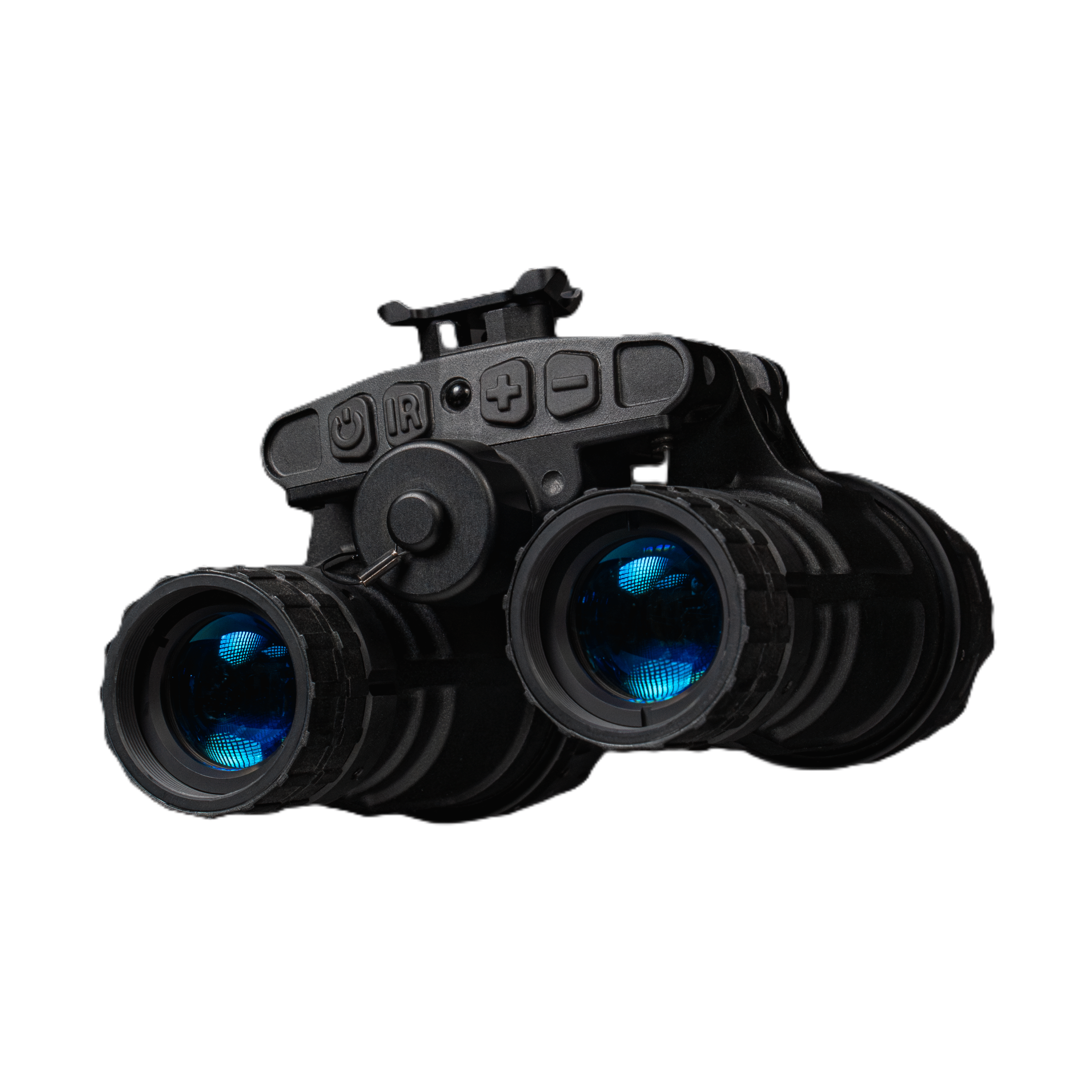
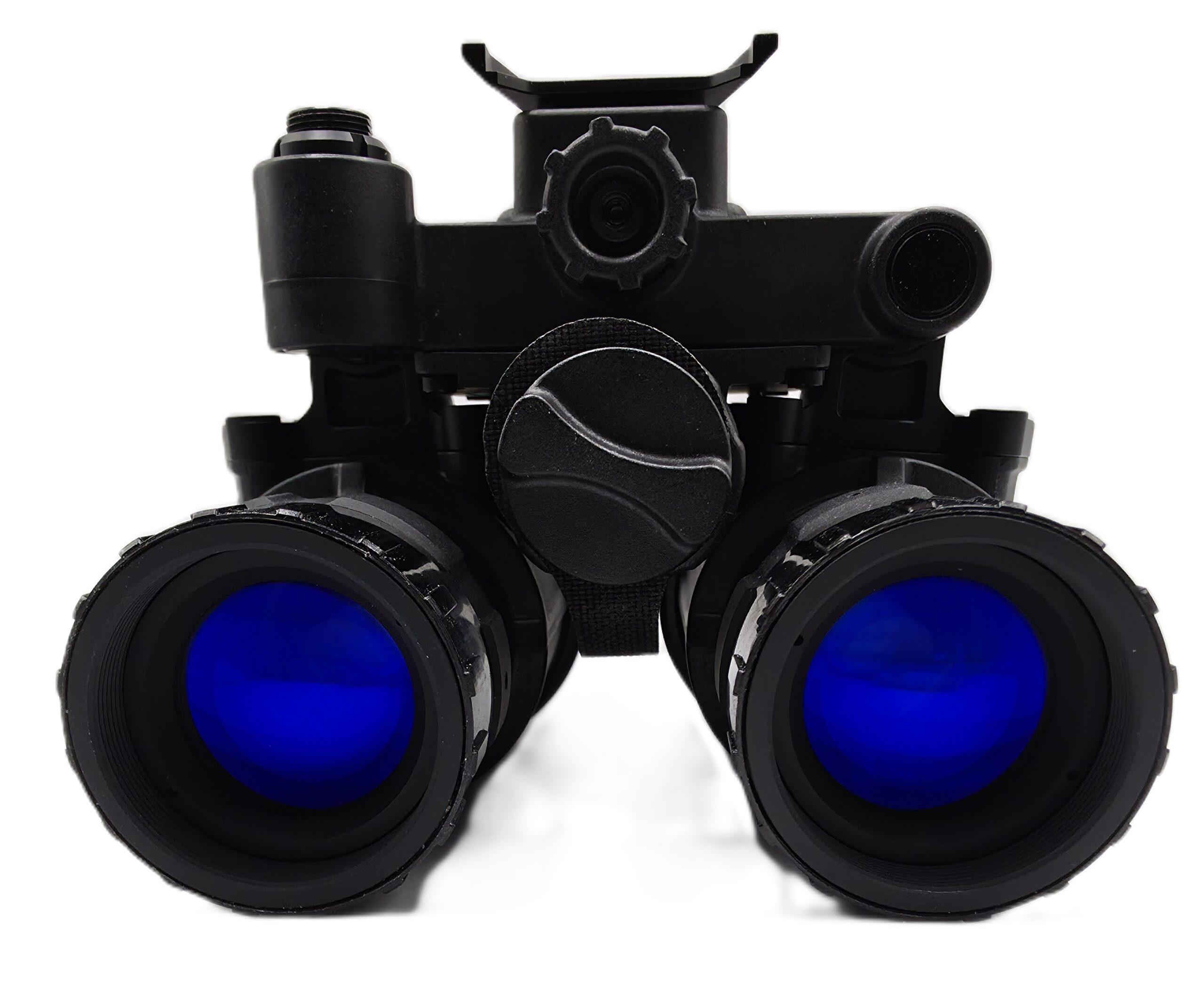
Night Vision Goggles Buyer’s Guide
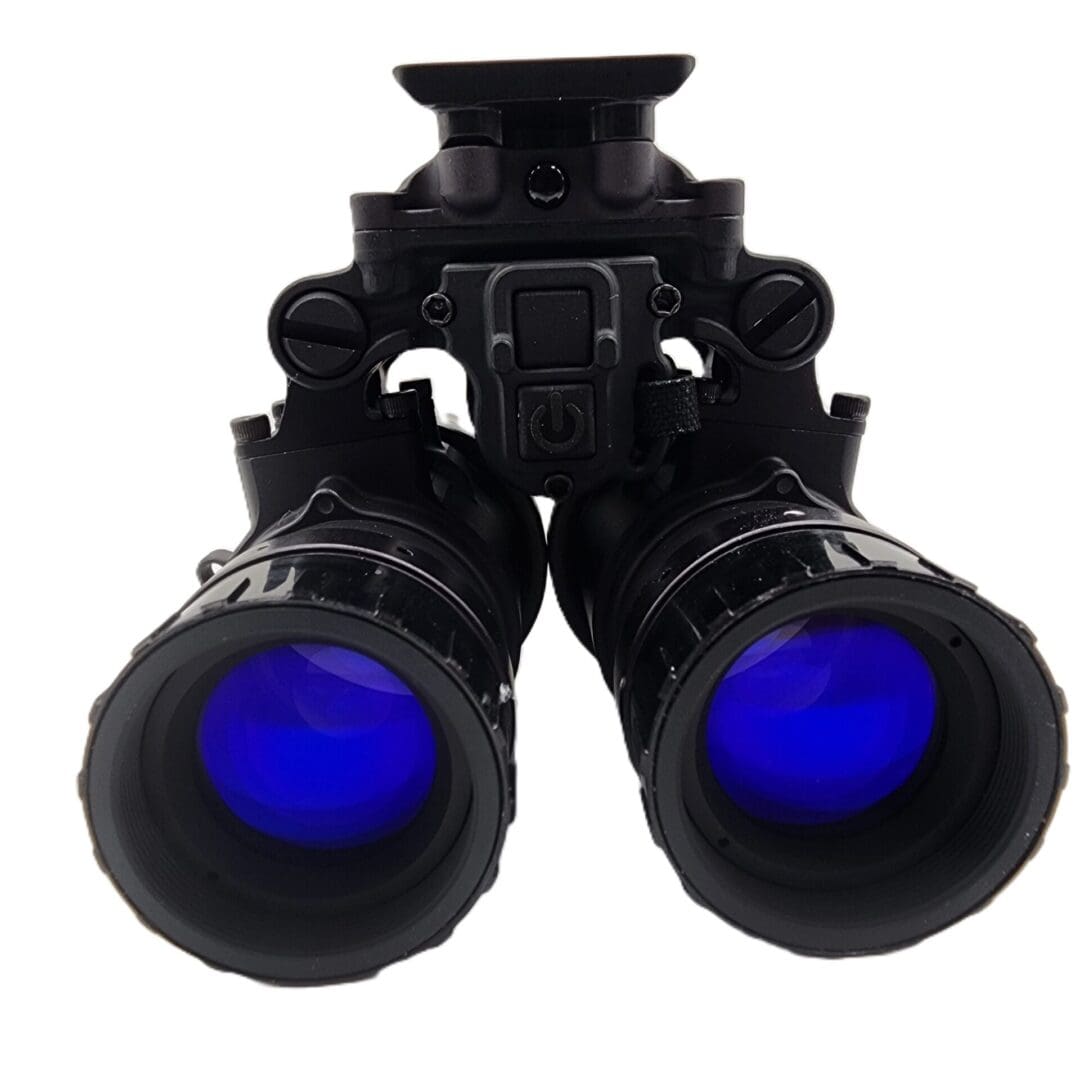
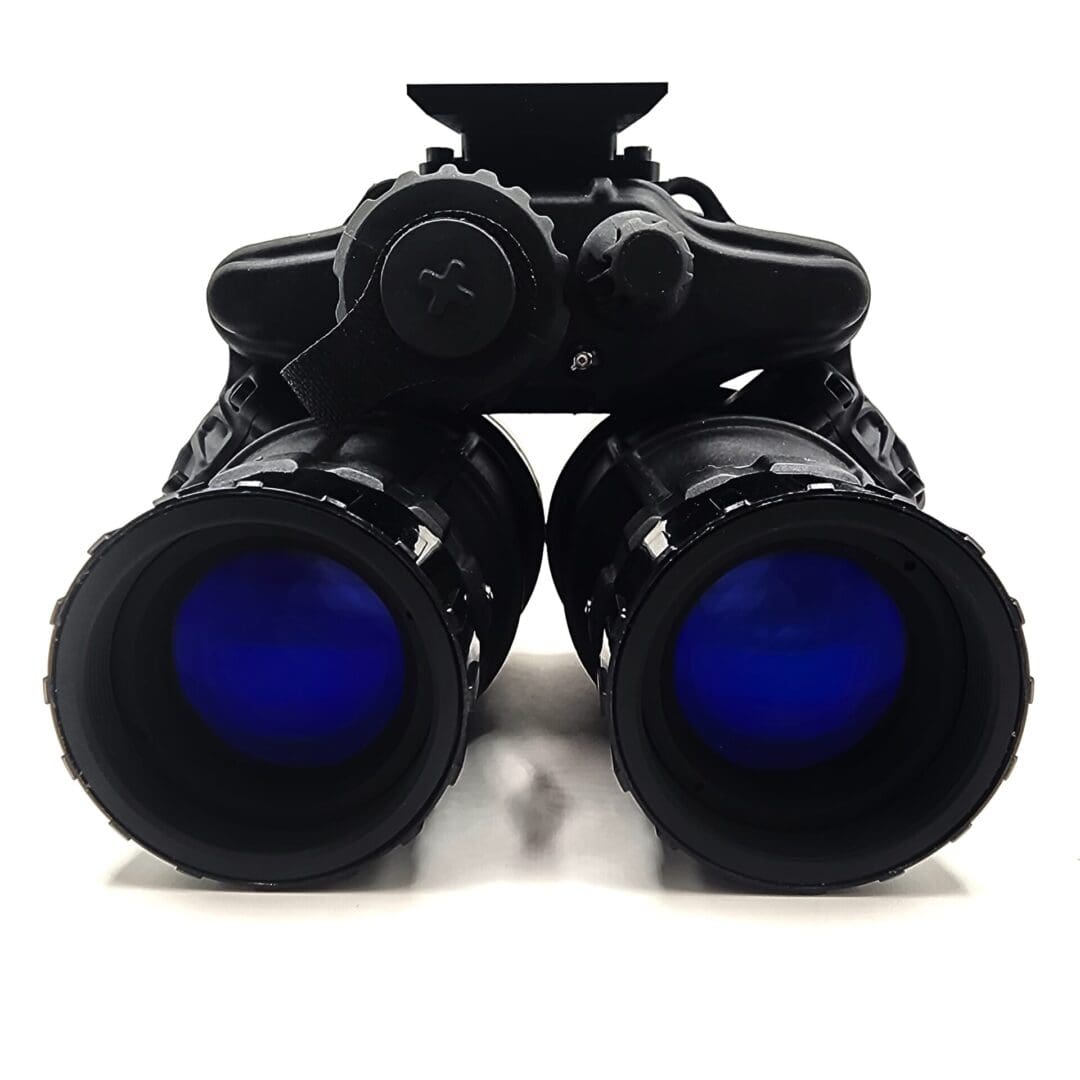
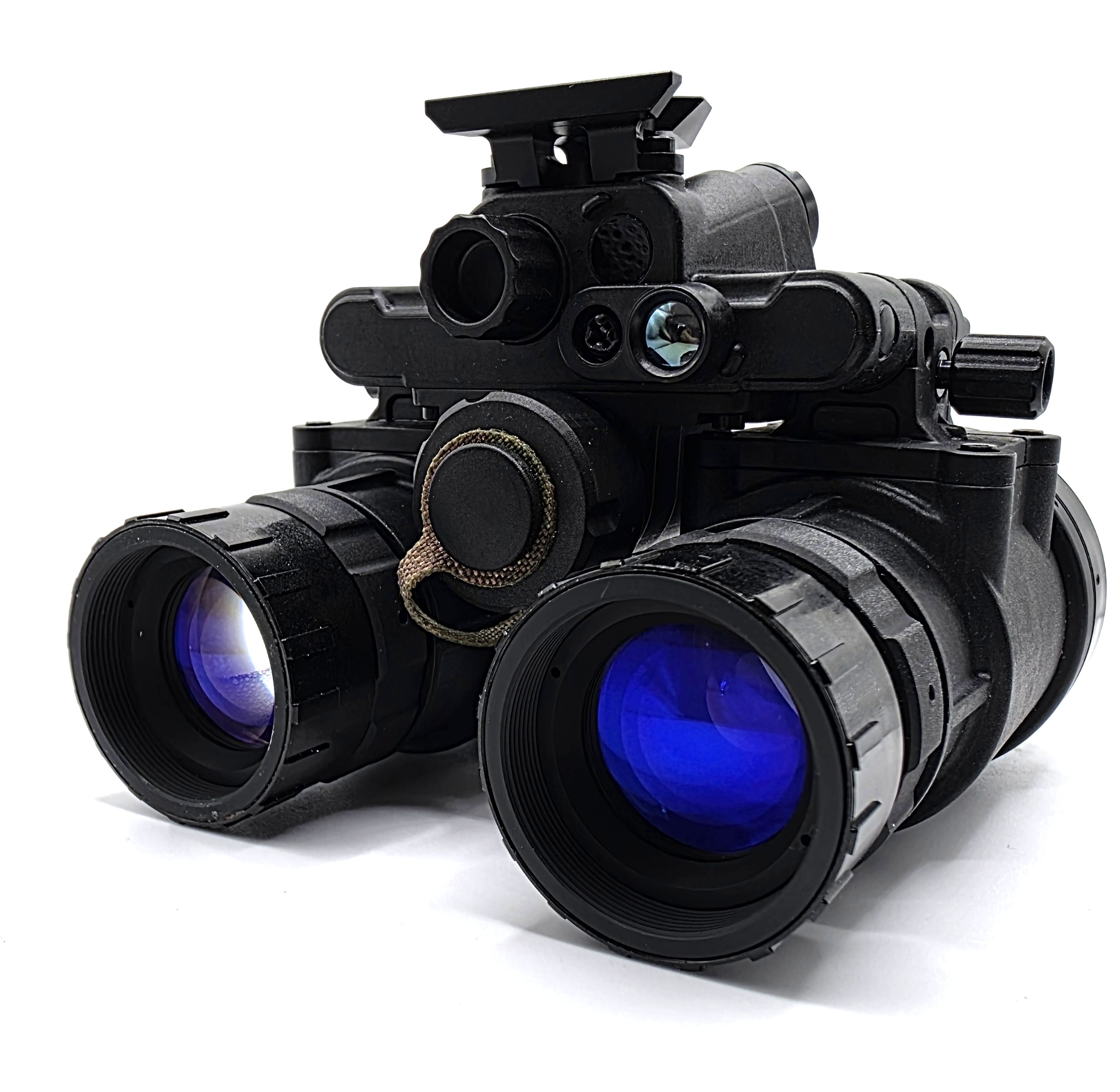
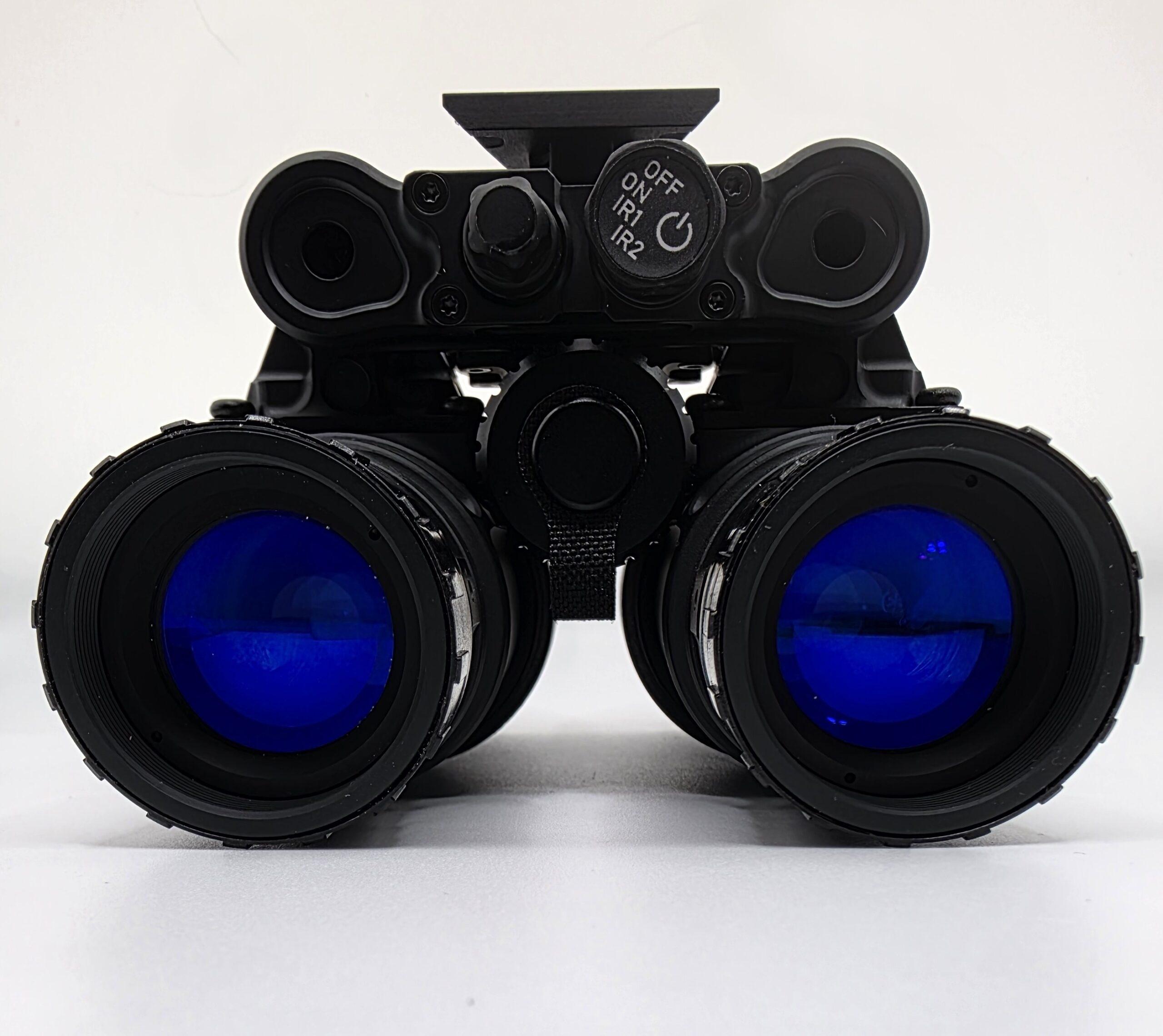
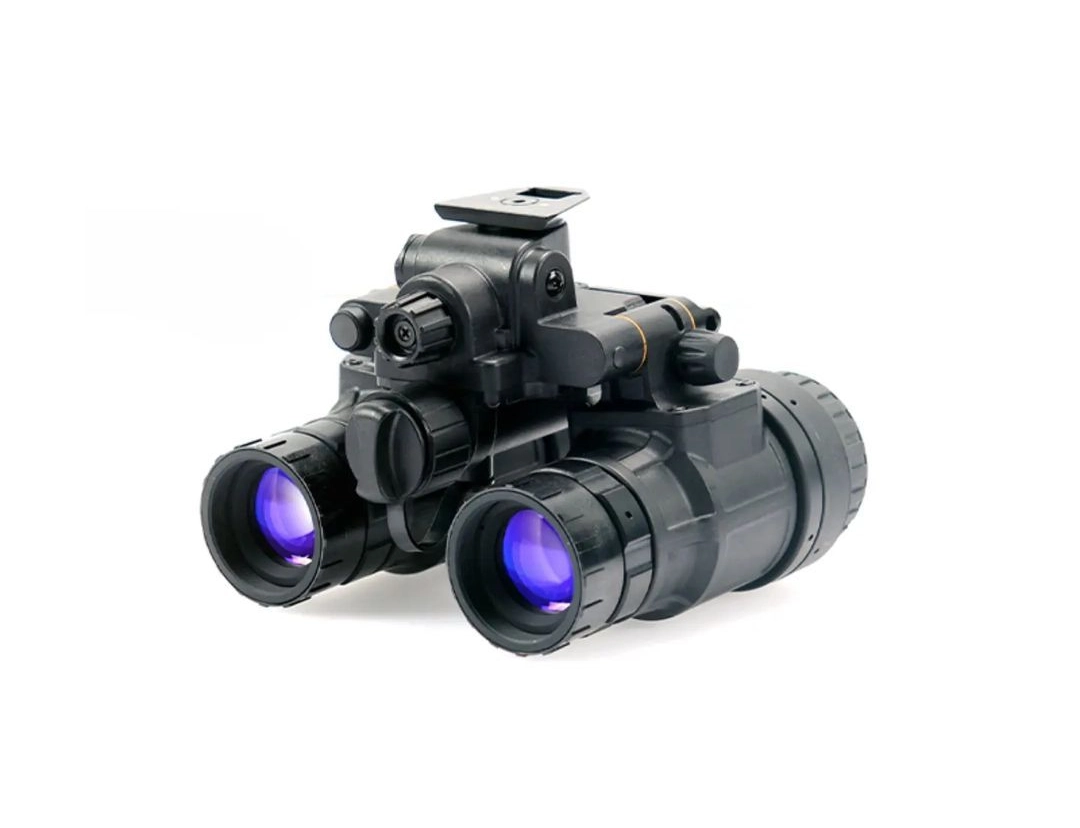
A night vision goggle (NVG) is a head- or helmet-mounted device that uses two image intensifier tubes — one for each eye — to amplify available light into a usable image. Unlike a single-tube monocular, a goggle gives you stereoscopic depth perception under night vision and lets both eyes share the workload, which most users find dramatically less fatiguing for extended wear. The trade-off is weight and price — but for any operator who’s spending serious time under NVGs, dual-tube is the standard.
This guide walks through the form factor differences (fixed bridge, articulating, hinged), what manual gain actually does, the tube specs that matter, and where each price tier sits.
Goggles, Monoculars, and Binoculars — What’s the Difference?
Form factor terminology gets used loosely in the industry, so it’s worth being precise:
- Monocular: Single image intensifier tube. Lightest and least expensive. Used helmet-mounted (one eye covered, the other unaided) or hand-held.
- Fixed-bridge goggle: Two tubes in one rigid housing. The interpupillary distance (IPD) is set by the design and isn’t adjustable beyond a few mm. Lightweight and durable.
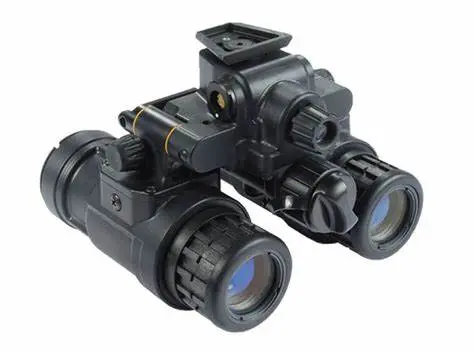
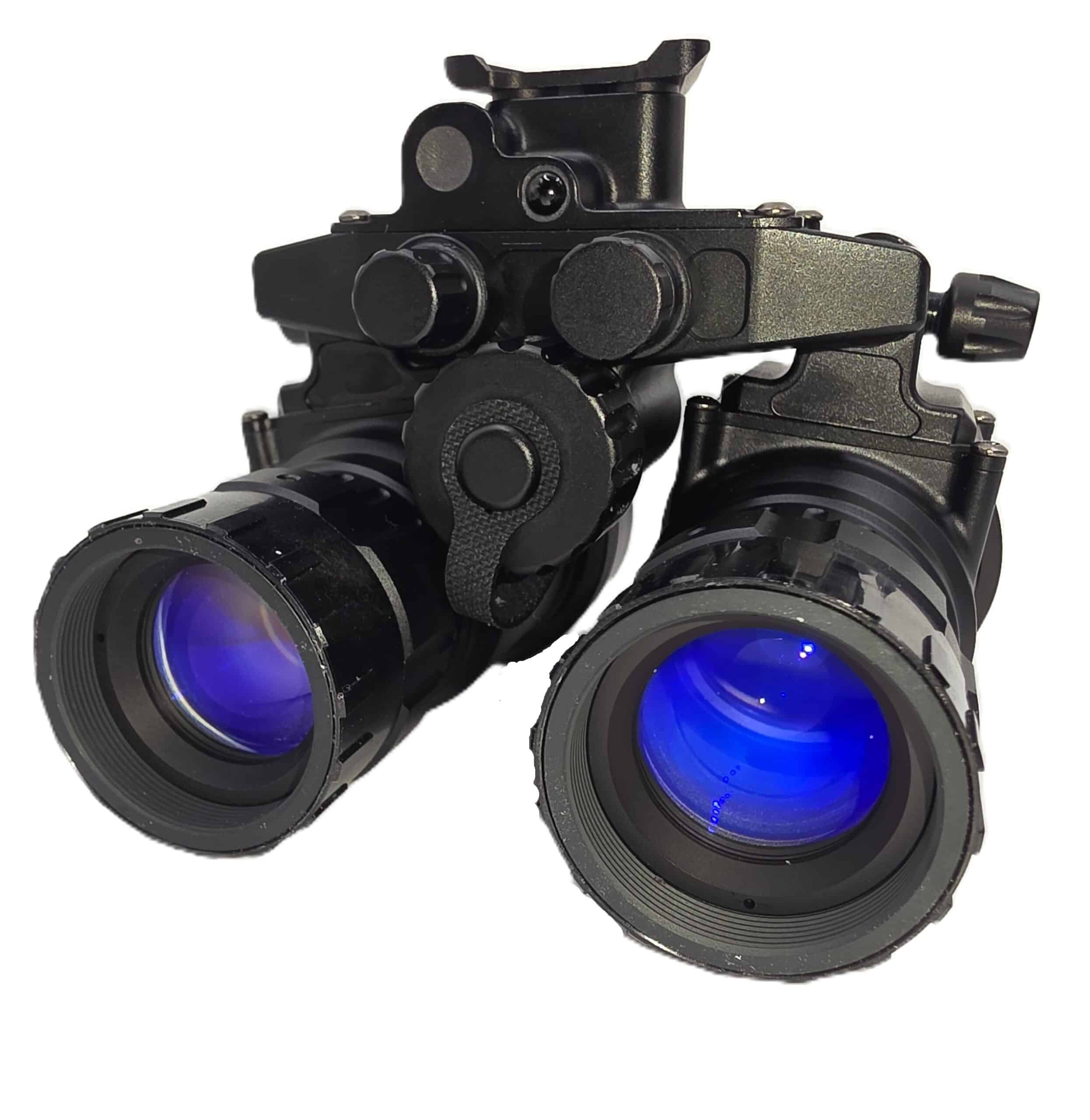
- Articulating goggle / binocular: Two tube pods on a hinged bridge that flip up and down independently. You can stow one or both pods out of the way, and on most designs adjust IPD and convergence for individual fit. Heavier and pricier than fixed-bridge, but more versatile. Includes BNVD-pattern designs like the L3Harris PVS-31A.
For most users, a quality fixed-bridge ruggedized goggle hits the sweet spot of weight, durability, and price.
Fixed-Bridge Ruggedized Goggles
A fixed-bridge design holds both tubes in one rigid housing — no moving parts, no flip-up, no articulation. Lighter than articulating designs and the simplest possible build, with nothing to fail or get fouled. The trade-off is no ability to flip a pod out of the way for white-light or unaided-eye work.
Our fixed-bridge option is the RNVG White Phosphor Ruggedized Goggle — Gen 3 tubes in a rugged fixed housing. If you want the lightest, simplest dual-tube setup and don’t need flip-up capability, this is the pick.
Articulating Goggles and Binoculars
Articulating designs use a hinged bridge that lets each tube pod flip up and down independently. Practical benefits: you can dial in IPD and convergence for individual fit, flip a single pod out of the way to use an unaided eye (for white light, optics, or situational awareness), or stow both pods up when you don’t need them. The trade-off is added weight and complexity versus a fixed bridge.
This is the bulk of our goggle lineup. Each model pairs Gen 3 tubes with a different housing — choose based on weight, materials (polymer vs. aluminum), feature set (manual gain), and budget:
- AB Night Vision RNVG-A (ARNVG) — articulating version of the ruggedized RNVG.
- ANVB Articulating Binocular — Gen 3 articulating binocular built for hard use.
- ACTinBlack DTNVS — popular dual-tube design with a strong following.
- ACTinBlack DTNVS-MG — DTNVS with manual gain control.
- LLI MH-1 — Gen 3 articulating goggle.
- SI Nighthawk-MG — rugged build with manual gain.
- Nocturn Manticore-R — rugged aluminum housing.
- NVG ALPHA — ruggedized articulating goggle.
- BNVD-1431 MK II — BNVD-pattern binocular, commercial build.
- L3Harris BNVD AN/PVS-31A — the genuine military-issue BNVD housing with high-FOM L3Harris tubes (2376+ FOM). Same device used by U.S. SOF units, and the top of our articulating lineup.
Manual Gain — What It Is and When You Need It
Most modern Gen 3 tubes are auto-gated: the tube automatically adjusts its gain to handle bright light without damage and to keep the image at a usable brightness. Manual gain adds a physical control that lets you override the automatic setting and dial brightness up or down to taste.
When manual gain matters: mixed-light environments where auto-gate may over- or under-correct (urban movement under street lights, transitioning from indoors to outdoors, working around vehicle headlights), or situations where you want a darker image to preserve dark adaptation. For pure outdoor field use, auto-gate alone is generally fine — but for tactical, urban, or mixed-environment use, manual gain is a meaningful upgrade. Most of our goggles include manual gain control; check the individual product pages to confirm.
Tube Specs in a Goggle
The tube fundamentals — FOM, SNR, resolution, halo, EBI, white vs. green phosphor — are the same as in a monocular. We covered them in detail in our monocular buyer’s guide; the short version: higher FOM means better performance in low light, lower halo means less bloom around bright sources, and modern thin-filmed Gen 3 tubes from L3Harris or Elbit are what to look for.
One thing that’s specific to goggles: both tubes should be matched. When you’re looking through two tubes simultaneously, mismatched FOM, brightness, or color tint between the left and right is noticeable and fatiguing. Quality dealers (us included) match tube pairs at build time so the left and right deliver visually consistent output. With our hand-select service — available on every tube level we sell — we send you the data sheets for the tubes we currently have available so you can pick a matched pair for your build.
Why Dual-Tube Matters: Stereo Vision Under NVGs
Single-tube monoculars work — millions of operators have used PVS-14s for decades. But there are real benefits to dual-tube that show up the longer you wear the device:
- Depth perception. Stereo vision lets you judge distances, see terrain features clearly, and move through complex environments (woods, stairs, vehicle interiors) without the unconscious balance issues that come with one-eye NV.
- Less fatigue. Both eyes are doing the same job. With a monocular, your brain is constantly reconciling a green/white image in one eye with darkness in the other — that’s mentally taxing on long ops.
- Better situational awareness. A wider effective field of view and faster target acquisition.
Mounting and Setup
Goggles use the same mounting hardware as monoculars: a J-arm, a dovetail shroud installed on a helmet, and a helmet mount that accepts the dovetail. Bridge dimensions and mount compatibility are standard across most quality goggles. The main practical difference: goggles are heavier than a PVS-14, typically 1.0-1.5 lbs vs. 0.8 lbs for a monocular, so a quality counterweight on the back of the helmet is more important. Browse our Mounts and Shrouds and Helmets categories for the supporting hardware.
Price Tiers and What You Get
- $4,000-$5,500 (entry-level Gen 3 dual-tube): Solid mil-spec Gen 3 in a quality fixed-bridge housing. The right choice for most buyers stepping up from a monocular.
- $5,500-$7,500 (mid-tier ruggedized): Higher-FOM tubes, premium housings (DTNVS, RNVG-style), often with manual gain options.
- $7,500-$10,000+ (premium / articulating / L3Harris BNVD-31A): Top-bin matched-pair tubes, articulating housings (RNVG-A, ANVB, BNVD-1431, PVS-31A), or the genuine L3Harris BNVD-31A military housing. The best you can buy in a dual-tube form factor.
Legal and Export Considerations
Gen 3 night vision is ITAR-controlled. U.S. persons can purchase and own freely; export, taking the device out of the country, or transferring to non-U.S. persons is restricted without specific government licensing. We sell only to verified U.S. customers and require a signed end-user statement on Gen 3 purchases.
Warranty and Support
All Superior Tactical goggle builds include our standard warranty on the housing and electronics, plus the manufacturer tube warranty (typically 2-10 years on Gen 3 tubes). We’re a full repair facility and can service most goggles, including warranty work and tube swaps if you want to upgrade later.
Frequently Asked Questions
Should I get a goggle or a monocular?
If you’ll be using night vision for short periods or want the lightest, least expensive option, a monocular is excellent. If you’re spending hours under NV — patrol, training, hunting, professional use — a dual-tube goggle is genuinely more comfortable and gives you depth perception. Many operators own both and use whichever the situation calls for.
What does manual gain do, and do I need it?
Manual gain lets you override the auto-brightness control and dial the image to your preference. You need it most in mixed-light environments — urban areas with streetlights, rooms with windows, transitioning indoors and out. For pure outdoor field use, auto-gate alone is fine.
Is the L3Harris BNVD-31A worth the premium?
It’s the genuine U.S. military-issue articulating housing with high-FOM L3Harris tubes — same device used by SOF units. If you want the absolute top of the articulating lineup and value the provenance and tube quality, yes. If you want similar form factor and performance for less, the BNVD-1431 MK II is a strong commercial alternative in the same articulating pattern.
Articulating vs. fixed-bridge — which should I get?
Fixed-bridge (the RNVG, in our lineup) is lighter, simpler, and the right call if you don’t need flip-up capability and want the most rugged dual-tube setup. Articulating is the more versatile choice — flip pods up for white-light work, looking through optics, or unaided situational awareness, and adjust IPD and convergence to fit your face. Most buyers shopping a dual-tube setup go articulating; the RNVG is for buyers who specifically want the simplest possible fixed dual-tube.
Will both tubes match?
On builds from us, yes — we pair tubes at build time so left and right deliver visually consistent FOM, brightness, and tint. With hand-select service (available on every tube level we sell), we send you the data sheets for the tubes we have available so you can pick the matched pair yourself.
How heavy are goggles on a helmet?
Most quality dual-tube goggles run 1.0-1.5 lbs. With a counterweight on the rear of the helmet, the load balances out and is comfortable for extended wear. Without a counterweight, expect neck fatigue.
Why are goggles so much more expensive than monoculars?
Two tubes instead of one is the biggest factor — tubes are the most expensive component, and a goggle uses two matched tubes. Add the more complex housing, and dual-tube units typically run roughly 1.8-2.5x the cost of a comparable monocular.
Same ITAR / export restrictions as a monocular?
Yes. The same rules apply to all Gen 3 night vision: U.S. persons can purchase and own freely, but export and transfer to non-U.S. persons are controlled without specific licensing.
Is hand-select available?
Yes, on every tube level we sell. With hand-select, we send you the data sheets for the tubes we currently have in stock so you can pick the specific pair you want for your build.
How long does shipping take?
All units ship within 1-2 business days.
Can I service or upgrade my goggle later?
Yes. We offer repair and tube upgrade service on goggle housings — tube swaps if you want to upgrade later, housing repairs, and warranty work.
Have a question we haven’t covered? Contact us or call (888) 330-7057 — we’re happy to help you spec the right setup.