The Ultimate Guide to U S Made Scopes
When you're shopping for a high-quality rifle scope, you’ll see the "U.S. Made" label a lot. But what does it actually mean? It’s a term that gets thrown around and often misinterpreted, but the distinction is critical. Getting it right is the difference between buying an optic with foreign parts simply put together on American soil versus one that's truly built from the ground up in the United States.
Understanding What U S Made Really Means
Let's cut through the marketing jargon. The difference between a scope that’s genuinely manufactured in the USA and one that’s merely assembled here is massive. Think of it this way: a truly U.S.-made scope is like a custom-built truck. The engine block was forged here, the transmission was machined here, and the chassis was welded here—all by American workers using American steel.
On the other hand, an "Assembled in the USA" scope is more like a vehicle built from a global crate of parts. The lenses might come from Japan, the electronics from Taiwan, and the aluminum housing from Germany. The final product is screwed together in an American facility, which is great for providing local jobs, but the heart and soul of the optic—its core components and their inherent quality—were sourced from all over the world.
This infographic does a great job of breaking down exactly what to look for.
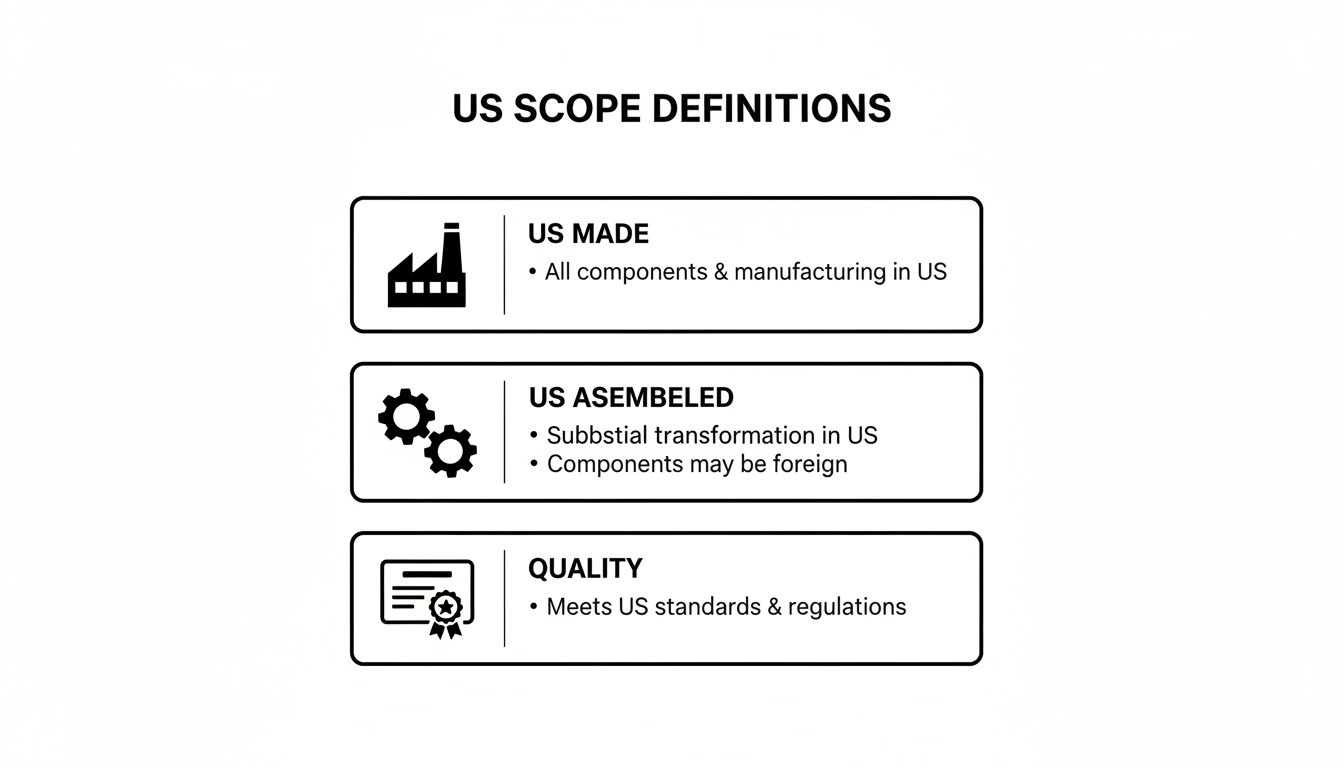
As you can see, the origin of the components is the real defining factor between a truly domestic product and one that just had its final assembly done stateside.
To make this even clearer, this table breaks down the key differences side-by-side.
U S Made vs U S Assembled Scopes at a Glance
| Attribute | Genuinely 'Made in the USA' | 'Assembled in the USA' |
|---|---|---|
| Components | All or virtually all components are sourced and manufactured in the United States. | Components (lenses, electronics, tubes) are primarily sourced from foreign countries. |
| Labor | All significant manufacturing, machining, and assembly processes occur in the U.S. | Only the final assembly of foreign-made parts happens in the U.S. |
| Quality Control | The manufacturer has end-to-end control over the entire production process and materials. | Quality is dependent on overseas suppliers; the U.S. facility only controls the assembly process. |
| Regulatory Standard | Often meets strict standards like the Buy American Act or Berry Amendment. | Does not typically qualify for stringent government procurement standards. |
Ultimately, while both labels involve American labor at some stage, the "Made in the USA" designation promises a much deeper commitment to domestic manufacturing from start to finish.
The Gold Standard of Domestic Production
These distinctions aren't just for show; they're enforced by federal regulations that set an incredibly high bar for what can be called American-made. For those of us who demand reliability, these rules are an assurance of quality.
Two regulations really set the standard:
- The Buy American Act: This law mandates that the U.S. government give preference to American-made goods. For a scope to qualify, its core components must be mined, produced, or manufactured right here in the States.
- The Berry Amendment: This one is even stricter. It applies specifically to Department of Defense (DoD) contracts and restricts the purchase of certain goods—from textiles to specialty metals—that aren't 100% produced in the United States.
While these acts are for government purchasing, they create a powerful "halo effect" for civilian shooters. Companies that invest in meeting these tough standards for military contracts tend to apply that same level of quality control to the U.S.-made scopes they sell to the public. You can get a deeper dive into this by reading our article on what makes tactical equipment different from regular outdoor gear.
The takeaway is simple: when you buy a product that meets Berry Amendment or Buy American Act standards, you're getting gear that has been built and vetted for absolute reliability under the toughest conditions imaginable.
This commitment to domestic production is a huge reason why the U.S. dominates in advanced optics, especially night vision. North America, led by U.S. innovation, was projected to command 39.74% of the global night vision market in 2025. That leadership is fueled directly by massive DoD investments—like the USD 377 million allocated in that fiscal year alone—which drives the cutting-edge technology that eventually makes its way into the optics we can all own.
Why Choose American Optics for Your Mission
When you’re lining up a critical shot, whether you're tracking a buck in the high country or operating in a no-fail environment, the last thing you should worry about is your gear. Choosing a U.S.-made scope isn't just about patriotism; it's a calculated decision for absolute confidence when it counts.
This confidence is rooted in an obsessive approach to quality. American manufacturers who build their optics from the ground up control every single step. From the raw materials and the precision of the machining to the brutal testing protocols, they have complete oversight, ensuring every scope that leaves the factory is ready for duty.
Built for the Real World
There’s a world of difference between a tool that’s simply assembled and one that’s truly built. American optics are often engineered to withstand the specific, unforgiving conditions that shooters actually face out in the field. This isn't just about surviving a drop from the truck. It’s about holding zero after hundreds of rounds of heavy recoil and delivering a crystal-clear sight picture in a freezing downpour or a swirling dust storm.
It's precisely this dedication to real-world reliability that leads so many professionals to trust only U.S. made scopes. They know that paying a bit more upfront is a wise investment in an optic that simply will not fail when a career or a once-in-a-lifetime hunt is on the line.
When you buy a genuinely U.S.-made optic, you're buying peace of mind. You get the assurance that comes from gear built under some of the world's toughest quality control systems—often designed by the very people who depend on it themselves.
This commitment is also pushing innovation in specialized fields like night vision. The U.S. Night Vision Equipment Manufacturing sector has seen consistent growth, proving a strong domestic capability for these advanced systems. As defense and law enforcement needs drive the market forward, American companies are leading the charge. You can learn more about the growth of this specialized industry on IBISWorld.com.
Accessible Support When It Matters Most
What happens after the sale is just as important. Choosing an American brand gives you a huge advantage in service and support. If something goes wrong, you’re not wrestling with international shipping, confusing time zones, or language barriers. You have a direct line to a team based right here in the States.
Think about the practical upsides:
- Faster Turnaround Times: Getting a scope serviced across the country is worlds faster and less of a headache than sending it overseas.
- Direct Communication: You can actually talk to a technician who knows the product inside and out, making sure your issue is fixed right the first time.
- Stronger Warranties: Great American companies stand behind their gear. A rock-solid warranty isn't just a marketing point; it's their promise of quality to you.
This level of support is a huge piece of the puzzle. At Superior Tactical, for example, our 10-year warranty on Gen 3 night vision is our vote of confidence in the American-made equipment we carry. We back that up with our own in-house repair services and free diagnostics, making sure your investment is protected for years to come.
Ultimately, choosing a U.S. scope is more than a single purchase. You're plugging into an entire ecosystem of reliability—a tough, high-performance tool backed by an accessible and accountable support network. For any serious shooter, that combination is everything.
How to Confidently Verify an Optic's Origin
When you're shopping for U.S. made scopes, you have to be willing to do a little homework. Marketing claims can be slick, but a few simple checks will help you cut through the fluff and find out where an optic really comes from. It's about turning yourself from a hopeful buyer into a truly informed one.
The first and easiest check is to get your hands on the scope itself. Don't just glance at the box—look at the actual scope body. Reputable U.S. manufacturers are proud of their work and will often engrave or clearly mark their products with "Made in USA" or the city and state where it was built. If all you see is vague phrasing like "Designed in the USA," that's a classic red flag.
Scrutinize the Source
Next, you'll want to head online. A manufacturer's website can be a goldmine of information, but you need to know where to dig. Skip past the big, flashy marketing banners and navigate to their "About Us" or "Manufacturing" section.
What you're looking for is transparency. Do they talk about their American factory? Do they show photos of their team and machinery in the States? Or is the language fuzzy, focusing on design and engineering while staying suspiciously quiet about where the parts are actually put together?
A lack of transparency is a tell-tale sign. If a company is genuinely proud of its American manufacturing, they’ll shout it from the rooftops. A website that’s cagey about sourcing should make you skeptical right away.
It's similar to what you see when researching other gear. If you check out reviews on night vision binoculars, you'll notice some brands are very upfront about their components and assembly, while others are not. Scope manufacturers are no different.
Look for Regulatory Clues and Red Flags
For higher-end and tactical optics, a few key regulations can tell you almost everything you need to know. Understanding these can give you a serious leg up.
- ITAR Compliance: The International Traffic in Arms Regulations (ITAR) is a big one. This set of rules governs the export of defense-related hardware. If a scope is listed as "ITAR-regulated," it's a very strong sign that it’s made in the U.S., because the government itself has classified it as a defense item. This isn't just marketing jargon; it's a legal status with real teeth.
- Price as an Indicator: You also have to be realistic about cost. If a deal looks too good to be true, it probably is. Authentic, American-made optics simply cost more to produce due to U.S. labor costs, rigorous quality control, and premium materials. A suspiciously low price on a scope being pushed as a top-tier U.S. product often points to a counterfeit or, at best, misleading marketing.
By combining a physical inspection with some smart online research and an eye for these key identifiers, you can move past the sales pitch. This approach lets you make a decision based on hard facts, ensuring the scope you buy has the authentic American quality you're paying for.
Key Technologies in High-Performance U.S. Scopes
The real magic of a top-tier U.S.-made scope isn't just its tough exterior; it's the technology humming away inside. These aren't just simple glass-filled tubes. They are precision instruments, and every single component is engineered to work in perfect harmony. Knowing what makes these optics tick helps you understand what you’re paying for and why it makes a difference downrange.
At the very core of any scope is its glass. Think of it like the engine in a race car—everything else is just there to support it. The best American manufacturers use extra-low dispersion (ED) or high-definition (HD) glass. These are highly specialized materials engineered to fight chromatic aberration, which is just a fancy term for that distracting color fringing you sometimes see on the edge of a target.
By precisely controlling how different colors of light bend, this high-quality glass gives you a razor-sharp, crystal-clear picture with true-to-life color. While the raw optical glass might be sourced from specialists in Germany or Japan, the real work happens in U.S. facilities. That's where it's ground, polished, and coated to meet demanding, military-grade standards.
The Power of Advanced Lens Coatings
But even the best glass is only part of the equation. The true secret to incredible light transmission and image clarity is found in the coatings applied to every lens. A single, uncoated piece of glass can lose 4-5% of its light to reflection. When you have a dozen or more lenses in a modern scope, those losses add up fast, leaving you with a dim, washed-out image.
This is where proprietary multi-coatings save the day. These are impossibly thin layers of material applied to the glass in a vacuum chamber. Each layer is designed to cancel out reflections for a specific wavelength of light.
A fully multi-coated optic, where every single air-to-glass surface has been treated, can achieve over 95% light transmission. That's the difference between spotting your target in the dim first or last light of day and going home empty-handed.
These coatings do more than just brighten the image. They also cut glare, boost contrast, and provide a tough, protective layer against scratches, fingerprints, and water. A premium American scope will feature coatings that are both optically brilliant and durable enough to handle serious field use.
Reticles and Turrets: The Language of Precision
Once you have that perfect image, you need a way to aim. This is where your reticle and turrets come in, and the choices you make here are critical. The two main systems of measurement are Minute of Angle (MOA) and Milliradian (MIL). Neither one is "better," but it is absolutely crucial to match your reticle to your turrets.
- Minute of Angle (MOA): An angular measurement that conveniently works out to about 1 inch at 100 yards. For many American shooters raised on the imperial system, this feels more intuitive.
- Milliradian (MIL): A base-10 angular unit that makes range calculations a breeze. One MIL equals 10 cm at 100 meters.
Just as important is the focal plane. With a First Focal Plane (FFP) reticle, the reticle itself seems to grow and shrink as you zoom, but its measurement markings stay true at any magnification. A Second Focal Plane (SFP) reticle stays the same size, but its markings are only accurate at one specific power setting. If you want to go deeper, our guide explains what all the numbers on your scope mean.
Finally, we get to the mechanical soul of a long-range scope: the turrets. These are the knobs you dial for elevation and windage. In a high-end American optic, these turrets must deliver perfectly repeatable and reliable tracking. That means if you dial up 20 MOA for a long shot, then dial all the way back down to your zero, it lands in the exact same spot. Every single time. That level of mechanical integrity is a non-negotiable hallmark of elite U.S. manufacturing.
Leading U.S. Scope Brands and Their Specialties
It’s one thing to talk about the nuts and bolts of U.S.-made scopes, but it's another to see how that translates into real-world performance. America is home to some of the most trusted optics brands on the planet, and each one has carved out its own niche through years of hard-won experience and a laser focus on who they're building for.
These aren't just faceless corporations; they're companies with distinct personalities and legacies. By getting to know what makes each brand tick—their history, their target user, and their signature tech—you can find an optic that feels like it was made just for you.
Leupold & Stevens: The Hunter's Choice
When you talk about American-made hunting optics, the conversation almost always starts with Leupold & Stevens. Based out of Beaverton, Oregon, for over 100 years, this company has built its entire reputation on one word: durability. Ask any seasoned hunter, and they'll likely have a story about a Leupold scope surviving a fall or extreme weather that would have destroyed lesser optics.
Leupold's DNA is pure hunting. Their scopes are designed to be lightweight enough for long treks, incredibly tough, and optically superior in those crucial minutes at dawn and dusk. They accomplish this with proprietary tech like the Twilight Max Light Management System, which is engineered to pull in more of the blue and red light that’s most visible when game is on the move.
The brand’s "Gold Ring" is more than just a slick logo—it's their bond with the customer. It represents a full lifetime guarantee and a promise that the scope is tough enough to be passed down from one generation to the next.
This obsession with toughness isn't just marketing. Every single Leupold scope design is tortured-tested. They're frozen, baked, and subjected to thousands of violent impacts on a recoil machine they call "The Punisher." For a hunter, knowing your scope will hold zero no matter what is a peace of mind you can't put a price on.
Trijicon: Battlefield Innovation
For battle-proven optics, Trijicon is in a league of its own. Operating out of Wixom, Michigan, Trijicon completely changed the game for tactical sights by perfecting the use of tritium and fiber optics. This dual-illumination system creates a bright aiming point without ever needing a battery, making it incredibly reliable in any light.
Their most famous product, the Trijicon ACOG (Advanced Combat Optical Gunsight), is a modern legend. As the official rifle optic of the U.S. Marine Corps, its tough-as-nails build, fixed magnification, and "both eyes open" aiming philosophy proved its worth in the most demanding environments on Earth.
This combat-heavy resume has solidified Trijicon's core audience: military operators, law enforcement officers, and anyone who needs an optic they can bet their life on. While they produce fantastic hunting scopes too, Trijicon's heart and soul will always be in tactical applications.
- Key Technology: Battery-free illumination using tritium and fiber optics.
- Core Audience: Military, law enforcement, and dedicated tactical shooters.
- Specialty: Ultra-rugged combat sights like the ACOG and the RMR red dot.
EOTech: The Leader in Holographic Sights
EOTech, another Michigan-based innovator, absolutely owns the market for holographic weapon sights (HWS). These are not your typical red dots. Instead of bouncing an LED light off a lens, EOTech uses a laser to project a true hologram of a reticle that appears downrange on your target. This offers some serious advantages when speed is everything.
The number one benefit is lightning-fast target acquisition. The EOTech reticle is incredibly easy to pick up, and the sight remains functional even if the window is partially shattered or caked in mud. As long as you can see through any piece of the window, you can see the reticle. That level of resilience is why it’s a top choice for special forces and SWAT teams across the globe.
Superior Tactical is proud to be an authorized dealer of EOTech products, giving our customers access to these truly battle-tested sights. Their unique technology and proven reliability make them a foundational piece of gear for any serious defensive or tactical rifle.
Your Partner for American Made Optics and Support
Picking out the right optic is a huge step, but it’s really just the beginning. The real test comes down the road, and that’s where solid support makes all the difference. After diving deep into what makes U.S. made scopes a cut above the rest, it's time to talk about who you can trust to back them up.
That’s exactly where we come in. At Superior Tactical, we’re not just moving boxes—we’re here to be your go-to resource for the long haul.
Our shelves are stocked with gear that lives up to the very standards we've been discussing. We hand-pick elite, American-focused brands like EOTech because we know they're built for the toughest conditions and represent the best of domestic engineering. We sell the gear we’d bet our own lives on, plain and simple.
More Than a Retailer A True Partner
We believe world-class optics deserve world-class support, and that belief comes from years of being out in the field ourselves. It’s not just a slogan; it’s a tangible commitment to keeping your equipment ready for whatever comes next.
Here’s what that looks like in practice:
- Decade of Expertise: We’ve been at this for over ten years. That means you get honest, no-nonsense advice from people who have actually used the gear and can help you find the perfect tool for the job.
- Same-Day Shipping: When you need a piece of equipment, you usually need it yesterday. We get that. That’s why we work hard to get orders out the door the very same day, so you spend less time waiting and more time ready.
- Unwavering Warranty Support: We don’t just pass the buck to the manufacturer. We stand behind every product, a commitment shown by our 10-year warranty on Gen 3 night vision. It’s our way of saying we’re confident this gear will perform for years to come.
Long-Term Commitment to Your Investment
Our relationship doesn't stop when your package hits the porch. We're fully invested in the life of your gear, from the day you unbox it to the day it needs a tune-up. This isn’t just an add-on service; it’s a core part of who we are.
At Superior Tactical, we know that high-performance optics are a serious investment. That's why we offer in-house repair services and free diagnostics. Our goal is to make sure your gear stays a reliable asset for years, not just a one-time purchase.
For those who like to get their hands dirty, we offer a full lineup of DIY parts and housing build kits. This gives you the freedom to build, customize, and maintain your own systems, empowering you with the know-how to keep your equipment at peak performance.
From expert advice on your first purchase to long-term maintenance down the line, we aim to be your one-stop shop. We provide the tools, the parts, and the expertise to ensure your investment in American-made optics delivers solid, dependable performance every single time you use it.
Answering Your Questions About U.S.-Made Scopes
When you're ready to invest in a quality American-made optic, a few key questions always seem to pop up. We've heard them all, so let's get you the straightforward answers you need to be confident in your choice.
Are Scopes With Foreign Glass Still U.S.-Made?
In a word, yes. It's a common point of confusion, but it makes sense when you look at how these high-end optics are built. The market for truly exceptional optical glass is global, with the best raw materials often coming from specialists in Germany or Japan.
The "Made in USA" label, as defined by the FTC, means that "all or virtually all" of the product's value and final assembly happens here. For a rifle scope, that means the critical work—the engineering, the precision machining of the scope body, the hand-assembly of the delicate internal mechanics, and the final quality control—is all done on U.S. soil. Think of it this way: the most important parts of the process, the ones that ensure a scope is tough and reliable, happen right here at home.
What Does ITAR-Regulated Mean for a Civilian Buyer?
For the average civilian shooter, seeing that a scope is ITAR-regulated is basically a stamp of approval from the U.S. government. ITAR, or the International Traffic in Arms Regulations, controls the export of defense-related items.
This means the optic is considered "munitions-grade" and built to a standard tough enough for military and law enforcement use. You can't just ship it overseas, but it gives you peace of mind that you're buying a piece of equipment that is incredibly durable, technologically advanced, and built for the most demanding situations.
Is There a Significant Price Difference?
You’ll definitely notice a price difference. Scopes built in the U.S. come with higher labor costs, intensive quality control, and the use of premium domestic materials for components like the housing and turrets.
It's a classic "you get what you pay for" scenario. While the initial investment is higher than a mass-market overseas optic, you’re paying for rock-solid reliability, superior clarity, and mechanics that won't fail you. Add in the value of having access to U.S.-based customer service and warranties, and the long-term value is hard to beat.
How Can I Tell if a Deal Is Too Good to Be True?
Trust your gut on this one. If you see a premium American scope from a top brand listed at a massive discount, especially on a random website or marketplace, you should be skeptical. The high-end optics market is flooded with convincing fakes.
Look for red flags: sellers using stock photos instead of pictures of the actual item, vague descriptions, or a seller with zero history. The single best way to protect yourself is to buy only from a reputable, authorized dealer. That’s the only way to guarantee you’re getting a genuine product and a warranty that the manufacturer will actually honor.
At Superior Tactical LLC, we are an authorized dealer for every brand we carry, ensuring you get only genuine, mission-ready gear. Explore our full catalog of mission-ready optics and accessories today.
