
Chin strap for ach helmet: Essential Guide (chin strap for ach helmet)
When it comes to your gear, it's easy to overlook the small stuff. But a quality chin strap for an ACH helmet isn't just a small upgrade—it’s the single most important one you can make for stability, comfort, and performance. This isn't just a piece of webbing; it's the heart of your helmet's retention system, and it makes or breaks your ability to use critical tools like night vision.
Why Your Chin Strap Is Your Helmet's Most Critical Component

Think of your Advanced Combat Helmet (ACH) like a high-performance rifle. You can have a top-tier optic and a match-grade barrel, but if the scope mount is loose, none of that precision matters. The chin strap is that scope mount for your helmet—it's the crucial link that ensures everything else works as intended.
The standard-issue strap might pass inspection, but it quickly shows its weaknesses in the real world. Under the stress of dynamic movement or the weight of mounted accessories, a basic strap just doesn't cut it. That's why a modern retention system isn't a luxury; it's a mission-critical investment.
The Foundation of a Stable Platform
At its core, a chin strap's job is to create an unshakable platform. Without that solid base, everything else falls apart. A loose or poorly designed strap lets the helmet shift, wobble, or tilt, which is more than just annoying—it's dangerous. A snug, dialed-in fit keeps your protection exactly where it needs to be, whether you're sprinting to cover or navigating a cramped space.
Getting the fit right delivers immediate, tangible benefits:
- Less Fatigue: A helmet that doesn't move feels lighter. You're not constantly making small, subconscious adjustments, which dramatically cuts down on neck strain over a long patrol or training evolution.
- Better Safety: During an impact or a sudden jolt, a properly secured helmet won't shift and expose parts of your head. It stays put and does its job.
- Clearer Focus: You can concentrate on your surroundings and the task at hand instead of constantly fiddling with your gear.
Unlocking Your Helmet's Full Potential
You really see the difference a great chin strap makes the moment you start adding accessories. Slap on a pair of Night Vision Goggles (NVGs), and that forward weight will immediately cause a standard helmet to sag down over your eyes. A good 4-point retention system acts like a counterbalance, keeping your NVGs steady and your sight picture perfectly clear.
A helmet is only as good as its retention system. When running NVGs, a cheap chin strap makes a $10,000 optic perform like a shaky handheld camera. A premium strap turns it into a stable, heads-up display.
The same logic applies to anything else you mount on your helmet, from comms headsets to lights and cameras. Integrating a Peltor helmet mount, for example, demands a solid base to keep your hearing protection secure and functional without becoming a distraction.
By upgrading this one component, you’re not just adding a strap. You're transforming your helmet from a simple piece of armor into a fully integrated, mission-ready platform.
The Evolution of ACH Helmet Retention Systems
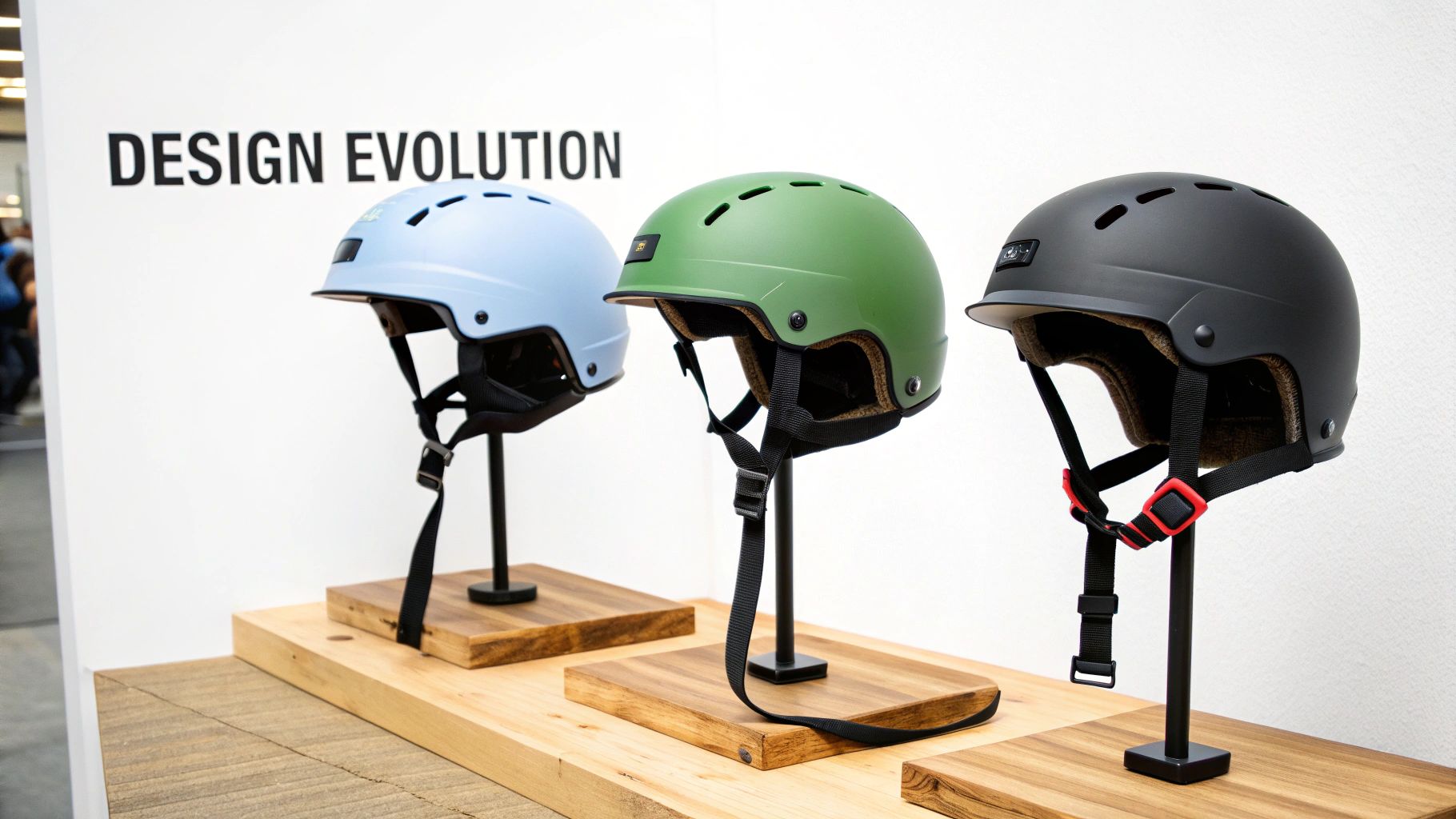
To really get why the modern chin strap for an ACH helmet is so good, you have to look at where we came from. The old combat helmets, like the PASGT or "K-Pot," used a simple two-point strap. It did the basic job of keeping the helmet on your head, but that's about it. The big problem? It was terribly unstable. The helmet would rock, shift, and tilt with any sudden movement.
That lack of stability went from an annoyance to a mission-critical failure when troops started mounting accessories to their helmets. The game-changer was the widespread adoption of night vision goggles (NVGs). Suddenly, you had a heavy piece of gear hanging off the front, pulling the helmet forward constantly. The old two-point straps just couldn't handle the new reality.
The Problem of the Forward Pull
Think about trying to carry a backpack with one loose shoulder strap. Every time you bend over or turn, the whole bag shifts and throws you off balance. That's exactly what operators felt. The helmet would constantly dip down, blocking their vision and forcing them to make frustrating adjustments in the field.
This was more than just a headache; it directly impacted their ability to do their job. You can't compromise on a clear, stable sight picture, and the old straps simply weren't cutting it. This urgent need for a fix is what drove one of the biggest leaps forward in helmet design.
A major breakthrough came when U.S. Special Operations Command developed the Modular Integrated Communications Helmet (MICH) to replace the old PASGT. When the U.S. Army adopted it in 2002 as the Advanced Combat Helmet (ACH), it came with a revolutionary four-point retention system. This "H-Harness" attached at four spots, using a chin cup and an H-shaped strap at the nape of the neck to lock the helmet in place. For anyone running NVGs, this was a massive improvement. You can dig into the full history of the Advanced Combat Helmet for a deeper look.
Deconstructing the Modern 4-Point System
The 4-point "H-Nape" harness was a genuine game-changer. By spreading the pressure out and anchoring the helmet at four distinct points, it created an incredibly stable platform. This design is the direct ancestor of nearly every tactical helmet chin strap you'll find on the market today.
Let's break down what makes it work so well:
- Four Anchor Points: Two straps connect near the temples and two connect behind the ears. This geometry basically builds a secure cage around your head, stopping it from moving side-to-side or front-to-back.
- The Nape Pad: This is the secret sauce for stability. The pad cups the occipital bone at the base of your skull, acting like a powerful brake that stops the helmet from tilting forward under the weight of NVGs.
- Chin Cup or Strap: This is the final piece that locks everything down under your jaw. Modern versions give you the choice between a soft webbing strap or a molded chin cup for extra comfort and security.
- Adjustment Slides: Multiple buckles let you dial in the fit perfectly. You can cinch down all the slack for a custom feel that moves with you, not against you.
The leap from a 2-point to a 4-point system was like going from a simple rope swing to a full-body climbing harness. One just holds you up; the other integrates with your body to provide total stability and control.
This evolution wasn't just about adding more straps; it was a total rethink of how a helmet should connect to its user. Every modern feature you see on a chin strap for an ACH helmet—from quick-release buckles to dial-fit systems—owes its existence to this foundational 4-point design, which was born out of pure necessity.
How to Choose the Right Materials and Buckles
What really separates a so-so chin strap from one you can bet your life on? It all comes down to the nuts and bolts—or in this case, the webbing, hardware, and buckles. These aren't just features on a spec sheet; they’re the pieces that determine how the strap performs, how long it lasts, and how comfortable it is when you’re wearing it for hours on end.
Think of it like buying tires. Sure, they're all round and black, but the actual rubber compound and tread design make all the difference between sticking to the road in a downpour and hydroplaning. It’s the same with a chin strap; the materials define its ability to fight off abrasion, handle sweat, and keep your helmet locked in place, no questions asked.
Webbing: The Unsung Hero of Durability
The webbing is the backbone of your entire retention system. For any serious piece of kit, mil-spec nylon webbing is the gold standard, and for good reason. This isn't the flimsy stuff you find on a cheap backpack—it's engineered to have incredible abrasion resistance and tensile strength. It’s built to take a beating without fraying or failing.
But brute strength is only half the story. Nylon is also naturally hydrophobic, which is a fancy way of saying it shrugs off water and sweat. This is huge. It means the strap won't get waterlogged, stretch out, or turn into a science experiment, which is critical for comfort and reliability on long patrols or multi-day treks. A dry strap is a secure strap, and that’s one less thing you have to worry about.
Hardware Materials: Polymer Versus Metal
The sliders, D-rings, and other bits of hardware are the parts you'll be fiddling with constantly. Most of the time, they’re made from either a high-impact polymer or a metal alloy. Each has its place, depending on what you're doing.
- High-Impact Polymer: This is what you’ll find on most modern chin straps. It's ridiculously lightweight, won't rust, and doesn't make a racket. That makes it perfect for anyone who needs to stay quiet and keep their loadout light.
- Metal Alloys: Metal hardware is the old-school choice for maximum, brute-force durability. But it comes with trade-offs: it's heavier, can be noisy, and might corrode if the coating gets scratched up.
For the vast majority of people, modern polymers hit the sweet spot, offering plenty of strength without the weight and noise penalty.
The choice between polymer and metal is really a trade-off between absolute toughness and tactical sense. While metal is undeniably stronger, the lightweight, silent performance of a quality polymer is usually the smarter choice for fast-moving situations.
The Critical Choice: Buckle Technology
The buckle is your main point of interaction with the chin strap, and its design has a massive impact on how easy it is to use. The old-school side-squeeze buckles are still around, but technology has given us much better options, especially for tactical professionals.
Anyone who’s tried to unclip a standard buckle with thick gloves on in the freezing cold knows the struggle. Recognizing these real-world frustrations, manufacturers stepped up their game, developing things like the H-Nape and X-Nape systems and slick magnetic buckles you can operate with one hand. This shift in design is well-documented in market analyses, like this one on the evolution of helmet systems from Fortune Business Insights.
This evolution means you now have real choices that can be tailored to your mission.
Comparing ACH Chin Strap Buckle Systems
Choosing a buckle isn't just about how it clicks; it's about how it performs under pressure. This table breaks down the most common types to help you figure out which one makes sense for your setup.
| Buckle Type | Best For | Pros | Cons |
|---|---|---|---|
| Side-Squeeze | General use, budget-conscious setups | Simple, reliable, low-cost | Can be difficult to operate with gloves |
| Magnetic Clasp | Fast-roping, tactical operations | Extremely fast, one-handed operation | Can be more expensive, more complex |
| Dial-Based | Precision fit, long-duration wear | Micro-adjustments for perfect tension | Adds weight and bulk to the system |
At the end of the day, the right buckle for you depends entirely on how you plan to use your helmet.
Ultimately, picking the right materials and buckle is about matching the gear to your reality. A SWAT officer might need the quick, one-handed action of a magnetic buckle for rapid deployment. A backcountry hunter, on the other hand, might value the quiet, simple reliability of a standard buckle. If you think through these details, you'll end up with a chin strap for an ACH helmet that feels like it was made just for you.
Getting Your New Chin Strap Installed and Dialed In
Swapping out the stock chin strap on your ACH helmet for an upgraded one is probably the single best improvement you can make to your whole setup. But here's the catch: a high-end strap that's poorly installed is just as wobbly and useless as the one you just took out. Getting it right is everything.
Think of it like zeroing a new rifle optic. You don't just clamp it on the rail and call it a day. You have to take the time to meticulously adjust it until it's perfect. The same goes for your helmet's retention system—the real stability and comfort only show up after you’ve properly installed and fine-tuned it.
The Installation Process
The good news is that most aftermarket 4-point systems are designed to be simple "drop-in" replacements. They use the same four bolt holes already on your ACH or MICH helmet. Grab your helmet, the new chin strap, and whatever tool you need for your helmet's bolts.
Yank the Old System: Start by unscrewing the four bolts holding your old chin strap and pads. Keep those bolts and their T-nuts handy; you'll almost certainly reuse them. With the hardware out, the old strap assembly should lift right out.
Position the New Strap: Drop the new chin strap into the helmet shell. Line up the four attachment points with the holes in the helmet. As a rule of thumb, the longer straps go to the back, with the nape pad sitting dead center. Give it a quick check to make sure none of the webbing is twisted.
Secure the Hardware: Pop the bolts back in from the outside, running them through the strap's mounting tabs and into the T-nuts on the inside. Get all four started by hand first to make sure everything is aligned, then snug them down. Don't go full gorilla on them; over-tightening can crack the shell or strip the hardware. Just get them nice and snug.
Fine-Tuning for a Rock-Solid Fit
Okay, the strap is in. Now comes the part that really matters: the adjustment. Your goal is to kill every last bit of wobble so the helmet feels like it’s a part of your skull, not a bucket sitting on top of it.
Throw the helmet on and loosely clip the buckle. Now, let's get this thing dialed in.
Lock Down the Nape Pad: This is your anchor point and the most critical adjustment for stability. That nape pad needs to sit low and tight at the base of your skull, right over the occipital bone. Cinch down the two rear straps until that pad locks the helmet in place. This one step is what kills that annoying forward-tilt you get when running night vision. Speaking of which, a solid retention system is the foundation for a good helmet night vision mount.
Set Chin Strap Tension: Now for the chin strap itself. A great rule to live by is the "two-finger" rule. You should be able to just barely slide two fingers, stacked flat, between the strap and your chin. It's tight enough to be secure, but not so tight that it's choking you out.
Balance the Side Straps: Last, tweak the two forward straps that run down your jawline. You want them to have even tension on both sides. This stops any side-to-side rocking and makes the helmet feel perfectly balanced. The pressure should feel evenly distributed across all four points.
A properly adjusted chin strap doesn't just hold a helmet on your head—it integrates it with your body. The helmet should move exactly when and where your head moves, with zero slop. That's how you create a stable platform for your optics and other gear.
Troubleshooting Common Fit Issues
Even if you follow the steps, you might need a little extra tweaking. Here’s how to fix the most common gripes:
Helmet Wobbles or Shifts: This is almost always a sign of slack somewhere. Go back to the nape pad first—cinch it down a little more. Then check your side straps. A tiny adjustment at the rear usually solves 90% of movement problems.
Forward Tilt with NVGs: If your helmet is still diving forward with nods on, your nape pad is either too high or too loose. Make sure it's sitting low and tight against the base of your skull. If it's still an issue, you might need to add a counterweight to get things perfectly balanced.
Painful Pressure Points: Feeling a "hot spot" or a pinch? That means one strap is way tighter than the others. Don't just loosen that one spot. Slack off all the adjustments and start the fine-tuning process over, this time focusing on making the pressure smooth and even all around.
Optimizing Your Helmet for NVGs and Other Accessories
This is where investing in a quality chin strap for an ACH helmet really starts to show its worth. The moment you begin adding accessories, a high-performance retention system goes from a "nice-to-have" to an absolutely non-negotiable piece of gear. This is doubly true if you’re running Night Vision Goggles (NVGs), counterweights, or comms.
Think of it like putting a $10,000 scope on a rifle with loose, wobbly scope rings. The rifle might be great, the scope might be top-tier, but you'll never hit your target. A cheap, standard-issue chin strap is those wobbly rings. It creates an unstable base that makes your expensive accessories frustrating and nearly useless.
Creating a Balanced, Strain-Free System
Mounting NVGs to your helmet immediately introduces a significant amount of forward-pulling weight. A basic chin strap just doesn't have the leverage to fight that. The result is the classic "helmet droop," where the NVGs constantly sag over your eyes, and you're always having to push your helmet back into place. This isn't just annoying—it causes real neck strain and pulls your focus from what's in front of you.
A modern 4-point chin strap, paired with a good counterweight, completely solves this by creating a balanced, stable platform. They work together perfectly:
- The Counterweight: You attach this to the back of the helmet to directly offset the forward pull of the NVGs. It brings the helmet's center of gravity right back to where it should be.
- The Chin Strap: With the weight now balanced, the chin strap's job gets a lot easier. Instead of fighting that constant forward pull, it just needs to keep a neutral platform stable. The nape pad locks the back of the helmet against your skull, and the four anchor points stop any shifting or wobbling dead in its tracks.
This synergy completely changes the game. Your entire setup feels lighter, neck fatigue is drastically reduced, and your NVGs stay put, giving you a clear and steady sight picture all night long.
Seamless Integration with Headsets and Gear
Beyond just NVGs, a well-designed chin strap ensures all your other kit plays nicely together. Older, bulkier retention systems are notorious for interfering with communications headsets, creating painful pressure points or breaking the earcups' noise-dampening seal.
Modern designs tackle this problem head-on. Many have low-profile nape pads and slimmer webbing that fit cleanly underneath your headset. This means you can maintain both your ballistic protection and clear comms without having to compromise. For anyone building out a full loadout, checking out different ballistic helmet accessories shows how these components are all designed to function as a system.
A high-quality retention system is the interface that connects all your accessories. It ensures every component, from your optics to your comms, functions as part of a single, stable, and efficient operational platform.
The diagram below breaks down the key steps to getting that perfect fit, which is the foundation for a stable helmet system.
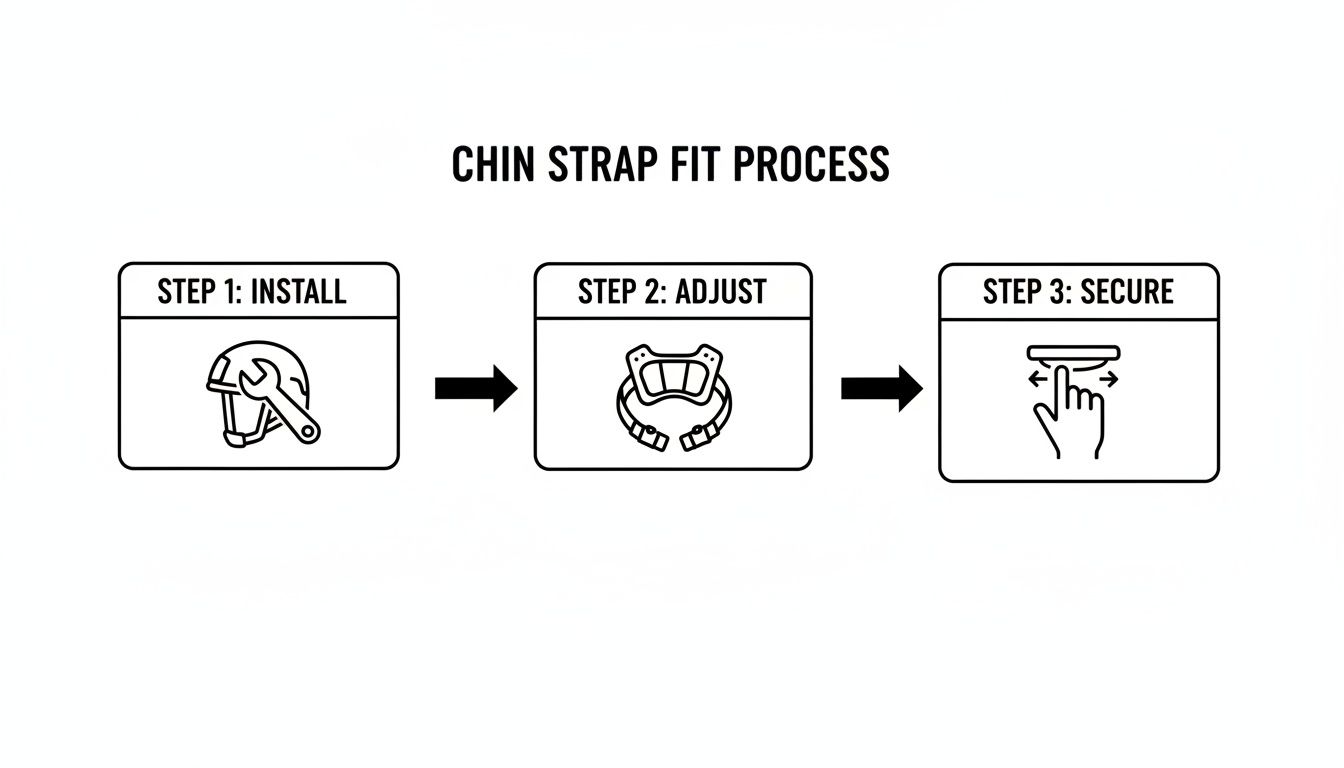
As you can see, the process moves from the initial installation to fine-tuning the nape pad and locking in the final fit. Each step builds on the last to create that rock-solid base you need.
By making your retention system a priority, you turn your helmet from a simple piece of protection into a fully integrated platform. It’s the critical upgrade that unlocks the true potential of all your other gear, making sure everything works together to improve your awareness and effectiveness when it counts.
Frequently Asked Questions About ACH Chin Straps
Stepping up your helmet's retention system is a smart move, but it's natural to have a few questions. Getting the details right is what separates a piece of gear that just works from one that performs flawlessly when it matters most. This FAQ section is designed to tackle the most common questions guys have when choosing, installing, and living with a new chin strap for an ACH helmet.
We'll get into everything from compatibility and cleaning to the all-too-common problem of helmet tilt with night vision. Think of this as the quick-and-dirty guide to reinforce everything we've already covered.
Can I Install Any 4-Point Chin Strap on My ACH Helmet?
This is the big one, and the short answer is: almost always, yes. The vast majority of modern 4-point chin straps on the market today are designed as direct, drop-in upgrades for the standard ACH and MICH bolt pattern. It's the gold standard. Manufacturers know this is the helmet most people are upgrading, so they build their kits to be compatible right out of the box.
What you're really looking for is confirmation of the bolt pattern and hardware. Any reputable brand will clearly state their product is "ACH/MICH compatible" and is meant to work with the four bolts and T-nuts already in your helmet. This makes swapping it out a simple, 10-minute job.
That said, always do your homework. Some obscure or older helmets might have funky, non-standard bolt spacing.
- Read the Product Page: Before you click "buy," look for a clear statement about ACH or MICH compatibility.
- Confirm the Bolt System: Make sure the strap you're looking at is designed for the standard four-bolt setup.
- Stick with Known Brands: Companies with a solid reputation build their gear to spec, which takes the guesswork out of it for you.
Bottom line: if you've got a standard-issue ACH or a close clone, a quality aftermarket 4-point strap should fit like a glove.
How Do I Clean and Maintain My Helmet Chin Strap?
Good gear lasts. And proper maintenance is what keeps your equipment reliable mission after mission. Over time, all that sweat, dirt, and grime can start to break down the materials in your chin strap. A simple cleaning routine is all it takes to keep your chin strap for an ACH helmet in fighting shape.
You don't need harsh chemicals or anything fancy. In fact, a simple approach works best.
- Mix Up a Solution: Just grab some mild soap (like basic dish soap) and mix it with warm water.
- Gentle Scrub: Use a soft brush to gently scrub the webbing, nape pad, and chin cup. You're just trying to lift out the built-up gunk.
- Rinse It Well: Use clean water to get all the soap residue off. Leftover soap can irritate your skin and actually attracts more dirt.
- Let It Air Dry: Hang the strap up to dry completely, but keep it out of direct sunlight or high heat. UV rays are a killer for nylon fibers over the long haul.
A word of warning: Never throw your chin strap in the washing machine or use bleach on it. The aggressive tumbling and harsh chemicals can destroy the integrity of the webbing. That's a critical failure you can't afford.
Beyond cleaning, get in the habit of giving your strap a quick inspection now and then. Look for any fraying, check the buckles for cracks, and make sure the mounting screws are still tight. Catching a small issue early prevents a major headache later.
My Helmet Tilts Forward With NVGs, Even When My Strap Is Tight!
Ah, the classic NVG head-bob. This is probably the most frustrating issue guys run into, but the fix isn't to just keep cranking down the chin strap until you can't feel your face. The problem isn't tightness; it's balance. A heavy night vision device hanging off the front of your helmet creates a powerful lever, and a chin strap alone was never meant to fight that kind of physics.
Imagine holding a 5-pound weight with your arm straight out. Eventually, your shoulder is going to give out. Your chin strap is in the same boat, fighting a battle it's guaranteed to lose.
The real solution is a proper counterweight system on the back of your helmet. A counterweight completely changes the game by balancing the load, making the entire helmet a neutral, stable platform. This frees up the chin strap to do its actual job: stabilizing the helmet, not single-handedly fighting gravity.
- Match the Weight: A good starting point is to use a counterweight that's roughly equal to the weight of your NVG and mount.
- Place It Low: For the best leverage, secure the counterweight as low as you can on the back of the helmet.
- Re-Adjust Your Strap: With the helmet balanced, you'll find you can actually loosen your chin strap for more comfort while the helmet stays locked in place.
A properly balanced helmet feels dramatically lighter, gets rid of that annoying forward tilt, and cuts down on neck fatigue during long nights.
What’s the Difference Between an X-Nape and H-Nape Chin Strap?
When you start browsing for a new chin strap for an ACH helmet, you'll immediately see two terms pop up: "X-Nape" and "H-Nape." The name simply describes the shape of the harness at the nape of your neck—the most important part for locking down your helmet.
An H-Nape system is the classic. It's what the original ACH used, featuring two vertical straps connected by a horizontal one, creating a clear "H" shape. This design is legendary for its rock-solid stability. It creates a powerful anchor point at the base of your skull and is incredibly effective at preventing that dreaded forward tilt.
An X-Nape system, as you can guess, has two straps that cross in an "X" pattern at the nape. This design often has a lower profile and can feel a bit more comfortable for some people, as it spreads the pressure out more evenly across the back of the head. That lower profile can also be a plus if you're wearing bulky collars or certain types of comms gear.
Ultimately, choosing between them is mostly about personal preference and how it integrates with the rest of your kit. Both are massive upgrades over older 2-point straps and will give you the stability you need to run a modern helmet setup effectively.
Ready to transform your helmet's performance? At Superior Tactical LLC, we offer a curated selection of top-tier retention systems and accessories designed to create a stable, comfortable, and mission-ready platform. https://superiortac.com
