A Guide to the Best Brands of Binoculars in 2026
When you start looking at brands of binoculars, it’s easy to get lost. The truth is, the "best" brand isn't a single name—it's the one that’s built for what you do. A brand's reputation is earned through years of field-tested reliability, proprietary optical technology, and warranties you can actually count on.
Choosing The Right Binocular Brand For Your Mission
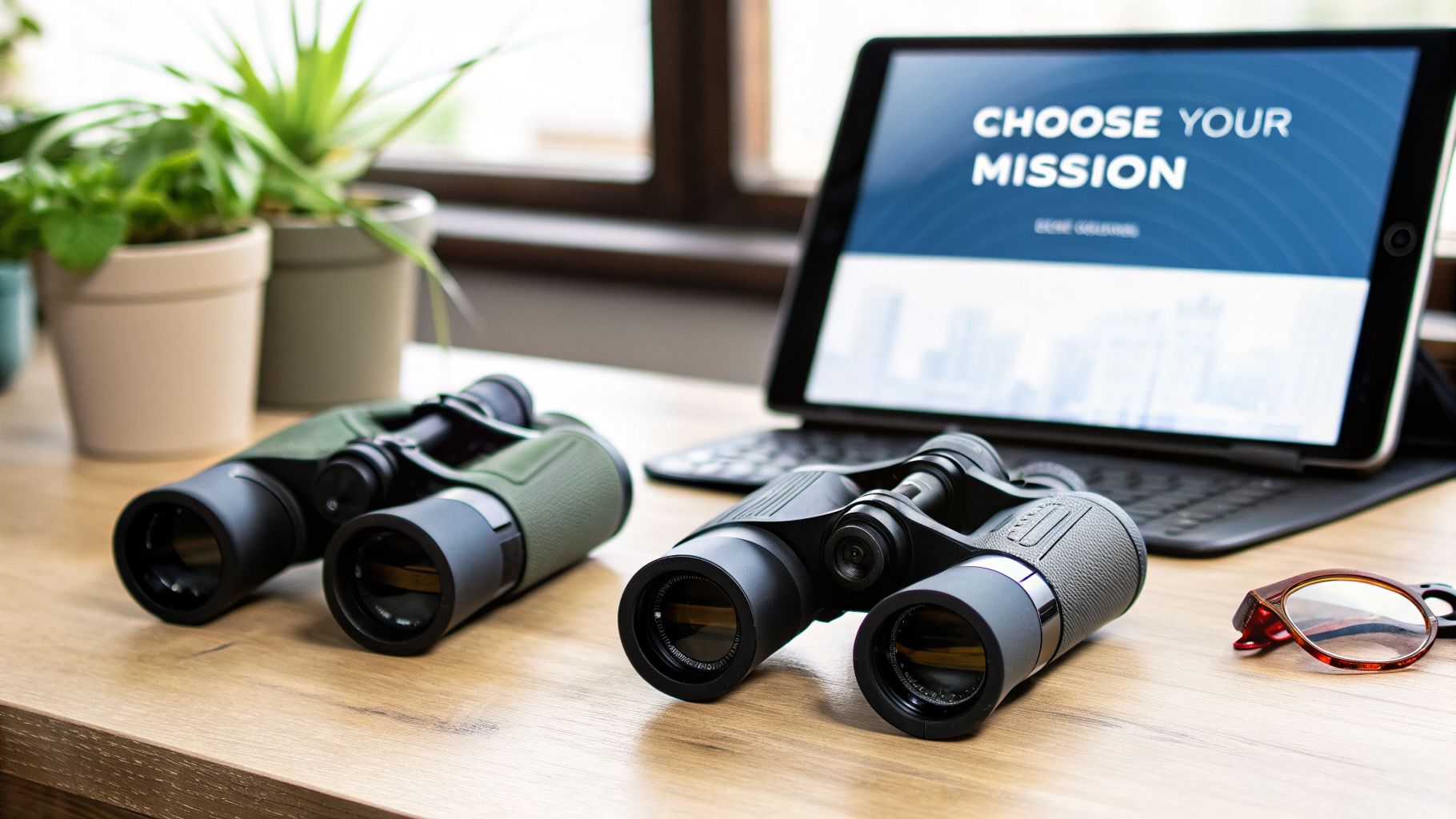
Think of it like buying a vehicle. You wouldn’t take a sports car down a rocky trail, and you wouldn’t commute in a massive dump truck. Each is a tool designed for a specific job, and the world of optics is exactly the same. The perfect brand for hunting in the dim light of dawn might be the wrong choice for tactical surveillance or spotting ships at sea.
This guide is designed to cut through the marketing noise. We'll look at the philosophies and technologies that really set brands apart, so you can make your choice based on what matters for your mission, not just a flashy logo.
Understanding Brand Tiers
It helps to group brands into a few general categories. While lines can blur, this framework gives you a solid place to start your search.
To give you a quick overview, here's a breakdown of the major brand categories you'll encounter.
Quick Guide to Major Binocular Brand Categories
| Brand Category | Known For | Primary Use Case | Example Brands |
|---|---|---|---|
| Alpha European | Unmatched optical purity, flawless glass, and legendary low-light performance. | Birding, elite hunting, nature observation, any activity where optical clarity is paramount. | Swarovski, Zeiss, Leica |
| High-Performance Tactical | Extreme durability, practical features for field use, and robust warranties. | Military, law enforcement, tactical operations, and demanding civilian use. | Vortex, Leupold, Steiner |
| Reliable Mid-Range & Entry | A strong balance of optical quality and affordability for a wide range of activities. | General hunting, hiking, sporting events, and entry-level birding. | Nikon, Bushnell, Celestron |
This table provides a great starting point, but it's important to remember that many brands have product lines that span multiple categories.
The market for high-quality optics is serious business, valued at around USD 0.98 billion in 2023 and expected to grow. You have the legacy titans like Carl Zeiss AG and Swarovski Optik who have defined optical excellence for generations. Alongside them, you have specialists like Vortex Optics, who’ve built a massive following by focusing on rugged, high-performance gear for professionals. You can learn more about the industry's direction in this global market report.
Understanding What Separates Top-Tier Optics
When you’re looking at different binocular brands, it’s easy to feel like you’re just reading marketing fluff. But the massive price gap between a $200 pair and a $2,000 one isn't just about a logo. The real difference is under the hood—in the quality of the optical system and how the whole thing is put together.
Think of it like a vehicle. A basic sedan and a high-performance truck will both get you from A to B. But one is built to deliver exceptional power, clarity, and reliability when conditions get tough, and that's precisely what you're paying for in premium glass.
The Glass and Coatings
At the absolute core of every binocular, you'll find the lenses and prisms. Top-tier brands pour their resources into two specific areas that have a huge impact on the image you see.
Extra-Low Dispersion (ED) Glass: Ever look through cheap binoculars and see weird color fringing, almost like a purple or green halo around objects? That’s called chromatic aberration, and it happens when standard glass can't focus all the colors of light to the same point. ED glass corrects this, acting like a precision filter to deliver a razor-sharp, color-accurate picture.
Advanced Lens Coatings: Lenses are coated with microscopically thin layers to reduce glare and let more light pass through to your eye. A basic "coated" lens might only transmit 80% of the available light. In contrast, a "fully multi-coated" model from a serious brand can achieve over 95% light transmission. That might not sound like much, but it's the difference between seeing a target clearly at dusk versus just seeing a murky silhouette.
In low light, a binocular's entire job is to gather as much light as possible. Those extra few percentage points in light transmission, all thanks to better coatings, can be the deciding factor between making a positive ID and missing the opportunity completely.
Built for The Field
World-class optics don't mean a thing if the binoculars can’t survive being dropped, soaked, or knocked around. This is where build quality comes in, and it's another area where the top brands truly pull away from the pack.
The chassis, or body, of the binocular is a perfect example. While many use aluminum, which is fine, high-end models often use a magnesium alloy chassis. It’s significantly lighter and much stronger, which you'll appreciate after carrying them all day.
These premium models are also purged with an inert gas like argon or nitrogen and then sealed with O-rings. This process makes them completely waterproof and, more importantly, fog-proof from the inside. When you need gear that just plain works, no questions asked, these are the details that matter. If you’re looking for gear that simplifies operation, you should check out our guide on how auto-focus binoculars operate for more on that.
A Look at the World of Premium European Optics
If you spend enough time around seasoned optics users, you'll inevitably hear a term pop up: “alpha glass.” This isn't just marketing hype; it’s a nod to a handful of legendary European brands that have set the standard for optical excellence for over a century. We're talking about the titans: Swarovski, Zeiss, and Leica.
These names have built their reputations not on flashy ads, but on relentless engineering and a deep-seated obsession with quality. Choosing a pair of binoculars from one of these makers is less a purchase and more of a long-term investment in your craft, whether that's hunting, guiding, or tactical observation.
A Legacy of Seeing What Others Can't
So, what sets them apart? It starts with the glass itself and the secret-sauce lens coatings they've spent decades perfecting. These proprietary formulas are fiercely guarded because they are the key to incredible light transmission, often pushing past 95%.
This isn't just a number on a spec sheet. It's what lets you see clearly when others can't. Think about a professional guide trying to spot game right at dusk—that critical window when most binoculars deliver a dim, frustratingly muddy image. This is precisely where alpha glass comes alive, pulling in every bit of available light to give you a bright, sharp, and detailed view.
For a serious hunter or an operator whose mission depends on their gear, this isn't a luxury—it's essential. The ability to distinguish a target from its background in low light can be the difference between success and failure.
Built to Outlast, Not to Be Replaced
This world-class optical performance is matched by build quality that can only be described as flawless. European optics are engineered to work perfectly in the harshest environments imaginable, from the biting cold of an arctic hunt to the oppressive humidity of a jungle.
They achieve this by using superior materials and construction methods that ensure the binoculars you buy today will deliver that same jaw-dropping performance for decades to come. Yes, the initial cost is significant, but it reflects a lifetime of value that cheaper alternatives simply can't offer. For those who demand the absolute best from their equipment, the investment in a top-tier brand pays for itself every single time you raise them to your eyes.
Tactical and Hunting Workhorses: Built for the Field
When you move past the world of pure optical perfection, you get into the gear that's built to be used, and used hard. This is the territory of brands like Vortex, Leupold, and Steiner. These companies have earned a rock-solid reputation with hunters, law enforcement, and military professionals for one simple reason: they build binoculars that just won't quit.
Think of them as the reliable workhorses of the optics world. They’re designed to get knocked around in the back of a truck, handle a sudden downpour, and still give you a crystal-clear image when that critical moment arrives. It’s no surprise that many, like Vortex, are famous for their unconditional lifetime warranties. That’s not a marketing gimmick; it's a statement of how much confidence they have in their equipment's durability.
Mission-Specific Features
What really sets these brands apart is their laser focus on features that actually matter out in the field. You're not paying for fancy names; you're paying for practical function.
- Mil-based reticles are common, giving you the ability to accurately estimate range and adjust your aim.
- Thick, rugged rubber armoring does more than just protect the optic—it gives you a solid grip, even with gloves on, and helps absorb impacts.
- Tripod compatibility is a must for anyone pulling long hours of observation, preventing the fatigue that can ruin a hunt or a surveillance operation.
This chart can help you decide which features to prioritize based on your primary use.
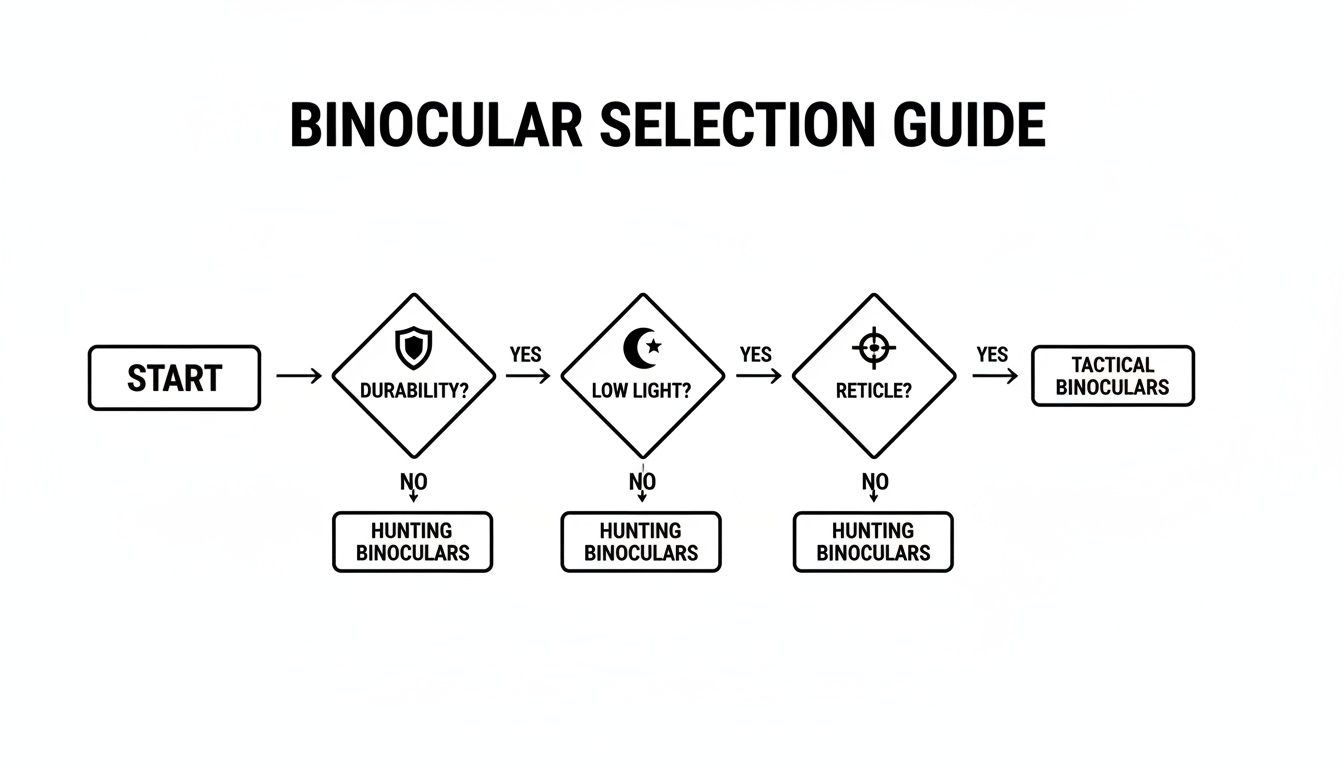
As you can see, while both missions demand toughness, tactical users often need a reticle for ranging, while hunters will get more benefit from superior low-light performance at dawn and dusk.
This commitment to battle-tested gear is a huge reason why North America is such a massive force in the global optics market, projected to account for between 32.43% and 32.46% of it by 2026. This demand comes straight from the defense and hunting communities, where professionals trust brands of binoculars like Vortex and Leupold when failure isn't an option. You can read more on the strength of the North American optics market here.
These brands hit the sweet spot. They deliver fantastic optical quality without the eye-watering price tag of the top-tier European "alpha" glass. They are the go-to for anyone who needs their gear to perform reliably under pressure, every single time.
Whether you're glassing a mountainside or conducting surveillance, these brands provide the toughness you need for demanding environments. And if your mission pushes into the dark, you may want to check out our guide on pairing binoculars with thermal and night vision.
How to Match the Right Brand to Your Mission
Knowing the science behind optics is one thing, but picking the right tool for the job out in the real world is a completely different ballgame. The best binocular brands aren’t just "the best" at everything. They're built with a specific purpose in mind, and the secret is matching their strengths to your mission.
This means you have to look past the logo on the side and focus on what truly matters for performance. A hunter’s priorities are all about those critical minutes at dawn and dusk, while a tactical operator needs something that can take a beating and provide ranging information. Let's break down which brands really shine for different applications.
For the Dedicated Hunter
When you're out hunting, the first and last moments of legal light are prime time. This is where your glass either earns its keep or lets you down, making the difference between a clean shot and a missed opportunity.
Leupold: This brand is practically synonymous with hunting. They are masters of light management, designing optics that pull in every available bit of light. Their binoculars are famously tough, built to survive the backcountry while delivering exceptionally bright, clear views when it counts most.
Vortex: If you're looking for that sweet spot between top-tier performance and a reasonable price, Vortex is hard to beat. They've become a go-to for hunters who need reliable optics without dropping "alpha glass" money. Their Diamondback and Viper lines, in particular, are celebrated for their clarity and rock-solid durability.
For Law Enforcement and Tactical Operations
In a tactical setting, equipment failure is simply not an option. Your binoculars need to be brutally durable, offer features for quick range estimation, and provide crystal-clear identification, day or night.
For an operator, a binocular isn't just for looking at things—it's an information-gathering tool. Features like a MIL-based reticle for ranging and extreme durability aren't just nice to have; they are non-negotiable requirements for mission success.
These are the brands that professionals trust when lives are on the line:
Steiner: With a long and proven history supplying military forces worldwide, the Steiner name is legendary for toughness. Many of their models come packed with features like laser rangefinders and specialized reticles, making them a top choice for serious professional use.
Vortex: Yes, Vortex is on the list again, and for good reason. Their tactical-focused Razor and Viper HD lines are built like tanks. Their commitment to rugged construction, locking diopters, and mil-reticles—all backed by their unconditional warranty—has made them a favorite among law enforcement and military units. If your mission bleeds into darkness, you can explore our collection of binoculars for day and night vision to see how these tools integrate into a complete 24-hour observation system.
Final Checks Before You Make Your Purchase
Alright, you've sifted through the top-tier European glass and the battle-tested tactical brands. You're close to making a decision, but don't head to checkout just yet.
Think of this last step as your final systems check before a mission. Running through a few key details now will prevent buyer's remorse later and ensure you get a tool that genuinely serves you for years.
Key Specs to Compare
Beyond the brand name, the spec sheet tells the real story of how a binocular will perform in your hands. It's easy to get overwhelmed, so let's focus on what actually matters out in the field.
- Field of View (FoV): This number, usually in feet at 1,000 yards, tells you how wide a picture you'll see. A generous FoV is a game-changer for scanning open country or trying to track a moving target without constantly whipping your head around.
- Eye Relief: This is the critical distance between the eyepiece and your eye. If you wear glasses, this spec is non-negotiable. Look for 15mm or more of eye relief, or you'll be jamming your glasses into the optic just to see the full image. It’s an uncomfortable and frustrating experience.
- Exit Pupil: Here's the secret to low-light performance. You find it by dividing the objective lens size by the magnification (a 42mm / 8x binocular has a 5.25mm exit pupil). A larger number means a brighter image when light is scarce, which is absolutely crucial for anyone operating at dawn or dusk.
Choosing the right retailer is just as important as choosing the right brand. A knowledgeable vendor provides crucial post-purchase support, from warranty assistance to answering technical questions that arise during use.
Questions to Ask Before You Buy
Finally, having a few sharp questions ready for your vendor can tell you a lot about the company you're buying from. Their answers reveal the level of support you can truly expect.
- Warranty: What, specifically, does the warranty cover? Is it a true lifetime, no-fault warranty, and does it transfer if I sell the binoculars later?
- Returns: What's your return policy look like if I get these into the field and they just don't work for me?
- Accessories: How easy is it to get model-specific accessories like tripod adapters or replacement lens caps down the road?
Your gear is a serious investment. Taking the time to understand these specs and ask the right questions ensures you’re getting the right tool from the best brands of binoculars for your specific needs. If you want to talk through the options with someone who uses this gear every day, don't hesitate to reach out to our team of experts.
Frequently Asked Questions About Binocular Brands
When you're shopping for binoculars, a few questions always seem to pop up. Let's get right to them with some straight-ahead answers based on years of field experience.
Is an Expensive Binocular Brand Always Better?
Honestly, no. It’s easy to get drawn in by the "alpha glass" from legendary brands like Swarovski and Zeiss. Their optical quality is breathtaking, but you're paying a serious premium for that last 2% of performance.
For most people, even in demanding roles, a solid mid-tier brand like Vortex or Leupold is the smarter buy. The "best" brand isn't the one with the highest price tag; it's the one that has the right features for your mission and a build quality you can bet your life on.
Think of it this way: for many users, a rock-solid build and an ironclad warranty are far more valuable than the absolute peak of optical perfection.
A great example is a brand’s warranty. When a company like Vortex offers an unconditional, transferable lifetime warranty, they're not just being generous. They're telling you they built that optic to take a beating and keep on working.
What Does the Warranty Tell Me About a Brand?
A warranty is one of the biggest clues about how a binocular is meant to be used. It reveals the manufacturer's confidence in its own engineering and durability. While you should always read the fine print, here’s what to look for:
- Unconditional Lifetime Warranty: This is the gold standard for hard-use gear. Brands like Vortex offer this, meaning they'll repair or replace the optic no matter what happens to it. If you’re in a tactical role or a hunter who is tough on equipment, this is what you want.
- Limited Lifetime or Numbered-Year Warranty: Often seen with high-end European optics, these warranties cover defects in manufacturing but usually not accidental damage. They're great warranties, but they signal that the optic might be built more for optical purity than for bouncing around in the back of a truck.
How Do I Know if I Need Tactical Features?
If you have to ask, you probably don't. The most common tactical feature is a reticle, which is a set of markings you see inside the optic.
A reticle is a purpose-built tool. It’s essential for military and law enforcement operators who need to estimate range or call in shots. For a civilian, it's mostly useful for long-range hunting. If you're just using your binoculars for general observation, birding, or spotting things on the water, a reticle just gets in the way.
At Superior Tactical, we live and breathe this stuff. Choosing the right optic is a critical decision, and our team has been in the field and knows what works. Take a look at the brands we trust, and don't hesitate to call us for advice. We're here to get you geared up for your mission.
