Boost Your Accuracy with the prismatic red dot: A Quick Guide
Ever looked through a red dot and seen a blurry, star-shaped mess instead of a crisp dot? If so, you’re not alone. That’s astigmatism, a common vision issue that can make standard reflex sights a real pain to use.
This is exactly where prismatic sights come in. They aren't your typical red dot; they're a compact scope built around an internal glass prism. This design creates a sharp, etched reticle that’s crystal clear, even if your eyes aren't perfect.
Decoding the Prismatic Red Dot
If that starburst effect sounds familiar, you've seen firsthand how astigmatism clashes with reflex sights, which work by projecting an LED dot onto a lens. A prismatic red dot gets around this by using a completely different optical system.
It's better to think of it as a tiny, non-magnified rifle scope rather than a simple window with a dot. Inside, a complex glass prism is used to focus an image and fold the light path, which is what allows for its compact size and two game-changing features.
The Power of an Etched Reticle
The first and most important feature is the etched reticle. The aiming point isn't a projected beam of light; it's physically carved into the glass. This gives your eye a solid, razor-sharp reticle to focus on, completely eliminating the blur and starbursting caused by astigmatism.
What's more, since the reticle is physically part of the glass, it's always there—even if your battery dies. The illumination is just there to light it up in the dark. That black, unpowered reticle serves as a foolproof backup, giving you peace of mind that you'll always have a usable aiming point.
A key advantage of the prism sight is its independence from battery power. The etched reticle ensures you always have a usable aiming point, transforming the battery from a necessity into a convenience for low-light conditions.
This built-in reliability is why prismatics have become so popular with law enforcement, hunters, and tactical shooters. They blend the fast acquisition of a red dot with the clarity of a traditional scope, offering a huge advantage when conditions are less than ideal.
Choosing the right optic can feel overwhelming, but understanding these core differences is the first step. To see how these technologies stack up, check out our full collection of red dot sights.
To make things even clearer, let's break down how prismatic sights compare to their reflex and holographic counterparts.
Prismatic vs Reflex vs Holographic At a Glance
Each of these popular "red dot" technologies gets the job done differently. This table gives you a quick rundown of what makes each one unique.
| Optic Type | How It Works | Best For Astigmatism | Battery-Free Reticle |
|---|---|---|---|
| Prismatic | Uses a glass prism and an etched reticle, similar to a traditional scope. | Yes | Yes |
| Reflex | An LED projects a simple dot or reticle onto a coated glass lens. | No | No |
| Holographic | A laser and mirrors create a true hologram of a reticle that appears downrange. | Better | No |
Ultimately, the prism sight carves out its own unique space. It offers the best solution for shooters with astigmatism while providing the peace of mind that comes with an always-on, battery-free reticle.
How a Prism Optic Creates a Perfect Sight Picture
At first glance, prismatic red dot sights seem to work like magic, packing a surprising amount of optical power into such a small package. But once you understand how the light moves through one, you'll see why they offer such unique advantages.
Think of it like a submarine's periscope, but instead of using a long tube with mirrors, the entire light path is bent and folded inside a solid block of glass. This clever design is the secret behind the modern prism optic.
A few key things make this possible:
- An etched reticle that's always visible, even with a dead battery.
- A folded light path that dramatically shrinks the sight's overall size.
- An adjustable diopter that lets you focus the reticle perfectly for your own eyes.
The Magic of the Folded Light Path
Instead of a series of lenses and mirrors like a traditional scope, a prism sight uses a solid piece of glass—the prism—to do all the work. It refracts (bends) the light internally, effectively folding the optical path and drastically reducing the length needed to create a clear image.
This efficient design gives you a true 1x image without the "fisheye" distortion you can get with some other optics. More importantly, because the prism is a single, rigid piece of glass, the reticle's alignment is locked in place, making it incredibly durable.
As any experienced gunsmith will tell you, the solid prism design inherently minimizes parallax better than many simple reflex sights.
That internal stability is why prismatic sights hold their zero so well, even under the heavy, repeated recoil of a high-caliber firearm. It’s a level of reliability that’s absolutely critical for law enforcement, military, and hunting applications.
To top it off, manufacturers use advanced anti-reflective coatings on the glass, which ramps up the brightness and cuts down on glare. This gives you a sharp, high-contrast sight picture, whether you're aiming in the dim light of dawn or the harsh midday sun.
Why an Etched Reticle Is a Game-Changer
One of the standout features of a prism sight is the etched reticle. The aiming point isn't projected by an LED; it's physically carved, or etched, directly onto the glass surface.
This means you have a permanent, razor-sharp aiming point that is always there, whether your battery is working or not. It's an analog fail-safe in a digital world. For a hunter in a blind at dusk or an officer in a critical situation, that kind of reliability is priceless.
Unlike painted or projected reticles, an etched one won't scratch off, and it's far less likely to "flare out" or become distorted in bright sunlight. It's built for the real world.
The diagram below gives you a quick visual breakdown of how prism optics stack up against the other major types.
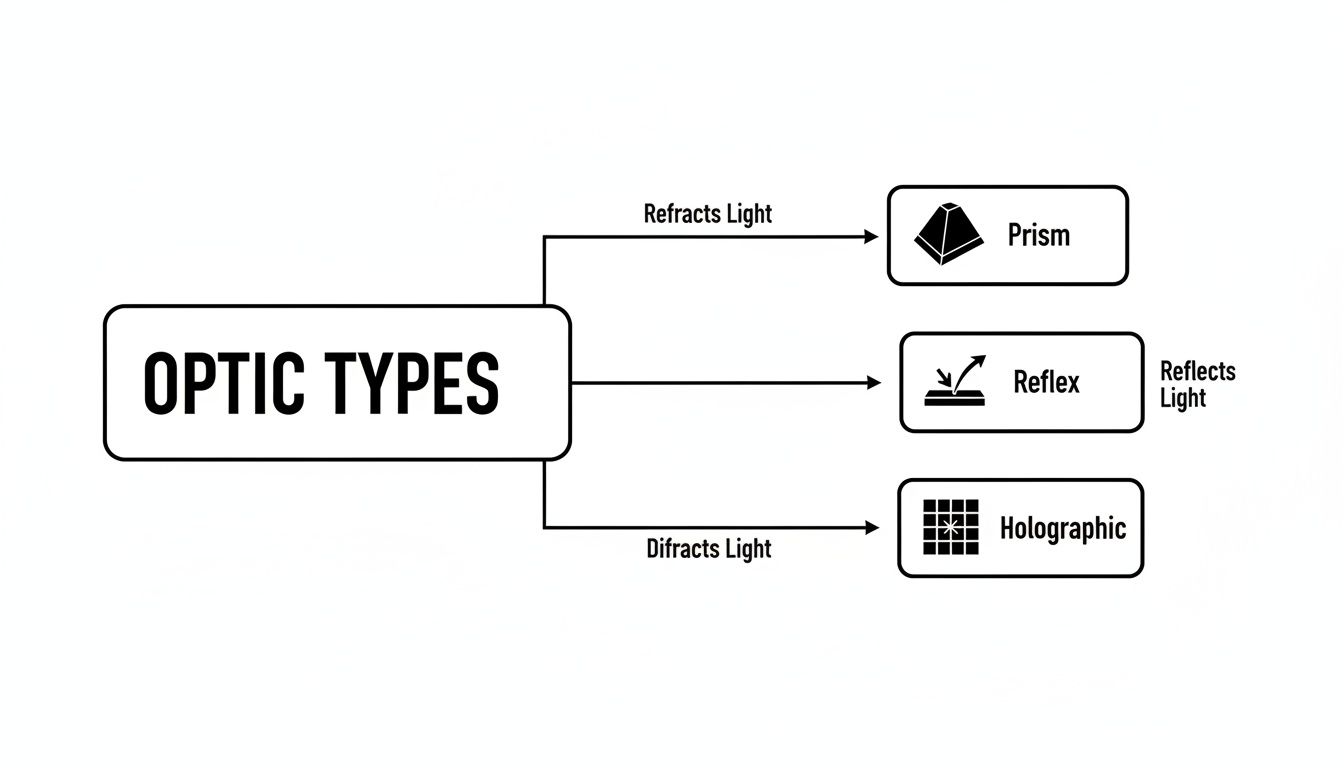
As you can see, prism sights occupy a unique middle ground, blending the compact size of a red dot with the crisp, focusable reticle of a scope—something you just don't get with reflex or holographic systems.
Fine-Tuning Your View with the Diopter
If you've ever used a good pair of binoculars, you're already familiar with a diopter. It’s that little focus ring on one of the eyepieces. On a prism sight, it does the exact same thing: it tunes the sharpness of the reticle to your specific eyesight.
This is a massive advantage for shooters with astigmatism. Where a standard red dot might look like a blurry starburst, a prism sight's diopter lets you dial the etched reticle in until it's perfectly crisp and sharp.
Pro Tip: The diopter is the one feature most new users forget to set, yet it's the single biggest reason a prism sight can feel so much clearer than other optics.
Getting it set up is simple, but it's a crucial first step before you even think about zeroing.
- Point the sight at a plain, bright background (like the sky or a blank wall).
- Turn the diopter ring until the reticle's edges are as sharp and clear as you can get them.
- Once it's perfect, lock it in place if your optic has a lock ring. Now you're ready to adjust your windage and elevation.
By combining that compact prism, a fail-safe etched reticle, and a fine-tunable diopter, these optics deliver a clear, personalized, and incredibly durable sight picture. It’s the perfect hybrid for anyone who needs the speed of a red dot but can’t compromise on optical clarity.
What Are the Real-World Advantages of a Prismatic Sight?
Theory and optical science are one thing, but what really matters is how a piece of gear performs on the range or in the field. This is where prismatic sights truly shine. They aren't just another type of red dot; they solve very specific, often frustrating, problems that many shooters face.
Let's break down the three biggest advantages that make a prism optic a game-changer for so many people.

The Definitive Fix for Astigmatism
If you have astigmatism, you know the struggle. You look through a standard reflex sight expecting a clean, crisp dot, but instead, you get a blurry starburst, a comet with a tail, or something that looks like a tiny bunch of grapes. This distortion makes aiming precisely a real chore and can lead to serious eye strain.
A prism sight completely eliminates this problem. Because the reticle is physically etched onto the glass and you can focus the sight with an adjustable diopter, you can tune the image perfectly for your eyes. That blurry mess snaps into a razor-sharp aiming point, making target acquisition faster, easier, and far more accurate.
Bombproof Reliability When It Matters Most
What if your battery dies at the worst possible moment? With a reflex sight, your dot simply disappears, leaving you with nothing. With a prismatic sight, the etched reticle remains visible in black, giving you a reliable, always-on aiming solution. You are never left completely without a usable sight.
This built-in fail-safe offers incredible peace of mind. Whether you're a law enforcement officer on a call or a hunter tracking game in fading light, knowing your optic works with or without power is a huge confidence boost. The battery is just there to light up the reticle; it isn't required for the sight to function.
An unpowered prism sight is still a usable optic. An unpowered reflex sight is just a piece of glass. This fundamental difference in reliability is a key reason professionals choose prismatic designs for duty use.
More Versatile and Capable Reticles
A simple red dot is fast, but it doesn't give you much information. Prismatic sights open the door to much more advanced reticles that can do a lot more for you downrange.
- Bullet Drop Compensators (BDC): These give you built-in holdover marks to easily account for bullet drop at different distances.
- Ranging Stadia: These are lines or patterns that help you estimate how far away a target is, provided you know its approximate size.
- Horseshoe or Chevron Patterns: These advanced designs are brilliant for combining fast, close-quarters aiming with the ability to make precise long-range shots.
This versatility transforms a simple 1x optic into a much more capable tool. For example, a 3-gun competitor can use BDC holds to nail targets at multiple ranges on the fly without ever touching their adjustment turrets. To learn more about getting more reach from your setup, check out our guide on the benefits of red dot magnifiers.
The rise of the prismatic red dot reflects a major shift in tactical accessories. When Trijicon introduced the ACOG prism sight in 1997, it changed close-quarters battle with its fixed magnification and bindon aiming concept, leading to its adoption by 70% of U.S. Special Forces units by 2010, according to military reports. Learn more about the growth of the tactical optics market and its key drivers.
The Give-and-Take of Prism Scopes
Prism sights solve some huge problems, especially for shooters with astigmatism, but like any piece of gear, they're not magic. They come with their own set of rules and limitations that are important to understand before you commit. You're making a conscious trade, swapping some of the flexibility of a traditional red dot for a few very specific, powerful advantages.
The biggest shift you'll notice coming from a standard red dot is the need to manage eye relief and the eye box. A reflex sight doesn't care where your head is—as long as you can see the dot, you're good to go. A prism sight, however, works more like a traditional rifle scope. It has a specific, limited distance your eye needs to be from the rear lens to see the full picture.
Get too close or too far back, and you'll see a black ring closing in from the edges. This defined window is called the "eye box," and it's less forgiving than a reflex sight's. It means your cheek weld and head position have to be more consistent to get on target quickly.
Size and Weight: The Physical Cost
There's no getting around the physics. The internal glass prism that makes these sights work is inherently more complex and bulkier than the simple emitter-and-lens setup in a reflex sight. This translates directly to a slightly larger and heavier optic.
For a competition shooter or someone building an ultralight mountain rifle, those extra couple of ounces can be a big deal. It's a tangible tradeoff for the benefits of a crisp, etched reticle and the ability to function without a battery.
At its core, the choice is simple. With a prismatic sight, you are trading the forgiving head placement and lower weight of a reflex sight for a vastly superior, astigmatism-friendly reticle and true battery-independent reliability.
This is the central compromise. You have to decide if the unmatched reticle clarity and failsafe design are worth the specific quirks of the prism system.
Is a Prism Sight Right for You?
To figure out if a prism sight fits your needs, think about what's most important in how you shoot.
- Shooting from Awkward Positions? If you're constantly shooting from unconventional positions where a perfect cheek weld is a luxury, the massive eye box of a reflex sight might serve you better.
- Need Absolute Reticle Clarity? If you have astigmatism and see a blurry starburst instead of a dot, the slightly tighter eye box of a prism is a tiny price to pay for a perfectly sharp aiming point.
- Building a Minimalist Rifle? If every single ounce matters, the lighter weight and smaller profile of a micro red dot will likely win out.
In the end, the prismatic sight fills a unique niche. It shines exactly where reflex sights struggle, but it does ask for a little more consistency from the person behind it.
How to Choose the Right Prismatic Red Dot for You
Picking the perfect prismatic red dot isn't about finding some mythical "best" optic—it's about finding the right one for you. The market is packed with options, from simple 1x models to magnified tactical sights. The key to making a smart choice is to stop looking at marketing hype and start evaluating a few core criteria against how you actually plan to use it.
First things first, think about the reticle and magnification. Do you need the raw speed of a clean, simple dot for up-close work? Or would a more detailed Bullet Drop Compensator (BDC) reticle help you connect with targets at a distance? The answer depends entirely on your mission.
Define Your Mission Parameters
A hunter moving through dense woods has completely different needs than a 3-gun competitor or a law enforcement officer clearing a building. Before you even glance at a spec sheet, get brutally honest about what you'll be doing.
-
For Close Quarters (0-100 yards): A true 1x prismatic red dot is king here. It gives you a massive field of view for snapping onto targets quickly and lets you shoot with both eyes open—a non-negotiable for maintaining situational awareness.
-
For General Purpose Use (50-300 yards): This is the sweet spot for a fixed 3x or 5x prism sight. You get just enough magnification to properly identify what you're shooting at and make good use of a BDC reticle, but it's not so powerful that it becomes a liability up close.
-
For Duty or Defense: In this world, toughness and reliability trump everything else. You need an optic with a bomb-proof, shock-rated housing, proven water resistance, and a simple, daylight-bright reticle that your brain can process instantly under stress.
Prismatic red dot sights really shine because of their hybrid design, fitting perfectly into setups with magnifiers and weapon lights for any scenario. In fact, industry tests show that 80% of tactical professionals prefer prismatic sights for engagements under 50 yards. Why? Their etched reticles offer zero parallax error, a clear advantage over the 2-3 MOA of parallax often found in traditional tube-style red dots. For a deeper dive into market trends, check out this red dot sight market report from Market Research Future.
Evaluating Key Features and Specifications
Once you know your mission, it's time to get into the nitty-gritty. This is where you look past the fancy ads and focus on the specs that actually matter in the real world.
Durability and Mounting Footprint
An optic is only as good as the box it's built in. Look for sights machined from high-grade aluminum, and make sure they're nitrogen-purged to stop the lens from fogging up internally when the weather turns. Just as important is the mounting footprint. Many of the best compact prisms use the popular mini-ACOG standard, which opens up a huge world of aftermarket mounts. If you're weighing your options against other compact optics, our guide on the EOTech Eflx Mini Red Dot Sight is a great place to see how they stack up.
One of the most critical—and most overlooked—features is motion activation. An optic that powers up the instant you pick it up and shuts down when it's sitting still can stretch a battery from months into years. It's the ultimate set-and-forget feature.
Battery Life and Advanced Functions
A dead optic is just a heavy piece of glass. Insist on models that offer thousands of hours of battery life from a common, easy-to-find battery like a CR2032. Features like a wide range of brightness settings, night vision compatibility, and that all-important motion activation add serious utility. A sight that intelligently manages its own power is one you can trust with your life, making it a smart investment for any serious shooter.
Mounting and Zeroing Your New Prism Sight
There's nothing quite like unboxing a new optic. But all that potential stays in the box until you get it mounted securely and zeroed correctly. This is where the rubber meets the road—a proper setup is the foundation of accuracy, ensuring your prism sight stays put and your rounds hit their mark, shot after shot.
Let's get you from the workbench to the range, ready to go.
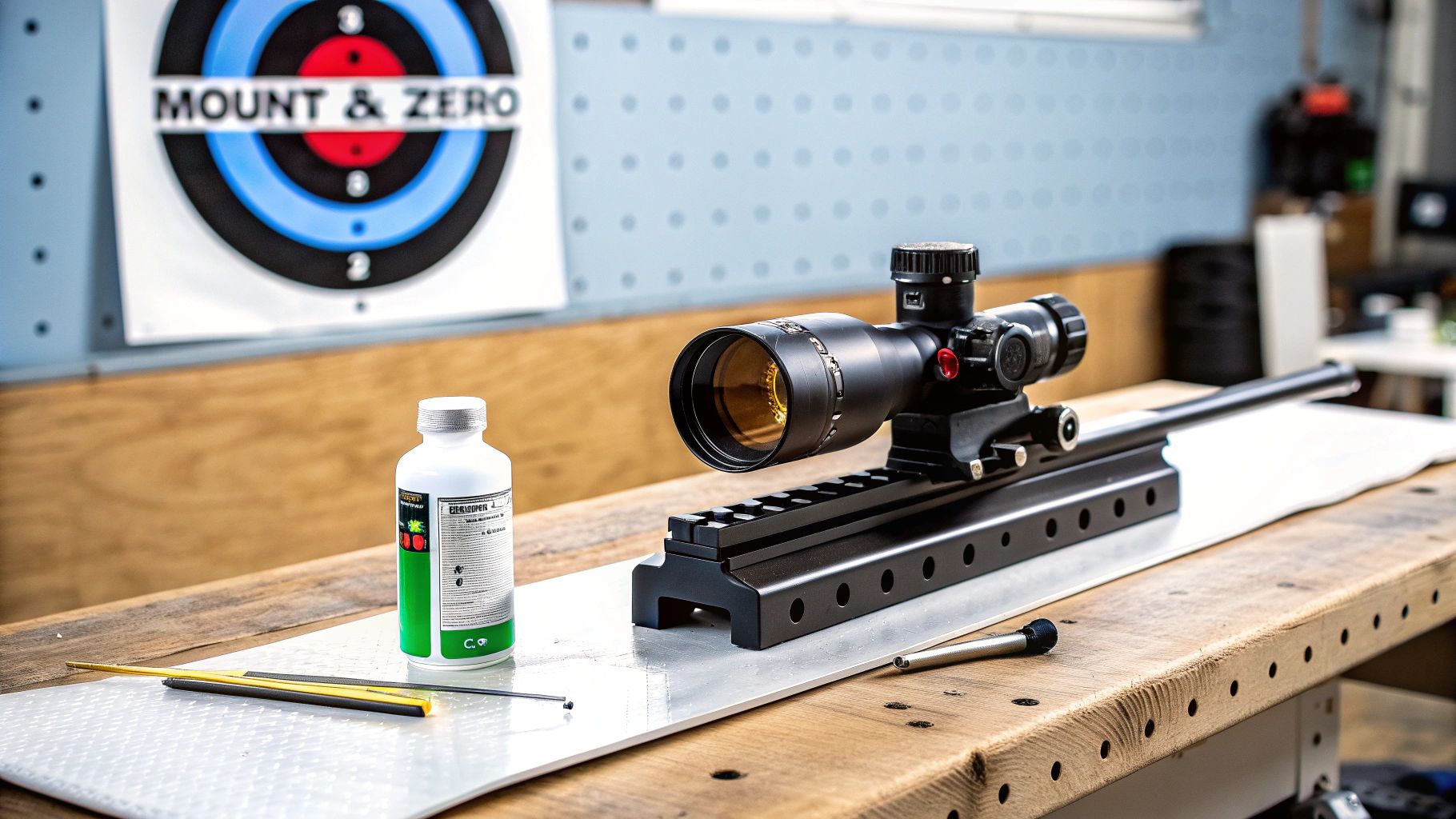
First things first: a rock-solid mount is absolutely non-negotiable. Before you do anything, make sure your firearm is unloaded and safe. Give the rail and the bottom of the optic's mount a quick wipe-down to get rid of any factory oil or grit. A tiny drop of blue thread locker on the screw threads is cheap insurance against recoil loosening things up down the road.
Slide the optic onto the rail, finding that sweet spot for your eye relief, then snug up the screws. Now, grab a torque wrench. This isn't optional. Most manufacturers call for something in the 20-30 inch-pounds range. Cranking down too hard can damage the mount or your rail, but going too light is a surefire way to lose your zero.
The Zeroing Process Step by Step
Alright, hold on before you start spinning those turrets. The most crucial step for any prism sight comes first: focusing the diopter. This adjusts the reticle specifically for your eye.
Point your unloaded firearm at a blank wall or the empty sky and twist the diopter ring (usually at the very back of the optic). Keep turning it until the reticle is perfectly sharp and crisp. If you don't do this, you'll spend the rest of the day fighting a blurry reticle, and your zero will never feel quite right.
Do not attempt to zero a prismatic red dot until the diopter is focused for your specific vision. This ensures you are aligning a sharp reticle with your target, not a blurry image.
With the diopter dialed in, you're ready to get on paper.
- Bore Sight First: A quick bore sight at 25 yards will save you a ton of time and ammo. It gets the optic roughly aligned with the barrel, ensuring your first shots are at least on the target.
- Fire a Group: Get into a stable, supported shooting position. A bench rest or a bipod is ideal. Carefully fire a tight, three-shot group.
- Measure and Adjust: Now, measure how far your group is from the bullseye. For example, you might be two inches low and one inch to the right.
- Make Corrections: Time to use the windage (left/right) and elevation (up/down) turrets. Check your optic's manual for the adjustment value—most are ½ MOA per click. In our example, you'd adjust the elevation "UP" and the windage "LEFT" by the required number of clicks to cover those distances.
- Confirm Your Zero: Fire one more three-shot group to make sure your adjustments were on the money. If it's dead on, you're set. If not, make minor corrections and confirm again.
Got Questions About Prismatic Sights? We've Got Answers.
Even after you get the basic concept down, a few specific questions always come up when you’re getting ready to pull the trigger on a new optic. Let's tackle the most common ones head-on so you can make a choice you'll be happy with.
Can I Use a Magnifier with a 1x Prismatic Sight?
You absolutely can, but the setup has a specific quirk you need to know about. It’s a simple two-step process.
First, look through the prism sight by itself and adjust its diopter until the reticle is perfectly sharp and crisp for your eye. Don’t skip this part.
Only after the reticle is focused should you flip the magnifier into place behind it. Then, use the magnifier's own diopter adjustment to get a clear view. If you follow that order, you'll have a sharp reticle and a perfectly magnified target.
Is a Prism Sight Better Than a Holographic Sight?
This is an "apples and oranges" situation—they’re just built for different jobs.
For anyone dealing with astigmatism, a prismatic red dot is almost always the winner. The etched, focusable reticle gives you a razor-sharp aiming point that many holographic sights simply can't provide for shooters with that condition. Plus, it works even if the battery dies.
On the other hand, a holographic sight provides a huge, forgiving eye box and has virtually no parallax. This makes it insanely fast for getting on target, especially from less-than-perfect shooting positions. It really boils down to what matters more to you: absolute reticle clarity for astigmatism (go with the prism) or pure speed and flexibility (holographic is your best bet).
A prismatic sight uses an adjustable diopter to physically solve the "starburst" effect of astigmatism. A holographic sight offers top-tier speed and parallax performance, but the reticle can still look fuzzy to those with the condition. Your eyes and your priorities should make the final call.
What's the Deal with Eye Relief on a Prism Sight?
Eye relief is simply the sweet spot—the specific distance your eye needs to be from the rear lens to see the entire sight picture clearly.
Reflex sights have nearly infinite eye relief, but prism sights are a different story. They have a defined and much tighter window, usually somewhere in the 2 to 4 inch range.
If you mount it too far forward or too far back, you’ll see a black ring or get a "looking through a tunnel" effect. This is the main trade-off for getting that crystal-clear etched reticle, and it means you need to practice a consistent cheek weld on your rifle.
