A Guide to Gen 4 Nightvision Technology
Let's get one of the biggest points of confusion out of the way first. Officially, there's no such thing as "Gen 4 night vision" in the eyes of the U.S. military. It's not a formal designation.
So, what is it? "Gen 4" is the common industry term for a major leap forward in image intensifier technology: filmless and autogated tubes. This tech delivers a night vision experience with incredible clarity, especially in tricky, mixed-lighting situations.
Unpacking the Truth About Gen 4 Night Vision
While the name might be a bit of a marketing term, the technology it describes is absolutely real and offers a serious performance edge. It represents the peak of analog image intensification that started showing up in the late 1990s.
These advanced units did away with the ion barrier film that was standard in most Gen 3 tubes. On top of that, they added autogating to rapidly manage changing light conditions. That one-two punch is what truly sets this class of night vision apart from everything that came before it.
At its core, "Gen 4" is really just a filmless Gen 3 tube. Removing that film is the secret sauce. It lets more light into the tube, which translates directly to a brighter, crisper image for the user. It’s like taking off a pair of slightly smudged sunglasses—suddenly, the world is sharper and clearer.
What Filmless Technology Really Means
In a standard Gen 3 tube, a thin ion barrier film protects the photocathode from being damaged. It does its job, but it comes at a cost—it slightly blocks incoming light and is the main cause of the "halo" effect you see around bright lights.
By getting rid of this film, "Gen 4" tubes unlock some serious benefits:
- Superior Light Sensitivity: More photons get through to be converted into electrons. This means you get a clean, usable image in near-total darkness where other units would just show you static.
- Reduced Halo Effect: That distracting glowing ring around a streetlight or a teammate's IR laser is drastically smaller. This is a huge deal for maintaining situational awareness in urban areas or during dynamic encounters.
- Higher Signal-to-Noise Ratio (SNR): The image is noticeably cleaner, with less of that grainy "snow." A higher SNR allows you to spot and identify targets from much farther away.
This jump in performance was a massive step in the story of night vision's progress. To get the full picture of how we got here, take a look at our detailed guide on the evolution of night vision from World War II to cutting-edge technology.
The real magic of filmless technology is how it wrings every last drop of performance out of the available ambient light. Think of it like swapping out a standard car antenna for a massive satellite dish—you're pulling in a much stronger, clearer signal.
So, while purists might argue about the "Gen 4" name, the performance of gen 4 night vision is undeniable. It describes a specific class of filmless, autogated devices that push the boundaries of clarity and low-light capability. This is why it's the go-to choice for professionals who need every possible advantage when the sun goes down.
How Gen 4 Technology Unlocks a Clearer Image
To really get what makes Gen 4 night vision such a huge step up, we have to look at what’s happening inside the image intensifier tube. It all comes down to two major upgrades working in tandem: filmless technology and autogating. Together, they create an image that is stunningly clear and incredibly responsive.
Think of a standard Gen 3 tube as having a microscopic screen door—the ion barrier film—sitting over a key component. This film is there to protect the tube, but it also gets in the way, blocking a bit of incoming light. The result is a slightly dimmer image and those annoying halos you see around bright lights.
Gen 4 simply gets rid of that screen door. This filmless design means way more photons (the basic particles of light) can make it into the tube and hit the photocathode. The payoff is a brighter, sharper image with much better contrast, especially when you're operating in near-total darkness.
This diagram helps visualize the two pillars of Gen 4 tech.
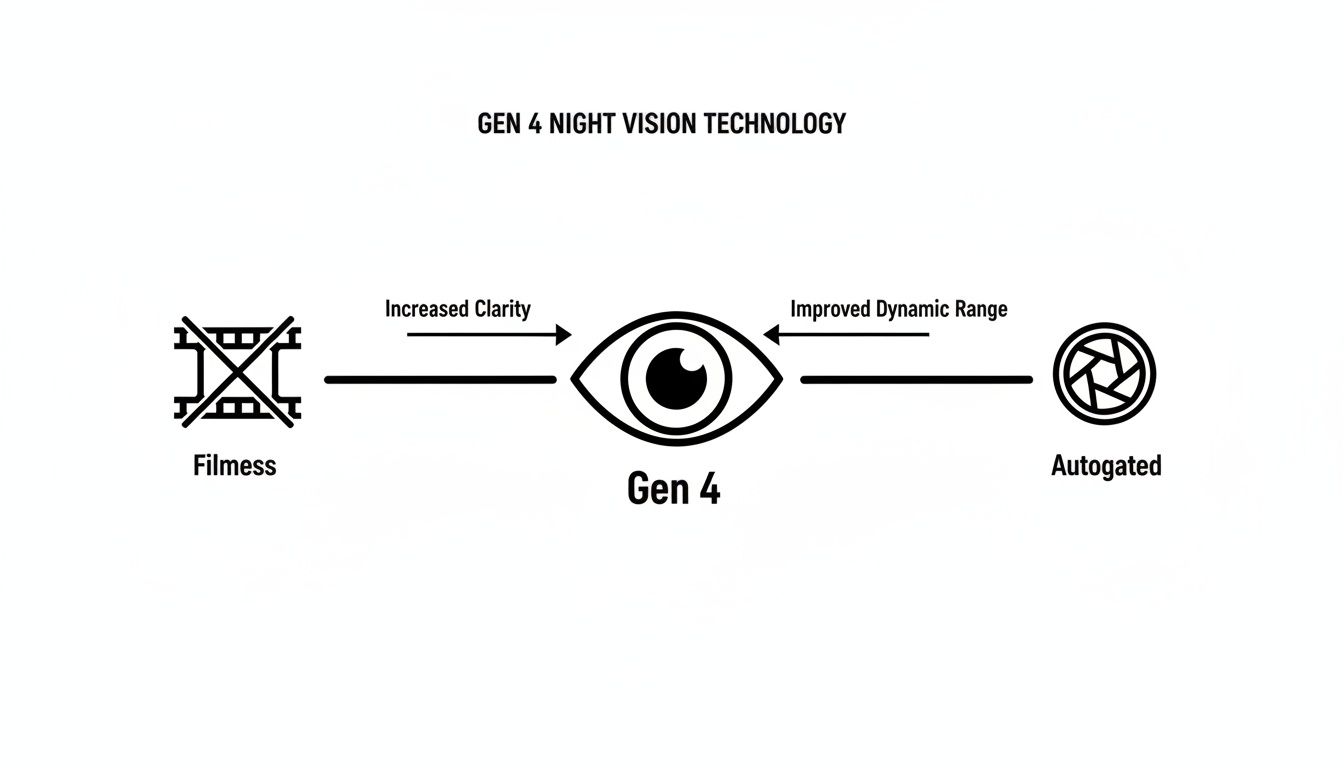
You can see how the filmless design lets more light in, while the autogating feature actively manages changing light levels. Both are critical for that top-tier image quality.
The Power of Autogating
The other half of this equation is autogating. The best way to picture it is to imagine a camera shutter flickering open and closed thousands of times every second—so fast you can't possibly see it. This constant, high-speed cycling of the tube's power supply is what makes these devices so effective in the real world.
When your night vision suddenly hits a bright light source—a muzzle flash, headlights, a porch light flipping on—the autogating instantly throttles down the power. This does two very important things:
- Protects the Tube: It shields the sensitive internal parts from getting fried by too much light, helping the tube last for its full operational life of over 10,000 hours.
- Saves Your Vision: It dramatically cuts down on the blooming, or "halo," effect. Instead of getting blinded by a flash, your view stays crisp, and you never lose situational awareness.
This instant adjustment stops the image from washing out completely, letting you keep a perfect sight picture even as you move through an urban area with unpredictable lights.
Autogating is what lets an operator move from a pitch-black alley onto a lit street without losing a single beat. It's a protective reflex for both the tube and the user.
Why Filmless and Autogating Matter Together
Filmless tech and autogating aren't just separate upgrades; they're a tag team. The filmless design is all about maximizing the light you have to work with, giving you the cleanest possible image to start with. This is often paired with a different image palette, and you can learn more about the advantages of white phosphor night vision to see how that impacts target ID.
Meanwhile, autogating is the guardian that makes sure that beautiful image stays perfectly usable, no matter what the environment throws at you.
This powerful synergy is what delivers the performance that defines Gen 4:
- Incredible Low-Light Performance: You can see clearly in situations where older gear would just show you a screen full of static.
- Superior Clarity and Resolution: The picture is sharper, letting you pick out details from much farther away.
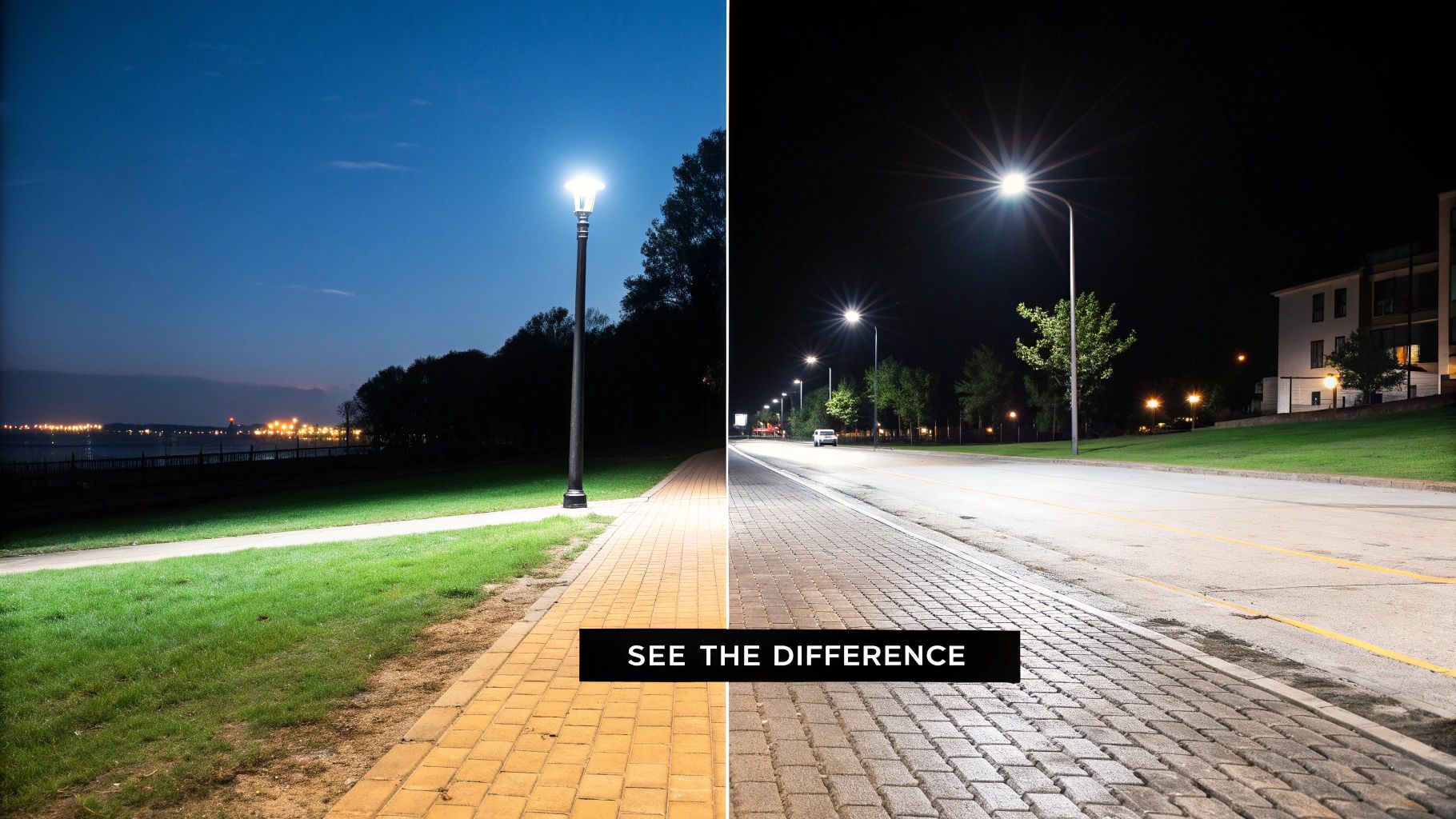
- Reduced Halo and Blooming: A clean view around streetlights and other artificial light is a must-have for law enforcement and military ops in cities.
- Enhanced Dynamic Range: The unit can handle deep shadows and bright spots in the same scene without the image quality taking a nosedive.
At the end of the day, these advances aren't just about making a prettier picture. They give you a real tactical edge, helping you see more, identify threats faster, and operate with more confidence when the lights go out.
Translating Night Vision Specs into Performance
Diving into a night vision spec sheet can feel like trying to read a foreign language. But those numbers and acronyms tell the whole story of how a device will actually perform when the lights go out. Getting a handle on them is the key to seeing past the marketing hype and truly understanding the capability of a gen 4 nightvision system.
Think of it this way: the spec sheet is the device's resume, and each metric is a core skill. Your job is to translate that resume into real-world performance to see if it’s the right tool for the job. Let's break down the specs that matter most so you can make a smarter, more confident investment.
Signal to Noise Ratio: The Bedrock of Clarity
The Signal-to-Noise Ratio (SNR) is arguably the single most important number on a spec sheet. It tells you, in simple terms, how clean the image is. The "signal" is the useful light information you're trying to see, while the "noise" is that distracting, grainy static—the "snow"—that gets in the way.
A great analogy is tuning into a radio station. A high SNR is like a crystal-clear broadcast where every word is sharp. A low SNR is like trying to listen through a blizzard of static, forcing you to guess what's being said. For night vision, a higher SNR means you can identify what you're looking at from farther away, especially when it gets really, really dark.
Resolution: Seeing a Threat, Not Just a Shape
Resolution, measured in line pairs per millimeter (lp/mm), defines the sharpness and detail in the image. This is the difference between seeing a vague, blurry shape in the distance and clearly identifying it as a specific person or animal.
It’s like the jump from an old standard-definition TV to a modern 4K display. Both show you a picture, but the 4K TV reveals incredible detail you’d never catch otherwise. In a gen 4 tube, high resolution is what allows you to distinguish between a branch and a rifle, or a deer and a wild hog, from a safe distance.
Putting It All Together With FOM
So how do you balance SNR and resolution? That’s where Figure of Merit (FOM) comes into play. It’s a straightforward calculation that gives you a single, easy-to-compare number to gauge a tube's overall performance.
FOM = Resolution (lp/mm) x Signal-to-Noise Ratio (SNR)
A higher FOM generally means a better-performing tube. For instance, a tube with 72 lp/mm and an SNR of 35 would have a FOM of 2520. This metric is incredibly helpful for quickly comparing different tubes and getting a snapshot of their potential.
Finally, we have Equivalent Background Illumination (EBI). This measures how much light the tube itself generates internally. A lower EBI is always better, as it means the tube can "see" deeper into the darkest shadows without its own glow washing out faint details.
Understanding these specs allows you to decode a tube's potential. These metrics are especially crucial when evaluating the differences between various tube technologies. For a deeper technical dive, check out our guide on the comparison of thin-filmed and unfilmed image intensifier tubes. By mastering this language, you're no longer just buying a product; you're selecting a high-performance tool based on its proven capabilities.
How Gen 4 Dominates in the Real World
Technical specs are one thing, but where gen 4 nightvision truly proves its worth is in the field. When the stakes are high and every second counts, the technology’s superior clarity, light sensitivity, and responsiveness give users a decisive edge.
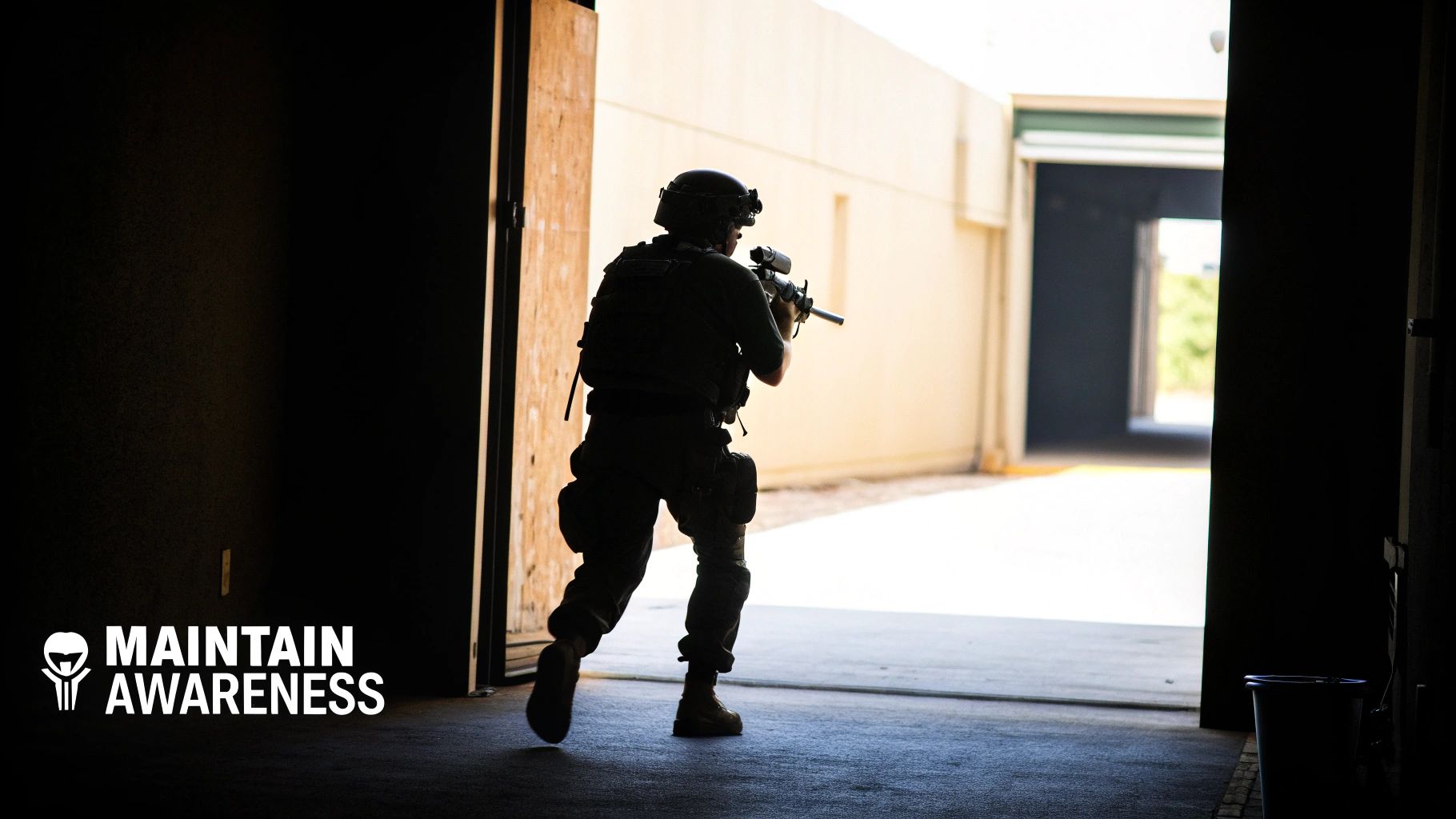
Think about a law enforcement officer clearing a building. One moment they're in a pitch-black hallway, the next they pass an open window flooded with light from a streetlamp. Older night vision would "bloom" out, a blinding white flare that completely wipes out the image and leaves the officer dangerously exposed.
This is exactly the kind of situation Gen 4 was built for. Its autogating kicks in instantly, throttling the incoming light to maintain a crisp, usable image. The officer can see threats in the dark room and identify movement outside the window without missing a beat. This isn't just a minor upgrade; it’s a fundamental change in how operators can work safely and effectively.
Law Enforcement and Tactical Operations
Urban environments are a nightmare of mixed lighting—deep shadows right next to sudden, blinding light sources. For police and SWAT teams, Gen 4 technology is the perfect tool for the job.
- Vehicle Takedowns: Approaching a car with its headlights blazing? The massively reduced halo effect lets an operator see inside the vehicle, not just a giant orb of light where a potential threat might be.
- Dynamic Entries: The incredible sensitivity of a filmless tube allows an officer standing in a lit hallway to peer deep into an unlit room, gathering intel before making entry.
- Surveillance: A high Signal-to-Noise Ratio (SNR) delivers a clean, grain-free image, making it possible to identify suspects from a safe distance, even on a cloudy, moonless night.
In a tactical environment, hesitation gets you hurt. Gen 4 all but eliminates the visual hesitation caused by changing light, letting operators process what they're seeing and act instantly.
History shows how game-changing this kind of technological leap can be. During Operation Desert Storm in 1991, the older Gen 3 tech gave U.S. forces a staggering 90% night engagement advantage. Building on that legacy, Gen 4 equivalents have pushed the envelope even further. In the 21st century, integrating this level of technology boosted SOCOM kill ratios by 40% during low-light operations. You can dive deeper into the history and ongoing debate in this detailed analysis on AGM Global Vision.
Military and Special Operations
For soldiers on the ground, these advantages directly translate to increased lethality and better odds of coming home. Owning the night is everything in modern warfare, and Gen 4 provides the sharpest edge possible.
The improved resolution and clarity allow for positive target identification at much greater ranges, which is critical for preventing tragic friendly-fire incidents. On top of that, the clean, detailed image from a high-FOM tube lets a soldier move faster and more confidently over rough terrain in the dark, reducing fatigue and keeping the operational tempo high all night long.
Hunting and Civilian Applications
The benefits of gen 4 nightvision aren't just for tactical professionals. For a serious hunter, this technology is an absolute game-changer, especially for nocturnal predators and hog control.
A filmless tube's superior light transmission means a hunter can pick out an animal in deep shadows under a new moon, at ranges where lesser devices show nothing but static. This directly translates to more successful hunts and, more importantly, the ability to make an ethical shot by clearly identifying the target and what’s behind it.
The same principles apply to civilian defense. Being able to identify a potential threat on your property without giving away your position with a flashlight is a huge advantage. Gen 4 provides the critical clarity needed to make a sound judgment call in a high-stress, low-light emergency, ensuring you can accurately assess a situation before deciding to act.
Choosing the Right Gen 4 Night Vision System
Putting together a high-performance Gen 4 night vision rig is a serious investment, but picking out a top-shelf tube is only the beginning. How you actually build out the rest of the system is just as important. The right setup feels like an extension of your own senses, while the wrong one is an expensive, frustrating paperweight.
Your first big decision is whether to go with a single tube or two. This choice between a monocular and a binocular setup really dictates how you'll use the device.
Monocular vs. Binocular Setups
A monocular, like the tried-and-true PVS-14, uses a single image intensifier tube for one eye. It's an incredibly popular and versatile choice for good reason. Your unaided eye is left free to adapt to the surrounding light, which is a huge plus for situational awareness. It makes simple tasks—like glancing at a map or sighting through a non-NV-compatible optic—much easier. Plus, they're lighter and easier on the wallet than a dual-tube setup.
Binocular systems, often called dual-tubes, give you a dedicated tube for each eye. The big payoff here is true depth perception. If you're moving over rough ground on foot or driving a vehicle at night, that stereoscopic vision is an absolute game-changer. It also dramatically cuts down on eye strain during long stints in the dark and just feels more natural. Of course, that added capability comes with extra weight and a significantly higher price tag.
Ultimately, the "one tube or two" question comes down to what you'll be doing. For all-around use where you need to stay aware of your immediate environment, a monocular is a fantastic tool. But for dedicated night ops that involve lots of movement, the depth perception you get from binos is worth its weight in gold.
White Phosphor or Green Phosphor
The next choice you'll face is the color of the image itself. For decades, that classic green glow was what everyone pictured when they thought of night vision. These days, though, modern white phosphor tubes are what most serious operators are running.
White phosphor tubes produce a black-and-white image, which offers far better contrast and detail than the old-school green. Most people find it much easier to pick out shapes and textures, which can be the difference-maker when trying to tell a threat from a shadow. On top of that, many users report that the black-and-white display is much easier on the eyes, leading to way less fatigue after hours under NODs.
Selecting the Right Housing and Mounts
Think of the image intensifier tube as the engine of your Gen 4 night vision device. The housing is the chassis. It determines everything from durability and weight to what features you get, like manual gain control. A rock-solid, lightweight housing is every bit as critical as the tube you put inside it.
Finally, the whole system is useless if you can't wear it. A quality helmet and mount are absolutely non-negotiable for going hands-free.
- Helmet: You need a stable platform, whether it's a ballistic helmet or a non-ballistic "bump" helmet.
- Shroud: This is the bracket on the front of your helmet that the mount locks into.
- Mount: This is the arm that connects the night vision device to the shroud. A good one lets you position the optic perfectly in front of your eye and flip it up out of the way when you don't need it.
Don't cheap out on your mounting system. A wobbly mount is not only maddening to use, but it can also put your expensive optics at risk. By thinking through each of these pieces—the tubes, the phosphor color, the housing, and the mounting—you can put together a complete Gen 4 night vision system that's perfectly dialed in for whatever you need it to do.
Protecting Your Night Vision Investment
Dropping a few thousand dollars on a top-tier Gen 4 nightvision unit is a serious commitment. This isn't just another piece of gear; it's a precision instrument that, with the right care, will serve you reliably for years to come. Think of it like a high-performance engine—a little preventative maintenance goes a long way in keeping it running at its peak.
The heart of your device, the image intensifier tube, is surprisingly delicate despite the rugged housing. The number one rule? Don't drop it. Always secure your unit with a quality helmet mount and a retention lanyard. A hard fall can easily shatter the internal components, and that's a mistake you only make once.
Essential Care and Maintenance Practices
Getting 10,000+ hours of service out of a tube isn't just possible; it's expected if you follow a few simple rules. These aren't complicated procedures, just smart habits that prevent the most common—and often most costly—failures.
-
Cleaning Your Lenses: Your glass is your window to the world, so keep it clean. Start by blowing off any loose dirt or grit with a bulb blower or canned air. For fingerprints and smudges, use a dedicated lens pen or a few drops of lens cleaning solution on a fresh microfiber cloth. Whatever you do, stay away from Windex or your t-shirt; they can permanently strip the anti-reflective coatings.
-
Managing Your Batteries: A fuzzy, green mess in your battery compartment is a nightmare scenario. Corroded contacts from a leaky battery can kill a device for good. Stick with the recommended battery type (usually AA lithium or alkaline) and, most importantly, always remove the batteries if you're storing the unit for more than a week.
-
Storing It Smart: When you're done for the night, your NVG should go back into its padded case with the daylight cap on. Find a cool, dry spot for it, away from wild temperature swings. Tossing a silica gel pack in the case is a cheap and effective way to fight off moisture damage.
If there's one mistake we see over and over, it's people leaving batteries in their gear for long-term storage. A single leaking battery can cause catastrophic damage that isn't covered by warranty, effectively turning your high-end optic into a very expensive paperweight.
These simple steps are about more than just keeping your gear looking new. They actively protect the photocathode from getting burned out, stop corrosion before it starts, and keep your view through the lenses crystal clear. A few minutes of care after each use ensures your Gen 4 nightvision is ready to go the moment you need it.
Got Questions About Gen 4? We've Got Answers.
Even after diving deep into the tech, a few key questions always pop up. Let's tackle the most common ones head-on, so you can feel confident you have the full picture.
Is Gen 4 Really Worth the Extra Money Over a High-End Gen 3?
This is the big one, and the answer really depends on how you'll be using it.
If you're an operator in a place with lots of shifting light—think city streets with lampposts, car headlights flashing by—then the answer is an absolute yes. Gen 4's autogating and tiny halo are game-changers. They prevent you from being temporarily blinded by sudden bright lights, which is a massive tactical advantage.
For those who need to squeeze every last drop of performance out of near-total darkness, that filmless tube makes a real difference. It can be the deciding factor between spotting a target way out there and just seeing shadows. A top-spec Gen 3 is still a fantastic piece of kit, but Gen 4 pushes that performance ceiling just a bit higher for the most demanding situations.
Is It Legal for Civilians to Own Gen 4 Night Vision?
Yes, it is 100% legal for a U.S. civilian to buy and own gen 4 nightvision. The tech is officially classified as filmless or gated Gen 3, but it falls under some very strict rules called the International Traffic in Arms Regulations (ITAR).
ITAR is the key here. It’s managed by the U.S. Department of State and means you absolutely cannot export this gear, sell it to a non-U.S. citizen, or even take it on a trip outside the United States without getting a special license. This is why buying from a trusted, U.S.-based dealer is so important—they'll make sure the sale is by the book and you know your responsibilities.
How Long Does a Gen 4 Tube Actually Last?
You can expect a very, very long service life. Modern Gen 4 tubes are tough as nails, rated for over 10,000 hours of runtime. For almost everyone, that’s more than a lifetime of use without seeing any real drop in performance.
There used to be some chatter about filmless tubes being more fragile, but those days are long gone. Advanced manufacturing and protective features like autogating have made them just as durable as any Gen 3 tube. Just practice good habits—keep the day cap on when you're not using it and don't stare at bright lights—and your gen 4 nightvision will be a reliable tool for decades.
Ready to see the difference for yourself? At Superior Tactical LLC, we live and breathe this stuff. We have a hand-picked selection of filmless systems and all the components you need, backed by expert advice to get your setup just right. Dive into our collection and get mission-ready at https://superiortac.com.
