Choosing The Best Night Vision Binoculars for Any Mission
When you're looking for the best night vision binoculars, it's easy to get lost in marketing buzzwords. The real key is to focus on the features that actually matter for your mission. For anyone in law enforcement, serious hunting, or tactical fields, the starting point is almost always a system built around high-performance Gen 3 image intensifier tubes. Nothing else provides the same level of clarity and light amplification needed for positive identification when it's pitch black.
How to Choose the Right Night Vision Binoculars
This guide is designed to cut through the noise. We'll get into the details that separate a top-tier system from an average one, looking at how resolution affects target detail, why a wide Field of View is critical for situational awareness, and how features like auto-gating protect both the gear and your eyesight. My goal is to give you a solid framework for making a smart choice, so you end up with equipment that's ready to perform when you need it most.
Defining Your Operational Needs
Before you even look at a single spec sheet, you have to be honest about what you'll be doing. The right gear for an officer clearing a dark warehouse is completely different from what a hunter needs to scan a field for coyotes.
Start by asking yourself a few practical questions:
- Mobility vs. Observation: Are you going to be on the move, needing to navigate hands-free? Or are you setting up in a static position to observe from a distance?
- Environment: Will you be in a city with streetlights and sudden flashes of light, or out in the country where the only light comes from the stars?
- Target Identification: Do you need to spot a man-sized target at 500 yards, or do you need to see fine details, like what's in someone's hands, at 150 yards?
Your answers will instantly start pointing you toward the right type of device and help you figure out which features are must-haves versus nice-to-haves.
The most expensive night vision isn't automatically the "best." The best system is the one that fits your specific needs like a glove, giving you the capability you require without weighing you down with features you'll never use.
Key Performance Indicators to Compare
Once you have a clear picture of your mission, you can start comparing devices based on the specs that truly count. Manufacturers list a lot of numbers, but only a handful really define how a unit will perform in the real world.
This table breaks down the core differences between professional-grade gear and the kind of digital or consumer models you might see elsewhere.
| Feature | Professional Grade (e.g., Gen 3) | Consumer/Digital Grade | Why It Matters |
|---|---|---|---|
| Image Clarity | High resolution (64+ lp/mm), minimal blemishes | Lower resolution, often pixelated at a distance | This is the difference between simply seeing a shape and positively identifying a target. |
| Low-Light Performance | Excels under starlight, no IR needed | Heavily reliant on a built-in IR illuminator | Operating passively (without an IR) is critical in tactical situations where an IR beam gives away your position. |
| Durability | Ruggedized, nitrogen-purged housings | Often plastic construction, less weather resistance | Your gear has to work reliably in rain, dust, and cold. This is an investment that needs to last. |
| System Latency | Instantaneous, analog image processing | Noticeable digital lag or "frame rate" | Zero lag is non-negotiable for moving safely, driving, or reacting to a sudden threat. |
Understanding Night Vision Generations and Core Specifications
If you're going to invest in a serious pair of night vision binoculars, you have to start with the heart of the system: the image intensifier tube. The "generation" of that tube isn't just marketing speak; it's a direct measure of its ability to turn a pitch-black scene into a clear, usable image.
The technology has come a long way. While you can still find older gear, any professional-grade system today starts with Generation 2 and finds its peak in Generation 3. This relentless improvement is what’s fueling the entire industry. In fact, the global night vision market hit USD 2.7 billion in 2024 and is growing at a 6.6% clip annually. That growth is largely driven by military and law enforcement demand, with U.S. agencies alone upping their night vision deployments by 25% between 2020 and 2024.
Decoding the Night Vision Generations
The performance jump from one generation to the next is night and day. Each new generation represents a fundamental breakthrough in how efficiently the device gathers and amplifies photons. Getting this right is the most critical part of your decision.
-
Generation 1 (Gen 1): This is the entry-level. Gen 1 units are the most affordable, but you get what you pay for: limited light amplification (around 1,000x), noticeable "fisheye" distortion around the edges, and a shorter operational life. They almost always need a built-in Infrared (IR) illuminator to be useful in real darkness.
-
Generation 2 (Gen 2): Here's where things get serious. Gen 2 introduced the Micro-Channel Plate (MCP), which cranked light amplification up to about 20,000x. The result is a much brighter, cleaner image with far less distortion. For many practical uses, a high-quality Gen 2 device is a fantastic workhorse without the top-tier price.
-
Generation 3 (Gen 3): This is the gold standard, period. It's what military forces, law enforcement teams, and serious professionals rely on. Gen 3 tubes use a gallium arsenide photocathode, which is incredibly sensitive to even the faintest light. It can amplify available light by 30,000x to 50,000x—sometimes even more. You get a crisp, incredibly detailed image with minimal background noise, often without needing any IR light at all. For a deeper dive, you can learn more about night vision generations in our detailed guide.
Translating Key Specifications into Performance
Beyond the generation, a few key specs on the data sheet tell you how a unit will actually perform when you're out in the field. These numbers separate the good from the great.
Resolution
Measured in line pairs per millimeter (lp/mm), resolution is all about image sharpness. A higher number means you can see more detail, which is critical for distinguishing a threat from a non-threat at a distance. A quality Gen 3 device should have a resolution of 64 lp/mm or higher; anything less and you start losing the ability to make a positive ID.
Magnification and Objective Lens
Most night vision systems you wear on a helmet are 1x magnification. This is intentional—it keeps your depth perception natural so you can move around without getting disoriented. Binoculars built for observation from a static position might offer 3x or 5x magnification, but know that this comes at the cost of a much narrower field of view. The objective lens (the front lens) size, like 50mm, dictates its light-gathering power. Bigger is always better for a brighter image.
Field of View (FOV)
FOV is simply how wide of an area you can see, measured in degrees. The industry standard is about 40 degrees. This gives you excellent situational awareness without feeling like you're looking through a toilet paper tube. A wide FOV is your best friend for catching movement in your periphery, which can be a literal lifesaver in a tactical environment.
A high-resolution Gen 3 system with a 40-degree FOV is the gold standard for balancing situational awareness with target identification. This combination allows you to see the bigger picture and the critical details within it.
Advanced Features That Make a Difference
For any professional, a couple of features are absolutely non-negotiable. They're about safety and mission success.
Auto-Gating
If you'll be anywhere near dynamic lighting—think urban operations with streetlights and car headlights—auto-gating is a must. This technology rapidly cycles the power to the tube, protecting it from getting fried by sudden bright light like a muzzle flash or flashlight beam. More importantly, it prevents you from being temporarily blinded, ensuring you always have a consistent image.
IR Illuminator
Think of an Infrared (IR) illuminator as a flashlight that's invisible to the naked eye. It floods an area with IR light that your night vision device can see perfectly. While a high-end Gen 3 unit can often operate "passively" on starlight alone, an illuminator is a game-changer in places with zero ambient light, like the inside of a sealed building. Just remember: if you have an IR illuminator on, anyone else with night vision can see you, too.
Comparing Dual-Tube Binoculars vs. Bridged Monocular Systems
When you hear "night vision binoculars," it's not as simple as one-size-fits-all. The market really offers two very different approaches to getting an image to both eyes, and the way they're built creates huge differences in the field. Getting this choice right is all about matching the gear to your actual mission.
Your decision boils down to dedicated dual-tube binoculars versus a bridged system of two monoculars. A dedicated unit like a Ruggedized Night Vision Goggle (RNVG) is a purpose-built goggle with two image intensifier tubes locked into a single, solid housing. On the flip side, a bridged system takes two independent monoculars—think two PVS-14s—and joins them together with an articulating mount.
Both give you a binocular view of the world, but their core designs create massive trade-offs. One is built for pure, unadulterated visual performance, while the other is all about modularity and having a backup plan.
The Case for True Dual-Tube Systems
Dedicated dual-tube binoculars are engineered from square one to do one thing exceptionally well: deliver the best stereoscopic night vision possible. Because both tubes are permanently fixed and aligned (a process called collimation) in a single chassis, they give you true depth perception. This isn't just a small perk; for anyone moving on their feet, it’s a total game-changer.
Trying to navigate a rocky trail, drive a vehicle, or judge the distance to a target becomes second nature with real stereoscopic vision. Your brain effortlessly fuses the two slightly different images into a 3D picture, just like it does in daylight. It's intuitive and dramatically cuts down on mental fatigue.
This enhanced depth perception makes you faster, safer, and less likely to misjudge a step or obstacle in a high-stress situation. For operators who are always on the move, that’s an undeniable advantage that a bridged system just can’t perfectly replicate.
A dedicated dual-tube housing provides superior rigidity and perfect alignment between the optical pods. This ensures a flawless stereoscopic image that enhances depth perception, making it the top choice for high-speed navigation and critical spatial awareness tasks.
These systems also tend to be tougher and a bit simpler. With fewer moving parts than a complex bridge mount holding two separate devices, there's less to break. They are the go-to solution for anyone who demands the most immersive and highest-performing visual experience.
The Advantage of Bridged Monocular Setups
While dedicated binos win on raw visual performance, bridged systems are the champions of versatility. The key benefit here is modularity. A setup with two PVS-14s on a Panobridge isn't just one device—it's three.
When you need it, you have a fully functional dual-tube goggle. But in seconds, you can split the system apart and:
- Equip a buddy: Instantly hand off a monocular to a teammate who is without night vision.
- Weapon-mount a unit: Run one monocular behind a red dot for passive aiming.
- Go handheld: Use one monocular for scanning while keeping your other eye naturally adapted to the dark.
This kind of flexibility is priceless for teams facing unpredictable scenarios. A bridged system also gives you built-in redundancy. If one of your monoculars dies or gets damaged, you just pop it off and keep running with the other one. With a dedicated dual-tube unit, a failure in one optical pod can sideline the entire goggle.
For a deeper dive into how these form factors stack up, check out our complete comparison of night vision monoculars versus binoculars.
Operational Comparison Dual-Tube vs. Bridged Monocular Systems
So, which one is right for you? It’s not about which is "better" overall, but which is better for the job you need to do. A bridged system might be perfect for one user, while a dedicated binocular is the only logical choice for another. This table breaks down the decision based on real-world mission factors.
| Operational Factor | Dedicated Dual-Tube Binoculars | Bridged Dual Monoculars |
|---|---|---|
| Depth Perception | Superior. True stereoscopic vision for intuitive navigation. | Good. Simulates depth perception but lacks true stereoscopic imaging. |
| Modularity | Low. The unit is a single, integrated system. | High. Can be split into two separate monoculars for various uses. |
| Redundancy | Low. A critical failure in one tube impacts the entire system. | High. If one unit fails, the other can still be used independently. |
| Weight & Balance | Often better balanced with a lower profile on the helmet. | Can be bulkier and more front-heavy, depending on the bridge. |
| Cost | Generally a higher initial investment for a complete system. | Can be built over time by purchasing one monocular, then another. |
The takeaway is clear: if your primary job involves moving fast and navigating difficult ground where depth perception is non-negotiable, a dedicated dual-tube system is the hands-down winner. But if your mission requires adaptability, sharing gear, and a solid backup plan, the strategic advantage of a modular bridged system is tough to beat.
Matching Night Vision Binoculars to Your Mission
Figuring out the best night vision binoculars isn't about finding a one-size-fits-all "best" model. It’s about matching the right tool to the right job. The gear a law enforcement officer needs for urban surveillance is worlds apart from what a hunter requires to track game in the backcountry. When you start with the mission first, you ensure every feature on your device serves a purpose, giving you the edge when the lights go out.
The market itself is shifting to meet these specialized demands. Night vision binoculars are the fastest-growing slice of the global binoculars market, which hit a value of USD 0.98 billion in 2023 and is pegged to grow at a CAGR of 4.56%. This boom is heavily driven by defense and security, where having the right gear for navigation and threat ID in pitch-black conditions is non-negotiable. If you want to dig into the numbers, this binoculars market analysis from Spherical Insights has the full breakdown.
This decision tree gives you a great starting point, helping you choose between a dual-tube or bridged system based on what you value more: true depth perception or modularity.
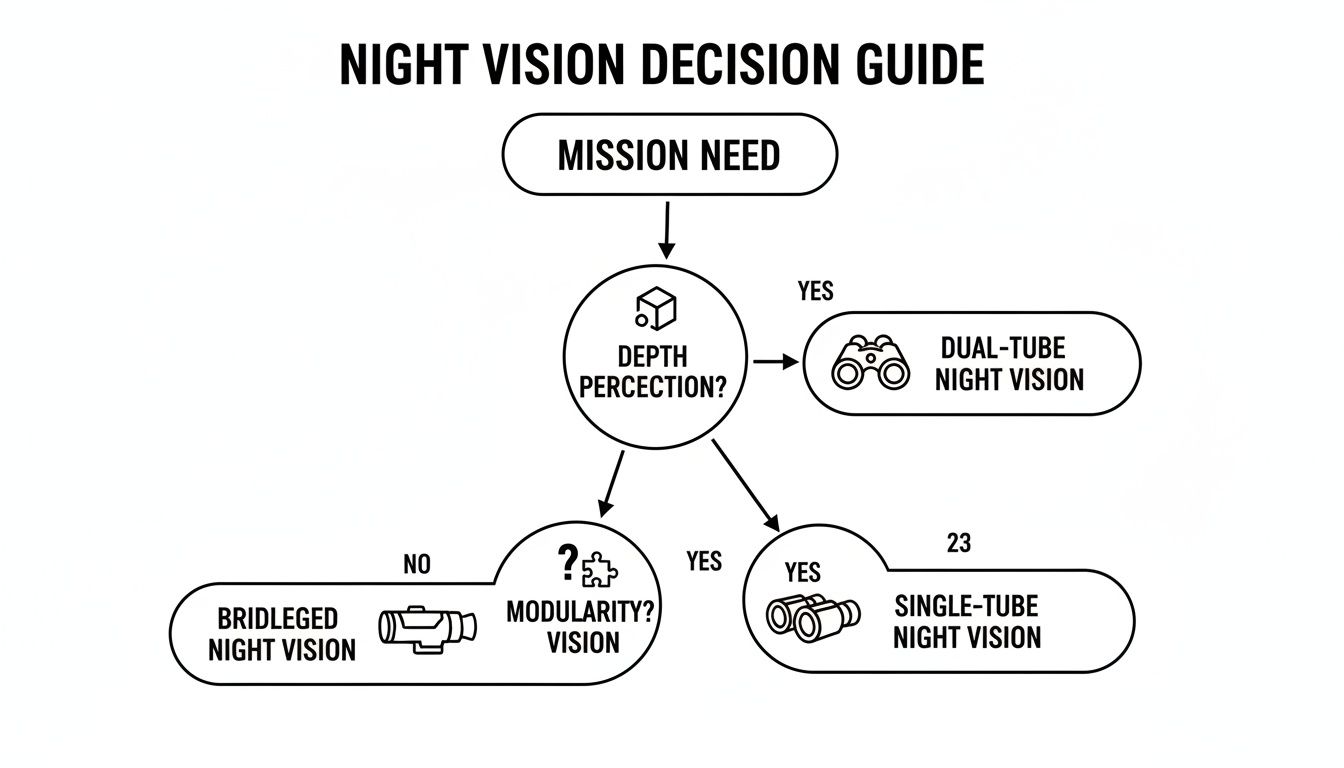
As you can see, if navigating terrain naturally is your top priority, a dedicated dual-tube setup is the way to go. But if you need a flexible system that can adapt to different roles, a bridged monocular setup makes a lot more sense.
For Law Enforcement and Tactical Operations
Officers on the street face a very specific set of problems, especially in urban environments with unpredictable lighting. A car's headlights or a suspect's flashlight can instantly wash out an operator's vision if their gear isn't up to snuff.
Because of this, two features are absolutely critical:
- Robust Auto-Gating: This is non-negotiable. It protects the sensitive image intensifier tubes from getting fried by sudden light, but more importantly, it keeps the user from being temporarily blinded. The image stays clear and consistent.
- Wide Field of View (FOV): A standard 40-degree FOV is essential for maintaining situational awareness. It lets an officer scan down an alley, clear a room, or spot a threat in their periphery without getting sucked into the tunnel vision that magnified optics can cause.
In law enforcement, the ability to move from a dark alley to a lit street without losing a single second of visual information is a core safety issue. A high-performance Gen 3 system with excellent auto-gating isn't a luxury—it's a critical piece of protective equipment.
For the Dedicated Hunter
A hunter’s needs are entirely different. The focus here is on spotting and positively identifying game at a distance, often in natural environments with very little ambient light. The name of the game is making an ethical, effective shot.
Key considerations for hunters are:
- Target ID Range: Your NVDs need enough resolution—think 64 lp/mm or better—to tell the difference between a buck and a doe at your typical engagement distance. This is crucial for avoiding mistakes and ensuring a clean harvest.
- Lightweight Build: When you're trekking through the woods with a rifle and a pack, every ounce counts. A lighter bino setup means less neck strain and better mobility over a long night of stalking.
- A Good IR Illuminator: On moonless nights or in thick woods where there's no ambient light, a powerful, focusable IR illuminator is your best friend. It essentially "paints" your target with light that only your device can see, letting you identify targets far beyond your passive range.
For Security Professionals
Security personnel often pull long shifts, either at a fixed post or on patrol. For them, reliability and endurance are everything. Their equipment has to work, hour after hour, without needing to be babied.
For security work, the focus shifts to:
- Durability and Weather Resistance: The housing needs to be tough enough to handle a few bumps and completely sealed against rain, dust, and humidity. Nitrogen-purged optics are the standard here to keep the lenses from fogging up internally.
- Long Battery Life: A system that runs for 20+ hours on a single set of batteries is a must for getting through a 12-hour shift without any downtime. Using common batteries like AAs or CR123As is also a huge practical plus.
- Solid Helmet Integration: For any professional needing their hands free, a comfortable and secure helmet mount is key. The whole setup has to be well-balanced to keep neck strain from becoming an issue over a long night.
For Preparedness and Recreational Use
For folks interested in general preparedness, homestead security, or just enjoying the outdoors at night through hiking or wildlife watching, versatility is king. The best NVDs for this group strike a smart balance between performance, price, and ease of use.
You'll want a system that offers a good mix of:
- User-Friendliness: Simple controls and an easy-to-use focus are important for someone who might not be using the device every single day.
- Versatility: A modular setup, like bridged dual monoculars, can be a fantastic choice. It lets you split the device to share a monocular with a buddy or use one as a handheld scanner.
- Overall Value: While everyone wants professional-grade Gen 3 performance, a high-quality Gen 2+ system can offer incredible capability for a much smaller investment. It's often the most practical and sustainable choice for non-professional users.
Why Investing in a Quality System Matters
Buying high-performance night vision isn't like picking up a new flashlight or a pair of binoculars. It’s a serious investment in your operational capability, whether you're on duty, in the field, or protecting your property. The market is absolutely flooded with options, but a truly superior system is defined by more than just a spec sheet. What really matters is the quality of the components, the precision of the assembly, and the support that backs it up for years.
This is exactly why going through a specialized retailer is so important. Instead of trying to sort through a confusing mess of unvetted products, you get access to a hand-picked selection from trusted, field-proven brands. This ensures that every piece of the puzzle, from the image intensifier tube to the housing it sits in, meets a high bar for performance. It’s the real difference between a toy and a tool you can bet your life on.
The Value of Long-Term Support
A huge part of what you're buying is peace of mind. When you see something like an industry-leading 10-year warranty on Gen 3 systems, that’s not just marketing fluff. It’s a powerful statement about the manufacturer's confidence in their product's durability. It protects your investment from defects and makes sure your gear remains a reliable asset, not a paperweight.
This kind of long-term assurance is only getting more critical. The global night vision device market is expected to explode from USD 9.2 billion in 2024 to USD 19.48 billion by 2030. The U.S. alone accounts for a USD 2.52 billion slice of that pie, which tells you the demand for professional-grade equipment from law enforcement and serious civilians is incredibly strong. You can dig into the specifics of this market growth in this detailed industry report.
An exceptional warranty isn't just about getting things fixed; it's a guarantee that you're buying a system built to last. It turns a major purchase into a secure, decade-long commitment to performance.
Beyond the warranty, having in-house technical support is a game-changer. Access to experts who can run diagnostics and handle repairs keeps your equipment in peak condition. If a problem does pop up, you’re not scrambling to find some third-party technician; you have a direct line to the people who know your system inside and out. That service protects your investment and keeps downtime to an absolute minimum.
More Than Just a Sale
Choosing the right partner means you get a lot more than just a box delivered to your door. You're building a relationship with a team that's genuinely invested in your success.
Think about the real-world benefits:
- Dedicated Support: You can get straight answers to tough questions, helping you make the right call without any high-pressure sales tactics.
- Competitive Pricing: A company that specializes in night vision usually has the relationships to offer better pricing on top-tier systems, making sure you get the most for your money.
- DIY Build Kits: For those of us who love to tinker and understand our gear on a granular level, the option of advanced build kits is fantastic. It gives you the chance to assemble or customize a system to your exact needs.
At the end of the day, investing in the best night vision binoculars is a commitment. By choosing a retailer that puts quality first, offers a rock-solid warranty, and provides genuine expert guidance, you’re ensuring your gear will be ready when you need it—tonight, and for years to come.
A Final Checklist Before You Buy (and for After)
Pulling the trigger on a high-end night vision setup is a big deal. Before you finalize everything, it's smart to run through a quick checklist. This isn't just about the purchase itself; it’s about setting yourself up for years of reliable use with some seriously valuable equipment.
First thing's first: vet your retailer. A trustworthy dealer is an open book about what they have in stock, how their warranties work, and what kind of support you can expect after the sale. And a quick heads-up on Gen 3 gear—it falls under International Traffic in Arms Regulations (ITAR). That's a fancy way of saying these are controlled U.S. defense items. They can't be shipped outside the States, and you’ll likely need to prove you’re a U.S. citizen to buy them.
Building Out the Full System
Remember, the night vision device itself is just the heart of the system. To actually use it hands-free the way it's intended, you’re going to need a few other key pieces of kit.
- Helmet and Shroud: You need a solid platform, whether it's a ballistic or a simpler bump helmet. The shroud is the little bracket on the front that your mount locks into.
- Mount: This is the articulating arm that connects your NVD to the shroud. A good one lets you snap the optics down in front of your eyes or stow them up and away when you don't need them.
- Counterweights: Don't skip these. A pouch with weights on the back of your helmet is what keeps the whole thing from feeling like a lead brick trying to pull your head forward. It’s all about balance and saving your neck from serious strain.
Without these pieces, your high-tech binos are basically just a very expensive handheld viewer. You'll completely miss out on the hands-free advantage.
Think of your purchase as building a complete system, not just buying a device. A properly mounted and balanced setup is the difference between a tool that enhances your capability and a heavy, awkward gadget.
Basic Care and Feeding
Taking care of your gear is non-negotiable if you want to protect that investment. A few simple habits will keep your device running at its best every single time. The biggest rule? Always keep the daylight caps on the objective lenses when you're not in the dark.
Flipping the unit on in bright light can instantly burn the image intensifier tube, leaving permanent spots or killing it entirely. When you’re putting it away, pop the batteries out. This stops any chance of corrosion or the unit accidentally turning on inside its case. For cleaning, only use a dedicated lens pen or a clean microfiber cloth to avoid scratching the coatings.
We have a guide covering the maintenance and care for a PVS-14 monocular, and honestly, the principles in there apply to just about any night vision system. Sticking to these simple rules will make a huge difference in how long and how well your gear serves you.
Frequently Asked Questions About Night Vision
Even with all the specs laid out, you probably still have a few lingering questions. That's perfectly normal. Making a big investment like this means getting all the details right, so let's tackle some of the most common things people ask before they buy.
We’ll clear up the practical differences between phosphor colors, why daytime use is a hard no, and what to realistically expect for your effective range. Getting these points straight ensures you know exactly what you’re getting.
Green Phosphor vs White Phosphor: Which is Better?
This is probably the most common fork in the road for buyers today: classic green (P43 phosphor) or modern white (P45 phosphor). For decades, that iconic green glow was the only game in town, and it’s what most people picture when they think of night vision. It works great and is often a bit easier on the wallet.
White phosphor, on the other hand, produces a black-and-white image. Many operators find this grayscale view feels more natural and causes less eye strain, which is a huge deal if you're going to be looking through the tubes for hours.
While some studies suggest white phosphor can give you a bit more contrast and detail in certain situations, it really boils down to personal preference. Both are Gen 3 performers, but if you anticipate long nights of observation, the grayscale image might be the more comfortable choice.
Can You Use Night Vision Binoculars During the Day?
Let me be crystal clear: absolutely no. Firing up a traditional analog night vision device (Gen 1, 2, or 3) in daylight is a fast way to turn your expensive gear into a paperweight. Too much light will permanently burn the image intensifier tube, leaving you with ugly black spots or a completely dead unit.
That’s why every unit comes with daylight caps that have a tiny pinhole in them. They let just enough light in to safely test the device for a few moments, but they are not meant for walking around in the sun.
How Far Can You See with Gen 3 Night Vision?
There’s no single, simple answer here. The effective range of a top-tier Gen 3 device isn't a fixed number—it depends entirely on the situation you're in.
- Ambient Light: On a bright night with a full moon, you could potentially spot a person from over 800 meters away.
- Atmospheric Conditions: Now, take that same setup to a dark, overcast night with no moon or starlight. Without an IR illuminator, your detection range might drop to less than 300 meters.
- Target Characteristics: You’ll see a big, blocky truck at a much greater distance than a person in camouflage hiding in the brush.
The best night vision binoculars don’t have a "max range" printed on the box. They simply give you the clarity to see as far as the light and conditions will permit.
At Superior Tactical LLC, we don't just sell gear; we provide the expert guidance and mission-ready equipment you need to own the night. Dive into our curated selection of high-performance night vision and give yourself the tactical edge. Find your perfect night vision solution at superiortac.com.
