A Complete Guide to Thermal Night Vision Scopes
Picture this: instead of seeing light, you see heat. That's the magic behind thermal night vision scopes. They don't need a single ray of moonlight or starlight. Instead, they pick up the invisible heat signatures coming off everything around you—animals, people, even the ground—and paint a clear picture, even in the dead of night.
Seeing a World Made of Heat
Let's toss out the old idea of "night vision." Traditional optics work by amplifying tiny amounts of existing light. Thermal is a whole different ballgame. It operates in a world of infrared radiation, the heat energy that every single object warmer than absolute zero gives off. This is what gives you such a massive advantage—you're seeing the subtle temperature differences between a target and everything around it.
Here’s a simple way to think about it. Your everyday camera captures reflected light to show you what something looks like. A thermal scope, on the other hand, captures the heat energy being emitted to show you what it feels like, temperature-wise. This is exactly why it's so powerful. A coyote hiding in a pitch-black field or a person obscured by thick fog will pop right out because their body heat contrasts sharply with the cooler environment.
The Heat-Based Advantage
Being able to see these heat signatures gives you a serious tactical edge that light-based systems just can't touch. Because thermal doesn't care about visible light, it punches right through conditions that would leave other optics completely blind.
What does this mean for you?
- True Zero-Light Operation: You can see perfectly in absolute darkness. Think deep inside a windowless building or on a cloudy, moonless night.
- Cutting Through Cover: Thermal energy sees through visual barriers that stop light cold. Smoke, dust, fog, and even light brush are no longer obstacles.
- Unbeatable Detection: Anything warm-blooded, like game animals or people, radiates a ton of heat. This makes them stand out like a beacon against a cooler landscape, no matter how well they're camouflaged.
When you get right down to it, thermal technology is all about one thing: detection. It’s the ultimate tool for answering that first, most critical question: "Is something out there?" Spotting a potential target from way out gives you the time you need to evaluate and decide what to do next.
This guide is here to pull back the curtain on these incredible optics. We’ll walk through how they work and why they're such a game-changer for hunters, law enforcement, and tactical professionals. Getting these fundamentals down is the first step to making a smart investment in a tool that lets you truly own the night. Let's break down what you need to know to pick the right thermal for your mission.
How Thermal Scopes See in the Dark
Ever wonder how a thermal scope creates a picture from something you can't see? It’s not magic, but it’s close. It all comes down to translating invisible heat energy into a clear image, a process that happens in a split second.
Everything around us that isn't at absolute zero gives off thermal energy—a form of infrared light our eyes can't pick up. Thermal scopes are built to see this world of heat.
It starts with a special lens, usually made from Germanium, which is one of the few materials transparent to the long-wave infrared spectrum. This lens gathers all the heat signatures from the environment and focuses them directly onto the core of the scope: the thermal sensor, or microbolometer.
You can think of the microbolometer as a grid of thousands of tiny, super-sensitive thermometers. Each one measures the temperature of the exact spot it's aimed at.
From a Heat Map to a Usable Image
This grid of temperature readings creates what’s known as a thermogram—basically a detailed heat map of everything in view. But at this point, it’s just raw data, not a picture you can use.
That's where the scope's onboard processor comes in. It takes that complex thermogram and instantly assigns a color or shade to each temperature point based on the color palette you've chosen. In White Hot mode, for example, hotter objects appear bright white, while cooler backgrounds are darker.
The final step is projecting this processed digital image onto a tiny, high-resolution screen inside the eyepiece. What you see is a live video feed of the world, painted entirely in heat. The better the components, the clearer and smoother that picture becomes.
This diagram breaks down how a thermal scope turns an unseen heat signature into a visible image.
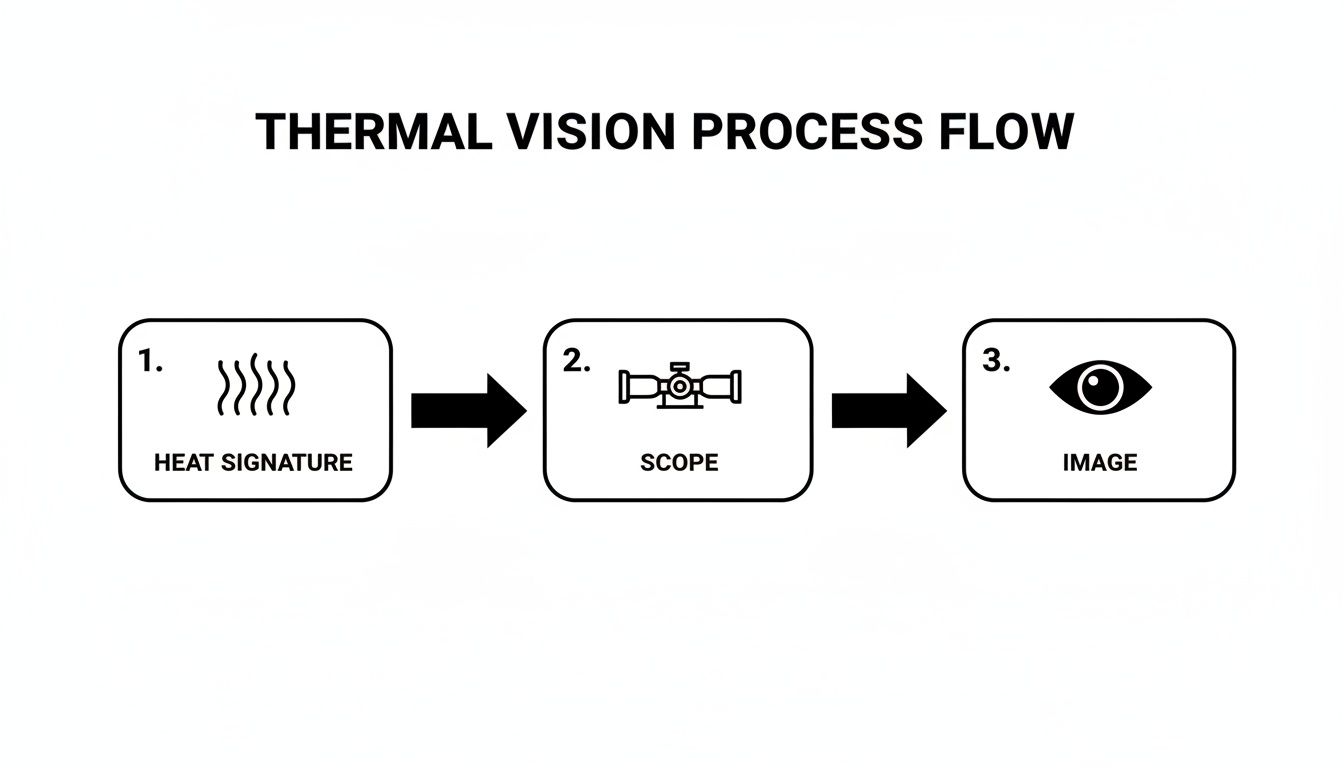
It’s all about converting raw environmental energy into a format our eyes can finally make sense of.
So, How Is Thermal Different From Traditional Night Vision?
The ability to see without any visible light is what makes thermal imaging so powerful. Traditional night vision, also called image intensification (I²), works by amplifying tiny amounts of ambient light from the moon or stars. Thermal, on the other hand, sees heat, which means it works in total, absolute darkness.
This key difference is why thermal is the fastest-growing segment of the night vision market, expanding at around 11.3% each year. It just plain works when other technologies can't.
Thermal imaging doesn't need light to work; it sees heat. This is the fundamental advantage it has over traditional image intensification. It allows you to detect a target through smoke, fog, and even light foliage because the heat signature passes through when light can't.
Deciding between the two really comes down to what you need to do. Thermal is the king of detection, while I² often provides a more natural-looking image for navigation and identification.
Here’s a quick breakdown of the main differences:
Thermal Imaging vs Image Intensification (Traditional Night Vision)
| Feature | Thermal Imaging Scopes | Image Intensification (I²) Scopes |
|---|---|---|
| Detection Method | Senses heat signatures (infrared energy) from objects. | Amplifies very low levels of available light. |
| Light Requirement | Works in complete darkness. No light is needed. | Requires some ambient light (moon, stars, IR illuminator). |
| Image Appearance | Creates an image based on heat contrast (e.g., White Hot). | Produces a green or white-and-black naturalistic image. |
| Best Use Case | Detection of live targets, even through camouflage or fog. | Navigation and positive identification at closer ranges. |
| Obstruction Issues | Can see through smoke, dust, and light foliage. | Obscured by smoke, fog, and heavy foliage. |
| Glass Penetration | Cannot see through glass, as glass blocks thermal radiation. | Can see through standard glass windows. |
Ultimately, the quality of the sensor and the power of the processor in a thermal scope directly impact its performance. A better sensor picks up finer temperature differences, and a faster processor delivers a crisp, smooth image, giving you a serious advantage when it matters most.
For a deeper dive, check out our complete guide on thermal scope vs. night vision to see which technology is right for you.
Decoding the Specs That Actually Matter
Walking into the world of thermal night vision scopes can feel like trying to read a foreign language. Spec sheets are a minefield of acronyms and numbers, but when you're out in the field, only a handful of those metrics actually dictate whether you succeed or fail. Let's cut through the marketing fluff and get down to what gives you a real-world advantage.
Don't think of these specs as just numbers on a page. They are direct measures of performance. Getting this right is the difference between buying a game-changing tool and a gadget that leaves you second-guessing in the dark. We'll break down the essentials so you can choose with confidence.
Detector Resolution: The Foundation of Image Clarity
If you only pay attention to one spec, make it detector resolution. Measured in pixels, like 384×288 or 640×480, this number tells you the raw amount of detail the thermal sensor can physically capture.
The easiest way to think about it is like your TV at home. An old standard-definition screen shows you a fuzzy blob, but a 4K TV reveals details you never even knew were there. It’s the exact same concept with thermal.
- A higher resolution scope, like one with a 640×480 sensor, crams more pixels onto the sensor. That gives you a sharper, cleaner, and far more detailed image.
- With that high-res picture, you can pick an animal out from the brush more easily, identify its features, and get a positive ID from much farther away.
For instance, a 384×288 sensor is a solid workhorse for calling in coyotes inside 200 yards. But if your shots are pushing 400 yards or more, a 640×480 sensor gives you the pixel density you need to confidently tell a big hog from a small deer. That’s the kind of detail that prevents mistakes when it counts.
NETD: How Well Your Scope Senses Heat
Next on the list is NETD, which stands for Noise Equivalent Temperature Difference. This number, measured in millikelvins (mK), is all about thermal sensitivity. Put simply, it’s how well the scope can pick up on tiny, subtle differences in temperature.
Imagine trying to hear a quiet whisper from across a noisy room. Someone with great hearing (a low NETD) can pick it out, while everyone else misses it. A lower NETD number means your scope has better "hearing" for heat.
A lower NETD value is always better. It means the sensor can tell the difference between objects with very similar heat signatures. This gives you a richer, more detailed image, especially when conditions are tough, like in heavy fog or high humidity.
A scope with a NETD of <50mK is decent, but the high-performance gear we see today often comes in at <30mK or even <25mK. That incredible sensitivity lets you see the texture on an animal's hide, details in the trees and rocks, and will perform worlds better when the weather isn't cooperating. It’s what helps you spot a bedded-down animal that has cooled off and is barely warmer than the ground around it.
Refresh Rate: Keeping a Lock on Moving Targets
Refresh rate, measured in Hertz (Hz), tells you how many times per second the image updates on your screen. If you're ever tracking something on the move—whether it's a hog on the run or a vehicle—this spec is non-negotiable.
Think of it like the difference between a choppy old film and a smooth, high-definition video. A high refresh rate is your high-def video.
- A 60Hz refresh rate updates the image 60 times every second. The result is a smooth, fluid picture that’s crucial for tracking fast targets without any lag or stutter.
- A lower rate, like 30Hz, refreshes half as often. It's fine for watching stationary targets, but the moment you pan quickly or try to follow a running animal, the image can get blurry and jumpy.
You really feel the difference in a dynamic situation. A 60Hz scope lets you scan a field from a moving truck or lead a running coyote while keeping the sight picture perfectly clear. That smooth image isn't just nice to look at; it reduces eye strain and helps you make a more precise shot under pressure. For any serious hunter or operator, 60Hz is the standard for a reason—it ensures your optic can keep up when the action heats up.
Thermal Optics in Real-World Scenarios
It’s one thing to read a spec sheet, but it's another thing entirely to see how a thermal night vision scope performs when the lights go out. The true magic of this technology isn’t just in its hardware; it’s in the incredible advantage it gives you when visibility is nonexistent. Whether you're in a pitch-black forest or a shadowy city street, thermal optics cut through the darkness.
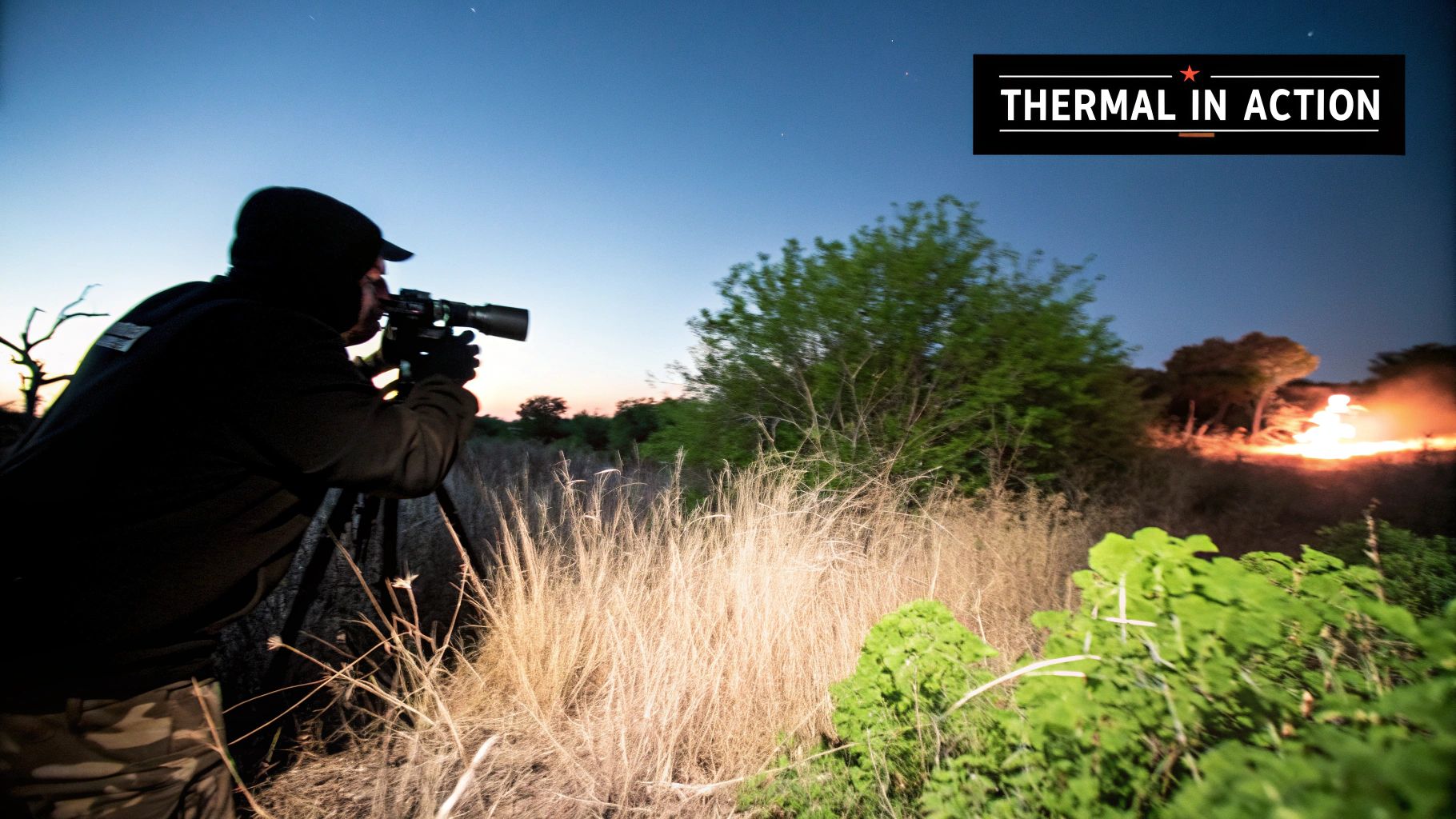
This is where the rubber meets the road. Let's look at the specific situations where a quality thermal scope isn't just another accessory—it's a mission-critical tool that can make or break your success and safety.
The Hunter's Edge in Any Condition
For hunters, thermal imaging is a complete game-changer. It unlocks detection capabilities that are simply impossible with traditional optics, even during the day.
Think about spotting game that’s perfectly camouflaged. A deer bedded down in tall grass or a hog hidden in dense brush just pops as a bright heat signature against the cooler background. You see it instantly, allowing for a clean, ethical shot without spooking animals you never even knew were there.
But it’s not just about the hunt; it’s about the recovery. Finding a downed animal after sunset can be a tough, frustrating task. With thermal, its residual body heat makes it stand out like a beacon, ensuring a fast and humane recovery even in the thickest undergrowth. We dive deeper into these tactics in our guide on thermal vision for hunting.
And for predator control? Nothing comes close. Coyotes and other nocturnal predators are clever and cautious, but a thermal scope lets you scan entire fields and treelines from a safe distance. You can identify targets without ever flipping on a light and giving away your position.
Tactical Superiority for Law Enforcement and Security
In the professional realm, thermal optics give law enforcement and security teams a massive tactical advantage, directly improving officer safety and mission success. These aren't just gadgets for watching; they're tools for taking control.
Imagine searching for a suspect in a sprawling, dark industrial park. An officer with a thermal scope can scan between shipping containers, check rooftops, and clear shadowy alleyways in seconds, immediately picking up a human heat signature. This ability to sweep huge areas quickly and safely is a true force multiplier.
Surveillance is another area where thermal shines. An operative can monitor a location from hundreds of yards out, tracking movements and identifying individuals without any risk of detection. And because thermal sees right through smoke and fog, it works when other visual tech is completely useless.
In search and rescue missions, a thermal optic can literally be the difference between life and death. The heat signature of a lost hiker or an injured person can be spotted from the ground or air, even in dense woods or total darkness. This dramatically cuts down search times and vastly improves the chances of a successful rescue.
This kind of professional-grade performance is what drives the market forward. The military has long relied on this tech, with the U.S. Department of Defense planning to acquire around 14,000 night vision systems between 2019 and 2024. Law enforcement agencies are now following that lead, integrating thermal for everything from border security to tactical raids.
Whether you're protecting livestock from predators or a community from threats, a thermal night vision scope delivers the clarity you need to make the right call when it matters most.
Integrating Thermal Into Your Gear Setup
A thermal optic is a phenomenal tool, but it's only as good as how you integrate it into your existing gear. The right setup isn't a one-size-fits-all solution; it comes down to your specific mission. Getting this first step right—choosing the correct type of optic—is absolutely critical.
Let’s break down the main ways to add a thermal night vision scope to your kit.
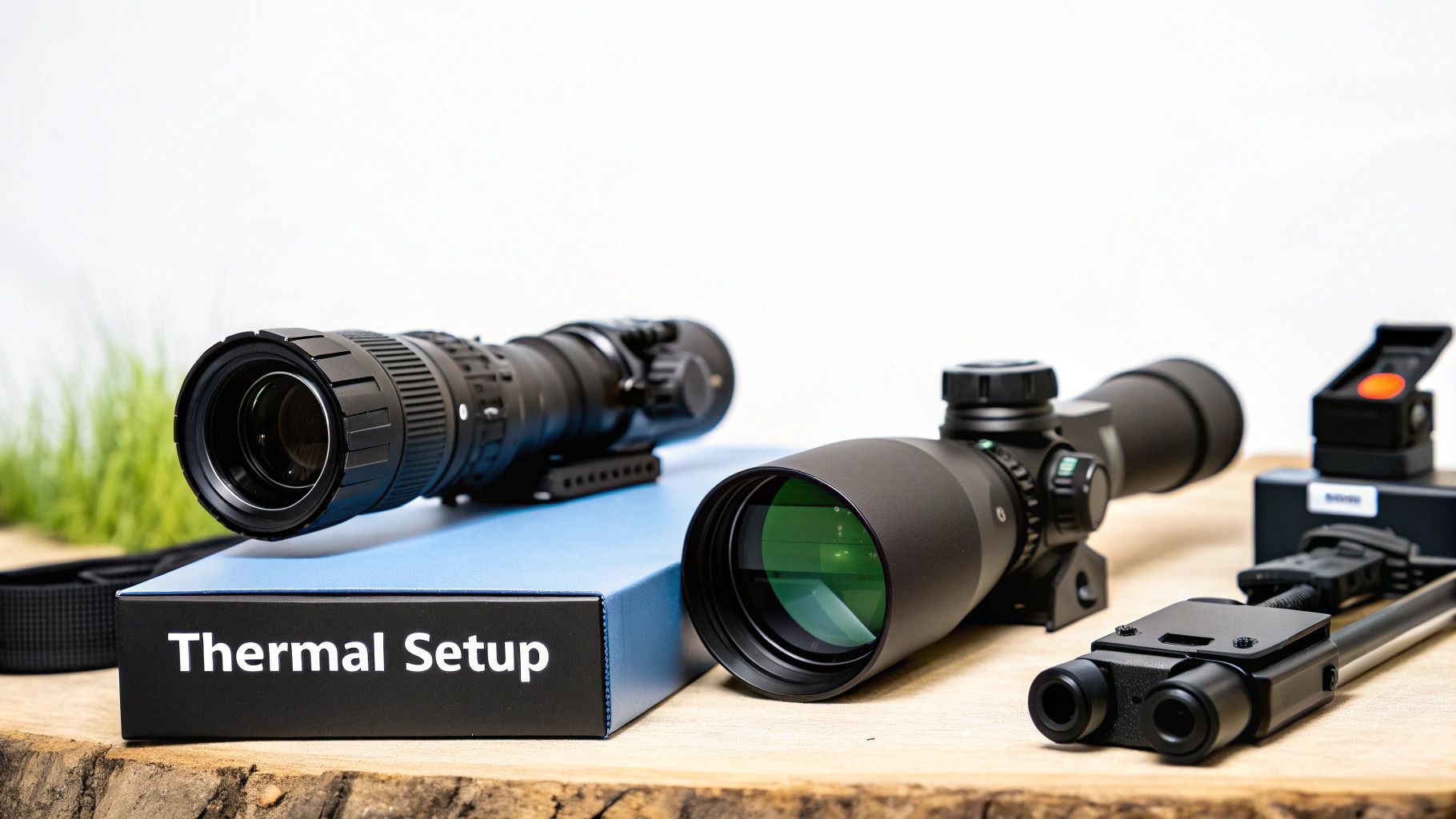
Each style of thermal device has its own strengths and weaknesses. The one you pick will fundamentally change how you find, identify, and engage targets after the sun goes down.
Choosing Your Thermal Optic Style
You'll find thermal optics in three main flavors, each designed for a different job—from dedicated long-range shooting to quick, on-the-go scanning.
- Dedicated Rifle Scopes: These are purpose-built to live on a rifle. For any kind of precision work, this is your best bet. They come packed with features like multiple reticles, ballistic calculators, and internals tough enough to shrug off repeated recoil.
- Handheld Monoculars: Compact, light, and easy to carry, these are your go-to for scanning and spotting. A handheld lets you quickly sweep a field or treeline to pick up a heat signature without flagging everything with your rifle. It’s safer and far stealthier.
- Clip-On Systems: This is all about flexibility. A clip-on attaches right in front of your trusted daytime scope, turning it into a thermal powerhouse. You get to use the magnification and reticle you already know and are zeroed with. No need to re-zero; just clip it on and you're ready.
For many hunters and shooters, the best system is actually a combination. Use a handheld monocular to find what you're looking for, then switch to the dedicated rifle scope for the shot. It’s an incredibly efficient way to operate.
The Critical Role of a Quality Mount
Don't overlook the mount. I don't care if you have the most expensive thermal scope on the market; if it's sitting on a cheap, flimsy mount, it’s basically useless. A bad mount simply will not hold zero under recoil.
A high-quality, quick-detach (QD) mount from a reputable brand is non-negotiable. It ensures your optic returns to zero every single time you attach and detach it. This is especially vital if you're running a clip-on or swapping optics between rifles. Think of a solid mount as an investment in your scope's accuracy and longevity.
Thermal Fusion: The Ultimate in Situational Awareness
For those at the top of the gear pyramid, there's thermal fusion. This technology overlays a thermal image on top of a digital night vision image. You get the best of both worlds: the uncanny heat-detection of thermal combined with the detail and depth perception of traditional night vision for positive target ID.
Building a truly effective system is about more than just the scope. It’s about choosing the right style for your application and securing it with a mount you can trust. Get those two things right, and you’ll have a reliable, mission-ready setup that lets you own the night.
A Practical Checklist for Buying Your First Thermal Scope
So, you're ready to invest in a thermal scope. It's a big step, and with all the technical jargon we've covered, it's easy to get lost in the weeds. This checklist is designed to cut through the noise and give you a straightforward, practical way to pick the perfect optic for what you actually do.
Let's be clear: this technology isn't just a niche gadget anymore. The global market for thermal scopes hit USD 1.2 billion in 2024 and is expected to climb to USD 2.30 billion by 2033. That explosive growth means more options for you, which is great, but it also makes having a solid game plan absolutely essential.
Step 1: Define Your Mission
Before you even glance at a product page, you need to answer one simple question: "What is this scope's main job?" Your answer is the compass that will guide every other decision. Get specific.
- Hog or Coyote Hunting? You’re dealing with quick targets, usually inside 300 yards. A snappy 60Hz refresh rate is non-negotiable for smooth tracking, and a 384×288 detector will give you all the detail you need at these distances.
- Long-Range Precision? If you're stretching shots out past 400 yards, image clarity is everything. You should be looking at 640×480 sensors (or better) and probably a lower base magnification to maintain a useful field of view for spotting.
- Home Defense & Property Security? Here, ranges are short and situational awareness is king. A wide field of view trumps a massive detection range every time. You need to see the whole picture, not just one small part of it.
- Search & Rescue or Observation? Your goal is to scan huge areas and spot faint heat signatures. A wide field of view is critical for scanning, and a highly sensitive sensor (low NETD) is what will help you pick out a person or animal from a cluttered background.
Step 2: Set a Realistic Budget and Prioritize Specs
With your mission locked in, you can now figure out where your money is best spent. This is always a game of give-and-take; you can't have it all without a massive budget.
The real trick is to put your money into the specs that directly help you accomplish your mission. Don't overpay for extreme range if you're hunting in the woods, and don't sacrifice thermal sensitivity for a bunch of bells and whistles you'll never use.
Think of it like this:
- Resolution and NETD: These are the foundation of your image. Period. Always get the best sensor you can afford. This is the single biggest factor in performance.
- Refresh Rate: If your targets are moving, you need 60Hz. It's that simple. For watching static targets, 30Hz can work, but the fluid, lag-free image from a 60Hz scope is a massive quality-of-life improvement you'll appreciate on every hunt.
- Lens Size and Magnification: Bigger lenses pull in more thermal energy, which means better performance and range. Match the base magnification to your typical engagement distance—lower for up-close work, higher for reaching out.
Step 3: Ask the Final Questions
You've got your mission and your priorities. These last few questions will help you nail down the final choice.
- Where will I be using it? If you're in a place with high humidity, fog, or rain, you absolutely need a scope with a low NETD (think <30mK) to punch through the atmospheric moisture and deliver a clear image.
- How will I be using it? Are you only shooting, or do you spend a lot of time scanning? A dedicated rifle scope is fantastic on the gun, but pairing it with a separate handheld monocular makes for a much more effective and comfortable system for scanning.
- What happens if something goes wrong? We know these are complex pieces of kit. Make sure the optic you choose is backed by a solid warranty and, just as importantly, accessible support. Here at Superior Tactical, we handle repairs in-house because we believe protecting your investment for the long haul is part of the deal.
Walking through these steps ensures you end up with a thermal scope that feels like it was built just for you. For a great example of a scope that balances features and price well, check out our deep dive into the AGM Rattler V2 19-256 thermal scope.
Your Top Questions About Thermal Scopes Answered
Stepping into the world of thermal optics always brings up a few questions. We get it. To make sure you're completely confident in your choice, we've rounded up the questions we hear most often and given them straight, no-nonsense answers.
Let's cut through the noise and address what you really need to know about how thermal night vision scopes perform in the field.
Can Thermal Scopes See Through Glass or Walls?
This is probably the biggest myth out there, and the answer is a hard no. Thermal scopes can't see through solid objects like glass, concrete walls, or even deep water. Why? Because those materials completely block the long-wave infrared energy (heat) that thermal sensors are designed to read.
If you aim a thermal scope at a window, you're not going to see the person on the other side. You'll just get a perfect picture of the window's own surface temperature. Where thermal really shines is cutting through things that block visible light—think smoke, heavy fog, dust, and even light brush. That’s where it leaves traditional optics in the dark.
What Is the Difference Between Digital and Optical Zoom?
Knowing the difference here is crucial, because it directly impacts what you see through the eyepiece. They both make things look bigger, but the way they do it couldn't be more different.
- Optical Zoom is the real deal. It uses physical lenses to magnify the image, just like a high-end camera lens. This means you get a crisp, clear picture with full sensor resolution, no matter how much you zoom in.
- Digital Zoom is more like cropping and enlarging a photo on your phone. It's the most common type in thermal scopes and works by electronically blowing up a piece of the image from the sensor. It makes the target appear closer, but you lose clarity and the image can get grainy or "blocky" fast.
Your scope's true performance yardstick is its base optical magnification. Think of digital zoom as a helpful tool for a quick, closer look, but remember it can't add detail that wasn't there to begin with.
How Important Are Warranty and Repair Services?
For a serious piece of equipment like a thermal scope, they're non-negotiable. These are sophisticated electronics, and even the toughest gear can run into issues. Out-of-pocket repairs can be a serious financial hit.
A solid warranty is your safety net for a major investment. More than that, knowing you have access to expert technicians who can get your scope fixed and back to you quickly is what keeps you in the game. You don't want your gear sitting on a shelf for months waiting for a repair—you want it ready to go when you are.
At Superior Tactical LLC, we don’t just sell gear; we support it. We offer in-house diagnostics and repair services to keep your equipment running at 100%. Check out our hand-picked selection of field-proven thermal optics and accessories at https://superiortac.com.
