The Ultimate Wilcox Aimpoint Mount Explainer
When you’re running night vision, the last thing you want is a clunky, inefficient setup. A Wilcox Aimpoint mount is the purpose-built solution that bridges the gap between your red dot, your helmet-mounted NODs, and your eye. It provides the high clearance you need for a seamless, “heads-up” shooting posture, which is why it’s the go-to choice for elite military and law enforcement teams operating after dark.
Why Professionals Trust The Wilcox Aimpoint Mount
Ever tried shooting with a red dot and night vision, only to find yourself craning your neck and mashing your face into the stock? It feels like looking through a soda straw. The Wilcox Aimpoint mount was designed to eliminate that exact problem by raising the optic to the perfect height, aligning it flawlessly with your helmet-mounted NVG.
Think of it like the high-performance suspension on a race car. A race car’s suspension is engineered to keep the tires glued to the track for absolute control. In the same way, a Wilcox mount gives your Aimpoint optic an unshakeable, zero-retention foundation. This isn’t just another piece of hardware; it’s a critical component that unlocks faster targeting and better battlefield awareness.
A System Built For Modern Tactics
The real game-changer here is the “heads-up” posture it enables. Traditional mounts force you into a hunched-over position. Wilcox’s high-clearance design lets you keep your head up, scanning your environment naturally with both eyes open. This is a massive tactical advantage.
It's faster, more comfortable, and simply more intuitive, especially when you're loaded down with a helmet and NVGs. The benefits are immediate:
- Enhanced Situational Awareness: With your head up, your peripheral vision is completely unobstructed. You see more of the world around you.
- Faster Target Acquisition: The alignment between your eye, NVG, and red dot becomes second nature, shaving critical moments off your engagement time.
- Improved Ergonomics: A natural head and neck position means less fatigue and strain, letting you stay in the fight longer.
The Wilcox Aimpoint mount is a cornerstone of modern night-fighting setups. Its adoption surged by 35% after 2020 among U.S. special forces, driven by a clear need to reduce targeting errors in chaotic environments. In fact, its optimized height is credited with preventing an estimated 15% of close-quarter targeting errors, according to operational data. You can review the specifics in this official government report on tactical systems.
A quick look at the mount's core strengths makes it clear why it's a top-tier choice for any serious shooter.
Wilcox Aimpoint Mount At A Glance
| Feature | Primary Benefit | Ideal User |
|---|---|---|
| High-Clearance Design | Enables a natural "heads-up" posture for seamless NVG use. | Night vision operators, tactical professionals. |
| Solid-State Mounting | Provides a rock-solid, zero-retention platform for the optic. | Anyone who demands absolute reliability. |
| Lightweight Aluminum | Delivers exceptional durability without adding unnecessary weight. | Shooters focused on agile, fast-handling rifles. |
This combination of features creates a system that simply performs when you need it most.
The Gold Standard In Reliability
For professionals whose lives depend on their gear, equipment failure simply isn't an option. Wilcox mounts are precision-machined from high-grade aluminum, holding tolerances that ensure your optic will not shift or lose zero, no matter how rough the conditions get.
This obsessive focus on durability is why elite teams trust Wilcox to connect a mission-critical optic to their rifle. Its proven performance under fire has cemented its reputation as the premier choice for anyone serious about low-light operations. Of course, a solid mount is just one piece of the puzzle; it often pairs with advanced laser systems to complete the setup. You can learn more about how it integrates with these devices in our guide on the Wilcox BOSS XE system.
Matching Your Aimpoint With The Right Wilcox Mount
Picking the right Wilcox mount for your Aimpoint isn’t just about making sure things screw together. It’s about building a cohesive system where every component works in concert. Get it right, and your rifle becomes a seamless extension of your will. Get it wrong, and you're fighting your gear, compromising stability, and potentially losing your zero when it matters most.
First things first, you have to know your optic. While many red dots might look the part, their mounting footprints—the specific pattern of screws and recesses on the bottom—are not universal. Wilcox mounts are engineered around the industry-standard Aimpoint Micro footprint. This is the pattern you'll find on the legendary T-1, T-2, H-1, H-2, and CompM5 series optics, ensuring a rock-solid, no-wobble fit.
This diagram breaks down how the mount serves as the critical link between your eye and the target.
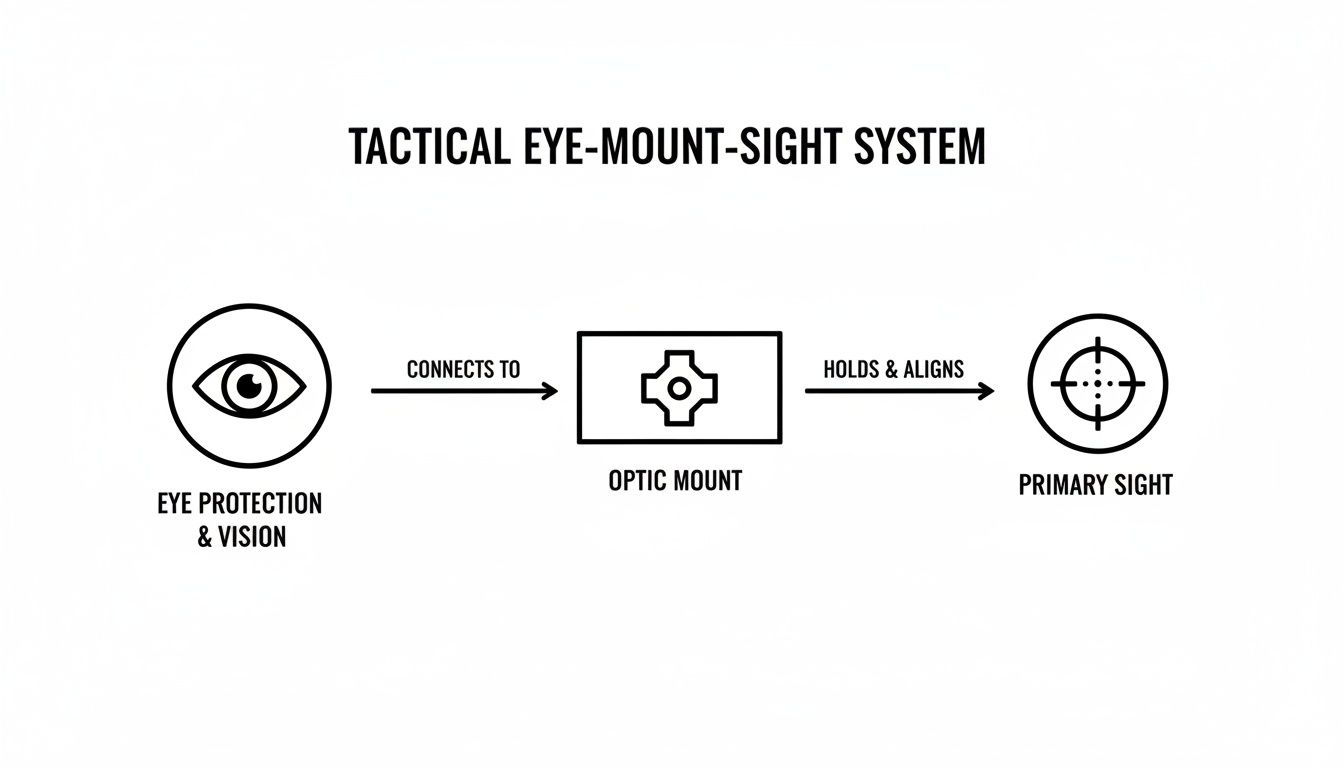
As you can see, the mount is what dictates the height and alignment of the entire sight picture. It's the foundation of the whole system.
Finding The Perfect Height For Your Needs
Once you've matched the footprint, the next critical decision is the mount's height. This isn't a matter of preference; it's a choice driven entirely by your mission, your gear, and how you intend to run the gun. Wilcox offers a few distinct configurations, each one optimized for a specific tactical application.
Lower 1/3 Co-Witness Mount: This is a classic setup that places the red dot just above your iron sights. It’s a fantastic all-around choice, giving you a clean dot picture while allowing you to use your irons as a backup by looking through the lower portion of the optic window.
High NVG Mount: If you're running night vision, this is your mount. It raises the optic significantly higher, letting you aim "passively" with a heads-up posture while looking through your helmet-mounted NODs. This is the key to modern night-fighting techniques, as it prevents the neck strain and awkward head position required by lower mounts.
Flip-to-Side (FTS) Mount: This isn't for your primary optic, but for the magnifier that works with it. The Wilcox FTS is renowned for its solid lockup and buttery-smooth action, letting you snap a magnifier in and out of position to instantly switch between 1x CQB and a magnified view for target ID.
Offset Mount: The ideal solution for a secondary optic. An offset mount positions your Aimpoint at a 45-degree angle next to a magnified primary scope. With a simple roll of the rifle, you can transition from a long-range engagement to a close-quarters threat in a split second.
The Wilcox Aimpoint mount has been central to the rise of modern shooting systems. Their NVG-height mounts, for example, clear over 90% of PVS-14 setups right out of the box, no extra risers needed. For firearm dealers, the known quality and compatibility of Wilcox mounts can even increase a rifle package's resale value by an estimated 18%. You can dig deeper into the data behind these kinds of system integrations in this defense logistics overview.
Pairing Models For Mission Success
So, how does this look in the real world? If you're building out a rifle for night operations, the clear choice is a High NVG Mount for your Aimpoint CompM5. That entire setup is purpose-built for seamless passive aiming under NODs. To get your helmet rig dialed in for this, our guide on choosing the best night vision mount is a great place to start.
Real-World Scenario: Picture a SWAT officer clearing a building. They're likely running a Wilcox High NVG Mount with a T-2. Why? Because a lower mount would be completely useless when they're wearing a helmet with comms and a gas mask. The higher, "heads-up" posture lets them maintain situational awareness while keeping a perfect sight picture.
On the other hand, consider a designated marksman. They might run a Wilcox offset mount holding an Aimpoint T-2 as a backup to their powerful primary scope. If a threat suddenly appears at close range, they don't have to fumble with magnification dials; they just roll the rifle and engage. It’s all about putting the right tool in place for the job at hand.
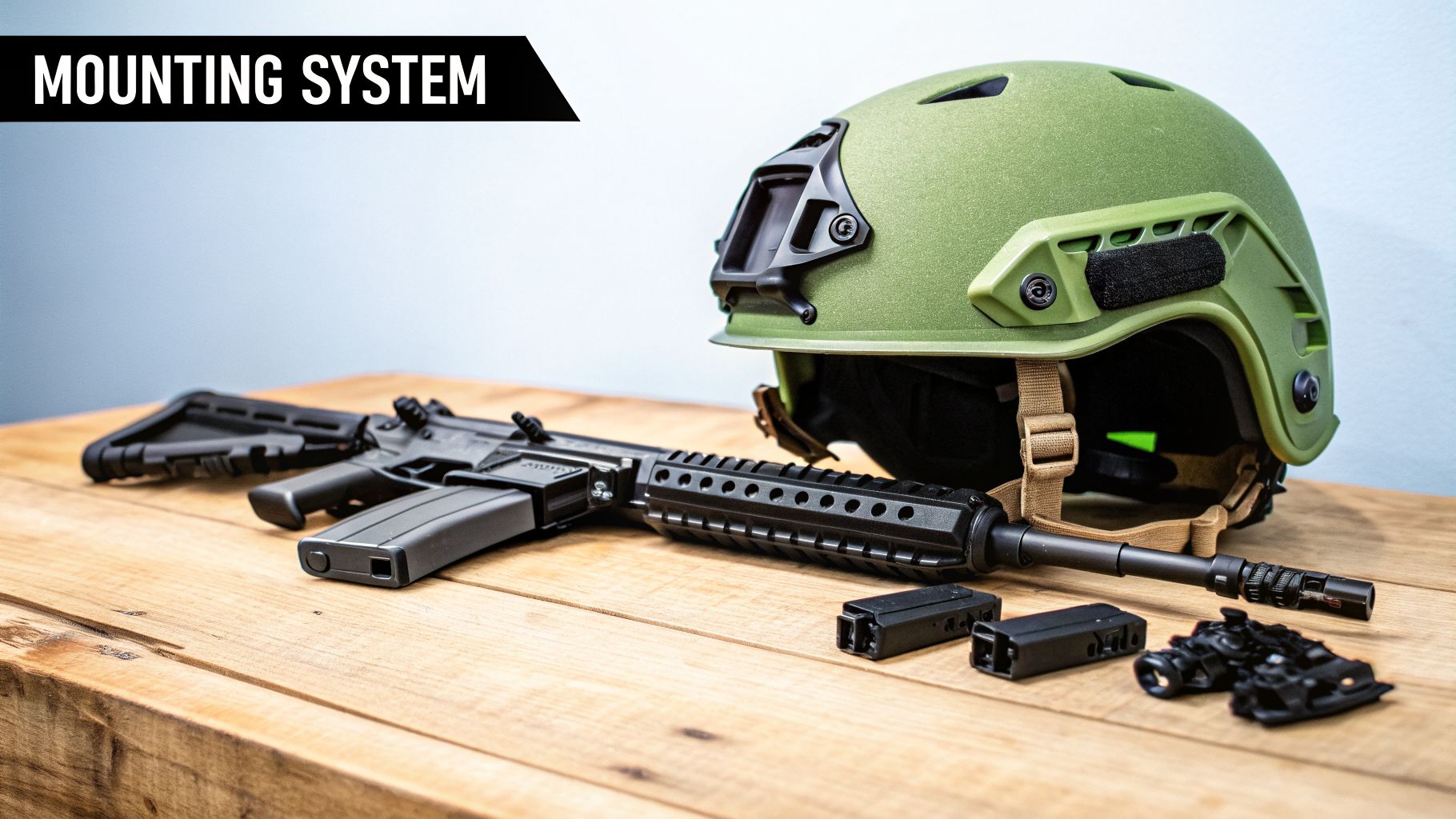
Understanding The Complete Mounting System
A Wilcox Aimpoint mount is a phenomenal piece of engineering, but it’s just one part of a larger system. To get the most out of it, you need to understand how it connects with everything else—the rifle, the helmet, and all the bits and pieces in between. Getting this right is the difference between a seamless, effective setup and a clunky, frustrating mess.
Think of it this way: the mount is the bridge, but it needs solid ground on both sides to work. This section breaks down the key components that form the rest of that system, ensuring your entire platform works in perfect concert.
Picatinny Rails: The Bedrock Interface
The starting point for almost any rifle accessory is the MIL-STD-1913 rail, known universally as the Picatinny rail. It’s the standardized docking system for the modern firearm world. Its series of cross-slots and angled surfaces create a secure, repeatable mounting point for optics, lights, lasers, and grips.
A Wilcox mount is designed to clamp onto this rail with immense force. The rail’s slots also act as recoil lugs, physically stopping the mount from sliding forward or backward under recoil. This mechanical lock-up is the first and most critical step to making sure your optic holds zero, shot after shot.
NVG Shrouds: The Helmet-Side Connection
While the Picatinny rail secures the mount to your rifle, the NVG shroud handles the helmet side of the equation. This is the rugged plate, usually bolted to the front of a ballistic or bump helmet, that serves as the docking station for night vision gear.
This is where the deliberate design of the Wilcox system shines. The specific height of a Wilcox NVG-height mount isn't a random number; it's calculated to perfectly align your Aimpoint's dot with a night vision monocular attached to a standard-issue helmet mount, like the Wilcox G24 mount. This creates a flawless sight picture through your NODs for "passive aiming"—allowing you to aim through your optic without ever turning on an IR laser.
Simply put, a proper NVG-height mount on your rifle and a G24-style mount on your helmet are two halves of the same system. When set up correctly, you look through your night vision, and the red dot is just there, perfectly aligned and ready to go. This is a massive tactical advantage for staying covert.
Risers: Getting the Right Elevation
Sometimes, the standard height of a mount isn't quite enough. That’s where a riser comes in. A riser is essentially a spacer that sits between your rifle's Picatinny rail and your optic mount, giving it an extra boost in elevation.
So why would you need one? There are a couple of key reasons:
- Clearing Obstructions: A riser can lift your optic high enough to get a clean view over bulky laser units (like a PEQ-15) or fixed front sights that might otherwise clutter your sight picture.
- Improving Ergonomics: Many shooters find a taller, "heads-up" shooting posture is faster and more comfortable, especially when wearing plate carriers, comms headsets, or other bulky gear. A riser helps achieve that natural head position.
Quick-Detach (QD) Levers: Flexibility on Demand
Finally, you have the Quick-Detach (QD) base. A mount with a QD lever lets you attach or remove your entire optic setup in seconds, without any tools. A simple throw of the lever unlocks the mount from the rail.
This capability is mission-critical for users who need to adapt quickly. You might need to ditch a damaged optic and switch to your iron sights, swap your red dot for a magnified scope, or simply break down your rifle for transport. A quality QD system, like those found on several Wilcox models, offers this flexibility while maintaining an incredible return-to-zero. That means you can pull it off, slap it back on, and be confident your zero hasn't shifted.
How To Select The Right Wilcox Mount For Your Mission
Figuring out the right Wilcox mount for your Aimpoint isn’t about picking the single “best” option—because there isn't one. It’s about matching the mount to your specific world. The setup a patrol officer needs is worlds apart from what a backcountry hunter or a tactical operator running night vision requires.
Let's break down these scenarios. By thinking about how you actually use your rifle, you can cut through the noise and choose a mount that feels less like an accessory and more like a natural extension of your weapon system.
For The Law Enforcement Officer
In the world of law enforcement, gear has to be one thing above all else: tough. We're talking about daily-duty-level tough. A patrol rifle gets knocked around in a vehicle rack, bumped against door frames, and exposed to every kind of weather imaginable. You simply can't afford for your optic to lose zero.
This is where a Wilcox mount earns its keep. It provides the kind of bomb-proof lockup that withstands the constant abuse of patrol life. For an officer, the main concerns usually boil down to a few key points:
- Co-Witness Capability: Most departments require proficiency with iron sights. A standard or Lower 1/3 co-witness height is non-negotiable, allowing you to use your BUIS right through the optic's window. It’s a familiar, dependable backup.
- Integration: The mount has to play nice with everything else on the rifle—lights, switches, and especially vehicle racks—without creating new snags or ergonomic headaches.
- Zero Retention: With all the vibrations and impacts of daily use, the mount absolutely must hold zero. The robust aluminum construction and clamping force of a Wilcox mount are purpose-built for this reality.
For this role, the classic Wilcox Aimpoint Mount at a Lower 1/3 height, paired with an Aimpoint CompM5 or T-2, is a proven, duty-ready workhorse. It delivers a clean sight picture and the ruggedness you need when things go sideways.
For The Dedicated Hunter
Now, let's shift gears to the hunter, whose priorities are almost the complete opposite. You're not worried about co-witnessing irons; you’re worried about fleeting shots in the low light of dawn and dusk. Here, speed and a wide field of view are king.
This is where a high mount really comes into its own, even if you never plan on using night vision. A higher mount allows for a "heads-up" shooting posture. Picture yourself tracking a buck as it moves through thick timber. Keeping your head up lets you use both eyes to scan your surroundings and follow the movement. When the rifle comes up, the dot is just there. There's no need to collapse your posture and lose that precious situational awareness.
For a hunter, this heads-up posture is a game-changer. It makes tracking moving game faster and dramatically improves your awareness during those critical low-light minutes. You're not just staring through a tube; you're seeing the whole environment with a dot floating in your vision.
Even for pure daytime use, a Wilcox High NVG Mount is an outstanding choice. It encourages a faster, more instinctive aiming process that’s perfectly suited to the dynamic nature of hunting.
For The Tactical Professional
For the tactical professional, especially one operating under night vision, the mission dictates the gear. The entire system is built around the concept of passive aiming—using your optic to aim while looking through your helmet-mounted NODs. This requires a mount that seamlessly integrates with NVGs, lasers, and everything else on your helmet and rifle.
The goal here is to get fast, precise shots in complete darkness without ever sending out an active IR laser beam that could give away your position.
For this user, the equipment checklist is driven by integration:
- Clearance is Everything: The mount has to be tall enough to clear a helmet, comms headsets, and gas masks without forcing you into an awkward, strained head position. This is the exact problem the Wilcox High NVG Mount was designed to solve.
- Passive Aiming: The alignment between your NVG and the red dot has to be perfect. A proper high mount makes this feel effortless, letting you aim through the optic in the dark as if it were broad daylight.
- Offset Options: When running a magnified scope for observation, an offset Wilcox mount with a T-2 is a must. It allows for an instant switch from long-range PID to close-quarters engagement without missing a beat.
To help you visualize these choices, we've put together a simple matrix comparing these different user profiles and their ideal Wilcox setups.
Wilcox Mount Selection Matrix
This table breaks down our recommendations to help you match your primary application with the best possible Wilcox mount configuration.
| User Profile | Recommended Wilcox Model | Key Considerations | Compatible Aimpoint Sights |
|---|---|---|---|
| Law Enforcement | Lower 1/3 Co-Witness Mount | Durability, gear retention, co-witness with irons | CompM5, T-2 |
| Hunter | High NVG Mount | Heads-up posture, speed, situational awareness | T-2, H-2 |
| Tactical Professional | High NVG Mount or Offset Mount | Passive aiming, NVG clearance, system integration | CompM5, T-2, ACRO |
By thinking about your needs through these real-world scenarios, you can confidently choose a Wilcox Aimpoint mount that does more than just hold your optic—it elevates your entire shooting system.
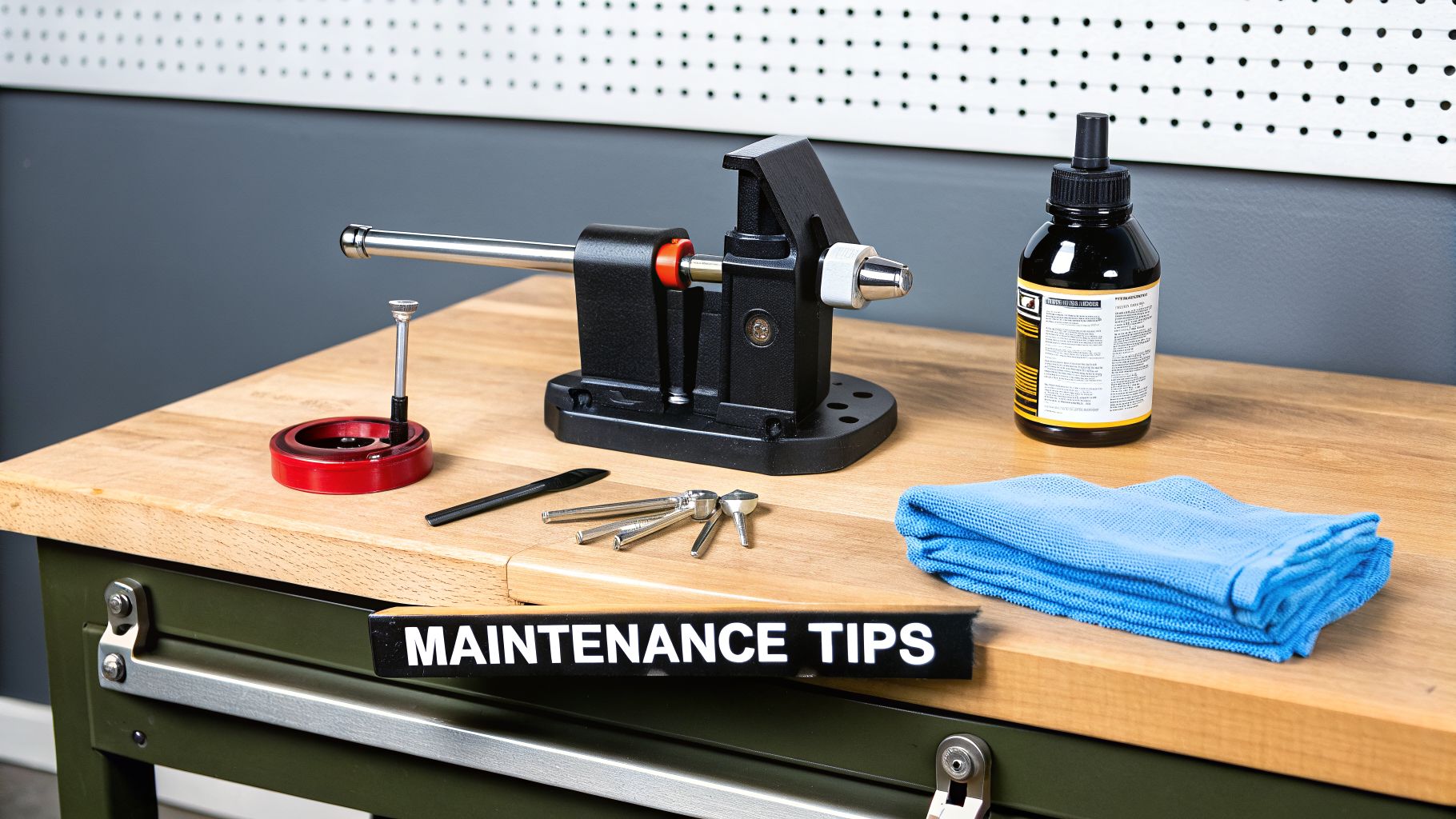
Installation And Maintenance Best Practices
You've got the gear. Now it's time to put it all together. Properly setting up your Wilcox Aimpoint mount isn't just the last step; it's the one that ensures your entire rifle system works as a single, rock-solid unit. Don't think of this as complicated gunsmithing. It's more like following a high-stakes recipe where precision is everything.
The same goes for keeping it running. A Wilcox mount is engineered to take a beating, but a few simple checks will guarantee it performs flawlessly for a lifetime. This isn't a long list of chores—just a quick, practical routine to protect your investment and keep your setup ready.
Correct Installation Principles
The whole point of a proper installation is to create a secure platform that absolutely will not shift, whether from recoil or getting banged around. This really comes down to two things: clean surfaces and correct fastener torque.
First, make sure the mounting surfaces on both your rifle’s rail and the Wilcox mount are totally clean and dry. Any oil, grease, or debris can create a slippery spot. A quick wipe with a degreaser like isopropyl alcohol on a clean rag is all you need to get a perfect, high-friction mate between the parts.
Next up is torque. Getting the screw tension right is non-negotiable. Think of it like tightening the lug nuts on your car's wheel—too loose, and it'll wobble; too tight, and you can strip the threads or even damage the mount. There's no guessing here. You need to use a calibrated torque wrench to hit the right spec.
Pro Tip: Before you apply that final torque, press the entire mount forward in the Picatinny rail slot. This seats the mount's crossbolt firmly against the front edge of the rail slot. It ensures recoil forces are absorbed by the solid steel rail, not by the clamping screws. This one little step is a hallmark of a professional job.
The Importance Of Thread-Locker
Once your screws are torqued down, you're almost done. The constant, sharp vibration from firing a rifle can work even the tightest screws loose over time. That’s where a medium-strength thread-locking compound, like Loctite 242 (Blue), becomes your best friend.
Just a small drop on the screw threads before you install them is the cheapest insurance policy you can buy. It fills the tiny gaps between the threads, forming a bond that holds tight against vibration but can still be broken with normal hand tools if you ever need to remove the mount. Steer clear of permanent (Red) Loctite; it requires a torch to break loose and you’ll likely strip your screws trying.
A Simple Maintenance Checklist
Keeping your Wilcox Aimpoint mount in top shape is incredibly easy. Just work these quick checks into your regular gun cleaning routine. The idea is to catch small issues before they ever have a chance to become big ones.
- Hardware Check: After every few hundred rounds or a hard day of training, give the mounting screws a quick check. If you used thread-locker correctly, they won't have budged, but verifying they're still snug is just good practice.
- Corrosion Prevention: Wilcox mounts are made from anodized aluminum and are highly resistant to corrosion. Still, dirt and moisture can get trapped in tight spaces. Use a small brush to clean out any grime from the clamping mechanism and wipe the whole mount down with a lightly oiled cloth.
- Inspect For Wear: Take a close look at the contact points—where the mount meets the rail and where it holds the optic. You’re looking for any unusual gouges, deep scratches, or cracks. These mounts are built like tanks, so any visible damage probably means it took a serious hit that warrants a closer look at your whole setup.
By making these simple steps part of your routine, you’re ensuring your Wilcox Aimpoint mount remains a reliable, zero-holding foundation for your optic, ready for any mission.
Why Choose Superior Tactical For Your Gear
When you're looking at a piece of kit like a Wilcox Aimpoint mount, you're not just shopping. You're making a serious choice about performance and reliability, investing in gear that has proven itself time and again where it counts. You know that mission-critical equipment can't have a single point of failure.
That same commitment to unflinching quality is exactly what we built Superior Tactical on. For over a decade, our reputation has come from a simple, honest philosophy: we only stock the gear we would trust our own lives with. When you buy from us, you’re not just getting a product; you’re getting a piece of kit that's been vetted by people who actually use it.
Guidance and Support, Not Just a Sale
Getting the right hardware is just the start. The real value comes from buying it from a team that understands how it works in the field and will stand behind it long after the package is delivered. That's our specialty.
We get it—when you need gear, you usually need it now. That's why we offer same-day shipping on all our in-stock items. We work hard to get your equipment out the door and on its way, whether you're heading for a hunt or preparing for a deployment.
At Superior Tactical, we believe the best decisions come from solid information. Our team is here to give you straight answers and expert advice to make sure you get the right setup for your specific needs, not just the most expensive item in the catalog. Your success in the field is how we measure our own.
This isn't just a marketing line; it’s how we operate every day. We aren't box-movers. We're shooters, armorers, and night vision experts who genuinely believe in the equipment we sell. From a single Wilcox Aimpoint mount to a complete rifle build, everything in our inventory is there because it has earned its place.
Your Go-To Source for Critical Hardware
We know that putting together a reliable rifle or tactical loadout can feel overwhelming. There are a lot of moving parts, and you need a partner you can trust to give you clear guidance every step of the way.
That's why our service goes well beyond the initial purchase:
- Expert Advice: Our team has the real-world experience to help you configure your entire system, ensuring every component works together flawlessly.
- Long-Term Support: We offer in-house diagnostics and repair services to keep your gear running for years to come. We’re here to help you maintain and upgrade your equipment, not just sell you new stuff.
- A Curated Catalog: You'll find proven brands like Wilcox, Unity Tactical, and EOTech in our shop because they consistently meet our non-negotiable standards for durability and performance.
Choosing Superior Tactical means you're getting more than just a part in a box. You're partnering with a team that is genuinely invested in making sure your gear gives you a decisive edge. Take a look at our complete collection of Wilcox mounts or reach out to our team today for personalized advice on building out your perfect setup.
Frequently Asked Questions
Let's tackle some of the most common questions we get about Wilcox mounts. These are the details that often come up when you're getting serious about your optic setup, and getting them right is key to building a reliable rifle.
Will A Wilcox Mount Work With My Non-Aimpoint Red Dot?
This is a big one. Wilcox mounts are engineered with extreme precision for the Aimpoint Micro footprint, the mounting pattern used by the T-1, T-2, H-2, and CompM5 series. The fit is absolutely perfect.
While some other red dot manufacturers have adopted this same footprint, we've seen enough tolerance-stacking issues to be cautious. Even a tiny deviation in a clone or budget optic's base can lead to a mount that won't hold zero under recoil or hard use. For a duty-ready rifle, sticking with the proven Wilcox-to-Aimpoint combination is the only way to guarantee rock-solid performance.
Is The Wilcox NVG Height Too High For Daytime Shooting?
Absolutely not. In fact, this is one of the biggest reasons shooters are moving to Wilcox. The taller, "heads-up" posture it enables is a game-changer for situational awareness, and it's not just for shooting under night vision. It allows you to keep your head up and scan your environment more naturally.
The NVG-height mount is a feature, not a compromise. It encourages a modern shooting stance that can lead to faster target acquisition and less fatigue over long periods. While it feels different from traditional co-witness heights at first, most shooters adapt quickly and find it more effective overall.
Think of it this way: a more upright head position is simply less fatiguing and allows your eyes to process your surroundings much faster. Many shooters find they can't go back once they get used to it.
How Does A Wilcox Mount Compare To A Unity FAST Mount?
Both are top-tier, professional-grade systems, but they approach the "high mount" concept from different angles. The Unity FAST series is a fantastic, self-contained system known for its built-in backup iron sights and modularity within its own product family.
Wilcox, on the other hand, is all about building a complete, integrated optical suite. Their reputation is built on the legendary Flip-to-Side (FTS) magnifier mounts that work in perfect harmony with their red dot mounts. If your end goal is to run a magnifier, pairing a Wilcox FTS with a Wilcox optic mount ensures perfect alignment and zero-compromise function right out of the box.
Ultimately, you can't go wrong with either. We even see advanced users mix and match, sometimes placing a Wilcox mount on a Unity riser to dial in a very specific setup. The choice really comes down to what other components you plan on running.
At Superior Tactical, we carry the best gear from trusted brands to help you build the perfect system for your needs. Explore our curated selection and find the ideal Wilcox mount for your rifle today at SuperiorTac.com.
