What Is PVS Unpacking the Tech Behind Night Vision
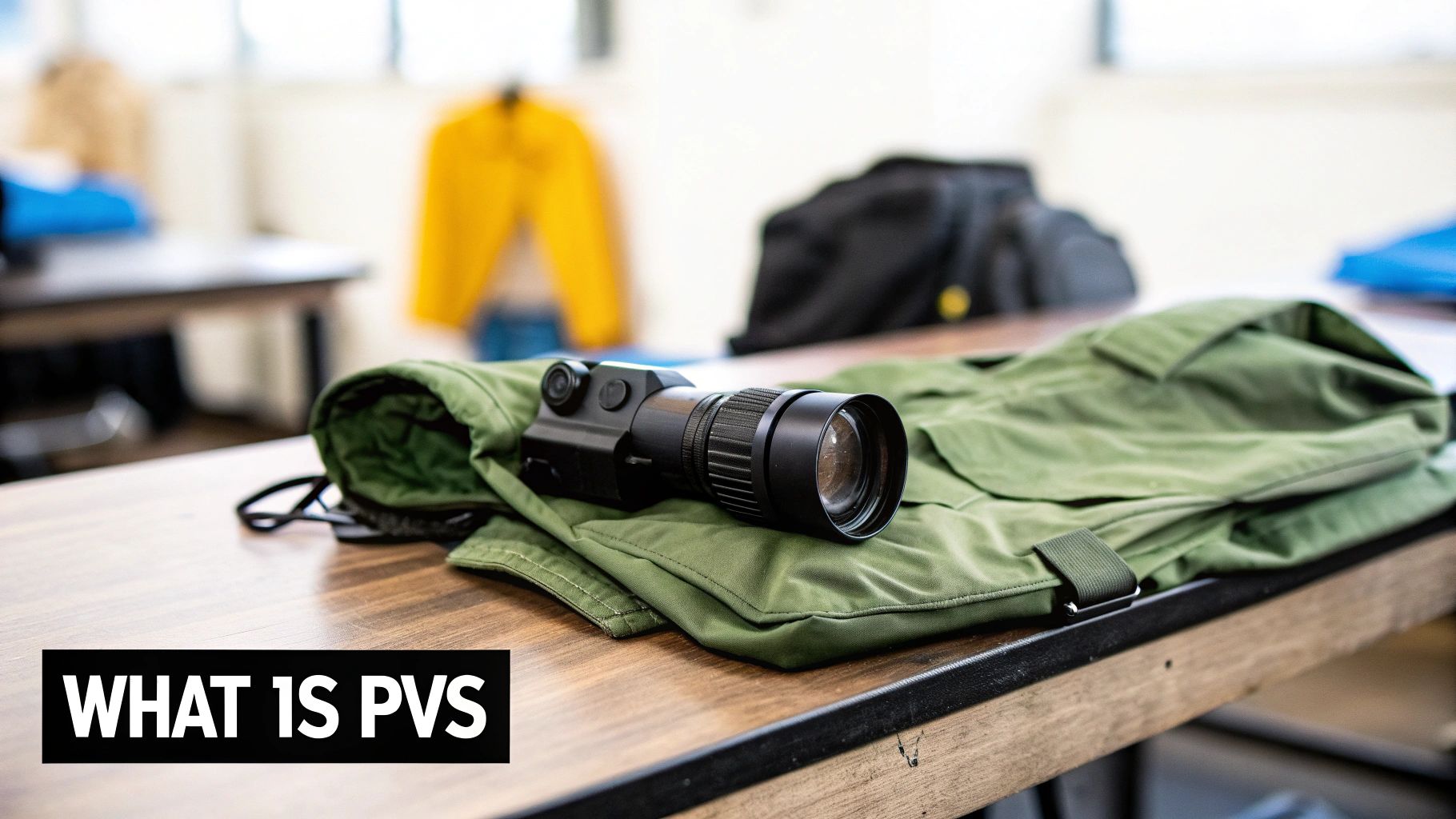
So, what does PVS actually mean? It’s a term you'll hear constantly in the night vision world. PVS stands for Portable Visual Search, which is the official military designation for a specific class of night vision devices.
These aren't just fancy cameras. PVS units work by capturing the tiniest traces of available light—from the moon, stars, or even distant city glow—and amplifying that light thousands of times. The result is a crisp, visible image, even when it looks pitch black to your naked eye.
How PVS Turns Night Into Day
At its heart, a PVS device is a light-gathering machine. It doesn't create light where there is none; it just becomes incredibly efficient at using the light that’s already there. This technology is called image intensification.
You've probably seen names like the PVS-14 or PVS-31. That number isn't random—it's part of the military's Joint Electronics Type Designation System (JETDS), a standardized way of naming equipment. While the name sounds technical, the purpose is simple: to give you a massive advantage in the dark.
Breaking Down the Basics
Think of it like this: trying to see in the dark is like trying to catch a light drizzle in a small cup. You won't collect much. A PVS device acts like a massive funnel for that drizzle, gathering every available light particle (called photons) and multiplying them exponentially before they hit your eye.
This process is what lets you see a detailed, usable landscape instead of just shadows. The image you see through the device is typically that classic green, though newer systems often use white phosphor for a grayscale view that many find more natural.
Why "PVS" Means More Than Just Three Letters
Getting a handle on what PVS is helps you understand why this gear is so valued. The PVS name signals a certain standard of performance and durability, built for people who can't afford to have their equipment fail.
Take the PVS-14 monocular, for example. It’s probably the most iconic piece of night vision gear out there, and for good reason. Its incredible versatility means you can use it in a few different ways:
Hand-held: Perfect for quick spotting and observation.
Helmet-mounted: This is the standard for hands-free movement and operating a firearm.
Weapon-mounted: Paired with an optic, it allows for precise targeting in total darkness.
It's easy to think all night vision is created equal, but that's a huge misconception. The PVS family represents a specific branch of image intensification tech, originally built for military and law enforcement. This heritage is what separates it from cheaper, consumer-grade gadgets.
At the end of the day, PVS technology is all about giving you the upper hand when the lights go out. It provides the situational awareness and safety you need to turn darkness from a limitation into a tactical advantage.
To make things even clearer, here’s a quick-reference table that breaks down the essential PVS terms you'll encounter.
PVS Key Concepts at a Glance
| Term | Simple Explanation | Why It Matters to You |
|---|---|---|
| PVS | Portable Visual Search. The official military name for a night vision device. | This tells you the gear was designed to a professional standard, not just for casual use. |
| Image Intensification | The process of gathering tiny amounts of light and amplifying them thousands of times. | This is the core technology that makes night vision possible. Better intensification means a clearer, brighter image. |
| Monocular | A single-tube device, like a PVS-14. | Offers great versatility (hand-held, helmet-mounted) and is a popular entry point into quality night vision. |
| Binocular/Goggle | A dual-tube device, like a PVS-31 or a set of dual PVS-14s. | Provides depth perception and reduces eye strain, which is critical for navigation and extended use. |
This table should help you quickly get up to speed with the lingo. Understanding these basics is the first step toward choosing the right gear for your needs.
The Evolution of PVS Technology
The sleek, lightweight PVS devices we take for granted today didn't just appear out of thin air. Their journey from bulky, experimental contraptions to the essential gear of modern operators is a story forged on the battlefield, with every feature refined through decades of real-world use.
This story really kicks off during the Vietnam War, a conflict that dragged modern warfare into the dead of night. Soldiers desperately needed a way to own the dark in dense jungle, and early image intensification technology was the answer.
From Starlight Scopes to Hands-Free Goggles
The first PVS devices to see wide use were a world away from the head-mounted units we see now. The AN/PVS-2 Starlight scope, famous for its use in Vietnam, was a game-changer but was also a heavy, rifle-mounted piece of kit. It could amplify ambient light by about 1,000 times, which was incredible for the mid-1960s, but it wasn't exactly nimble.
By the mid-1990s, the U.S. Army had shifted from the old PVS-5 goggles to the much-improved PVS-7. This was a monumental leap forward. The PVS-7 was a binocular goggle system that allowed for hands-free operation, finally untethering the soldier from their rifle. You can explore more on the development of digital night vision history to see how these early systems paved the way for current technology.
This move from a clunky, weapon-mounted scope to a hands-free goggle was a major turning point. The AN/PVS-7 used a single image intensifier tube but directed the image to both eyes, giving users the freedom to navigate, drive, and perform complex tasks in the dark.
This new capability completely changed nighttime operations, allowing for far greater mobility and efficiency. It set a new standard for what night vision equipment could—and should—do.
The Rise of the Modern Monocular
While the PVS-7 was a huge step up, the push was on for systems that were even lighter, more versatile, and offered better overall situational awareness. The next major evolution in the PVS line tackled these needs head-on.
The core challenge has always been balancing performance with ergonomics. A powerful device is useless if it's too heavy or awkward to use effectively in high-stress situations. This principle drove the shift toward monocular systems.
The result of this push was the legendary AN/PVS-14. This single-tube, single-eyepiece monocular quickly became the gold standard for ground forces and law enforcement agencies around the globe, and for good reason.
Here’s why the PVS-14 design took over:
Situational Awareness: By keeping one eye unaided, the user maintains their natural night vision. This makes it much easier to adapt to changing light, like when moving from a dark alley into a lit room.
Reduced Weight: A single-tube system is naturally lighter than a dual-tube goggle. That might not sound like much, but it dramatically reduces neck strain over the course of a long mission.
Versatility: The PVS-14 is a jack-of-all-trades. You can hold it in your hand like a spotter scope, mount it on a helmet for navigation, or clip it behind a red dot sight on a rifle for targeting.
This incredible adaptability made the PVS-14 an effective and cost-efficient tool, cementing its place as one of the most successful night vision devices ever made.
The steady progression from the PVS-2 to the PVS-7 and finally to the PVS-14 shows a clear pattern: each new generation was a direct response to feedback from the field. The focus was always on making the tech more practical and effective for the people who bet their lives on it. That user-driven philosophy continues to shape the future of night vision today.
How Image Intensifiers Turn Night Into Day
At the very core of every PVS device is a phenomenal piece of technology: the image intensifier tube. This is the engine that drives night vision, doing the seemingly impossible job of taking a pitch-black scene and making it look like day. To really get what PVS is, you first have to understand how this tube works its magic.
Think of an image intensifier as a super-powered light amplifier. It doesn't create light out of thin air. Instead, it scoops up all the tiny, invisible bits of ambient light—from the moon, stars, or even distant city glow—and cranks up the brightness by thousands of times.
This whole process happens almost instantly, broken down into three key steps that work together to turn darkness into a clear, usable image.
Step 1: Gathering Light Photons
It all starts at the objective lens, the glass at the very front of your night vision device. Its only job is to collect as many particles of light, called photons, as it can from the scene in front of you. Even on what seems like the darkest night, these photons are everywhere, bouncing off every surface.
The objective lens gathers these photons and funnels them directly onto the first crucial component inside the tube: the photocathode. This is a special screen designed to react to light.
When a photon smacks into the photocathode, its energy knocks an electron loose. In short, this first step is all about converting light particles into electrical particles, which sets the stage for what comes next.
Step 2: Amplifying The Electronic Signal
With light now converted into electrons, the real work begins. These electrons are pulled toward a component called a micro-channel plate (MCP). The MCP is an incredibly thin wafer, just a few millimeters thick, packed with millions of microscopic glass tubes, all tilted at a slight angle.
Picture a tiny, super-dense honeycomb. As a single electron zips into one of these channels, it hits the wall and causes a chain reaction, freeing several more electrons. These new electrons then shoot down the channel, hit the wall again, and release even more.
This cascade effect multiplies the original number of electrons exponentially. A single electron going in can result in thousands coming out the other side. This is the heart of image intensification—turning one weak signal into an avalanche.
This process happens simultaneously across millions of channels, perfectly preserving the original layout of the electrons to keep the image from getting distorted.
Step 3: Creating The Visible Image
Finally, this massive cloud of amplified electrons shoots out of the MCP and slams into a phosphor screen. This screen is coated with a material that lights up whenever it's hit by an electron—think of it like an old-school CRT television screen.
When the electrons hit the phosphor screen, their energy is converted back into light. But this time, it's thousands of times brighter than the faint light that first entered the device. This glowing green or white image is what you see when you look through the eyepiece. To get a closer look at the parts involved, you can learn more about the PVS-14 image intensifier tube itself.
This diagram shows just how far PVS systems have come, from the bulky early scopes to the modern monoculars we use today.
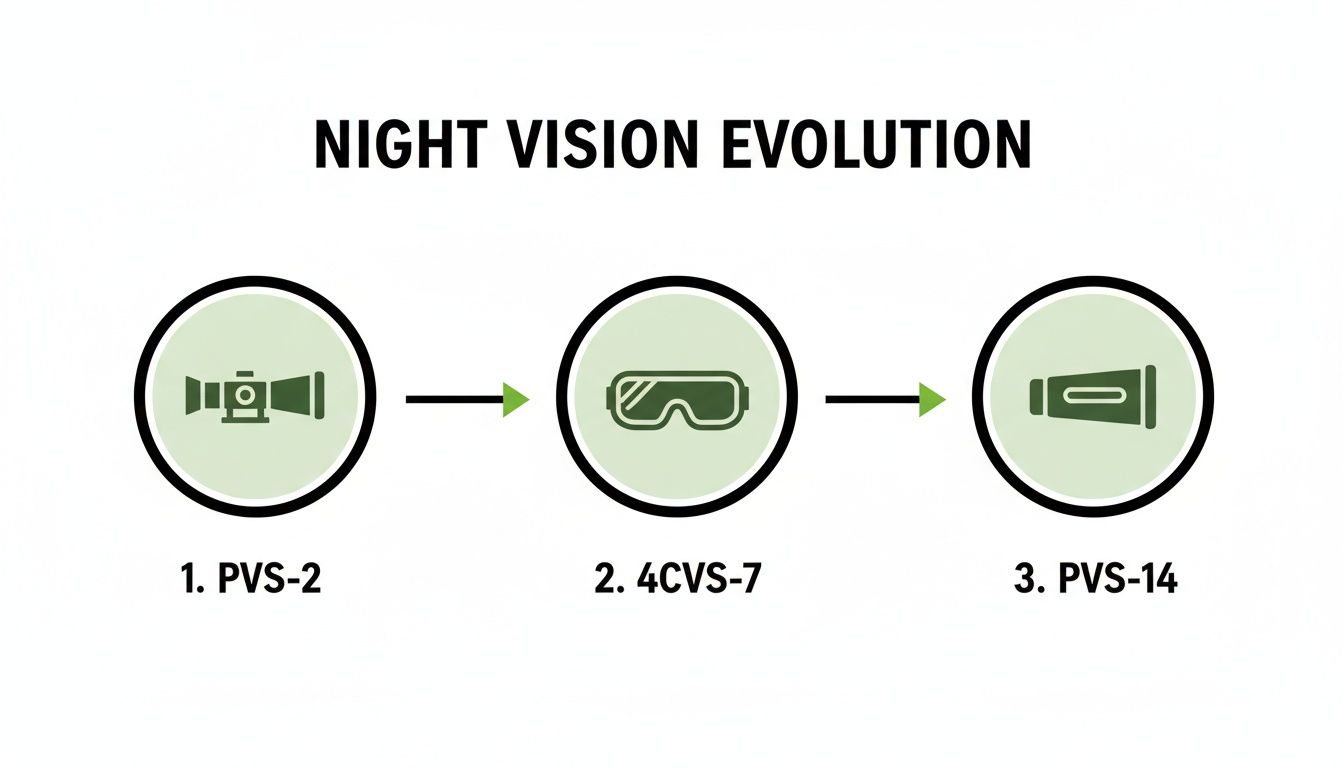
You can clearly see the progression toward smaller, lighter, and more versatile hands-free units over the decades.
A Leap Through Generations
The technology packed into these image intensifiers has improved dramatically over the years, leading to what we call "generations" of night vision. Each new generation marks a huge jump in performance, clarity, and durability.
The basic science goes all the way back to 1934, but it wasn't until the Vietnam War that Generation 1 (Gen 1) devices like the AN/PVS-2 Starlight scope saw widespread use. These early units could amplify light by about 1,000 times, but the image was often grainy, and they only lasted for around 1,500 hours.
The table below breaks down the key advancements from one generation to the next.
Comparing Night Vision Generations
| Generation | Key Technology | Typical Light Amplification | Best Use Case |
|---|---|---|---|
| Gen 1 | Photocathode + Phosphor Screen | ~1,000x | Basic observation, budget-friendly entry |
| Gen 2 | Micro-Channel Plate (MCP) | ~20,000x | Hunting, civilian use, serious enthusiasts |
| Gen 3 | Gallium Arsenide Photocathode | 50,000x – 80,000x+ | Military, law enforcement, professional use |
The big breakthrough for Generation 2 (Gen 2) was the addition of the micro-channel plate, which boosted light amplification to around 20,000 times and produced a much cleaner, sharper picture.
Today, the gold standard for any serious application is Generation 3 (Gen 3). These tubes use a more sensitive photocathode material called gallium arsenide. They also have an ion barrier film on the MCP, which dramatically extends the tube's lifespan to 10,000+ hours while delivering the incredibly bright and crisp images that professionals rely on.
Exploring Common PVS Models and Their Uses
The science behind image intensifier tubes is fascinating, but the real magic happens when you see how that tech performs in the field. "PVS" isn't a single device; it's a whole family of tools, each one built for a specific job. Whether you're a hunter tracking game or a SWAT team clearing a building, the right model is everything.
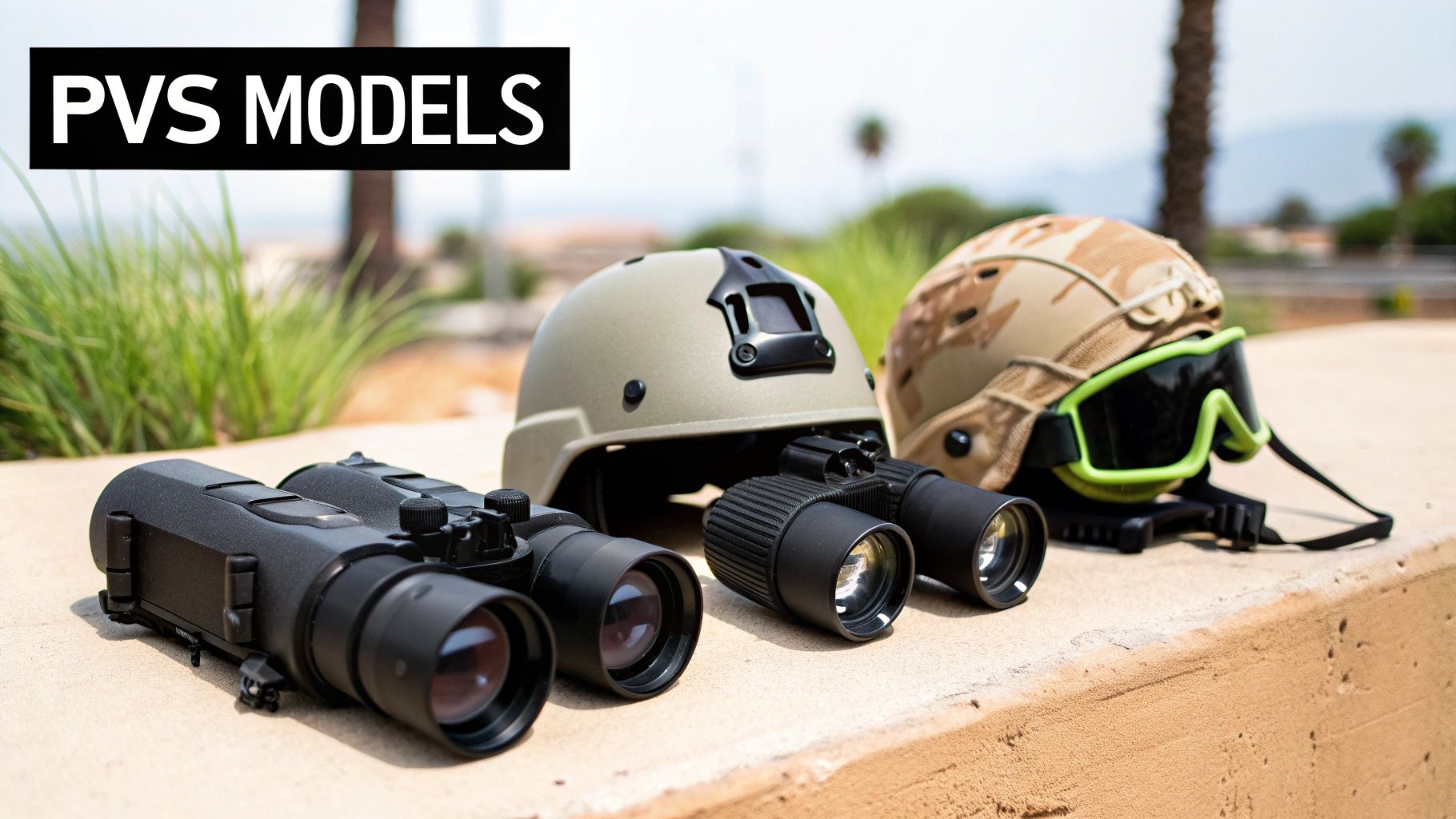
You'll find two main designs out there: the single-tube monocular and the dual-tube binocular (or goggle). Each one has its own strengths and trade-offs when it comes to weight, situational awareness, and depth perception. The best choice really boils down to what you need to do in the dark.
The PVS-14: The Versatile Workhorse
When most people think of night vision, the image that pops into their head is the AN/PVS-14. This monocular is without a doubt the most recognized and widely used night vision device on the planet, and for good reason. Its superpower is versatility.
You can run a PVS-14 in several different ways, making it a true jack-of-all-trades:
Helmet-Mounted: This is its most popular configuration, giving you hands-free mobility. By mounting it over just one eye, you keep your other eye free to use your natural night vision. This is a huge advantage for judging distances and quickly adapting to sudden bright lights.
Hand-Held: Need a quick look across a field? Use it as a compact spotting scope. It's perfect for quick scans without having to gear up with a helmet.
Weapon-Mounted: Pop it behind a compatible red dot or holographic sight, and your rifle is suddenly a formidable nighttime platform.
This incredible adaptability makes the PVS-14 a favorite for law enforcement officers who constantly switch between driving and searching on foot. It's also a go-to for hunters who need a lightweight, multi-purpose optic. Because it only uses one tube, it's also lighter and more affordable, which your neck will thank you for after a long night.
PVS-31 and Dual-Tube Systems: The Depth Perception Advantage
A monocular is a fantastic tool, but some jobs absolutely require the edge you get from a dual-tube system. Units like the AN/PVS-31 are standard issue for special operations forces for one critical reason: depth perception.
When both of your eyes are looking through their own image intensifier tube, your brain gets the stereo vision it needs to see the world in 3D. This is non-negotiable when you're moving fast over tricky ground, driving a vehicle, or needing to judge distances perfectly in a close-quarters situation.
Think of it like listening to music in mono versus stereo. Mono gets the sound across, but stereo gives you a rich, immersive experience that lets you place every instrument. That's what dual-tubes do for your vision.
Dual-tube systems are the professional standard for anyone whose mission depends on maximum spatial awareness. They're also far more comfortable for long-term use, significantly reducing eye strain. Sure, they are heavier and carry a higher price tag than a PVS-14, but for high-stakes work, the tactical advantage of true binocular vision is impossible to ignore.
Real-World Applications Across Different Fields
The specific PVS model someone uses is a direct reflection of their needs. The underlying technology is the same, but the form factor is tailored to the mission.
Here’s a quick breakdown of how these devices are used:
| User Group | Primary PVS Type | Key Reason for Choice |
|---|---|---|
| Law Enforcement Patrol | PVS-14 Monocular | Incredibly versatile for shifting from a vehicle to foot patrol; keeps one eye free to adapt to urban lighting. |
| Military Special Operations | PVS-31 Binocular Goggle | Gives superior depth perception for fast movement and CQB; much less eye fatigue on multi-hour operations. |
| Hog or Coyote Hunter | PVS-14 Monocular | Light enough to carry all night; can be weapon-mounted for the shot or helmet-mounted for scanning. |
| Rancher/Landowner | Hand-Held Monocular | Perfect for quickly spotting predators or checking on livestock without needing a full hands-free helmet setup. |
At the end of the day, whether it's a do-it-all PVS-14 or a specialized PVS-31, the goal remains the same: to own the night with clear vision and a decisive advantage.
How to Choose Your First PVS Device
Alright, now that we've covered the basics of PVS technology, you’re ready to think about getting your own setup. But let’s be honest—choosing your first night vision device can feel like drinking from a firehose. With all the different models, tech specs, and acronyms, it’s easy to get overwhelmed.
This guide is here to cut through that noise. We'll break down the essentials so you can confidently pick the right gear for what you actually plan to do.
First things first, let's talk about the numbers you'll see on a spec sheet, like FOM and SNR. They might seem technical, but they answer one simple question: how well will this thing actually let me see in the dark?
Decoding Key Tube Specifications
Getting a handle on these two numbers is the single most important part of evaluating a PVS device. They tell you everything about the quality of the image intensifier tube—the engine of the whole system.
Signal-to-Noise Ratio (SNR): Think of this as pure image clarity. A higher SNR means the picture will be crisp and clean, not filled with that grainy "snow" you see in low-quality video. This is absolutely critical on those moonless, starless nights. For a solid Gen 3 tube, you're looking for an SNR of 25 or higher.
Figure of Merit (FOM): This is a handy, at-a-glance performance score. It’s calculated by multiplying the tube's resolution (in lp/mm) by its SNR. While it’s not the end-all-be-all, a higher FOM generally points to a better-performing tube. Most high-quality Gen 3 devices will boast a FOM of 1800 or more.
Don't just chase the highest FOM. While a big number looks impressive, a tube with an outstanding SNR is often what makes the real difference. A clean, usable image in the absolute darkest conditions is what you're paying for, so prioritize a high SNR.
Focusing on these specs lets you see past the marketing hype and understand the real-world performance you can expect. A tube with a killer SNR will give you a serious edge when it matters most.
Monocular vs. Binocular: Which Is Right for You?
Your next big decision is the form factor. Are you better off with a single-tube monocular like the classic PVS-14, or do you need a dual-tube binocular system? Each one has its own strengths and weaknesses, and the right choice really depends on how you'll be using it.
A monocular is the jack-of-all-trades. Because it only covers one eye, your other eye is left free to see naturally. This is a massive advantage for situational awareness, letting you instantly adapt to changing light—like when you move from a dark alley into a lit street. A PVS-14 is also lighter on your head, easier on your wallet, and can be pulled off your helmet to use as a handheld spotter.
Binoculars, on the other hand, give you one huge advantage: depth perception. With an image tube for each eye, you get true stereo vision. This makes a world of difference when you’re trying to navigate rough terrain, drive a vehicle at night, or judge distance to a target. They’re heavier and more expensive, but for many pros, that improved spatial awareness and reduced eye strain is a mission-critical feature.
Here’s a quick breakdown of how they stack up:
| Feature | PVS-14 Monocular | Dual-Tube Binocular |
|---|---|---|
| Depth Perception | None (one eye) | Excellent (both eyes) |
| Situational Awareness | Superior (one unaided eye) | Limited (both eyes aided) |
| Weight on Head | Lighter | Heavier |
| Cost | More affordable | Significant investment |
| Best For | Patrol, hunting, general use | Navigation, driving, special ops |
So, what’s the verdict? If you need a versatile, do-it-all tool for a wide range of tasks, a high-quality monocular is a fantastic place to start. But if your mission absolutely depends on the best possible navigation and spatial judgment, the investment in a dual-tube system is worth every penny.
Protecting and Maintaining Your Night Vision Gear
Dropping a few thousand dollars on a quality PVS device is a serious investment. Like any high-end piece of equipment, you can't just toss it in a bag and forget about it—not if you want it to work when you need it most. Protecting your gear is the single most important factor in its longevity.
Let's start with the absolute golden rule: never, ever expose the image intensifier tube to bright light while it’s on. Seriously. Always keep the day cap on when you're not operating in the dark. That one simple habit prevents catastrophic burns to the photocathode, which is the heart of your device.
Essential Care Practices
Beyond the big stuff, consistent, basic maintenance will keep your night vision in top form. Think of it like cleaning a firearm; it's just part of responsible ownership.
Here are the non-negotiables for keeping your gear running smoothly:
Lens Cleaning: The lenses have special anti-reflective coatings. Wiping them with your t-shirt or a dry paper towel is a great way to scratch them permanently. Instead, use a dedicated lens pen or a fresh microfiber cloth with an approved lens cleaning solution. Be gentle.
Battery Management: Stick to high-quality lithium batteries. If you’re putting the unit away for more than a few days, always take the battery out. A leaky battery will corrode the contacts and fry the electronics, which is a very expensive lesson to learn.
Safe Storage: Your night vision should live in a hard, padded case when it’s not on your head. This protects it from drops, dust, and moisture. I always toss a desiccant packet in the case, too—it's cheap insurance against humidity.
Upgrades and Long-Term Service
One of the great things about a PVS system is that it can grow with you. You might start with a basic setup and later add a better helmet mount for more stability or a high-power IR illuminator to punch through deep darkness. These kinds of upgrades keep your kit relevant and effective.
When something actually goes wrong inside the unit, resist the urge to play technician. Attempting a DIY repair on these things often voids the warranty and can turn a small problem into a total loss. They are incredibly delicate and require a clean, specialized environment.
For anything from a routine check-up to a serious repair, you need a pro. At some point, most owners will, and it pays to know who to trust. For a really deep dive on upkeep, you can find a comprehensive guide on the maintenance and care for a PVS-14 monocular written by people who live and breathe this stuff. Let the experts handle it and protect your investment.
Commonly Asked Questions About PVS
Jumping into the world of night vision can feel like learning a new language. You're going to have questions, and that's a good thing. To get you started, here are the straight answers to some of the most common things people ask when they're looking at PVS devices for the first time.
What Is the Difference Between Green and White Phosphor?
The color you see through a night vision device—that iconic green or a crisp black and white—comes down to the phosphor screen inside the image intensifier tube.
Green phosphor is the classic you see in movies and for good reason. The human eye is incredibly sensitive to shades of green, which makes the image pop and feel bright, even in near-total darkness. It’s a proven, effective technology.
White phosphor is the newer kid on the block, producing a grayscale image that looks a lot like a black-and-white photo. Many users feel it offers better contrast and makes it easier to pick out details and textures. Some also say it’s easier on the eyes during long sessions. The choice is mostly personal preference, but top-tier white phosphor tubes usually command a higher price.
The green vs. white debate is a big one. While green is the tried-and-true standard, a lot of experienced users are moving to white phosphor, swearing by its clarity and reduced eye fatigue, especially on multi-hour operations.
Can I Use My PVS During the Day?
Absolutely not. You should never turn on your PVS in daylight or a brightly lit room without the protective day cap snapped on tight. The image intensifier tube is extremely sensitive, and blasting it with bright light can cause permanent damage, leaving you with dark spots or "burns" in your tube.
That little pinhole in the middle of your day cap isn't just for looks. It lets in just a tiny, safe amount of light, allowing you to check if the unit is working without frying the tube. Unless you're in the dark, that cap stays on.
What Is an IR Illuminator and When Do I Need One?
Think of an IR (Infrared) illuminator as a stealth flashlight. It throws out a beam of light that's completely invisible to the naked eye but shows up bright and clear through your PVS device. Night vision works by amplifying tiny amounts of existing light, like from the moon or stars.
But what happens when there's no light to amplify? Picture a windowless basement or a moonless night under a thick canopy of clouds. That's "no-light," and your PVS can't make something out of nothing. This is where an IR illuminator is crucial. It creates its own light source, letting you see perfectly when you'd otherwise be blind.
Is It Legal for Civilians to Own PVS Devices?
Yes, in the United States, it is 100% legal for civilians to buy, own, and use PVS night vision devices. You don't need any special permits or federal licenses.
The critical thing to know is that high-performance Gen 3 systems fall under ITAR (International Traffic in Arms Regulations). This means their export is strictly controlled. You can't legally ship, carry, or take them out of the country without a government license. This is why you should always buy from a reputable, U.S.-based dealer to stay on the right side of the law.
Ready to explore your options and find the perfect night vision solution? The team at Superior Tactical LLC has over a decade of experience and offers a 10-year warranty on Gen 3 devices. Check out our curated selection of PVS devices and tactical gear.
