
What are snap caps: Essential Guide for Safe Dry-Fire Practice
If you've spent any time around firearms, you've probably heard the term "snap cap." But what exactly are they, and why are they so essential for serious shooters?
Think of a snap cap as a dedicated sparring partner for your firearm. It’s an inert, completely safe training cartridge that lets you practice handling, firing, and clearing your gun without ever touching live ammunition. Its most important feature is a soft, cushioned primer designed to safely absorb the impact of the firing pin, protecting your firearm during dry-fire practice.
What Are Snap Caps and Why Do They Matter
At its heart, a snap cap is a dummy round built for one critical job: to protect your firearm's firing pin. When you pull the trigger on an empty chamber, the firing pin rockets forward with nothing to stop it. Over time, especially in older firearms or rimfire models, this repeated impact can cause stress, wear, and eventually, a broken firing pin.
Snap caps are the solution. They're built to the exact same dimensions as a live round for a specific caliber, so they feed, chamber, and extract just like the real thing. But here's the difference: they have no primer, no gunpowder, and no projectile.
Instead of a live primer, they feature a soft, durable cushion—often a spring-dampened brass piece or a solid polymer insert—that gives the firing pin a safe place to land. It’s a simple, brilliant design that allows for thousands of trigger pulls without putting any undue stress on your gun's most delicate parts. This makes them a non-negotiable tool for building muscle memory and genuine skill.
Understanding the Training Cartridge Hierarchy
It’s easy to get the terminology mixed up, but not all inert rounds are the same. Snap caps occupy a specific, important place in the world of training cartridges, and their protective design is what sets them apart.
This diagram helps clarify where they fit in.
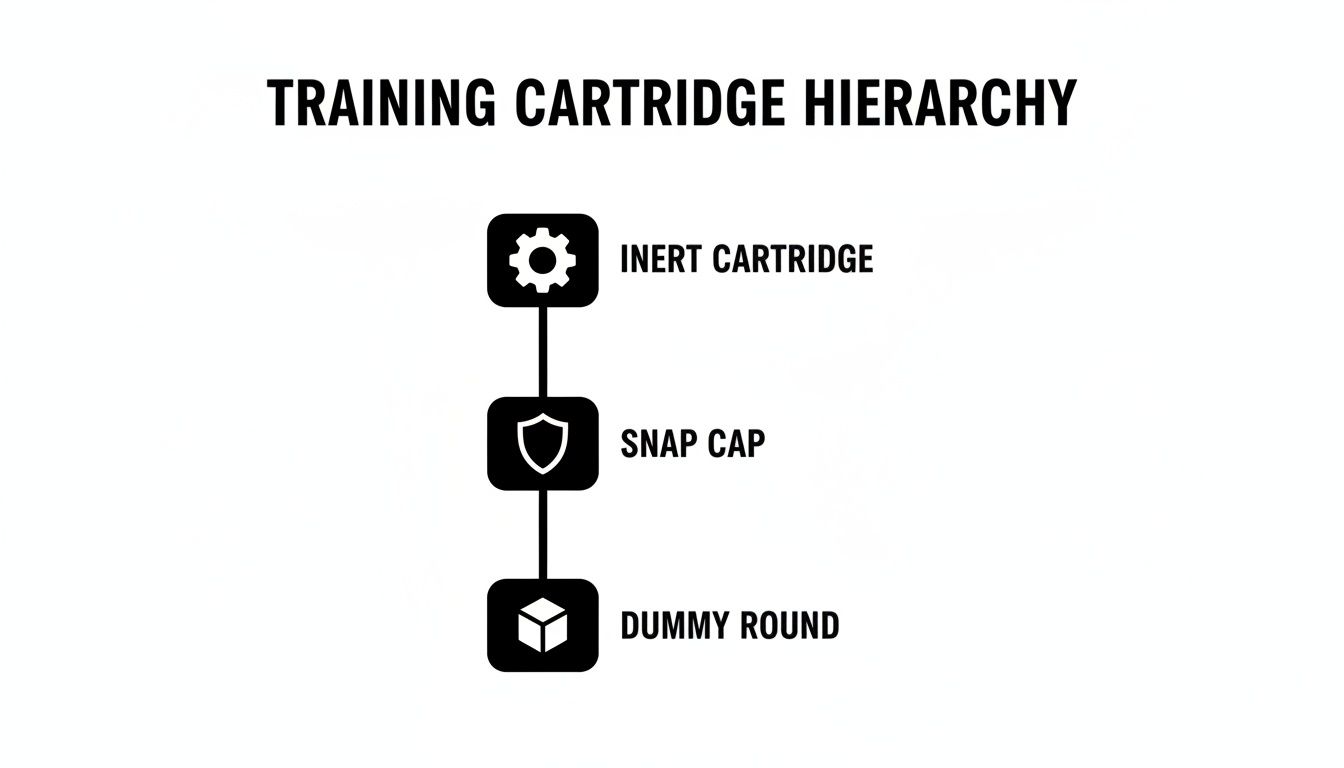
The main thing to remember is this: all snap caps are inert "dummy" rounds, but not all dummy rounds are snap caps. The special, cushioned primer is the key feature that makes a dummy round a true snap cap.
A common myth is that modern, centerfire firearms don't need snap caps. While many are built tough enough to handle some dry-firing, high-volume practice still accelerates wear. Using snap caps is a cheap, easy insurance policy for the longevity of your firearm.
Their usefulness goes far beyond just pulling the trigger, too. They’re critical for practicing other essential skills:
- Practice Reloads: Get a realistic feel for the weight and mechanics of emergency and tactical reloads without the obvious danger of live ammo.
- Conduct Function Checks: After cleaning, maintenance, or installing a new part, you can use snap caps to make sure your firearm is feeding, chambering, and extracting correctly.
- Simulate Malfunctions: Intentionally set up common stoppages, like a failure-to-eject or a double feed, to build the reflexive, life-saving skill of clearing them under pressure.
Snap Caps vs Other Cartridge Types
To really drive the point home, it helps to see how snap caps stack up against other types of cartridges you might encounter. Each one has a very different purpose.
| Cartridge Type | Propellant | Projectile | Primary Use Case | Safe for Dry-Fire |
|---|---|---|---|---|
| Snap Cap | None | None | Dry-fire practice, malfunction drills, function checks | Yes |
| Live Ammunition | Gunpowder | Yes (Bullet) | Live-fire training, duty, self-defense, hunting | No |
| Blank Round | Gunpowder | No | Film production, starter pistols, simulations | No |
| Dummy Round | None | Optional | Display, basic loading drills, function checks | Sometimes |
As you can see, only snap caps are specifically designed with a cushioned primer to make high-repetition dry-firing completely safe for your firearm. While a standard dummy round is inert, it often has a solid or empty primer pocket that offers no protection for your firing pin, making it unsuitable for repeated trigger pulls.
Snap Caps vs. Dummy Rounds: What's the Difference?
You'll often hear shooters throw around the terms “snap cap” and “dummy round” as if they mean the same thing. They don’t. While they look similar, a crucial difference separates them—one that directly affects the health of your firearm.
Here’s the simplest way to remember it: all snap caps are a type of dummy round, but not all dummy rounds are snap caps. The secret is hidden in one tiny, but critical, component.
That component is the false primer. A true snap cap is built specifically for dry-fire practice and always has a cushioned or spring-loaded primer. It might be a small brass plunger on a spring or a piece of tough, self-healing polymer. Its entire job is to safely absorb the impact of the firing pin, preventing the metal-on-metal smack that can cause damage over time.
A standard dummy round, on the other hand, might just have a solid piece of metal where the primer should be, a hard plastic plug, or sometimes just an empty pocket. It’s great for practicing loading, unloading, and malfunction drills, but it offers zero protection for your firing pin. Repeatedly dropping the hammer on a basic dummy round can cause the very wear and tear you're trying to avoid.
The Anatomy of Protection
Think of it like training gear for a boxer. A generic dummy round is the heavy bag—it has the right shape and weight, and you can practice your moves with it. But a snap cap is like a pair of focus mitts. The mitts (the cushioned primer) are designed to absorb the punch (the firing pin strike), protecting the boxer’s hands just as much as the person holding them.
This small difference has a huge impact, especially if you’re serious about practice. The wear from thousands of tiny impacts against a hard surface really adds up.
The key feature that separates a snap cap from a generic dummy round is its ability to safely absorb energy. One is a passive placeholder for function checks; the other is an active training tool built to preserve your firearm during repetitive dry-fire.
Why This Difference Matters for Your Firearm
Using the right tool for the job is fundamental to keeping your gear in top shape. Using a basic dummy round for dry-fire is like using a screwdriver as a pry bar—it might work for a bit, but you're asking for trouble. A well-intentioned training session could easily turn into a trip to the gunsmith.
Here’s a quick look at what that cushioned primer actually prevents:
- Firing Pin Damage: This is the big one. The cushioned primer stops the firing pin from chipping, mushrooming, or even fracturing from repeated impacts. This is especially important for many rimfire firearms, where the firing pin is designed to strike the soft brass rim of a cartridge, not the hard steel of the chamber wall.
- Breech Face Wear: By giving the firing pin a safe place to land, a snap cap also reduces the stress on the breech face right around the firing pin hole.
- Long-Term Reliability: Protecting these small, vital parts is key to ensuring your firearm runs reliably for thousands and thousands of rounds. It keeps your gun performing exactly as it should, especially when it matters most.
At the end of the day, a dummy round is just a cartridge-shaped object. A snap cap, however, is a purpose-built piece of equipment designed to actively protect your firearm’s internals during dry-fire practice. Choosing the right one isn't just a small detail—it's a core part of responsible firearm ownership and effective training.
How Snap Caps Take Your Training to the Next Level
It's one thing to talk about snap caps in theory, but where they really shine is in your hands, integrated into your training. They aren't just plastic or metal plugs to protect your firearm; they're dynamic tools that make your practice sessions safer, more effective, and a heck of a lot more convenient. By adding snap caps to your routine, you can build serious skills without the cost, noise, and hassle of a trip to the live-fire range.
These simple, inert cartridges give you a real edge. They let you focus purely on the mechanics of shooting, building the kind of rock-solid muscle memory that pays off when the pressure is on.
Master Your Trigger Control with Dry-Fire
If there’s one skill that separates a good shooter from a great one, it’s trigger control. And the absolute best way to perfect it is through dry-fire practice—the simple act of practicing a trigger pull on an empty firearm. Snap caps make this process completely safe for your gun's firing pin.
When you press the trigger with a snap cap chambered, you can focus 100% on a smooth, steady squeeze. There’s no recoil or blast to anticipate. This isolation helps you root out bad habits like flinching and jerking the trigger, which are the culprits behind most missed shots. Regular dry-fire with snap caps builds the precise, repeatable muscle memory you need for that perfect shot, every single time.
Verify Your Firearm's Function—Safely
Ever finished cleaning your gun, put it back together, and had that nagging thought: "Did I get everything right?" Snap caps give you the answer without the risk of using a live round. You can safely cycle the action and confirm your firearm is running like a well-oiled machine.
This process is called a function check, and it’s dead simple. You’re just making sure the gun can do its job:
- Feeding: Does it load a snap cap from the magazine into the chamber smoothly?
- Chambering: Does the slide or bolt fully close and lock into battery?
- Extracting: When you rack the slide, does the extractor claw grab the snap cap's rim?
- Ejecting: Does the snap cap get tossed cleanly out of the ejection port?
Running a few snap caps through your firearm after maintenance or after installing a new part gives you the confidence that it will work when it absolutely has to. After all, you spend time getting your gear just right, and that includes knowing the details, like what your scope numbers mean.
Practice Realistic Malfunction Drills
In a high-stress situation, you don’t have time to remember how to clear a jam. Your hands have to know what to do on their own. Snap caps are the only way to safely practice clearing common malfunctions with your actual firearm.
Here's a great drill for the range: have a buddy randomly mix one or two snap caps into a magazine filled with live rounds. When you pull the trigger and get a "click" instead of a "bang," you're forced to execute the immediate action drill—tap, rack, and reassess. This is how you build the reflexive skill to get your gun back in the fight instantly.
And this kind of training works. Many shooters—around 40-50%—report a noticeable improvement in their trigger control within just a few weeks of consistent use. Plus, investing in quality pays off; durable models like A-Zoom snap caps are known to last over 30 times longer than their cheaper plastic counterparts. You can learn more about the durability and benefits of snap caps to see how they fit into a serious training regimen.
How To Choose The Right Snap Caps
Picking the right snap caps isn't as simple as grabbing the first box you see. It's a key decision that impacts how safe and effective your training will be. The right ones protect your firearm's internals and feel realistic, while the wrong ones can offer false security or even cause damage.
Think about it like this: you wouldn't put just any oil in your car's engine. You need the right type for your specific model. Your firearm is no different. It needs a snap cap that’s perfectly matched to its design, and that starts with understanding the materials they're made from.
Compare Materials and Durability
The material a snap cap is made from tells you a lot about how long it will last and how it will feel in your firearm. Each option strikes a different balance between cost, realism, and sheer toughness, so you can pick what's best for your training regimen.
- Anodized Aluminum: These are the workhorses. Brands like A-Zoom machine them from solid aluminum, making them incredibly durable. They can take thousands of hits from a firing pin, so they're perfect for anyone who takes their dry-fire practice seriously.
- Polymer/Plastic: This is your budget-friendly option. They're great for occasional function checks or light use, but they definitely wear out faster than metal. The false primer will get chewed up over time, which means it stops protecting your firing pin as effectively.
- Brass: If you want the most realistic feel, look for brass snap caps. They have the same weight as live ammunition, which is a huge advantage when you're practicing reloads and want to simulate the feel of a fully loaded magazine.
Ensure Exact Caliber Compatibility
This is the golden rule, and it's non-negotiable: always use a snap cap that exactly matches your firearm’s caliber. Don't even think about putting a 9mm snap cap in a .40 S&W pistol. It won't chamber right, it won't extract properly, and you risk damaging your extractor claw or even the chamber itself.
Your firearm is a precision machine. Its parts are engineered to work with ammunition of very specific dimensions. Using a correctly sized snap cap is absolutely critical to keeping those internal mechanisms safe during practice.
Thankfully, the market has you covered. A-Zoom, one of the biggest names out there, makes snap caps in over 120 different sizes, from the tiny .22 Hornet to the massive .50 BMG. You can find a safe, purpose-built option for almost any firearm out there. A five-pack for a common handgun caliber will usually run you $8-15, while a two-pack for larger rifle rounds might cost between $12-20. You can find more great insights on the importance of training with snap caps on thetruthaboutguns.com.
One last thing—always choose brightly colored snap caps. There's a reason most are made in eye-catching red, blue, or orange. It makes them impossible to mistake for live rounds. This simple visual check is a powerful safety measure that can prevent a tragic accident during training. Getting these details right is a core part of building out your gear, which is covered in more detail in The Ultimate Tactical Gear Checklist for 2025.
A Step-By-Step Guide To Using Snap Caps Safely
Knowing what snap caps are is one thing; using them the right way is what actually builds skill and keeps you safe. Every effective training session is built on a disciplined, repeatable process. Following a solid protocol every single time helps eliminate complacency and drills in the safe habits every firearm owner needs.
Proper technique starts before your hands even touch the firearm. The whole point is to create an environment where a catastrophic mistake is physically impossible. This means you have to make a conscious choice to completely separate your training activities from your live-fire readiness.
Preparing Your Training Environment
First things first: you absolutely have to create a "sterile" training space. This is a non-negotiable safety rule. Pick a specific room or area in your home for dry-fire practice and make it a hard-and-fast rule that no live ammunition ever enters this area. Period.
Get all loaded magazines, boxes of ammo, and any loose live rounds out of that room. Put them away in a totally separate, secure spot. This physical separation is your number one safety net—it's what prevents a live round from ever making its way into your training firearm by accident. Once the area is completely clear, you're ready to prep your gear.
The Five Steps For Safe Snap Cap Use
With your sterile environment set up, you can now safely handle your firearm and snap caps. Follow this five-step process every single time you start and end a dry-fire session. Doing this religiously is how you build unbreakable safety habits.
Unload and Verify Clear
Drop the magazine from your firearm and lock the slide or bolt to the rear. Now, visually inspect the chamber and the magazine well to confirm they're empty. Don't stop there—physically check the chamber with your finger to be 100% certain the weapon is unloaded.Load Snap Caps
Grab your caliber-specific snap caps and load them into an empty magazine. The process of loading a magazine is a core skill, and practicing it correctly, even with inert rounds, is great for muscle memory. For a refresher, you can learn more about how to load a magazine in our detailed guide. Once loaded, insert the magazine of snap caps into your firearm.Perform Your Drills
With snap caps loaded, you're clear to begin your training. This is where you can safely practice your trigger press, work on sight alignment, run function checks, or drill malfunction clearing procedures. Concentrate on smooth, deliberate movements to build good habits that stick.
Pro Tip: If you're using a semi-automatic pistol, remember you'll need to manually rack the slide after each trigger pull. This resets the trigger and "chambers" the next snap cap. Think of this extra step as a valuable part of the training process itself.
Unload and Verify Clear Again
When your training session is done, drop the magazine with the snap caps. Lock the slide or bolt open and eject any snap cap that might be left in the chamber. And just like when you started, perform both a visual and a physical check to confirm the firearm is completely empty.Secure and Separate Your Gear
Last but not least, put your snap caps away. Store them in a dedicated container or bag that is kept completely separate from where you store your live ammunition. This is the final step to prevent a dangerous mix-up. After that, store your firearm according to your normal safety protocols.
Got Questions About Snap Caps? We've Got Answers.
Even after you get the basic idea of what a snap cap is, a lot of specific questions tend to pop up. Getting straight answers is key to feeling confident enough to make them a regular part of your training routine. Let’s tackle some of the most common things people ask.
Are Snap Caps Really Necessary for Modern Centerfire Guns?
This one comes up a lot. It's true that most modern centerfire pistols and rifles are built tough and can handle some dry-firing without falling apart. But think about it—heavy, repeated practice without a snap cap is still putting a lot of stress on your firing pin and its spring. The impact adds up over thousands of clicks.
Using them is really a "better safe than sorry" move. For the few bucks a set of snap caps costs, you buy total peace of mind, knowing you're protecting your firearm's guts from unnecessary wear. Think of it as cheap insurance for anyone who's serious about their training.
Do I Need Snap Caps for My .22LR?
Yes, absolutely. For any rimfire firearm, snap caps aren't just a good idea—they're essential. This comes down to a basic design difference that makes rimfires especially easy to damage when dry-fired.
In a rimfire, the firing pin is meant to hit the soft brass rim of the cartridge, right on the edge of the chamber. When there's no round or snap cap there, the pin smacks directly into the hard steel of the chamber wall. That metal-on-metal impact is a fast track to a peened, chipped, or broken firing pin.
With rimfire guns, dry-firing without a snap cap isn't about long-term wear. It's about causing immediate damage. Always use a proper rimfire snap cap to avoid a trip to the gunsmith.
How Long Do Snap Caps Last?
That really depends on what they're made of and how often you're using them. The lifespan can vary a ton between different types, so you need to give them a quick look-over for wear and tear before you start practicing.
- High-quality aluminum snap caps, like the ones from A-Zoom, are machined for toughness and can take thousands of hits.
- Cheaper plastic or polymer versions will give out a lot faster, especially if you're doing a lot of drills.
It’s time to replace your snap caps when the fake primer gets really dented, chipped, or flattened out. Once it's worn down, it's not providing that crucial cushioning anymore, and your firing pin is taking the full force of the impact again.
Can Using the Wrong Snap Cap Damage My Gun?
You bet it can. Using the correct, caliber-specific snap cap is non-negotiable. It's a matter of both safety and protecting your firearm.
A snap cap in the wrong caliber might not chamber right, potentially messing up your extractor or even the chamber itself as the action tries to force something that just doesn't fit. And as we just covered, using a worn-out snap cap is pretty much the same as using nothing at all—it defeats the whole purpose. Always double-check that you have the right snap cap for your firearm and that it’s in good shape before you start any training.
For all your tactical equipment needs, from advanced optics to essential training accessories, Superior Tactical LLC provides the gear and expertise to keep you mission-ready. Explore our curated selection of high-quality products backed by a commitment to outstanding customer support. Find the right gear for your needs at https://superiortac.com.
