A 2026 Guide to Thermal Vision Glasses
Imagine for a moment that you're operating in complete darkness. Not just low light, but zero visibility. Your eyes are useless, but what if you could see the world painted in a vibrant tapestry of heat? That's precisely the advantage thermal vision glasses give you, turning infrared energy into a clear picture when the naked eye sees nothing at all.
This isn't just a fancy gadget. For professionals who operate when the lights go out, it's a critical piece of gear that delivers unmatched situational awareness.
Seeing a World of Heat with Thermal Vision Glasses
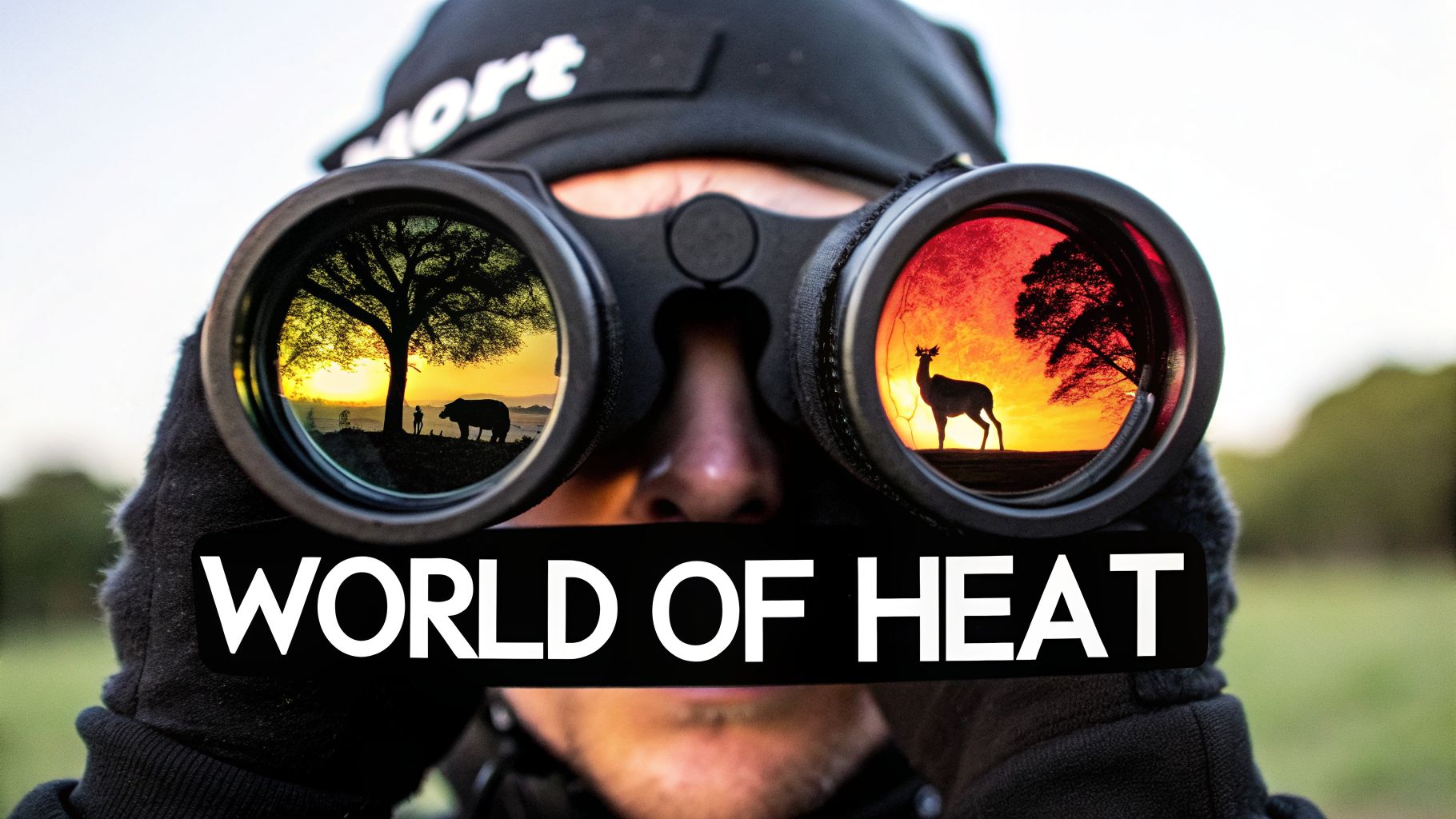
Unlike traditional night vision that needs some ambient light to amplify, thermal imaging plays by a different set of rules. It doesn't see light; it sees heat. Every object, living or not, gives off a certain amount of infrared energy, and a thermal device renders this invisible world into a real-time temperature map.
This gives operators a massive tactical edge in environments where light is compromised or completely absent. For law enforcement, security teams, and search and rescue personnel, this technology is nothing short of a game-changer. Its true power, however, lies in its ability to see through things that would stop normal vision in its tracks.
Piercing Through Obscurants
From a practical standpoint, the single greatest benefit of thermal is its power to cut through visual barriers that would render other optics useless. Think about what that means in the field.
- Smoke and Dust: A firefighter can scan a smoke-choked room and instantly spot the heat signature of a person on the floor. An officer can track a suspect's vehicle through the thick dust of a high-speed chase.
- Fog and Haze: A SAR team scanning a foggy hillside can pick out a lost hiker’s body heat from hundreds of yards away, turning a days-long search into a matter of hours.
- Thick Foliage: A hunter or surveillance team can easily detect the heat signature of a target hiding in dense brush, long after the sun has set.
The bottom line is simple: thermal vision doesn't need light to build an image, it only needs heat. This fundamental difference makes it the most reliable detection tool you can have when conditions are at their absolute worst.
In this guide, we're going to break down the technology behind thermal vision in a way that makes sense for the real world. We'll dive into the key specs you need to understand, put thermal head-to-head with traditional night vision, and give you practical advice from a professional standpoint. When you're done, you'll know exactly how this technology can support your mission and how to choose the right tool for the job.
Here’s how thermal imaging actually works, broken down in simple terms.
Forget everything you know about normal cameras. A thermal device isn’t seeing light; it’s seeing heat. Every single thing that has a temperature above absolute zero—and that’s everything you’ll ever encounter—is constantly giving off infrared energy. Thermal imagers are built to see that invisible energy.
Think of the sensor inside a thermal unit as a massive grid of incredibly sensitive, microscopic thermometers. We call these individual points microbolometers. Each one measures the temperature of whatever tiny spot it's looking at, and the device collects millions of these data points in real-time. It then instantly translates that temperature map into an image, which we call a thermogram.
Painting a Picture with Heat
This is the process that lets you cut through complete darkness, fog, or smoke. The device assigns colors or shades to different temperatures. Typically, hotter objects that radiate more energy show up as bright colors—white, yellow, or red. Cooler objects that radiate less energy appear dark—black or deep blue.
This is exactly why a person stands out like a beacon against a cool nighttime background. Your body heat is much higher than the surrounding air, trees, and ground, creating a stark, high-contrast silhouette that’s impossible to miss. It's not magic; the device is simply painting a picture for you using heat as the paint.
A critical point that many people miss: thermal doesn't detect the heat on an object. It detects the infrared energy emitted by the object. This is a subtle but huge distinction. It’s why thermal can see through smoke, dust, and fog—the heat signature travels right through obscurants that would block visible light completely.
This ability to pick up on tiny temperature differences is what makes thermal so powerful. It’s about finding what’s hidden, which has driven massive growth in this sector. The night vision market, which heavily features thermal vision glasses, jumped from $234.1 million in 2023 to $240.5 million in 2024. Experts project it will hit $347.6 million by 2033, with thermal optics being essential for spotting human heat signatures beyond 500 meters in zero-light tactical situations.
Interpreting the Thermal World
Getting good with a thermal imager means learning to read this new world of heat signatures. What you're seeing isn't a photograph; it's an interpretation of data. This takes a different mindset.
For instance, a rock that's been baking in the sun all day will hold onto that heat and glow brightly for hours after sunset. The engine and tires of a car that was just running will pop on the screen, instantly telling you it was recently driven. Learning to spot these thermal "clues" is what separates a novice from an expert. To dig into these concepts further, check out our guide on what is thermal vision.
Here are a few real-world examples of what you can learn to see:
- Footprints: On a cool night, the faint heat left behind by footsteps on concrete or damp earth can remain visible for a short period, showing you a recent path of travel.
- Hidden Compartments: A false wall or a hidden compartment in a car’s dashboard will often have a slightly different temperature from the surrounding material, creating a faint but visible outline.
- Disturbed Earth: Soil that has been recently dug up has a different density and moisture level, giving it a unique thermal signature compared to the solid ground around it.
Ultimately, effective use of thermal vision glasses is about re-training your brain. You learn to see the world not in light and dark, but in hot and cold. It’s about picking up on the subtle story that heat signatures tell, giving you an undeniable advantage when it matters most.
Decoding Key Specs for Field Performance
When you're looking at a spec sheet for professional thermal vision glasses, it can feel like you're trying to read another language. All those numbers and acronyms might seem abstract, but in the field, each one directly impacts your effectiveness and, more importantly, your safety. Knowing how to read these specs is the difference between buying a mission-critical tool and a costly paperweight.
Let's break down what these key metrics actually mean for your performance on the ground. This isn't about memorizing technical jargon; it's about understanding how a device will behave before you ever have to bet your life on it.
It all starts with how these devices see the world. Every object gives off invisible heat (infrared energy), which the thermal optic captures. It then processes that energy and turns it into a visible image, called a thermogram.
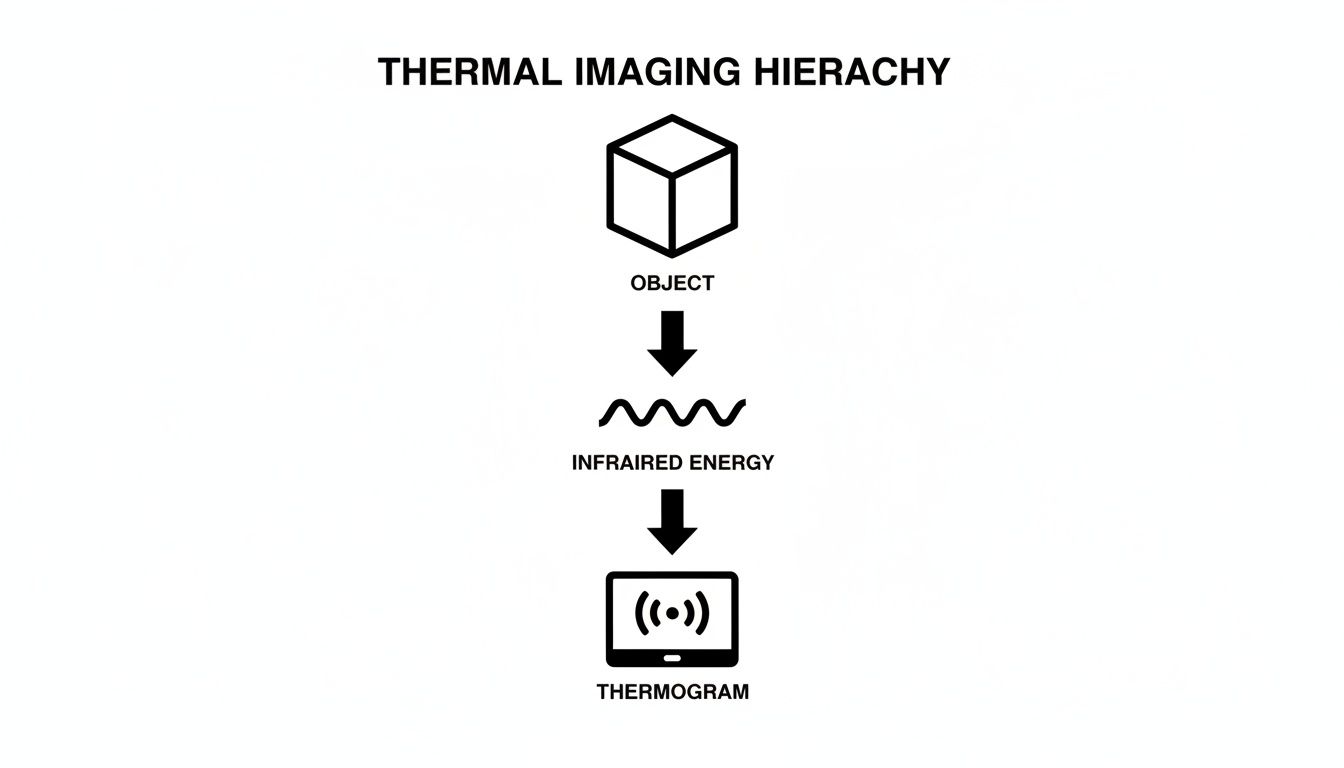
The quality of that final image hinges entirely on how well the device’s internal components can sense and interpret that invisible heat signature.
To help you connect the dots between the spec sheet and real-world capability, this table breaks down the most important numbers you'll encounter.
Key Thermal Vision Specs and Their Real-World Impact
| Specification | What It Measures | Why It Matters for Professionals |
|---|---|---|
| Sensor Resolution | The number of heat-detecting pixels on the sensor (e.g., 640×480). | Higher resolution means a sharper, more detailed image. It's the key to positive identification at a distance. |
| Refresh Rate (Hz) | How many times per second the image updates on the screen. | A high refresh rate (60Hz) provides a smooth, real-time video feed, essential for tracking moving targets without motion blur. |
| NETD (mK) | The sensor's ability to detect tiny temperature differences. Lower is better. | A low NETD (<30mK) allows the device to pull clear heat signatures even in low-contrast conditions (e.g., humid nights). |
| Field of View (FOV) | The width of the scene you can see at one time, measured in degrees. | A wide FOV is for scanning large areas. A narrow FOV acts like a zoom lens for long-range identification. |
| DRI Ranges | Standardized estimates for Detection, Recognition, and Identification distances. | Helps you understand the practical operational limits of the device for mission planning and target engagement. |
Ultimately, these specs work together. A high-resolution sensor is great, but if the refresh rate is too low, you can't track a moving vehicle. Understanding how they interplay is what separates a novice user from an expert operator.
Sensor Resolution Is Your Image Clarity
If you only look at one spec, make it sensor resolution. This number tells you how many pixels (or microbolometers) the thermal sensor has. Just like with a regular digital camera, more pixels give you a sharper, clearer picture.
An entry-level device might have a 320×240 resolution, which packs in 76,800 pixels. For a quick scan of an open area, that might be enough to see a heat blob. But a professional-grade 640×480 sensor gives you 307,200 pixels—that's four times the detail. This leap in quality means you can make a positive identification from much farther out.
A higher resolution isn't just about a "nicer" image. It is a critical tactical advantage. It means you can distinguish a human holding a long gun from a person carrying a shovel, or differentiate an animal from a person, from much farther away.
Refresh Rate Is Smoothness in Motion
Next up is the refresh rate, measured in Hertz (Hz). This tells you how many times per second the image on your display updates. For anyone dealing with moving targets, this spec is non-negotiable.
Imagine trying to follow a suspect on the run or a fast-moving vehicle with a choppy, lagging video feed. A low refresh rate of 9Hz or even 30Hz creates motion blur and can make tracking nearly impossible.
- 30Hz: This is a common baseline and can feel "good enough" for static observation. But with fast movement, you’ll notice a definite lag or blur.
- 60Hz: This is the gold standard for any serious operational use. At 60Hz, the image updates 60 times per second, giving you a buttery-smooth picture that lets you track targets in real-time without any disorienting lag.
For high-speed pursuits, tactical entries, or even tracking fast game, a 60Hz refresh rate is an absolute must.
NETD Measures Thermal Sensitivity
Noise Equivalent Temperature Difference (NETD) sounds complicated, but the concept is simple: it's a measure of the sensor's sensitivity. It tells you the smallest temperature difference the device can detect. Here, a lower number is better.
NETD is measured in milliKelvins (mK). A decent unit will have a rating of <50mK, but truly professional systems will be rated at <30mK or even <20mK. A lower NETD gives you a cleaner, higher-contrast image, especially when there isn't much temperature difference between your target and the background.
Think about a humid night where the ground, the air, and a person's body heat are all close in temperature. A cheap thermal with a high NETD will show you a washed-out, muddy picture. A high-end unit with a low NETD will cut right through that and pull out a crisp, clear heat signature.
Field of View Dictates Your Awareness
Field of View (FOV), measured in degrees, is simply how wide of an area you can see at once. This is a classic trade-off between having broad situational awareness and getting a magnified view for identification.
- Wide FOV (e.g., 24°): Perfect for scanning your surroundings, like an open field or a wooded treeline. You can see a lot at once, but objects in the distance will appear small.
- Narrow FOV (e.g., 9°): This acts like a telephoto lens, giving you built-in magnification to identify a target at long range. The downside is "tunnel vision," where you lose awareness of what's happening in your periphery.
Some of the more advanced thermal glasses solve this problem by offering a dual-FOV lens or a digital zoom, giving you the best of both worlds.
DRI Defines Your Operational Range
Finally, many manufacturers list Detection, Recognition, and Identification (DRI) ranges. These are standardized metrics—based on the "Johnson Criteria"—that give you a realistic idea of a device's performance at distance.
- Detection: The absolute maximum range where you can see a hot spot and know something is there. It might just be a few pixels on the screen.
- Recognition: The range at which you can classify that target. For example, you can tell it's a person, not a deer, or a truck, not a car.
- Identification: The range where you can start picking out specific details. Can you tell if the person is holding something? Can you confirm they are armed?
These DRI numbers are incredibly valuable for mission planning. They tell you the practical limits of your gear, ensuring you have the right tool with the right range to stay safe and get the job done.
Thermal Vision vs. Night Vision: Picking the Right Tool for the Job
When the lights go out, operators have two main choices: thermal vision glasses or traditional night vision. People often lump them together, but they’re completely different technologies built for different tasks. Knowing when to use which is the first step to truly owning the night.
Think of it this way. Traditional Image Intensification (I²) night vision acts like superhuman eyesight. It grabs whatever tiny bit of ambient light is available—from stars, the moon, or distant city glow—and amplifies it thousands of times so you can see.
Thermal, on the other hand, is more like gaining a new sense. It doesn't see light at all; it sees heat. This allows it to work in ways that I² night vision simply can't.
Detection vs. Identification: The Core Difference
The decision between thermal and night vision really comes down to a single question: is your main goal to find something, or to identify it?
Thermal Is for Detection: Nothing beats thermal for pure detection. It’s unmatched at picking up a heat signature, whether it’s in pitch-black darkness, hidden in thick brush, or obscured by smoke. Because it sees heat, it makes any living thing or recently used engine pop, no matter the lighting.
Night Vision Is for Identification and Navigation: I² night vision usually gives you a much clearer, more detailed picture. This makes it the better choice for moving through terrain and figuring out exactly what you're looking at. Since it’s working with reflected light, you can read signs, recognize faces, and judge distance with far more accuracy—as long as there’s some light to work with.
The best way to think about it is this: Thermal finds them. Night vision tells you who they are. That's why the most experienced operators don't pick one over the other; they use both.
Situational Advantages of Each Technology
The mission always dictates the gear. A firefighter clearing a smoke-filled building needs something very different from a security guard patrolling a dimly lit perimeter.
You’ll want thermal vision glasses when:
- You're in total darkness. Inside a sealed building or on a moonless, overcast night, thermal is your only way to see.
- Visibility is obscured. Thermal cuts right through smoke, heavy fog, dust, and thick vegetation that would completely blind standard night vision.
- You're up against camouflage. Camo is designed to trick the eye by breaking up visual patterns. It does absolutely nothing to hide body heat from a thermal imager.
- Detection is everything. For search and rescue, surveillance, or spotting threats on a perimeter, nothing finds a heat signature faster than thermal.
You’ll want traditional night vision when:
- You need to move. The superior detail and depth perception from I² makes it easier to navigate complex environments quickly and safely.
- Positive ID is non-negotiable. If you need to recognize a face or read a license plate, the high-resolution image from I² is usually your best bet.
- There’s some ambient light. With even a quarter-moon, modern night vision can produce incredibly sharp and detailed images.
The demand for this kind of hands-free capability is exploding. The market for night vision devices, valued at $7.02 billion in 2022, is on track to hit $16.32 billion by 2030. A huge driver of this is the growing adoption of thermal vision glasses, with that specific sub-segment growing at an impressive 8.9% CAGR as more professionals choose them for their ability to see through obscurants.
The Ultimate Setup: Fusing Both Technologies
For those who need every possible advantage, the answer isn't to choose one—it's to combine them. The gold standard is a helmet-mounted bridge system that holds a thermal monocular over one eye and a night vision monocular over the other.
This "fusion" setup gives an operator the best of both worlds.
Your brain naturally merges the two images. You can scan an area and instantly detect a heat signature with the thermal unit, then shift your focus to the night vision unit for a positive ID and better navigation. It’s a level of situational awareness that neither technology can deliver on its own.
For a deeper dive into this comparison, check out our comprehensive guide on thermal imaging vs. night vision.
Real-World Applications of Thermal Vision
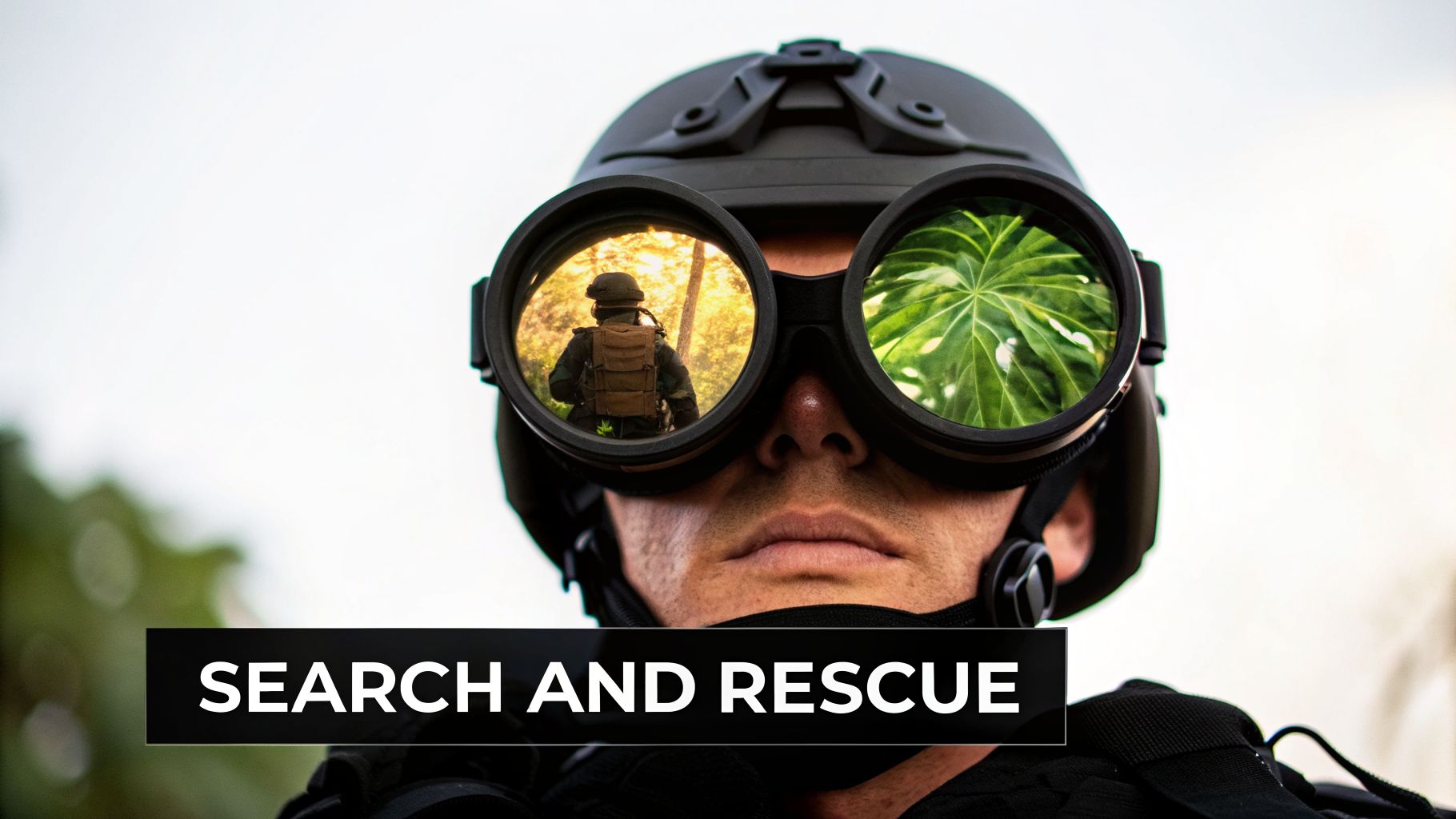
Specs on a sheet are one thing, but the real test of any gear is how it performs in the field. This is where thermal vision stops being a concept and becomes the one tool that can mean the difference between mission success and failure. When visibility is gone, thermal vision glasses give you the upper hand.
Take a law enforcement officer clearing a pitch-black warehouse. A suspect has vanished into a maze of dark alleyways. With the naked eye, the officer is effectively blind and vulnerable. But with thermal, the suspect's body heat pops against the cool concrete. Suddenly, a hiding spot behind a dumpster a hundred yards away isn't a hiding spot at all.
Search and Rescue Operations
For any search and rescue (SAR) team, the clock is the enemy. A hiker lost in a dense national park could be anywhere. A ground search is slow and laborious, and even an aerial search can fail if the person is under a thick tree canopy.
This is where thermal completely changes the game. A SAR operator on the ground can scan the same dense underbrush and instantly pick up the faint heat signature of the lost hiker, who may be hurt and unable to respond. The thermal imager sees right through the visual camouflage of the forest, turning a desperate multi-day search into a quick recovery.
By detecting heat instead of light, thermal vision glasses empower operators to find what is hidden. Whether concealed by darkness, foliage, or smoke, a heat signature provides a clear and undeniable point of detection that no other technology can match.
Hunting and Wildlife Management
Hunters know the challenge of tracking an animal after a shot at dusk. Fading light can make a blood trail nearly impossible to follow, and an animal can cover a surprising amount of ground before it expires.
Thermal optics make this process faster and far more ethical. A hunter can easily scan the terrain, not just for a heat trail, but for the residual body heat of the downed game itself. An animal lying motionless in tall grass that would be invisible to the eye becomes a clear thermal target. You can get a much more detailed breakdown in our guide on how thermal vision can be used for hunting.
Security and Perimeter Defense
Think about a security professional tasked with guarding the perimeter of a large, remote facility at night. An intruder's best tools are darkness and cover. To a standard camera, or even the guard's own eyes, they can easily blend in with the shadows.
A guard with thermal glasses sees a completely different picture. That intruder's body heat creates a stark, high-contrast silhouette against the cool ground. It’s an unmistakable sign of a threat, allowing for an immediate response long before a breach can occur.
This mission-critical advantage is why the professional optics market is booming. The global night vision devices market, where thermal vision glasses play a leading role, was valued at $8.9 billion in 2025 and is on track to hit $13.58 billion by 2030. That explosive growth is driven by professionals who demand gear that works when traditional optics fail. In fact, thermal technology captured a massive 41.7% of the market share as far back as 2022. If you want to dive into the numbers yourself, you can read the full research on the night vision devices market.
Choosing Your Next Set of Thermal Glasses
Alright, you’ve done the homework. You now have a solid grasp of what separates a basic imager from a professional-grade tool. You get why resolution is king for clarity, how refresh rates make or break your ability to track a moving target, and why seeing in heat gives you such a massive advantage.
Now comes the hard part: turning all that theory into the right purchase. It’s about more than just comparing spec sheets and finding the lowest price. It's about finding a partner who will give you straight answers and stand behind the gear they sell you for years to come.
Beyond the Initial Purchase
Think of professional thermal vision glasses as a long-term investment in your effectiveness and safety. Like any critical piece of equipment, it needs support. The real value isn't just in the device itself, but in the service that keeps it running when you need it most.
A supplier that disappears after the sale is a liability. You need someone who offers real support to protect your investment and keep you in the field:
- Long-Term Warranties: A serious warranty, like the 10-year coverage you’ll find on many Gen 3 systems, says a lot. It means the company trusts its own products, giving you peace of mind that you're covered against defects.
- Fast Shipping and Availability: When you need gear, you often need it now. Waiting weeks just isn't an option for most professionals. Look for a supplier that can ship same-day or next-day to get you operational fast.
- In-House Repair Services: Gear gets dropped, banged up, and put through the wringer—it happens. Having access to an in-house repair center is a game-changer. Services like free diagnostics can pinpoint a problem quickly without you having to shell out cash just to find out what’s wrong.
Who you buy from is just as important as what you buy. You're looking for a team that will be a resource for the long haul, not just a one-time transaction.
At Superior Tactical, this is the core of what we do. We’re not just here to move boxes; we’re here to be a reliable partner for law enforcement, dedicated hunters, and security pros who depend on their gear.
Our team has been there, and we can help you cut through the noise to find the exact piece of equipment for your mission—no jargon, no pressure. Whether it’s from top-tier brands like EOTech and Unity Tactical or our own in-house technical support, we’ve built our entire operation around keeping you ready. Your mission is the priority, and we have the gear, the know-how, and the support to back that up. When you’re ready to make a choice, we’re here to help you get it right.
Common Questions About Thermal Vision
Even after you get a handle on the basics of thermal tech, a few questions always seem to pop up. Let's tackle some of the most common ones we hear from both seasoned pros and newcomers to the field.
Can Thermal Vision Glasses See Through Walls?
This is probably the number one question we get, thanks to movies and video games. The straight answer is no, thermal vision cannot see through solid objects like a concrete wall or a door.
Think of it this way: a thermal imager reads the surface temperature of an object. It can't see what's behind that surface. What it can do is spot clues on the surface itself. For instance, you can easily see the heat signature from hot water pipes running inside a wall, pinpoint where insulation is failing, or even spot the faint heat left by a handprint just moments after it was there. Its real superpower is cutting through visual clutter like smoke, fog, and dense foliage—not solid barriers.
What’s the Average Battery Life?
For anyone using gear in the field, battery life is everything. Most modern thermal vision glasses will give you 4 to 12 hours of continuous run time on a fresh charge or new batteries. Of course, this number can swing quite a bit depending on the model, how bright you run the screen, and the outside temperature.
A lot of units run on common CR123A batteries, which makes it simple to pack spares. Others come with internal, USB-C rechargeable packs. For operators on longer missions, it's standard procedure to hook up an external battery pack to the device. You just can't afford to have your gear die when you need it most.
Remember that cold weather can significantly reduce battery life. Always test your gear in conditions similar to your operational environment and plan accordingly by carrying extra power sources.
Are Thermal Vision Glasses Legal for Civilians?
Yes, for the most part. Here in the United States, it is generally legal for civilians to buy and own thermal imaging devices. Most thermal units aren't subject to the same strict ITAR (International Traffic in Arms Regulations) export rules that apply to some high-end, military-grade night vision, which makes them much more accessible.
However, the laws get a bit more specific when it comes to using thermal, especially for hunting. Some states have very clear rules about whether you can use a thermal optic to harvest game. Before you head out, you absolutely need to check your local and state regulations.
Do I Need Thermal if I Already Have Night Vision?
That’s the million-dollar tactical question. While traditional night vision (the green kind) is fantastic for moving around and identifying things in the dark, it still needs some ambient light to work. Thermal gives you a completely different—and complementary—capability by detecting heat alone.
A thermal unit can spot a hiding suspect in pitch-black conditions or through thick brush where night vision would just see a dark shape, if anything. This is exactly why many professionals run both systems together on a helmet bridge mount. This "fused" setup gives you the best of both worlds: thermal for instant detection and night vision for crystal-clear identification.
At Superior Tactical, we know that choosing the right optics is a mission-critical decision. Our team is here to offer real-world advice to help you select, maintain, and get the most out of your gear. Take a look at our handpicked selection of professional-grade thermal and night vision optics.
