Decoding Reviews on Night Vision Binoculars
Trying to make sense of dozens of reviews on night vision binoculars can be a real headache. The secret isn't reading more reviews; it's knowing how to read them smarter. The most helpful feedback won't come from a five-star rating with a one-sentence comment, but from a user whose mission mirrors your own and who gets into the nitty-gritty details of performance.
How to Actually Read Reviews on Night Vision Binoculars
Staring at a wall of user reviews feels a lot like fumbling in the dark—ironic, isn't it? You've got the glowing raves, the furious rants, and a sea of "it's okay" comments that don't help one bit. The real skill is learning to decode this mess. You need to turn all that raw, unfiltered feedback into a clear picture of how a specific device will actually hold up for you.
The best way to start is by filtering reviews by the user's background. Think about it: a comment from a hog hunter out in the sticks under a new moon is going to be infinitely more valuable than one from someone watching raccoons in their well-lit suburban backyard. Context is king.
Understand the Reviewer's Mission
Before you even get to the pros and cons, stop and ask yourself one simple question: "Is this person using this gear for the same reason I am?"
Different jobs put completely different strains on night vision equipment. A cop on a SWAT team needs something rugged and helmet-mountable with a wide field of view for clearing rooms. On the other hand, a long-range hunter trying to spot a buck at 300 yards couldn't care less about helmet mounting; they need raw magnification and crystal-clear target identification.
A five-star rating from a casual user might praise the easy-to-use digital zoom. But for a professional, that same feature is often a liability that degrades the image and creates a critical point of failure. Always filter feedback through the lens of your own operational needs.
Look For Specifics, Not Generalities
Vague comments like "great clarity" or "works well" are basically worthless. They tell you nothing. The gold is in the details—the reviews that paint a picture you can actually see in your head. For a deeper dive into what specs to watch for, our guide on how to buy night vision binoculars online safely breaks down the key details you should be looking for.
Keep an eye out for reviews that mention:
- Environmental Conditions: Where were they? A pitch-black rural field with no moon, or a city park with tons of ambient light pollution? The difference is huge.
- Specific Distances: Did they just say they could "see far," or did they mention being able to positively identify a coyote at 150 yards? That's actionable intel.
- Direct Comparisons: The best reviewers often compare the device to other models they’ve owned or used. This gives you an invaluable performance baseline.
Getting this level of detail is more important than ever. Night vision binoculars are a serious part of the optics world, commanding a massive 27.1% market share of the entire binocular industry. That popularity means there are thousands of user experiences out there. You just have to know how to spot the ones that matter.
Quick Review Analysis Checklist
To help you cut through the noise faster, here's a quick checklist to keep in mind as you scan reviews.
| Check For | What It Tells You | Red Flag Example |
|---|---|---|
| User's Application | Is their use case (hunting, law enforcement, security) similar to yours? | "Great for watching birds in my backyard at dusk." (If you're a LEO) |
| Specific Distances | Does the review mention actual ranges in yards or meters? | "I can see really far with these." |
| Lighting Conditions | Did they mention moonlight, starlight, or complete darkness? | "Works great!" (With no context on the environment) |
| Comparisons | Is the device compared to other known models? | A standalone review with no frame of reference. |
| Image Detail | Do they describe the image (grain, clarity, contrast) instead of just saying "clear"? | "The picture is good." |
| Purchased vs. Free Product | Is it a verified purchase or a review for a free/discounted item? | "I received this product for free for my honest review." (Proceed with caution) |
This simple framework can help you instantly separate the genuinely useful reviews from the unhelpful ones, saving you time and helping you make a much more informed decision.
Translating Tech Specs from Reviews into Real-World Performance
When you're sifting through reviews on night vision binoculars, the technical jargon can feel like a foreign language. A reviewer throws out terms like "high FOM" or a "clean tube," and if you don't know the lingo, you're left guessing. Let's cut through that confusion and act as your translator, focusing on what these specs actually mean for performance out in the field.
Think of it like buying a performance car. Just looking at the horsepower figure is a rookie mistake. You need to know how it handles the corners, how the brakes feel, and how efficient it is to truly understand how it drives. It's the exact same with night vision—we have to look past the flashy numbers to see the whole picture.
Decoding the Core Performance Metrics
Dive into any serious review, and you'll see a few acronyms pop up again and again. These aren't just there to sound impressive; they're the bedrock of night vision performance. Get a handle on these, and you'll start separating genuine capability from marketing hype.
Figure of Merit (FOM): This is the big, flashy number everyone talks about. It’s a simple calculation: the device's resolution (lp/mm) multiplied by its Signal-to-Noise Ratio (SNR). FOM is the horsepower of the night vision world—a quick, top-level indicator of potential. A higher FOM is generally better, but it's far from the only thing that matters.
Signal-to-Noise Ratio (SNR): Honestly, this might be the most important spec of all. SNR tells you how much clean "signal" (the light from the image you want to see) you're getting compared to the "noise" (that fuzzy, static-like graininess). A high SNR is like a high-end sound system; you get a crisp, clear picture without any distracting hiss. A low SNR is like trying to have a conversation next to a running faucet—the details get lost in the noise.
Resolution (lp/mm): Measured in line pairs per millimeter, this is all about detail. High resolution is what lets you see the fine lines and distinguish between two objects that are close together, far away. It’s what helps you tell the difference between a tree branch and the antlers of a buck hiding in the shadows.
Here’s a classic mistake: chasing resolution at the expense of SNR. You can have all the resolution in the world, but if the SNR is low, the image will be so grainy and "snowy" that you can't use any of that detail. When you’re in near-total darkness, a high SNR is what will actually let you see that target.
To tie this all together, think about how you approach a review holistically.
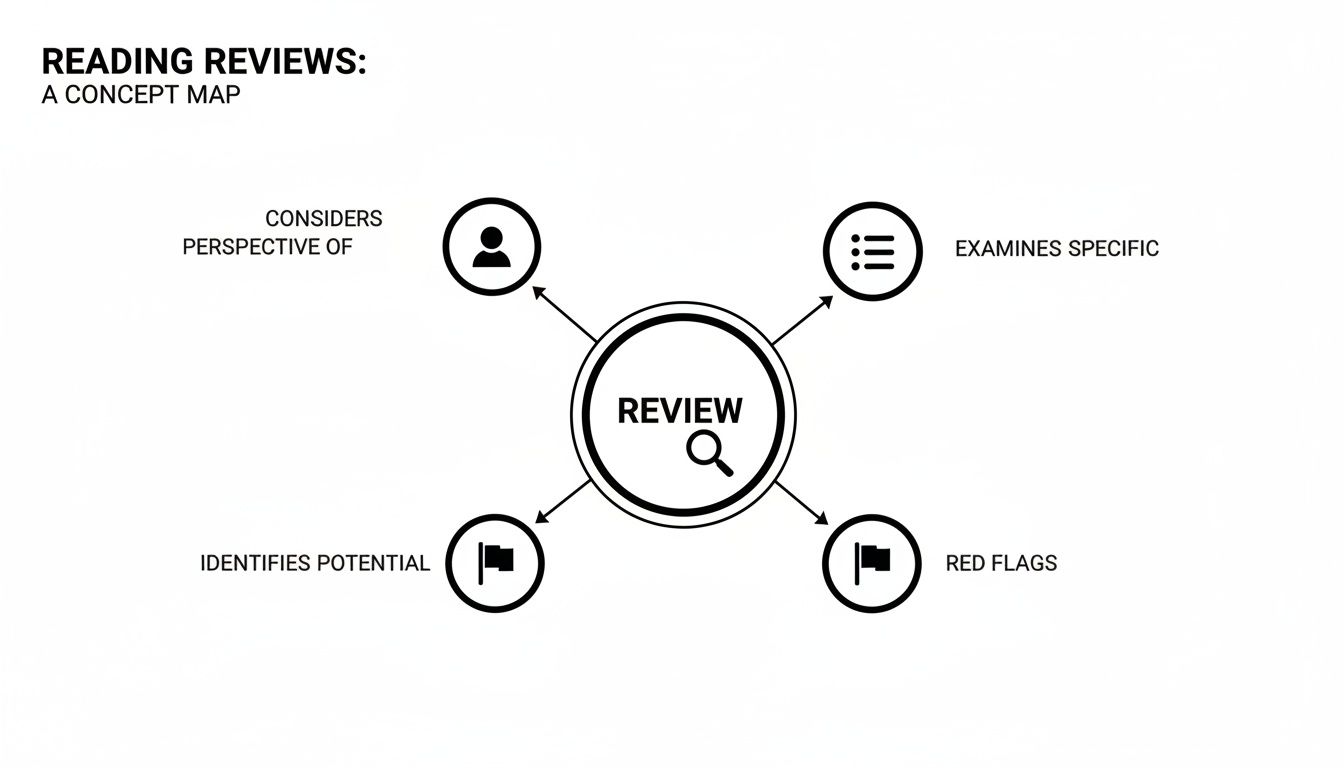
This map drives home the point that you need to consider the reviewer's perspective, the specific details they share, and any red flags they raise—not just the raw numbers.
Beyond the Numbers: What Really Matters in the Field
While FOM, SNR, and resolution are the foundation, a truly insightful review will get into other characteristics that make or break a device in the real world. One of the biggest is HALO, which is that bright ring you see around streetlights or a car's headlights. A lower HALO value means that ring is smaller and less distracting, which is absolutely critical for maintaining awareness in urban environments.
The technology inside the housing is also evolving. We're seeing more multispectral units that fuse thermal imaging with traditional night vision. This tech can give you incredible clarity through fog for up to 1 km, a game-changing feature that gets mentioned constantly in 4.7/5 star reviews for the latest Gen 3 dual-tubes. Users also rave about lightweight designs under 1 lb that you can wear all night without strain—a huge deal for law enforcement, where these devices have been shown to provide a 40% boost in situational awareness. For a deeper dive, market reports from firms like Research and Markets confirm this trend.
At the end of the day, you have to connect the data back to your mission. Are you hunting coyotes in a wide-open field where long-distance resolution is king? Or are you clearing rooms where a high SNR and minimal HALO are non-negotiable? Understanding that difference is everything, and you can learn more about how night vision technology works and compares in our detailed guide. Once you can translate the specs into real performance, you'll be able to read any review and know instantly if a device is right for you.
Spotting Trustworthy Reviews from Biased Feedback
When you’re digging through reviews on night vision binoculars, you’re not just reading opinions—you’re hunting for evidence. The internet is a minefield of feedback, from genuinely insightful field reports to completely useless rants. Learning to tell them apart is one of the most important skills you can develop.
This isn’t just about finding five-star ratings. It’s about piecing together an accurate picture of how a device actually performs in the real world, based on authentic user experiences. Think of yourself as an investigator. You need to look for clues that prove the reviewer actually put the gear through its paces.
The Anatomy of a Trustworthy Review
A truly useful review reads less like a quick thumbs-up and more like an after-action report. It’s packed with specifics that answer the big questions: How did it perform? Where was it used? Under what conditions? These details are the hallmarks of a genuine, hands-on assessment.
When you stumble upon a review like this, you’ve struck gold.
Here are the tell-tale signs of a high-quality, authentic review:
- Specific Environmental Context: A reviewer who mentions, "I was out on a no-moon night with heavy tree canopy cover," gives you a ton more useful information than someone who just says, "it works well in the dark." The first comment tells you about the device's true low-light capabilities.
- Direct Product Comparisons: Experienced users almost always compare new gear to what they’ve used before. A comment like, "The image is way clearer than my old Gen 2 monocular, with a lot less scintillation," gives you a solid performance baseline to work with.
- A Balanced Perspective: Let's be honest, no piece of gear is perfect. A reviewer who points out both the good and the bad is almost always more credible. They might rave about the image quality but note that the battery drains faster than advertised, giving you the full story.
A reviewer who only complains about slow shipping or a dented box tells you absolutely nothing about the night vision binoculars themselves. And if a review just sounds like a rehashed product description from the manufacturer's website, that's a huge red flag. Real users talk about real experiences—the good, the bad, and the ugly.
Red Flags That Signal a Biased or Useless Review
Just as important as knowing what to look for is knowing what to ignore. A lot of reviews are biased, uninformed, or just plain irrelevant. Training your eye to spot these red flags will save you from getting suckered by feedback that has zero to do with actual performance.
Some are intentionally misleading, while others come from users who simply didn't know how to operate the gear or had completely unrealistic expectations.
Keep an eye out for these common warning signs:
- Overly Emotional or Vague Language: Be wary of reviews loaded with extreme words like "amazing," "unbelievable," or "total garbage" that aren't backed up by any details. Genuine, helpful feedback is usually more measured and specific.
- Lack of Technical Detail: If someone is reviewing a complex piece of equipment like NVGs and doesn't mention a single technical spec—like image clarity, tube blemishes, or how the IR illuminator performs—they probably don't know what they're talking about.
- Focus on Irrelevant Issues: A one-star review because the package arrived a day late is not a review of the product. These kinds of comments can tank an overall rating and should be completely disregarded when you're trying to assess the gear itself.
- "Verified Purchase" Status: While it’s not a foolproof system, always check if the reviewer is a "verified purchaser." It adds a much-needed layer of credibility and helps filter out comments from people who have probably never even held the product.
By learning to separate detailed, evidence-based reports from vague, emotional reactions, you can cut through the noise. It lets you focus on the reviews on night vision binoculars that offer real-world data, helping you make a decision based on facts, not just feelings.
Why Your Mission Defines the Most Valuable Reviews
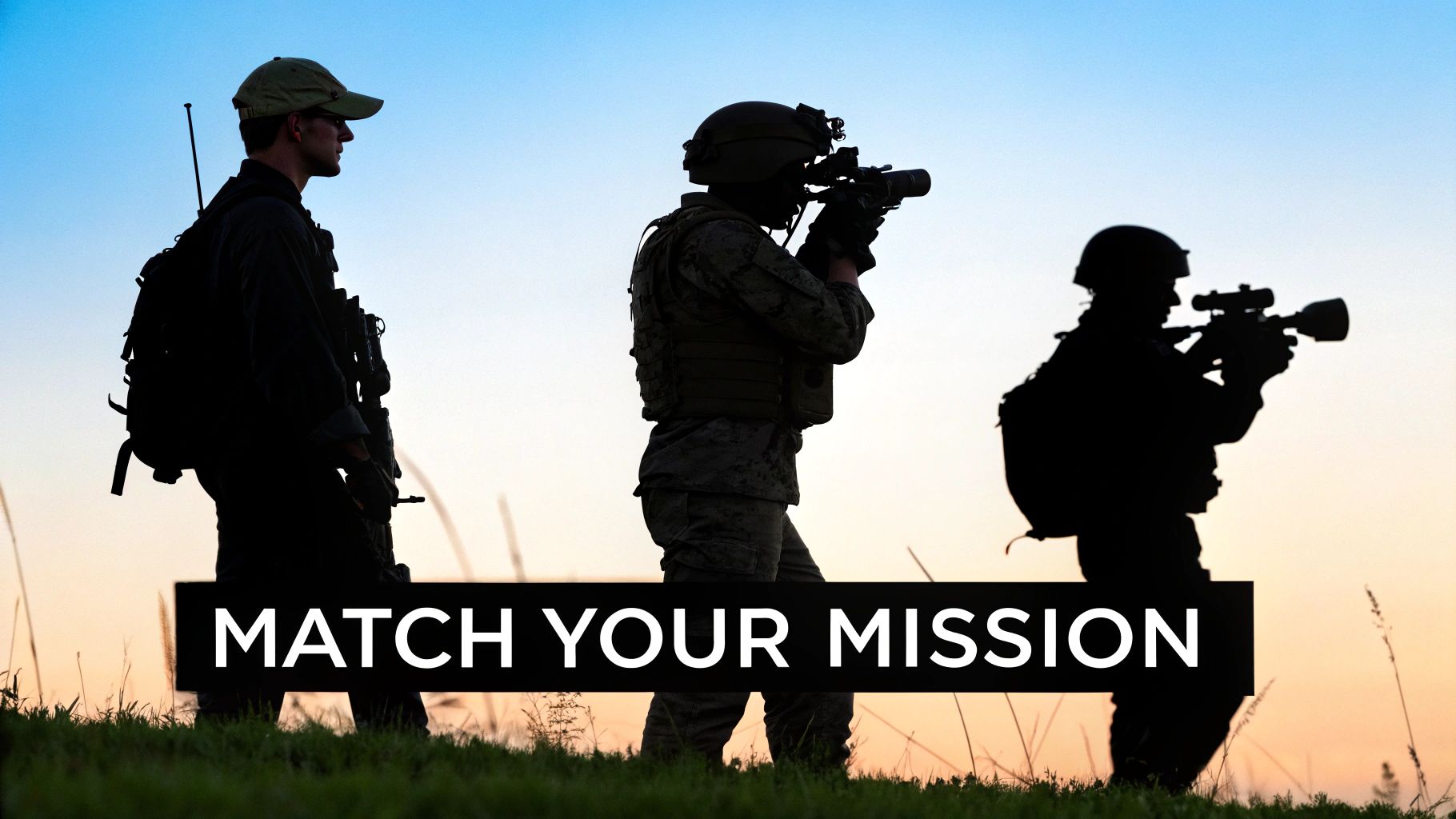
A glowing five-star rating seems like a sure thing, but it can be the most misleading piece of information you find when digging through reviews on night vision binoculars. The problem isn't the rating itself—it's the lack of context. A perfect score from a hobbyist observing constellations from their back deck is completely irrelevant to a law enforcement officer preparing to clear a dark warehouse.
The single most important filter you can apply to any review is the user’s mission. Every feature, from magnification to helmet compatibility, carries a different weight depending on the job. Failing to align the reviewer’s purpose with your own is like taking navigation advice from someone heading in the opposite direction. You might end up somewhere, but it won’t be where you need to go.
That’s why you need to stop just reading reviews and start qualifying them.
Law Enforcement and Tactical Operations
For a police officer or tactical operator, mobility and situational awareness are everything. When you’re moving through a building or scanning a dynamic urban environment, your gear has to enhance your ability to react, not slow you down. This completely changes which reviews actually matter.
A critical feature here is a wide Field of View (FOV), typically around 40 degrees, which provides the peripheral vision needed to spot threats without constant head movement. Any review that gets into the nitty-gritty of helmet mounting, counterweight systems, and overall durability is pure gold. An officer needs to know if the binoculars can take a bump against a doorframe or stay locked in place during a sprint.
In this context, a review praising a device's powerful 5x optical zoom is actually a red flag. While great for stationary observation, that level of magnification is disorienting and dangerous during movement. The most valuable feedback comes from users who discuss the binocular’s performance in close-quarters and its seamless integration with other gear.
Hunting and Wildlife Observation
The hunter’s mission is fundamentally different. Success often depends on detecting and identifying a target from a concealed, stationary position—frequently at long distances. Here, the priorities pivot from wide-angle awareness to long-range clarity and positive identification.
When sifting through reviews for hunting applications, you should be laser-focused on comments about:
- Detection and Identification Range: Look for specifics. A review saying, "I could spot heat signatures at 800 yards and confirm it was a coyote at 250," is infinitely more useful than a vague "it has a long range."
- Image Clarity and Resolution: Hunters need to tell the difference between a branch and an antler. Reviews talking about image crispness and the ability to pick out fine details are what you’re looking for.
- Battery Life: A long, cold night in a deer stand makes battery performance non-negotiable. Real-world feedback on how long a device lasts on a single charge is invaluable.
This corner of the market is booming. The global night vision device market is projected to climb from USD 10.07 billion to USD 14.44 billion by 2031. Binoculars are a standout category for wildlife spotters and hunters, a segment growing at a projected 12.8% CAGR. This growth is fueled by enthusiasts who love the wider FOV compared to traditional scopes. You’ll see plenty of discussions on platforms like Reddit, where users give 4.5-star ratings to devices that can spot targets beyond 500 meters. You can dig deeper into these night vision market trends from Mordor Intelligence.
Security and Surveillance Professionals
Security professionals often sit somewhere between law enforcement and hunters. They might need to conduct long-duration surveillance from a fixed point but also be ready to patrol a large perimeter. For this role, absolute reliability and extended operational time are paramount.
The most relevant reviews will talk about extremely long battery life or the ability to run off an external power pack. Look for feedback on the stability of tripod mounts, video recording features, and weather resistance (IP ratings). A security contractor needs to know their gear will perform flawlessly through an entire shift, no matter what the weather is doing.
By filtering reviews through the lens of your specific mission, you stop collecting random opinions and start gathering actionable intelligence.
To make this crystal clear, here’s how different priorities stack up for each professional user.
Feature Importance by User Profile
| Feature | Law Enforcement Priority | Hunter Priority | Security Contractor Priority |
|---|---|---|---|
| Wide Field of View (FOV) | High: Essential for situational awareness in close quarters. | Low: Less critical than magnification for long-range spotting. | Medium: Useful for patrolling, less so for fixed surveillance. |
| High Magnification | Low: Can be disorienting and detrimental during movement. | High: Critical for identifying targets at a distance. | Medium: Important for fixed positions, but not for patrols. |
| Helmet Mount Compatibility | High: A must-have for hands-free operation and mobility. | Low: Rarely a primary concern for stationary hunting. | Medium: Depends on if the role involves active patrolling. |
| Long Battery Life | Medium: Important, but missions are often shorter duration. | High: Absolutely critical for all-night hunts. | High: Essential for covering long shifts without interruption. |
| Durability / Ruggedness | High: Gear must withstand impacts and rough handling. | Medium: Important, but less likely to see heavy abuse. | High: Must be reliable in all weather and conditions. |
| Detection/ID Range | Medium: Focus is on close-to-medium range threats. | High: The single most important performance metric. | High: Key for monitoring large areas from a distance. |
This table shows just how much priorities can shift. A feature that's a deal-breaker for one user might be a total non-issue for another. That’s why your mission is always the first and most important filter.
Reading Between the Lines for Warranty and Support Quality
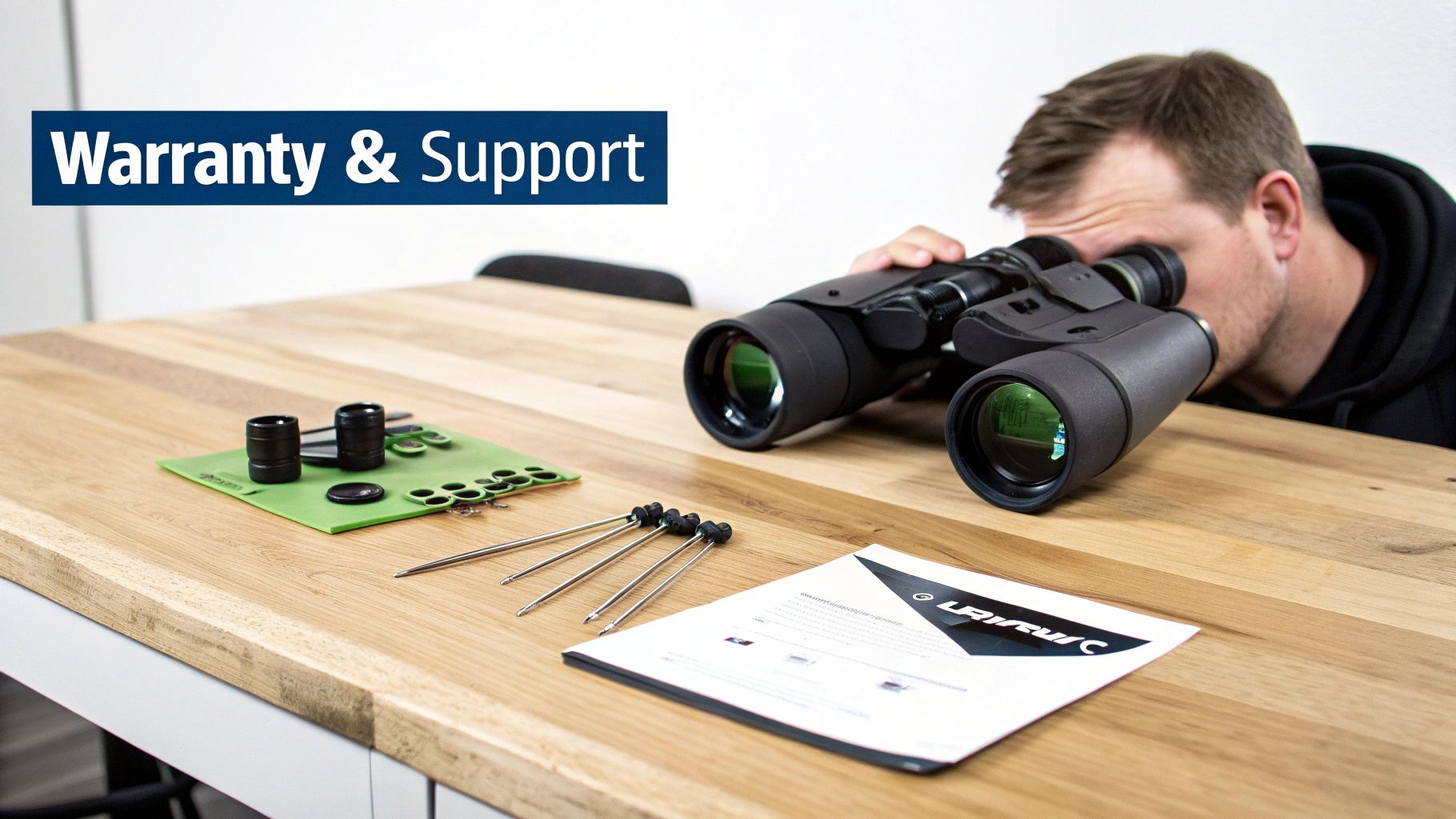
When digging into reviews on night vision binoculars, it's easy to get tunnel vision on performance specs like image clarity and detection range. But let’s be real—high-end optics are a serious investment. What happens after the purchase is just as critical as what happens on day one. A solid warranty and a responsive support team can be the difference between a minor hiccup and a multi-thousand-dollar paperweight.
Often, the most revealing clues about a company's post-sale support aren't in the glowing five-star reviews. They’re buried in the negative ones. While a dozen positive comments might praise fast shipping, a single, detailed story about a warranty claim gone wrong can show you a company's true colors. You have to actively hunt for these stories.
Searching for Post-Sale Support Clues
Don't just skim star ratings. Get surgical. Use the search function on review platforms and forums to look for keywords that get right to the heart of long-term reliability. This is how you filter out the fluff and focus on what matters for the life of your gear.
Here are some of the most valuable search terms I use:
- "Warranty": How does the company actually handle claims? Are they quick and fair, or do users describe a nightmare process full of loopholes?
- "Repair": What are the turnaround times? If something goes wrong, are you looking at a few weeks or a few months without essential equipment?
- "Customer Service": This tells you about responsiveness. Are the staff helpful and knowledgeable, or do people complain about unreturned emails and endless hold times?
- "Return": Look for mentions of "no-hassle" versus difficult return processes. This speaks volumes about a company’s confidence in its own products.
One detailed account of a three-month repair for a simple housing issue tells you more about a brand’s integrity than twenty five-star reviews from guys who’ve only had the product for a week. Always prioritize feedback from people who have actually needed help.
Identifying Signs of a Dependable Partner
As you're reading, certain phrases and details should jump out at you. These are the green flags—the signs of a company that’s truly committed to its customers. These aren't just buzzwords; they represent real investments in people and infrastructure that will directly impact your experience down the road.
Keep an eye out for comments that highlight a company's dedication to keeping your gear in the fight. Understanding common night vision gear issues and how repairs can help will give you the context to see why these things are so important.
A company that genuinely stands behind its products will often have reviews mentioning:
- In-house technicians: This is huge. It means they have the expertise to diagnose and fix problems on-site, not ship your expensive gear to some random third party. This almost always means faster, more reliable repairs.
- Free diagnostics: A willingness to inspect your unit without an upfront fee shows they value your business and aren't just trying to nickel-and-dime you.
- Long-term warranties: A 10-year warranty on a Gen 3 device isn't just a marketing gimmick; it's a powerful statement of quality. It shows the manufacturer is confident the product is built to last.
By actively digging for these details, you're not just buying a piece of equipment. You're vetting a long-term partner who will be there when your mission-critical gear needs attention. This is how you make sure your investment is protected for years to come.
Alright, let's put everything we've talked about into a practical checklist you can use on the ground. Think of this as your final mission briefing before you commit to a purchase. It’s designed to help you cut through the marketing noise and get to the truth of how a pair of night vision binoculars actually performs.
This isn't just about reading reviews; it's about interrogating them. Every question here is a tool to help you build a real-world picture of the gear, ensuring your hard-earned money goes toward a device that won’t let you down when it matters most.
Step 1: Size Up the Reviewer and Their Mission
Before you even get to the gear, you have to qualify the person writing the review. A five-star rating from a backyard stargazer is practically useless if you're a hog hunter working in thick timber.
What’s their job? Are they a cop on a SWAT team, a rancher checking on livestock, or a hunter stalking predators? Their mission shapes what they value. A law enforcement officer might focus on helmet mounting and durability, while a hunter might care more about long-range identification.
Are they a rookie or a veteran? See if they compare the unit to other devices they’ve used. A comment like, "The halo on this unit is much tighter than my old PVS-14," gives you a concrete benchmark. It tells you they have a frame of reference, and their opinion carries more weight.
Step 2: Dig Into the Performance Nitty-Gritty
Now it's time to focus on the hardware. Generic praise like "the image is great" is a red flag. You're looking for details—the kind of stuff you'd only know if you've spent hours behind the eyepiece.
What were the conditions? A review from someone using the binos on a "moonless night with heavy cloud cover" is worth its weight in gold. That’s a world away from a test done in a suburban backyard with tons of ambient light pollution helping the unit out.
Do they mention the important specs? Hunt for keywords related to real performance: image clarity, any dark spots on the tube ("specs"), the size of the halo around streetlights, and the real-world distance for both detection (spotting a heat signature) and identification (confirming it's a coyote, not a deer).
How does it feel and hold up? Did they use it in the pouring rain? How did it feel after a 4-hour patrol—was it a neck-breaker? Does it mount solidly to a helmet, or does it wobble? These ergonomic and durability points are often what separate a good unit from a great one.
A single, detailed review that describes a device’s performance in your exact operating environment is infinitely more valuable than a dozen vague, five-star ratings. Context is king.
Step 3: Look for Clues About Post-Purchase Support
Great performance means nothing if the company disappears after they have your money. The final step is to find out what happens when things go wrong.
Do they talk about the warranty or customer service? You might have to do some digging. Use the search function on forums or review pages for words like "repair," "customer service," or "return." This is where you find the horror stories and the success stories.
How did the company respond? A detailed post about a fast, no-questions-asked warranty repair speaks volumes about a company's integrity. That's the kind of peace of mind that tells you you're buying a professional-grade tool, not a disposable toy.
Common Questions We Hear All the Time
When you start digging into reviews on night vision binoculars, you'll notice the same questions come up again and again. Let's tackle some of the most common ones head-on so you can feel confident in your decision.
So, How Much Do Good Night Vision Binoculars Actually Cost?
You're going to see a massive price swing, from a couple hundred bucks to upwards of $10,000. It can be a bit of a shock at first.
On the low end, you can find digital models for under $500, but these are more for recreational use. The real professional-grade stuff—the Gen 3 analog systems that give you that incredible clarity in pitch-black conditions—usually starts around $5,000. For a top-of-the-line binocular setup, it's not uncommon to see prices pushing past $12,000.
What are you paying for? It all comes down to the quality of the image intensifier tube (Gen 2 vs. Gen 3), its specific performance specs (like FOM and SNR), and how rugged the housing is. More money almost always means a cleaner image and the ability to see in much, much darker environments.
What's the Real Difference Between Digital and Analog Night Vision?
This is probably the most important distinction you'll find in any review. The easiest way to think about it is like a modern digital camera versus an old-school film camera.
- Analog night vision is the classic "green screen" look most people imagine. It uses a sophisticated tube to physically amplify tiny amounts of available light. Generations 1, 2, and 3 fall into this category, and it's the gold standard for performance in near-total darkness.
- Digital night vision works like a camcorder, using a digital sensor to create an image on a screen. The big perks here are features like video recording and sometimes even full-color night viewing. The downside is they often lag behind high-end analog units when the lights really go out.
If there's one thing to pull from user reviews, it's this: Digital is fantastic for casual observation or recording your hunt. But for serious professionals in law enforcement or tactical roles, analog Gen 3 is the only way to go. Its raw performance and utter reliability are what they bet their lives on.
Can I Use These Things During the Day?
Be very, very careful here. Firing up a traditional analog night vision device in broad daylight is a quick way to permanently fry the image intensifier tube. That bright light will overload the system and can cause irreversible damage. That's why they come with lens caps—use them religiously when it's not dark.
Digital night vision, on the other hand, is a different story. Since it operates like a regular digital camera, most models can be used during the day without any risk of damage. Many even have a specific full-color daytime mode, which makes them a more versatile option if you need a single device for both day and night use.
Ready to find the right gear for your mission? Superior Tactical LLC offers a curated selection of top-tier night vision and thermal optics backed by a 10-year warranty on Gen 3 systems and expert in-house support. Explore our collection and get mission-ready at https://superiortac.com.
