Your Definitive Guide to Real Night Vision Binoculars
When we talk about real night vision binoculars, we’re talking about gear that works by amplifying existing light, not by using a digital camera sensor. This is the single most important distinction to understand, as it's what separates professional-grade equipment from the consumer gadgets you see online. It’s all about the image intensifier tube technology inside, which delivers the crisp, lag-free performance needed for any serious operation.
What Makes Night Vision Binoculars Real
As you start your search, you'll quickly run into two completely different kinds of "night vision": genuine image intensification and digital night vision. Getting this straight is the first step toward picking the right tool for the job.
Most of the budget-friendly scopes and trail cams out there are digital. Think of them like a smartphone camera in low-light mode. They use a sensor to snap a picture, process it electronically, and then show it to you on a tiny screen. The result is often a laggy, pixelated image that gets you nowhere in near-total darkness.
On the other hand, real night vision binoculars use an analog process called image intensification. Here’s a good way to think about it: imagine a powerful microphone that can pick up the faintest whisper from across a room and boost it into perfectly clear audio. That's what these devices do with light.
They gather the few available photons—particles of light from the moon, stars, or even distant city glow—and convert them into thousands of electrons.
Those electrons are then multiplied exponentially inside an image intensifier tube before they hit a phosphor screen. This is what creates the bright, surprisingly detailed green or white image you see through the eyepiece. The entire process is analog and happens almost instantly, giving you a real-time, zero-lag view of your surroundings. This is exactly why military operators, law enforcement officers, and serious hunters rely on it.
The core advantage of image intensification is its ability to deliver superior clarity and situational awareness without the digital lag common in camera-based systems. This is non-negotiable when navigating difficult terrain or identifying a potential threat in fractions of a second.
This technology is the heart of every high-performance system you’ll find from specialists like us at Superior Tactical. It's what ensures you can stay aware and operate effectively when the lights go out. The difference isn't just about image quality; it’s a fundamental split in how the device lets you see in the dark.
To dig even deeper, you can explore the full breakdown by reading our guide on analog vs digital night vision. Grasping this core distinction is the most important thing you can do before investing in a pair of real night vision binoculars.
Understanding Night Vision Generation Technology
Alright, so you know the difference between real analog night vision and its digital counterpart. But what separates a budget-friendly unit from a professional-grade one? It all comes down to the "Generation" of the image intensifier tube inside. Each generation represents a massive leap in performance and capability.
Getting the right one is about matching the tech to your mission, and understanding these tiers is the first critical step.
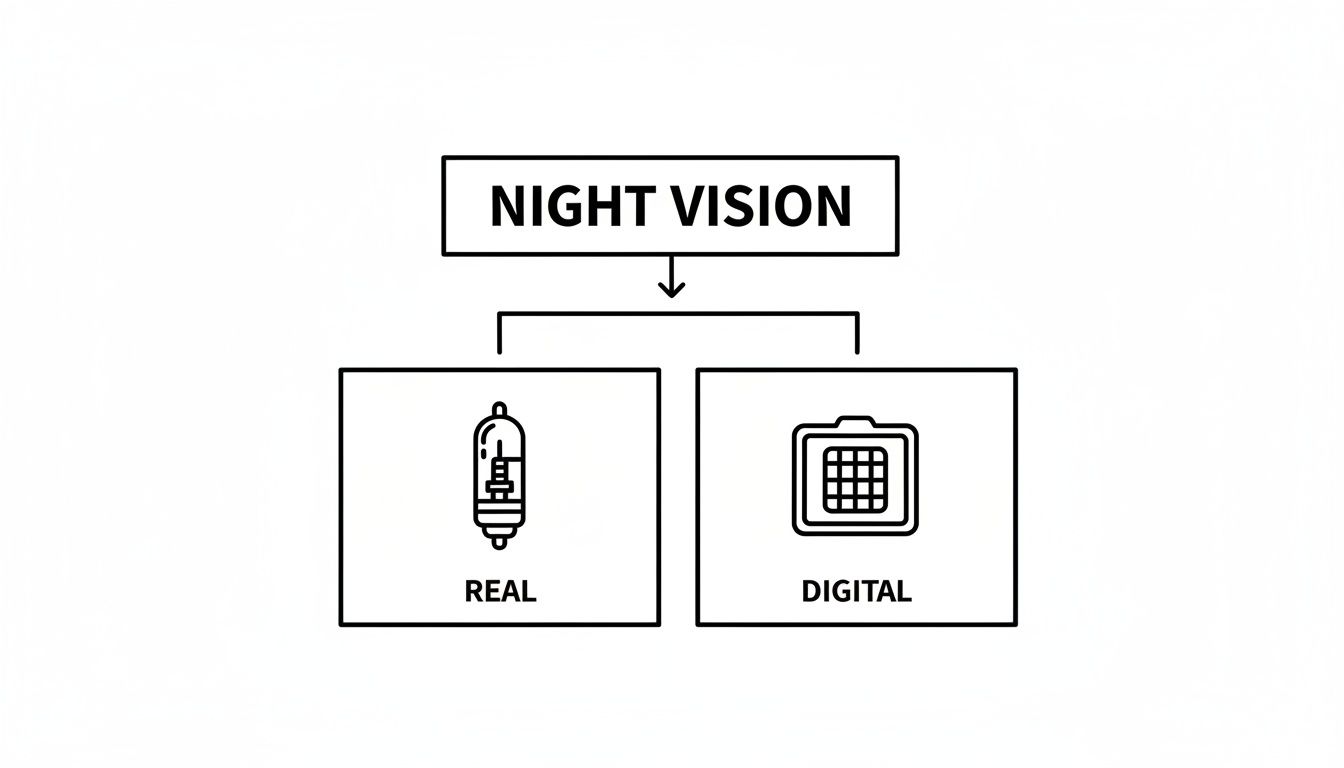
As you can see, the path for analog night vision is all about light amplification. It's a fundamentally different process than the digital sensors in most consumer electronics, and it's what gives real night vision its incredible performance.
H3: Generation 1: The Starting Point
Generation 1 (Gen 1) is the technology that started it all. It’s what most people first encounter in the sub-$1,000 price range. These tubes work by amplifying available light, but they have some serious limitations.
You'll often see noticeable distortion around the edges of the image—a classic "fish-eye" effect. They also depend heavily on a built-in infrared (IR) illuminator to be useful in anything less than a full moon. With a lifespan of only about 1,500 hours, they’re best for casual backyard observation, not for anything serious.
H3: Generation 2: A Major Leap Forward
The real game-changer was Generation 2 (Gen 2). The key innovation here was the introduction of the micro-channel plate (MCP), which acts as an electron multiplier. This one component boosted performance exponentially.
Suddenly, you had a device that produced a much brighter, cleaner image with far less distortion.
- Better Low-Light Performance: Gen 2 devices can often work effectively without an IR illuminator in much darker conditions.
- Longer Lifespan: The operational life jumps to around 5,000 hours, making them a more durable investment.
- Clearer Image: The view is significantly flatter and sharper from edge to edge.
Gen 2 represents that sweet spot for many people, offering truly capable performance that feels worlds away from the limitations of Gen 1.
H3: Generation 3: The Professional Standard
At the top of the food chain is Generation 3 (Gen 3). This is the current benchmark for military forces, law enforcement agencies, and any serious civilian user. The secret sauce is a gallium arsenide (GaAs) photocathode.
This material is incredibly sensitive and efficient at converting light particles (photons) into electrons, giving it unmatched performance when it’s truly dark.
If Gen 1 is an old tube TV, Gen 3 is a modern 4K OLED screen. It delivers the brightest and sharpest image, making it possible to identify targets and navigate safely on the darkest, moonless, starless nights.
The market reflects its importance. The global night vision industry was valued at USD 7.02 billion in 2022 and is expected to soar to USD 16.32 billion by 2030, largely because of professional demand for this level of technology. For a real-world example, look at the U.S. invasion of Panama in 1989. Gen 3 AN/PVS-7B units were responsible for 85% of nighttime engagements and resulted in zero friendly-fire incidents during those low-light operations.
With a tube life of 10,000 hours or more, Gen 3 devices are built to last. It’s why we at Superior Tactical can confidently offer a 10-year warranty on our Gen 3 systems. For anyone whose job or safety relies on owning the night, Gen 3 is the only real option. You can take a deeper dive into the specifics in our guide on the different night vision generations.
To put it all in perspective, here is a direct comparison of what each generation brings to the table.
Night Vision Generation Comparison
| Feature | Generation 1 | Generation 2 | Generation 3 |
|---|---|---|---|
| Key Technology | Basic Photo-cathode | Micro-Channel Plate (MCP) | Gallium Arsenide (GaAs) Photocathode |
| Image Quality | Distorted edges, grainy | Clear, less distortion | Sharpest, brightest, cleanest |
| Low-Light Need | Requires strong IR | Can work in low light | Excels in near-total darkness |
| Tube Lifespan | ~1,500 hours | ~5,000 hours | 10,000+ hours |
| Typical Cost | $ | $$ | $$$$ |
As you can see, the jump from one generation to the next isn't just a minor tweak—it's a complete overhaul in performance, reliability, and what's possible in the dark.
Decoding Key Night Vision Specifications
Popping open a spec sheet for a pair of high-end night vision binoculars can feel like trying to read another language. You’re hit with a wall of acronyms and numbers that, on the surface, don’t mean a whole lot. But learning to speak that language is what separates a smart investment from a very expensive paperweight.
Once you know what you're looking at, those numbers stop being abstract and start telling a story about how the device will actually perform in the dark. Let's break down the most important specs so you can read any sheet and know exactly what you’re getting.
The Most Important Performance Metrics
When you’re looking at an image intensifier tube—the engine of your night vision—a few key figures tell you almost everything you need to know. These aren't just numbers on a page; they directly translate to how clean the image will be and how well you can see when the lights are completely out.
First up is Figure of Merit (FOM). The easiest way to think of FOM is as the device's overall horsepower rating. It’s a quick, down-and-dirty way to judge a tube's potential, calculated with a simple formula:
FOM = Resolution (lp/mm) x Signal-to-Noise Ratio (SNR)
A higher FOM is almost always better. For a serious Gen 3 unit, you really want to see a FOM of 2000 or higher. This single number gives you a reliable snapshot of the tube's quality right out of the gate.
Next, and arguably even more important, is the Signal-to-Noise Ratio (SNR). Remember trying to tune in a weak radio station and getting a ton of static? That’s a perfect analogy for SNR. In night vision, the "signal" is the light that forms the image you want to see, and the "noise" is the grainy, sparkling distraction that gets in the way.
- High SNR (30+): This is your crystal-clear broadcast. You get a clean, sharp image that lets you pick out fine details, even on a moonless night. It's absolutely critical for identifying threats.
- Low SNR (Below 20): This is your static-filled station. The image is "noisy" or "peppery," which can easily obscure details and make it hard to tell what you're looking at.
A high SNR is one of the most sought-after specs because it directly impacts your ability to see clearly when it matters most.
Image Clarity and Protection
While FOM and SNR provide a fantastic overview, a couple of other specs dive into the nitty-gritty of image detail and the tube's durability.
The first is Resolution, which is measured in line pairs per millimeter (lp/mm). Simply put, this tells you how sharp the image is. A higher number means the tube can resolve more detail, allowing you to distinguish a branch from a rifle barrel or identify a person's face from further away. Quality Gen 3 tubes typically sit at 64 lp/mm or higher.
Then there's Autogating, a feature that’s less about image quality and more about protecting both the device and your eyes. Think of it as a lightning-fast dimmer switch inside the tube. When you’re suddenly hit with a bright light—like car headlights or a muzzle flash—autogating instantly cuts the power.
This has two huge benefits:
- It protects the tube from getting burned or permanently damaged by the intense light.
- It stops you from being blinded, keeping the image from "blooming" out and allowing you to see what’s happening in the shadows around the bright light.
Without autogating, a sudden flash would wash out your entire view, leaving you effectively blind for critical seconds. For anyone in law enforcement or security, this feature is non-negotiable.
Optical Specs and User Experience
Beyond the tube's electronics, the physical design of the binoculars themselves dramatically affects how usable they are. These specs define your actual experience looking through the device.
Field of View (FOV) is a big one. It's measured in degrees and tells you how wide of an area you can see at any given moment. Most PVS-14s and dual-tube binoculars have a standard 40° FOV. This is narrower than your natural vision and creates a bit of a "tunnel vision" effect, so you'll need to constantly move your head to scan the area and stay aware of your surroundings. While some high-end systems offer a wider view, 40° is the industry benchmark.
Finally, you have Exit Pupil and Eye Relief. Eye relief is the distance you can hold the eyepiece away from your eye and still see the entire image. A generous eye relief makes long nights of observation much more comfortable and is a must-have if you wear glasses.
By getting a handle on these core specs—FOM, SNR, resolution, autogating, and FOV—you can cut right through the marketing fluff. You'll be able to look at any pair of real night vision binoculars and know exactly what kind of performance you can expect before you ever spend a dime.
Choosing Between Dual Tube and Single Tube Systems
When you're ready to invest in serious night vision binoculars, one of the first big questions you'll face is about the physical setup. It’s not just about having two eyepieces; it's about how they see the world. You’re essentially choosing between two distinct philosophies: true dual-tube systems and bridged monocular systems. Each has its own strengths depending on what you plan to do with them.
The single biggest advantage of a true dual-tube system is genuine stereoscopic vision. Because each eye gets its own image intensifier tube, your brain can process two separate images and create real depth perception. It’s exactly how your eyes work naturally, and you can’t overstate how important that is in the dark.
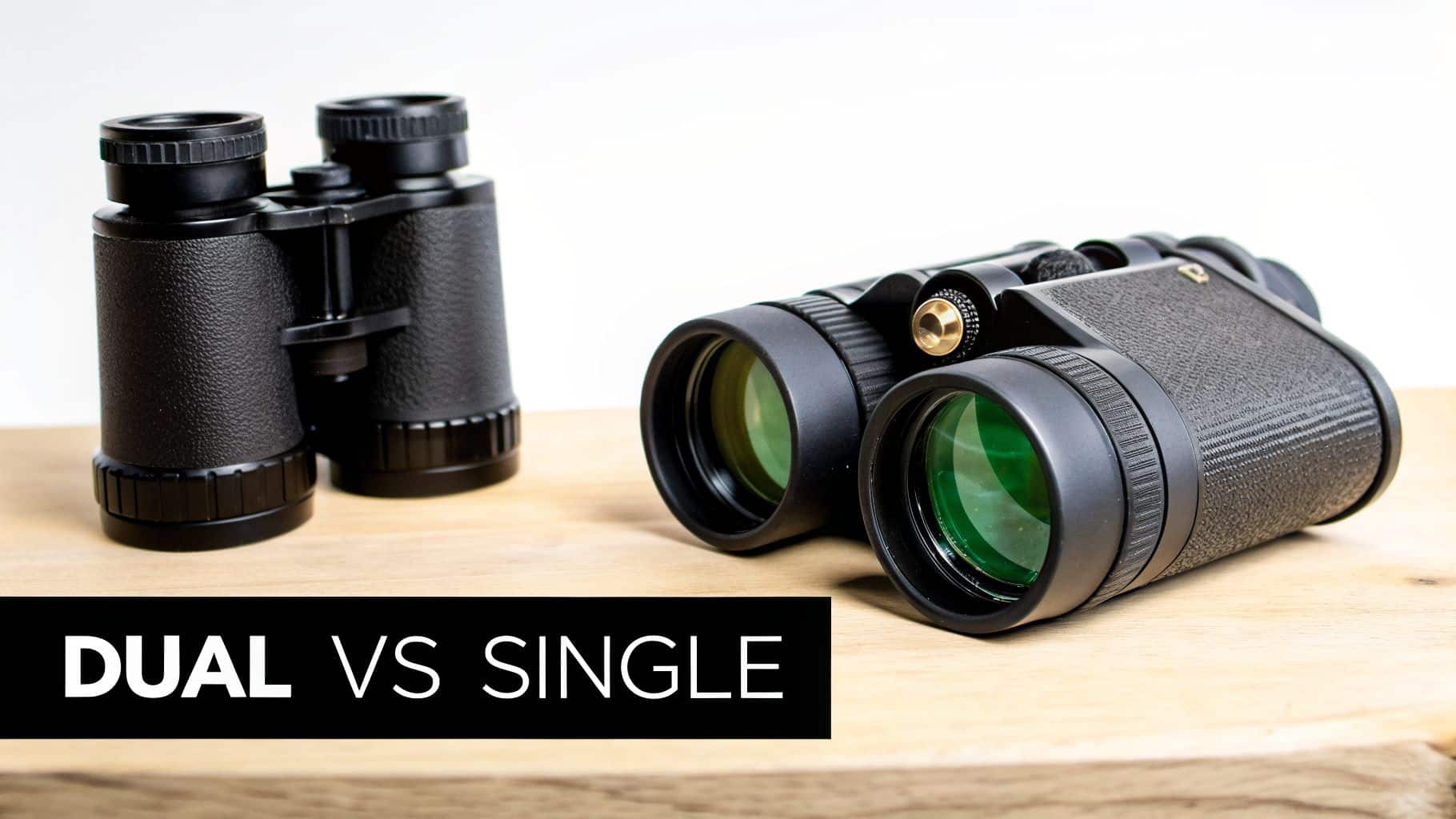
Just try walking over rough terrain or estimating how far away a fence is with one eye closed. It’s slow, awkward, and you feel uncertain. True dual-tube binoculars remove that handicap entirely, making it dramatically safer and more natural to move fast, drive a vehicle, or handle equipment in pitch-black conditions.
The Power of True Binocular Vision
There's an immersive quality and level of situational awareness you get from a dual-tube setup that a single tube just can't replicate. That natural depth perception also cuts down on eye strain over long nights of observation and gives you the confidence to move decisively. When every second is critical, that clarity can make all the difference.
This isn't just theory. The 2003 Iraq War provided a stark real-world lesson when U.S. forces using PVS-31 dual-tube binoculars experienced a 50% drop in nighttime casualties compared to units with monoculars. That pivotal moment heavily influenced modern night vision design and cemented the value of dual-tube systems. It's a big reason why night vision now makes up 27.1% of the entire binoculars market—a market expected to hit USD 1.55 billion by 2035.
The Versatility of Bridged Monoculars
On the other hand, you have bridged systems. This approach takes two separate monoculars—like the workhorse PVS-14—and mounts them together on a "bridge" to create a binocular. The key word here is versatility.
- Shareable: Need to equip a teammate? Just pop one monocular off the bridge and hand it over. Now two people have night vision.
- Redundancy: If one unit goes down—dead battery, damage—you're not out of the fight. You still have a perfectly good monocular ready to go.
- Flexible: Run the full binocular setup for maximum awareness, or just use a single monocular to save weight while keeping one eye adapted to the dark.
The trade-off is pretty straightforward: bridged systems give you incredible flexibility and backup options, which is why they are so popular for team operations. But, they tend to be heavier and have more moving parts than a dedicated, lightweight dual-tube binocular.
Ultimately, your mission dictates the gear. If your top priority is solo navigation, driving, or getting the absolute best situational awareness possible, a dedicated dual-tube system is tough to beat. But if you value redundancy, the option to share your gear, and overall mission flexibility, a bridged system might be the smarter play. If you're still weighing your options, you can check out our guide on the best night vision binoculars where our team breaks down the top models for every scenario.
Matching the Right Binoculars to Your Mission
Knowing the tech behind real night vision binoculars is one thing. Actually picking the right pair for what you do? That's where the rubber meets the road. The "best" device isn't the one with the flashiest specs on a datasheet; it's the one that gives you a genuine edge when you're on the ground.
It's time to stop thinking in abstract numbers and start thinking about real-world scenarios. A setup that's perfect for a law enforcement officer clearing a building is probably a poor fit for a hunter glassing a hillside. Let's connect the dots between specs like Gen 3 performance, FOM, and autogating and the missions that truly demand them.
This is all about making sure your investment actually pays off when the lights go out. It's about having the right tool for the job, so you can move with confidence, whatever the situation.
For Law Enforcement and Security Professionals
If you’re in law enforcement or private security, your world is unpredictable and often high-stakes. One minute you could be clearing a pitch-black warehouse, the next you're navigating the chaos of strobing emergency lights. In this line of work, there’s simply no room for compromise.
Recommendation: A rugged, autogated Gen 3 dual-tube system is the professional standard for a reason.
Gen 3 Performance: You need the absolute best image clarity and low-light capability to tell a threat from a non-threat in a split second. A high-FOM (2200+) and high-SNR (30+) Gen 3 tube is non-negotiable for that level of certainty.
Dual-Tube Design: True stereoscopic vision from a dual-tube binocular is critical. It gives you the depth perception needed to navigate stairs, doorways, and other obstacles quickly and without stumbling.
Autogating: This feature is your lifeline in a dynamic urban environment. When you're hit with sudden muzzle flashes, headlights, or a suspect's flashlight, autogating instantly adjusts. It keeps the image from washing out, allowing you to maintain awareness and see right through the burst of light.
For these professionals, equipment failure is not an option. Investing in a top-tier, warrantied Gen 3 binocular isn't a luxury—it's a fundamental part of staying effective and safe on the job.
For the Serious Hunter and Outdoorsman
Hunters face a different set of challenges. While you absolutely need sharp performance to spot game from a distance, things like weight and packability become just as crucial when you’re humping a pack over miles of rough country.
Recommendation: A high-spec Gen 2+ or Gen 3 system that strikes a smart balance between performance and weight.
Performance vs. Weight: A lightweight monocular or a more streamlined dual-tube binocular is often the way to go. Every ounce matters when you're putting in the miles on foot.
Clarity at Distance: High-quality tubes with excellent resolution (64 lp/mm or more) are what allow you to spot and positively identify game hundreds of yards away. It’s the key to picking that trophy animal out from the brush.
Demand for this kind of gear has exploded. Real night vision binoculars are now a huge slice of a global market projected to be worth $13.58 billion by 2030. This growth is fueled by both defense contracts and a surge in civilian use, with over 70% of digital night vision sales coming from outdoor sports like hunting. For a deeper dive into the numbers, check out the full research on night vision device market trends.
For the Preparedness-Minded Citizen
If your focus is on preparedness, home defense, or keeping an eye on your property, your priorities shift again. Here, the name of the game is reliability, longevity, and straightforward function. You need a device that will work flawlessly when you pull it out, even if it’s been stored for a while.
Recommendation: A robust system with a strong warranty and a reputation for durability.
The most important feature for a preparedness-focused individual is not the absolute peak of performance, but rock-solid reliability. You need the confidence that your equipment will function perfectly years from now, which is where a comprehensive warranty becomes a true indicator of quality.
This is where you look for a high-quality Gen 2 or Gen 3 unit from a trusted name like Superior Tactical, where a 10-year warranty stands behind your purchase. That kind of backing ensures your gear remains a dependable tool for perimeter security, navigating a power outage, or any other emergency. This long-term support guarantees your real night vision binoculars are always ready for whatever comes next.
Protecting Your Investment with Proper Care
Think of your real night vision binoculars as a serious piece of precision gear, not just another gadget. Dropping thousands of dollars on a high-end unit is an investment in your safety and effectiveness, and just like any professional tool, it needs to be treated with respect to last a lifetime.
A few simple habits are all it takes to protect the sensitive image intensifier tubes at the heart of your device. Neglecting them can turn a top-tier asset into a very expensive paperweight.
Essential Maintenance and Handling
It all starts with the basics: how you handle, clean, and store your binos.
Lens Care: The lenses have special anti-reflective coatings that are surprisingly easy to ruin. Before you even think about wiping them, use an air blower to get rid of any loose dust or grit. For fingerprints and smudges, a proper lens cloth and dedicated cleaning solution are your only friends. Never, ever use a t-shirt or paper towel—you’ll scratch the coatings right off.
Battery Discipline: If you’re putting the unit away for more than a couple of days, always remove the batteries. A leaking battery is a death sentence for the internal electronics, causing corrosion that is almost always impossible to repair.
Avoid Bright Light: This is the cardinal sin of night vision. Never, ever power on your unit in daylight without the lens caps on. A quick flash of bright light is all it takes to cause permanent black spots or "burn-in" on the intensifier tube, scarring your view forever.
These aren't just suggestions; they're the fundamental rules for keeping your gear in the fight.
Treat your night vision like you would a high-end camera lens. You wouldn't toss it in the back of a truck to rattle around or clean it with a dirty rag. A little bit of care goes a long, long way in ensuring it works flawlessly every single time you need it.
The Importance of Service and Support
Even the most well-cared-for electronics can have issues. That’s when you’ll be glad you bought from a provider who actually stands behind their products. This is where a company with an in-house service department, like Superior Tactical, really proves its worth.
Having access to free diagnostics and expert technicians means you're not left in the dark if something goes wrong. Instead of shipping your unit off to a mysterious third-party repair shop and waiting months, you can talk to the same people who know your gear inside and out. It’s about buying a support system, not just a product.
A Note on ITAR Regulations
Finally, it’s critical to know that high-performance night vision is a controlled technology. These devices fall under the International Traffic in Arms Regulations (ITAR), which strictly governs the export of defense-related items.
In simple terms, this means Gen 3 real night vision binoculars cannot be shipped or carried outside of the United States without a specific government license. The rules are there for a reason—this technology offers a significant tactical advantage—and they are enforced with serious penalties.
Common Questions About Real Night Vision
Even after you've got the basics down, a few key questions always seem to pop up. Let's tackle some of the most common ones we hear from people who are serious about buying the right gear.
First and foremost, can you use real night vision during the day? The answer is an emphatic no. Think of an image intensifier tube as a super-powered light collector. Exposing it to daylight, even for a second while it's on, will overwhelm the system and cause permanent damage, leaving you with ugly black spots or a completely dead tube. Always, always keep those lens caps on during the day.
Phosphor Color and Technology Differences
Next up is the great debate: classic green versus modern white phosphor. For decades, the iconic green glow was all there was. That specific shade of green was chosen for a good reason—the human eye is incredibly sensitive to it, allowing us to pick out a lot of detail.
These days, though, white phosphor is the choice for many seasoned operators. It produces a crisp black-and-white image that a lot of people find gives them better contrast and a more natural sense of depth. For many, it's also just plain easier on the eyes over long hours of observation, making it a premium feature worth considering.
Another point of confusion is the difference between night vision and thermal. They might both help you see in the dark, but they are worlds apart in how they do it.
Night vision works by taking the tiny amount of ambient light available—from the moon, stars, or distant city glow—and amplifying it thousands of times. Thermal imaging, on the other hand, detects heat signatures (infrared energy) and couldn't care less if there's any light at all.
This means night vision is for seeing what is there in great detail, just like you would with your own eyes in daylight. Thermal is for detecting things, like a person hiding in thick brush or a recently driven vehicle, by its heat signature alone.
Finally, just how important is a good warranty? When you're investing in a high-end Gen 3 unit, it's absolutely critical. A long warranty, like a 10-year guarantee, isn't just a piece of paper. It's the manufacturer's vote of confidence in their own work, telling you that the tube and the housing are built to withstand real-world use. It’s your assurance that the investment is protected.
At Superior Tactical, we don't just sell gear; we make sure you get the right equipment backed by expert support and a rock-solid warranty. Take a look at our curated collection of mission-ready real night vision binoculars and get ready to own the night.
