A Complete Guide to Night Vision with Color
Forget everything you thought you knew about the classic green glow from movies and video games. True night vision with color is here, and it’s a game-changer. It works by blending advanced digital sensors and thermal imaging to paint a much clearer, more detailed picture of what's going on in the dark.
This isn't about making things look pretty; it's about giving you critical information that old-school monochrome systems simply can't provide.
Seeing Beyond the Green Glow
When most of us think of night vision, we picture that iconic, eerie green world. That’s traditional analog technology, often called image intensification (I²), and it's fantastic at taking tiny amounts of ambient light and making the invisible, visible.
But it has one big limitation: everything is presented in a single color. If you're curious about the science behind that, you can dive deep into our guide on why night vision is green.
Now, what if you could see more than just green shapes moving in the dark? Imagine being able to spot a recently driven truck by the heat still glowing from its engine, or identifying someone’s jacket color from a hundred yards out. That's the real power of night vision with color—it adds crucial layers of data to what you're seeing.
The Problem with a Monochrome World
Traditional night vision is a lot like looking at a really good black-and-white photograph. You get incredible clarity on contrast, shapes, and movement, but you lose all the contextual clues that color gives you. In a high-stakes tactical, hunting, or security situation, that loss can make a huge difference.
A police officer using a standard green phosphor tube might see a dark blob near a building. Is it a trash bag? An animal? Or a suspect hiding in the shadows? The lack of color strips away vital details that help our brains make snap, accurate judgments under pressure.
How Color Changes the Game
Modern systems that offer "color" get around this by fusing different technologies. Instead of just cranking up the available light, they use sophisticated digital sensors or merge a thermal overlay with a traditional night vision image. This approach doesn't just tell you something is there; it helps you understand what it is.
Think about these real-world advantages:
- Threat Identification: Instantly telling the difference between a civilian in a blue shirt and an adversary in camo.
- Situational Awareness: Spotting a trail of warm footprints on cold pavement or picking out a hidden vehicle by its lingering heat signature.
- Reduced Ambiguity: Quickly knowing if a distant light is from a headlamp, a car, or a campfire based on its thermal profile.
This shift from simple light amplification to multi-layered data fusion is one of the biggest leaps forward in low-light observation. It’s about turning a grainy, one-dimensional image into a detailed operational picture.
At the end of the day, night vision with color isn't just an incremental upgrade—it's a whole new way of seeing in the dark. It delivers a richer, more intuitive view that boosts safety, efficiency, and decision-making when the lights go out. In this guide, we'll break down exactly how this tech works and who stands to gain the most from seeing the night in a completely new light.
How Color Night Vision Technology Works
To really get what a huge step forward night vision with color is, you have to look under the hood at the tech making it happen. Traditional green-phosphor night vision is essentially a massive light amplifier. It takes what little light is there and makes it thousands of times brighter. Color systems, on the other hand, use much smarter methods to interpret the world at night. They don't just show you what's there; they add critical layers of information.
The two main technologies bringing color to the dark are Digital Night Vision and Thermal Fusion. Each one tackles the challenge from a completely different angle, offering its own set of pros and cons depending on the mission.
This infographic gives you a quick visual breakdown of how we got from the classic green monochrome view to the rich, data-layered images we have today.
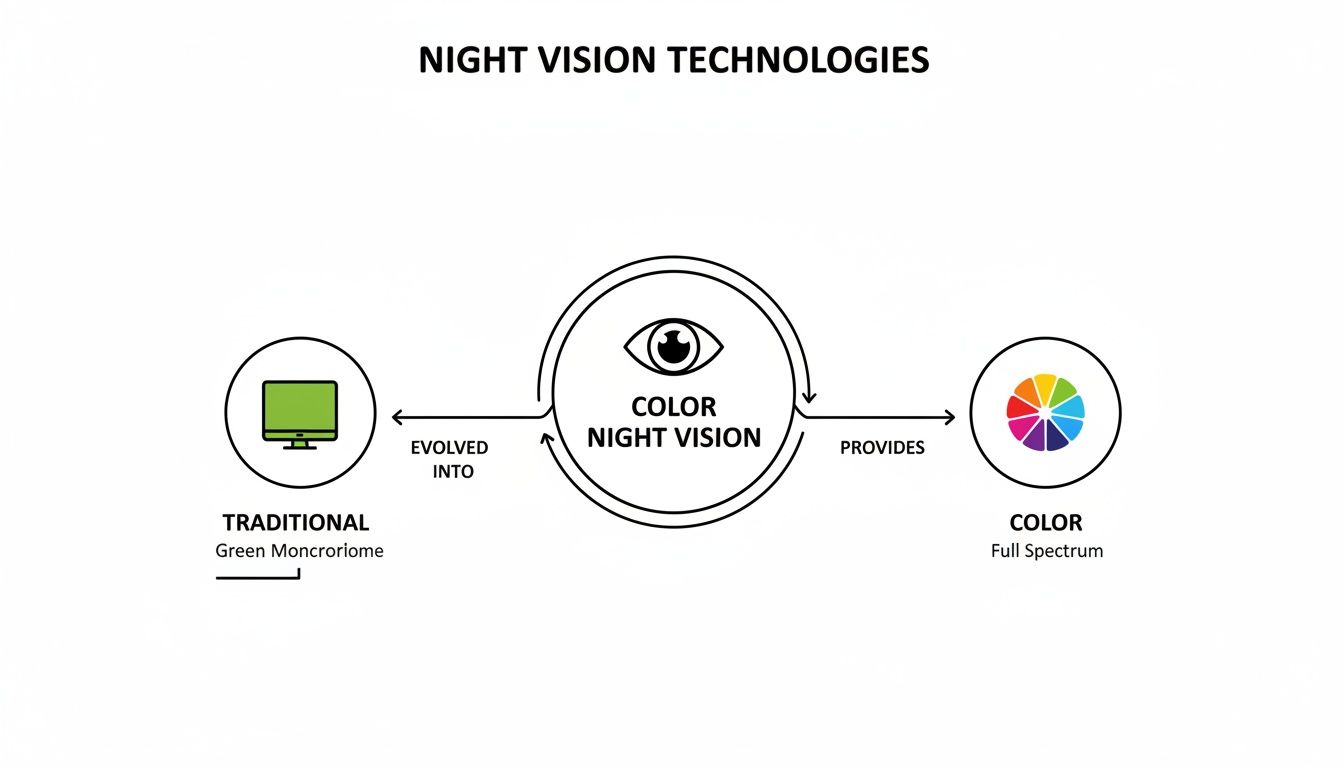
As you can see, it's a shift from just amplifying light to fusing multiple data sources for a much clearer operational picture.
Digital Night Vision: The Camera Brain
At its heart, digital night vision is a lot like the camera in your smartphone, just supercharged for darkness. It relies on a specialized CMOS (Complementary Metal-Oxide-Semiconductor) sensor that's incredibly sensitive to even the faintest light.
Think of it this way: your eyes can only see a tiny slice of the light spectrum. A CMOS sensor is built to gobble up photons far beyond that range—light that's completely invisible to you. An onboard processor then takes all that light data, crunches the numbers, and constructs a full-color image that you see on a tiny screen inside the eyepiece.
The real magic here is the system's ability to render a true-color image, as long as there's a little ambient light from the moon, stars, or city glow. This is what lets you identify the color of a vehicle or a piece of clothing in near-total darkness.
But there's a catch. When it's truly pitch black, even the most advanced sensor can't find enough light to build a color picture. In those situations, the device typically switches to a high-contrast black-and-white mode and needs a boost from an external infrared (IR) illuminator to see anything at all. You can get a deeper look at how these systems compare in our detailed breakdown of different night vision technologies.
Thermal Fusion: The Heat Map Overlay
Thermal fusion is a whole different ball game. It couldn’t care less about reflected light. Instead, it sees heat. This technology is a hybrid, blending two powerful systems into a single optic:
- Image Intensification (I²): This is your classic night vision, which amplifies ambient light to give you a sharp, detailed view of your surroundings, usually in black and white (white phosphor) or green.
- Thermal Imaging: A completely separate sensor detects tiny differences in temperature, creating a heat map of everything in the scene.
A processor then digitally merges these two feeds, laying the thermal data right over the night vision image. The result is a game-changer. You get a crisp, detailed view of the terrain, but heat sources—like people, animals, or recently driven engines—glow in vibrant colors. Hot targets might pop in bright red or orange, making them impossible to miss against the cooler background.
Comparing The Technologies
To make it easier to see how these systems stack up, here’s a quick comparison of the main approaches to achieving color in low-light conditions.
Color Night Vision Technology Comparison
| Technology Type | How It Works | Primary Advantage | Best For |
|---|---|---|---|
| Digital CMOS | A highly sensitive sensor captures ambient light and a processor digitally constructs a color image. | Provides true-to-life color for positive identification of objects and subjects. | Surveillance, evidence gathering, and general-purpose observation where color detail is critical. |
| Thermal Fusion | Combines a traditional image intensification (I²) tube with a thermal sensor, overlaying heat signatures in color. | Excellent target detection. Heat signatures stand out dramatically, even through camouflage or in total darkness. | Hunting, tactical operations, and search and rescue where spotting hidden targets is the priority. |
| Multi-Spectral | Fuses data from multiple light spectrums (e.g., visible, thermal, SWIR) into a single composite image. | Unparalleled detail and information. Can defeat camouflage, see through obscurants like fog, and provide maximum situational awareness. | High-end military and intelligence applications requiring the most advanced detection capabilities. |
Each of these technologies offers a unique way of "seeing" in the dark, and the best choice really comes down to the specific demands of your mission.
Color vs. Monochrome: Performance Tradeoffs
Choosing between night vision with color and a top-shelf monochrome system isn’t about picking a winner. It’s a classic trade-off, a textbook case of choosing the right tool for the job. Each technology brings something different to the table, and knowing where they shine—and where they don't—is the key to getting the capability you actually need.
Think of it like this: a high-end Gen 3 monochrome tube is a specialist. It’s been perfected over decades for one single, critical task: sucking in every last photon and turning it into a clear, usable image. On the other hand, digital or thermal fusion color systems are more like generalists. They give you a much richer picture of the world, but not without making a few compromises along the way.
Raw Power: Who Owns the Dark?
When you’re working in true, pitch-black conditions where light is a precious commodity, traditional monochrome image intensifier (I²) tubes are still king. There’s a reason high-spec Gen 3 white phosphor tubes are the gold standard—they are incredibly efficient at gathering and amplifying even the faintest traces of ambient light.
This raw sensitivity means you can get a crisp, clean image on a moonless, starless night under a thick canopy of trees, often without ever touching your IR illuminator. Digital color systems, which rely on CMOS sensors, have come a long way but generally need more light to work with before they can paint a full-color picture. In the deepest dark, they’ll often switch over to a black-and-white mode and lean heavily on an IR flashlight, which, of course, can broadcast your position to anyone else with night vision.
For pure light-gathering muscle in the darkest environments imaginable, high-end analog monochrome tubes are still the benchmark. Their ability to deliver a bright, detailed image from almost nothing is their signature strength.
Image Clarity vs. Information Density
Here’s another critical trade-off: the raw sharpness of the image versus the amount of information that image gives you. A quality white phosphor I² tube delivers an incredibly crisp, high-resolution picture. You can pick out fine details, textures, and subtle movements with ease, which is vital for positive target identification and navigating tricky terrain.
But this is where night vision with color, particularly thermal fusion systems, changes the game by providing superior information density. The base image might not always have the tack-sharp resolution of the best analog tubes, but the addition of color provides a massive leap in context.
- Monochrome: You see a shape behind a bush with perfect clarity. Is it a person? A deer? A stump?
- Color Fusion: You see the exact same shape, but it's glowing bright orange against the cool blue of the foliage. It’s a warm body. No question.
That extra layer of thermal data slashes ambiguity and massively speeds up your decision-making loop. You’re not just looking at shapes anymore; you're reading a data-rich environment.
The Problem of Lag
One area where analog tech still has a decisive lead is latency—the tiny delay between something happening in the real world and you seeing it through the device. Image intensifier tubes are an analog system, giving you an almost instantaneous feed with virtually zero lag. This is absolutely critical for dynamic situations like driving a vehicle or engaging moving targets, where even a few milliseconds of delay can throw you off.
Digital systems, by nature, have to capture light on a sensor, process that data, and then display it on a tiny screen inside the eyepiece. While this process is now incredibly fast, it introduces a small but measurable delay we call image lag or latency. For most uses, modern digital optics have gotten this down to a point where it's barely noticeable. But for operators who rely on that immediate, one-to-one connection with their environment, it can still be a deal-breaker.
This table breaks down the core differences so you can weigh what truly matters for your mission.
Performance Tradeoff Comparison
| Performance Factor | High-End Monochrome (White Phosphor) | Color Night Vision (Digital/Fusion) | The Takeaway |
|---|---|---|---|
| Light Sensitivity | Excellent; works in near-total darkness with little to no IR. | Good, but often needs more ambient light for color or relies on IR. | Monochrome wins in the darkest conditions. |
| Image Clarity | Superior resolution and detail for a sharp, crisp picture. | Resolution can be lower, but color adds critical context. | Monochrome gives you sharper physical detail. |
| Information | High detail but lacks contextual data like heat signatures. | Delivers rich data layers (color, thermal) for better situational awareness. | Color gives you more actionable intelligence. |
| Image Lag | Virtually zero latency for instantaneous, real-time feedback. | A slight lag exists due to digital image processing. | Monochrome is superior for high-speed tasks. |
In the end, it all comes back to your primary mission. If you need the absolute best low-light performance and image sharpness with zero delay, a high-end monochrome unit is the unbeatable specialist. But if your main goal is rapid threat detection and a complete understanding of your surroundings, the rich, contextual data from a night vision with color system offers a powerful, undeniable advantage.
Where Color Night Vision Makes a Real-World Difference
The technical specs and trade-offs are important, but where this technology really proves its worth is out in the field. Night vision with color isn't just about a prettier picture; it's about delivering critical information that can make or break a mission. Let's move past the theory and look at exactly where adding color to the dark gives operators a serious tactical advantage.
For law enforcement, hunters, and security teams, doubt is a liability. In low-light situations, every detail counts. Color night vision, particularly thermal fusion, is built to eliminate that doubt, turning ambiguous shapes into clearly identifiable targets or threats.
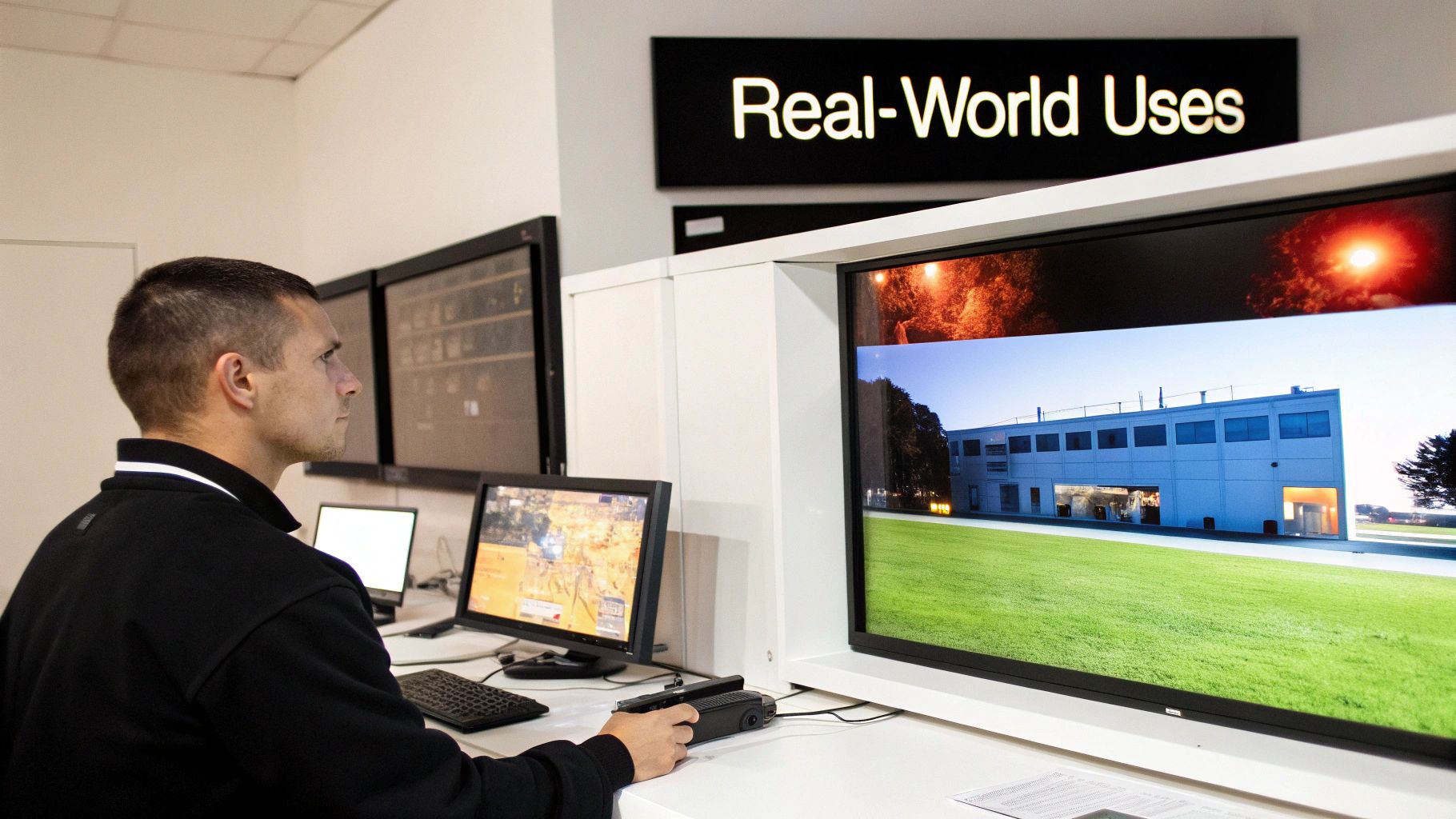
Law Enforcement And Tactical Operations
On the streets or on a callout, situational awareness is everything for patrol officers and SWAT teams. A standard green-and-black image shows you movement, sure. But a thermal fusion overlay gives you a layer of data that completely changes how you read a scene.
Picture this: officers responding to a silent alarm at a warehouse. Using traditional night vision, the getaway car that just pulled up looks identical to every other cold vehicle in the parking lot. With thermal fusion, that same car is practically glowing from the heat still radiating off its engine and tires. Officers instantly know which vehicle is their priority.
This advantage plays out in other critical ways:
- Tracking a Suspect: An officer can follow a suspect not just by what they see, but by the faint heat signature of footprints left on cool pavement. This gives a clear direction of travel even if the target ducks behind cover.
- Finding Evidence: Locating a tossed weapon in the dark is a nightmare. But its slight temperature difference can make it pop against the cool ground when viewed through a thermal optic.
- Securing a Perimeter: When watching a perimeter, officers can instantly tell the difference between a warm human silhouette and a cold, stationary object like a trash can, cutting down on false alarms.
Hunting And Wildlife Observation
For any ethical hunter, positive target identification is rule number one. Color night vision provides a massive leg up in spotting and tracking game, especially when animals are using their natural camouflage to blend into a cluttered background.
A hunter scanning a dense treeline with a thermal fusion scope can immediately pick out the glowing heat signature of a deer that would be invisible to the naked eye or even through standard night vision. The animal’s vibrant heat signature against the cool blues and grays of the woods makes target acquisition faster and far more certain. This is just one of many applications of night vision that gives outdoorsmen a decisive edge.
By detecting heat, thermal fusion effectively defeats natural camouflage. An animal’s body warmth makes it pop from the environment, turning a difficult spotting challenge into a simple task of looking for the glowing object.
This technology is also a game-changer for tracking a wounded animal. A blood trail, which is warmer than the surrounding ground, can show up clearly through a thermal optic long after it’s become impossible to follow with a flashlight.
Security And Asset Protection
Professionals tasked with guarding large properties, remote sites, or critical infrastructure are constantly fighting to tell real threats apart from harmless activity. The ability of night vision with color to distinguish between people and animals is invaluable for slashing the number of false alarms.
Think about a security guard monitoring a long fence line that borders a patch of woods. With old-school monochrome night vision, every rustle in the brush could be an intruder. With a thermal fusion system, that operator can immediately see the distinct heat signature and shape of a person versus a wandering raccoon.
This translates directly into tangible benefits:
- Fewer False Alarms: Operators stop wasting time and resources chasing down non-threats, letting them focus on actual security breaches.
- Quicker Response Times: When a human-shaped heat signature appears where it shouldn’t, security can act immediately without having to second-guess what they’re seeing.
- Better Deterrence: The capability to detect threats from farther away and through concealments like fog gives security teams a proactive, not just reactive, advantage.
In every one of these fields, the core benefit is the same. Color adds context, slashes ambiguity, and allows for faster, smarter decisions when the stakes are high.
What to Consider Before You Buy
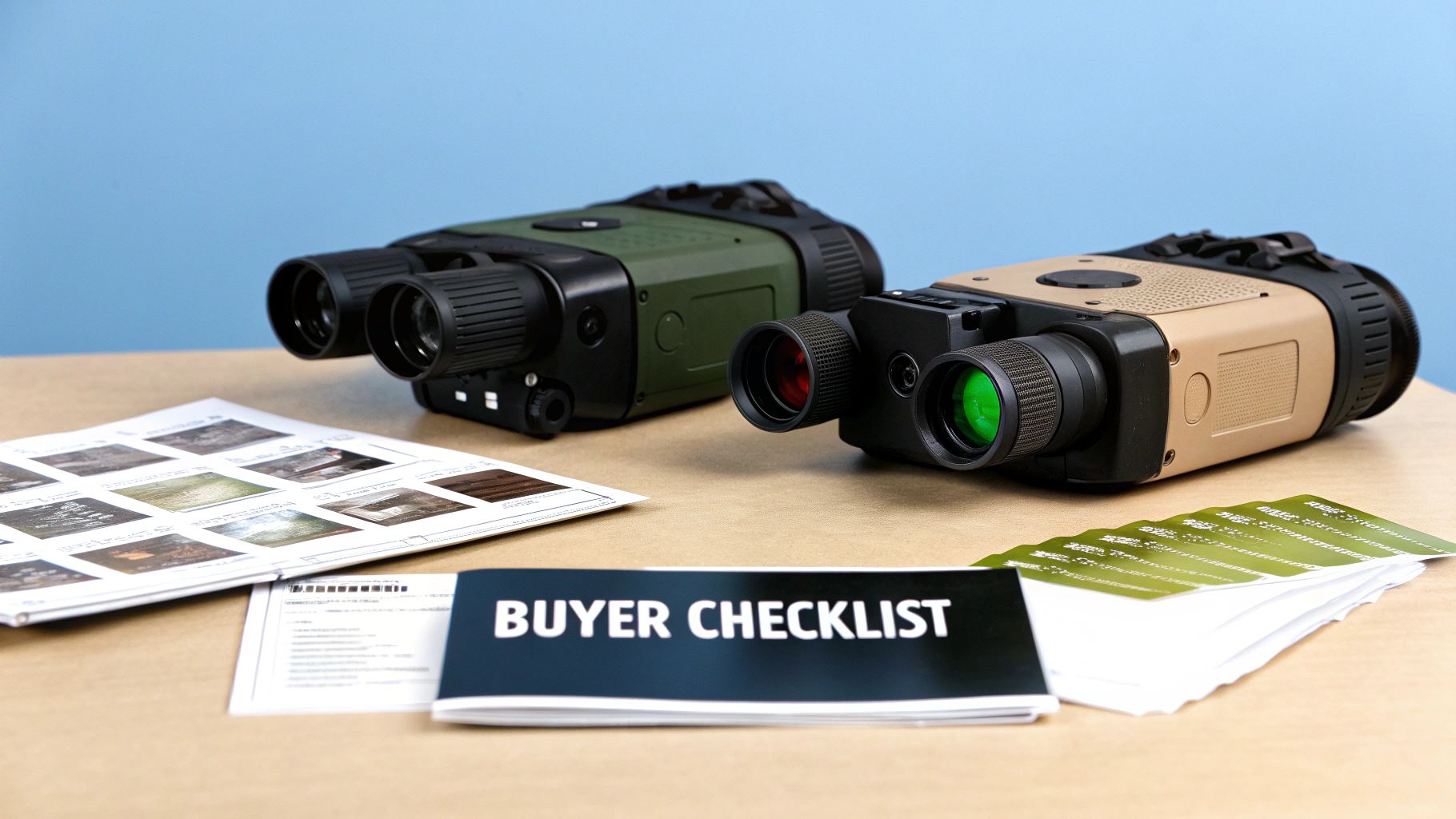
Dropping serious cash on night vision with color is a big move. Before you pull the trigger, there are a few real-world factors to weigh that go way beyond the tech specs. This is your final gut-check to make sure you’re getting a piece of gear that’s effective, reliable, and actually right for what you need to do.
Think of it like buying a high-performance truck. You wouldn't just look at the horsepower; you'd check the suspension travel, the axle ratios, and the frame. With night vision, it's the same deal—you have to look at the whole system to make sure it won’t let you down when it counts.
The Role of Infrared Illuminators
An IR illuminator is basically a stealth flashlight. It throws out a beam of light that's completely invisible to the naked eye but lights up the world for your night vision device. For any digital color system, an IR illuminator isn't optional—it's essential. While they can pull some color from ambient light, they're blind in true, pitch-black darkness without one.
But here’s the trade-off: firing up an IR illuminator is like sending up a flare for anyone else running NODs. This is precisely why top-tier analog or fusion systems are the go-to for tactical situations. Their ability to work passively, without giving away your position, is a non-negotiable advantage when staying unseen is the name of the game.
Technical Specifications That Matter
Don't let the marketing fluff fool you. A few key numbers tell the real story of a device's performance. The two you absolutely need to focus on are resolution and sensor size. Higher resolution gives you a sharper image, which means you can positively identify things from farther away. A larger sensor gathers more light, dramatically boosting performance when it gets seriously dark.
Think of a sensor like a bucket in a rainstorm. A bigger bucket (larger sensor) catches more raindrops (photons). More photons mean a cleaner, more detailed picture with less of that fuzzy digital noise.
Practical Field Considerations
Specs on a sheet are one thing; how a unit handles in the field is another. These practical points should be at the top of your checklist:
- Battery Life: Color and fusion systems are power hogs. All that processing and multiple sensors chew through batteries. Always check the expected runtime and see what kind of batteries it takes—you want something common like CR123As or AAs, not some exotic cell you can’t find.
- Weight and Ergonomics: If this is going on a helmet, every single ounce counts. A heavy, unbalanced unit will wreck your neck after a few hours, killing your focus and endurance.
- Durability and Weather Resistance: Your gear is going to get beat up. It's just a fact. Look for a solid IP rating (Ingress Protection), which tells you how well it stands up to dust and water. A tough, ruggedized housing is a must for any kind of professional use.
Legal And Export Regulations
High-end night vision isn't just another piece of electronics; it's sensitive technology. In the U.S., these devices fall under ITAR (International Traffic in Arms Regulations). That means you can't just ship them overseas or take them out of the country without a license.
This isn't new. The regulations are a direct result of the tech's military roots. Back in World War II, darkness was cover, until the Germans started fielding the first primitive night vision systems. Today’s Gen 3 tubes, like those in the PVS-14s we stock at Superior Tactical, can amplify light by 50,000x, and fusion tech adds that critical color context—a different universe from those early units. You can dive deeper into the history of night vision technology to see just how far we've come.
So, Is Color Night Vision Actually Right for You?
Choosing between a high-performance monochrome tube and a newer color night vision system isn't about finding a one-size-fits-all winner. It’s a classic trade-off. The real question is: which technology gives you the specific edge you need for your mission, environment, and budget?
Think of it this way: high-end, traditional image intensification (I²) systems are masters of one thing—amplifying light. Their specialty is delivering an incredibly crisp, high-resolution image with absolutely zero lag, even when you're working with just a sliver of moonlight. When you’re moving fast or picking your way through rough country, that razor-sharp clarity and real-time feedback are still the gold standard.
Color systems, on the other hand, especially those using thermal fusion, are all about adding context. They’re built to give you rich, layered information for one primary purpose: spotting threats and understanding the scene at a glance.
Matching the Gear to the Mission
So how do you decide? It really comes down to what you’ll be doing.
- Need to see in the pitch-black? If your primary challenge is navigating deep darkness without flipping on an IR illuminator, a top-tier monochrome system is still your best bet. Nothing beats its raw light-gathering performance.
- Need to spot threats fast? For any job where instantly picking a person out from a cluttered background is life-or-death, the thermal overlay in a fusion system is a game-changer. That heat signature just pops.
- Need positive ID? If identifying specific details like the color of a vehicle or a suspect's jacket is crucial for intel gathering, a true digital color system is the only way to go.
The decision boils down to this: Do you need the purest, most detailed view of the terrain, or do you need a data-heavy image that screams "threat" and cuts through the ambiguity? Both have a critical role to play.
Ultimately, this is a calculated choice. Traditional I² gives you unparalleled performance in amplifying faint light, while digital and fusion systems add a powerful layer of information. Figure out what your operational priorities are, and you'll know which piece of gear will truly let you own the night.
Frequently Asked Questions
When you start digging into night vision with color, a lot of questions pop up, especially about how it actually performs in the field compared to the high-end green or white phosphor units most of us are used to. Let's tackle some of the most common ones head-on.
This is all about cutting through the noise and giving you the straight answers you need to figure out if this tech is right for you.
Does Night Vision with Color Work in Complete Darkness?
That all comes down to what’s under the hood.
Digital color night vision—the kind using a CMOS sensor—still needs a little bit of ambient light to work its magic and produce a color image. In a pitch-black room with zero light, it has to switch on an infrared (IR) illuminator, and that kicks the image back to black and white.
On the other hand, thermal fusion systems are a completely different animal. They don't care about light levels at all. Since they see heat, not reflected light, they excel in total darkness. These systems paint a colorized thermal image over the standard night vision view, making anything with a heat signature pop.
Is Color Night Vision Better Than Traditional Green Night Vision?
It's not about "better," it's about having the right tool for the job. They're built for different purposes.
Your high-end traditional Gen 3 green or white phosphor tube is a specialist. It offers unmatched image clarity, incredible light amplification, and zero lag. For pure observation, navigation, and target ID in the dark, it's still the king.
Night vision with color, especially thermal fusion, is a master of detection. It adds a layer of information that helps your brain instantly spot threats. The best choice really hinges on what your mission requires and what your budget can handle.
What Are the Main Downsides of Color Night Vision?
Nothing comes for free; there are always trade-offs.
With digital color night vision, you might see lower light sensitivity compared to a top-tier analog tube. You could also notice a tiny bit of image lag because of the digital processing, and it tends to be a bit thirstier on batteries.
For the more advanced thermal fusion systems, the biggest hurdles are the price tag, complexity, and weight. That extra weight is a huge factor if you plan on running it on a helmet for hours at a time.
Can I Upgrade My Existing Night Vision to Have Color?
You can't just crack open your PVS-14 and swap in a color tube—the core technology is fundamentally different.
But you can add color capability to your current setup. The go-to method is a Clip-On Thermal Imager (COTI). This device mounts right in front of your existing monocular and overlays a thermal image onto your view. It's a killer way to get a multi-spectrum advantage, blending the best of both worlds.
At Superior Tactical LLC, we live and breathe this stuff. Whether you need the crystal-clear view of a high-end monochrome unit or the tactical edge of thermal fusion, we've got the gear and the know-how to get you set up. Check out our hand-picked selection of night vision and tactical optics to find the right tool for your mission.
