Night Vision Scope Reviews For Hunting And Tactical Use
Picking the right night vision scope is more than just buying gear; it's a critical decision that directly impacts your effectiveness in the field, whether you're stalking a coyote or securing a perimeter. The ideal scope for you comes down to a careful balance of image clarity, detection range, and what you're willing to spend. This guide is here to help you cut through the noise and understand the real differences between traditional image intensification, digital, and thermal optics.
How to Choose the Right Night Vision Scope
Choosing a night vision scope isn't about grabbing the newest, shiniest model off the shelf. It’s a mission-driven decision. The market is absolutely flooded with options, and their true strengths—and weaknesses—only show up after dark. Getting a solid grasp of the core technologies is the first, most important step toward making an investment you won't regret.
The demand for this technology is exploding. The global night vision market was valued at around USD 8.03 billion in 2025 and is on track to more than double to an estimated USD 16.94 billion by 2032. That massive growth isn't just military and law enforcement; it’s a clear sign of how vital this tech has become for civilians, too.
Core Technologies at a Glance
Before we jump into specific scope reviews, you need to understand the three main technologies powering them. Each one works differently, which makes it better for certain jobs. The environment you operate in and what you’re trying to see will steer you toward the right choice.
-
Image Intensification (I²): This is the classic "green screen" night vision everyone knows. It works by taking tiny amounts of ambient light—from the moon, stars, whatever—and amplifying it thousands of times to create a visible image. It’s fantastic for getting the detail you need for positive identification.
-
Digital Night Vision: Think of this as a super-sensitive digital camera. It converts available light into a digital signal that you see on a small screen inside the scope. The big advantages here are versatility, like being able to use it during the day and record video.
-
Thermal Imaging: This technology is in a different league. It doesn’t see light; it sees heat. Thermal scopes pick up on the heat signatures of objects, letting you spot targets in total darkness, through smoke, fog, and even light brush. For pure detection, nothing beats it.
Getting these fundamentals down is non-negotiable. For a deeper dive, our guide on https://superiortac.com/how-to-choose-the-right-night-vision-device-for-your-needs/ is a great place to continue.
The most crucial trade-off you'll face is detection versus identification. Thermal is the undisputed king of finding a heat signature at long range, but image intensification (I²) often delivers the clearer detail needed to know exactly what you're looking at.
Deciphering the Specs
When you start digging into reviews, you'll get hit with a lot of technical jargon. Two of the most important specs you need to understand are resolution and Figure of Merit (FOM). Resolution, measured in line pairs per millimeter (lp/mm), tells you how sharp the image is. A higher number means a crisper, more detailed view.
FOM is a number used to grade the overall performance of an I² tube. It's a calculated value that combines the tube's resolution and its signal-to-noise ratio. Simply put, a higher FOM means the unit will perform better when the lights are really out. These numbers give you a concrete way to compare scopes that goes beyond marketing hype and price tags.
Comparing Image Intensifier Tube Generations
When you start digging into traditional night vision, you'll quickly learn that everything comes down to one critical component: the image intensifier (I²) tube. This is the heart of the device, the engine that turns darkness into a visible picture. The "Generation" of that tube isn't just marketing speak; it's a direct reflection of the technology inside, dictating performance, clarity, and, of course, price.
Getting a handle on these differences is the first step to choosing the right scope for your needs. A Gen 1 unit might be perfectly fine for checking out what's making noise in your backyard, but it will leave a serious hunter or tactical operator completely in the dark when it matters most. It always boils down to a trade-off between cost and how well you need to see when the lights go out.
Gen 1: The Accessible Entry Point
Generation 1 is where most people get their first taste of night vision, mainly because it's the most affordable and common technology out there. These tubes amplify existing light, but the process is pretty basic and comes with some serious limitations.
Gen 1 scopes are heavily dependent on an active infrared (IR) illuminator to be useful in anything other than bright moonlight. Without that IR boost, you're not going to see much of anything. You'll also notice a classic "fish-eye" effect that distorts the edges of the image, along with a low, persistent hum while it's running. It's not the right tool for critical missions, but it’s a solid, low-cost way to get your feet wet.
Gen 2: A Major Leap In Performance
Generation 2 is where night vision technology really starts to get serious. The game-changing addition here was the micro-channel plate (MCP), which dramatically boosts the light gain. The result is an image that is significantly brighter, sharper, and cleaner than anything Gen 1 can produce.
The difference is night and day, literally. Gen 2 devices can actually work passively under starlight, giving you a much clearer sight picture without the obvious distortion. This makes them a fantastic middle-ground option for hunters, farmers, and property owners who need reliable performance but aren't ready to jump to the Gen 3 price point.
The jump from Gen 1 to Gen 2 is where night vision becomes a truly practical tool rather than just a novelty. The improved light amplification and image clarity mean you can identify targets at greater distances without relying as heavily on an IR illuminator.
Gen 3: The Professional Standard
For military, law enforcement, and any professional who depends on their gear, Generation 3 is the benchmark. The key innovation is a gallium arsenide photocathode, which is incredibly sensitive to light, especially in the near-infrared spectrum where there's more ambient energy to work with.
This translates to an exceptionally bright and crisp image with a fantastic signal-to-noise ratio, allowing it to perform in extremely dark environments. A good Gen 3 unit lets you see fine details at a distance, making the difference between identifying a threat and just seeing a blurry shape. When failure is not an option, Gen 3 is the standard.
Gen 3+ Unfilmed: Elite Performance
Often called Gen 3+ or unfilmed, these tubes are the absolute peak of I² technology. They work by removing the ion barrier film that's present in standard Gen 3 tubes. This allows more light to pass through, boosting the signal-to-noise ratio and delivering the best image quality possible. You can get into the technical weeds by reading our comparison of thin-filmed and unfilmed image intensifier tubes.
The practical advantage shows up in the darkest conditions, where unfilmed tubes produce a brighter, higher-contrast image with less "scintillation" or sparkle. They carry the highest price tag, but for special operations teams and dedicated users who demand every last ounce of performance, this is the top tier.
Night Vision Generation Performance Comparison
To help visualize how these specs translate to real-world performance, the table below offers a straightforward breakdown of what to expect from each generation. It highlights the practical differences in capability and why the costs vary so much.
| Generation | Typical Light Amplification | Effective Range (Ideal Conditions) | Image Clarity & Resolution | Common Use Case |
|---|---|---|---|---|
| Gen 1 | ~1,000x | Up to 75 yards | Lower resolution, noticeable edge distortion | Casual observation, backyard security |
| Gen 2 | ~20,000x | Up to 150 yards | Good resolution, much cleaner than Gen 1 | Hog hunting, property defense |
| Gen 3 | ~50,000x | 200+ yards | High resolution, minimal distortion | Tactical operations, serious hunting |
| Gen 3+ Unfilmed | 70,000x+ | 250+ yards | Exceptional clarity and low-light performance | Special operations, professional users |
As you can see, the progression from one generation to the next isn't just a small step—it's a massive leap in light amplification, range, and clarity, fundamentally changing what's possible in the dark.
Digital And Thermal Scopes: The Modern Alternatives
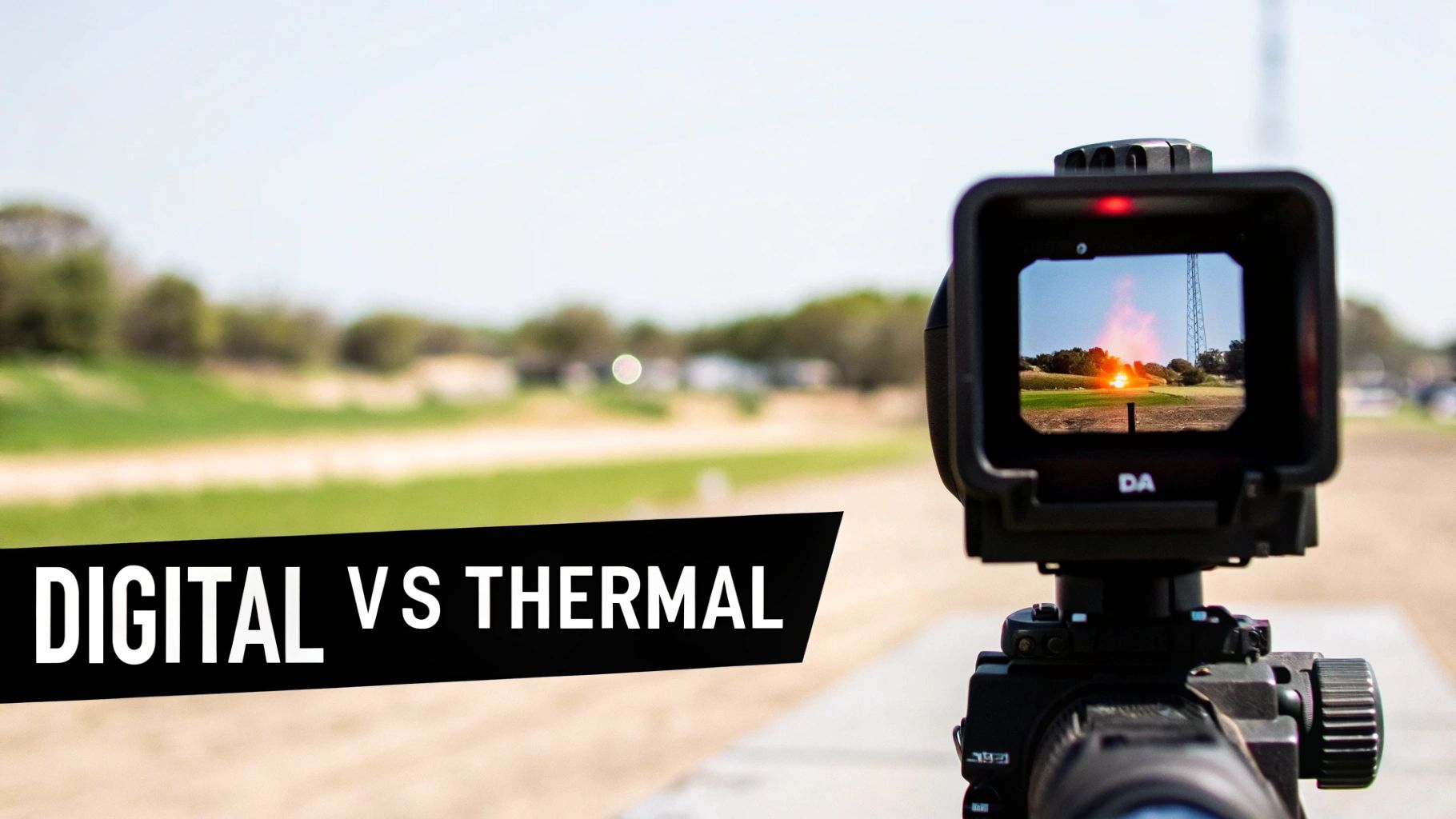
While image intensifier tubes are the classic way to own the night, the game has changed. Today, digital and thermal scopes have entered the arena, offering powerful capabilities that often make them a better fit for specific jobs. These aren't just trying to copy what I² tubes do; they’re creating entirely new ways to operate in the dark.
Digital night vision works a lot like a super-sensitive digital camera. It uses a CCD or CMOS sensor to grab whatever light is available, turning it into a video signal you see on a tiny screen in the eyepiece. This tech completely blurs the line between day and night optics, giving them a versatility that traditional scopes just can't touch.
The Rise of Digital Versatility
One of the biggest wins for digital night vision is its sheer toughness against bright light. You can fry an expensive I² tube by accidentally exposing it to sunlight, but a digital scope couldn't care less. In fact, many are designed to be used 24/7, with full-color modes for daytime shooting, making one optic a true do-it-all solution.
But it’s the onboard tech that really makes them shine. It’s now common to see digital scopes packed with features like:
-
HD Video and Audio Recording: Capture your hunt or training session right onto a memory card. No more clumsy camera setups.
-
Integrated Ballistic Calculators: Just plug in your ammo data, and the scope handles the bullet drop compensation for you.
-
One-Shot Zeroing: A lifesaver at the range. These systems calculate your adjustments after a single shot, getting you on target in minutes.
-
Multiple Reticle Options: Switch between different reticles and color palettes on the fly to match your preference or the conditions.
This level of integration is what’s pushing the market forward. Recent analysis shows that consumer demand for these advanced, user-friendly features is a huge factor in the industry's growth, with North America expected to account for about 35% of the global market expansion.
Thermal Imaging: The Apex Predator Detector
Thermal imaging is a whole different animal. It doesn't need any light. Instead, it sees heat, building a picture based on the tiny differences in thermal energy everything gives off. This gives it an almost unfair advantage in spotting living targets, especially when other optics are completely blind.
A good thermal scope can cut right through thick fog, smoke, and even light brush to reveal the heat signature of an animal. For pure, raw detection—especially at distance or in bad weather—nothing else comes close.
This makes thermal the ultimate tool for spotting hogs in a foggy field or a coyote hiding in tall grass. They will glow like a lightbulb in the optic, making them impossible to miss. But this incredible power comes with a critical catch when it’s time to pull the trigger.
Detection vs. Identification: The Core Tradeoff
The main headache with thermal is positive identification. You can easily spot a warm body hundreds of yards away, but the image often looks like a blurry, heat-painted silhouette. You’ll see the shape of an animal, but good luck telling a large coyote from a small deer, or worse, the neighbor’s golden retriever.
This is where traditional I² and modern digital scopes pull ahead. By amplifying ambient light, they show you a much more detailed, recognizable picture of your target and what's behind it. For anyone doing night vision scope reviews, this is the fundamental conflict you have to resolve:
-
Thermal: Unbeatable for detection. It tells you something is out there, period.
-
I² and Digital: Superior for identification. They give you the crucial detail to know exactly what that something is.
If you're interested in off-rifle options, our guide to digital night vision binoculars is a great place to learn more. At the end of the day, the right choice boils down to your mission. If you need to scan a huge area and ensure nothing gets by you, thermal is king. If you need to positively identify every target before taking a shot, a quality digital or I² scope will give you the clarity you need.
Field Reviews: Putting Night Vision to the Test
Specs on a datasheet are one thing, but how a scope performs when you’re freezing in a deer stand or clearing a dark hallway is what really counts. This is where we get down to brass tacks, moving from theory to what you’ll actually see through the lens.
We’ve hand-picked three different but representative scopes to put through their paces. Each one is a leader in its own category, and our goal is to show you the subtle but critical differences that only pop up after hours of real-world use. We've got a top-tier Gen 3 tactical scope, a digital optic packed with features for the modern hunter, and a thermal unit built for pure, unadulterated detection.
The Tactical Titan: A Premium Gen 3 I² Scope
For our tactical example, we went with a popular unfilmed white phosphor Gen 3 scope—the kind of optic professionals trust their lives with. This unit is really the peak of image intensification (I²), built to deliver the kind of clarity and performance you need when the stakes are high.
The moment you pull it out of the box, you can feel the build quality. The housing is rock-solid, clearly designed to handle the recoil from heavy calibers and the inevitable bumps and scrapes of fieldwork. But the real magic happens after sunset. Under just a quarter-moon, the image was stunningly clear. We’re talking sharp, edge-to-edge detail with almost no scintillation. This is where a high Figure of Merit (FOM) number makes a tangible difference, letting you positively identify a target well past 200 yards.
What really blew me away was its performance in near-pitch-black conditions, with only starlight to work with. Cheaper scopes would have shown nothing, but this unit produced a grainy yet completely usable image—a powerful testament to its light-gathering ability. The controls are dead simple, just a single knob for power and gain. There are no menus to fumble with under stress, which is exactly what you want in a tactical situation.
The biggest takeaway with a high-end Gen 3 scope like this is its unmatched ability to provide clear, detailed imagery for positive identification at a distance. A thermal might spot a heat blob further out, but this I² unit tells you exactly what you’re looking at. For law enforcement and military applications, that’s not a feature; it’s a necessity.
The Digital Hunter: A Feature-Packed Powerhouse
Next up, we put a mid-range digital night vision scope to the test. These have become incredibly popular with hunters, especially for hogs and predators, and it’s easy to see why. This optic is less about pure night vision and more about a whole suite of technology rolled into one package.
Its main selling point is versatility. It has a full-color daytime mode, so it works just fine as your regular riflescope. No need to swap optics when the sun comes up. When darkness falls, its powerful built-in IR illuminator and sensitive CMOS sensor kick in, creating a crisp black-and-white image on the internal screen. It’s not the organic, natural view of a Gen 3 tube, but the image is remarkably clear out to 150 yards, which covers most hunting scenarios.
But it’s the bells and whistles where this scope really pulls away from the pack:
-
One-Shot Zero: This feature actually worked as advertised. We had the scope sighted in within a few minutes, which is a huge time-saver.
-
Ballistics Calculator: After plugging in our ammo data, the scope gave us accurate holdover points on the reticle. It makes taking longer shots much less of a guessing game.
-
Video Recording: Being able to record your hunts in 1080p HD is a fantastic bonus, whether you're a content creator or just want to review your shots.
The user interface is all menu-based, controlled by a few tactile buttons. It takes a little getting used to, but after a few minutes, it feels pretty natural. We used an external battery pack, and it easily powered the scope through a full night of testing.
The Thermal Predator: Unmatched Detection
Finally, we mounted a dedicated thermal scope to see what it could do. This technology is a different beast entirely. It couldn't care less about visible light; it operates by seeing tiny differences in heat and painting a picture from those thermal signatures.
Using it in the field is a game-changer. We scanned a dark, wooded treeline where animals were completely invisible to the naked eye—and even to the I² scope—and they instantly popped as bright, glowing shapes. We were spotting deer and coyotes at over 500 yards, a range where the other scopes couldn’t see a thing. Another huge advantage was its ability to see right through light fog and brush.
Of course, the classic thermal trade-off quickly became apparent. While its detection capability is off the charts, identification can be tricky. At 150 yards, we could easily see the shape of a coyote, but telling it apart from a farm dog of a similar size based on the thermal image alone would be tough. The scope has multiple color palettes (white-hot, black-hot, and various colors) which help, but it’s a fundamental limitation of the tech. The menu was easy to navigate, and the picture-in-picture zoom was a genuinely useful feature for getting a closer look without losing your wider field of view.
Head-to-Head Performance Breakdown
To boil it all down, here’s a straightforward comparison of how these three scopes stacked up in the real world. This table highlights the unique strengths each technology brings to the table.
| Performance Metric | Gen 3 Tactical I² Scope | Digital Hunting Scope | Thermal Predator Scope |
|---|---|---|---|
| Primary Strength | Target Identification | All-Around Versatility | Target Detection |
| Image Quality | Excellent, natural view | Very good, digital display | Good, shows heat signatures |
| Effective Range | 200+ yards (ID) | 150 yards (ID) | 500+ yards (Detection) |
| Daytime Use | No (can cause damage) | Yes (full-color mode) | Yes (sees heat, not light) |
| Key Features | Durability, simplicity | Video recording, ballistics | Sees through fog/smoke |
| Ideal User | Tactical professional | Modern hunter, tech enthusiast | Predator hunter, farmer |
What this comparison really shows is that there’s no single "best" night vision scope. The right choice depends entirely on your mission, your environment, and that critical trade-off between just seeing that something is out there and knowing exactly what it is.
Matching The Right Scope To Your Application
All the tech specs and tube data in the world don’t mean a thing until you apply them to a real-world mission. The "best" scope isn't the one with the highest price tag; it's the one that gives you a decisive edge in your environment. A scope that's perfect for a law enforcement officer clearing a building will likely be the wrong tool for a hunter scanning a foggy field for coyotes.
This is where we connect the dots between the spec sheet and the situation on the ground. We’ll walk through the most common scenarios and break down which technologies and features matter most, so you can be sure your investment is going toward the right capability for your primary goal.
The Tactical Operator And Law Enforcement Professional
When your life is on the line, there's simply no substitute for a top-tier Gen 3 image intensifier tube. In any tactical situation, positive target identification is everything. The incredible clarity and resolution you get from a high-FOM, unfilmed white phosphor tube are absolutely critical for telling friend from foe at a distance.
Durability and simplicity are just as important. A duty-grade scope has to be built like a tank, capable of taking abuse and holding zero through it all. The controls need to be dead simple—ideally, a single knob for power and gain. Fumbling with menus under stress is a non-starter. A wide field of view is another must-have, giving you the situational awareness needed to clear rooms or scan complex areas effectively.
Thermal is fantastic for detection, but for the split-second, life-or-death decision of identification, the crisp detail of a Gen 3 I² scope is irreplaceable. For military and LE applications, this is the number one priority.
The Dedicated Predator Hunter
Hunters, especially those after nocturnal predators like coyotes and hogs, are playing a different game. Your biggest challenge is detection—spotting a target across a wide-open field, often when it's camouflaged or hidden in the brush. This is thermal imaging's home turf.
A thermal scope cuts right through fog, tall grass, and light cover by picking up an animal's heat signature, making it a game-changer for finding targets. While identification used to be a weakness, modern thermals with variable magnification and multiple color palettes close that gap significantly. Many of these scopes now come loaded with features hunters love, like integrated rangefinders and ballistic calculators, taking the guesswork out of an ethical shot.
This flowchart breaks down the decision-making process based on your primary use case.
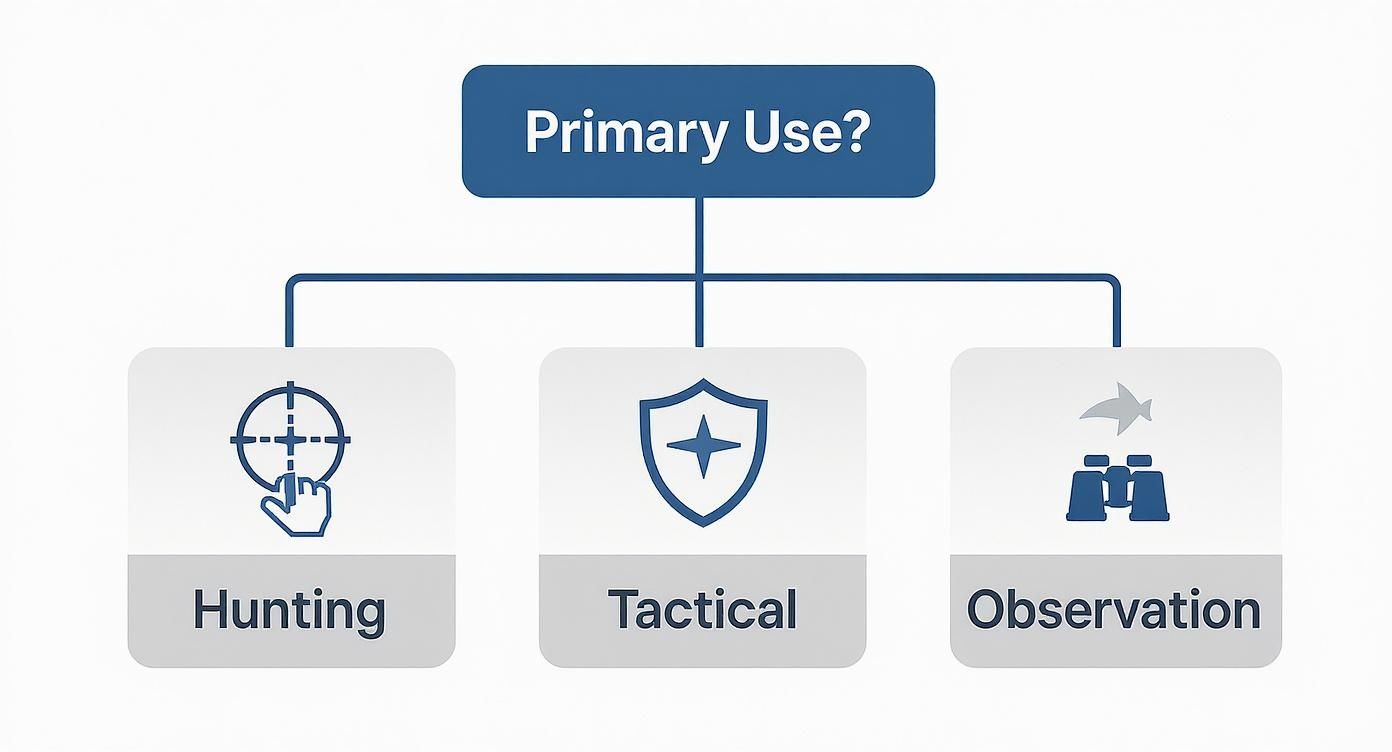
As you can see, the specific demands of hunting, tactical operations, and general observation point you toward very different technologies and features.
The Landowner And Security Professional
For property owners, ranchers, or private security, the job is about surveillance and defense over a familiar patch of ground. You need to monitor a perimeter, spot threats to livestock or property, and have a solid tool for investigating bumps in the night. For this role, digital night vision often hits the sweet spot between performance and cost.
Digital scopes are incredibly versatile. Many work just fine in daylight and offer high-definition video recording, which is perfect for documenting any activity for security records. Because stealth isn't always the top concern in a defensive scenario, the need for a built-in IR illuminator isn't a major downside. They are tough, affordable, and a highly practical choice for keeping an eye on your homestead.
This demand isn't just anecdotal; the night vision market is booming. It hit an estimated USD 7.5 billion in 2024 and is expected to climb to USD 7.8 billion in 2025. The biggest piece of that pie belongs to ground-based systems for infantry, border security, and counter-terrorism, which shows just how vital this technology has become. You can dig into more market insights from Stratview Research.
Common Questions About Night Vision Scopes
After digging through specs and comparisons, you're bound to have a few practical questions left. We get it. This is where we tackle the most common things people ask when they're zeroing in on the right scope. Think of this as the real-world advice that can make or break your experience out in the field.
Getting these details sorted out is the last step before you pull the trigger on a big investment. It’s all about making sure there are no surprises when you finally get your hands on your new gear.
Can I Use A Night Vision Scope During The Day?
This is probably the most critical question we hear, and the answer is a hard it depends on the tech inside. If you're looking at a traditional image intensifier (I²) scope—especially Gen 2 and Gen 3 models—using it in daylight is a recipe for disaster. The intense light will overload and permanently damage the tube, leading to an expensive paperweight.
Digital night vision scopes, on the other hand, are a different beast entirely. They function like specialized digital cameras, so they are completely safe to use during the day. Many are designed as true 24/7 optics with a full-color daytime mode, which is a huge advantage.
Thermal scopes are also perfectly fine for daytime use. They see heat, not light, so the sun won't damage the internal sensor. The only hiccup is that on a very hot, sunny day, the background can get "loud" and wash out the image a bit, but they still work just fine for spotting targets.
What Is The Difference Between White And Green Phosphor?
The image color you see through an I² tube comes down to the phosphor screen. For years, that iconic green was the only game in town. The reason was simple: the human eye is fantastic at picking out different shades of green, which can help reduce eye strain over long periods of observation.
White phosphor is the newer option, producing a black-and-white image. A lot of users feel it gives a more natural scene with better contrast. This can be a real help when it comes to depth perception and picking out fine details on a target that might get lost in a sea of green.
It's important to remember that the core performance—the FOM, for instance—can be identical between a green and a white phosphor tube of the same quality. The choice really boils down to personal preference. Some people swear white phosphor is easier on their eyes, while others are just more comfortable with the classic green they trained on.
How Important Is An Infrared Illuminator?
Think of an IR illuminator as a mandatory piece of kit. It's basically a high-powered flashlight that your eyes can't see but your night vision device sees as a brilliant spotlight. Its purpose is to throw extra light downrange when the ambient light just isn't cutting it.
Even a top-tier Gen 3 scope will have trouble creating a clean image on a moonless, overcast night or deep inside a building. Flip on an IR illuminator, and you instantly flood the area with usable light, drastically sharpening the image and pushing your identification range way out.
For some gear, an illuminator isn't just a helpful accessory; it's a necessity.
-
Gen 1 and most digital scopes absolutely rely on an IR illuminator to give you a workable image in anything but bright moonlight.
-
Gen 2 and Gen 3 scopes are great at running passively, but to get maximum performance in true darkness, you still need an illuminator.
At the end of the day, your IR illuminator is the "turbo button" for your night vision. It guarantees you'll have a clear sight picture no matter how dark it gets. Any serious review will tell you that a quality illuminator is non-negotiable.
At Superior Tactical LLC, we provide the expertise and gear to ensure you're always mission-ready. Explore our curated selection of high-performance night vision and thermal optics to find the perfect solution for your needs.
