
Night Vision in Color A Guide for Tactical Professionals
It's a common question I get asked: Is color night vision actually real? The answer is a definitive yes, and it’s a technology that gives users a massive leg up over traditional monochrome systems. It ditches that classic green-and-black view by using sophisticated digital sensors that can interpret the faintest ambient light and reconstruct a full-color image. In any low-light situation, that’s a serious advantage.
Seeing the Night in a New Light
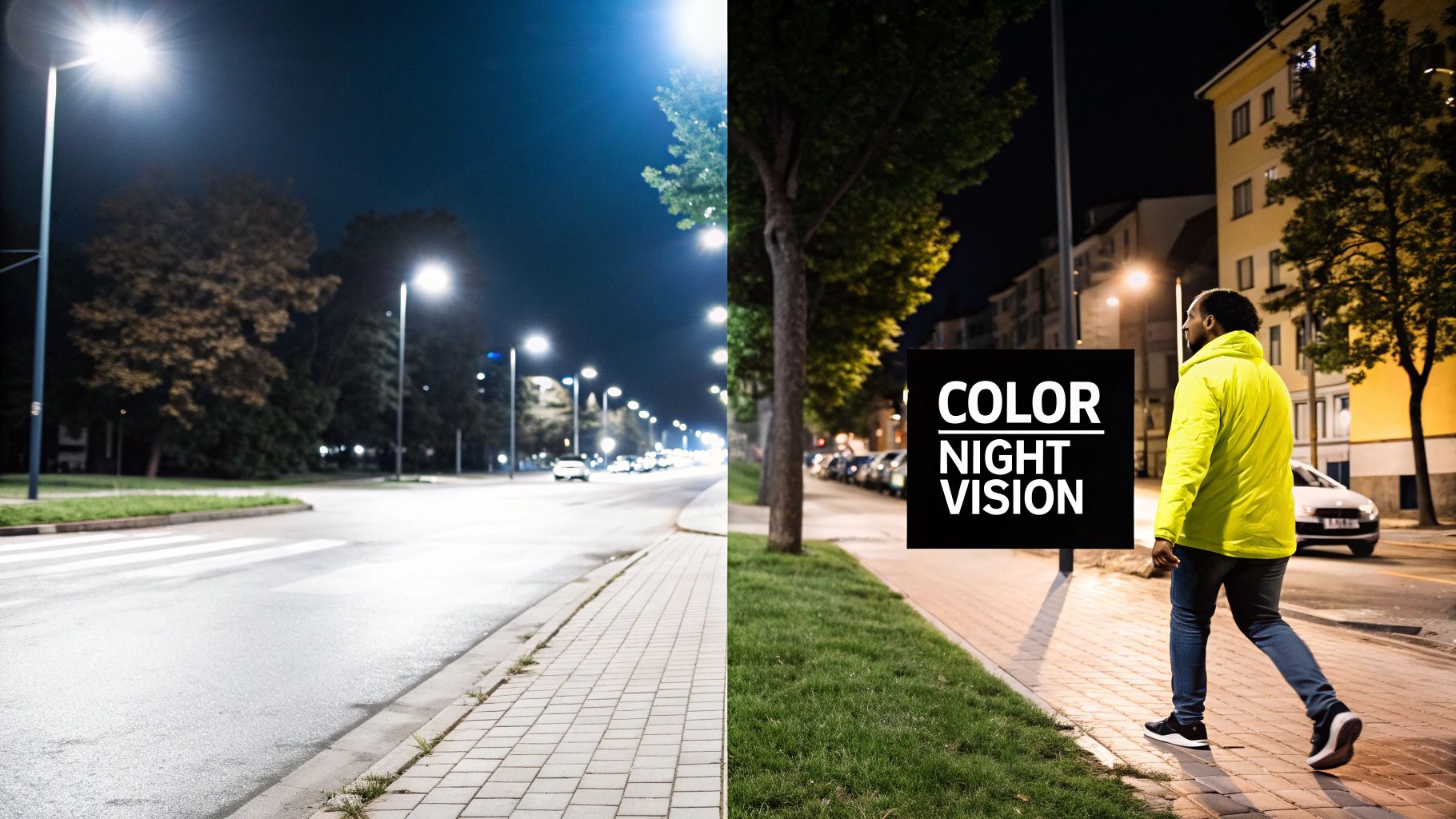
For years, anyone operating after dark—whether in law enforcement, the military, or hunting—saw the world through a single color: green. That iconic glow works, but it also leaves a ton of important information on the table. Think about trying to identify a suspect from a vague clothing description or trying to tell one car from another when they're all just ghostly shapes. Those are the exact limitations that night vision in color was built to solve.
Being able to see true-to-life color when it's nearly pitch-black isn't just a cool feature; it fundamentally changes your situational awareness. When the world is rendered in its actual hues, you get specific, actionable details that can make or break a mission. Decision-making shifts from a slow process of guessing and interpreting to one of instant recognition.
Why Color Is a Tactical Game-Changer
Bringing color into the picture adds layers of detail that are completely invisible in a monochrome view. The practical benefits are huge and can be felt immediately in fields from law enforcement to private security.
Just think about these real-world scenarios where color gives you a clear edge:
- Positive Identification: An officer gets a BOLO alert for a suspect in a red jacket and blue jeans. With color night vision, they can make a positive ID in seconds, removing the guesswork that could lead to a dangerous mistake.
- Enhanced Tracking: A hunter or a search-and-rescue team can spot a fresh blood trail against dark soil or brown leaves. That’s a nearly impossible task with a standard green-phosphor unit.
- Threat Assessment: A security team can immediately tell the difference between a random civilian car and a specific vehicle they’re looking for based on its color, allowing for much faster and more accurate reactions.
The real power of color night vision is how it slashes ambiguity. When you can see the color of a wire, a uniform, or a fluid leak on the ground, you can act with far more speed and confidence.
At its core, this technology closes the gap between simply seeing an image and truly understanding what's happening. It lets an operator process what they're seeing intuitively, much like how our eyes work during the day. This guide will dig into how it all works, where it's being used, and what you need to know before choosing a system for your own needs.
From Green Glow to Full Spectrum Color
If you've spent any time in the tactical world, you know the iconic image: the eerie, monochromatic green glow of classic night vision. For decades, that was the color of the night. But this wasn't just for sci-fi movie aesthetics; it was a smart decision grounded in human biology.
The human eye is remarkably good at distinguishing between different shades of green, especially when light is scarce. The engineers behind early night vision knew this and used green phosphor screens to give operators the best possible chance of spotting movement, contrast, and subtle shapes in the dark. For a long time, that green-tinted view wasn't just an option—it was the gold standard.
The Reign of Analog
That classic green picture comes from a technology called analog image intensification (I²). It’s a brilliant but straightforward concept: take the tiny bit of ambient light available—from the moon, stars, or distant city glow—and amplify it thousands of times.
The process creates a clear, bright image, but it has a built-in limitation: it can’t see color. The intensifier tube just multiplies photons, it doesn't know what color they started as. Everything gets rendered in that one shade, whether it's the old-school green or the more modern advantages of white phosphor night vision.
This analog tech hit its stride with Gen 3 systems. It really cemented its place during the 1991 Gulf War, where the U.S. equipped over 80% of frontline units with devices that could amplify light up to an incredible 50,000x, effectively letting them "own the night." But the world doesn't stand still. By 2025, digital color night vision had already carved out 35% of the U.S. tactical market—a huge leap from virtually zero a decade earlier, all thanks to new sensor and fusion technologies.
The Digital Leap
Even as analog systems got better and better, operators wanted more information. Identifying a target is one thing, but knowing the color of a vehicle, a piece of clothing, or a specific wire can be life-or-death. This demand pushed engineers toward digital night vision.
Instead of an intensifier tube, digital systems use ultra-sensitive camera sensors, much like the ones in high-end DSLRs but specifically built to work in near-total darkness. These CMOS sensors gather the few available photons and convert them into a digital signal. A powerful onboard processor then gets to work, interpreting that data and reconstructing a full-color image on a tiny screen inside the eyepiece. This was the first real break from the monochrome tradition, finally giving users a chance to see the night in its true colors.
Digital night vision was a fundamental change in thinking. We went from just making the dark visible to trying to make it look like daylight, complete with all the crucial color cues we'd been missing.
Fusing Technologies for Total Awareness
The most recent and powerful development is fusion technology. The idea here is to take different sensor technologies and merge their outputs, letting the strengths of one cover the weaknesses of another. The most common setup today overlays a thermal image on top of a digital or analog night vision feed.
This hybrid approach delivers an incredible tactical advantage:
- Thermal cuts through smoke, fog, and camouflage to spot heat signatures.
- Image Intensification (or digital) provides context, showing you the terrain, obstacles, and details of the environment.
With a fused system, you can see the bright heat signature of a person hiding behind a bush while also seeing every branch and leaf in crisp detail. When you add full color to that mix, you get an unbelievably rich and informative view of the battlefield. It’s the pinnacle of night vision today—a journey that started with a simple green glow and has evolved into a complete, multi-layered understanding of the dark.
How Color Night Vision Technology Works
To really understand how we get night vision in color, you have to know that it's more than just cranking up the brightness. Traditional night vision is a phenomenal light amplifier, but seeing color in the dark requires a totally different bag of tricks. It’s all about gathering, interpreting, and then rebuilding the visual information from scratch.
Think of it like this: just turning up the volume on a whisper makes it louder, but it doesn't add any detail you couldn't already hear. Color night vision is more like a system that not only makes the whisper louder but also identifies who is speaking and what they're saying. It adds a critical layer of context.
The Foundation: Analog Image Intensification
That classic green or white phosphor view most people associate with night vision comes from analog image intensification (I²) technology. At its core, this gear is a powerful light multiplier. An objective lens gathers the few photons available from starlight or moonlight and shoots them onto a photocathode. This part converts those light particles into electrons, which are then multiplied thousands of times before hitting a phosphor screen to create that bright, recognizable image.
The catch? This entire process is colorblind. It only cares about the amount of light, not its wavelength (which is what defines color). While it’s incredibly good for navigating and spotting movement in near-total darkness, it gives you a monochrome image, stripping away all the crucial information that color provides.
Capturing Color Electronically: Digital Night Vision
Digital night vision works on a completely different principle, one that's much closer to a high-end digital camera than an analog tube. Instead of a photocathode and phosphor screen, it uses a highly sensitive Complementary Metal-Oxide-Semiconductor (CMOS) sensor built specifically for low-light performance.
This sensor captures incoming photons and converts them into digital data. From there, a powerful onboard image signal processor (ISP) takes over. It cleans up the visual "noise" and, most importantly, interprets the different wavelengths of light to digitally reconstruct a full-color image. You see the final result on a small screen inside the eyepiece.
- How It Works: A specialized CMOS sensor acts like an electronic net, snagging every bit of available light.
- The Processor's Job: A tiny, powerful computer scrubs the signal and essentially "paints" a color picture from the raw data.
- The Result: You get a real-time color video feed, delivering invaluable context that analog systems simply can't.
This diagram helps visualize how we got from the classic monochrome view to today's advanced multi-layered systems.
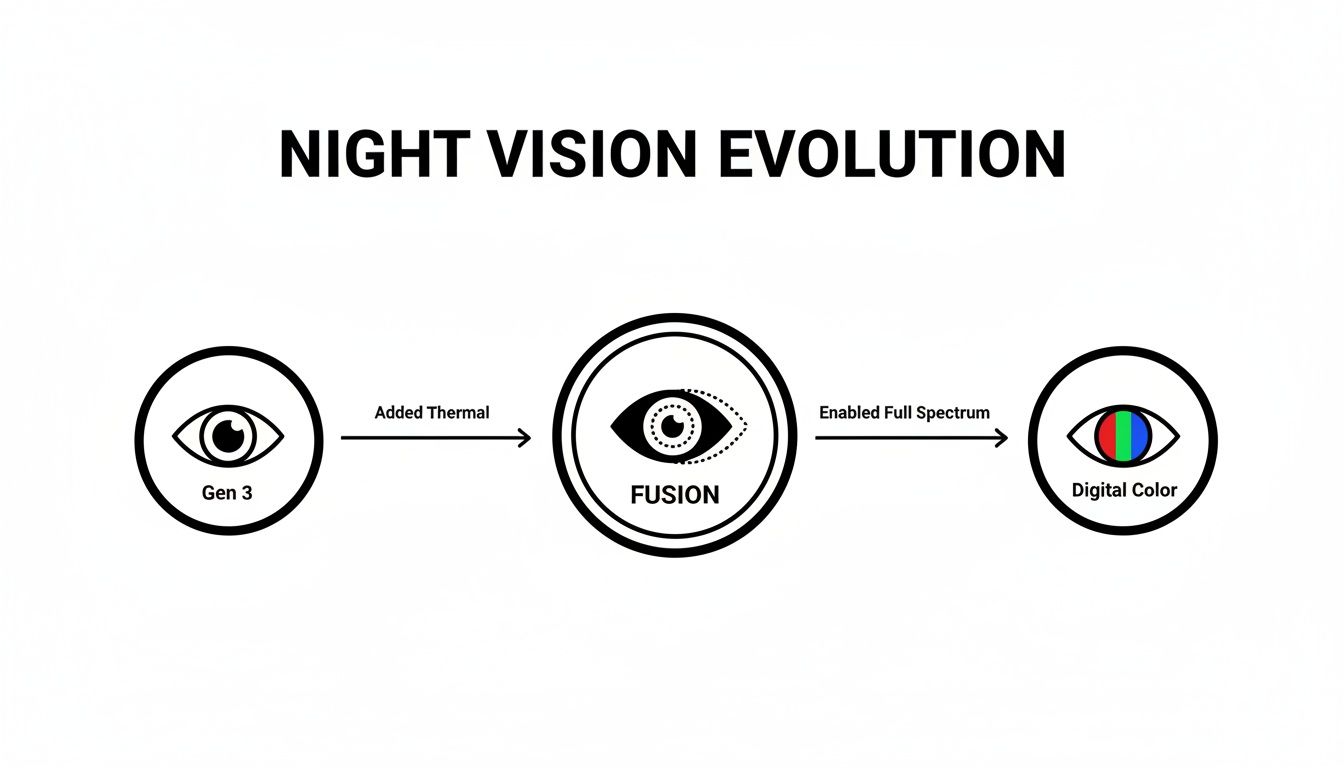
You can clearly see the jump from basic Gen 3 light amplification to the combined data of Fusion and, finally, the full-spectrum capability of Digital Color.
The Best of Both Worlds: Fusion Technology
Fusion technology is the current pinnacle of night-time situational awareness. It works by combining two or more different sensor types into a single, cohesive image for the user. The most common and effective pairing merges a thermal imaging sensor with either an analog I² tube or a digital night vision sensor.
Imagine laying two different maps over one another. The thermal sensor gives you a "heat map," perfectly highlighting people, running vehicles, and other heat sources, even if they're hidden by smoke or camouflage. At the same time, the night vision sensor provides the "topographical map," showing you the terrain, obstacles, and environmental details.
By digitally overlaying these two feeds, you get an image that is far more than the sum of its parts. You can see a person's heat signature hiding in a ditch and clearly see the ditch itself, giving you a complete tactical picture.
This hybrid approach has been a game-changer. Night vision has evolved dramatically from its monochromatic green-hued origins, with the 2020s marking a huge shift with the rise of color night vision. While traditional image intensifiers like a Gen 3 PVS-14 can amplify ambient light 30,000 to 50,000 times, they still only produce a monochrome view. By the early 2020s, digital fusion tech began blending these systems with full-color sensors, using advanced imaging chips and smart algorithms to render realistic colors in extreme darkness.
To help you sort through these options, we've put together a quick comparison of the different technologies.
Night Vision Technology Comparison at a Glance
| Technology Type | How It Works | Primary Advantage | Key Limitation | Best For |
|---|---|---|---|---|
| Analog (I²) | Amplifies ambient light photons thousands of times using a photocathode and phosphor screen. | Exceptional performance in extreme low light; high-resolution, "organic" view. | Monochrome image (green or white); no color information. | Military operations, navigation, and target detection where low-light performance is paramount. |
| Digital | Uses a sensitive CMOS sensor to capture light and an ISP to process it into a digital image. | Provides full-color imaging, recording capabilities, and is often more affordable. | Can be less sensitive than analog in near-total darkness; potential for digital noise/lag. | Surveillance, hunting, and enthusiast use where color identification is critical. |
| Fusion | Combines an I² or digital sensor with a thermal imaging sensor, overlaying the two feeds. | Unmatched situational awareness by blending thermal detection with environmental detail. | High complexity and significant cost; can require more user training. | Special operations, law enforcement, and high-stakes scenarios requiring maximum information. |
This table simplifies the core trade-offs, but the best choice always comes down to your specific mission and environment.
Ultimately, the technology you choose hinges on your specific needs. For a deeper dive into how these systems stack up, check out our detailed guide comparing thermal imaging vs. digital vs. analog night vision. Understanding these core differences is the first step toward picking the right tool for the job.
Understanding the Performance Tradeoffs
Picking the right night vision system always comes down to a game of trade-offs. While the thought of seeing in full, vivid color at night is incredibly compelling, you need to understand what you're giving up to get it. There's no magic bullet; what you gain in the richness of color information, you often sacrifice in raw low-light performance.
The core of the issue is a hard limit set by physics: there just isn’t much light out there after the sun goes down. Traditional analog image intensifier (I²) tubes are marvels of engineering, built to do one thing exceptionally well—grab every available photon and multiply it. A top-tier Gen 3 tube can paint a surprisingly clear picture using nothing but faint starlight.
Digital systems, which are the technology behind true night vision in color, tackle the problem from a different angle. They use a CMOS sensor, much like a high-end digital camera, to gather light and a processor to interpret it into a color image. These sensors have gotten incredibly good, but they still can't match the sheer light-gathering efficiency of the best analog tubes. This creates a performance gap that becomes obvious when the lights really go out.
The Sensitivity vs. Color Fidelity Dilemma
The biggest trade-off you'll face is light sensitivity versus color fidelity. In a field bathed in moonlight, a digital color system can deliver a stunningly crisp and color-accurate view. But take that same device into a dense forest under a thick canopy of leaves, and it will start to struggle.
To create a color image, the sensor needs enough light to tell the difference between wavelengths—the reds, greens, and blues. When photons are scarce, a few things start to happen:
- Increased Digital Noise: The image becomes grainy or "staticky" as the system amplifies the signal, which can hide important details.
- Reduced Color Accuracy: Colors look washed out or just plain wrong as the processor makes its best guess with the limited data.
- Slower Frame Rates: The camera might slow its shutter speed to let in more light, leading to motion blur and a laggy image.
An analog tube, on the other hand, doesn't care about color. It just amplifies whatever light it receives, producing a sharp monochrome image even in conditions where a digital sensor would show you a screen full of noise. This is exactly why so many professionals still trust high-spec analog units for operations in the darkest environments.
The Role of Supplemental Illumination
This sensitivity gap brings us to another critical point: the reliance on infrared (IR) illuminators. Digital color systems often need an active IR light source to essentially "paint" the scene with light that's invisible to our eyes but perfectly visible to the sensor. This lets them produce a bright, colorful picture even in pitch-black conditions.
The problem? Using an IR illuminator isn't always an option. In any tactical scenario, hitting that IR switch is like waving a flashlight for anyone else with night vision—it instantly blows your cover.
A top-tier analog system’s ability to operate passively (without an illuminator) in extremely low light is a significant tactical advantage. The decision to use a digital color system often hinges on whether the operating environment permits the use of supplemental IR.
This is a huge reason why fusion systems are so compelling. They combine the passive low-light mastery of an I² tube with the heat-detecting power of a thermal sensor, giving you a powerful solution that doesn't advertise your position. To get deeper into the nitty-gritty of analog performance, our guide on thin-filmed and unfilmed image intensifier tubes is a great place to start.
Image Clarity and Resolution
Finally, we have to talk about how the image actually looks and feels. The view through a high-end analog device is often described as more "organic." The image is projected directly onto a phosphor screen, creating a smooth, high-resolution picture with zero noticeable lag. It feels connected and immediate.
Digital systems show you the image on a microdisplay—a tiny screen inside the eyepiece. While these screens are getting remarkably good, they can introduce a tiny bit of latency or a "digital" quality to the view. For fast-paced situations like driving or navigating tight spaces, even a millisecond of lag can be disorienting.
Ultimately, your choice has to be driven by your mission. If identifying the color of a suspect's shirt or a getaway car is more important than seeing in a moonless, overcast wilderness, then color NV is a game-changer. But if your safety depends on moving silently through the darkest night without giving yourself away, the proven sensitivity of a high-quality analog system is probably still the right tool for the job.
Real-World Scenarios Where Color is Critical
Technical specs are one thing, but the real test of any gear is how it performs in the field. When a split-second decision can change the outcome, that's where night vision in color proves its worth, shifting from a cool feature to a genuine operational advantage.
Adding color to a low-light scene gives you instant context that a classic green or white image just can't match. It means identifying, tracking, and assessing situations with more certainty, making operators faster and safer. Let's look at a few real-world situations where seeing in color isn't just a nice-to-have—it's absolutely critical.
Law Enforcement and Suspect Identification
Imagine a late-night stakeout. Officers are watching a location linked to a series of robberies, and the suspect is said to drive a dark blue sedan. As they observe from a distance, two very similar sedans arrive just minutes apart.
With traditional green phosphor night vision, both cars are just ghostly shapes, almost impossible to tell apart. An officer might have to get dangerously close to confirm the color or wait for the driver to get out, losing the element of surprise. That kind of uncertainty is a recipe for a bad outcome—a blown operation or a confrontation with the wrong person.
Now, let's run that scenario again, but this time the team has a digital color night vision system. The first sedan is immediately identified as black. When the second one shows up, its dark blue paint is unmistakable, a perfect match for the intel. The team can confirm their target with 100% certainty from a safe distance, stay hidden, and choose the perfect moment to move in.
This isn't just about convenience; it's about eliminating the costly and dangerous hesitation that comes from incomplete information. Color provides positive identification, which translates directly to officer safety and mission success.
Hunting and Ethical Game Recovery
For hunters, the magic hours around dawn and dusk are prime time. It's also when the light is fading fast, making it incredibly tough to track an animal after the shot. A hunter with standard monochrome night vision might see a wounded deer bolt into the woods, but finding a blood trail is a different story.
Through a green-phosphor device, a blood trail is practically invisible against the dark ground. The hunter is often forced to wait for sunrise, which dramatically lowers the chances of recovering the animal ethically and successfully.
This is where a hunter with color night vision has a huge advantage. The bright red of a fresh blood trail pops against the browns and greens of the forest floor. What was once a frustrating, needle-in-a-haystack search becomes a clear path to follow. This technology doesn't just improve success rates; it ensures a more humane and responsible hunt by making sure a wounded animal isn't lost.
Security Operations and Threat De-escalation
Picture a large industrial complex at night with multiple teams on patrol. The in-house security guards wear blue uniforms, and a contracted maintenance crew wears gray. Suddenly, a security alert goes out—someone is spotted moving between buildings.
Through a monochrome lens, those blue and gray uniforms could look nearly identical. In a tense, high-stress situation, this creates a very real risk of a friendly fire incident.
But a security team using night vision in color can tell the difference in an instant. They can see the gray uniform and immediately identify the person as a maintenance worker, de-escalating the situation without a word. That instant color recognition is an invaluable safety net that prevents tragic mistakes and keeps different teams coordinated.
It’s for reasons like these that adoption is skyrocketing. U.S. law enforcement use has jumped 60% since 2023 as agencies upgrade from older Gen 3 to newer hybrid color systems. In fact, digital color overlays have been shown to improve threat detection by 55% in blind tests for security contractors. You can discover more insights about these night vision technology findings.
How to Choose the Right Color Night Vision System
Picking the right night vision in color system isn't about chasing the absolute "best" device on the market. It's about finding the best tool for your specific job. Now that we've broken down how the tech works, making the right choice comes down to a realistic look at your environment, your goals, and of course, your budget.
Start With Your Environment
The very first thing to consider is where you'll be using this gear. Are you moving through a city or suburb with plenty of ambient light spilling from street lamps and buildings? Or are you out in the middle of nowhere, with only the moon and stars to light your way? The answer drastically changes which device will perform best.
A top-tier digital color system, for example, really shines in areas with some light to work with. It can produce incredibly detailed, color-accurate images that are perfect for identifying people and objects. But take that same device into the pitch-black of a forest on a cloudy night, and its performance will likely suffer, forcing you to rely on an IR illuminator.
Define Your Primary Mission
Next, get crystal clear on what you need the device to accomplish. Is your main task identifying a target, or is it simply moving from point A to point B without tripping over everything?
- Identification-Focused Missions: If you need to know the color of a suspect's shirt, identify a specific vehicle, or tell friend from foe at a distance, a digital or fusion color system is a game-changer. That extra layer of color information provides critical context for law enforcement and security teams.
- Navigation-Focused Missions: On the other hand, if your only goal is to navigate terrain safely and silently, the pure light-gathering power of a high-end analog Gen 3 device might be the better choice. Nothing beats its passive performance for stealthy movement in near-total darkness.
At the end of the day, ask yourself this: "Will having color information help me make faster, safer, and more accurate decisions?" If the answer is yes, then a color-capable system is well worth the investment.
Sort Out Compatibility and Budget
Finally, you have to think about the practical stuff. A new night vision device needs to play nice with the gear you already own, like your helmet, mount, and any weapon-mounted optics. Double-check that the system you're eyeing is compatible with your current setup to avoid headaches and extra costs later.
And then there's the budget. Let's be honest—high-performance fusion systems are a serious investment, usually reserved for professionals who need every possible advantage. Digital color night vision, however, has become much more affordable, offering a great way to see the night in color without a five-figure price tag.
Your goal is to find that perfect balance between what you need and what you can afford. Weigh your mission-critical requirements against your budget to land on a system that gives you the capability you need to operate effectively and confidently in the dark.
Got Questions About Color Night Vision? We've Got Answers.
Even after you've got the basics down, real-world questions always pop up. Here are some of the most common things we get asked by tactical pros, enthusiasts, and everyone in between when they're deciding whether to add night vision in color to their gear.
Is Color Night Vision as Good as Gen 3 in Total Darkness?
This is the big one. While digital color systems give you amazing detail and context, a high-spec Gen 3 analog tube still rules the roost when it comes to pure light amplification in near-total darkness.
On a moonless, overcast night with no cultural light, a digital system will almost always need an IR illuminator to produce a usable color image. A top-tier analog unit, on the other hand, can often get the job done passively. It all comes down to what you need more: the tactical advantage of color data or the absolute best sensitivity in the darkest conditions.
Can I Upgrade My PVS-14 to See in Color?
Not directly, no. A standard PVS-14 can't be internally modified to see in color because the core technology—the image intensifier tube—is fundamentally different from a digital sensor.
However, you can get the best of both worlds with a "fusion" setup. By using a bridge mount to pair your PVS-14 with a compact digital color or thermal device, you can overlay that data onto your crisp, familiar analog view. It’s a smart way to get a hybrid capability without having to replace your trusted gear.
For anyone already running a PVS-14, a hybrid or fusion setup is often the smartest move. You keep the proven low-light performance you trust and simply add the tactical edge of color or thermal imaging on top.
How Does Battery Life Compare to Analog Night Vision?
There’s a significant difference here. Analog devices like the PVS-14 are famous for their incredible power efficiency, often giving you 40+ hours of runtime from a single AA battery.
Digital and fusion color systems are much thirstier. Their sensors, processors, and displays demand more power, so you're typically looking at a battery life between 4 to 10 hours. For this reason, anyone running a digital system on a long mission will carry spare batteries or an external power pack.
Ready to see the night in a whole new light? The experts at Superior Tactical LLC can help you find the perfect night vision or thermal system for your mission. Explore our collection of cutting-edge optics today.
