A Definitive Guide to Night Vision Goggles Generation 3
Imagine trying to navigate a field on a moonless, starless night. Your eyes see nothing but an endless, inky black. This is precisely the environment Generation 3 night vision goggles were built to dominate, marking a monumental leap forward in our ability to turn pitch-black darkness into a clear, usable landscape.
Why Gen 3 Owns the Night
There’s a very good reason Generation 3 is the benchmark technology for military forces, law enforcement, and serious civilian users. It delivers a level of clarity and performance that simply wasn’t possible with older tech.
Think of it like this: early night vision was like trying to listen to a distant radio station filled with static. You could make out the music, but it was a struggle. Gen 3 is like listening to that same station in crystal-clear HD. The signal is stronger, the static is gone, and every detail comes through loud and clear. This guide will break down what makes Gen 3 so effective, without getting bogged down in impenetrable jargon.
We’re going to look at the science that makes this possible, explore where it’s being used in the real world, and arm you with the knowledge to understand this incredible equipment. This isn't just about seeing in the dark; it's about controlling it. For a wider view on how this tech stacks up against others, you can learn more about the differences between night vision technologies like thermal and digital in our comprehensive guide.
What Puts Gen 3 in a Class of Its Own
The upgrades in night vision goggles generation 3 aren't just minor tweaks. They completely change what a user can see and do in the dark. The main advantages are:
-
Unmatched Low-Light Performance: The secret sauce is a gallium arsenide photocathode. This allows Gen 3 tubes to create a clear image even under heavy cloud cover or deep in the woods with no moon—conditions where older generations would be completely blind.
-
Drastically Improved Image Quality: With much higher resolution and a far better signal-to-noise ratio, the image is incredibly sharp and clean. You get rid of that classic "snowy" or grainy picture, which makes identifying targets from a distance much easier.
-
Built to Endure: Gen 3 tubes are incredibly robust and are typically rated for 10,000+ hours of operation. This isn't a fragile piece of kit; it's a long-term investment for anyone who takes their nighttime operations seriously.
At the end of the day, Gen 3 technology gives you a brighter, cleaner, and more dependable view into the night. It's this capability that lets operators keep their situational awareness and make the right call when visibility drops to zero.
How Gen 3 Tech Turns Night Into Day
At the very heart of any Generation 3 night vision device is the image intensifier tube. You can think of it as a powerful light amplifier. Its entire job is to scoop up the tiniest, almost non-existent bits of ambient light—from the moon, stars, or even distant city glow—and crank up their brightness tens of thousands of times. This tube is the magic that transforms a pitch-black scene into a clear, usable image.
So, how does it work? The whole process is a quick trip from a single particle of light to a full-blown picture. It kicks off the moment those faint light particles, called photons, pass through the goggle’s main lens and hit a special surface called the photocathode. This is where the Gen 3 secret sauce comes into play.
The Gallium Arsenide Advantage
Unlike older tech, Generation 3 night vision goggles use a photocathode made from gallium arsenide (GaAs). This material is hyper-sensitive to light, especially in the near-infrared spectrum, which is surprisingly abundant even on overcast, moonless nights. When a photon smacks into this GaAs surface, it triggers the release of a spray of electrons, converting light into an electrical signal.
This first step is what gives Gen 3 its legendary performance in near-total darkness. The sheer efficiency of gallium arsenide means more electrons are knocked loose for every photon that comes in. This sets the stage for a brighter, sharper image down the line.
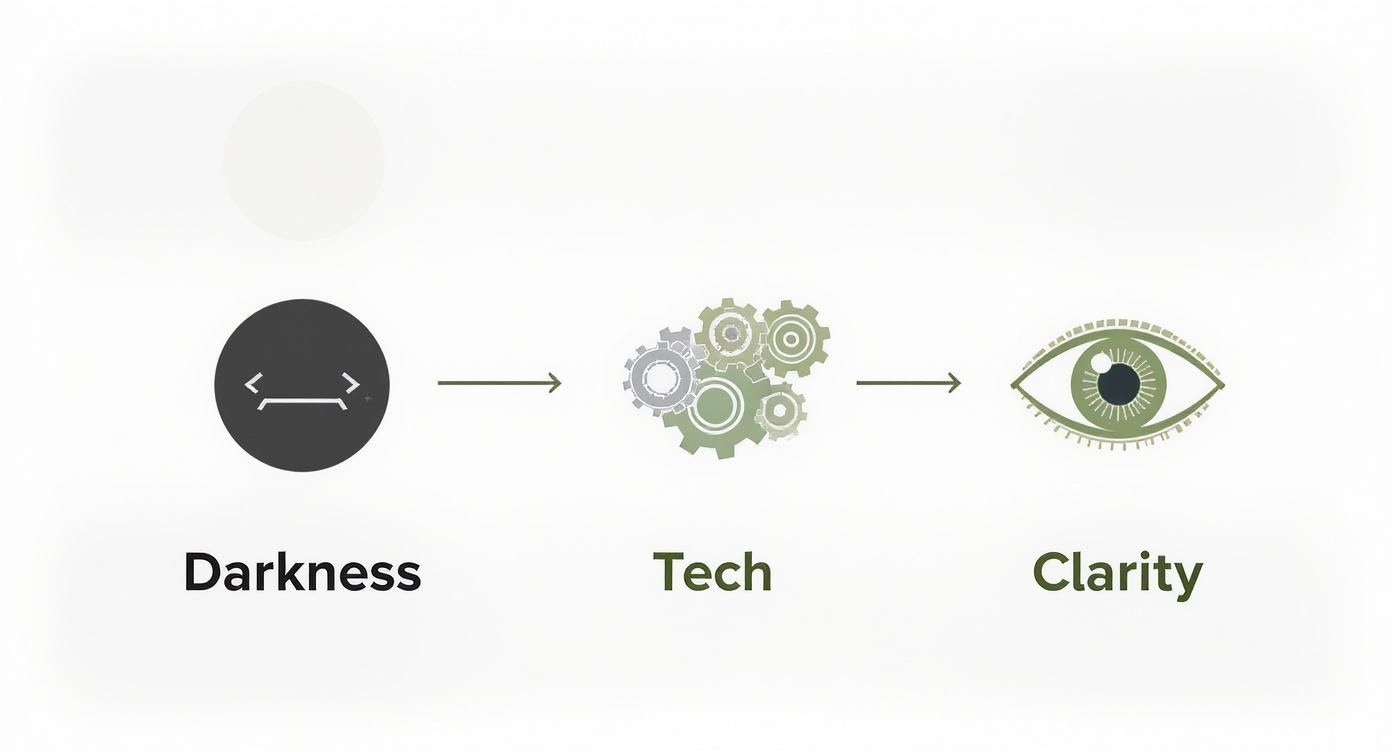
This diagram gives you a great visual of how complex technology turns invisible light into something our eyes can easily see and understand.
Multiplying the Signal with the MCP
Once they’re free, those electrons are zapped toward a critical component called the Micro-Channel Plate (MCP). Imagine a super-thin disc, almost like a wafer, that’s jam-packed with millions of microscopic glass tubes, all tilted at a slight angle.
Here’s where the amplification goes into overdrive. As a single electron enters one of these tiny channels, it hits the wall and knocks several more electrons loose. This creates a chain reaction, with the electron shower bouncing down the channel and growing exponentially. By the time it exits the other side of the MCP, that single electron has turned into thousands.
This is how a Gen 3 device achieves its massive light gain, typically between 30,000 to 50,000 times. It’s the reason the faint glow of a few stars can be amplified enough to light up an entire field with breathtaking clarity.
For the final step, this supercharged cloud of electrons is converted back into a picture we can see. The electrons fly out of the MCP and strike a phosphor screen, which lights up wherever an electron hits it. This creates that iconic green or white image you see through the eyepiece, effectively turning night into day.
The Ion Barrier Film: A Key to Longevity
One of the biggest breakthroughs in Gen 3 tubes was the addition of an ion barrier film. This ultra-thin protective layer is coated onto the MCP to solve a long-standing problem. During operation, stray positive ions can get pulled back toward the very sensitive photocathode, slowly damaging it and degrading the tube's performance over time.
The ion barrier film acts as a gatekeeper, blocking these damaging ions while letting the electrons pass through. It’s a simple concept, but it’s the main reason Gen 3 tubes last so long—boasting an operational life of over 10,000 hours, a huge leap from earlier generations. This innovation cemented Gen 3 as the gold standard for the U.S. military, delivering top-tier performance with the rugged durability needed for the field.
The exact type of film used can also tweak performance, which is where you hear terms like "thin-filmed" and "unfilmed" tubes. If you want to dive deeper into that, we wrote a detailed comparison of thin-filmed and unfilmed image intensifier tubes that breaks it all down. At the end of the day, it's this trifecta—a superior photocathode, massive amplification, and built-in protection—that makes Gen 3 technology the powerhouse it is today.
Key Metrics That Define Gen 3 Performance
When you start digging into night vision goggles generation 3, you'll quickly run into a spec sheet loaded with numbers and acronyms. These aren't just technical fluff—they're the real-world measurements of what you'll actually see through the eyepiece. Understanding these key metrics is how you cut through the marketing hype and get a true sense of a device's capability before you pull the trigger.

Think of it like buying a high-end camera. You wouldn't just look at the megapixel count; you’d want to know about sensor size and lens quality. Night vision specs work the same way, giving you the hard data on the sharpness, clarity, and overall quality of the image you’ll get in the dark.
Resolution: The Sharpness of Your View
Resolution is probably the easiest metric to grasp. It's measured in line pairs per millimeter (lp/mm) and tells you exactly how sharp the image will be. A higher lp/mm number means the tube can distinguish finer details, giving you a much crisper and more defined picture.
A device hitting 64 lp/mm or more is where you can start to easily identify targets at a distance, read signs, or pick out subtle textures in the environment. It’s the difference between seeing a blob in a field and knowing for sure it’s a coyote. Most solid Gen 3 tubes sit comfortably in the 64-72 lp/mm range.
Signal-to-Noise Ratio: Image Clarity in Darkness
If resolution is about sharpness, Signal-to-Noise Ratio (SNR) is all about cleanliness. This number measures the amount of "signal" (the actual light information) against the "noise" (the electronic static that looks like snow or grain in the image).
A higher SNR delivers a cleaner, less "sparkly" image, especially when you’re operating in near-total darkness. It’s like listening to the radio: a low SNR is a station buried in static, while a high SNR is a crystal-clear broadcast. For Gen 3, an SNR of 25 or higher is considered solid, with elite-level tubes pushing past 30.
A high SNR is absolutely critical for separating a target from a cluttered background in very low light. It also makes a huge difference in reducing eye strain over long nights and gives you the clean image needed for positive identification.
Figure of Merit: The Overall Performance Score
Figure of Merit (FOM) is a quick-and-dirty calculation that gives you a single number to judge a tube's overall performance. It's a simple formula, but a powerful one.
FOM = Resolution (lp/mm) x Signal-to-Noise Ratio (SNR)
This number lets you quickly compare the raw potential of different tubes. While you should always look at the individual specs, a higher FOM almost always means a better-performing tube. Quality Gen 3 devices start around a FOM of 1800, with some of the best units soaring past 2300. These specs are the foundation of performance, whether you prefer the traditional green phosphor look or are considering a different color palette. If you're curious about the visual differences, check out our guide on the advantages of white phosphor night vision.
To put this all into perspective, let's look at how Gen 3 stacks up against the previous generation.
Night Vision Generation Performance Comparison
| Performance Metric | Generation 2 (Typical) | Generation 3 (Typical) |
|---|---|---|
| Resolution (lp/mm) | 45 – 54 lp/mm | 64 – 72+ lp/mm |
| Signal-to-Noise (SNR) | 16 – 21 | 25 – 30+ |
| Figure of Merit (FOM) | 900 – 1100 | 1800 – 2300+ |
| Tube Lifespan (Hours) | ~5,000 Hours | 10,000+ Hours |
The table makes it pretty clear—the leap from Gen 2 to Gen 3 isn't just a small step, it's a massive jump in every key area. By understanding resolution, SNR, and FOM, you can look at any spec sheet and know exactly what you’re paying for.
Where Gen 3 Night Vision Shines in the Real World
While Gen 3 night vision was forged for the modern battlefield, its incredible performance has found its way into a host of other demanding fields. It turns out, the ability to see with sharp, clear detail in near-total darkness isn't just a tactical advantage—it's a game-changer for anyone who has to get the job done after sundown.
Whether you're in a sprawling wilderness or a dense urban jungle, this gear provides the critical edge needed to own the night. The superior light amplification and image clarity of Gen 3 directly translate to better situational awareness and safety. For people whose work can't afford failure in low light, this technology is less of a luxury and more of an essential tool.
Military and Law Enforcement
For soldiers and police officers, owning the night isn't just a goal; it's a requirement. Gen 3 devices are the standard-issue choice for these elite groups, giving them the visual information they need for surveillance, positive target identification, and navigating hostile terrain safely. That high signal-to-noise ratio means operators see a clean, crisp image, making it much easier to distinguish a real threat from a non-combatant.
This was famously put on display during the Gulf War back in the early '90s, where Gen 3 technology handed coalition forces a decisive advantage in nighttime combat. Today, autogated Gen 3 tubes allow an officer to move seamlessly from a pitch-black alley into the sudden glare of headlights without being blinded, maintaining tactical control of the situation. You can dig deeper into the historical impact of Gen 3 on military operations to really grasp its importance.
The arrival of Gen 3 completely changed the game, turning the cover of darkness from a liability into a powerful asset. Being able to see, move, and communicate when your adversary can't is a massive force multiplier.
Search and Rescue Missions
When someone goes missing in a remote area, the clock is always ticking, and the search doesn't stop just because the sun sets. For search and rescue (SAR) teams, Gen 3 night vision goggles are a genuine lifeline. These devices let crews scan huge, dark landscapes for any sign of a lost hiker or a survivor after a disaster.
The clarity Gen 3 provides means SAR personnel can spot a piece of clothing, the reflection off an emergency blanket, or subtle movement that would be totally invisible to the naked eye. This capability blows the operational window for a rescue mission wide open, dramatically increasing the odds of finding someone in time. It also keeps the rescuers themselves safer as they navigate treacherous ground in the dark.
Advanced Hunting and Wildlife Observation
Serious nocturnal hunters and wildlife biologists have come to rely on Gen 3 night vision for ethical and effective work. When you're hunting predators or invasive species like feral hogs, positive target ID is everything. The high resolution of Gen 3 ensures a hunter can absolutely confirm their target and what's beyond it before taking a shot. It's about safety and responsible wildlife management.
Beyond the hunt, this tech has unlocked a whole new world for observing nocturnal wildlife. Biologists and nature lovers can study animal behavior without flooding the area with artificial light and disturbing the very creatures they want to see. This allows for truly natural observation of elusive animals, helping us better understand their habits and ecosystems.
Civilian and Recreational Applications
The civilian market for high-performance night vision is growing fast, and people are finding all sorts of creative uses for it. For many, it's simply about pushing the boundaries of what's possible and seeing the world in a new light—or lack thereof.
-
Property Security: Landowners with big properties can use Gen 3 goggles to check for trespassers or predators without giving away their position with a flashlight beam.
-
Nocturnal Astronomy: Stargazers are discovering that night vision can seriously amplify their view of the cosmos, revealing faint nebulae and star clusters that are normally invisible.
-
DIY Builders and Enthusiasts: There's a whole community of hobbyists who love building their own night vision devices. They take high-quality Gen 3 tubes and create custom setups perfectly suited to their needs, from helmet-mounted monoculars to full binocular systems.
From saving lives to pursuing a passion, the real-world uses for Generation 3 night vision are as varied as they are vital, proving its worth far beyond its military origins.
Choosing Your First Gen 3 Night Vision Setup
Getting into Gen 3 night vision is a huge step, but it’s about more than just buying a cool piece of gear. You’re not just picking a device; you’re building a system. A top-tier goggle is only as effective as the helmet and mount supporting it, so thinking through the entire setup is key to protecting your investment and getting the performance you paid for.
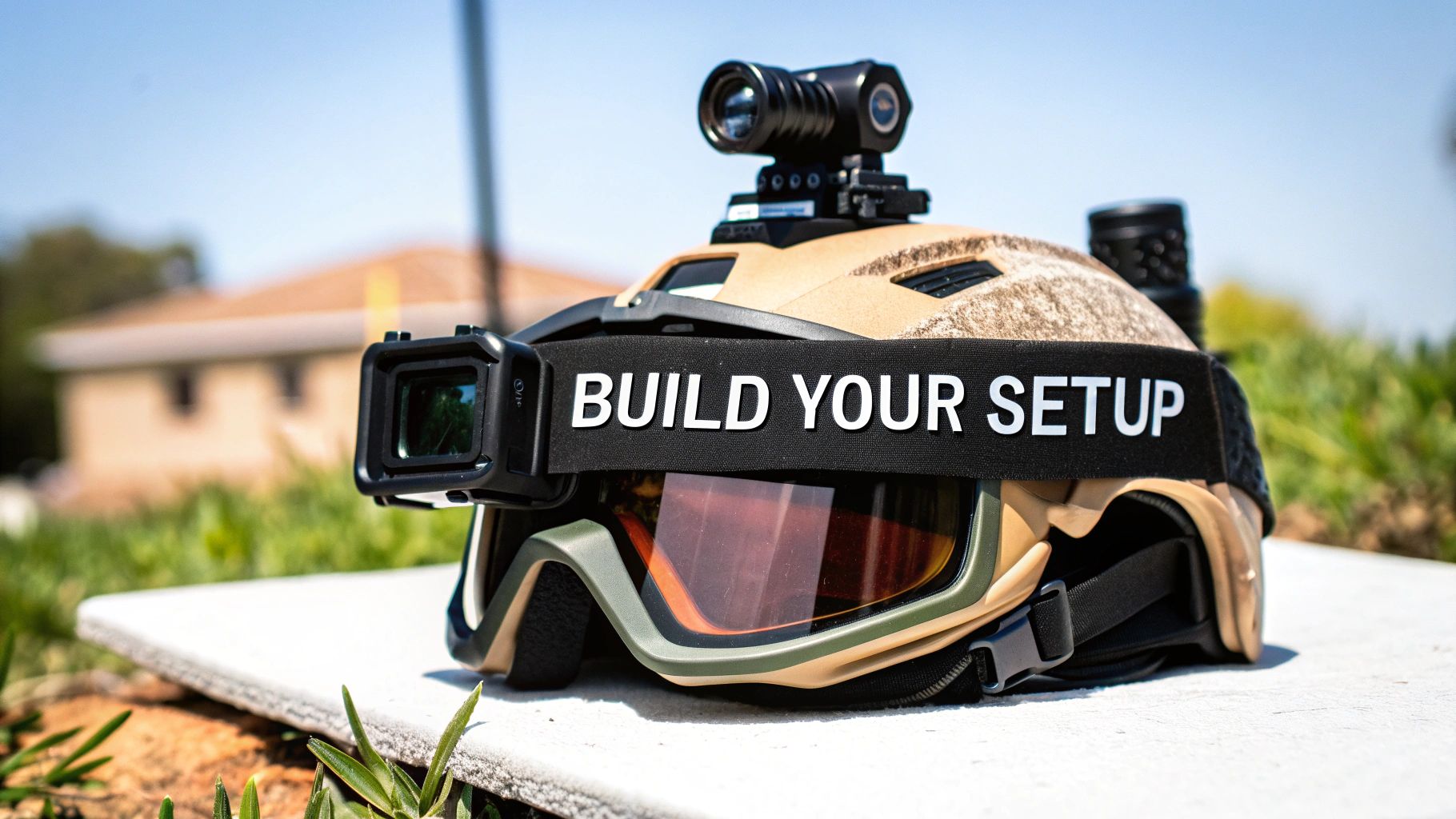
The first step is always to figure out what you really need. Are you a hunter scanning wide-open country, or do you need a hands-free system to move through tight, enclosed spaces? Knowing your primary use case will steer every decision you make and help you build a kit that’s ready for anything you throw at it.
Building Your System From the Ground Up
Believe it or not, the foundation of a solid night vision rig isn't the goggle—it's the helmet. A stable, comfortable helmet is absolutely non-negotiable for any kind of hands-free use. If your mount is wobbly or the helmet fits poorly, you'll get image shake and eye strain, which completely tanks your experience and wastes the incredible clarity of a Gen 3 tube.
Here are the absolute essentials for your core setup:
-
A Quality Helmet: Don't skimp here. A good ballistic or bump helmet provides a secure and stable platform for everything else.
-
A Mount and Shroud: This is the hardware that connects your NVD to the helmet. Go with a reputable brand to get tight tolerances that kill any wobble and allow for fine-tuning the fit.
-
The Night Vision Device (NVD): This is the main event—your Gen 3 monocular or binocular. The spec sheet is important, but don't overlook things like cosmetic blemishes. A "blemished" tube can save you a ton of money while still delivering outstanding performance.
-
Counterweights: A PVS-14 hanging off the front of your helmet gets heavy, fast. A counterweight pouch on the back balances the load and makes hours-long ops far more comfortable on your neck.
Understanding Cosmetic Blemishes
When you start shopping for image intensifier tubes, you'll see terms like "Zone 1," "Zone 2," and "Zone 3." These zones map out the viewing area and identify where tiny black spots, or "blems," from the manufacturing process might be located.
-
Zone 1: The dead center of your view. A blem here is the most distracting.
-
Zone 2: The ring between the center and the outer edge.
-
Zone 3: The very outermost edge of your field of view.
The reality is, tons of excellent tubes have minor blems in Zone 2 or 3 that you will never notice in the field. Choosing a tube with a few acceptable blems is one of the smartest ways to get into a high-FOM Gen 3 night vision goggle without maxing out your credit card.
Newcomers often get hung up on finding a perfectly "clean" tube. Here's a pro tip: a tube with a few tiny blems on the outer edge but a monster spec sheet will almost always outperform a flawless tube with mediocre resolution and SNR.
Essential Accessories to Complete Your Kit
With your core system built, a few key accessories will protect your gear and unlock its full potential. Think of these less as "add-ons" and more as mission-critical components.
First up is an IR illuminator. Gen 3 is incredible in low light, but it can't make light out of nothing. In places with zero ambient light—think deep caves or windowless rooms—you're blind. A good IR illuminator works like a powerful flashlight that only your NVD can see, letting you cut through total darkness.
Next, a sacrificial lens is non-negotiable. It's a cheap, clear filter that screws onto the front of your very expensive objective lens, protecting it from scratches, dust, and impact. Would you rather replace a $20 piece of glass or a $1,000 objective lens? The choice is pretty simple.
Finally, get in the habit of carrying spare batteries. It's basic, but it's critical. By carefully picking each part of your system, you can build a complete and reliable night vision goggles generation 3 setup that's perfectly tuned for whatever you do.
Protecting Your Investment with Proper Care
A set of night vision goggles generation 3 is a serious piece of equipment, and it's a significant financial commitment. Just like any other high-performance tool, its longevity and reliability hinge entirely on how you treat it. Proper care ensures your NVD will be ready to perform for its entire lifespan, which can easily top 10,000 hours of operation.
The most common task you'll face is cleaning the lenses, and this needs to be done carefully to protect the delicate optical coatings. Never, ever use a dry cloth or the corner of your t-shirt. Always start by blowing off any loose dust and grit with a lens puffer or some canned air. After that, use a dedicated lens pen or a fresh microfiber cloth with a drop of quality lens cleaning solution, wiping gently in a circular motion.
Smart Storage and Battery Habits
How you store your device and manage its batteries is just as crucial as keeping the lenses clean. Getting lazy here can lead to permanent damage over time, effectively turning your high-tech investment into a very expensive paperweight.
A few simple habits can make all the difference:
-
Remove the Battery: Always take the battery out before putting your NVD away, even if it's just for a few days. A leaking battery can cause catastrophic corrosion that is often beyond repair.
-
Use a Hard Case: Keep your unit stored in a padded, waterproof hard case. This shields it from moisture, dust, and the kind of bumps and drops that can knock optics out of alignment or crack the housing.
-
Avoid Extreme Temperatures: Don't leave your night vision gear baking in a hot car or freezing in an unheated garage. Big temperature swings are tough on the internal components and seals.
Following these steps is your first and best line of defense in keeping your equipment mission-ready.
The Importance of a Strong Warranty
Even if you do everything right, sometimes things just go wrong. This is where a solid warranty proves its weight in gold. A vendor who truly stands behind their product offers more than just a sale; they offer peace of mind and protection from expensive, out-of-the-blue problems.
A strong warranty is more than just a piece of paper; it’s a direct reflection of a company's confidence in its own products and its commitment to you, the customer. It's what separates a true gear partner from a simple box-shover.
This philosophy is why we back every single Gen 3 device with a 10-year warranty. Here at Superior Tactical, we also handle all diagnostics and repairs in-house. That means if a problem ever does pop up, you’re talking directly to the experts who built and understand the gear inside and out. This kind of post-purchase support is a critical part of your investment, guaranteeing your night vision goggles generation 3 will remain a reliable tool for years to come.
Gen 3 Night Vision: Your Questions Answered
Alright, let's dig into some of the most common questions we get about Gen 3 night vision. Getting straight answers to these is key, especially before you decide to invest your hard-earned money into a high-end device.
Can a Civilian Legally Own Gen 3 Night Vision?
Absolutely. Here in the United States, it is 100% legal for any civilian to own and use Generation 3 night vision.
The major catch is that these devices fall under the International Traffic in Arms Regulations (ITAR). This means you cannot take or ship them outside of the U.S. without getting a specific license, which is a serious process. For this reason, always stick to reputable, U.S.-based dealers.
What Is the Difference Between Green and White Phosphor?
The real difference comes down to the color of the image you see through the eyepiece. Green phosphor is that classic, iconic "night vision green" you see in movies and video games.
White phosphor, on the other hand, gives you a black-and-white image. Many operators find this looks more natural and causes less eye strain over long periods of use. While performance is nearly identical between the two, the choice really boils down to personal preference. Just be aware that white phosphor units typically cost a bit more.
Autogating is a must-have feature for any serious user. It acts like a high-speed dimmer switch, protecting the tube from bright light and ensuring you always maintain a clear, usable image in dynamic lighting conditions.
Ready to build your own professional-grade night vision setup? Superior Tactical LLC offers a curated selection of high-performance Gen 3 devices, mounts, and accessories backed by a 10-year warranty and in-house expert support. Explore our full catalog and get mission-ready today.
