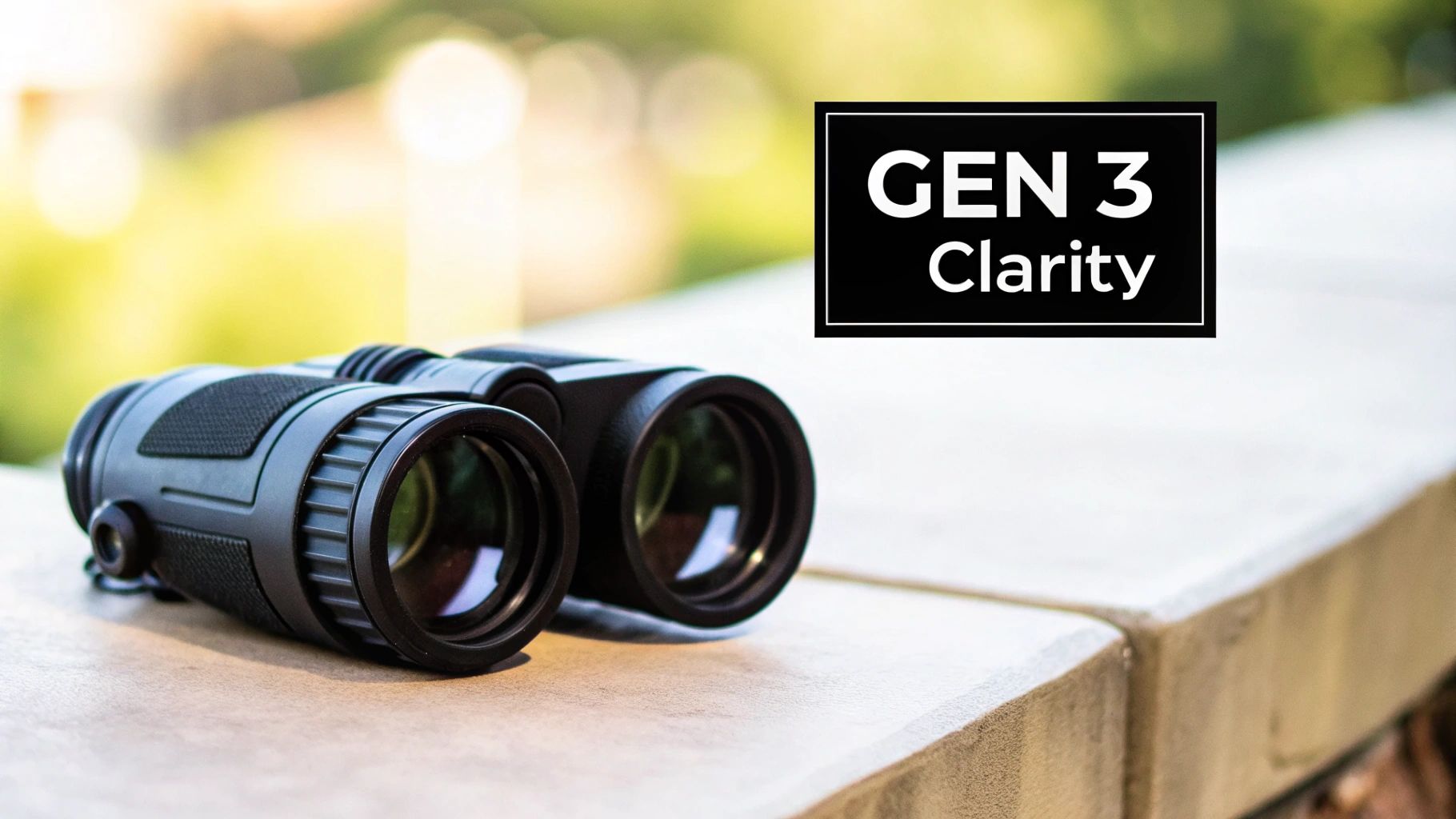
Night Vision Binoculars Gen 3 A Complete Hands-On Guide
Generation 3 night vision binoculars represent the pinnacle of professional-grade, low-light observation. They're built around a highly advanced image intensifier tube that delivers an incredibly clean and bright picture, even when it seems pitch black to the naked eye. For anyone who absolutely needs to see clearly when the lights go out, Gen 3 is the standard.
The Gold Standard in Night Vision Technology
When you hear seasoned professionals talk about top-tier night vision, they're talking about Gen 3. The performance jump from older generations isn't just a minor improvement; it's a massive leap. Imagine switching from an old standard-definition TV to a brand new 4K Ultra HD display—everything is suddenly sharper, clearer, and packed with detail.
That incredible boost in quality all comes down to one critical component: the Gallium Arsenide (GaAs) photocathode. The photocathode is essentially the device's retina. While older generations used materials that struggled to collect light, the GaAs photocathode in a Gen 3 tube is exceptionally good at its job, converting the faintest traces of photons (light) into electrons (an electrical signal). This high efficiency is what allows it to build a bright, crisp image from minimal ambient light like starlight.
To put the differences into perspective, here's a quick comparison of how night vision technology has evolved.
Night Vision Generations at a Glance
| Feature | Gen 1 | Gen 2 | Gen 3 |
|---|---|---|---|
| Photocathode | S-20 | S-25 | Gallium Arsenide (GaAs) |
| Light Amplification | ~1,000x | ~20,000x | 30,000-50,000x |
| Image Quality | Distorted at edges, requires IR | Clearer, less distortion | Sharp, clean, high-contrast |
| Tube Lifespan | ~1,500 hours | ~2,500-5,000 hours | 10,000+ hours |
| IR Illuminator | Almost always required | Needed in very low light | Rarely needed (passive) |
As you can see, Gen 3 isn't just a small step forward; it's a complete game-changer in terms of performance and reliability.
Why Professionals Choose Gen 3
First developed for the U.S. military in the 1980s, Gen 3 technology was a monumental breakthrough. By swapping older photocathode materials for Gallium Arsenide, these devices became roughly ten times more effective at gathering light. This upgrade allows modern night vision binoculars gen 3 to amplify available light by an astonishing 30,000 to 50,000 times. You can read more about this technological evolution on Alpha Optics.
This level of performance isn't just about seeing farther; it's about seeing better. Two key specs really define this superiority:
- Signal-to-Noise Ratio (SNR): Think of this as a measure of image clarity. A high SNR delivers a crisp view with very little of the "static" or electronic snow you see in lower-quality units, which is critical for identifying targets at a distance.
- Figure of Merit (FOM): This is a quick-and-dirty calculation (resolution multiplied by SNR) used to gauge a tube's overall performance. A higher FOM number almost always means a better, more capable device.
The real magic of Gen 3 is its ability to produce a high-quality image without needing an active infrared (IR) illuminator. Being able to operate passively is non-negotiable in tactical situations where giving away your position isn't an option.
In the end, it’s the combination of a hyper-sensitive GaAs photocathode and outstanding image quality that makes Gen 3 the undisputed choice for those who can't afford to compromise. It's the technology trusted by military operators, law enforcement, and serious civilian users to own the night.
How Gen 3 Tubes Turn Night into Day
At the heart of any Gen 3 night vision binocular is the image intensifier tube. It's a marvel of physics packed into a tiny cylinder, and its job is to grab the faint, invisible light from a dark scene and amplify it into a bright, detailed image you can actually see.
To really get what's happening, let's follow a single particle of light—a photon, maybe from a distant star—on its journey through the tube. This whole trip happens in a flash, but it’s what gives you the power to see in the dark.
Step 1: The Photocathode Catches the Light
As soon as that photon passes through the objective lens, it slams into a special surface called the photocathode. In a Gen 3 tube, this isn't just any old material; it's made from Gallium Arsenide (GaAs). This stuff is incredibly sensitive to light, especially the near-infrared energy that's all around us at night, even when our eyes can't see it.
Think of the photocathode as a solar panel for photons. When our single photon hits the Gallium Arsenide, it gives up its energy and kicks out a single electron. That's it. One photon in, one electron out. This swap from light energy to electrical energy is the first critical step.
The secret sauce behind Gen 3's amazing low-light performance is that Gallium Arsenide photocathode. It's just way better at converting photons to electrons than the materials in older generations, meaning it can work its magic with far less available light.
But one electron is useless for creating an image. It’s just a tiny blip of electrical charge. The real magic, the amplification, happens next.
Step 2: The Micro-Channel Plate Multiplies the Signal
That brand-new electron is immediately pulled toward the Micro-Channel Plate (MCP). Imagine an incredibly thin glass wafer, maybe a millimeter thick, that's been drilled through with millions of microscopic, angled tunnels. It's essentially a honeycomb for electrons, designed to multiply them on a massive scale.
When our electron zips into one of these tiny channels, it smacks against the wall. The impact is hard enough to knock loose a few more electrons. These new electrons are then pulled down the channel, where they also hit the walls, freeing up even more electrons.
It’s a chain reaction, an avalanche happening on a microscopic level.
- One electron goes in.
- It hits the channel wall, releasing three or four new electrons.
- Each of those electrons hits the wall, releasing more.
- By the time this cascade bursts out the other side, that single starting electron has been turned into tens of thousands.
The MCP is the engine of the whole system. It provides the raw power, or "gain," that makes the image so bright. To keep this engine running smoothly for years, Gen 3 tubes have a protective ion barrier film. This ultra-thin layer shields the photocathode from being damaged by rogue ions, which is a big reason why Gen 3 tubes are known for their incredible lifespan of over 10,000 hours. If you want to dive deeper into tube specs, check out our guide on how to choose the best Gen 3 Elbit image intensifier tube.
Step 3: The Phosphor Screen Makes It Visible
Once the amplified cloud of electrons exits the MCP, it shoots across a tiny vacuum gap and collides with the phosphor screen. This screen is coated with a material that does one simple thing: it glows when electrons hit it.
This is the final translation. The electrical energy is turned back into visible light.
The bright, detailed green or white image you see when you look through the eyepiece is that phosphor screen lighting up. Every tree, every shadow, every target is a perfect reconstruction of the original scene, just amplified thousands upon thousands of times.
Translating Tech Specs into Real-World Performance
Looking at a spec sheet for Gen 3 night vision binoculars can feel like trying to read a foreign language. All those numbers and acronyms don't mean much until you understand how they affect what you actually see on a moonless night. Let's break down what these critical metrics really mean for your ability to own the dark.
These specs aren't just arbitrary figures; they're the DNA of your device. They directly measure how well the internal image intensifier tube can take nearly invisible light and turn it into a crisp, clear picture. We'll focus on the ones that matter most.
The entire process, from a single photon of light entering the lens to a visible image appearing in the eyepiece, is a little bit of technological magic. This diagram gives you a simplified look at how it all happens inside a Gen 3 tube.
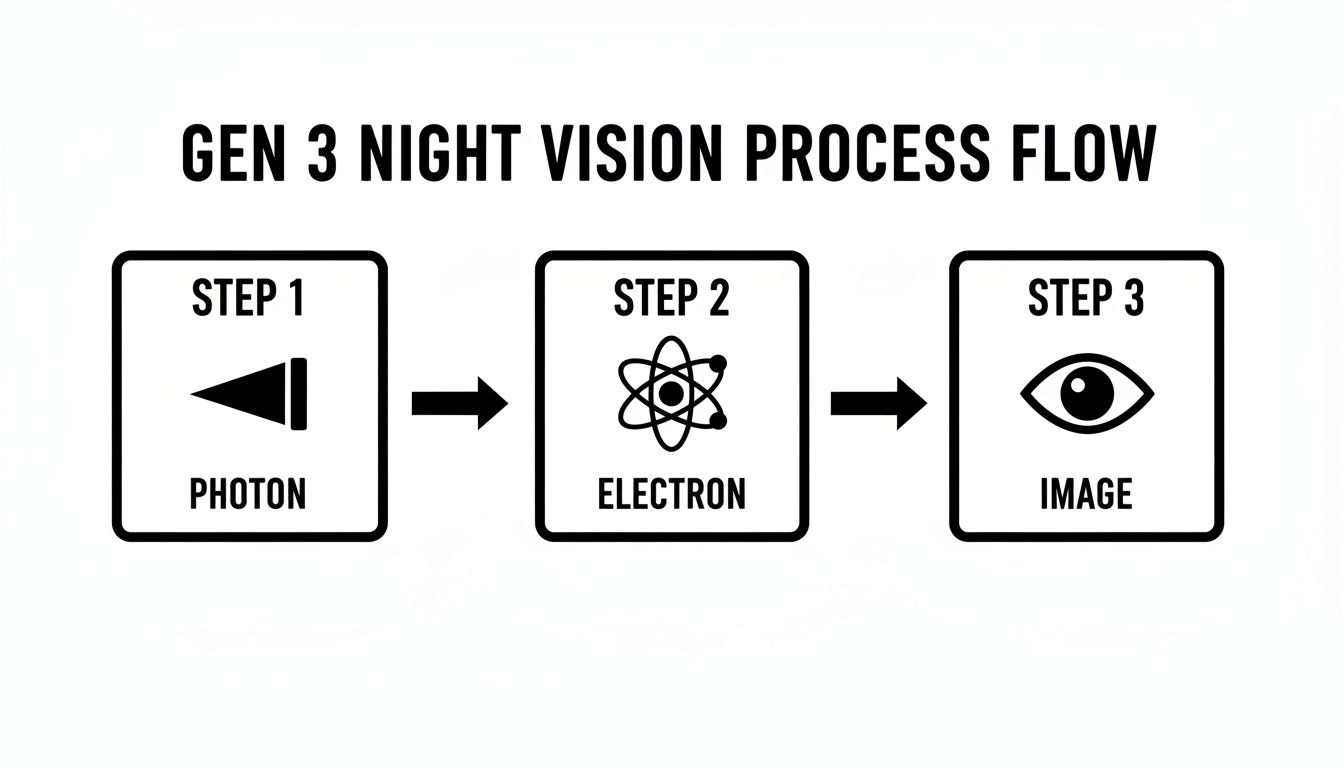
This incredible journey is what every technical specification on that sheet is designed to measure and perfect.
Decoding Signal-to-Noise Ratio (SNR)
If you only pay attention to one spec, make it the Signal-to-Noise Ratio, or SNR. This is, without a doubt, the most important number for judging how well a tube will perform when light is scarce.
Think of it like tuning an old radio. The "signal" is the clear music you want to hear, and the "noise" is that annoying static and hiss that gets in the way. A higher SNR means you get a much cleaner image with less of that distracting electronic "snow." This is absolutely critical on a cloudy night or deep in the backcountry, where every photon counts. A tube with an SNR of 25 or higher gives you a massive advantage, letting you positively identify targets at much greater distances.
Understanding Resolution in lp/mm
Resolution, measured in line pairs per millimeter (lp/mm), is all about the sharpness and detail of the image. It’s the difference between seeing a blurry shape and being able to count the points on a buck’s antlers.
High-quality Gen 3 tubes will typically have a resolution of 64 lp/mm or higher. This is the kind of detail that allows a law enforcement officer to distinguish a cell phone from a weapon, or a hunter to spot a coyote hiding in the brush. The more line pairs, the more fine detail you can resolve from far away.
The Critical Role of Autogating
Imagine you’re scanning a dark field and a car suddenly crests a hill, blasting its high beams right at you. Without protection, that sudden burst of light can cause the image to bloom into a blinding white-out. That’s where autogating saves the day.
Autogating is a protective feature that acts like an incredibly fast set of sunglasses for your tube. It instantly throttles the power supply in a fraction of a second, preventing damage and preserving your vision. The moment the bright light is gone, it returns to full performance. For anyone operating in dynamic environments with unpredictable light sources—think urban settings or tactical scenarios—this is a non-negotiable, must-have feature.
Green vs. White Phosphor
The final piece of the puzzle is the color of the image you see. For decades, the iconic "night vision green" was the only game in town. Now, many premium Gen 3 tubes are available with white phosphor, which produces a black-and-white image that looks a lot like a crisp grayscale photo.
So, which one is better? It really comes down to personal preference.
- Green Phosphor: Our eyes are naturally very sensitive to shades of green, which can make it feel more comfortable and less fatiguing during long observation sessions. It’s the proven, reliable standard.
- White Phosphor: Many users find that the black-and-white image provides superior contrast and a greater sense of depth. It can make it easier to pick out subtle details and textures, especially against man-made backdrops.
While it’s a subjective choice, white phosphor is now widely seen as the premium option. Of course, even the best tube can't create light out of thin air. In situations with zero ambient light, you’ll need an external infrared light source. If you're looking to complete your setup, our guide on choosing an infrared illuminator for night vision will help you find the perfect match.
Making the Right Choice for Your Mission
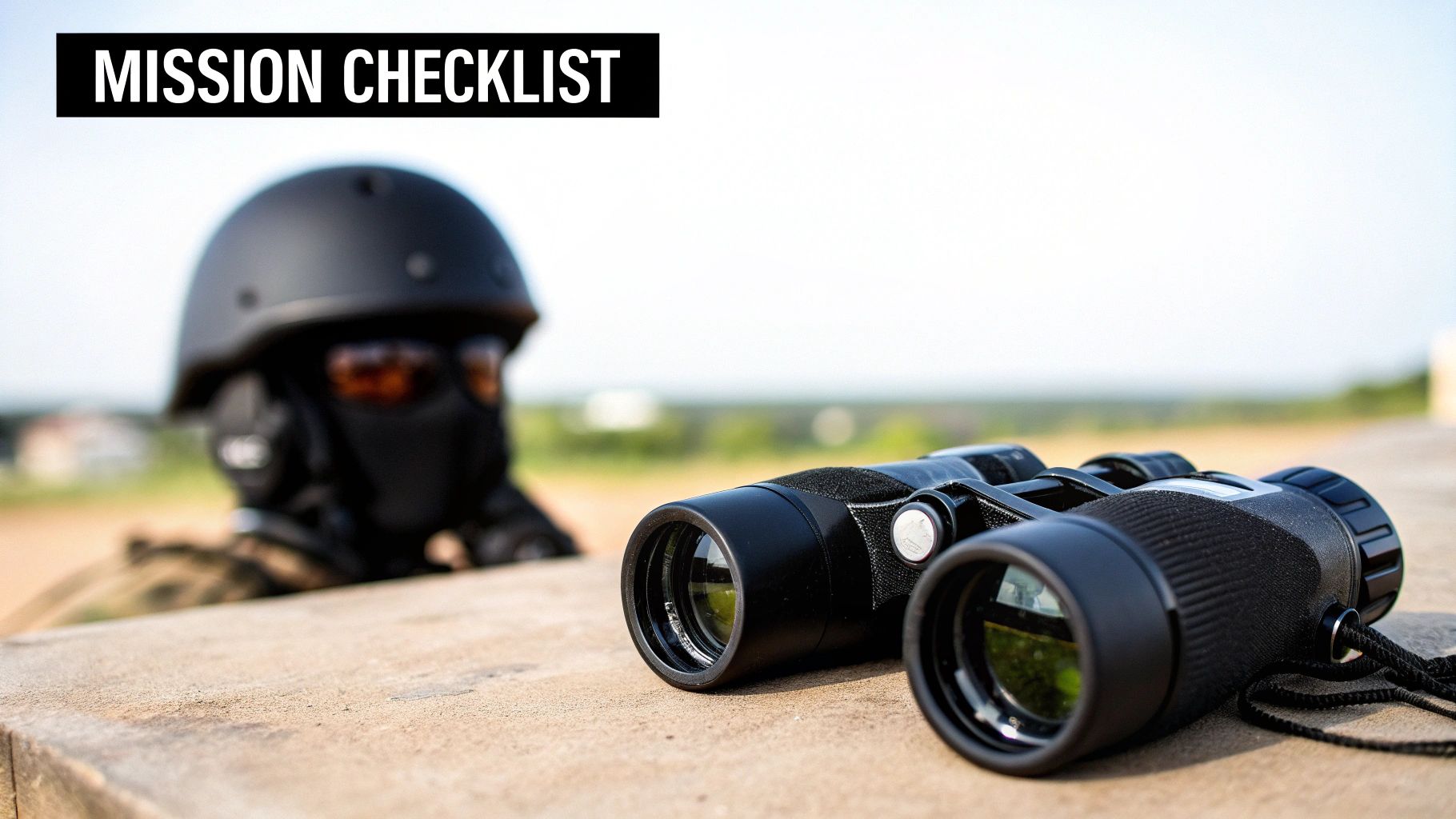
Picking out the right pair of night vision binoculars gen 3 isn't just about chasing the highest specs on a datasheet. It’s about making a series of smart choices to match the gear to your specific needs, your environment, and your budget. When you step up to Gen 3, you're faced with a few key decisions that will have a real-world impact on how the device performs when you need it most.
The first major fork in the road is a big one: do you go with a dual-tube binocular setup or a single-tube monocular? Each has its own distinct pros and cons, and what’s right for one person might be completely wrong for another. Let's break it down.
H3: Form Factor: Binos vs. Monos
So, what’s the real-world difference between having one tube or two? It all comes down to how your brain sees the world.
A true dual-tube binocular setup, with a separate image intensifier tube for each eye, gives you something a monocular never can: stereoscopic vision. This is just a fancy way of saying you get genuine depth perception. It’s an absolute game-changer for navigating tricky terrain at night, driving a vehicle, or trying to judge the distance to a target. Your brain gets two slightly different images and fuses them into a single 3D picture, just like it does in the daytime.
Of course, that second tube adds weight to your helmet and a significant cost to your wallet.
A monocular, on the other hand, is a much simpler beast. It uses a single tube, leaving your other eye free to adapt to the ambient light. This is great for keeping your situational awareness, as you can quickly transition from looking through the device to scanning your immediate surroundings. They're also lighter and much easier on the bank account. The big trade-off? A total loss of depth perception. You’re looking at a flat image, which can make moving around and judging distances a real challenge until you get used to it.
To make this choice clearer, let's compare them side-by-side.
Dual-Tube Binoculars vs. Monocular Systems
| Factor | Dual-Tube Binoculars | Single-Tube Monocular |
|---|---|---|
| Depth Perception | Excellent. Provides true stereoscopic vision for natural 3D viewing. | None. The image is flat, making distance judgment difficult. |
| Situational Awareness | Good. Your entire field of view is under night vision. | Excellent. One eye remains adapted to ambient light for quick transitions. |
| Weight | Heavier. The added tube and housing increase helmet load. | Lighter. Less neck strain and a more minimalist setup. |
| Cost | Significant investment. Two high-performance tubes are expensive. | More affordable. The single most expensive component (the tube) is halved. |
| Primary Use Case | Navigating, driving, and tasks requiring spatial judgment. | Observation, budget-conscious setups, and uses where one eye needs to be free. |
Ultimately, the decision boils down to your primary mission. If you’re on the move, the depth perception from a binocular is almost a necessity. For more static roles or if budget is the main driver, a monocular is a fantastic and capable tool.
H3: Housing: Articulating vs. Fixed
If you’ve settled on a dual-tube system, your next choice is the housing. This is the chassis that holds the tubes and optics, and it primarily comes in two flavors: fixed and articulating.
A fixed housing is exactly what it sounds like—both optical pods are locked in place. Think of the classic AN/PVS-7. These are often tough and simple, but they lack flexibility.
Articulating housings are the modern standard for a reason. They allow each optical pod to pivot up and out of your line of sight independently. This offers a few huge advantages:
- Low-Profile Stowage: You can fold the unit tightly against your helmet, reducing its profile so it doesn't snag on branches or door frames.
- Added Versatility: You can flip one pod up and run the unit as a monocular. This is perfect for when you need to use a weapon-mounted optic with your unaided eye.
- Better Ergonomics: The ability to adjust each pod individually makes it much easier to get a perfect, comfortable fit.
For anyone investing in a high-end set of binos, an articulating housing is a massive quality-of-life upgrade. If you want to dive deeper, check out our comprehensive guide on how to choose the right night vision device for your needs.
H3: Tube Type: Thin-Filmed vs. Unfilmed
The final, and arguably most important, decision comes down to the heart of the system: the image intensifier tubes. Gen 3 tubes are typically categorized as either thin-filmed or unfilmed.
Most standard Gen 3 tubes are “thin-filmed.” They have a protective aluminum oxide ion barrier coating on the Micro-Channel Plate. This film is a workhorse, protecting the photocathode from ion feedback and giving the tube its incredible 10,000+ hour lifespan.
“Unfilmed” tubes (sometimes called Gen 3+ or Filmless) do away with this protective barrier. By removing it, more electrons can reach the MCP, which bumps up the Signal-to-Noise Ratio (SNR) and delivers truly breathtaking performance in near-total darkness.
So what's the catch? This peak performance comes at the cost of a theoretically shorter lifespan, although modern unfilmed tubes are still exceptionally durable. The visual difference can be subtle, but for operators who need every last ounce of performance, unfilmed is the top of the mountain.
By thinking through these key areas—form factor, housing, and tube type—you can zero in on the exact night vision binoculars gen 3 system that will serve you best and ensure you're ready for whatever the night throws at you.
Where Gen 3 Night Vision Really Makes a Difference
The advanced tech packed into Gen 3 night vision binoculars isn't just about impressive numbers on a spec sheet. It's about having a real, decisive edge when the stakes are high. In situations where seeing clearly at a distance without giving away your position is everything, Gen 3 performance becomes an absolute necessity.
Think of it this way: these aren't just gadgets for seeing in the dark. They're force multipliers.
For police officers and military personnel, the advantages are immediate and obvious. The high resolution and incredible Signal-to-Noise Ratio (SNR) mean an officer can positively identify a threat from a safe distance, telling the difference between a firearm and a cell phone in a dark alley. The ability to operate passively, without needing an IR illuminator that screams "I'm here," is critical for staying hidden during surveillance or a tactical approach.
In a fast-moving urban situation, autogating is a game-changer. It keeps an officer from being blinded by sudden headlights or a flashlight, meaning they never lose situational awareness when it matters most.
For Hunters and Wildlife Experts
Serious hunters and wildlife biologists depend on Gen 3 for one simple reason: it lets them observe animals ethically and effectively. The sheer light amplification means they can often work under faint starlight, completely ditching the IR illuminator that would otherwise spook skittish nocturnal animals. This is huge for getting accurate population counts, studying natural behavior, and ensuring ethical shot placement without disrupting the entire area.
With a good set of Gen 3 binos, a hunter can:
- Identify Species Accurately: Clearly distinguish a target from a non-target animal at hundreds of yards out, which helps prevent tragic mistakes.
- Assess Trophy Quality: The sharp detail from a 64+ lp/mm tube is enough to judge an animal's maturity and size from a safe distance.
- Navigate Safely: True dual-tube binoculars give you real depth perception, making it much safer and more natural to walk through rough terrain in the dark.
Specialized Professional Applications
The usefulness of Gen 3 extends far beyond tactical and hunting scenarios. It provides a critical capability in other specialized fields where failure to see in the dark can have serious consequences.
Take maritime navigation, for example. On a moonless night, a captain can use Gen 3 binoculars to spot unlit channel markers, small boats, or debris floating in the water, avoiding a potentially catastrophic collision. The technology punches through light haze and amplifies the faintest light, making it a vital piece of safety gear.
Search and Rescue (SAR) teams also find Gen 3 to be an indispensable tool. When every second counts, a high-performance optic can help a team member spot a lost hiker or identify a person in dense woods where cheaper devices would just show a wall of shadows. Even amateur astronomers have started using Gen 3, finding it reveals faint nebulae and distant galaxies that are totally invisible to the naked eye, opening up a whole new view of the cosmos. In every one of these cases, Gen 3 delivers the performance needed when the mission simply can't fail.
When you own a piece of gear like Gen 3 night vision binoculars, you’re not just buying a tool—you’re making a serious investment. And just like any high-performance equipment, it needs proper care and a clear understanding of the rules that come with it.
Keeping Your Gear in Top Shape
Think of it like owning a finely tuned rifle. You wouldn't just toss it in a closet after a day at the range. The same discipline applies here.
Proper care starts with the glass. The lenses are the heart of the system, so keep them pristine. Always reach for a dedicated lens pen or a fresh microfiber cloth with a good quality cleaning solution. Grabbing your t-shirt to wipe off dust is a fast track to creating tiny, permanent scratches that will ruin your view.
Battery hygiene is another big one. If you’re storing your binos for more than a few weeks, take the batteries out. Leaky batteries and corroded contacts can kill the sensitive electronics inside. When you’re not using them, a hard case in a cool, dry place is your best bet for protection against bumps, drops, and humidity.
The Fine Print: Understanding ITAR
Now for the serious part. Beyond keeping your gear clean, you need to know the laws. Generation 3 night vision is controlled under the International Traffic in Arms Regulations (ITAR), a set of U.S. government rules that control the export of defense-related technology.
This isn’t just legal jargon; it has real-world consequences for every owner. Because Gen 3 is considered military-grade, you can't just take it out of the United States. Getting an export license from the Department of State is a complex, often impossible process for a private citizen.
This means you absolutely cannot:
- Bring them with you on an international vacation or hunting trip.
- Ship them to a friend or buyer outside the U.S.
- Sell them to a non-U.S. citizen, even if they're currently in the States.
Don’t take ITAR lightly. The penalties for violations are severe, including massive fines and federal prison time. These rules exist to keep advanced U.S. technology from ending up in the wrong hands, and the government enforces them strictly.
When you buy a Gen 3 device, you become its custodian within U.S. borders. Protecting your investment is about more than just careful handling—it’s about respecting the critical legal lines that come with owning this level of technology.
Getting to the Point: Your Gen 3 Questions Answered
So, you're wondering if that leap to Gen 3 night vision binoculars is actually worth it when the stars are hidden and the moon is new. Is the price jump from Gen 2 just hype, or does it deliver a real, tangible advantage in the field?
For anyone who relies on their gear professionally, the answer is a clear yes. That extra cost buys you a massive performance boost—we're talking up to 50% better performance in near-total darkness and a light amplification increase of 30,000 to 50,000 times.
Another hot topic is the green vs. white phosphor debate. Think of it this way: the traditional green is famously easy on the eyes for hours of scanning, while white phosphor provides a crisp, grayscale image that many find more natural and detailed.
Ultimately, though, the secret sauce of Gen 3 is its Gallium Arsenide (GaAs) photocathode. This is what gives it such an edge in sensitivity, and when paired with autogating, it provides a stunningly clear image while protecting the tube from sudden flashes of light.
Your Top Questions, Answered Directly
Here are the most common questions we get from people weighing their options.
-
Is Gen 3 really worth the premium over Gen 2?
Absolutely, especially when conditions are poor. Under just starlight or heavy cloud cover, Gen 3 tubes produce a much brighter, cleaner image with significantly less noise or "scintillation." For law enforcement, serious hunters, and search and rescue teams, this translates directly to spotting targets from further away and identifying them with more confidence. -
What’s the real difference between green and white phosphor?
It boils down to personal preference and your environment. Green phosphor is the classic choice, and it's excellent for reducing eye fatigue during long nights of observation. White phosphor, on the other hand, often gives a greater sense of contrast and depth, which can be a huge help in urban settings or complex terrain. -
Can I use my night vision binos during the day?
Never. Exposing an active image intensifier tube to daylight, or even a bright indoor light, will cause immediate and permanent damage. You'll end up with burned-in black spots that ruin the tube. Always keep the daylight lens caps on and the unit turned off until you're in the dark.
"In dynamic environments where you're moving between light sources, the autogating in modern Gen 3 tubes isn't a luxury—it's essential for protecting your investment and maintaining a clear sight picture."
— Certified Night Vision Technician
Protecting your gear goes beyond just careful handling. It’s critical to remember that Gen 3 systems are regulated by ITAR (International Traffic in Arms Regulations). This means exporting them outside the United States without a proper license is illegal.
As for keeping your unit running, maintenance is simple. Use a microfiber cloth to keep your lenses clean, and always take the batteries out before storing it for an extended period. If you ever have an issue, units from Superior Tactical are covered by a 10-year warranty and can be sent in for free diagnostics and expert in-house repairs.
The Bottom Line on Gen 3
When every bit of light matters, Gen 3 night vision binoculars deliver an undeniable edge. If your work or passion demands the absolute best in clarity, range, and performance under the darkest skies, this technology is in a class of its own.
For an extra boost, consider pairing your binos with a quality, lightweight IR illuminator to really punch through the darkness.
Ready to see the night in a new light? Explore our Gen 3 systems at Superior Tactical LLC: https://superiortac.com
