Night Vision and Thermal Binoculars: Which to Choose?
The whole debate boils down to one simple question: do you need to see what’s out there, or do you just need to know that something is out there?
That’s the core of the night vision versus thermal decision. Night vision amplifies existing light to show you detail, letting you identify a person or read a sign. Thermal, on the other hand, detects heat signatures, making a warm body pop against a cool background, even in pitch-black darkness. It’s the difference between identification and detection, and your mission dictates which one you need.
Choosing Your Tactical Advantage: Night Vision or Thermal
Picking between night vision and thermal binoculars isn't about which one is "better." It's about which tool gives you the right advantage for the job at hand. Forget the spec sheets for a moment; we're going to break down how these optics actually perform when it counts.
Whether you're trying to spot a bedded-down buck in thick brush, clearing a building, or running a surveillance operation, the fundamental way these technologies work will make or break your success. Let’s get into what makes them tick.
How the Technology Works
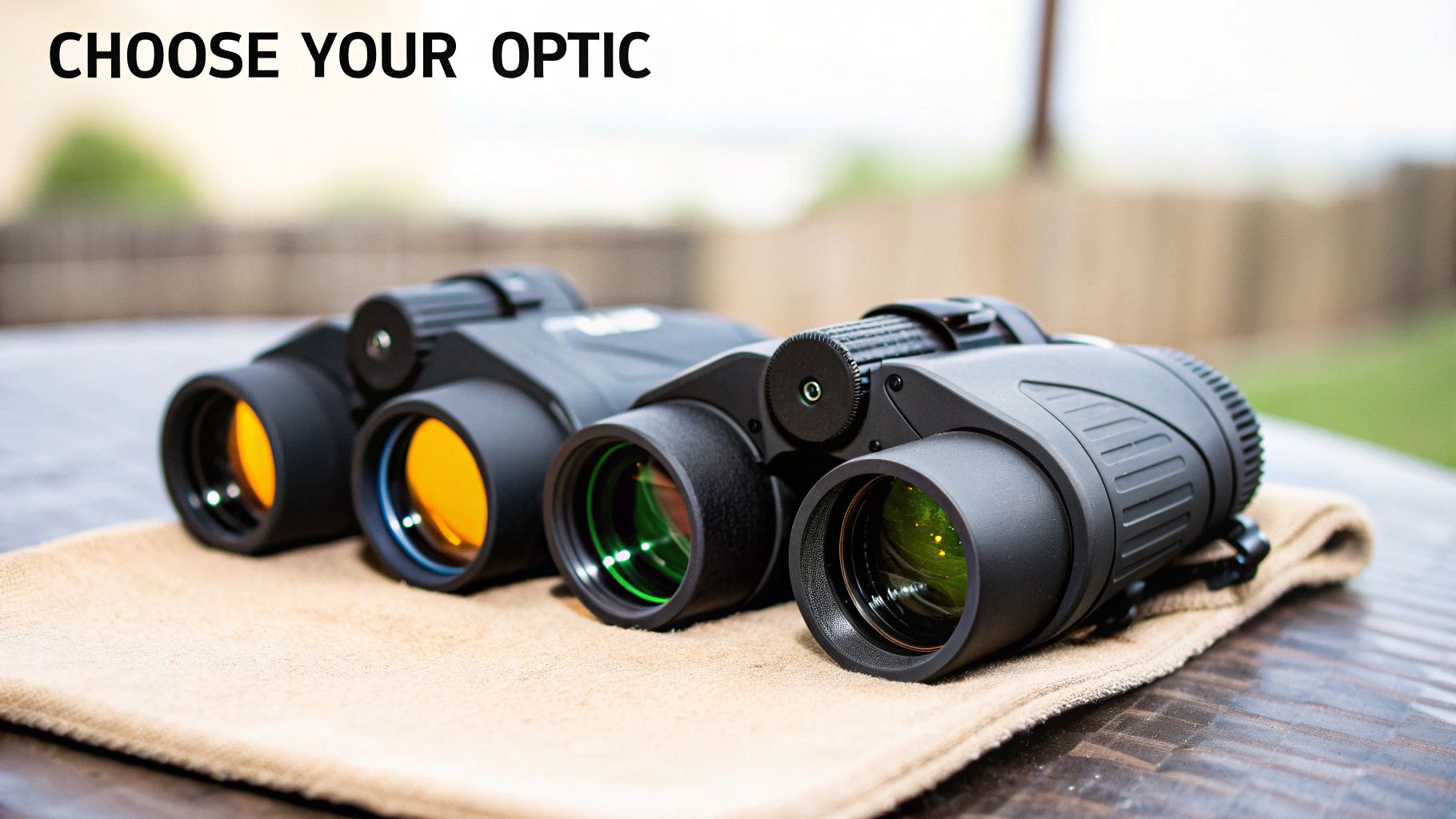
At a basic level, these two systems paint entirely different pictures of the world. Night vision devices are light amplifiers. They need some ambient light—even just starlight or a sliver of the moon—to work. An internal tube gathers these tiny amounts of light, multiplies them thousands of times, and projects a visible, detailed image.
Thermal imaging is a whole different ballgame. It doesn't care about visible light at all. Instead, it senses infrared radiation—heat. Every object emits some level of heat, and a thermal imager creates a visual map based on these temperature differences. That’s why a warm target stands out so clearly against the cooler environment, even through smoke, fog, or camouflage.
This is the single most important distinction between the two.
The Bottom Line: Night vision lets you see in the dark by making faint light brighter. Thermal lets you see through the dark by detecting heat.
The market for these devices is exploding, which tells you just how critical they've become. The global night vision sector is expected to hit USD 14.44 billion by 2031, growing at a steady 7.45% each year. This isn't just a military trend; it shows how essential both technologies are for security, law enforcement, and serious outdoorsmen. You can find more details in these night vision device market trends.
Quick Comparison: Night Vision vs. Thermal
To put it all in perspective, here's a straightforward breakdown. Think about your most common scenarios and see which column lines up better with your needs.
| Feature Comparison | Night Vision Binoculars | Thermal Binoculars |
|---|---|---|
| Primary Function | Amplifies ambient light | Detects heat signatures |
| Best For | Identification (seeing details) | Detection (spotting targets) |
| Light Requirement | Needs some ambient light | Works in complete darkness |
| Image Type | Detailed, monochromatic green/white | Heat map with color palettes |
| Sees Through Obscurants | No (impaired by smoke, fog, dust) | Yes (cuts through smoke, fog, dust) |
| Typical Use Cases | Navigation, facial recognition, reading text | Surveillance, tracking, search & rescue |
How Night Vision and Thermal Technology Work
Before you can pick the right tool for the job, you have to know how it actually works. While both night vision and thermal binoculars let you see in the dark, they get there in completely different ways. This isn't just a technical footnote; it’s the core difference that dictates what you can see, where you can see it, and how clearly you’ll see it.
One technology works by taking the tiniest bit of available light and cranking it up, while the other sees a world of heat that's completely invisible to our eyes. Grasping this distinction is the first and most critical step in matching the right gear to your mission.
Night Vision: The Science of Light Amplification
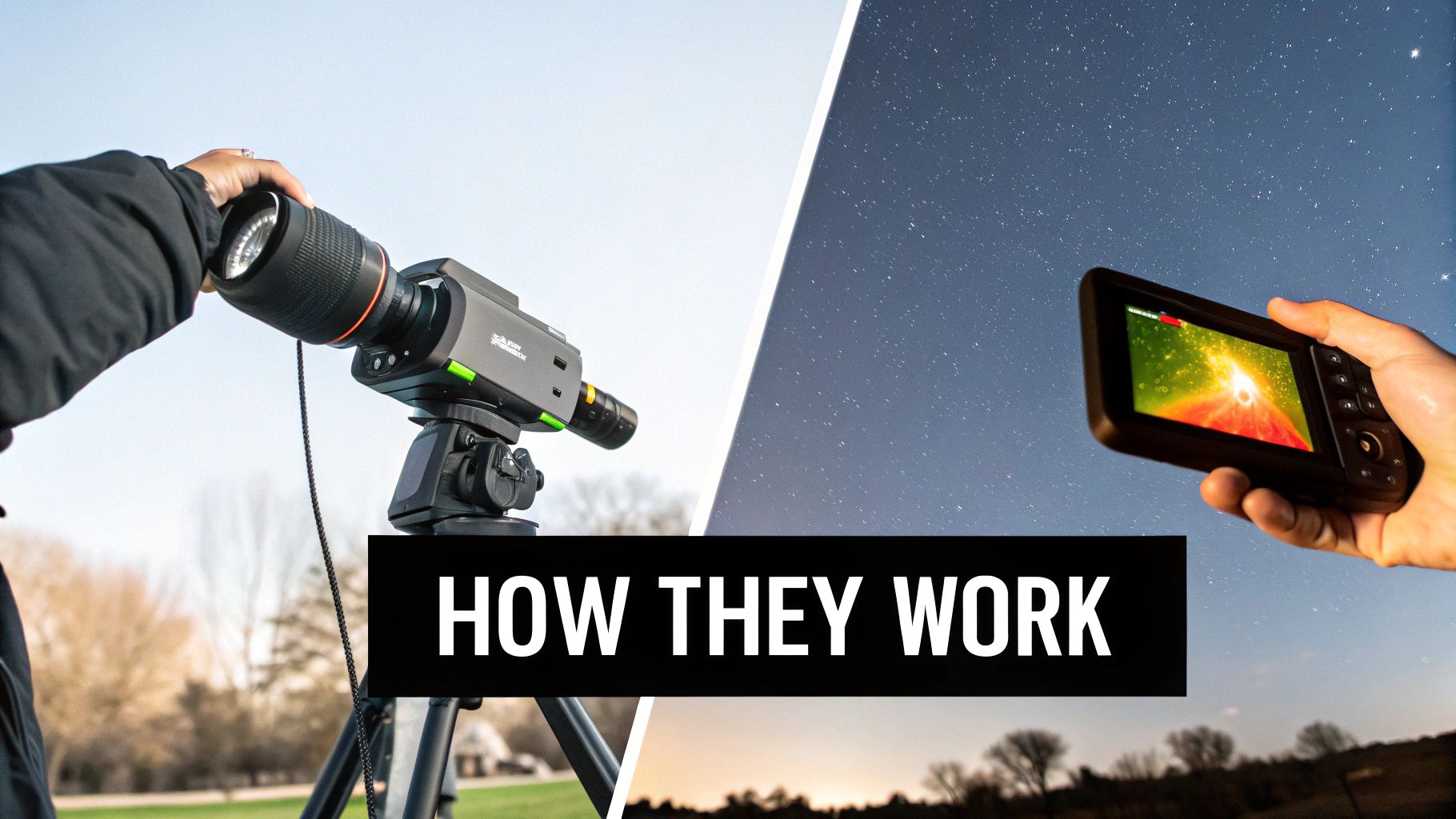
Night vision operates on a principle called image intensification. Think of it as a supercharger for your eyes. The device gathers incredibly faint traces of ambient light—from the moon, stars, or even distant city glow—that are far too weak for you to see on your own.
Inside the image intensifier tube, a lot happens in a split second:
- Gathering Photons: An objective lens pulls in these faint particles of light, called photons.
- Photons to Electrons: The photons hit a surface called a photocathode, which converts them into electrons.
- Multiplying the Signal: These electrons are then shot through a microchannel plate—a tiny disc packed with millions of microscopic channels. As they pass through, a chain reaction multiplies them thousands of times. A single electron can become 30,000 to 50,000 electrons in a high-quality Gen 3 tube.
- Creating the Image: Finally, this massive cascade of electrons strikes a phosphor screen, causing it to glow brightly. This creates the classic green or white-phosphor image you see through the eyepiece.
Because night vision amplifies reflected light, its biggest strength is showing you incredible detail. You can make out textures, patterns, and even facial features, making it the clear winner for positive identification and navigating terrain. For a much deeper dive, you can learn more about night vision technology and its various types in our detailed guide.
Thermal Imaging: The Art of Heat Detection
Thermal imaging, on the other hand, couldn’t care less about visible light. It works by detecting infrared radiation—the heat that every object with a temperature above absolute zero gives off. Your thermal binoculars are essentially painting a picture based on a detailed heat map of your surroundings.
This technology relies on a sensor called a microbolometer. Each pixel on this grid measures the temperature of whatever it’s looking at, and a processor assigns a color or shade of gray based on that heat reading. The result is a thermogram, an image where warmer objects pop against cooler backgrounds.
The game-changing advantage of thermal is its ability to work in zero-light conditions. Because it sees emitted heat, not reflected light, it can cut through total darkness, smoke, fog, and even light brush that would leave a night vision device completely blind.
This makes thermal optics unbeatable for pure detection. A living creature or the warm engine of a truck radiates a bright heat signature that’s impossible to miss. The trade-off? Because it only sees heat, it can’t render the fine details needed for identification. You'll see the heat signature of a person from 500 yards, but you won't be able to recognize their face.
How They Differ in Practice
| Technology | Core Principle | Primary Advantage | Key Limitation |
|---|---|---|---|
| Night Vision | Light Amplification | Detailed Identification | Requires some ambient light |
| Thermal Imaging | Heat Detection | Superior Detection | Lacks fine visual detail |
In the end, it comes down to this: night vision shows you a super-powered version of what your eyes would see if they were thousands of times more sensitive. Thermal, however, opens up a completely different dimension—the world of heat—letting you spot targets that are otherwise perfectly camouflaged or hidden by the elements.
Operational Performance: A Head-to-Head Comparison
Understanding the science behind the gear is one thing, but what really matters is how it performs when you're out in the field. Once you get past the spec sheets, the real-world differences between night vision and thermal binoculars become glaringly obvious. This is where your mission goals will point you directly to the right tool for the job.
The entire performance debate really comes down to a single, critical concept: detection versus identification. One of these technologies is built to find a needle in a haystack from a ridiculous distance. The other is designed to tell you exactly what kind of needle it is once you get closer.
Detection vs. Identification
Picture this: you're scanning a dark, wooded hillside. With a good thermal, a small, bright signature suddenly pops out at 400 yards. It could be a deer, a person, or a coyote—you don't know what it is yet, but you know with 100% certainty that something warm is over there. That’s the raw power of thermal: unmatched, long-range detection.
Now, let's say you switch to a quality pair of Gen 3 night vision binoculars. Looking at that same hillside, you might not spot the target as quickly, especially if it's well-camouflaged or tucked behind some brush. But once you lock onto it, you can see its actual shape, how it's moving, and fine details. You can make out the antlers on a buck, the backpack on a hiker, or the uniform of a police officer. That's the key strength of night vision: superior identification.
The Field Takeaway: Thermal finds them, night vision identifies them. This simple rule is the cornerstone of choosing the right optic for a given task.
This fundamental difference is why so many professional teams run both systems together. They'll use a thermal monocular to scan an area and find heat signatures, then switch over to night vision goggles or binoculars for a positive ID and closer look.
Night Vision vs Thermal Performance at a Glance
For a quick breakdown, this table highlights the core strengths and weaknesses of each technology. Use it as a quick reference to see how they stack up in different scenarios.
| Performance Metric | Night Vision Binoculars | Thermal Binoculars |
|---|---|---|
| Detection in Darkness | Good, but requires some ambient light | Excellent, works in absolute darkness |
| Identification | Excellent, provides clear, detailed images | Poor to fair, shows heat shapes, not details |
| Range (Detection) | Moderate to long, light-dependent | Long to very long |
| Range (Recognition) | Moderate, light-dependent | Short to moderate |
| Use Through Obscurants | Poor (blinded by fog, smoke, heavy rain) | Excellent (sees through fog, smoke, dust) |
| Seeing Through Foliage | No, blocked by leaves and brush | Yes, can detect heat through light cover |
| Navigational Use | Excellent for moving through terrain | Difficult, lacks depth perception & detail |
| Best For… | Identifying targets, navigation, driving | Finding targets, search & rescue, surveillance |
Ultimately, the best choice is driven by your primary mission. Are you trying to find a lost hiker in a foggy forest or identify a specific threat from a known location? The answer will point you to the right optic.
Environmental Factors and Obscurants
How your gear holds up when the weather turns is a true test of its value. Things like fog, smoke, and thick vegetation can make one technology completely useless while barely affecting the other.
Thermal imaging is the undisputed champion in bad conditions. Since it reads emitted heat instead of reflected light, it can cut right through things that block your vision.
- Smoke and Dust: In a building fire or out on a dusty trail, thermal will easily pick up a person's heat signature through the haze. Night vision would be completely washed out, as the amplified light reflects off every particle.
- Fog and Haze: Thermal punches through fog with amazing clarity. This makes it a go-to for maritime navigation or search operations in humid, low-visibility areas.
- Foliage: A thermal imager can often spot the heat from an animal or person partially hidden by light brush or leaves, a task that's impossible for night vision.
Night vision, on the other hand, absolutely requires a clear line of sight. Any physical barrier or atmospheric gunk that blocks light will block your view. It works best in clear, open spaces where there's at least a little ambient starlight or moonlight to amplify. The market has definitely taken notice; in 2022, thermal imaging grabbed 41.7% of the night vision device market, largely thanks to its incredible ability to detect heat in zero-light and poor weather. You can find more data on the night vision device market here.
Range and Clarity
When you're talking about pure detection distance, thermal usually takes the prize. A high-end thermal unit can detect a vehicle's heat from several miles away or a person from over a mile out. The catch is that the image at those distances is often just a blurry, pixelated blob—you know something is there, but you have no idea what.
Night vision's effective range is tied directly to how much ambient light is available. On a clear night with a full moon, you can recognize a person-sized target at several hundred yards with a Gen 3 device. But that effective distance shrinks fast on a cloudy, moonless night. The trade-off is that within its effective range, night vision gives you a much sharper, more detailed, and recognizable image.
To get a better handle on how these differences play out, check out our in-depth look at a thermal scope vs night vision optic.
In the end, choosing between night vision and thermal binoculars isn't about which one is "better." It's about which one is right for the situation. For spotting game in a foggy field or finding a suspect hiding in the dark, thermal is your tool. For moving across terrain, identifying a threat, or getting a clear look at details, night vision delivers the clarity you need.
Choosing the Right Optic for Your Mission
When you’re trying to decide between night vision and thermal, the first question shouldn't be "which one is better?" The real question is, "what do I need to accomplish?" These technologies are both incredible, but they solve very different problems. The right choice for a hog hunter is likely the wrong one for a police officer clearing a building.
Forget a simple spec-sheet comparison. The only way to make the right call is to think through how these optics perform in the real world. You have to match the tool to the task. That's how you guarantee you have the advantage when the lights go out.
This flowchart breaks down the fundamental choice: do you need to detect something, or do you need to identify it?
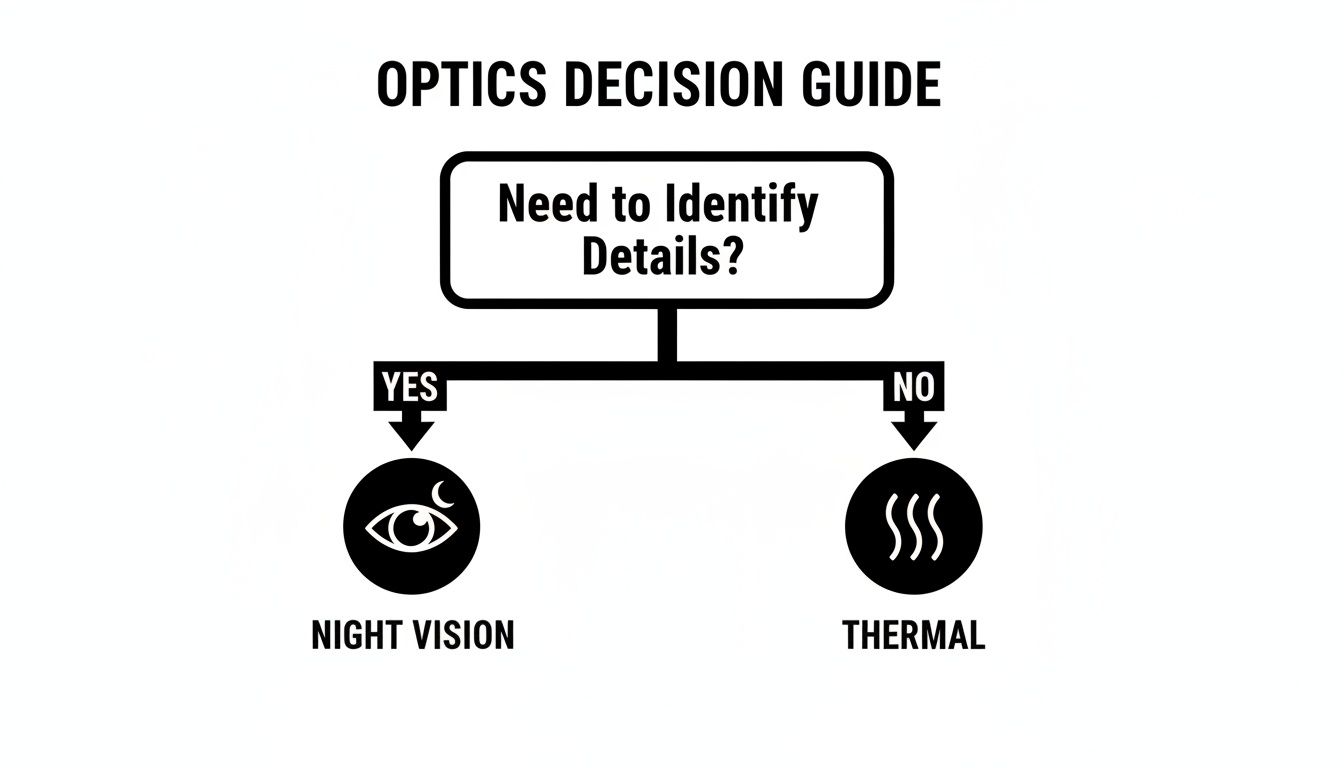
As you can see, it boils down to a simple principle. If seeing fine details for positive identification is your main goal, night vision is your tool. If simply detecting a target is the priority, thermal wins every time.
Hunters and Wildlife Observers
Out in the field, hunting really has two parts: finding the animal and then making sure it’s the right one. For that first part, nothing beats thermal. A good thermal optic will pick up an animal's heat signature from hundreds of yards away, even if it’s hidden in thick brush or tall grass. It’s the fastest and most effective way to scan a large field or tree line.
But once you’ve got a glowing blob on your screen, you need to know what it is. That’s where night vision takes over. For safety and to stay legal, you have to be 100% certain of your target. Night vision lets you see the details—the species, the size of the rack, and what’s behind your target—that a thermal image just can't show you.
- Initial Detection and Recovery: Thermal is king for spotting game and is a lifesaver for tracking after a shot. A warm body or blood trail glows bright, making recovery much faster.
- Positive Identification: Night vision is non-negotiable for confirming your target. It prevents tragic mistakes and ensures you're following game laws.
Law Enforcement and Security
For professionals on duty, the optic has to match the immediate objective. In a surveillance role, thermal is a massive advantage. It lets an officer see a suspect hiding in pitch-black darkness, concealed in bushes, or obscured by smoke. You can even spot things like a recently discarded weapon by its faint heat or a car that was just running.
When the situation goes dynamic, like a building entry, night vision is essential. It's no surprise that night vision is a staple in defense applications; the ability to see clearly in a practical range of 100 to 400 feet is perfect for close-quarters work. It lets you navigate rooms and identify threats without giving away your position with a flashlight.
The most effective professional teams don't choose one over the other—they use both. It’s common to see a handheld thermal monocular used to scan for threats, paired with a helmet-mounted night vision device for hands-free movement and positive ID once a contact is made.
Navigation and Search and Rescue
If you’re just trying to walk through the woods at night, night vision is the clear winner. Because it works by amplifying existing light, it shows you the world with texture and depth. You can see the rocks, holes, and branches in your path. Trying to navigate with thermal is like walking through a flat, confusing heat map—it’s completely disorienting.
But for a search and rescue (SAR) operation, thermal is a life-saving tool. A person, even if unconscious, is a source of heat. That heat signature stands out like a beacon against a cool landscape, making them visible from a helicopter or a distant ridge. Thermal punches through fog, rain, and smoke, drastically cutting down search times when every second is critical.
A well-equipped SAR team will often use both technologies:
- Night vision for the ground team, allowing them to move quickly and safely over treacherous terrain.
- Thermal optics for the searchers, enabling them to scan huge areas to find the heat signature of the missing person.
A Buyer's Guide to Key Specifications
When you start shopping for night vision or thermal binoculars, you’re going to run into a wall of technical jargon. Don't let it intimidate you. Getting a handle on these key specs is the single most important step in making a good purchase—it’s what separates a mission-ready tool from an expensive paperweight.
These numbers aren't just for marketing. They have a direct impact on what you can see in the dark, how far you can see it, and how clear the image will be. Let's break down the most important specs for both technologies so you know exactly what you’re looking at on a product page.
Decoding Night Vision Specifications
With traditional night vision, it all comes down to the quality of the image intensifier tube inside the device. You can cut through most of the noise by focusing on three critical numbers that tell you almost everything about its performance.
- Resolution (lp/mm): This is all about image sharpness. Measured in line pairs per millimeter, resolution dictates how much detail you can resolve. A higher number, like 64 lp/mm or more, gives you a much crisper picture, which is vital for positively identifying a target at a distance instead of just seeing a blurry shape.
- Signal-to-Noise Ratio (SNR): This is arguably the most important spec for low-light performance. SNR tells you how "clean" the image is by measuring the light signal against the background static or "scintillation" you see in the dark. A higher SNR (above 25 is good, 30+ is excellent) means a less grainy, more defined image, especially when there’s almost no ambient light to work with.
- Figure of Merit (FOM): Think of FOM as a quick, overall performance score. It’s calculated by simply multiplying the Resolution by the SNR (Resolution x SNR). A high FOM, typically 1800+ for a quality Gen 3 tube, is a clear indicator of a top-tier device that will deliver a bright, sharp, and clean view.
The bottom line for night vision? A high FOM is your at-a-glance sign of premium performance. It wraps up the two most crucial factors—clarity (Resolution) and sensitivity (SNR)—into one simple number you can use to compare units.
Understanding Thermal Binocular Specs
For thermal optics, performance is all about the sensor's ability to detect and process tiny differences in heat. When you’re comparing thermal units, pay close attention to these three specs—they determine the quality and smoothness of the image.
- Sensor Resolution: This is just like megapixels on a digital camera, but for heat. A higher resolution, such as 640×480, packs more pixels into the sensor, giving you a drastically more detailed image than a standard 384×288 sensor. This means better identification at longer ranges and a much clearer picture up close.
- Refresh Rate (Hz): Measured in Hertz, the refresh rate tells you how many times per second the image updates on your screen. A fast refresh rate, like 50Hz or 60Hz, is crucial for watching anything on the move. It delivers a smooth, fluid image that lets you track a running animal or a moving vehicle without any frustrating lag or choppiness.
- Thermal Sensitivity (NETD): Noise Equivalent Temperature Difference is a more advanced spec, but it’s a big one. Measured in millikelvins (mK), it tells you the smallest temperature difference the sensor can possibly detect. The lower the number, the better. A sensor with <25 mK is incredibly sensitive and can paint a detailed picture even when temperature differences are minimal, like on a humid night.
Protecting Your Gear: Care and Maintenance Tips
When you invest in high-performance night vision or thermal binoculars, you're buying a precision instrument. Keeping that gear in top shape isn't complicated, but it does require discipline. A consistent care routine is what separates a reliable tool from a costly paperweight, ensuring it’s ready to go when you are.
While both types of optics need to be handled with respect, they have their own specific quirks. For traditional night vision, the absolute number one rule is to avoid bright light. Firing up a Gen 2 or Gen 3 unit in daylight or pointing it directly at a car's headlights can instantly burn the image intensifier tube. That leaves you with a permanent black spot in your field of view, and it's not something you can fix.
The single most important habit you can develop is to keep the protective lens cap on your night vision device whenever it's not in use. It's the simplest and most effective way to prevent accidental light exposure from destroying the intensifier tube.
Essential Cleaning and Storage
You wouldn't clean a sniper scope with a paper towel, and the same logic applies here. The specialized coatings on these lenses demand a delicate touch to avoid scratches that can ruin your image quality.
- Lens Care: Stay away from Windex or your t-shirt. Thermal imagers use germanium lenses, which are incredibly soft and expensive to replace. Your best friends are a dedicated lens pen, a soft camel-hair brush for dust, and a microfiber cloth with a proper lens cleaning solution for smudges.
- Body Cleaning: The housing is tough, but it's not invincible. A simple wipe-down with a damp cloth is all you need to get rid of mud and grime. Just make sure the unit is completely dry before you pack it away.
- Battery Management: If you're putting the gear away for more than a few days, take the batteries out. A leaking battery can cause catastrophic corrosion, effectively destroying the electronics inside your night vision and thermal binoculars.
A hard, padded case isn't a luxury; it's a necessity. It’s your first line of defense against drops, impacts, and the elements. Storing it in a cool, dry place will not only extend its life but also help it hold its value. For a deeper dive, our guide on the maintenance and care of a PVS-14 monocular covers principles that apply to most night vision gear.
Answering Your Top Questions on Night Vision and Thermal
When you're digging into the world of night vision and thermal binoculars, a lot of questions pop up. It’s easy to get lost in the specs. Let's clear up some of the most common points we hear from customers to help you make the right call.
We'll skip the jargon and get straight to the practical answers you need to feel confident in your investment.
Can I Use These Binoculars During the Day?
This is a big one, and getting it wrong can be a costly mistake. You must never power on a traditional analog night vision device (Gen 2 or Gen 3) in daylight without the protective lens cap securely in place. The intense light will overload and burn out the image intensifier tube, causing permanent damage.
On the other hand, digital night vision and all thermal optics are completely safe to use during the day. In fact, thermal can be a game-changer in daylight, helping you spot a camouflaged animal or see through smoke and fog that would blind the naked eye.
What's the Real Difference Between Digital and Analog Night Vision?
It all comes down to the engine inside. Analog night vision uses a sophisticated image intensifier tube that physically multiplies available light particles (photons). This is why high-end Gen 3 units are unmatched in near-total darkness—they're amplifying real light.
Digital night vision works more like a high-sensitivity digital camera, using a sensor to create an image electronically. While they're more affordable and safe for day use, they just can't compete with the raw light-gathering sensitivity and crisp detail of a quality analog system when the lights truly go out.
The Bottom Line: Analog is the king of pure low-light performance, thanks to its light amplification technology. Digital offers incredible versatility and daylight safety at a more accessible price. For serious operators or hunters who need to own the dark, analog is still the professional standard.
Are Those "Fusion" Devices Worth It?
Fusion systems, which combine and overlay a thermal image on top of a night vision picture, are the absolute peak of this technology. It's truly the best of both worlds—you get the heat-detecting power of thermal fused with the detailed environmental awareness of night vision.
The catch? This incredible capability comes with a very steep price tag. For now, fusion technology is typically found in the hands of elite military units, law enforcement teams, and other professionals where the massive operational advantage outweighs the cost.
At Superior Tactical LLC, our job is to give you honest, straightforward advice so you can get the right tool for the job. Take a look at our handpicked collection of night vision and thermal optics.
