A Player’s Guide to Night Vision Airsoft Goggles
Trying to navigate an airsoft field in total darkness is a losing game. You're practically blind, relying on sound and guesswork. Real night vision airsoft goggles change the rules entirely. They don't create light out of thin air; they work by taking the tiniest, most scattered bits of available light and multiplying them thousands of times.
The result? That iconic glowing green image that turns the night into your personal playground.
How Night Vision Actually Works on the Field
At the heart of any true night vision device is an image intensifier tube. Think of it as a supercharger for light. This single component is the magic that separates military-grade gear from simple digital cameras or toy replicas. It’s what gives you a true tactical edge.
The whole process kicks off when the front lens gathers whatever ambient light it can find—moonlight, starlight, even the faint glow from a distant town. These particles of light, called photons, travel into the intensifier tube and hit a special surface called a photocathode.
The photocathode's job is to convert those incoming photons into electrons.
The Science of Seeing in the Dark
Now we have a stream of electrons, but not nearly enough to see with. This is where the real amplification happens. The electrons are shot through a microchannel plate, a tiny disc filled with millions of microscopic holes.
As each electron zips into a channel, it bounces off the walls, creating a cascade effect that releases thousands of new electrons. It's an incredible chain reaction.
This now-massive cloud of electrons smashes into a phosphor screen at the other end. The screen lights up brightly wherever the electrons hit, instantly converting that electrical energy back into visible light. This creates the sharp, green-tinted image you see when you look through the eyepiece. The whole thing happens in a fraction of a second, giving you a real-time view of the battlefield.
This technology is a serious game-changer. The global night vision market was valued at USD 240.5 million for a reason—it works. A good set of goggles can amplify light by more than 40,000 times, letting you spot a target from 300 meters away in conditions that would otherwise look like total blackness.
The Role of Infrared Illumination
So, what happens when there's zero ambient light? Imagine you're clearing a windowless basement. That’s where infrared (IR) illumination becomes your best friend.
Think of an IR illuminator as a tactical flashlight that's completely invisible to the naked eye. It floods an area with IR light that your night vision goggles can see perfectly, lighting up the room like daytime for you while leaving your opponents completely in the dark.
The ability to use IR light is a game-changer. It transforms a defensive tool used for passive observation into an offensive one, allowing you to aggressively control dark environments and dictate the terms of engagement.
For a deeper technical breakdown of the physics involved, check out our guide on how night vision works.
This diagram gives a great visual of how ambient light, amplification, and IR all work together to give you sight in the dark.
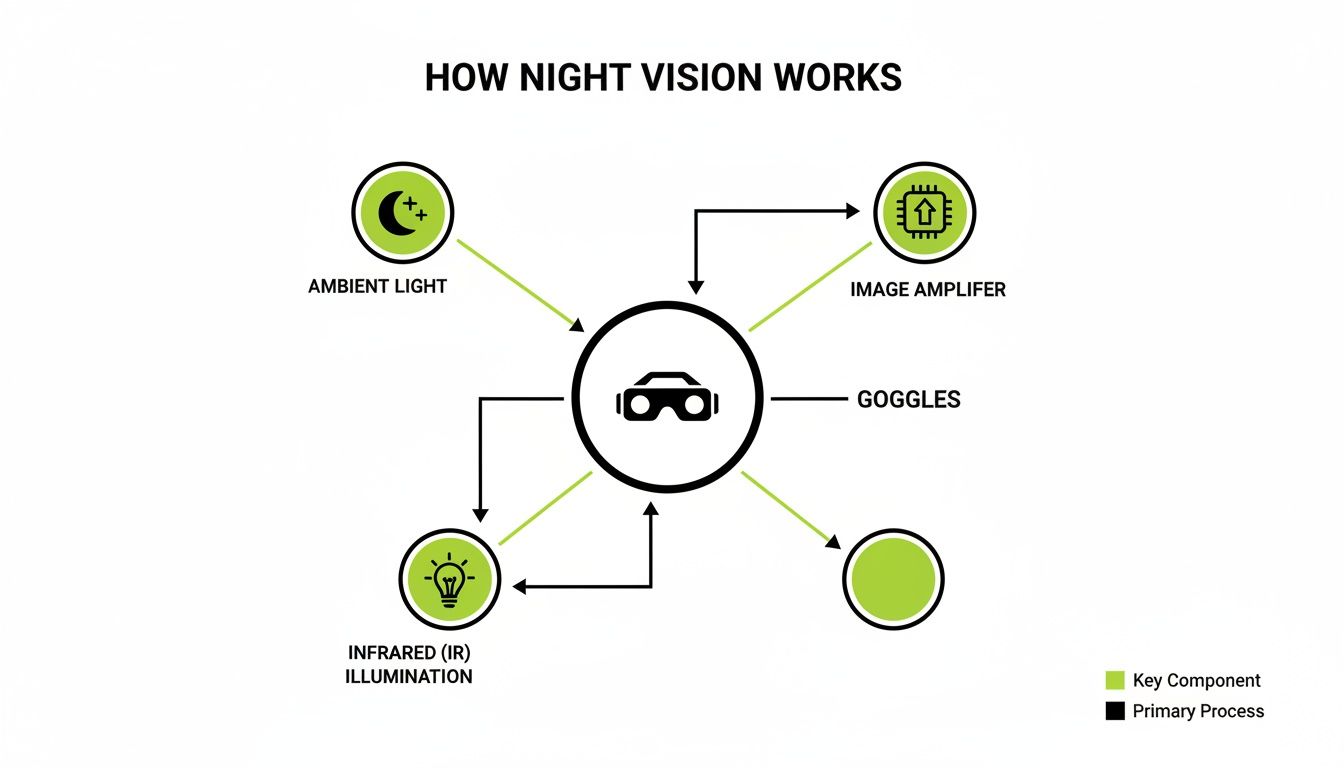
As you can see, the goggles are always either boosting existing light or creating their own invisible light source, making sure you're never left blind.
To help you keep these concepts straight, here's a quick cheat sheet covering the basics.
Key Night Vision Concepts at a Glance
This table breaks down the core ideas we've covered. It’s a handy reference to have before we get into specific features and models.
| Concept | Simple Explanation | Why It Matters for Airsoft |
|---|---|---|
| Image Intensifier Tube | The "engine" of the device. It takes in a little light and amplifies it into a usable image. | This is what separates real, effective night vision from cheap imitations or digital toys. |
| Ambient Light | Natural light available from the moon, stars, or distant artificial sources. | Your goggles use this as the raw material to create an image. More is always better. |
| Photocathode | The first part of the tube. It converts light particles (photons) into electrical signals (electrons). | This is the starting point for the entire amplification process. |
| Microchannel Plate | A tiny disc that multiplies the electrons thousands of times. | This is the "supercharger." It determines how bright and clear the final image will be. |
| IR Illuminator | An invisible flashlight that only night vision can see. | Lets you see in absolute darkness and actively light up targets without giving away your position. |
With these fundamentals down, you're ready to start understanding what makes one set of goggles better than another.
Choosing Your Gear: Real vs. Replica Goggles
When you dive into the world of night vision airsoft goggles, the very first fork in the road is deciding between a true, military-grade analog unit and a more affordable digital or replica setup. This isn't just a small choice—it’s the one that will define your entire nighttime airsoft experience, from your budget to your effectiveness on the field.
Think of it like choosing between a high-performance sports car and a solid daily driver. Both will get you where you need to go, but the performance, the feeling, and the price tag are in completely different leagues.
The Power of Analog: Real Night Vision
The real deal—what we call analog NODs (Night Observation Devices)—is what you see in the movies and what professionals use. Devices like the legendary PVS-14 use incredible image intensifier tube technology. They don't just record an image; they physically amplify the tiniest bits of ambient light from the moon and stars through a complex analog process.
The result is a crisp, fluid green-hued image that feels completely natural. There’s no lag, no screen refresh rate—just pure, amplified vision. For any serious Milsim player or someone looking for a genuine tactical advantage, a Gen 2+ or Gen 3 unit is the undisputed king. You can spot opponents, navigate silently, and own the night in a way digital simply can't match.
Of course, this level of technology comes with a serious price tag. We’re talking thousands of dollars for a quality setup.
The secret sauce of real analog night vision is its zero-latency image. What you see is happening in real-time, which is absolutely critical in airsoft. A split-second of lag is all it takes to lose a firefight.
Getting the right device is a big decision, so it pays to do your homework. You can learn more about how to choose the right night vision device for your needs in our article, which gets into the nitty-gritty of different models and specs.
The World of Digital and Replica Goggles
On the other end of the spectrum, we have digital night vision and replica goggles. Instead of a sophisticated analog tube, these use a digital camera sensor, much like the one in your phone or a security camera. It captures light, processes it electronically, and then projects it onto a tiny screen inside the eyepiece.
This approach makes them much more affordable and accessible, which is why they’re a fantastic starting point for newcomers or casual players who don't want to drop a ton of cash. They work pretty well when there’s some moonlight or when you blast the area with a powerful IR illuminator.
But that affordability comes with some very real trade-offs:
- Image Lag: That digital processing takes time, creating a noticeable delay between an action and when you see it. It can be disorienting and a huge liability when BBs are flying.
- Weak in the Dark: Digital sensors just aren't as sensitive as analog tubes. In truly dark conditions, they struggle and become heavily dependent on IR light, which can give away your position.
- Hit-or-Miss Durability: Many replicas are built to look the part, not to survive a hard tumble in the woods. While some higher-end digital units are tough, many are not built for rugged use.
Real Night Vision vs. Airsoft Replicas
So, which path is right for you? It really boils down to how you play, how often you play, and what you’re willing to invest. This table lays out the core differences to help you decide.
| Feature | Real Night Vision (Gen 2/3) | Digital & Replica Goggles |
|---|---|---|
| Core Technology | Analog Image Intensifier Tube | Digital CMOS Sensor and LCD Screen |
| Performance | Superior low-light capability, clear image, and no lag. | Dependent on IR illumination, noticeable lag, and lower resolution. |
| Cost | $2,500 – $10,000+ | $150 – $800 |
| Durability | Built to military specifications for rugged, reliable field use. | Varies widely; many are less durable and not meant for hard use. |
| Best For | Serious Milsim players, dedicated enthusiasts, and tactical training. | Casual players, beginners, and budget-conscious airsofters. |
Ultimately, a player who only attends a few night games a year will probably be perfectly happy with a good digital unit. It gets the job done without breaking the bank.
But for the dedicated operator who lives for those weekend-long Milsim events, the investment in a real PVS-14 isn't just a purchase—it's a game-changer that provides a true, decisive edge on the field.
Decoding the Specs: What Really Matters on the Field
Diving into the world of genuine night vision means you’re about to get hit with a wall of acronyms and technical terms. It can feel like learning a new language, but this is where you separate the marketing fluff from real-world performance. Getting a handle on these numbers is the only way to know what you’re actually paying for.
Think of a spec sheet as the DNA of your night vision airsoft goggles. Two units can look identical on the outside, but the quality of the image intensifier tube inside makes all the difference. That spec sheet tells you the story of how that tube will perform when the lights go out.
The "Big Three" Performance Numbers
When you’re looking at a spec sheet, there are three numbers that tell you almost everything you need to know. Master these, and you’ll have a solid grasp on what makes a unit great.
Resolution (lp/mm): This is all about sharpness. Standing for "line pairs per millimeter," it measures how clearly you can distinguish between two objects that are very close together. A higher number means a crisper, more detailed image. For airsoft, where telling a friendly from a foe at 50 yards is the name of the game, you’ll want to look for something at 64 lp/mm or higher.
Signal-to-Noise Ratio (SNR): Ever tried to listen to a radio station that’s mostly static? The music is the "signal," and the static is the "noise." It’s the exact same concept for night vision. A high SNR gives you a cleaner image with less "scintillation" or sparkling, which is especially important in the darkest environments.
Figure of Merit (FOM): This is your quick-and-dirty performance score. You get it by simply multiplying Resolution by SNR (Resolution x SNR = FOM). Think of it as the tube's overall horsepower. Generally, a bigger FOM means a more capable, higher-performing device.
A common rookie mistake is thinking a higher FOM is always better. It's more nuanced than that. A unit with a slightly lower FOM but a killer SNR might actually give you a cleaner image in near-total darkness than a unit with a higher FOM but weaker SNR. It’s all about balance.
These three metrics work together to paint the full picture. A device that scores well across the board will deliver that clean, sharp view you need for fast target identification and total situational awareness.
Monocular vs. Binocular: Your Eyes on the Prize
Beyond the tube's internal specs, the physical setup of your goggles is a massive decision that will shape how you play. The choice boils down to a monocular (one tube) or binoculars (two tubes).
A monocular, like the legendary PVS-14, is how most people get into real night vision. It’s a fantastic setup that gives you a high-performance image while leaving your other eye free to adapt to ambient light. This is great for maintaining your natural situational awareness and is also lighter on both your helmet and your wallet.
Binocular setups, on the other hand, feed an image to both of your eyes. The huge advantage here is depth perception. Judging distances, navigating tricky terrain, and moving through structures feels far more natural and is way less fatiguing over a long night. Of course, that superior spatial awareness comes with a higher price tag and more weight.
This choice isn't just a personal preference; it's driving the market. The demand for high-end binocular systems, especially four-eye night vision goggles, is booming in tactical circles, with the market projected to hit a staggering US$984 million by 2030. This growth is all about the unrivaled depth perception these systems offer, a game-changing advantage in CQB scenarios. You can dig into the numbers and see the full market analysis on Valuates Reports to understand the trend.
Mounting Systems and Comfort
Don't overlook how you attach the device to your helmet. A wobbly or uncomfortable mount will not only ruin your experience but could also lead to you dropping and destroying thousands of dollars worth of gear. The two main systems you'll run into are Bayonet and Dovetail.
- Bayonet Mount: This is the older, military-standard mount, often called a "J-Arm" when used with a PVS-14. It’s tough, but it's known for having a bit of "wobble" and doesn't offer much adjustment.
- Dovetail Mount: This is the modern go-to. It provides a much more secure, stable lock-up and gives you way more options for adjustment. For any serious user, a dovetail mount is the only way to go, as it keeps your expensive optics planted firmly in place, even when you're moving hard.
Finding the right mix of tube specs, housing, and mounting is how you build a night vision rig that truly works for you. By understanding what these specs actually mean for your performance on the field, you can invest with confidence.
Mastering Your Loadout with IR Illuminators and Lasers
Having a quality set of night vision airsoft goggles is your ticket into the night game, but it's the right accessories that let you own the dark. Integrating infrared (IR) illuminators and lasers into your loadout is what takes you from a passive observer to an active hunter, giving you the tools to truly control your environment.
Think of your night vision device like a super-sensitive microphone that can hear the faintest whisper. An IR illuminator, then, is like a directional shout that only your microphone can hear. This lets you gather more intel, "paint" targets for your team, and move with a confidence that’s just not possible when you're only relying on passive observation.
Your Invisible Flashlight
For any serious night vision user, an IR illuminator isn't a luxury; it's essential. It’s basically a high-tech flashlight that pumps out light in the infrared spectrum. This light is completely invisible to the naked eye but shows up bright as day through your goggles.
Imagine you're clearing a pitch-black building. Your goggles alone might struggle to collect enough ambient light to give you a clear image. But with the click of a button, your IR illuminator can flood the room with light, instantly revealing every corner, piece of cover, and lurking opponent.
This is just as critical outdoors. Under a new moon or a dense forest canopy, an illuminator slices through the gloom, feeding your goggles the light they need to produce a sharp, usable picture. In effect, you're carrying your own personal moonlight. If you're ready to add one to your rig, you can learn more about IR illuminators for night vision and see what options are out there.
Aiming Without Being Seen
The next piece of the puzzle is aiming your rifle. Trying to look through a standard optic while wearing NVGs is a clumsy, slow, and frustrating experience. This is where an IR aiming laser, like those found on PEQ-15 style devices, becomes an absolute game-changer.
An IR laser projects a small, precise dot onto your target that's only visible through your night vision. The result is incredibly fast and intuitive aiming. You just look at the target, put the dot on it, and pull the trigger. No more mashing your face into your stock trying to get a sight picture. It’s as close as you can get to point-and-shoot effectiveness in total darkness.
IR discipline is the art of using your illuminator and laser only when you absolutely have to. Every time you switch them on, you're broadcasting your position to anyone else with night vision. Knowing when to see versus when to be unseen is what separates the rookies from the veterans.
The Critical Skill of IR Discipline
This brings us to a more advanced skill: IR discipline. Owning powerful tools is one thing; knowing when and how to use them is what really counts. If the opposing team has night vision capabilities, carelessly splashing your IR illuminator around is like waving a massive flare. You'll give your position away instantly.
Mastering IR discipline is all about using your gear with purpose and restraint.
- Short, Controlled Bursts: Use your illuminator in quick flashes to scan an area, then shut it off. Don't leave it on continuously unless you're actively engaging someone.
- Laser for the Shot: Only activate your IR laser in the final moments before you take a shot. "Painting" a target for too long just gives them a bright red arrow pointing right back to you.
- Passive is Your Default: Let your goggles do the work. Rely on their natural ability to amplify ambient light whenever possible. Save your IR tools for when you absolutely need more light or a faster aiming solution.
By combining the right IR accessories with smart tactical discipline, your night vision airsoft goggles become a complete system. You're no longer just seeing in the dark—you're actively controlling it, turning a piece of gear into a true force multiplier on the field.
Treating your night vision airsoft goggles like a piece of high-end gear is one thing; actually knowing how to care for them is another. This isn't just about keeping them clean. Proper setup and a little routine maintenance are what separate a reliable, game-winning tool from a very expensive paperweight.
Think of it like a finely tuned race car. You wouldn't just jump in and floor it without checking the basics. A few simple habits will keep your image sharp and your gear running for years, and thankfully, it's all pretty straightforward.
Nailing the Fit and Focus
Right out of the box, the most important thing is getting the goggles mounted and focused for your eyes. A wobbly, out-of-focus unit is a one-way ticket to a headache and eye strain, making it totally useless in a long game. You're aiming for a setup that feels so stable and comfortable it's like it's not even there.
- Get it Mounted Solid: Attach your mounting arm (like the popular G24) to your helmet's shroud. You want to hear and feel a solid click when it locks in. If there's any wobble, something's wrong—fix it.
- Dial in Eye Relief: Bring the goggle up to your eye. You shouldn't have to jam your face into it or stretch your neck. Adjust the mount until the eyepiece sits at a natural, comfortable distance.
- Focus the Diopter First: This is the step everyone forgets. Before you focus on the world outside, you need to focus the device on your eye. Close your other eye, look into the eyepiece at the green glow, and turn the diopter ring. You're looking for the faint, built-in "honeycomb" pattern to become perfectly sharp. This sets the baseline.
- Now, Focus the Objective Lens: With the diopter set, look at something far away—at least 50 yards. Now, turn the main focus ring on the front of the goggle until that distant object is as crisp as you can get it. This two-step process is the secret to a perfect, strain-free image.
The Unbreakable Rule of Airsoft NODs
If you ignore everything else in this guide, please, listen to this: always use a sacrificial lens. This isn't a suggestion; it's a command. A single BB hitting your objective lens will shatter it, instantly turning your expensive device into a repair bill that can cost hundreds, if not thousands, of dollars.
A sacrificial lens is just a cheap, clear, impact-rated piece of plastic or glass that screws onto the front of your goggle. It's designed to take that BB hit, crack, and be replaced for a few bucks. It's the cheapest insurance policy you'll ever buy.
Seriously. Don't even think about stepping onto the field without one.
Simple Maintenance for a Long Lifespan
Beyond shielding the lens, a few good habits will keep your unit in top shape. A quality Gen 3 tube is built to last for 10,000 to 15,000 hours, but that number depends entirely on how you treat it.
- Cleaning Lenses the Right Way: Always blow or brush off loose dirt and dust first. Wiping a gritty lens is like using sandpaper. For fingerprints or smudges, put a little bit of lens cleaning solution on a microfiber cloth (never spray it directly on the lens!) and wipe gently.
- Battery Smarts: Stick to high-quality lithium or alkaline batteries. If you're storing your goggles for more than a week, take the batteries out. A leaky battery will corrode the contacts and can kill your electronics for good.
- Safe Storage: When you're done for the night, put your goggles away in a padded, hard case. Keep the daylight cap on to protect the intensifier tube from any accidental light exposure, and store it somewhere cool and dry.
Following these steps isn't a chore—it's just part of owning night vision. It ensures your gear is ready to go when you are and protects it from the unique abuse of an airsoft field.
Building Your Ideal Night Vision Setup
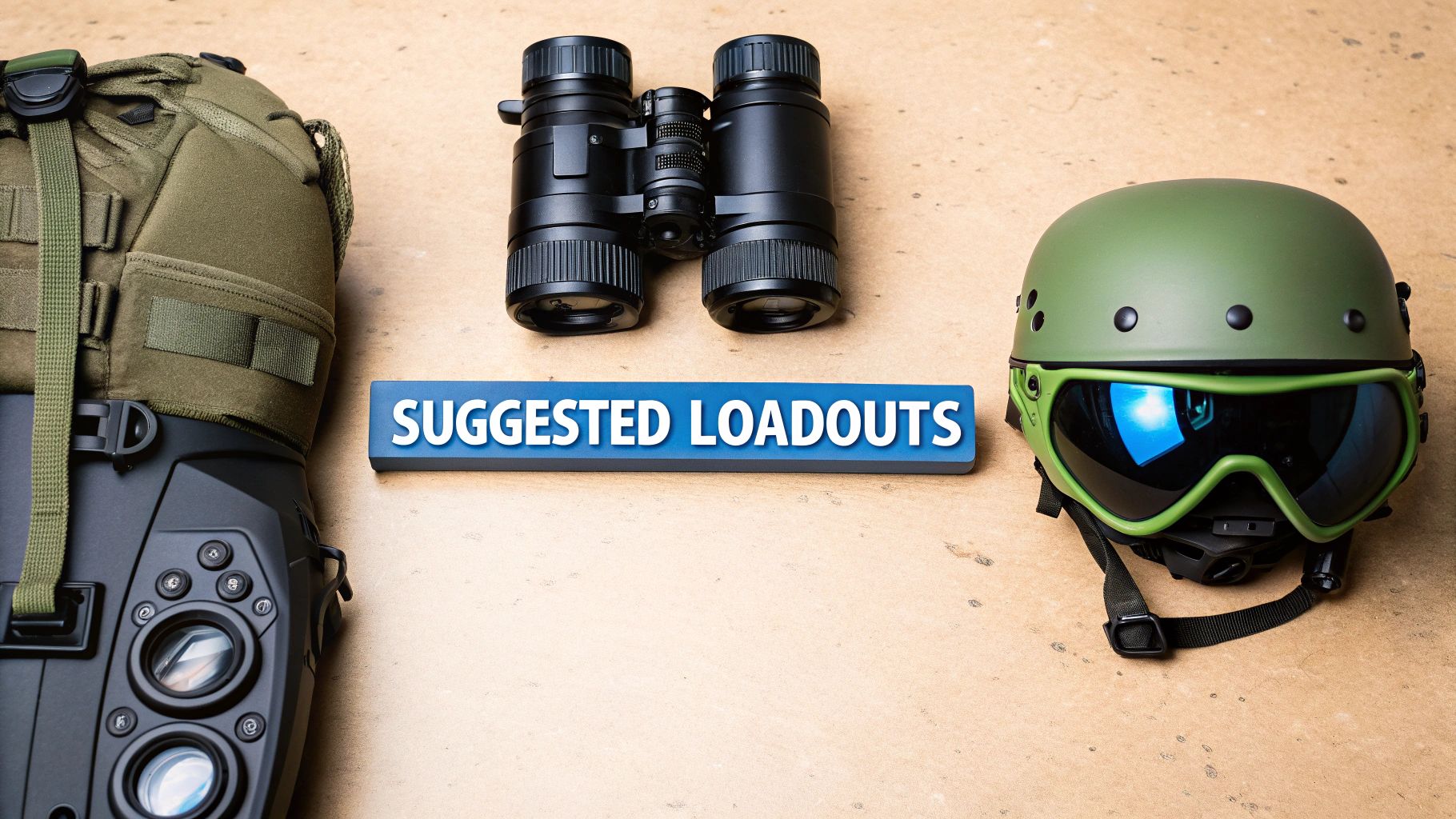
Alright, specs are one thing, but figuring out how all this gear actually comes together in a usable loadout is where the rubber meets the road. Let's move past the theory and look at three practical setups. Think of these as blueprints for different budgets and play styles, giving you a solid starting point for building a rig that works for you.
Seeing these examples laid out will help you figure out which profile fits your commitment level and wallet. This way, you're not just guessing; you're investing in gear that actually supports how you play.
The Weekend Warrior Loadout
So, you play the occasional night game but aren't ready to drop thousands of dollars. No problem. A high-quality digital monocular is the perfect way to get your feet wet. This setup is all about getting the most bang for your buck, giving you a real advantage without emptying your bank account.
- Core Device: A good-quality digital night vision monocular.
- Mounting: A basic helmet shroud and a J-Arm mount will do the trick.
- Accessories: You'll absolutely need a powerful, weapon-mounted IR flashlight. This is key to making up for the digital sensor's lower light sensitivity.
- Goal: To give you a solid night-fighting capability for casual games. You'll be able to navigate and spot targets inside 50 yards.
This loadout gets you in the game and comfortable with using night vision airsoft goggles.
The Dedicated Milsim Operator
For the serious airsofter who lives for those long, immersive Milsim events, this is the classic, time-tested setup. It’s built around a genuine analog PVS-14 monocular, which strikes the perfect balance between high performance, rugged reliability, and situational awareness.
The investment here is a big step up, mirroring a professional market where night vision devices were valued at a staggering USD 10.28 billion. Head-mounted goggles are a huge piece of that pie, and for good reason—they're essential for long ops. You can learn more about the night vision device market trends on stellarmr.com.
- Core Device: A Gen 2+ or Gen 3 PVS-14 monocular.
- Mounting: A rock-solid dovetail mount (like a G24) on a quality helmet.
- Accessories: An IR aiming laser/illuminator combo (like a PEQ-15 replica) is a must for quick, heads-up aiming.
- Goal: To own the night. This rig is for achieving tactical dominance through superior vision and aiming.
The No-Compromise Pro
If you demand the absolute best and have the budget to match, a dual-tube binocular system is the endgame. This is professional-grade gear that gives you true depth perception, which dramatically reduces eye strain and makes you much faster at navigating and engaging targets.
Binocular systems offer a level of immersion and awareness that monoculars just can't match. Having true depth perception makes moving through cluttered environments feel natural, which is a massive advantage when speed and safety are critical.
This is the pinnacle of what’s available for airsoft. It's a lightweight, incredibly high-performing setup for the operator who accepts no substitutes.
Got Questions? We've Got Answers
Diving into the world of night vision for airsoft can feel a bit overwhelming. A lot of questions pop up when you start thinking about how this tech applies to slinging BBs in the dark. Let's tackle some of the most common ones players ask before gearing up.
Think of this as a quick-fire round to clear up the practical stuff and get you on the right track.
Can I Use Real Steel Night Vision for Airsoft?
You sure can, and honestly, it’s the best performance you'll ever get. But—and this is a big one—you have to remember that real-deal NVGs are not built to take a BB to the face. You absolutely must run a high-quality, impact-rated sacrificial lens protector over your objective lens anytime you're on the field.
This cheap little piece of plastic is the only thing standing between your multi-thousand-dollar investment and a single, unlucky shot. Ask any seasoned player; it's not optional, it's essential.
What's the Deal with Green vs. White Phosphor?
Green phosphor is what everyone pictures when they think of night vision. It’s that classic, iconic look, and it’s usually the more affordable option. White phosphor, on the other hand, gives you a black-and-white image that many operators feel offers better contrast and is easier on the eyes over long periods.
While the actual performance between tubes of the same generation is often very similar, the choice really boils down to your budget and what you prefer looking at. Just know that white phosphor almost always comes with a premium price tag.
Do I Really Need an IR Illuminator for Outdoor Games?
It really depends on where you're playing. If you’re in a big, open field with a bright moon, a good Gen 2+ or Gen 3 unit might be perfectly happy just soaking up all that ambient light. You'll likely see just fine for moving around and spotting targets.
But the second you step under a thick forest canopy, duck into a pitch-black building, or play on a cloudy, moonless night, that IR illuminator becomes your best friend. It’s like a flashlight that only your NVGs can see, lighting up the darkness and turning an unplayable area into your personal hunting ground.
Ready to dominate the dark? Superior Tactical LLC has the authentic, high-performance night vision and tactical gear you need to build your ultimate loadout. Find your edge today at https://superiortac.com.
