A Complete Guide to Infrared Laser Pointers
When you're operating in the dark, giving away your position is the last thing you want to do. A standard red or green laser is a dead giveaway—a bright, painted line leading right back to you. This is precisely why infrared laser pointers are such a game-changer for anyone working under the cover of darkness.
They give you a massive tactical edge, creating a silent, invisible language between you and your night vision gear. This guide will break down the science, safety, and real-world use of these essential tools.
The Invisible Advantage of Infrared Lasers
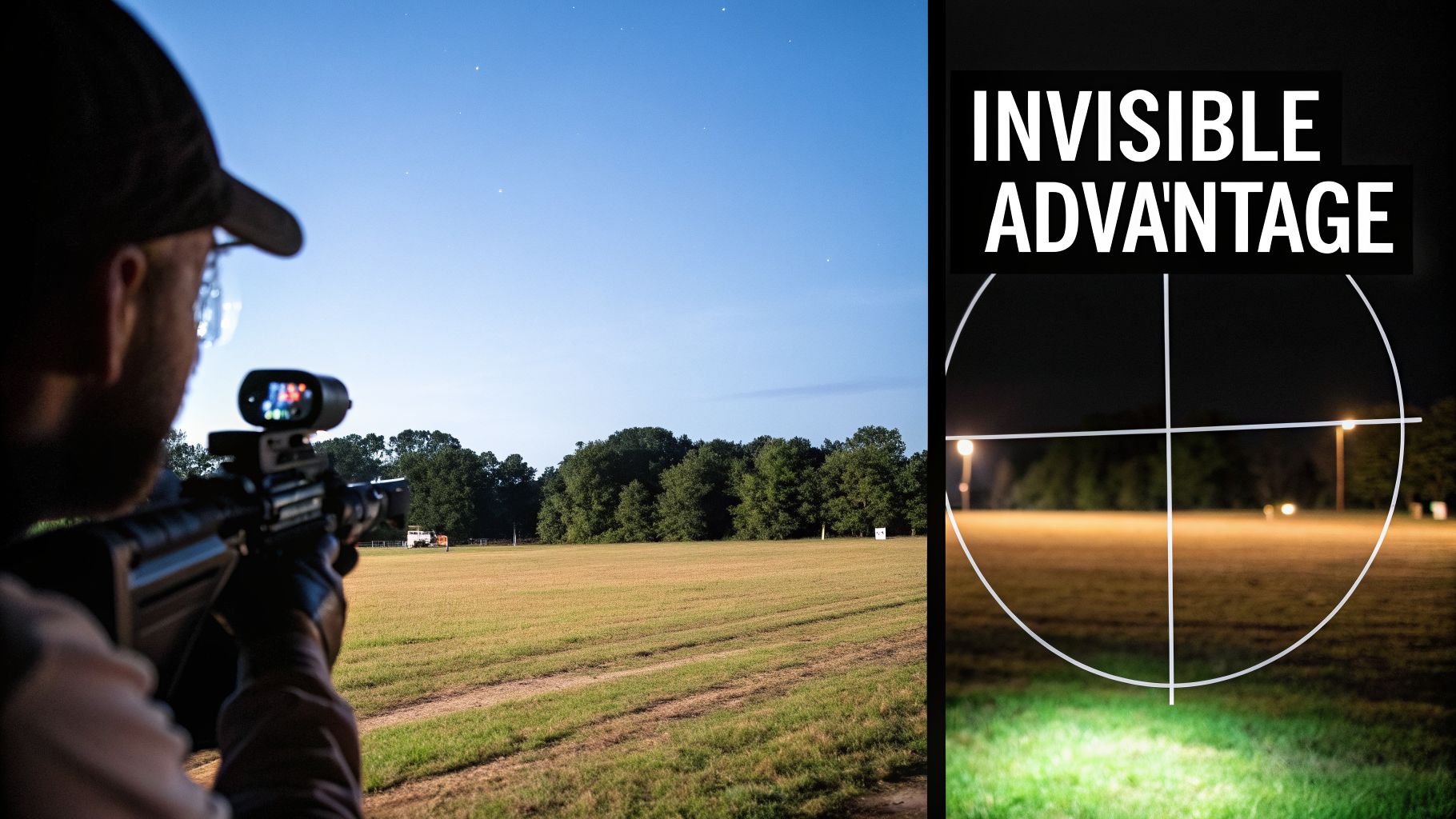
So, what makes an infrared (IR) laser different? In short, it projects a beam of light that the human eye simply can't see. This isn't magic; it's just science.
It all boils down to where this light falls on the electromagnetic spectrum. Our eyes are only tuned to a tiny slice of that spectrum, the part we call visible light. Infrared light has a longer wavelength that sits just beyond the red light we can see, making it completely imperceptible to us without help. If you want to get into the nitty-gritty, you can learn more about the spectrum of light in our detailed article.
Think of it like a secret code. The IR laser sends out a message—a bright, precise dot—but you need a special decoder to read it. That decoder is your night vision device (NVD). Without it, the beam doesn't exist.
Why Invisibility Matters
This one feature—invisibility—is what gives you a huge operational advantage. For law enforcement, military operators, or even nocturnal hunters, the ability to designate a target without announcing your presence is everything.
A visible laser beam compromises your cover instantly. An IR laser, on the other hand, lets you operate with complete stealth.
- Covert Aiming: You can put a precise aiming point on a target that only you or a teammate with night vision can see.
- Silent Communication: Point out threats, mark rally points, or guide your team's movement without saying a word.
- Reduced Target Spook: For hunters, an IR beam is far less likely to startle game than a sudden, bright flashlight or visible laser.
Throughout this guide, we'll demystify the technology behind IR lasers. We’ll turn these seemingly complex devices into tools you understand inside and out—from wavelengths and safety ratings to practical mounting solutions. By the end, you'll have the knowledge to choose the right gear for your mission.
Understanding IR Wavelengths and Power Classes
Staring at a spec sheet for an IR laser can feel like trying to crack a code. You'll see numbers like 850nm and labels like Class 3R thrown around, but what do they actually mean for you out in the field? Getting a handle on these two key factors—wavelength and power class—is the first real step to picking a laser that’s going to work the way you need it to, when you need it to.
Think of an IR laser's wavelength like its specific radio station. Your night vision device is the radio, and it’s tuned to "hear" certain stations better than others. We measure this wavelength in nanometers (nm), and it dictates just how visible the laser is, not just to your NVDs but to anyone else who might be looking.
It's a critical distinction because not all infrared light is the same. A tiny shift in that number can mean the difference between a crisp aiming point and a barely-there smudge—or the difference between staying hidden and giving away your position.
Matching Wavelength to Your Mission
For most infrared laser pointers, you’re going to be looking at wavelengths between 820nm and 980nm. The numbers may seem close, but the practical difference is huge. The lower the number, the closer the laser is to the visible red light we can see with our own eyes.
830nm – 850nm: This is the workhorse range for most commercial and law enforcement IR lasers. They produce a bright, sharp dot that really pops in most Gen 2 and Gen 3 night vision. The trade-off? The emitter itself gives off a faint, dull red glow, like a hot stove element, which is visible to the naked eye up close.
860nm: This is a fantastic middle ground. An 860nm laser is significantly more discreet than its 850nm cousins. The visible signature from the device is drastically reduced, making it a go-to for guys who need a solid balance of performance and stealth.
980nm: If you need to be a ghost, 980nm is your ticket. The light from these lasers is almost completely invisible to the human eye, meaning there's no tell-tale glow from the unit. The catch is that this wavelength is also dimmer under night vision, so the laser needs more power to look as bright as an 850nm dot.
Ultimately, your mission dictates the wavelength. For general use where absolute stealth isn't the number one priority, an 850nm laser is a reliable performer. But for any tactical situation where being seen is not an option, stepping up to 860nm or higher is the smart play.
Decoding Power and Safety Classes
If wavelength is the laser's "frequency," then its power class is its "horsepower." These classes are regulated by the FDA and define the laser's maximum output. That output directly translates to its effective range and—most importantly—its safety profile. Just because you can't see the beam doesn't mean it's harmless. An IR laser can cause permanent, life-altering eye damage faster than you can blink.
An infrared laser’s power determines its reach, but it also dictates the level of risk. A more powerful laser isn’t always better; it's a tool that demands greater responsibility and awareness.
Knowing these classes isn't just a good idea; it's a non-negotiable part of being a responsible operator. Lasers are categorized by their potential to cause harm, with the higher classes being far more dangerous.
The table below breaks down the common FDA laser classes you'll find for IR devices, giving you a clear picture of their power, reach, and what they're really meant for.
Infrared Laser Classes and Their Tactical Applications
This table compares common FDA laser classes for IR devices, outlining their power limits, typical engagement ranges, and primary use cases for tactical professionals and hunters.
| Laser Class | Power Output (mW) | Typical Effective Range | Primary Use Case | Eye Safety Consideration |
|---|---|---|---|---|
| Class 1 | <0.7 mW | Up to 75-100 yards | Eye-safe training, very short-range aiming | Considered eye-safe under all normal operating conditions. |
| Class 3R | <5 mW | 150-400+ yards | The civilian standard for hunting and general use | Poses a low risk for accidental eye exposure. Avoid direct or reflected staring into the beam. |
| Class 3B | 5 mW – 500 mW | 600 – 2000+ yards | Military, LE, and restricted professional use | Extremely hazardous. Immediate eye damage from direct or reflected beams. Requires professional training. |
For the vast majority of civilian uses, like hunting or target shooting, a Class 3R infrared laser has all the power you need to designate targets at typical ranges. They hit that sweet spot of great performance and manageable risk. Class 1 lasers, while the safest, are really only suited for very close-range training.
At the end of the day, reading that spec sheet is about translating numbers into real-world capability. Once you understand how wavelength and power work together, you can confidently choose an IR laser that fits your gear, your mission, and your commitment to operating safely.
How IR Lasers Work with Night Vision Gear
Let's get one thing straight right away: an infrared laser pointer by itself is almost completely useless. Its real power is only unleashed when you pair it with a night vision device (NVD). This combination is the key, turning an invisible beam of light into a precision tool that fundamentally changes how you own the night.
The magic happens inside the image intensifier tube of your night vision gear. Think of this tube as a massive light-gathering engine. It takes the faintest traces of ambient light—from the moon, stars, or even distant city glow—and amplifies it thousands of times, creating that familiar green-tinted view of a dark world.
When your IR laser beam hits a target, it's just a concentrated splash of light energy. While your naked eye can't see it, your NVD's intensifier tube picks it up loud and clear. That focused IR light is gathered and amplified, appearing as a brilliant, sharp dot on your target. This is the simple but powerful principle behind covert aiming with infrared laser pointers.
The Aimer and The Spotlight
A lot of people new to night vision get tripped up on the difference between an IR laser and an IR illuminator. They both use infrared light and often live in the same housing on your rifle, but they do two very different, yet equally important, jobs.
It's easiest to think of it like this: The IR laser is your aiming dot, the crosshair. The IR illuminator is your invisible flashlight, casting a wide flood of IR light to brighten up an entire area so you can see what's out there.
This isn't just semantics; it's a critical operational concept. You use the illuminator to scan a dark treeline, identify a threat, and get a better sense of your surroundings. Once you’ve got your target, you pop on the IR laser to place a precise aiming point for the shot. We go into much more detail in our complete guide to IR illuminators for night vision.
This flowchart helps visualize the core properties that dictate an IR laser's performance.
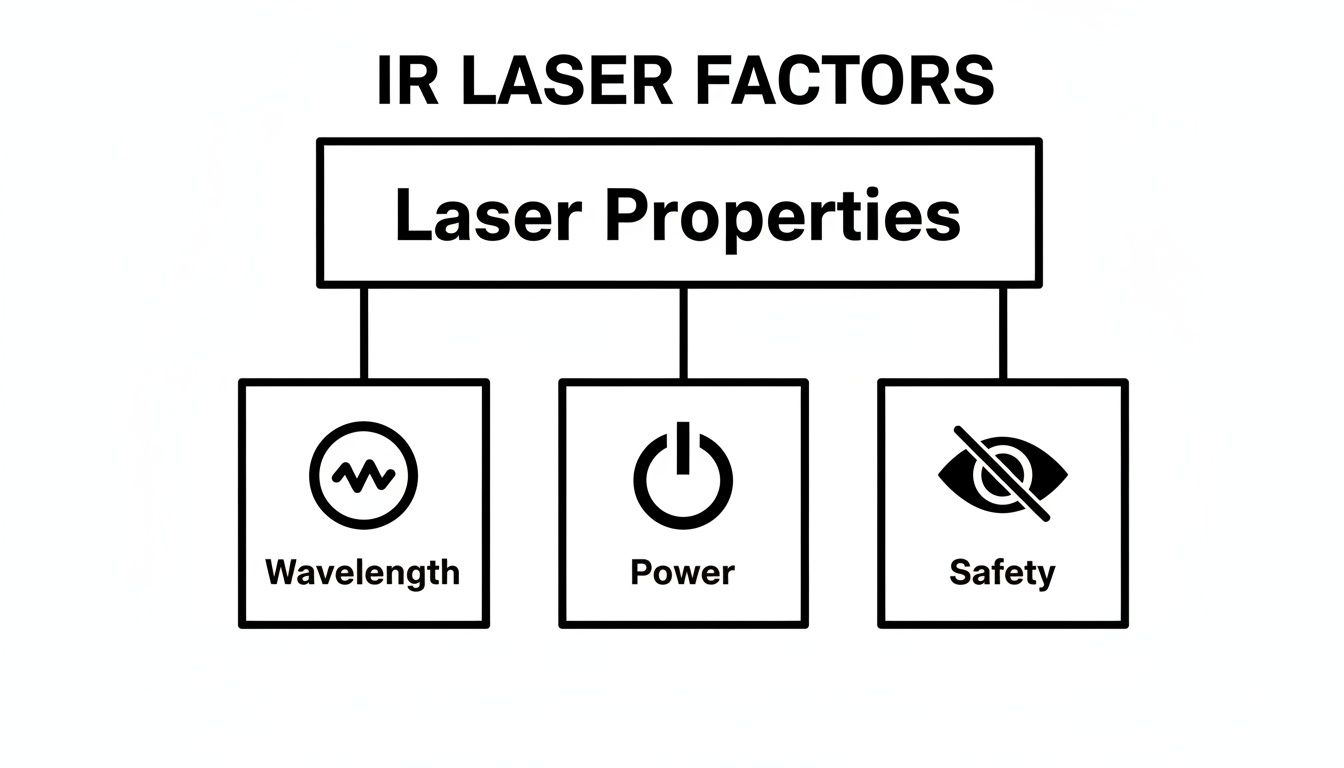
As you can see, a laser's effectiveness comes down to a blend of its specific wavelength, its power output, and the safety classifications that govern its use.
The Critical Thermal Optic Exception
Here's a piece of information that can make or break a mission: IR lasers are invisible to thermal optics. This is a non-negotiable fact of physics and something every operator needs to burn into their brain, especially if your team uses a mix of gear.
Thermal imagers don't see light. At all. They build a picture based on detecting and displaying minute differences in heat signatures.
- Night Vision: Amplifies reflected light (visible and IR).
- Thermal Vision: Detects and displays radiated heat.
An infrared laser emits light, not heat. So, when you point an IR laser at a steel target, a thermal scope sees nothing. The laser simply doesn't change the target's surface temperature enough to register.
The tactical implications here are massive. A team leader trying to mark a target for a sniper using a thermal scope is just pointing an invisible light at a wall. The sniper will never see the dot. For teams with mixed tech to work together, they must have a plan—either using visible lasers, devices with thermal trace modes, or rock-solid communication to overcome this hurdle. This isn't just technical trivia; it's a fundamental concept for safe and effective low-light operations.
Real-World Uses in Tactical and Hunting Scenarios

Theory and tech specs are one thing, but putting an IR laser to work in the field is where you truly grasp its power. For anyone who operates after dark, this tool is less of an accessory and more of a fundamental shift in capability. It’s all about silent, invisible communication and aiming that directly enhances safety and the odds of success.
Take a law enforcement scenario. A SWAT team is methodically clearing a pitch-black warehouse when an officer on overwatch spots a threat hiding deep in a shadowed corner. Instead of risking radio chatter that could give away their position, they simply "paint" the threat with their IR laser.
Instantly, every team member wearing night vision sees the bright, unwavering dot. There’s no confusion and no noise—just a clear, silent confirmation of the threat's location. This allows the team to coordinate their next move with absolute precision, holding onto the crucial element of surprise and keeping everyone safer.
The Hunter's Secret Weapon
That same advantage translates perfectly to the world of modern hunting. When you're after nocturnal animals like coyotes or feral hogs, stealth is everything. One flick of a bright flashlight or a visible laser, and your target is gone in a flash.
An IR laser, however, changes the entire game. A hunter can scan a field through their night vision device, spot their quarry, and place a completely invisible aiming point on it. The animal has no idea it's being targeted, which allows for a calm, well-placed, and ethical shot. It removes the guesswork that comes with shooting in the dark, leading to higher success rates and more humane hunts.
This is why we're seeing such a surge in their use by outdoorsmen. The global laser pointer market, which hit USD 3.3 billion in 2024, is expected to grow to USD 5.71 billion by 2033. A lot of that growth, especially in North America, is driven by hunters and tactical professionals who demand this technology. U.S. hunters alone are a major factor in the 12.7% CAGR of the laser diode market. You can dive deeper into the numbers with a full market analysis on laser pointers from SkyQuest.
Expanding Operational Capabilities
But the utility of an IR laser goes well beyond just aiming a rifle. Its real strength lies in its ability to serve as a silent, versatile marker that only friendlies with NVGs can see. Military and police units have found countless ways to use them for more than just putting rounds on target.
The core function of an IR laser in a team environment is communication. It's a non-verbal language that cuts through the noise and confusion of a high-stress environment, conveying critical information instantly and discreetly.
This silent language plays out in a number of incredibly practical ways:
- Marking Landing Zones (LZs): For night helicopter operations, ground teams can use their IR lasers to covertly outline the corners of an LZ. The pilot, viewing through NVGs, gets a clear picture of the landing area without broadcasting their location with visible lights.
- Non-Verbal Commands: A flick of the wrist can replace a complex hand signal or a risky radio call. An officer can "draw" a line on the ground to show a path of movement, point to a specific door for entry, or highlight a potential IED, all without making a sound.
- Covert Navigation: Moving through the woods at night with a white light is like carrying a beacon. An IR laser lets a team leader briefly point out the next rally point or a dangerous obstacle on the trail that only their squad can see, maintaining light discipline and total stealth.
Whether you're designating a threat, ensuring an ethical hunt, or guiding a helicopter to a safe landing, the IR laser proves its worth time and time again. It’s the tool that transforms night vision from a passive observation device into an active system for communication and engagement, making it an essential piece of kit for anyone serious about working in the dark.
How to Choose and Mount Your IR Laser System
Picking the right IR laser system isn't about grabbing the most expensive unit off the shelf. It’s a process of matching the gear to your mission, your firearm, and your wallet. To get it right, you have to start by asking yourself a few honest questions that will immediately narrow the field.
First off, what are you putting it on? A laser destined for a rifle built to reach out past 100 yards has a completely different job description than a compact unit for a pistol. The rifle system needs to be tough as nails, powerful, and will often have a built-in IR illuminator. A pistol laser, on the other hand, is all about being small, light, and snag-free.
Budget is always part of the equation. Professional-grade laser aiming modules can be a serious investment, but plenty of more affordable options perform incredibly well for hunting or other civilian uses. Be real about what you need. Overspending on features you’ll never touch is just as bad as buying a cheap tool that fails when you need it most.
Prioritizing a Rock-Solid Mount
Once you've got a general idea of your needs, we need to talk about the single most critical component of a reliable setup: the mount. An infrared laser pointer is completely worthless if it won’t hold zero. A mount that shifts even a hair after a few shots makes your aiming point a random dot generator.
This is why a sturdy, zero-retaining mounting system is absolutely non-negotiable. For rifles, that means a high-quality Picatinny or M-LOK interface. These systems are designed to clamp down and stay put, ensuring your point of impact doesn't wander as you run the gun.
A high-end laser on a cheap, wobbly mount is a recipe for failure. Your mount is the foundation of your entire aiming system; invest in it as if your accuracy depends on it, because it does.
On pistols, your options are usually limited to the firearm's built-in accessory rail. Just make sure the laser you pick is specifically designed for your handgun model. This guarantees a secure fit that can handle the violent, sharp recoil of a pistol slide without shaking loose.
Ergonomics and Activation Under Stress
How you turn the laser on is just as important as where you stick it. When your heart is pounding, your fine motor skills go right out the window. Fumbling for a tiny button in the dark simply isn't an option. This is where smart design and ergonomics make all the difference.
Modern lasers give you a couple of great ways to activate them:
- Integrated Push-Buttons: Simple, easy-to-find buttons located right on the laser housing.
- Remote Pressure Switches: These are game-changers. They let you place an activation pad anywhere on your handguard or grip, allowing you to turn the laser on without ever shifting your hold.
The goal is to make activation an automatic, subconscious action. A well-placed pressure switch can be the difference between getting on target instantly and fumbling for a critical second. Think about how you naturally hold your firearm and find a system that works with you, not against you.
The demand for these systems is only growing, especially within professional circles. Infrared laser pointers have become a staple in military and law enforcement operations, dramatically improving night-fighting capability. In fact, military and defense needs are a huge driver of the market, with North America being the biggest consumer. For a deeper dive, you can check out the data on the growing semiconductor laser market from Mordor Intelligence.
Ultimately, choosing and mounting your infrared laser pointer is a methodical process. If you clearly define what you need, refuse to compromise on a quality mount, and prioritize intuitive activation, you’ll build a system that’s dead-on reliable and a true force multiplier when the lights go out.
Navigating Laser Safety Rules and Legal Guidelines
An infrared laser pointer is a serious tool, not a toy. Its beam is completely invisible to the naked eye, but the potential for harm is very real. Getting a handle on the safety rules and legal side of things isn't just about checking a box for compliance—it's about protecting yourself and everyone around you from permanent injury.
In the United States, the Food and Drug Administration (FDA) is the main agency that regulates lasers. They classify them based on power output and how much of a hazard they pose. These classifications create a hard line between the devices anyone can buy and the more powerful, restricted gear used by professionals.
The invisibility of the beam is what makes these devices so tricky. It's easy to get complacent when you can't see where the energy is going. But a high-power IR laser can cause permanent eye damage in a fraction of a second, long before you’d ever feel a thing. The most important rule is simple: treat every IR laser like a loaded weapon.
Understanding FDA Power Regulations
The FDA's rules are all about managing risk. They want to keep the public safe while still allowing law enforcement and military personnel to have the tools they need to do their jobs. For most of us, the key difference is between "eye-safe" and restricted-power devices.
Civilian-Legal Lasers: These are your Class 1 or Class 3R lasers, and their power is capped at less than 5 milliwatts (mW). For most hunting and recreational shooting, this is plenty of power to aim effectively out to several hundred yards without posing an extreme risk of accidental eye exposure.
Restricted Lasers (LE/MIL): These are Class 3B lasers. Their power can start at 5mW and go all the way up to 500mW. This level of output makes them incredibly effective at long ranges, but it also makes them exceptionally dangerous. A direct look into the beam, or even a strong reflection, can cause instant and permanent blindness.
These FDA regulations, especially the 5mW cap on civilian pointers set way back in 1974, have really shaped the market. It pushed manufacturers to develop more powerful and innovative IR systems for their professional clients. In fact, this led to a 45% jump in law enforcement adoption of IR technology by 2015. You can dig into more data on the mid-IR hybrid lasers market from Cognitive Market Research.
Your Core Safety Checklist
It doesn't matter if you're running a civilian-legal model or a full-power unit—a strict safety protocol is non-negotiable. These rules aren't complicated, but they are absolute. You need to burn them into your brain until they become second nature.
The most dangerous aspect of an infrared laser pointer is its invisibility. Never assume a device is off or safe. Always verify its status and handle it with the same respect you would a loaded firearm.
Make these safety practices a part of your routine every single time you handle your IR laser:
- Never Point at People or Animals: This is the golden rule, period. Never aim the beam at another person, an animal, or any vehicle. Pointing a laser at an aircraft is a federal crime with serious consequences.
- Know Your Target and What's Beyond It: An IR beam doesn't just stop when it hits your target. You have to be aware of your backstop. Reflective surfaces like windows, water, or even shiny metal can send that invisible beam careening in unpredictable directions.
- Use the Lowest Power Necessary: If your laser has adjustable power settings, always dial it down to the minimum level you need to get the job done. This not only lowers the risk of eye damage but also reduces your signature to anyone else using night vision.
- Get Proper Training: This is critical if you are authorized to use a high-power Class 3B device. Seek out professional training from a qualified instructor. Understanding the specific hazards and operational quirks of these powerful tools is the only way to use them safely.
Frequently Asked Questions About IR Lasers
Alright, we've covered a lot of ground. But I know from experience that a few key questions always come up once you start thinking about putting this gear to use. Let's tackle some of the most common ones to make sure everything is crystal clear.
Can You See an Infrared Laser Without Night Vision?
Let's clear this up right away: absolutely not. The human eye simply isn't built to perceive light in the infrared spectrum. To see the beam or the dot from an IR laser, you will always need the help of an image-intensifying device like a PVS-14 or a specialized digital night vision camera.
Frankly, this invisibility is the entire point. It's what gives you a massive tactical advantage, allowing you to aim or signal without giving away your position to anyone not equipped with night vision.
What Is the Difference Between an IR Laser and an IR Illuminator?
Here's the best way to think about it: an IR laser is your pinpoint aiming tool, while an IR illuminator is your invisible floodlight.
- The Laser: This creates that one, sharp, distinct dot. You place it on a target, and that’s where your round is going. It's all about precision.
- The Illuminator: This casts a wide cone of IR light, lighting up a whole scene through your NODs. It helps you scan an area, spot potential threats, and get positive identification before you decide to aim.
Most modern tactical devices, often called LAMs (Laser Aiming Modules), combine both. This gives you the versatility to search with the wide beam of the illuminator, then instantly switch to the laser for precise aiming.
A critical point that trips people up: thermal optics cannot see an IR laser. Thermals detect heat signatures, not light. This means your laser pointer is completely invisible to a thermal scope, a crucial detail to remember when working with teams using mixed gear.
Is a More Powerful IR Laser Always Better?
This is a big one, and the answer is a firm "not always." While more power equals more range, it’s a trade-off. Pushing power levels way up introduces serious safety hazards and puts you into a different legal category.
For most real-world scenarios, like hunting inside 200 yards or law enforcement use in urban areas, a civilian-legal Class 1 or Class 3R laser is plenty powerful and significantly safer.
In fact, an overly powerful laser can be a liability up close. It can create a massive "bloom" on the target, like a camera flash in a dark room, washing out the details and making it impossible to aim accurately. The key is to match the laser's power to the distances you'll actually be shooting at.
At Superior Tactical LLC, we provide the mission-critical gear you need to operate with confidence in any light condition. From professional-grade laser aiming modules to complete night vision systems, we have you covered. Explore our curated selection of tactical optics and accessories at https://superiortac.com.
