
Uncovering Generation One Night Vision Technology
Welcome to the ground floor of night vision technology: Generation 1. This is the classic, analog tech that first brought the ability to see in the dark to the masses. It was a game-changer, but like any pioneering technology, it has its quirks and has long since been overtaken by its descendants.
What Is Generation 1 Night Vision, Really?
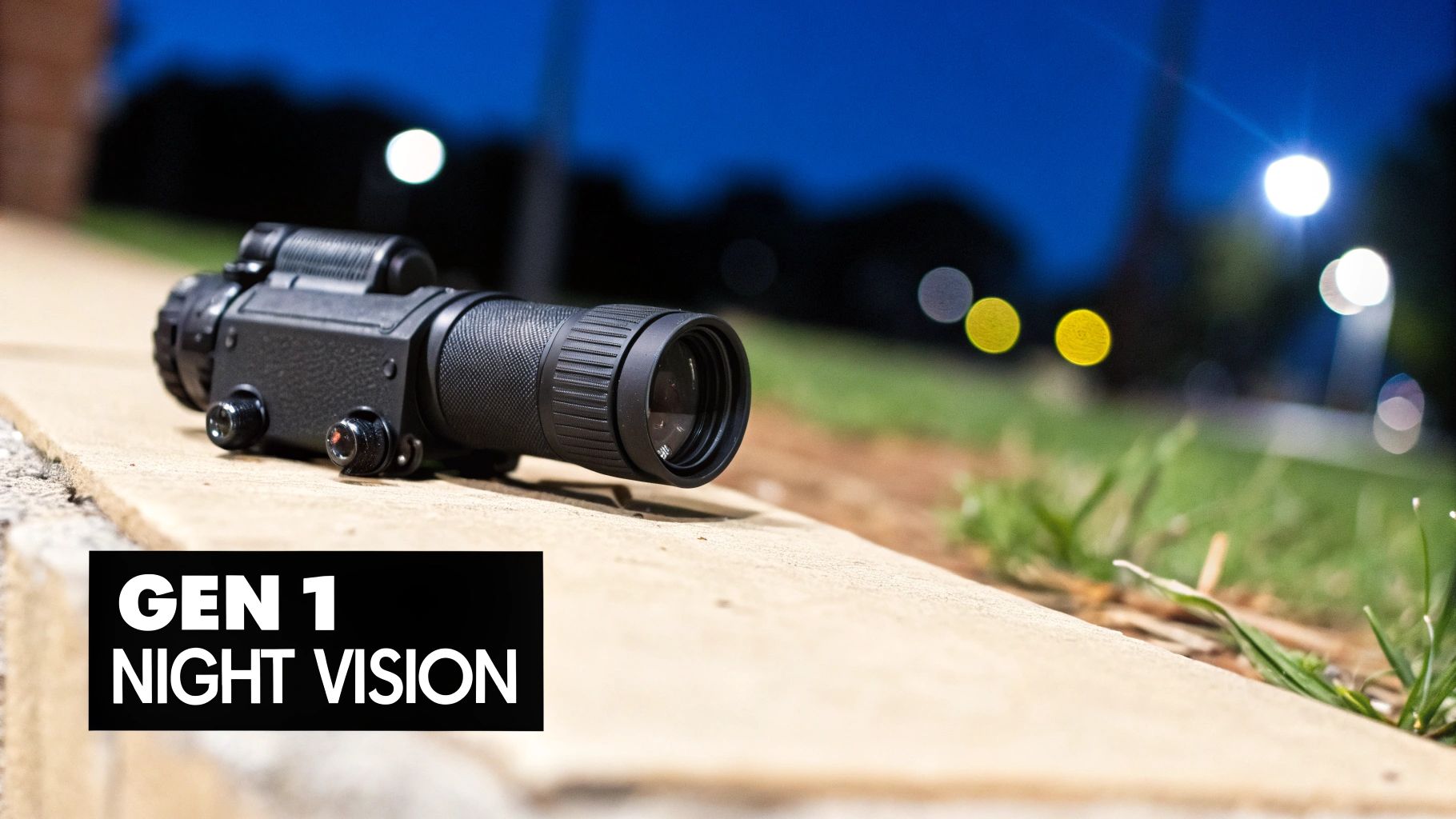
At its heart, Gen 1 is a passive system. That means it works by gathering whatever tiny bit of ambient light is available—starlight, moonlight—and amplifying it thousands of times so your eye can see it. This was a huge leap from older "active" systems that needed a giant, obvious infrared searchlight just to function. Gen 1 gave users a way to see in the dark without announcing their presence to the world.
Think of it like the very first affordable digital camera. It was incredible for its time and opened up a whole new world, but you wouldn't compare its grainy, low-res photos to what a modern DSLR can produce. Gen 1 night vision is much the same; it gets the job done, but it has some very distinct traits you need to be aware of.
The Hallmarks of a Gen 1 Device
Using a Gen 1 unit is a unique experience, defined by the technology of its era. These aren't necessarily defects, but they are built-in characteristics of the design.
- Needs Some Light to Work: Gen 1 devices are light amplifiers, not magic. They have to have some light to amplify. In a sealed room or a deep cave with zero light, they're blind.
- Comes with a Built-in IR Flashlight: To get around that "total darkness" problem, almost every Gen 1 unit has a built-in infrared (IR) illuminator. It’s a flashlight that’s invisible to the naked eye but lights up the world for the night vision device.
- Classic "Fisheye" Image: The view through a Gen 1 tube often has some geometric distortion, especially around the edges, making it look a bit like you're looking through a fisheye lens. The image can also be a little grainy or have tiny, flashing points of light (scintillation).
- The Signature Whine: Fire up a Gen 1 device, and you'll often hear a faint, high-pitched whine. That’s totally normal. It's the sound of the high-voltage power supply doing its job inside the image intensifier tube.
A common mistake is thinking all night vision is created equal. The reality is that the performance gap between generations is massive. A Gen 1 unit will let you see things in the dark. A modern Gen 3 device will let you identify them with stunning clarity from a serious distance.
Getting a handle on these basics is key. It helps you set realistic expectations for what a Gen 1 device can deliver. If you're just getting into this world, taking a moment to learn about the different night vision generations will give you the context you need to make a smart choice. After all, this is the technology that started it all, paving the way for the incredible systems we have today.
How Gen 1 Night Vision First Owned the Night
To really get a handle on Generation 1 night vision, you have to go back in time. Picture the dense jungles and tense standoffs of the Cold War. Before Gen 1, fighting at night was a clumsy, risky business. Soldiers were stuck using flares that lit up everybody, or clunky active infrared systems that acted like giant, invisible flashlights. The big problem? The enemy could spot those IR beams a mile away, turning your attempt to see them into a "shoot here" sign.
This glaring tactical weakness drove the push for something new—a way to see in the dark passively, without broadcasting your position. The answer was a system that could amplify the tiny bit of light already there, from the moon or stars. This leap from active to passive wasn't just a small step; it completely rewrote the rulebook for after-dark warfare.
A Decisive Edge in the Jungles of Vietnam
The Vietnam War was where this new tech was truly put to the test. In the mid-1960s, the first Gen 1 devices started getting into the hands of U.S. troops, and it changed the fight overnight. These were the first practical passive systems, capable of boosting ambient starlight and moonlight by about 1,000 times without needing a separate IR illuminator. Suddenly, soldiers could see into jungle shadows where light levels were as low as 0.001 lux. This gave them the ability to spot an enemy up to 75 yards away—a feat that was pure science fiction just a few years earlier. You can explore more about the history of night vision development to see how these first steps set the stage for everything that followed.
The poster child for this era was the AN/PVS-2, better known as the "Starlight" scope. Bolted onto an M16, it gave a single soldier the power to run ambushes, collect intel, and hold a perimeter with an advantage that felt like cheating. For the first time, American forces could truly "own the night," turning darkness from a threat into their greatest ally.
The arrival of the AN/PVS-2 Starlight scope was a genuine game-changer. It allowed small units to operate with a level of stealth and lethality after dark that completely disrupted enemy tactics, which had long relied on the cover of night.
This new capability meant patrols could move without being seen and listening posts could spot threats without giving themselves away. The psychological effect on the enemy was huge. They could no longer melt into the darkness, creating a constant sense of fear and uncertainty.
The Gritty Reality of Early Gear
While Gen 1 was a revolutionary advantage, it was far from flawless. The technology of the day had some serious downsides that troops had to wrestle with in the field. This wasn't the slick, high-performance gear we're used to today.
- Heavy and Awkward: The AN/PVS-2 scope alone tipped the scales at about six pounds. Once you mounted it on a rifle, you were dealing with a top-heavy, clumsy weapon that was a real burden to hump through the jungle.
- Constant Thirst for Power: Keeping these early units running was a logistical headache. The batteries were bulky, not cheap, and would only last for a few dozen hours at best. Soldiers had to lug spares and be stingy with their power usage.
- Delicate and Temperamental: As the first of its kind, the tech was fragile. The image intensifier tubes were easily damaged by sudden exposure to bright light, and the scopes themselves just weren't built for the abuse of combat. They demanded careful handling.
Even with all these headaches, the strategic edge Gen 1 provided was too good to pass up. The lessons learned and the feedback from soldiers who used this gear in Vietnam became the driving force behind the push for smaller, lighter, and better systems. This history is crucial because it shows just how far we've come—from these pioneering, beastly scopes to the crystal-clear, advanced night vision you can get from Superior Tactical today.
How a Gen 1 Image Intensifier Tube Actually Works
At the heart of any Generation 1 night vision device is a component called an image intensifier tube, or IIT. You can think of it as a miniature light-amplifying engine. It takes the faintest traces of ambient light—starlight, moonlight, anything—and cranks up the volume, turning an invisible scene into a bright, visible image.
The magic starts the moment those faint particles of light, called photons, pass through the objective lens and hit a special surface at the front of the tube known as the photocathode.
From Light to Electrons
The photocathode has one critical job: for every photon that strikes it, it kicks out an electron. This is real-world physics in action, called the photoelectric effect. In an instant, the device converts the image from a pattern of light into a corresponding pattern of electrons.
Of course, these new electrons don't just sit there. A powerful electrostatic field immediately grabs them and slingshots them down the length of the vacuum-sealed tube. This high-voltage acceleration is what gives the electrons a massive energy boost, which is the key to amplifying the image.
This diagram helps visualize how Gen 1's "passive" system works. It doesn't need to project its own light source; it just amplifies what's already there.
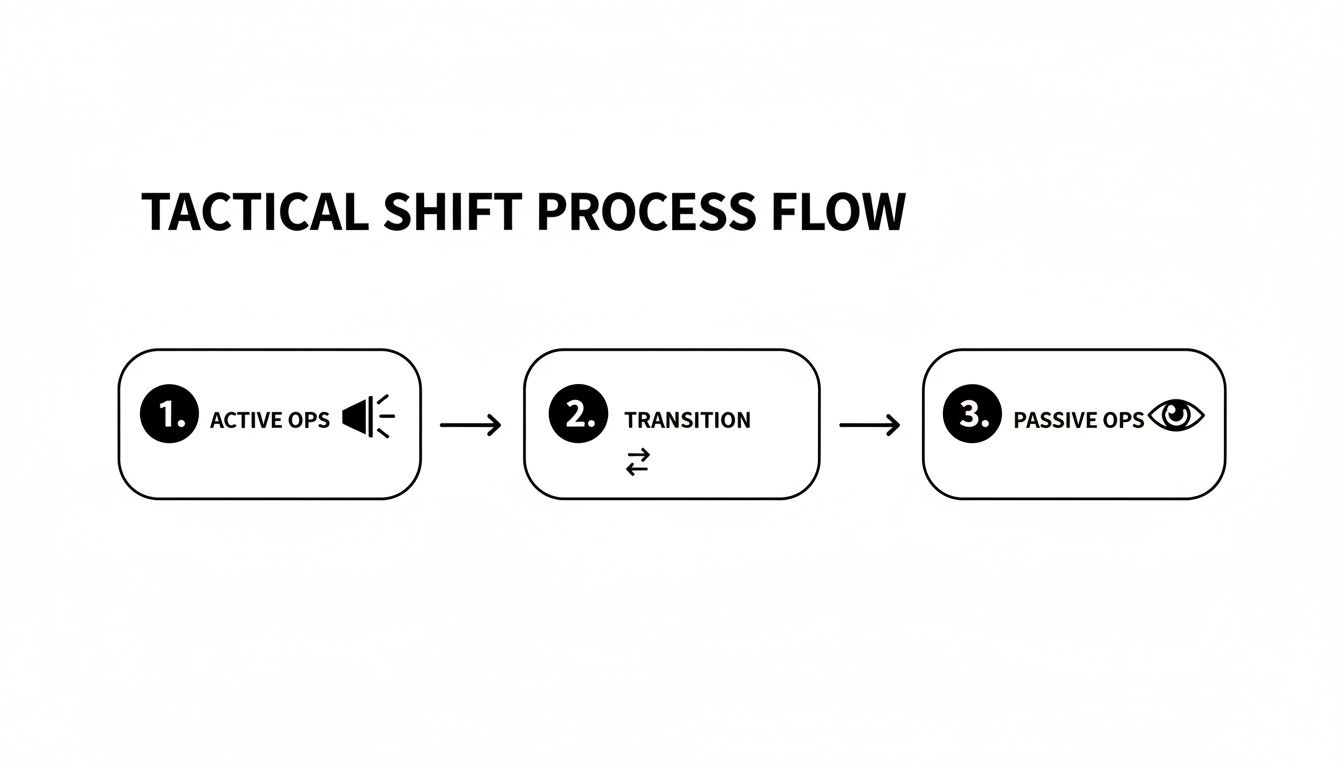
That's a huge advantage. Passive operation means you can observe without giving away your position with a detectable IR beam.
Creating the Classic Green Image
After their high-speed journey, these super-charged electrons crash into the final piece of the puzzle: the phosphor screen. When an electron hits this screen, it causes the phosphor coating to light up brightly at that exact point.
This screen is what creates that iconic green image everyone associates with night vision. Why green? Because the human eye is most sensitive to shades of green, which allows us to see more detail and subtle contrast compared to other colors.
The entire process, from a photon entering the lens to the green image appearing in your eyepiece, happens so fast it feels instantaneous. That's what gives you a real-time view of the world in the dark.
While the fundamental principles are the same, it's interesting to see how the technology has evolved. If you want to dive deeper, you can read a comparison of thin-filmed and unfilmed image intensifiers to see how modern tubes have improved on this original concept.
Why Gen 1 Images Have That Signature Look
Ever wonder why Gen 1 night vision has those specific quirks? It all comes back to the design of the tube. They aren't flaws, just characteristics of the technology.
- Geometric Distortion ("Fisheye" Effect): The simple electrostatic field that accelerates the electrons isn't perfect. It pulls electrons at the edges of the tube along a slightly different path than those in the center. This causes the image to look a bit warped or stretched around the periphery.
- Image Graininess (Scintillation): Gen 1 tubes don't have a microchannel plate (MCP), which is a key component in Gen 2 and 3 devices that multiplies the number of electrons by the thousands. Without it, the amplification isn't as clean, leading to a grainier, sometimes "sparkly" image, especially when light is scarce.
- Blooming: Point a Gen 1 device at a bright light, like a streetlight, and you'll see a big halo or "bloom" that washes out the area around it. This happens when the photocathode gets overloaded with too many photons at once.
These traits are the tell-tale signs of a Gen 1 device. While it has its limitations, this foundational technology was the first to truly give us the ability to own the night, and understanding how it works is key to using it effectively.
Understanding Gen 1 Performance and What to Expect
When you peer through a Generation 1 night vision device, you're looking through a piece of history. To get the most out of it, you need a solid grasp of its real-world performance—and you have to be honest about its limitations. Knowing how the specs translate to what you actually see in the field is everything.
Let's talk about image clarity. In the night vision world, we measure this in line pairs per millimeter (lp/mm). You can think of it like the resolution on a TV; more lines mean a sharper, cleaner picture. A typical Gen 1 unit sits around 20 lp/mm, which gets the job done but gives you a noticeably grainy image. Compare that to the crystal-clear 64+ lp/mm you'd get from a modern Gen 3 system, and the difference is night and day.
What This Means in the Field
That lower resolution has a direct impact on your ability to identify things at a distance. What might be a clear silhouette of a deer through a Gen 3 scope could just be a fuzzy, undefined blob through a Gen 1 unit at the same range. For a hunter who needs positive target ID or a security professional trying to assess a threat, that distinction is absolutely critical.
We learned a lot about these limitations when the U.S. military rolled out Gen 1 devices in Vietnam. Scopes like the AN/PVS-2 were game-changers, but they had their issues. The image resolution was often under 20 lp/mm, leading to serious graininess that made it tough to spot targets past 50 yards. This was made worse by a narrow, 40-degree field of view and a hefty build, with some units weighing up to 5 pounds. If you want to dive deeper, you can read more about the historical context of these early night vision systems and their battlefield impact.
Key Drawbacks You'll Encounter
Beyond just resolution, a few other quirks define the Gen 1 experience. These aren't defects; they're just part of how the technology works. Knowing them ahead of time will help you use the device properly and recognize when it's time for an upgrade.
- Blooming and Halos: Bright lights are the arch-nemesis of a Gen 1 tube. If you point it at a streetlight or even a bright flashlight, you’ll get a huge, glowing halo that washes out everything else in the scene. This "bloom" can temporarily blind you to anything happening near the light source.
- Limited Tube Lifespan: An image intensifier tube doesn't last forever. A Gen 1 tube is good for about 1,500 hours of operation. That's plenty for occasional use, but it's a fraction of the 10,000+ hours you can expect from a good Gen 3 tube.
- That Signature Whine: Turn on a Gen 1 device, and you'll hear a faint, high-pitched whine. That's the sound of the high-voltage power supply doing its job. It's totally normal, but it's definitely noticeable when you're in a dead-quiet environment.
- Edge Distortion: As we touched on earlier, Gen 1 tubes have a classic "fisheye" effect. The image is sharpest right in the center, but it gets progressively more distorted and blurry as you look toward the edges.
Knowing these limitations isn't about knocking the tech—it's about using the tool correctly. A Gen 1 device is a perfectly capable tool for short-range observation, but it's not the high-performance gear you'd want for a serious tactical situation.
A Head-to-Head Comparison
Putting the specs side-by-side makes the leap in performance between generations starkly clear. This is why professionals and serious enthusiasts are willing to invest in more advanced systems where clarity and dependability are non-negotiable.
Night Vision Generation Performance Comparison
This table breaks down how the generations stack up across the most important performance metrics.
| Specification | Generation 1 | Generation 2 | Generation 3 |
|---|---|---|---|
| Light Gain | ~1,000x | ~20,000x | ~50,000x+ |
| Resolution (lp/mm) | 20-28 | 28-38 | 64-72+ |
| Tube Lifespan (Hours) | ~1,500 | ~5,000 | 10,000+ |
| Blooming Control | None | Limited | Excellent (Autogated) |
| Image Distortion | Significant at edges | Minimal | None |
As you can see, there's a clear evolution. While Generation 1 night vision was revolutionary for its time, each new generation brought massive improvements across the board, leading us to the incredible systems we have today.
Practical Uses for Gen 1 Night Vision Today
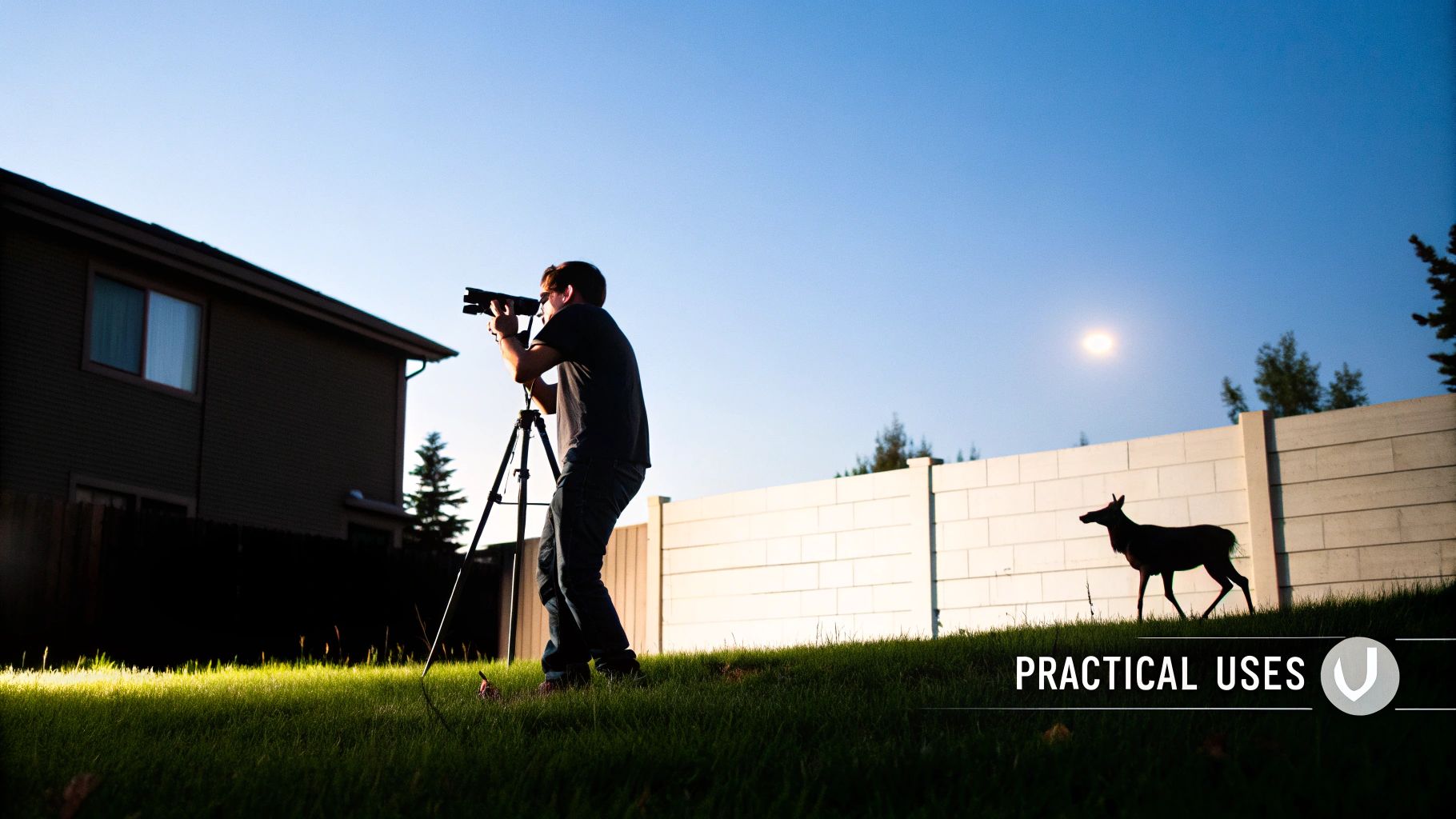
Even with all the high-tech options out there, generation one night vision still has a solid place in the real world. Its biggest advantage? Affordability. It's the perfect gateway for anyone curious about seeing in the dark but not ready to drop a ton of cash.
Think of it as your first step into a much larger world. A Gen 1 device is a low-cost way to figure out if night vision is something you'll actually get use out of before you commit to more expensive gear. You get to learn the basics of moving and spotting things in the dark without a major investment.
A Great Entry Point for Recreation
For casual fun where cutting-edge performance isn't a deal-breaker, Gen 1 really shines. It opens up a whole new world of things to do after the sun goes down, giving you a completely different perspective.
Here are a few places where Gen 1 is right at home:
- Backyard Wildlife Observation: Ever wonder what's making noise in your yard at night? A Gen 1 monocular is perfect for watching raccoons, deer, or owls from your porch without spooking them.
- Casual Night Hiking: On familiar trails with a bit of moonlight, a Gen 1 unit makes things safer and a lot more exciting.
- Airsoft and Paintball: Seeing when the other team can't is a massive advantage in night games. For close-quarters fun, Gen 1 gives you a real edge.
- Camping and Stargazing: It’s great for scanning the edge of your campsite for animals or finding your way to the latrine without killing your night vision with a bright flashlight.
The key to success with Gen 1 is managing expectations. It’s not a high-performance military tool, but it is an excellent and affordable device for seeing things that go bump in the night close to home.
Honestly, the typical Gen 1 issues like fisheye distortion and blooming don't matter much when you're just watching a possum. They become a much bigger deal when you're trying to identify a potential threat hundreds of yards away.
Smart Applications for Hunters and Landowners
While most serious hunters will see a huge benefit from Gen 2 or Gen 3, there are still jobs where a Gen 1 device makes a lot of sense. It can be surprisingly effective when you use it for the right tasks, especially from a fixed spot and at closer distances.
Take short-range pest control, for instance. If you're dealing with rodents or other nuisances inside 50 to 75 yards, a Gen 1 scope on a rimfire rifle can be all you need, especially on a farm or ranch.
Scouting from a blind or tree stand is another great use. Grab a Gen 1 monocular and a good infrared illuminator, and you can easily scan a food plot without broadcasting your location with a spotlight. To really dial this in, you need to understand how your device and IR light work together. For a complete breakdown, check out our guide on choosing an infrared illuminator for night vision.
That said, you have to be honest about where generation one night vision falls short. If you need to positively identify a target at a distance, move through rough country, or operate where safety is paramount, its limited clarity and resolution are serious drawbacks. Gen 1 definitely has its purpose, but knowing what that purpose is ensures you always grab the right tool for the job.
When It's Time to Upgrade Your Night Vision Gear
Knowing when to move on from generation one night vision—or whether you should skip it entirely—is a big question. The right answer really boils down to what you're trying to do, but there are some clear signs that your current gear is holding you back.
If you’re a first-time buyer, the low price of Gen 1 can be tempting. But you have to look past the price tag. A decent entry-level unit, even a Gen 1, should feel solid in your hands, have a clear objective lens, and pack a useful built-in IR illuminator. Just be skeptical of wild claims; if a budget device promises Gen 3 performance, that’s a huge red flag.
Upgrade Triggers: When Your Gear Is Holding You Back
If you’re already running a Gen 1 device, you know its limits. When you start bumping up against that performance ceiling over and over again, it’s a sure sign you’ve outgrown your gear and it’s time for a real upgrade.
- You Just Need More Range: Are you constantly struggling to see anything clearly past 75 yards? If your hunting or security work demands that you can spot and identify targets at 100 yards or more, a Gen 1 unit is going to let you down every time.
- Positive ID is a Must: The grainy, low-resolution image from a Gen 1 makes it tough to tell a coyote from a stray dog at a distance. If making a positive identification is critical for your safety or success, the clarity you get from Gen 2 or Gen 3 isn't just nice to have—it's essential.
- You Work in Pitch-Black Conditions: Gen 1 tubes are starved for light. On an overcast, moonless night deep in the woods, they're practically useless without blasting an IR illuminator, which gives away your position. If that's your operating environment, you need a more sensitive tube.
- Distortion and Blurriness Are Getting in the Way: That classic "fisheye" effect and blurry edges common in Gen 1 can be more than just annoying; they can be disorienting, especially when you're on the move. That kind of image distortion can cause eye strain and slow you down when every second counts.
Think of it this way: your night vision gear should be an asset, not a liability. When you find yourself fighting its limitations more than you're using its capabilities, it’s no longer doing its job.
Making the Jump to a Higher Generation
Stepping up from Gen 1 to Gen 2 or Gen 3 isn't just an incremental improvement; it's a completely different world of capability. Generation 1 was incredible stuff back in the 1960s, but its specs—a light gain around 1,000x and a lifespan of maybe 1,500 hours—are ancient history by today's standards. After the Vietnam War, it became the go-to for the civilian market simply because it was cheap.
Today, the pros here at Superior Tactical LLC rely on Gen 3 systems that run for 5,000 to 15,000 hours and give us crisp, clear identification well beyond 200 yards. That’s the kind of performance Gen 1 just can’t touch. You can learn more about the evolution of this technology on superiortac.com.
Ultimately, upgrading is an investment in your safety, effectiveness, and confidence in the dark. It gives you the clarity to make good decisions, the range to control your environment, and the reliability to perform when it counts. Learning to spot these upgrade triggers will help you know when it's time to make the move to gear that can keep up with you.
Got Questions About Gen 1 Night Vision? We've Got Answers.
When you're first dipping your toes into the world of night vision, especially with Gen 1 gear, a lot of questions pop up. It's totally normal. Let's tackle some of the most common things people ask, so you can get a straight-up understanding of what this technology can and can't do.
Can Gen 1 Actually See in Complete Darkness?
Not on its own, no. A Gen 1 device needs some ambient light to work with—think moonlight or starlight. It's an amplifier, so it has to have something to amplify in the first place. If you're in a pitch-black room with no light sources, you won't see anything.
That's exactly why nearly all Gen 1 units have a built-in infrared (IR) illuminator. Think of it as an invisible flashlight. It throws out a beam of light your eyes can't see but the device can, letting you light up your surroundings and see even in total darkness.
Why is the Image Green and Kind of Warped?
That classic green glow comes from the type of phosphor (P43, to be exact) used on the screen inside the tube. Our eyes are incredibly good at picking out different shades of green, which helps our brains see more detail and contrast in what would otherwise be a simple black-and-white image.
As for that "fisheye" effect where the edges get blurry and distorted? That's just a hallmark of the simple electron optics used in Gen 1 tubes. It was one of the biggest things engineers set out to fix in later generations, and they largely succeeded by using more sophisticated components.
Is it Okay to Use Gen 1 Night Vision During the Day?
Never. Seriously, don't do it. Pointing any night vision device at a bright light source, especially the sun, will instantly fry the image intensifier tube. The tube is built to multiply tiny amounts of light, so hitting it with a massive blast of intense light overloads and burns it out, leaving you with permanent black spots or a completely dead unit.
Rule number one: always keep the lens cap on during the day or in any bright area. It’s the single most important thing you can do to protect your gear and make sure it lasts.
Is Gen 1 Good Enough for Hunting?
That really depends on what you're hunting and how you're doing it. For short-range work, like controlling pests around a property inside 75 yards or observing from a fixed blind, a Gen 1 unit can get the job done. This is especially true if you pair it with a good IR illuminator.
However, for most real-world hunting scenarios where you need to positively identify a target at a distance, move through rough country, or guarantee safety, Gen 1's low resolution and short effective range become major limitations. Most serious hunters quickly realize that the clarity and capability of a Gen 2 or Gen 3 system is a much better, safer, and more reliable investment.
Ready to see the difference that modern technology makes? The team at Superior Tactical LLC has over a decade of experience outfitting professionals and enthusiasts with top-tier night vision and tactical optics. Explore our curated selection of gear and get expert advice to ensure you're always mission-ready at https://superiortac.com.
