A Guide to Generation 3 NVG Technology
Generation 3 night vision represents the pinnacle of analog image intensification, setting the benchmark for performance in the darkest conditions. The secret sauce is its Gallium Arsenide (GaAs) photocathode, a massive leap forward that gives these devices their incredible light sensitivity and image clarity, leaving older generations in the dust.
What Is Generation 3 Night Vision
At its heart, a Generation 3 NVG is a light-gathering machine on steroids. It takes whatever faint ambient light is available—starlight, moonlight, or even the subtle glow from a city miles away—and amplifies it tens of thousands of times. This creates a bright, crisp image of a scene that would be completely black to the naked eye. All this magic happens inside the image intensifier tube.
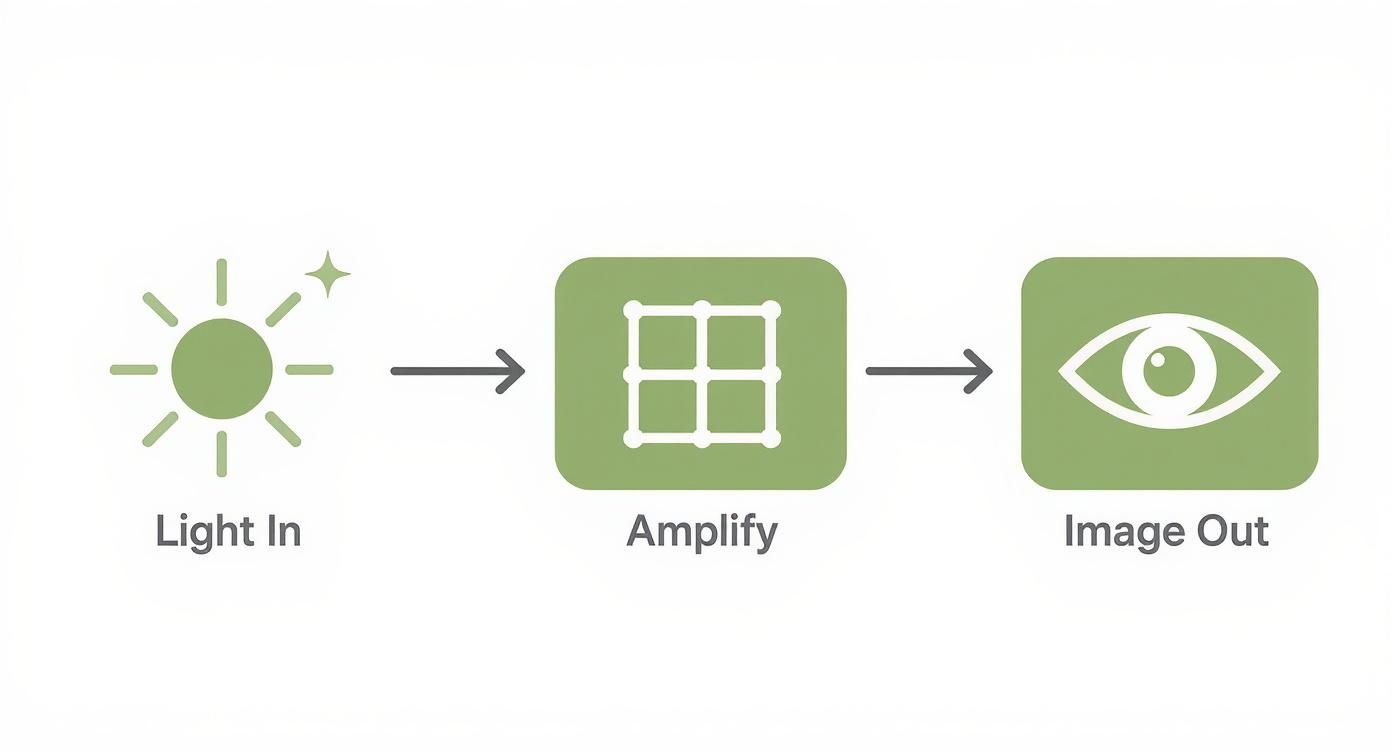
You can think of the image intensifier tube as a three-step process that turns invisible light into a visible picture. This ability to see in the dark is what gives users a massive advantage, whether they're navigating rough terrain, identifying a target, or just maintaining awareness of their surroundings.
How an Image Intensifier Tube Works
The process inside a Gen 3 tube is a brilliant piece of physics, but it's pretty straightforward once you break it down.
-
The Photocathode: This is where it all starts. When tiny particles of light, called photons, enter the device, they hit this specialized surface. In Gen 3, this surface is made of Gallium Arsenide, which is incredibly efficient at converting those photons into electrons. It’s far better at this job than the materials in Gen 2 devices, meaning it captures more of the available light right from the get-go.
-
The Microchannel Plate (MCP): Now for the real amplification. The electrons released from the photocathode fly into the MCP, which is a wafer-thin disc honeycombed with millions of microscopic glass tubes. As an electron zips through a tube, it bounces off the walls, knocking loose a whole cascade of new electrons with each impact. One electron goes in, and thousands come out.
-
The Phosphor Screen: This is the finish line. The now massive cloud of electrons slams into a screen coated with phosphor, causing it to glow brightly wherever the electrons hit. This creates the image you see—either in the traditional green or the more modern white phosphor.
This simple, three-step journey is what turns a few photons of starlight into a detailed, usable image.
The efficiency of this process is what truly sets Gen 3 apart from anything that came before it.
The real-world advantage of Gen 3 technology is its exceptional sensitivity and high signal-to-noise ratio. This translates to a much cleaner and sharper image, especially under a dark, star-lit sky where older devices would show a lot of "snow" or static that washes out the details.
The following table highlights the key technological milestones that define Gen 3 performance.
Gen 3 NVG Key Performance Milestones
| Core Technology | Performance Impact | User Benefit |
|---|---|---|
| Gallium Arsenide (GaAs) Photocathode | Dramatically increased sensitivity to light, especially in the near-infrared spectrum. | Clearer images in extremely low-light conditions (e.g., overcast, moonless nights). |
| Ion Barrier Film | Protects the photocathode from ion bombardment, significantly extending tube lifespan. | A device that lasts 10,000+ hours versus the 2,000-4,000 hours typical of Gen 2. |
| Improved Microchannel Plate (MCP) | More efficient electron multiplication, contributing to a higher signal-to-noise ratio (SNR). | A less "staticky" or "snowy" image, allowing for better target identification at a distance. |
These advancements work together to create the high-performance, durable, and reliable night vision systems that have become the standard for serious users.
What Makes a Gen 3 Night Vision Device Tick?
Looking at a spec sheet for a Gen 3 NVG can be intimidating. It's a wall of numbers and acronyms. But those numbers are the whole story—they tell you exactly how a device will perform when the lights go out. Let's break down what those key metrics actually mean for you out in the field.
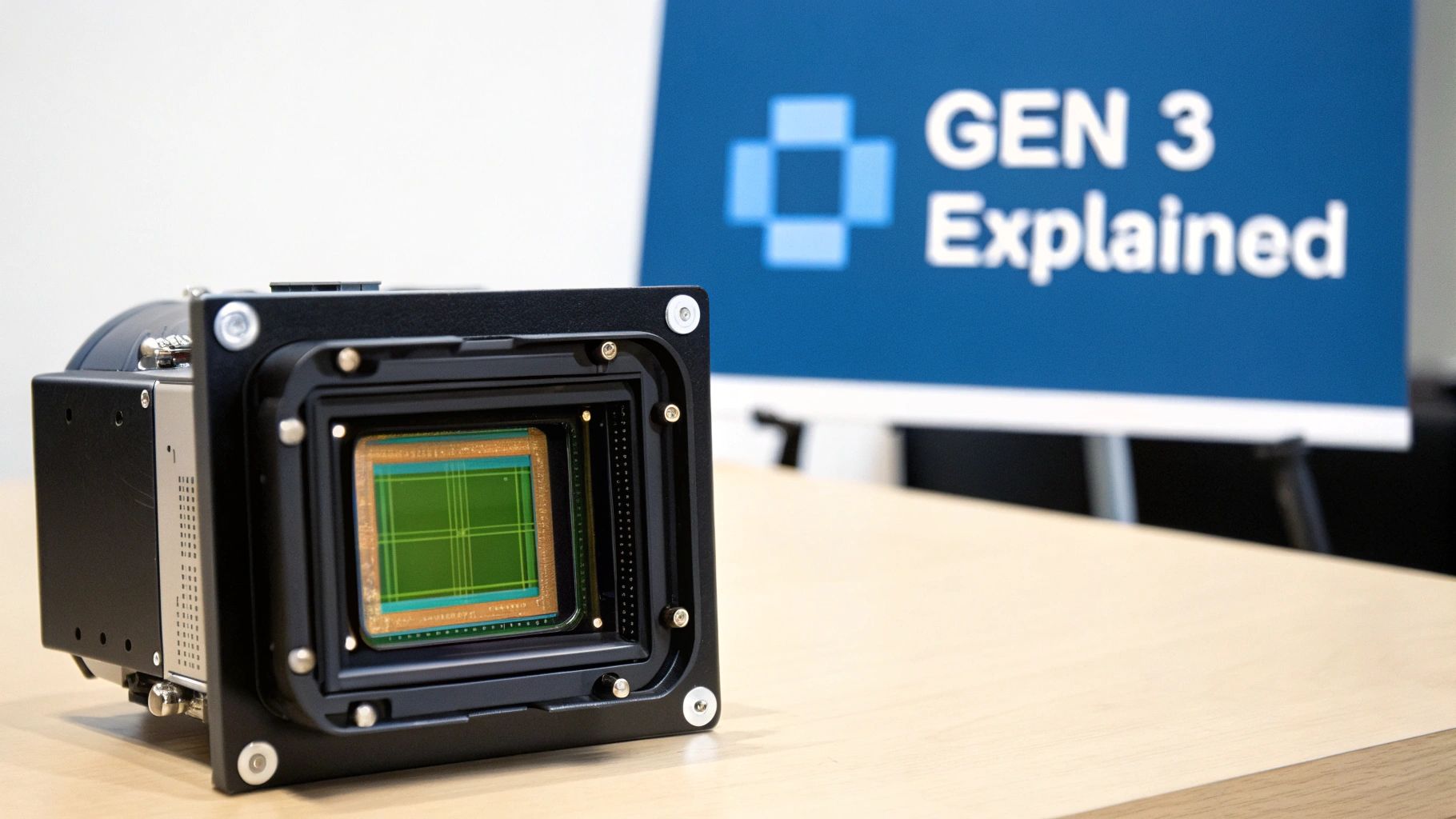
The heart and soul of any Gen 3 device is its Gallium Arsenide (GaAs) photocathode. This is the technological leap that separates Gen 3 from everything that came before it. Think of it as the engine that drives performance. This material is incredibly efficient at converting the faintest traces of light into electrons, which is the first and most critical step in creating a usable image in near-total darkness. For a deeper dive into the market and technology, you can check out this detailed industry analysis.
While the photocathode is the starting point, a few other key specs determine what you actually see through the eyepiece.
Signal-to-Noise Ratio (SNR): The Quest for Clarity
Ever tried to listen to a radio station with a weak signal? The music you want to hear (the signal) is fighting against a backdrop of static (the noise). Signal-to-Noise Ratio (SNR) in night vision is the exact same concept.
The "noise" shows up as a faint, sparkling graininess in the image, often called "scintillation." It's most noticeable in the darkest environments. A high SNR means the image intensifier tube is powerful enough to amplify the available light without introducing a lot of that distracting static. The result is a much cleaner, clearer picture that makes it easier to spot details.
A tube with an SNR of 25 is solid, but top-tier units push into the mid-30s and beyond. That difference becomes glaringly obvious on a moonless, overcast night, where a high-SNR device will deliver a crisp image while a lower-spec one might be a mushy, grainy mess.
Resolution: It's All in the Details
If SNR is about clarity, then resolution is all about sharpness. It’s measured in line pairs per millimeter (lp/mm) and, in simple terms, tells you how much fine detail the tube can distinguish. Think of it as the difference between standard definition and high definition.
Most decent Gen 3 tubes will have a resolution of at least 64 lp/mm, while the really good ones can hit 72 lp/mm or more. A higher number means you can better distinguish textures, read signs from a distance, or identify a potential threat by its silhouette. While more is always better, the gains become harder for the human eye to notice much past the low 70s.
Autogating: Protecting Your Eyes and Your Gear
The real world isn't consistently dark. You'll encounter sudden, bright lights—car headlights, street lamps, or even a muzzle flash. Without protection, these can overwhelm your tube, causing damage, and temporarily blind you. That's where autogating comes in.
Autogating is essentially a super-fast, self-adjusting brightness control for your NVG. It rapidly flickers the tube's power supply thousands of times a second to regulate the amount of light that gets amplified. This has three huge benefits:
-
Tube Protection: It acts as a safety valve, preventing bright light sources from burning out the sensitive components inside the tube.
-
Image Integrity: It drastically reduces the "bloom" or halo effect around lights, letting you see what's happening around the light source instead of just being washed out.
-
Keeps You in the Fight: By preventing temporary blindness and after-images, it preserves your situational awareness when things get dynamic.
This feature is standard on any modern, high-performance generation 3 nvg and is non-negotiable for tactical or professional use. It also plays a big role in the overall lifespan of the tube. To learn more about protective measures, check out our comparison of thin-filmed and unfilmed image intensifier tubes.
Green vs. White Phosphor: The Final View
The last major choice you'll make is the color of the image itself. This is determined by the phosphor screen that displays the final, amplified image to your eye.
| Phosphor Type | Image Appearance | Key Advantage | Where You'll See It |
|---|---|---|---|
| Green (P43) | The classic "night vision green" you see in movies. | The human eye is very sensitive to shades of green, which can make it easier to pick out details. | Traditional military units and more budget-conscious options. |
| White (P45) | A crisp, black-and-white grayscale image. | Many users find it provides better contrast and depth perception, and most agree it causes less eye strain over long nights. | The new standard for high-end tactical, law enforcement, and serious civilian use. |
There's nothing wrong with green phosphor—it's a proven workhorse. But white phosphor has quickly become the preferred choice for those who spend a lot of time under NODs. The improved contrast and reduced eye fatigue can make a real difference during hours-long operations or hunts. The choice often comes down to budget and personal preference, as white phosphor tubes usually carry a premium price tag.
How Gen 3 Compares to Other NVG Generations
To really get why Generation 3 NVGs are such a big deal, it helps to look at where the technology came from. Every generation marks a huge jump in what's possible, taking us from the grainy, warped images of the past to the incredibly sharp views we have today. The road from Gen 1 to Gen 3 is a story of some serious innovation.

This isn't just about better numbers on a spec sheet. It's about what you can actually do in the dark. A Gen 1 unit might keep you from walking into a tree, but a Gen 3 unit lets you spot and identify a threat from hundreds of yards away. That's a world of difference.
Generation 1: The Affordable Starting Point
Dating back to the 1960s, Generation 1 was the first real attempt at bringing night vision to the masses. These devices are still the most affordable you can find, but you get what you pay for. They need a good bit of ambient light—think a half-moon or brighter—just to produce a usable image.
Even with enough light, the image is often plagued by geometric distortion around the edges, giving you a weird "fish-bowl" effect. Gen 1 units also lean heavily on an active infrared (IR) illuminator. This is basically an invisible flashlight, but it's a dead giveaway to anyone else using night vision.
Here are the key drawbacks of Gen 1:
-
Weak Light Amplification: They only boost light by a few thousand times, making them struggle in truly dark conditions.
-
Image Distortion: The view is often blurry and warped, especially at the periphery.
-
Short Lifespan: You can expect a tube life of only around 1,500 hours.
Generation 2: A Major Leap Forward
The game-changer for Gen 2 technology in the 1970s was the Microchannel Plate (MCP). This component amplified light far more effectively, resulting in images that were worlds brighter and clearer than anything Gen 1 could produce. It was the first time devices could work "passively"—without an IR illuminator—in most moonlit environments.
Gen 2 was a huge improvement, delivering better resolution (45-54 lp/mm) and much less distortion. But when you get into genuinely dark situations, it still can't hang with Gen 3. The image often breaks down into a grainy, "snowy" mess.
While Gen 2 devices are perfectly capable for a lot of civilian uses like hunting or checking your property, they just don't have the raw sensitivity for situations where every single photon counts.
Generation 3: The Gold Standard
Everything changed again with the arrival of the Gallium Arsenide (GaAs) photocathode in Gen 3 devices. This material is incredibly efficient at turning photons into electrons, blowing the photocathodes in Gen 2 out of the water. This one advancement is the secret sauce behind Gen 3's legendary performance in near-total darkness.
A generation 3 nvg can amplify light by 30,000 to 50,000 times or more. The result is a crisp, clean image even when the only light source is the stars. With resolution typically hitting 64 lp/mm or higher and a lifespan that can exceed 10,000 hours, Gen 3 is the undisputed standard for military, law enforcement, and serious civilian pros.
This performance gap is night and day, especially when you put it up against digital systems. For a deeper dive, check out our guide on thermal, digital, and analog night vision where we break it all down.
To make things even clearer, here's a quick side-by-side comparison:
Night Vision Generations at a Glance
This table breaks down the core differences in performance you can expect as you move up through the generations.
| Feature | Generation 1 | Generation 2 | Generation 3 |
|---|---|---|---|
| Light Amplification | Low (1,000x – 3,000x) | Medium (20,000x) | High (30,000x – 50,000x+) |
| Image Quality | Distorted, blurry edges | Clearer, some noise | Very sharp and clean |
| Typical Resolution | ~20-30 lp/mm | 45-54 lp/mm | 64+ lp/mm |
| IR Illuminator | Almost always required | Needed in low light | Rarely needed |
| Tube Lifespan | ~1,500 hours | ~5,000 hours | 10,000+ hours |
| Key Technology | Basic photocathode | Microchannel Plate (MCP) | GaAs photocathode |
As you can see, each generation builds upon the last, with Gen 3 representing the pinnacle of analog image intensification technology widely available today.
What About Generation 4?
You'll sometimes hear the term "Gen 4" thrown around, but it's important to know this isn't an official military designation. The term was cooked up by the industry to market a specific type of high-end Gen 3 tube known as "unfilmed" or "filmless."
These tubes get rid of the ion barrier film on the MCP. This tweak allows a little more light to get through and also reduces the halo effect you see around bright light sources. While these "unfilmed" tubes offer truly exceptional performance and are often seen as the peak of Gen 3 tech, the U.S. Army officially classifies them as Gen 3.
So, when you see "Gen 4," just think of it as an advanced, top-tier version of Gen 3, not a whole new generation.
Where Gen 3 NVGs Actually Get Used
The specs are impressive, but they don't paint the whole picture. The real story of generation 3 nvg technology is out in the field, where its ability to cut through the dark can mean the difference between mission success and failure—or even life and death. From critical operations to specialized hobbies, Gen 3 devices deliver a serious advantage when the sun goes down.
This isn't just a niche market, either. The demand for high-performance night vision is booming. The global market was valued at around USD 3.46 billion in 2025 and is expected to climb to USD 4.25 billion by 2029. This growth is fueled by military modernization programs and a growing need for advanced surveillance tools across the board. You can dive deeper into these trends in this detailed industry report.
Military and Law Enforcement
For soldiers and police officers, darkness isn't a limitation; it's an opportunity. Gen 3 technology is a huge part of what makes that possible. These professionals work in high-stakes environments where knowing what's around you is everything. A Gen 3 unit gives them the clarity to move through tricky terrain, spot threats from hundreds of meters out, and coordinate with their team—all without a flashlight that would scream, "here I am!"
This is where features like autogating become absolutely essential. It means an operator can transition from a pitch-black alley to a brightly lit street or take a muzzle flash to the face without being completely blinded. The image stays usable, and they stay in the fight.
The ability to clearly distinguish between a threat and a non-combatant in near-total darkness is a capability that fundamentally changes the outcome of nighttime operations. It reduces risk to both the operator and innocent civilians.
Search and Rescue
When someone is lost in the wilderness, the search doesn't stop when the sun sets. For search and rescue (SAR) teams, Gen 3 NVGs are a game-changer. They allow teams to scan huge, dark areas for any sign of a missing person, a downed plane, or survivors after a disaster.
The high resolution and clean image of a good Gen 3 tube let rescuers pick up on tiny details that are completely invisible otherwise. Things like:
-
Reflective clothing: A tiny glint from a piece of tape on a backpack can be seen from far away.
-
Movement: Catching the slight shift of someone trying to stay warm under a tree.
-
Contrast: Being able to pick out the outline of a person against a messy background of rocks and foliage.
This tech dramatically expands the effective search area and gives rescuers a much better shot at finding someone in time.
Civilian and Recreational Use
It’s not just for professionals anymore. Generation 3 nvg gear has carved out a solid niche in the civilian world, too. Nocturnal hunters rely on it to track and identify game like coyotes and feral hogs, making for a more ethical and effective hunt without spooking every animal in the county with a spotlight.
Wildlife enthusiasts and photographers are also big fans. They can observe animals acting naturally in their own environment, capturing incredible footage and insights that were once impossible to get. And then there’s the growing community of DIY builders and hobbyists, who piece together their own setups for everything from stargazing to keeping an eye on their property at night. This adaptability has made top-tier night vision more accessible than ever before.
A Practical Guide to Buying Your First Gen 3 NVG

Jumping into Gen 3 night vision is a serious investment, but figuring out the right device for you doesn't have to be a shot in the dark. Think of this as your field guide to making a smart choice, one that gets you the performance you need without the buyer's remorse. It all boils down to knowing how to judge a good tube and what to look for beyond the marketing hype.
It's no secret that high-performance night vision is becoming more accessible, and the market reflects that. Valued at USD 8.01 billion in 2024, the night vision industry is expected to climb to USD 12.91 billion by 2030, largely thanks to the incredible performance of Gen 3 tech. You can dig deeper into the numbers in this industry analysis on MarketsandMarkets.com.
Learning to Read the Spec Sheet
Every image intensifier tube is born with a data sheet—its birth certificate. Learning how to read this "spec sheet" is probably the single most important skill you can have as a buyer. At first glance, it might look like a mess of acronyms, but a few key numbers tell you almost everything you need to know about its performance.
Focus on these critical specs first:
-
SNR (Signal-to-Noise Ratio): If you only look at one number, this is it. It’s a direct measure of image clarity versus electronic "snow" or static. Anything over 30 is fantastic and means you’ll get a clean, crisp picture even in the darkest environments.
-
Resolution (lp/mm): This tells you how sharp the image is. A resolution of 64 lp/mm is a solid baseline for a good tube, but premium units can push 72 lp/mm or even higher, letting you see finer details.
-
EBI (Equivalent Background Illumination): Think of this as the tube's "self-glow." A lower EBI means darker black areas and better contrast, which is crucial for spotting shapes in deep shadow. You want this below 2.0, and anything under 1.0 is excellent.
-
Halo: This is the ring of light that blooms around bright sources like streetlights. A low halo value (under 1.0) is a huge plus for use in urban areas or anywhere you'll encounter artificial light.
These aren't just abstract numbers; they have a direct impact on what you can see. A tube with high SNR and low EBI will pierce through the darkness on a moonless, overcast night. High resolution helps you positively identify something at a distance.
Remember: The spec sheet is the objective truth. Don't fall for flashy marketing terms. Always insist on seeing the data for the exact tube you're buying.
Choosing Your System: Monocular vs. Binocular
Once you know what makes a good tube, you have to decide what kind of housing to put it in. The choice usually comes down to a single-tube monocular or a dual-tube binocular setup. Both have their pros and cons, and we cover them in depth in our guide on how to choose the right night vision device for your needs.
The classic PVS-14 is the workhorse of monoculars for a reason. It's incredibly versatile—you can mount it on a helmet, a weapon, or just use it as a handheld spotter. A huge benefit of a monocular is that it leaves your other eye free, which preserves your natural night adaptation and helps with situational awareness.
Binocular systems, on the other hand, give you true depth perception. This is a game-changer for moving on foot over rough terrain or driving at night. They provide a much more immersive experience that's less fatiguing on your eyes over long periods. While they are heavier and more expensive, for many serious users, the trade-off is well worth it.
Don't Overlook Warranty and Support
A Gen 3 NVG is a sophisticated piece of equipment. Your relationship with the seller shouldn't end the moment your card is charged. A solid warranty and accessible support are just as crucial as the specs on the tube itself.
At Superior Tactical, we provide a 10-year warranty on our Gen 3 systems because we believe in the products we build. More importantly, we handle our own repairs and offer free diagnostics in-house. If something goes wrong, you talk directly to us—the people who built it. No third-party runaround, no endless waiting. It's about protecting your investment for the long haul and giving you the confidence to actually use your gear.
Common Questions About Generation 3 Night Vision
When you start digging into Generation 3 NVGs, you’re bound to have questions. It’s a big investment, and whether you're buying your first unit or you’re a seasoned pro, getting straight answers is what matters. We get these questions all the time, so let's break them down.
We'll cover everything from how long your tubes will last and the legal side of things to the nitty-gritty details of tube performance. The goal here is to cut through the noise so you can feel confident you're getting the right setup for your needs.
How Long Does a Gen 3 Night Vision Tube Last?
This is easily one of the first things people ask, and for good reason. The simple answer is a long, long time. A modern Gen 3 image intensifier tube is built to last, with a typical rating of 10,000 to 15,000+ hours of operation.
To put that in perspective, for the average civilian user, that’s easily decades of service. A tube doesn't just burn out like an old lightbulb. Instead, its performance might very slowly degrade over thousands of hours. The real killers are things you can control: severe physical shock (like dropping your PVS-14 on concrete) or exposing the tube to bright light without the day cap on.
Treat it with care, and your Gen 3 tube will be a reliable tool for years to come.
Is It Legal for Civilians to Own Generation 3 NVGs?
Let's clear this one up right away: Yes, in the United States, it is 100% legal for a U.S. citizen to purchase, own, and use Generation 3 night vision devices.
There is one critical piece of regulation you need to know about, though. This gear falls under the International Traffic in Arms Regulations (ITAR). In plain English, this means it's a controlled item that cannot be exported or even taken out of the U.S. without a specific license from the Department of State. This is why any reputable vendor will need to verify your U.S. citizenship before a sale—it's about staying compliant with federal law.
What Is the Difference Between Green and White Phosphor?
The color you see through your device—that iconic green glow or a crisp black-and-white image—is determined by the phosphor screen in the tube. The choice between them really boils down to a mix of performance and personal preference.
-
Green Phosphor (P43): This is the classic night vision look. For decades, green was the standard because the human eye is incredibly sensitive to its shades, making it easier to pick out details in the dark.
-
White Phosphor (P45): A more recent development, white phosphor produces a grayscale image. Many users find that it provides better contrast and depth perception, which helps a lot when you’re trying to judge distances or identify what you're looking at.
A common piece of feedback we hear from experienced operators is that the black-and-white image from white phosphor causes far less eye strain, especially during long nights. While both are incredibly effective, white phosphor has become the go-to for most serious users.
Should I Expect Blemishes in a Gen 3 Tube?
It's important to set the right expectations here. Tiny cosmetic blemishes, often called "spots" or "blebs," are a normal part of the tube manufacturing process. Think of them as tiny, fixed black dots in the image.
Even the most expensive, high-spec tubes can have a few small spots. The key is where they're located. The viewing area is divided into zones to grade these spots:
-
Zone 1: The very center of your view.
-
Zone 2: The ring just outside the center.
-
Zone 3: The outermost edge of the image.
A tube with no spots in Zone 1 is considered very clean. While a truly flawless tube is the holy grail—and priced accordingly—a few tiny spots in the outer zones (Zone 2 or 3) are perfectly normal. In practice, they don’t affect the device's performance, and you likely won't even notice them when you're actually moving and scanning.
At Superior Tactical LLC, we don't just sell gear; we provide the support you need to use it with confidence. All our Gen 3 systems are backed by a 10-year warranty, and we handle all our repairs and diagnostics in-house. Explore our curated selection of high-performance night vision and tactical accessories at https://superiortac.com.
