A Complete Guide to Gen 3 NVGs Technology and Performance
Imagine you're out on a moonless night. It's so dark you can't see your hand in front of your face. This is where Gen 3 NVGs (Night Vision Goggles) come in. They are the benchmark for professional-grade night vision, transforming pitch-black environments into a clear, detailed landscape by amplifying trace amounts of light thousands of times.
What Makes Gen 3 NVGs the Gold Standard
To really get why Gen 3 NVGs are a big deal, you have to look at the tech inside. The magic happens in something called an image intensifier tube. This isn't like a digital camera that just records light; it actively gathers photons—the basic particles of light—and multiplies them on a massive scale before sending that amplified image to your eye.
Here’s a good way to think about it: imagine someone whispering from across a massive, empty stadium. You'd never hear it. But the image intensifier tube is like a flawless sound system that catches that whisper, boosts its volume thousands of times, and plays it back with perfect clarity. That's exactly what Gen 3 devices do with starlight, moonlight, or any other faint light source.
The Gallium Arsenide Advantage
The real breakthrough with Gen 3 is the material used for the photocathode: Gallium Arsenide (GaAs). The photocathode is the part that does the initial work of converting incoming light (photons) into electrical signals (electrons). Earlier generations used materials that were okay, but the switch to GaAs changed everything.
Gallium Arsenide is incredibly sensitive to light, particularly in the near-infrared part of the spectrum that’s invisible to our eyes but plentiful on even the darkest nights. This means Gen 3 units can paint a bright, sharp picture with far less ambient light than any older technology could ever hope to.
The jump to Gallium Arsenide was such a massive leap forward that it cemented Gen 3's status as the go-to for military and law enforcement. It lets you see with incredible clarity in conditions where older gear would just show you a screen full of static.
This technology first hit the scene in the early 1980s and kicked off a new era for night operations. Generation 3 tubes boosted light amplification to between 40,000 and 70,000 times—a huge jump from the 20,000x gain you'd get from a good Gen 2 system. This is what solidified Gen 3 as the top choice for anyone who can't afford to compromise, a market shift detailed in comprehensive night vision goggle market research.
Gen 3 NVG Core Technology At a Glance
To see how these pieces come together, this table breaks down the core components that give Gen 3 its incredible performance. Each part has a specific job in turning the unseen world into a clear, usable image.
| Key Component | Function | Performance Impact |
|---|---|---|
| Gallium Arsenide (GaAs) Photocathode | Converts faint light (photons) into electrons with high efficiency. | Dramatically improves low-light sensitivity and overall image brightness. |
| Microchannel Plate (MCP) | Multiplies the number of electrons by the thousands. | Creates significant light gain, making the image bright enough to see. |
| Phosphor Screen | Converts the amplified electrons back into visible light. | Renders the final green or white image that the user sees through the eyepiece. |
Ultimately, it’s the synergy between these highly advanced components that delivers the clarity, brightness, and range that make Gen 3 the undisputed king of night vision.
Comparing Gen 3 Against Other Night Vision Tech
To really grasp what makes Gen 3 NVGs the gold standard, it helps to see how they stack up against the other options out there. While Gen 3 is the benchmark for serious users, it's not the only game in town. Each technology has its place, and understanding the core differences is the key to picking the right tool for your specific mission.
At its heart, a Gen 3 device is a light-gathering machine. It takes incredibly faint traces of ambient light—from the moon, stars, or even distant city glow—and amplifies it thousands of times to paint a clear, bright picture for your eyes.
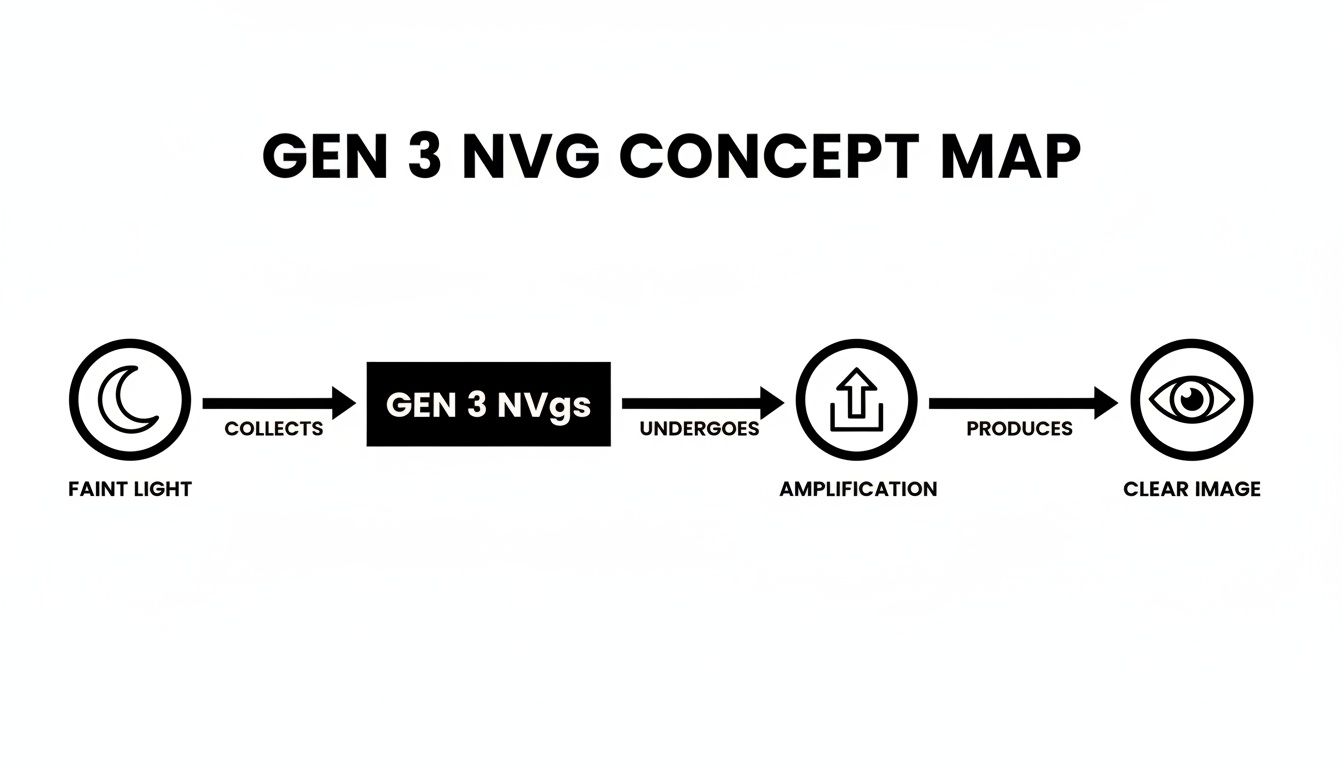
This process, called image intensification, is what modern night vision is all about. But as you'll see, not all image intensification is created equal. That's where the generational differences really come into play.
The Generational Leap: Gen 1 and Gen 2 vs. Gen 3
Think of the jump from Gen 1 to Gen 3 like going from an old tube TV with rabbit ears to a modern 4K screen. They both show you a picture, but the quality, clarity, and overall capability are worlds apart.
-
Gen 1: This is where it all started. Gen 1 devices need a lot of ambient light, like a bright, full moon, to work well. They're heavily reliant on built-in infrared (IR) illuminators, and the images are often blurry, with a distinct "fish-eye" distortion around the edges.
-
Gen 2: A huge step up. The introduction of the microchannel plate (MCP) boosted light amplification to around 20,000 times. This made Gen 2 units far more useful in low-light scenarios, reducing the need to blast an IR illuminator everywhere you look. It's a solid, capable technology for many civilian uses.
-
Gen 3: This is where the magic happens. By using a Gallium Arsenide photocathode, Gen 3 tubes amplify light by a staggering 40,000 to 70,000 times, sometimes even more. The result is a dramatically brighter, cleaner, and sharper image with much less of that distracting electronic noise or "scintillation," even on overcast, moonless nights. Your effective range is pushed way out, often well beyond 300 yards.
For a police officer who needs to positively identify a threat from a safe distance, or a hunter trying to spot a buck in a dark treeline, that Gen 3 clarity and range provides an operational edge that older generations just can't deliver.
Image Intensification vs. Thermal Imaging
People often lump night vision and thermal imaging together, but they're two completely different tools for different jobs. Here’s a simple way to think about it: night vision lets you see in the dark, while thermal lets you detect in the dark.
Gen 3 NVGs let you identify who or what you’re looking at by creating a detailed picture from available light. Thermal imaging, on the other hand, only sees heat signatures, telling you that something is there, even if you can't make out its features.
Let's break it down with a practical comparison:
| Technology | Best Use Case | How It Works |
|---|---|---|
| Gen 3 Night Vision | Navigation, identification, driving. | Amplifies ambient light to show you the world as it is, just much brighter. |
| Thermal Imaging | Detection, spotting hidden targets. | Creates an image from heat differences, making warm bodies (people, animals) glow against a cooler background. |
Imagine you're hiking a treacherous trail at night. Gen 3 NVGs are what you want. They'll let you see every rock, root, and potential misstep with clarity. A thermal imager would show you that a trail exists, but it wouldn't give you the detail or depth perception needed to navigate it safely.
Now, flip the script. You're scanning a field for a coyote hiding in thick brush. Thermal is your ace in the hole. The animal's body heat will pop right out against the cool vegetation, while a Gen 3 device might struggle to distinguish its fur from the surrounding leaves. To explore this topic further, check out our detailed guide on how night vision technology works.
The Myth of "Gen 4"
You might see the term "Gen 4" thrown around in marketing, but it’s crucial to know that this is not an official U.S. military designation. The term usually refers to unfilmed or filmless image intensifier tubes.
While these tubes do offer slightly better light transmission, the U.S. Army classifies them as an advanced type of Gen 3. Why? Because during testing, they didn't meet the tough durability and reliability standards required to be named a whole new generation. So, when you see "Gen 4," think of it as the absolute peak of Gen 3 technology, not a new category altogether.
Decoding Gen 3 Performance Specifications
Looking at the spec sheet for a set of Gen 3 NVGs can feel a lot like trying to read a foreign language. It's a wall of acronyms and numbers, but cracking that code is how you'll know exactly what kind of performance you're getting for your money. These aren't just random figures; they directly translate to how well you can see when the lights go out.
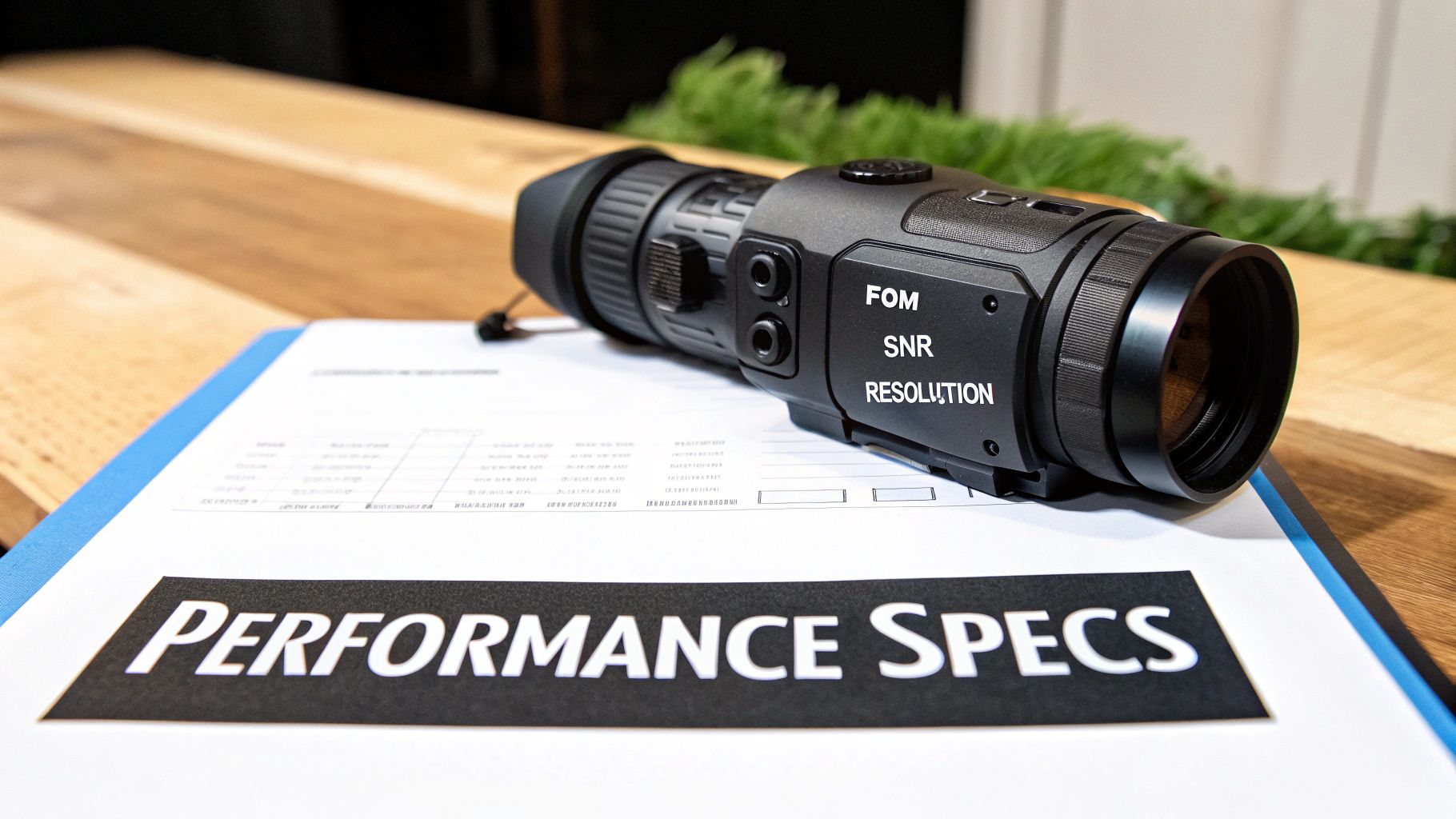
Think of that spec sheet as the DNA of your night vision device. Every number tells a piece of the story, from its ability to spot a target at a distance to its power to cut through the murk on a moonless night. Let's translate the most important specs into plain English.
The Big Three: SNR, Resolution, and FOM
If you can get a handle on three core metrics, you'll know most of what matters about a Gen 3 tube's performance. Understanding these gives you a huge advantage when comparing different units.
1. Signal-to-Noise Ratio (SNR): This is all about image clarity. Imagine trying to tune an old analog radio. A high SNR is like finding a crystal-clear station with zero static. A low SNR is that fuzzy, crackling broadcast you can barely make out. In night vision, the "signal" is the light you want to see, and the "noise" is that grainy, sparkling effect called scintillation. The higher the SNR, the cleaner and less grainy the image will be, which is a massive deal in extremely low-light situations.
2. Resolution (lp/mm): Measured in line pairs per millimeter, resolution dictates how much detail you can resolve. It’s a lot like the pixel count on a high-definition TV. A higher number means you can distinguish fine details from a distance, like individual branches on a tree or the features of a person's face. Gen 3 tubes will typically offer 64 lp/mm or higher, which is what provides that characteristically sharp view.
3. Figure of Merit (FOM): This is the ultimate "at-a-glance" performance score. You get this number by simply multiplying the SNR by the resolution (SNR x lp/mm). It boils down the tube's overall capability into a single, easy-to-compare figure.
Think of FOM as a car's overall horsepower. While you can get bogged down in specs like torque and RPM, horsepower gives you a quick, reliable summary of its performance potential. For Gen 3 NVGs, a higher FOM almost always means a better-performing tube.
When you're trying to make sense of a spec sheet, these numbers can tell you a lot about what to expect. Here's a quick breakdown of the key performance indicators for both standard and high-end Gen 3 tubes.
Gen 3 Performance Metrics Explained
| Specification | What It Measures | Typical Range (Standard Gen 3) | Typical Range (High-Performance Gen 3) |
|---|---|---|---|
| Figure of Merit (FOM) | Overall tube performance (SNR x Resolution). | 1600 – 2000 | 2000 – 2500+ |
| Signal-to-Noise Ratio (SNR) | Image clarity vs. electronic "snow" or grain. | 21 – 28 | 28 – 35+ |
| Resolution (lp/mm) | The ability to see fine detail. | 64 lp/mm | 64 – 72+ lp/mm |
| EBI (Equivalent Background Illumination) | How much light the tube generates internally; lower is better for dark conditions. | < 2.5 | < 1.0 |
| Halo | The size of the bright ring around light sources. | ~1.0 mm | < 0.8 mm |
As you can see, jumping to a high-performance tube delivers a noticeable improvement across the board, resulting in a cleaner, sharper image, especially when ambient light is almost non-existent.
Beyond the Numbers: Phosphor and Tube Type
Past the core three, a couple of other choices can dramatically change your experience.
The most obvious one is the phosphor color. This isn't just about looks; it affects how your brain interprets the image and can even impact eye fatigue.
-
Green Phosphor (P43): This is the classic "Predator" look we all know. The human eye is incredibly sensitive to shades of green, which can make the image seem brighter and more detailed. The trade-off is that some users report eye strain after looking through it for hours.
-
White Phosphor (P45): This newer technology produces a black-and-white image. Many operators find it provides better contrast and feels more natural to look at, which can reduce eye fatigue during long operations. It often makes it easier to distinguish between different shapes and shadows.
The technology inside modern Gen 3 NVGs often delivers FOM ratings between 1800-2500. Some of the more advanced thin-filmed tubes can also cut down the halo effect around bright lights by as much as 30%—a mission-critical feature for anyone working in urban environments or around vehicles. This level of performance is why the technology remains dominant, with some analysts projecting cumulative sales to hit USD 18.85 billion by 2030. You can find more details in the night vision device market report from strategicmarketresearch.com.
Finally, you'll hear talk of "thin-filmed" versus "unfilmed" tubes. This refers to a protective ion barrier inside the tube. While unfilmed tubes can sometimes eke out a small performance advantage, the filmed tubes generally offer better durability and a longer service life. We dive deep into this topic in our comparison of thin-filmed and unfilmed image intensifier tubes.
By getting comfortable with these specs, you'll be able to look past the marketing and choose a Gen 3 device that's truly right for your mission.
How Gen 3 NVGs Are Used in the Real World
Technical specs on a sheet are one thing, but stories from the field are where the real value of gear comes to light. It's time to move beyond the numbers and look at how professionals and serious enthusiasts actually rely on Gen 3 NVGs when failure isn't an option. These real-world situations show exactly how superior performance translates into getting the job done.
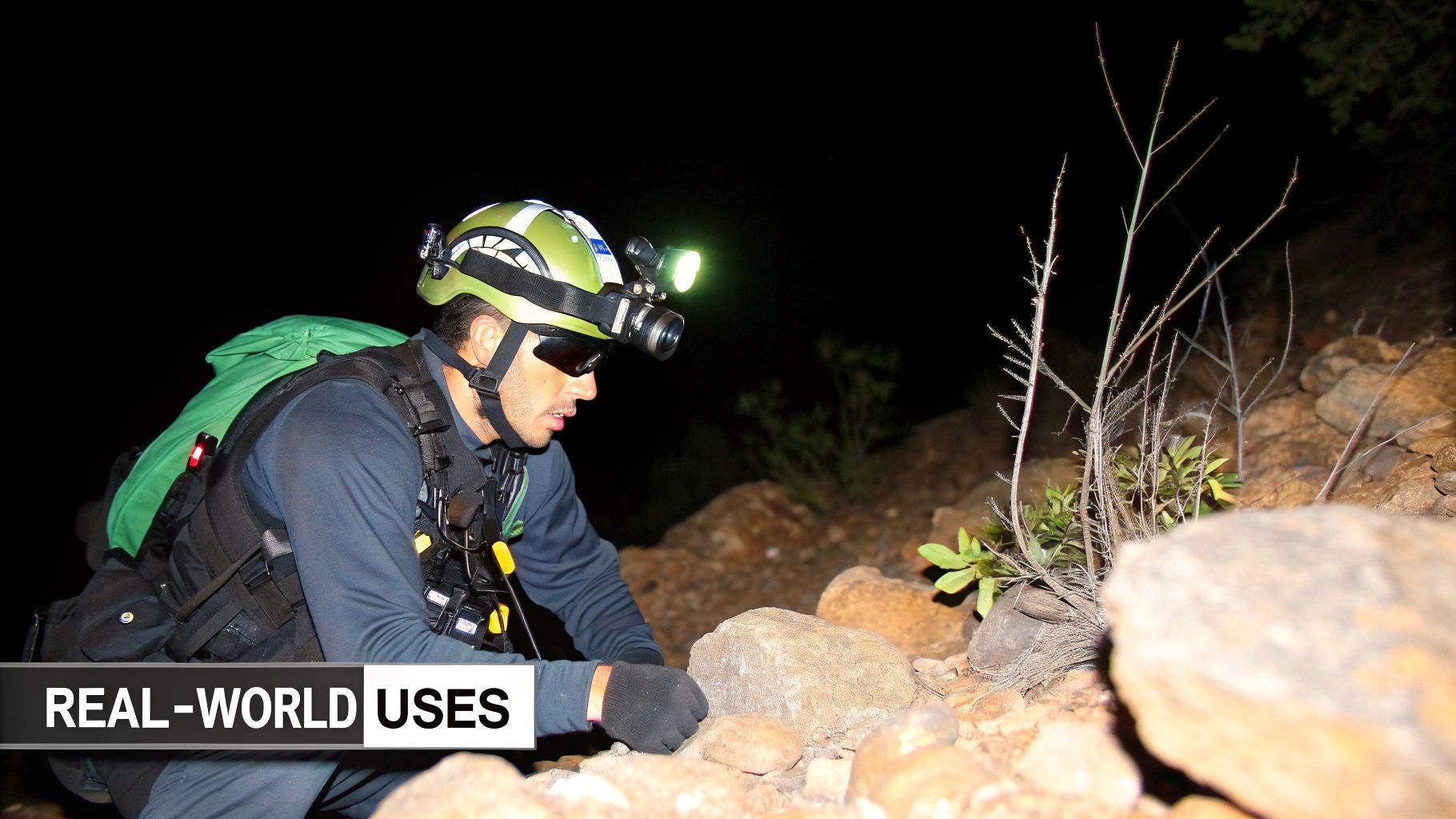
From a police officer on a stakeout to a SAR volunteer on a mountainside, the clarity and reliability of Gen 3 devices are more than just nice-to-haves. They are genuine, mission-critical advantages that save lives and ensure success when the lights go out.
Law Enforcement Surveillance
Picture a surveillance team set up across a dimly lit street, watching a target 150 yards away. With older-generation night vision, making a positive ID would be a gamble. The image would be a fuzzy, grainy mess, turning facial features into an indistinct blob. To be sure, the team would have to risk moving closer, potentially blowing the whole operation.
This is exactly where Gen 3 technology completely changes the game. A high-resolution tube with a strong Signal-to-Noise Ratio (SNR) slices through the darkness, rendering a crisp, detailed image.
-
Positive Identification: Officers can clearly make out faces, clothing, and even see if a subject is holding something—all from a safe standoff distance.
-
Situational Awareness: The clean, wide field of view lets them watch more than just the target. They can monitor the entire area for approaching vehicles or other threats.
In this kind of work, gathering undeniable visual intel without being detected is everything. The leap in clarity with Gen 3 gear directly leads to safer, more effective police work.
Backcountry Hunting and Tracking
Now, think about a hunter tracking a wary buck through a thick forest long after the sun has set. The last bit of ambient light is gone, and the woods have become a maze of deep shadows. A hunter using subpar optics could easily mistake a branch for an antler or, far worse, fail to see another animal—or person—in the background.
A quality Gen 3 monocular or binocular setup delivers the fine detail needed for a safe, ethical hunt. That high resolution lets the hunter accurately judge the animal, confirming its species, size, and position before even thinking about taking a shot.
For a hunter, Gen 3 isn't just about seeing in the dark; it’s about making a clean, ethical decision. The technology provides the confidence to identify the target and what lies beyond it, ensuring a responsible shot every single time.
This level of detail is absolutely essential for picking game out from its surroundings and verifying a safe backstop. For anyone who takes hunting and wildlife management seriously, Gen 3 performance is an indispensable tool for those crucial hours at dusk and dawn.
Search and Rescue Operations
Finally, imagine a Search and Rescue (SAR) team picking their way across treacherous, uneven ground on a moonless night, searching for a lost hiker. Every minute counts, and the environment is working against them. Every rock, root, and drop-off is a hazard that can slow the team down or, worse, cause an injury.
SAR teams running Gen 3 NVGs can move with more speed and safety. The incredible light amplification and minimal image distortion allow them to navigate the landscape with confidence, saving their energy for the actual search.
When they do spot the missing person, that same clarity helps them evaluate the scene from a distance. They can see if the individual is hurt, conscious, or in immediate danger, which allows them to form a solid rescue plan before they even make contact. In a life-or-death situation, that time saved can be everything.
How to Choose Your First Gen 3 NVG
Stepping into the world of Gen 3 night vision is a serious move. It's a significant investment, and you want to be damn sure the device you choose is the right one for your mission, whether that’s tracking hogs, clearing a building, or just exploring the backcountry after dark. Let's walk through the key decisions so you can buy with total confidence.
Your first big decision point is the classic monocular vs. binocular debate. Think of it as choosing between a lightweight, do-it-all scout and a fully dedicated observation tool.
A monocular, like the legendary PVS-14, is built around a single image intensifier tube. The upside? It’s lighter, less expensive, and incredibly versatile. You can run it on a helmet, use it as a handheld spotter, or even mount it behind a rifle's red dot. Plus, keeping one eye free and adapted to the darkness helps you maintain better overall situational awareness and a more natural sense of depth.
Binoculars, on the other hand, give you a true stereoscopic image by dedicating a tube to each eye. This dramatically improves your depth perception, which is an absolute game-changer for navigating tricky terrain on foot or driving a vehicle in the dark. While they are heavier and carry a higher price tag, the immersive view and reduced eye strain over long nights make them a top choice for serious users. To see why so many people start with a mono, you can learn more about why the PVS-14 is such a popular night vision monocular.
Understanding What Specs Matter for You
Once you've settled on a configuration, it's time to look at the spec sheet. It's easy to get caught up in chasing the highest numbers, but the real key is matching the tube's performance to how you'll actually use it. A monster FOM tube is incredible, but it might be overkill if you're mostly stargazing or scanning your property.
Here's a practical way to think about which specs you should prioritize:
-
For Urban/Suburban Use: Look for a low Halo value and make sure the unit is autogated. These features are critical for managing bright, artificial lights like streetlamps and headlights, keeping your image clear and protecting the tube from damage.
-
For Deep Wilderness/Rural Use: Your priorities here are a high Signal-to-Noise Ratio (SNR) and a low EBI (Equivalent Background Illumination). These specs are what give you a clean, crisp image when there's almost no ambient light to work with.
A key thing to remember is the law of diminishing returns. That jump from a good, solid tube to a top-of-the-line "god-tier" one comes with a very steep price increase. Be honest about where you'll be spending most of your time and set your budget accordingly—a well-rounded tube will serve most people incredibly well.
Setting a Realistic Budget
The price tag on Gen 3 NVGs can be a shock at first, but it directly reflects the complex manufacturing and high-grade materials that go into them. This isn't just a niche hobbyist market; it's a massive industry. The global night vision market was valued at USD 10.28 billion and is expected to hit USD 19.16 billion by 2032, with Gen 3 technology accounting for a whopping 75% share of military and defense applications.
With individual units ranging anywhere from USD 4,000 to over USD 15,000, it's clear this is a serious piece of equipment. You can discover more insights about the night vision goggles market on intelmarketresearch.com if you want to dig into the numbers.
For most first-time buyers, a quality PVS-14 monocular kit is the smartest entry point. It delivers outstanding performance without the significantly higher cost of a dual-tube system. Above all else, buy from a reputable dealer that provides a full, detailed spec sheet for the exact tube you're buying and backs it up with a solid warranty. That transparency is the best way to protect your investment.
Owning and Maintaining Your NVG Investment
Dropping a serious amount of cash on a set of Gen 3 NVGs is no small thing. It’s a significant investment in a professional-grade tool, and protecting it means knowing how to take care of it. With the right habits, that device will serve you reliably for years to come.
Proper maintenance isn't about complex procedures; it's about avoiding simple, costly mistakes. Think of it like handling a high-end camera lens or a firearm—a little bit of preventative care makes all the difference. The number one rule? Never, ever point the front lens at a bright light source when the unit is powered on. This can permanently burn the image intensifier tube, leaving black spots in your view that can't be fixed. When it’s not in use, the daylight cap stays on. No exceptions.
The Essentials of Care and Upkeep
Keeping your unit in fighting shape comes down to a few basic disciplines. Nailing these down will head off the most common issues and ensure your gear is ready to go when the sun goes down.
-
Keep Those Lenses Clean: Treat the glass with respect. Only use a clean microfiber cloth and a dedicated lens cleaning solution. A gentle, circular wipe is all you need to avoid scratching those critical coatings.
-
Mind Your Batteries: If you're putting your NVGs away for a while, pull the batteries out. Leaky batteries are a death sentence for the internal contacts and electronics, and it’s a completely avoidable problem.
-
Store It Smart: Your NVGs should live in a hard, padded case when not in use. Find a spot for it that’s cool, dry, and doesn't have wild temperature swings.
Following these simple steps is the key to getting the most out of your gear. A well-cared-for Gen 3 tube can easily last beyond 10,000 hours of operation.
A solid, long-term warranty is more than just a piece of paper; it's a statement. It tells you the builder is confident enough in their work to stand behind it for the long haul. That peace of mind, knowing you’re covered if a defect pops up, is invaluable.
At Superior Tactical, we back our Gen 3 systems with a 10-year warranty. We also handle diagnostics and repairs right here, in-house. We’re not just selling you a device; we’re your partner for the entire life of your equipment.
Understanding Your Legal Responsibilities
Owning a piece of tech as capable as Gen 3 night vision also means you have some legal homework to do. The big one to know is the International Traffic in Arms Regulations (ITAR). These are the U.S. government rules that control where defense-related equipment can and can't go.
Gen 3 night vision is squarely on that list. For a civilian owner, the rules are simple but strict: you cannot take your NVGs outside of the United States. You can't sell them to a non-U.S. citizen, and you certainly can't ship them overseas without getting explicit, hard-to-get permission from the government. The penalties for breaking ITAR are severe. Being a responsible owner means knowing where these lines are and staying well within them.
Your Top Questions About Gen 3 NVGs Answered
When you're diving into the world of Gen 3 night vision, you're bound to have questions. That’s a good thing. Getting the right answers is crucial for both protecting your investment and using it effectively when it counts. Here are the straight answers to the questions we hear most often from our customers.
Can You Use Gen 3 NVGs During the Day?
Let me be blunt: absolutely not. Firing up your Gen 3 device in daylight, even for a split second, is a surefire way to permanently damage the image intensifier tube. Bright light will instantly overload the system and can burn permanent black spots into your field of view. Those spots don't go away.
Modern tubes have some smart features like autogating to protect against sudden bright flashes—think a muzzle flash or a streetlight popping on. But that’s an emergency brake, not a feature for daytime driving. The rule is simple: if it's not dark, keep the daylight cap on.
How Long Do Gen 3 Tubes Actually Last?
You’ll be happy to know that a modern Gen 3 tube is built to last. We're talking a service life of 10,000+ hours. For most hunters, law enforcement officers, or hobbyists, that translates to many years—often decades—of solid performance.
The two things that kill a tube's lifespan are total runtime and, you guessed it, exposure to bright light. If you treat your gear with respect and follow the basic rules of light discipline, you'll get every bit of performance out of that 10,000-hour rating.
The sheer durability and long life of Gen 3 tubes are exactly why they became the gold standard for serious professional use. That upfront investment pays dividends over thousands of hours out in the field.
Is a Higher Spec Tube Always Worth the Money?
Honestly, no. It’s easy to get caught up in chasing the highest Figure of Merit (FOM) number, but the best tube isn't always the one with the biggest number—it's the one that best fits your mission and budget.
Think of it this way: a law enforcement team clearing a pitch-black warehouse needs every ounce of performance they can get from a top-tier, high-FOM tube. But if you're a hunter working in open country with moonlight, a fantastic mid-spec Gen 3 unit will give you more than enough clarity and brightness to do the job well. The key is matching the specs to your reality.
What Is the Difference Between Filmed and Unfilmed Tubes?
This question gets down to the nitty-gritty of tube technology. It all comes down to a tiny protective layer inside the tube called an ion barrier film.
-
Filmed Tubes: This film acts as a shield, protecting the photocathode from ion feedback that can shorten its life. The result is an incredibly durable and reliable tube built for the long haul.
-
Unfilmed Tubes: By removing that film, you get a small but noticeable boost in performance. Light passes through a little more efficiently, giving you a slightly brighter image and a better Signal-to-Noise Ratio.
So, you have a choice. Filmed tubes give you maximum reliability and longevity, while unfilmed tubes squeeze out that last bit of raw performance.
At Superior Tactical LLC, we don't just sell gear; we provide solutions backed by real-world expertise and an industry-leading 10-year warranty. Explore our full range of Gen 3 night vision systems and get yourself equipped for the dark.
