A Complete Guide to Gen 3 Night Vision Goggles
Gen 3 night vision is the benchmark for a reason. When people talk about "real" night vision, this is what they mean. It’s the kind of performance that professionals trust their lives with, offering incredible clarity and capability when the lights go out.
Think of it this way: earlier night vision let you see a shape in the dark. Gen 3 lets you see the expression on a face. That’s the level of difference we’re talking about, and it makes it the go-to choice for military, law enforcement, and dedicated civilian users who can't afford to compromise.
How Gen 3 Night Vision Turns Night Into Day
Moving up to Gen 3 isn't just a small step; it's a complete game-changer in how you operate in low-light conditions. While older tech was certainly useful, Gen 3 provides the kind of detail and brightness that gives you true confidence to move, identify targets, and maintain awareness, even on overcast, moonless nights.
The magic happens inside the image intensifier tube—the heart and soul of any night vision device. First developed back in the 1980s, Gen 3 was a massive leap forward. The key innovation was using a gallium arsenide (GaAs) photocathode, which is exceptionally good at converting the few photons of available light into electrons. This allows the device to amplify ambient light by a staggering 30,000 to 50,000 times, painting a clear, detailed picture out of what looks like total darkness to the naked eye. To learn more about how this technology evolved, you can find a great history of night vision on agmglobalvision.com.
What Gen 3 Performance Really Means in the Field
So, what does all that fancy science mean for you when you're actually out there? It means real, tangible advantages that leave other generations in the dust. This isn't just about numbers on a spec sheet; it's about practical performance that can make all the difference when it counts.
-
Clarity in the Darkest Conditions: Where older tech shows a screen full of static "scintillation," a good Gen 3 tube delivers a clean, crisp image. This lets you positively identify what you're looking at from much farther away.
-
Massively Increased Range: Because it gathers light so efficiently, you can simply see further. This extends your effective range for everything from observation and navigation to hunting and security.
-
Built to Last: Gen 3 tubes are incredibly robust and are typically rated for 10,000+ hours of operation. This isn't a fragile piece of tech; it's a long-term investment in a serious capability.
To put it simply, Gen 3 technology provides a distinct advantage that lets you see more, farther, and with greater clarity than anything that came before it.
Here’s a quick breakdown of what makes Generation 3 the top tier:
Gen 3 Night Vision At a Glance
| Key Advantage | What It Means For You |
|---|---|
| Gallium Arsenide Photocathode | Extremely efficient at converting light, resulting in a much brighter and cleaner image, especially in very dark environments. |
| Superior Signal-to-Noise Ratio | Less "static" or graininess in the image. You get a sharper, clearer picture that's easier on the eyes during long use. |
| Exceptional Longevity | Tubes are rated for 10,000+ hours, making it a reliable, long-term tool rather than a disposable gadget. |
| Greater Operational Range | The combination of sensitivity and clarity allows you to detect, recognize, and identify targets at much greater distances. |
Ultimately, Gen 3 night vision isn't just about seeing in the dark—it's about owning the night.
It delivers the clarity and confidence required for critical tasks where vision is absolutely non-negotiable.
This guide will walk you through everything you need to know about Gen 3 night vision. We’ll break down the science behind the image tube, explain the specs that matter when you're ready to buy, and show you why this technology remains the definitive choice for professionals and serious enthusiasts alike.
How an Image Intensifier Tube Actually Works
At the heart of any pair of Gen 3 night vision goggles is the image intensifier tube, often called an I2 tube. This is the engine that does all the heavy lifting, taking impossibly faint light and turning it into a crisp, clear picture. It isn't magic, but it's close—a fascinating, multi-stage process that amplifies light thousands of times over.
Let's trace the journey of a single photon, a tiny particle of light from a star or the moon, as it enters your NVGs. This all happens in a flash, transforming a pitch-black landscape into a world you can see and navigate.
The diagram below gives you a bird's-eye view of this process, showing how that faint light gets captured, multiplied, and finally presented to your eye.
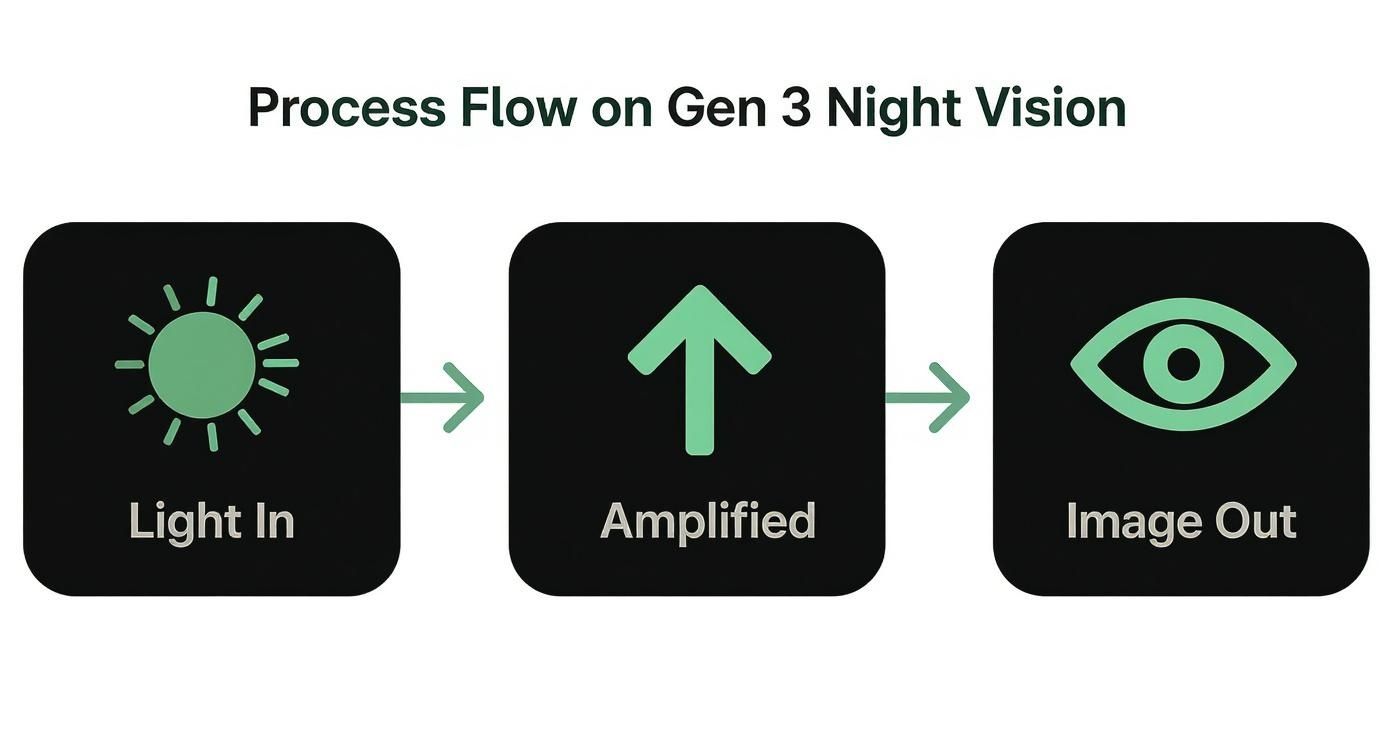
While this simplifies a very complex journey, it perfectly shows the three key stages that turn invisible light into a visible image.
The Photocathode: The Light Collector
First up, that photon shoots through the objective lens and smacks into a special surface called the photocathode. For Gen 3 devices, this critical component is made from gallium arsenide (GaAs), a material that's incredibly sensitive to light—especially the near-infrared light that fills the night sky.
When a photon hits the gallium arsenide, its energy kicks an electron loose. Think of it like a cue ball (the photon) hitting a rack of billiard balls and sending one (the electron) flying off. The incredible sensitivity of GaAs is the single biggest reason Gen 3 performance is such a massive leap over older generations.
This was a game-changer when it was introduced in the 1980s. Gallium arsenide photocathodes gave units a huge boost in sensitivity to infrared light, allowing for sharp images even in near-total darkness. Gen 2 devices just couldn't compete.
The Microchannel Plate: The Electron Multiplier
That lone electron is then zapped by an electrical field toward the next stage: the Microchannel Plate (MCP). This is where the real amplification happens.
Picture the MCP as a tiny, razor-thin disc made of millions of microscopic glass tubes, all fused together like a honeycomb. When our electron enters one of these channels, it hits the wall and knocks several more electrons loose.
These new electrons accelerate, hit the walls again, and create a massive chain reaction. For every one electron that goes into the MCP, thousands can come pouring out the other side. A top-tier Gen 3 tube can amplify the original light signal by tens of thousands of times.
This is the engine of light amplification. The MCP's ability to create an electron avalanche from a single light particle is what makes seeing in starlight possible.
The Phosphor Screen: Creating the Image
Finally, this supercharged cloud of electrons flies across a tiny gap and slams into the phosphor screen. This screen is coated with a material that lights up whenever it's hit by an electron, creating the image you see.
The screen is what gives night vision its signature green or white-and-black glow. Each electron impact creates a tiny dot of light, and the millions of impacts happening every second merge to form the complete, brightened picture you see through the eyepiece. To protect the tube from this constant bombardment, manufacturers add an ion barrier film. However, the exact type of film used has a big impact on performance, which is why we break down the pros and cons in our detailed guide on thin-filmed versus unfilmed image intensifier tubes.
From a single photon to a cascade of electrons and finally to a glowing screen, the image intensifier tube does its work in an instant. This whole sequence is what gives Gen 3 night vision the power to truly own the night.
Decoding the Specs That Truly Matter
When you start digging into Gen 3 night vision goggles, you'll immediately run into a long list of technical specs. It can feel a little overwhelming at first, but these numbers are what separate a top-tier device from an average one. Getting a handle on them is the only way to cut through the marketing fluff and make a smart investment.
Think of a spec sheet less like a boring science paper and more like a scouting report for the image intensifier tube inside your gear. Every single metric tells a story about how that unit will perform in the real world, whether you're in a pitch-black forest or a complex urban environment.
Let's break down the numbers that really count.
The Most Important Metric: SNR
If you only pay attention to one number, make it the Signal-to-Noise Ratio (SNR). This is, without a doubt, the single best indicator of how well a device will perform when the lights go out. It’s a simple measure of the "signal" (the clear image you want to see) versus the "noise" (the grainy, static-like scintillation you don't).
It’s just like tuning an old AM/FM radio. A high SNR is that perfect, crystal-clear broadcast. A low SNR is a fuzzy station buried in static. For night vision, a higher SNR means a cleaner, crisper image, especially when there’s very little ambient light to work with.
A device with an SNR of 25 is serviceable, but a high-end tube with an SNR of 35 or more will give you a dramatically better picture. You'll be able to pick out fine details at greater distances on even the darkest nights.
Understanding Resolution and FOM
Next up is Resolution, which is measured in line pairs per millimeter (lp/mm). This spec tells you exactly how much detail the tube can resolve. A higher number here means the device is better at distinguishing between two objects that are very close together, giving you a sharper, less blurry image. It’s the difference between watching a 4K movie and an old standard-definition TV show.
Most quality Gen 3 tubes will have a resolution of 64 lp/mm or higher.
So, how do you combine these two critical specs into a single, easy-to-understand number? That’s where Figure of Merit (FOM) comes into play.
FOM is a quick-and-dirty calculation that gives you a general idea of the tube's overall performance. It's calculated by simply multiplying the two specs we just covered.
FOM = SNR x Resolution (lp/mm)
For instance, a tube with an SNR of 30 and a Resolution of 64 lp/mm would have a FOM of 1920. While it’s not the whole story, FOM is incredibly useful for quickly comparing the general performance tier of different devices. A higher FOM almost always means a better tube.
The table below breaks down how these numbers translate into what you'll actually see through the goggles.
Gen 3 Performance Metrics Compared
| Specification | Minimum/Good | Excellent/High-End | Real-World Impact |
|---|---|---|---|
| SNR | 25-28 | 32-38+ | Directly affects how clean the image is in very low light. Higher is always better. |
| Resolution | 64 lp/mm | 72 lp/mm | Determines image sharpness and the ability to distinguish small details. |
| FOM | 1800 | 2300+ | A great at-a-glance metric for overall tube performance. Higher FOM is preferred. |
Ultimately, these specs work together. A high-resolution tube won't do you much good if the image is a grainy mess from low SNR. A good tube is a balanced tube.
Autogating for Dynamic Lighting
The real world isn't a dark, static range. You've got headlights, street lamps, and muzzle flashes suddenly flooding your vision. Without protection, this intense light can cause the image to "bloom" out into a bright halo, obscuring your target, or even permanently damage the tube.
This is where autogating proves its worth. Autogating is a feature that rapidly cycles the tube's power supply on and off thousands of times a second. It happens so fast your eye can't perceive it, but it allows the device to instantly regulate how much light enters the tube.
This has two huge benefits:
-
Reduces Blooming: It dramatically shrinks the halo effect around bright lights, so you can actually see what's happening around the light source.
-
Protects the Tube: It acts as a safety shield, protecting the sensitive internal components from being fried by sudden, bright light exposure.
Autogating is now a standard feature on nearly all modern military-grade Gen 3 night vision goggles. For anyone working in dynamic or urban environments, it's a non-negotiable feature.
Tube Manufacturers: The Major Players
Not all Gen 3 tubes are created equal, and the company that made the tube has a huge impact on its quality. In the United States, the market is dominated by two primary producers of high-quality image intensifiers:
-
L3Harris Technologies: Widely considered the top of the food chain. L3Harris is famous for its unfilmed white phosphor tubes that deliver jaw-dropping performance in the darkest conditions.
-
Elbit Systems of America: A massive player in the industry and a direct competitor to L3Harris. Elbit produces outstanding thin-filmed tubes that are the go-to for many military contracts and civilian enthusiasts.
While you might see tubes from other manufacturers, L3Harris and Elbit are the undisputed titans. Knowing who made the tube inside your device, combined with a solid understanding of the specs, gives you the power to choose gear that truly meets your needs.
Putting Gen 3 Performance in Perspective
It’s one thing to read a spec sheet, but it’s another thing entirely to understand what gen 3 night vision actually does for you in the real world. The jump from older generations isn't just a minor upgrade—it's a complete game-changer that becomes crystal clear the second you look through the eyepiece.
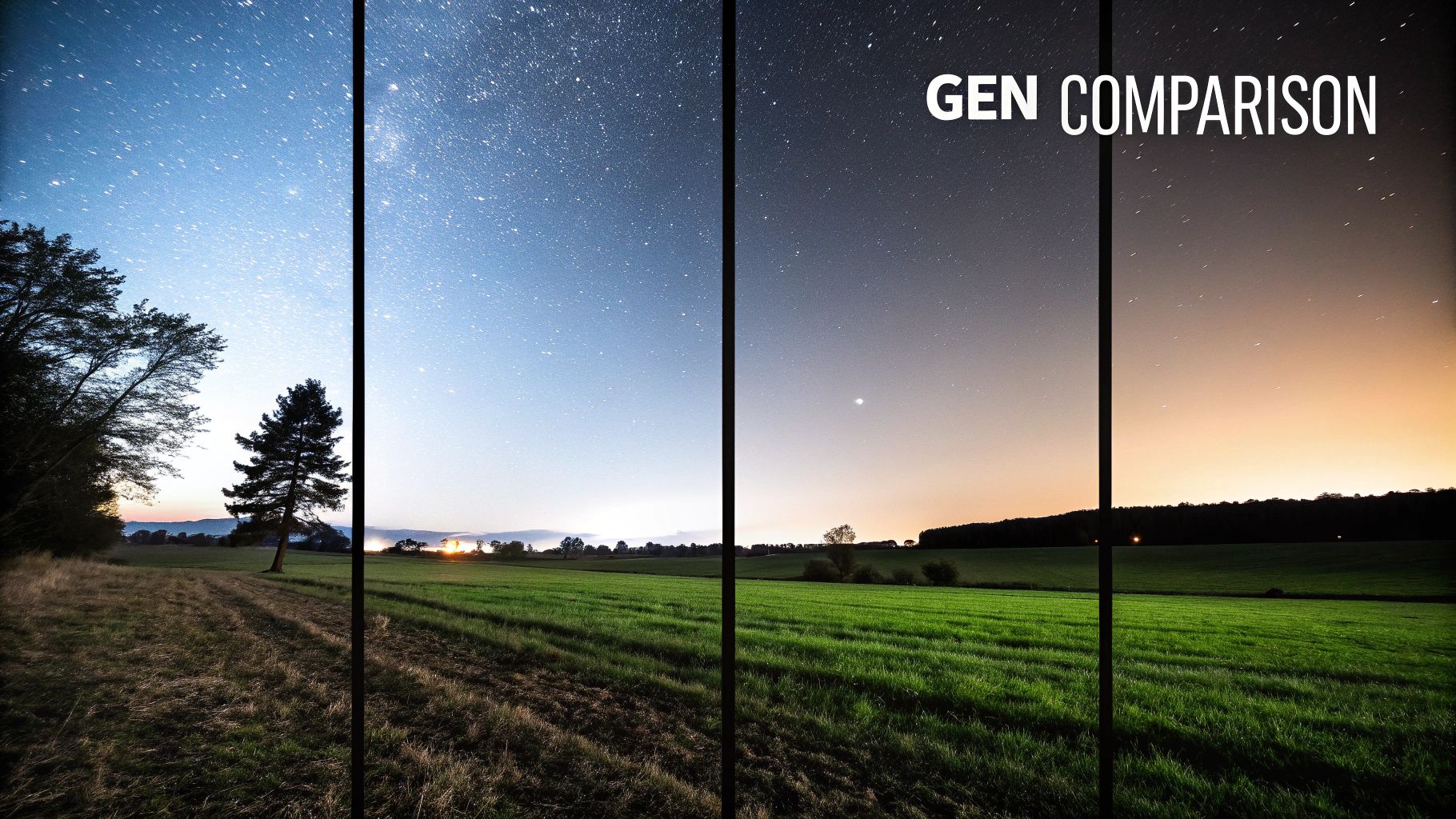
Let’s set the scene. You’re at the edge of a wide-open field on a cloudy, moonless night. It’s dark. Really dark. About 200 yards out, there's a thick tree line you need to observe. This is the kind of scenario where the differences between night vision generations aren't subtle at all.
From Gen 1 to Gen 3: A Real-World Walkthrough
With a Gen 1 unit, you’d be fighting to see anything. The image would be a noisy, static-filled mess, and you’d almost certainly have to flick on your IR illuminator. That little red glow instantly announces your position to anyone else out there with night vision. You might barely make out the silhouette of the trees, but identifying anything smaller? Forget it.
Now, swap that out for a Gen 2 device. Things get a lot better. The picture is brighter, clearer, and you can easily see the tree line without needing an illuminator. Still, there’s a noticeable grain or "scintillation" in the image, and details at that 200-yard distance are pretty fuzzy. You’d spot movement, but good luck making a positive ID.
Finally, you bring up a pair of Gen 3 goggles. The difference is night and day. The image is unbelievably bright, crisp, and clean. You're not just seeing the tree line; you're seeing individual trees and even some of the larger branches. If a person or animal were to step out from behind those trees, you'd know exactly what it was in a heartbeat.
This is precisely why Gen 3 became the gold standard for military and law enforcement. It provides the clarity needed for positive identification at a distance—a massive advantage for both safety and tactical effectiveness.
That huge leap in performance comes down to the gallium arsenide photocathode inside the tube. It’s far more sensitive to light, which boosts the signal-to-noise ratio and lets Gen 3 devices punch through darkness where older tech simply gives up. This is how soldiers can spot targets beyond 600 meters on nights that would leave other devices showing nothing but static.
What About Digital Night Vision?
You might be wondering where digital night vision fits in. Unlike analog image intensifiers, digital units work like a specialized camera, capturing light on a sensor and showing it on a tiny screen. They're great for recording and can offer different color modes, but when it comes to raw performance, they just don't stack up.
In our dark field scenario, a digital unit would be struggling. The image would be laggy, pixelated, and full of digital noise. It simply can’t amplify faint ambient light the way a Gen 3 analog tube can. For serious navigation or detection in near-total darkness, there’s really no contest.
Unfilmed Tubes: The "Gen 3+" Advantage
Even within the Gen 3 world, there are tiers. You'll often hear terms like "Gen 3+" or unfilmed. This refers to a specific type of high-performance tube, most famously from L3Harris, that doesn’t have the protective ion barrier film found on standard "thin-filmed" tubes from manufacturers like Elbit.
By removing that film, more light-generated electrons can hit the microchannel plate, cranking up the signal-to-noise ratio even further. The result is an image that's as clean and bright as it gets.
-
Unfilmed (L3Harris): Delivers the absolute pinnacle of low-light performance. The image is exceptionally clean. The only theoretical trade-off is slightly reduced tube life, though modern unfilmed tubes are still rated for over 10,000 hours of operation.
-
Thin-Filmed (Elbit): This is the rugged, reliable workhorse of the Gen 3 world. The performance is still phenomenal and a massive jump over Gen 2, even if it's a small step behind an unfilmed tube on the darkest nights.
Choosing between them often boils down to budget versus that last bit of performance. It’s also worth noting that many people find the black-and-white image of modern white phosphor tubes to be easier on the eyes over long periods. You can learn more about the advantages of white phosphor night vision to decide if it’s for you.
No matter which you choose, any quality Gen 3 tube—filmed or unfilmed—gives you a true, decisive advantage in the dark.
Picking the Right Gen 3 Setup for Your Needs
Knowing the specs is half the battle. The real trick is matching those numbers to the gear that will actually serve you best out in the field. After all, the ideal Gen 3 night vision goggles for a SWAT officer are going to look very different from what a hunter needs to stalk hogs at 200 yards. Your mission truly drives the decision.
So, let's connect the dots from specs to setups. By walking through a few common roles, we can highlight the specific features and form factors that give you a real-world advantage. This way, you can be sure your investment is a perfect fit for what you do.
For Law Enforcement and Tactical Professionals
On a tactical team, everything comes down to speed, toughness, and total situational awareness. You're moving through unpredictable environments where a split-second hesitation can make all the difference, so your equipment has to be an asset, not a liability.
This is where a binocular setup, with two image intensifier tubes, really shines. Binos give you true depth perception, which is absolutely critical for navigating tight spaces, driving a vehicle, or accurately engaging a threat up close. The simple act of seeing with both eyes feels more natural, reduces mental fatigue, and keeps you sharp when the pressure is on.
-
Go-To Housings: A rugged, articulating binocular housing like a DTNVS or KATANA is the standard for a reason. They let you fold the pods up against your helmet, creating a low-profile silhouette when you don't need them and automatically killing power to save battery.
-
Must-Have Specs: You'll want to aim high here. Look for a FOM of 2300+ and an SNR of 32+ to get a crisp, clean image inside dark buildings. Autogating isn't a luxury; it's mandatory. It protects your tubes and your vision from sudden blasts of light from street lamps, weapon lights, or muzzle flash. Many pros also prefer white phosphor for its grayscale image, which they find easier on the eyes over long nights.
For Hunters and Outdoorsmen
Hunters play a different game. The priorities shift to long-range detection, the ability to aim without giving away your position, and overall flexibility. The whole point is to spot that animal far off in the dark and plan your next move.
In this world, a top-tier monocular—like the legendary PVS-14—is an incredibly versatile choice. You can pop it on your helmet to hike in, mount it behind a red dot sight for passive aiming, or just use it as a handheld scanner. That adaptability means one device can do it all without weighing you down.
For a hunter, being able to move a single night vision unit from your head, to your rifle, and back to your hand in seconds is a massive tactical advantage. This is what makes a high-spec PVS-14 such a powerhouse in the woods.
-
Go-To Housing: A PVS-14 monocular is hard to beat. When built with a high-performance tube, it offers the perfect mix of capability and practicality for hunting and exploring.
-
Must-Have Specs: Pour your budget into the highest SNR you can get. A clean, "snow-free" image is what lets you pick out the flicker of an ear or the subtle movement of a deer against a busy treeline at 200-300 yards. Good resolution is a close second, as it helps you positively identify your target.
For Search and Rescue Operations
Search and Rescue (SAR) teams face their own unique challenges. They're often covering huge areas of rough country on foot, where efficiency and safety are the top priorities. The gear needs to maximize awareness and minimize exhaustion.
Much like tactical users, SAR pros get a huge benefit from binocular systems. Having that wide, natural field of view and depth perception helps them move safely and avoid stumbles while scanning vast, uneven terrain. And when a search mission stretches through the entire night, the reduced eye strain you get from binos is a game-changer.
-
Go-To Housings: Lightweight binocular systems are a great pick here, as they help reduce neck fatigue over many hours. Any housing that offers a wider-than-standard field of view is also a bonus.
-
Must-Have Specs: You don't need to chase the absolute highest numbers. A solid, well-balanced tube with a FOM of 2000+ is more than enough. The main goal is navigation and awareness, not picking out tiny details at extreme distances. Here, long-term reliability and durability are far more important than bleeding-edge specs.
Protecting Your Investment with Proper Care
Dropping a good chunk of change on high-performance Gen 3 night vision goggles is a serious investment. Like any finely tuned piece of equipment, it needs a bit of care to give you years of solid performance. If you neglect the basics, you can seriously shorten the life of the image intensifier tube, which, despite its 10,000+ hour rating, is still a sensitive piece of kit. A little preventative maintenance goes a long way in making sure your gear is ready to go when the lights go out.
The golden rule, the one you never, ever break, is to keep the lenses and internals away from bright, direct light. Don’t even think about powering on your unit in daylight without the protective day cap snapped on tight. A split-second mistake can permanently burn spots onto the phosphor screen, and once that damage is done, it's there for good.
Essential Maintenance Routines
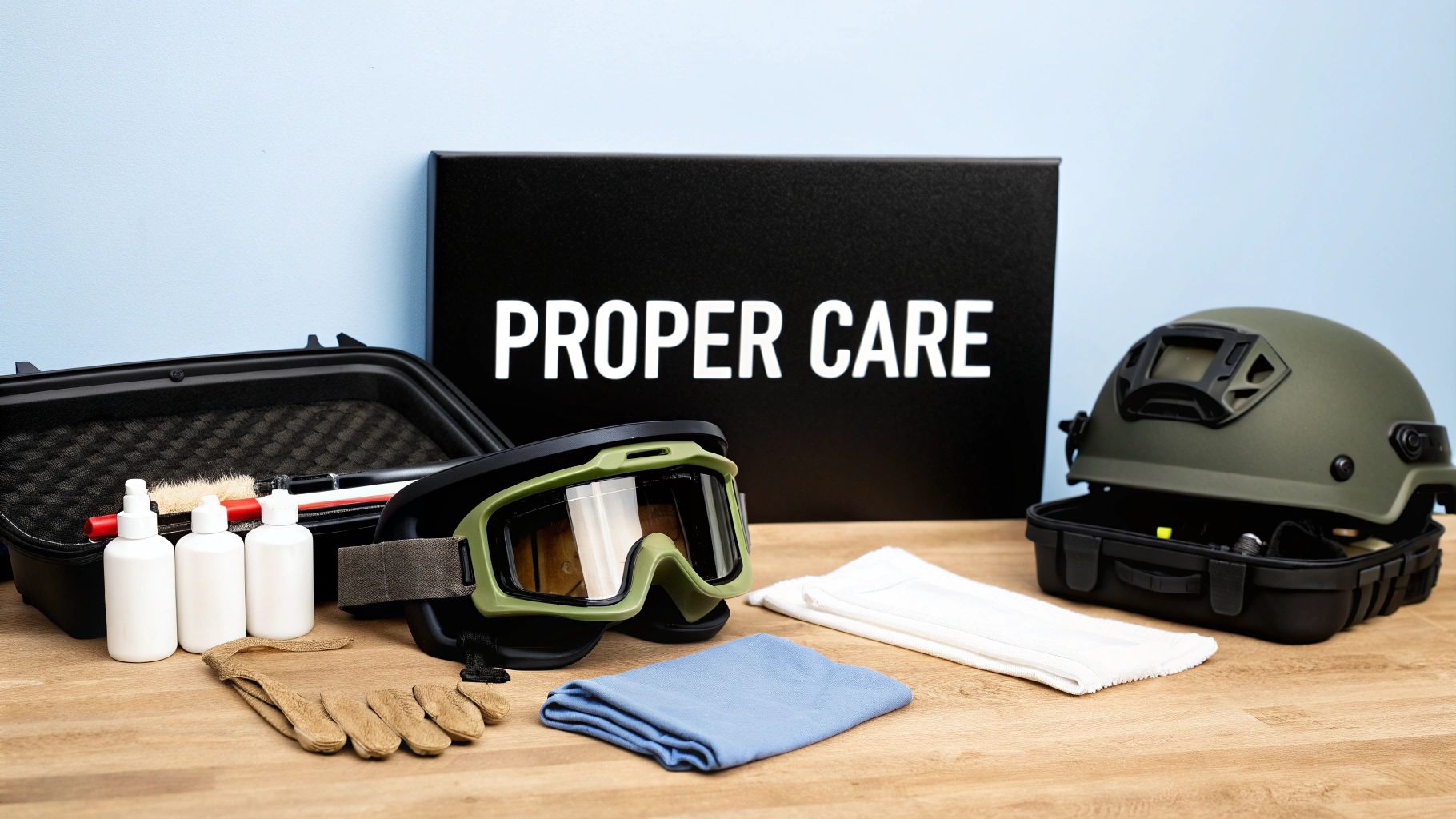
Getting into a solid care routine is simple, but it's what separates a well-maintained unit from a neglected one. First off, keep your lenses clean. A lens pen or a fresh microfiber cloth is all you need to gently wipe away dust and fingerprints. Stay away from harsh chemicals or your t-shirt—those can strip the delicate coatings right off the glass.
Battery discipline is another big one. Stick with high-quality lithium batteries; they handle the cold better and are far less likely to leak acid all over your electronics. And here's the most important part: always pull the batteries out if you’re storing the device for a while. Corrosion from a leaky battery can be a death sentence for your unit's internal components.
When you're not using it, proper storage is your gear's best friend. A padded, hard-sided case is ideal. Keep it somewhere cool and dry, away from crazy temperature swings or high humidity.
Must-Have Accessories and Support
Out in the field, a few extra pieces of gear are practically mandatory for keeping your NVGs safe. A solid helmet mount, like the gold-standard Wilcox G24, is non-negotiable. It keeps the device locked down tight, preventing the kind of accidental drop that can shatter the internals.
To keep your objective lens from getting scratched up by dirt, branches, or whatever else you run into, you'll want to add a couple of things to your setup:
-
Sacrificial Lenses: Think of these as cheap, clear screen protectors for your very expensive objective lens. They screw on the front and take all the abuse, so your primary glass stays pristine.
-
IR Illuminators: Gen 3 is incredible in low light, but it can't see in total darkness. In a pitch-black basement or a cave, an external IR illuminator provides the light you need to see clearly without being a drain on your device's battery.
Finally, nothing beats the peace of mind that comes with a solid warranty. A 10-year warranty backed by in-house diagnostics and repair services means that if something does go wrong, you’ve got experts ready to get your investment back in fighting shape. For a deeper dive, this guide on maintenance and care for a PVS-14 monocular has some fantastic, real-world advice that's useful for almost any night vision system.
Got Questions About Gen 3 Night Vision? We've Got Answers.
Even after you've done your homework, a few questions always seem to pop up. That's perfectly normal. Here are some straightforward answers to the most common things people ask us before they pull the trigger on a new set of Gen 3 NODs.
Is It Actually Legal for Me to Own Gen 3 Goggles?
Absolutely. In the United States, any civilian can legally buy and own Gen 3 night vision. It’s a common misconception that this gear is restricted.
The only real legal catch you need to be aware of is ITAR, or the International Traffic in Arms Regulations. This means your high-end night vision can't leave the country. You can't legally ship it, mail it, or take it with you on an international trip without a whole lot of government paperwork. This is why sticking with a reputable U.S. dealer who plays by the rules is non-negotiable.
Green vs. White Phosphor: Which One Is Better?
This is probably the most common question we get, and the honest answer is: it's mostly personal preference. The color doesn't change the tube's core performance stats—a high-spec tube is a high-spec tube, whether it's green or white. It really comes down to what your eyes and brain prefer.
-
Green Phosphor: This is the classic "night vision green" you see in movies. Our eyes are naturally very sensitive to shades of green, so some people feel it gives the image an extra pop of brightness.
-
White Phosphor: This creates a grayscale, black-and-white image that many users find more natural and easier to look at for hours on end. It can reduce eye strain, which is a big deal if you're planning on being under NODs all night.
White phosphor tubes do tend to cost a bit more, but that's a market-driven thing. You're not necessarily getting "better" performance, just a different visual experience.
If you ever get the chance, look through both. Your eyes will tell you pretty quickly which one feels more comfortable for you. That’s the right answer.
What's the Real-World Lifespan of a Gen 3 Tube?
Modern Gen 3 tubes are incredibly durable pieces of technology. They're typically rated for over 10,000 hours of runtime.
To put that in perspective, if you used your goggles for 4 hours every single weekend, it would take you almost 50 years to hit that 10,000-hour mark. For most people, that’s a lifetime of use.
The real killers of image intensifier tubes aren't old age, but accidents. The two biggest threats are severe physical shock from a hard drop and, more commonly, light exposure. Blasting the tube with a bright light source can cause permanent screen burn-in. Always use your daylight cap and be mindful of your surroundings, and your investment will last for decades.
Ready to see the night in a whole new light? At Superior Tactical LLC, we don't just sell gear—we use it, and we're here to help you find the exact right setup for what you do. Browse our complete collection of night vision goggles and accessories today.
