The Definitive Guide to Dual Tube Night Vision Goggles
Imagine trying to walk through a dark, unfamiliar room. Would you rather do it by peeking through a straw, or with both eyes wide open? That’s the simplest way to think about the difference between a single-tube monocular and a set of dual tube night vision goggles. It's why professionals who can't afford to compromise on performance and awareness almost always choose duals for serious work.
Why Dual Tubes Offer Superior Night Vision
The real advantage of a dual-tube system isn't just about making the dark less dark—it's about giving you a massive tactical edge. Your brain is hardwired for binocular vision. It takes the two slightly different images from your eyes and instantly combines them into a single, three-dimensional view, which is exactly how you get depth perception.
When you strap on a single-tube monocular, you're only feeding one of those channels a night-vision-enhanced image. Your other eye is left seeing plain darkness or its own unassisted view. This creates a confusing mismatch, forcing your brain to work overtime just to make sense of it all. It’s a mental tax that can be disorienting and exhausting, especially when you're on the move.
Dual tube night vision goggles completely sidestep this issue. By giving each eye its own dedicated image intensifier tube, the system lets your brain operate just as it would in broad daylight. The result is a seamless, natural perception of depth and distance.
To give you a quick snapshot, here's how the two systems stack up side-by-side.
Dual Tube vs Single Tube Night Vision At a Glance
This table breaks down the core differences in performance, highlighting why two tubes are fundamentally better for awareness and navigation.
| Feature | Dual Tube Goggles | Single Tube Monocular |
|---|---|---|
| Depth Perception | True stereoscopic vision, excellent for judging distance and terrain. | Non-existent; requires user to constantly pan and assess. |
| Situational Awareness | Wide, natural field of view. Brain processes information faster. | Limited to the device's field of view; a "soda straw" effect. |
| User Fatigue | Minimal eye and brain strain, allowing for extended use. | High cognitive load and eye strain, leading to fatigue. |
| Movement & Navigation | Intuitive and fast. Easy to navigate complex terrain or drive. | Slow and disorienting. High risk of trips and misjudging obstacles. |
As you can see, the benefits of a dual-tube setup go far beyond just having a second image. It’s about creating a more complete and intuitive operational picture.
The Power of True Depth Perception
Try this: close one eye and try to quickly grab a small object on your desk. It's surprisingly tricky, right? You might overshoot it or misjudge the distance. Now, imagine trying to do that while navigating rocky ground or stepping over a gap in total darkness, where a mistake could have serious consequences.
True stereoscopic vision isn't a luxury feature; it's a critical tool for effective movement and spatial awareness. By delivering two distinct images to your brain, dual tube systems restore this vital sense, making every action faster, safer, and far more intuitive.
This improved perception has a direct impact on performance in the field. Operators move with more confidence, judge distances to targets with greater accuracy, and maintain a clear head without the constant mental gymnastics required by a monocular. If you want to get into the science behind this, you can learn more about the principles of binocular vs monocular vision in our detailed guide.
Reduced Fatigue and Increased Endurance
The mental drain of running a monocular for hours is a very real problem. That cognitive fatigue slows your reaction time and clouds your judgment when you need it most. Because dual tube goggles work with your brain's natural wiring instead of against it, they drastically cut down on that mental workload.
This leads to some huge practical benefits:
- Longer Runtimes: You can stay under NODs for hours on end with significantly less eye strain and mental burnout.
- Quicker Reactions: Your brain processes a natural 3D image much faster, helping you identify threats or points of interest in a split second.
- Better Coordination: Tasks that need fine motor skills—like driving, working on a vehicle, or rendering aid—become dramatically easier.
At the end of the day, dual tube night vision goggles are the standard for a reason. They don't just amplify light; they enhance your brain's ability to process your surroundings and operate at peak efficiency in the dark.
At the heart of any night vision device, whether it's a monocular or a set of dual tube night vision goggles, is a piece of technology called the image intensifier tube. It's easy to think of it as a tiny camera, but that's not quite right. A better way to picture it is as a powerful light multiplier.
Its sole purpose is to gather the faintest traces of ambient light—the kind you get from starlight, a sliver of the moon, or even the glow from a city miles away—and crank up the brightness by thousands of times.
It all starts when that weak light enters the objective lens and hits a component called the photocathode. This isn't just a piece of glass; it's a highly specialized surface that converts light into electricity. As particles of light (photons) strike the photocathode, it immediately kicks out a proportional stream of electrons.
These electrons are then drawn toward the real engine of the device: the Micro-Channel Plate (MCP).
The Engine of Amplification
The MCP is a marvel of engineering. It's a tiny glass wafer, no thicker than a credit card, but it's packed with millions of microscopic channels. When the electrons from the photocathode are pulled into these channels, a high-voltage field sends them ricocheting off the walls.
Every time an electron strikes a channel wall, it knocks loose a shower of additional electrons. This chain reaction repeats itself thousands of times in the blink of an eye, multiplying the original electron count by 30,000 to 50,000 times or even more. That’s how a pitch-black environment is transformed into a clear, visible picture.
The final step is the phosphor screen. This massive cloud of amplified electrons smashes into the screen at the back of the tube. Just like an old-school CRT television, the screen is coated in phosphors that light up on impact, creating the bright green or white image you see through the eyepiece.
The entire journey, from a photon of starlight entering the lens to a fully formed image appearing on the screen, happens so fast that your brain sees it in real-time. That's the magic of image intensification.
This visual shows how your brain uses the two separate images from a dual-tube setup to build a complete, three-dimensional view of your surroundings.

As the flowchart shows, giving each eye its own image is what allows your brain to naturally process information and perceive "true depth"—something that's absolutely critical for moving and working in the dark.
The Gen 3 Performance Leap
Of course, not all image intensifier tubes are built the same. The technology has evolved through different "generations," and today's high-end dual tube night vision goggles almost exclusively rely on Gen 3 tech. The biggest difference boils down to the material used for the photocathode.
- Older Generations: Used materials that were less efficient, meaning they needed a fair amount of ambient light to work well and often produced a "noisier" image.
- Generation 3: Employs a gallium arsenide photocathode. This material is incredibly sensitive to a much wider spectrum of light, especially in the infrared range that's invisible to our eyes.
What does this mean for you? A Gen 3 tube delivers a noticeably brighter and cleaner picture with far less static, even in extremely dark conditions like a cloudy, moonless night. It's the go-to standard for military operators, law enforcement, and any serious civilian user for a reason. To see just how much these components matter, take a look at our breakdown of the PVS-14 image intensifier tube, which is built on these same core principles.
When you put two of these high-performance Gen 3 tubes into a single goggle—one for each eye—you get the best night vision experience possible. Your brain gets the information it needs to function naturally, preserving your depth perception and giving you a high-fidelity view to navigate and act with confidence in total darkness.
Decoding Night Vision Specs That Actually Matter
When you start shopping for dual tube night vision goggles, you're going to get hit with a wall of numbers and technical jargon. It's easy to get overwhelmed, but you don't need a degree in physics to figure it out. Honestly, you only need to understand a few key metrics to know exactly what you’re buying and separate the high-performance gear from the duds.
Think of it this way: you wouldn't buy a truck just because it has a "V8." You’d want to know its horsepower and torque. The same goes for night vision. These numbers directly translate to how well you'll be able to see and operate in the dark, so let’s break down the ones that really count.
Figure of Merit (FOM)
The first spec you’ll almost always see is the Figure of Merit, or FOM. This is the industry's go-to number for a quick, high-level summary of a tube’s potential.
FOM is calculated by multiplying the tube's Resolution by its Signal-to-Noise Ratio. For quality modern devices, you're looking for a FOM that's well over 2000.
But here's a pro-tip: don't stop at FOM. It's a useful starting point, but it doesn't paint the whole picture. Two units can have the exact same FOM but deliver a very different visual experience. That's why you have to dig into the two numbers that actually produce that score.
Signal-to-Noise Ratio (SNR)
If there’s one spec you absolutely must pay attention to, it’s the Signal-to-Noise Ratio (SNR). This number single-handedly determines how clean your image will be in the darkest conditions. The "signal" is the good stuff—the light that creates the image you see. The "noise" is the electronic static, or "scintillation," that can clutter up your view.
A high SNR is like a crystal-clear radio signal on a long drive; the message comes through perfectly. A low SNR is like trying to hear that same station through a wall of static, making it nearly impossible to understand. For night vision, a higher SNR—ideally above 30—gives you a crisp, clean image with far less distracting sparkle. This is what allows you to spot details and identify targets from a distance.
Resolution (lp/mm)
Resolution, measured in line pairs per millimeter (lp/mm), dictates the image's sharpness and clarity. Think of it as the difference between a new 4K TV and an old tube television from the 90s. The more line pairs the tube can resolve, the more detail you'll be able to see.
- What does this mean for you? With low resolution, everything gets a bit soft and blurry, making it tough to distinguish one object from another.
- With high resolution? The image is sharp. You can pick out fine details, read signs, and more easily identify what you're looking at.
Most quality Gen 3 tubes will offer a resolution of 64 lp/mm or higher. Just remember, resolution doesn't exist in a vacuum. A high-resolution spec is only as good as the SNR behind it. You need a clean signal (high SNR) to take advantage of that sharpness. If you want to dive deeper into the tech, our guide to night vision generations breaks down how these advancements create such amazing performance.
Equivalent Background Illumination (EBI)
Finally, there’s Equivalent Background Illumination (EBI). In simple terms, this measures how much light the tube generates on its own. Even in a pitch-black room with the lens caps on, you'll notice a very faint glow. That’s EBI.
For this spec, lower is always better. A low EBI means the tube produces less of its own light, giving you a darker, higher-contrast image. This is crucial for picking out faint light sources or silhouettes against a very dark background. A good EBI is below 2.5, but truly premium tubes can get this number down under 1.0.
By getting comfortable with these four core specs—FOM, SNR, Resolution, and EBI—you’ll have all the knowledge you need to read a spec sheet like a pro and invest in a set of dual tube night vision goggles that won't let you down.
Choosing the Right Night Vision System for Your Mission
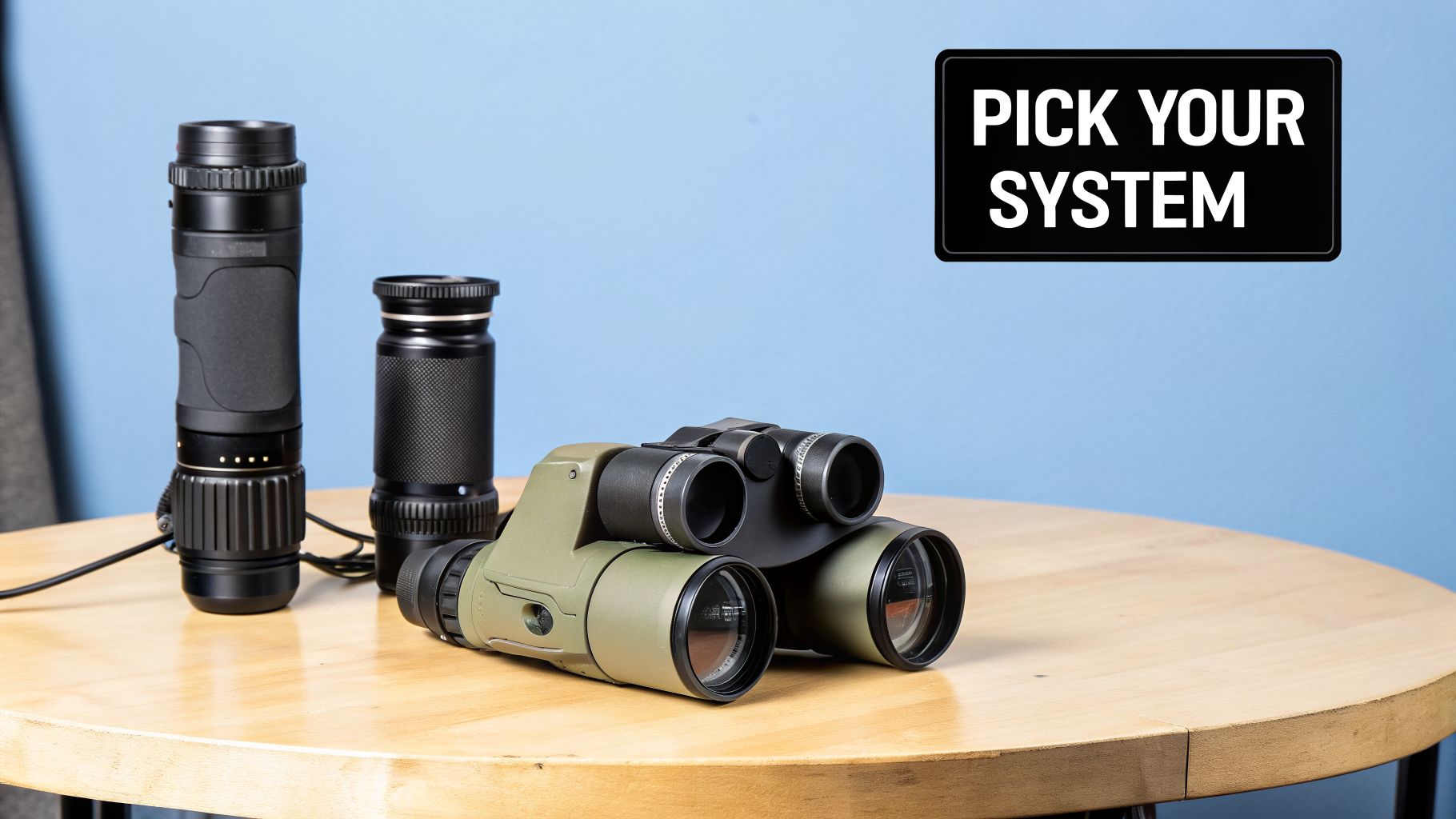
The single most important question to ask when buying night vision is: "What do I actually need to do with it?" The best gear is always the gear that's right for the job. Picking between a monocular, binoculars, or a set of dual tube night vision goggles really comes down to balancing what you want to achieve against practical limits like budget and weight.
Think of it this way: you wouldn't take a sports car on a rugged off-road trail, and you wouldn't take a heavy-duty truck to a racetrack. Night vision is the same. The needs of a casual camper are worlds apart from those of a law enforcement officer or a dedicated nocturnal hunter.
Let's walk through who uses what, and why.
The Casual User or Hiker
If you're looking for something to help you navigate a trail after dark or spot some wildlife from your campsite, a single-tube monocular is often the perfect place to start. They are light, simple, and won't break the bank.
A monocular keeps one eye free and adapted to the darkness, which helps with situational awareness. The big trade-off? No depth perception. This makes moving quickly or handling gear a real challenge. A monocular is a tool for seeing in the dark, not for operating in it.
The Dedicated Hunter or Observer
Hunters, property owners, and anyone who spends a lot of time scanning from a static position will get a ton of value from night vision binoculars. These systems almost always have built-in magnification, like 3x or 5x, which lets you spot and identify targets at ranges far beyond what standard 1x goggles can manage.
The magnification is great for observation, but it makes these devices totally impractical for walking around. The narrow field of view and altered perspective would be disorienting and unsafe. They're a specialized tool for looking far, not for moving fast.
The Tactical Professional or Serious Enthusiast
For anyone who needs to move, shoot, and work with their hands in total darkness, nothing beats a set of helmet-mounted dual tube night vision goggles. This is the gold standard for a reason.
Having a tube for each eye provides true stereoscopic vision, giving you the depth perception needed to navigate difficult terrain, drive a vehicle, or engage a target with confidence. This is the setup used by military and law enforcement operators because it allows you to function at speed without disorientation. It’s an absolute game-changer.
Your choice of night vision system should be dictated by your primary activity. Matching the device to the mission ensures you have the right capability when you need it most, without being burdened by features you don't.
This table gives a quick rundown of which system type is generally best for different goals.
Night Vision System Comparison by Use Case
This table helps you choose between monoculars, binoculars, and dual tubes based on activity, budget, and performance needs.
| System Type | Best For | Key Advantage | Main Drawback |
|---|---|---|---|
| Monocular | Occasional navigation, basic observation | Lightweight, affordable, versatile | No depth perception, high user fatigue |
| Binoculars | Long-range spotting, hunting from a blind | Magnification for distant identification | Heavy, narrow field of view, not for movement |
| Dual Tube Goggles | Tactical operations, driving, serious navigation | True depth perception, maximum awareness | Higher cost and weight |
Considering your primary use case will quickly point you toward the right category of device, saving you time and money.
Articulating Goggles: The Best of Both Worlds
A major leap forward in dual tube night vision goggle design is the articulating housing. Unlike older, fixed binocular systems, these modern housings let you pivot each optical pod up and out of your line of sight independently.
This gives you an incredible amount of flexibility on the fly.
- Full Binocular Vision: With both pods down, you get the immersive, true-depth-perception view that dual tubes are known for.
- Monocular Capability: Need to check a map, use a non-magnified optic, or just talk to someone? Flip one pod up and you can instantly use the system like a monocular, keeping one eye free.
- Low-Profile Storage: When you stow the goggle, articulating the pods up and back against the helmet dramatically reduces the overall profile. This prevents snags on branches, doorways, or when getting in and out of a vehicle.
This adaptability makes articulating goggles the most versatile and effective solution for dynamic environments. You get all the advantages of binocular vision with the added utility of a monocular, all in one package.
Your Guide to Helmet Setup and Goggle Integration
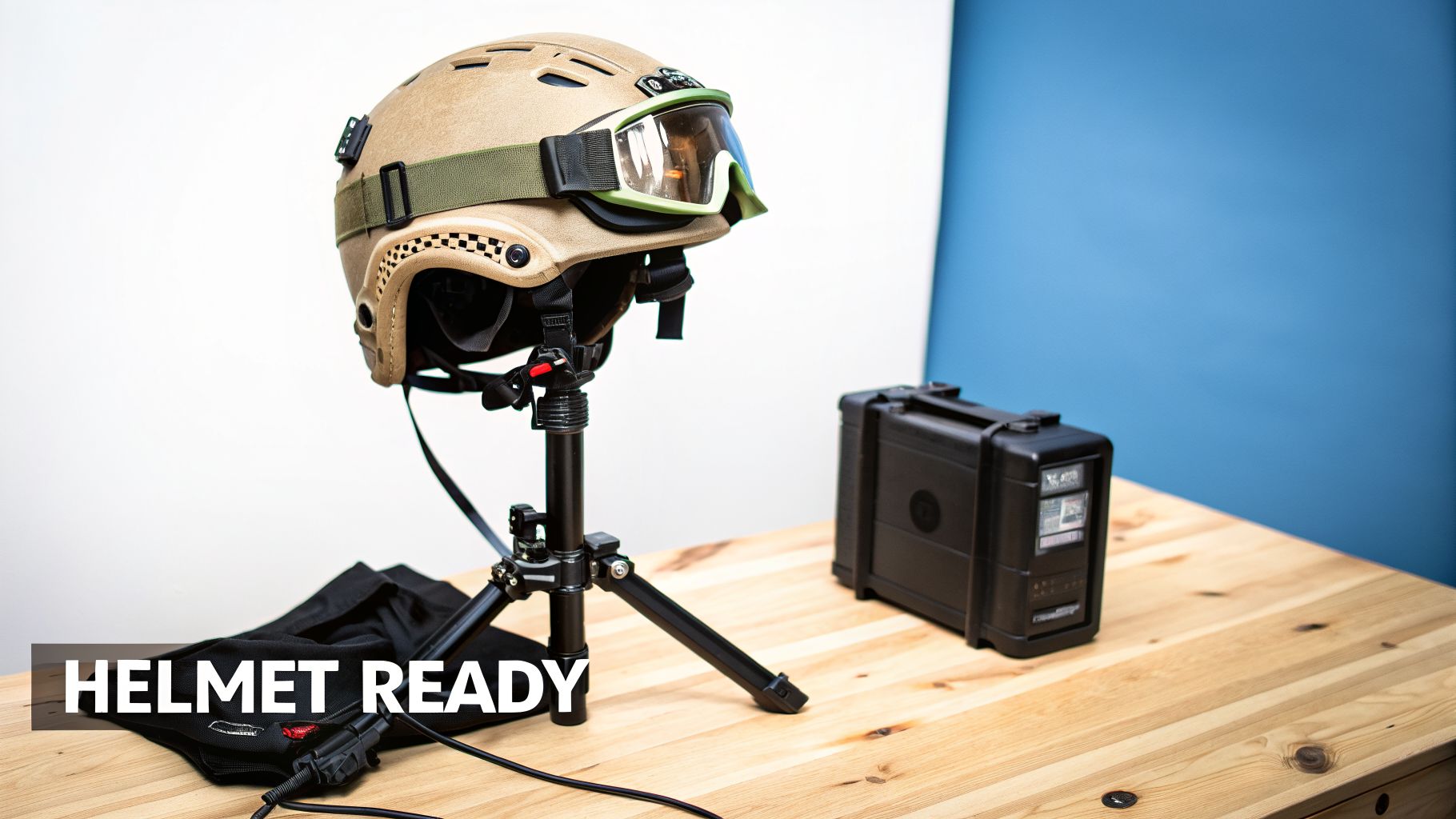
Getting your hands on a quality set of dual tube goggles is a huge step, but it’s really just the beginning. The real work—and where you truly get your money’s worth—is in building the helmet system that carries them. This is how you turn a box of expensive gear into a comfortable, perfectly balanced rig that feels like a natural extension of yourself.
Let's be clear: a slapped-together setup is a recipe for a miserable night. You'll be dealing with a wobbly image, a sore neck, and constant fiddling instead of focusing on the task at hand. We'll walk through a proper build, from the shell to the accessories, to make sure your investment works for you, not against you.
Building Your Helmet Foundation
First things first, you need the right helmet. This choice really boils down to your specific mission and how you'll be using the gear.
- Bump Helmets: Think of these as the lightweight, non-ballistic option. They're built to protect your head from impacts, like bumps and falls, and to serve as a stable platform for your NODs and other accessories. For most civilian users, hunters, and training, a bump helmet is the way to go.
- Ballistic Helmets: These are the real deal, offering protection from gunfire and shrapnel. They're standard issue for military and law enforcement for obvious reasons. While they are heavier, modern ballistic helmets are much more manageable than their older counterparts, making them a solid choice if you need that level of protection.
No matter which type you choose, make absolutely sure it has a built-in shroud. This is that machined plate right on the front. It’s the non-negotiable interface that connects your mount to the helmet, and most quality lids come with a standard 3-hole shroud that works with the best mounts on the market.
The Mount and Goggle Connection
With your helmet sorted, the next piece is the mount. This is the arm that physically connects the goggles to your helmet, and it's the absolute last place you want to cut corners. A cheap, wobbly mount will make even the best dual tube night vision goggles feel like a cheap toy.
For a rock-solid, dependable setup, a high-quality dovetail mount is the only way to fly. Something like the Wilcox L4 G24 is the gold standard for a reason: it locks up tight with zero slop and has all the adjustment you need.
- Attach the Mount: Press the release lever on the mount and slide it right into the helmet shroud. You'll hear and feel it click solidly into place.
- Connect the Goggles: Take the dovetail on your goggle housing and slide it into the shoe on the mount. It will lock in tight.
- Adjust for Eye Relief: Now, put the helmet on and flip the goggles down. Power them on and use the mount's fore/aft slider to bring the eyepieces closer or further from your eyes. You’re looking for a perfect, full image without any black rings or shadows.
Proper eye relief is everything. The goal is to get a clean, full circle in each eye. When you achieve that, your brain fuses the two images into a single, immersive view, which is the whole point of running duals.
Essential Accessories for Balance and Endurance
As soon as you mount your goggles, you'll feel it—the whole helmet wants to tip forward. Trying to fight that front-heavy weight for hours is a fast track to serious neck pain. That's why counterweights and battery packs aren't just nice to have; they're essential.
A counterweight system straps to the back of the helmet and does exactly what its name implies: it offsets the weight of your NODs. This simple addition creates a center of balance, making the entire setup feel surprisingly light and comfortable for long-term wear. Many counterweight pouches are also designed to hold your power source.
Running an external battery pack is a pro move for two big reasons. First, it acts as a functional part of your counterweight. Second, it blows the stock battery life out of the water. While internal batteries might give you a couple of dozen hours, an external pack can push your runtime to 50 hours or more. That means you can run hard for multiple nights without ever worrying about going dark.
The final piece of the puzzle is an infrared (IR) laser and illuminator on your weapon. An IR laser gives you a pin-point aiming solution only you can see, and an IR illuminator acts like a stealth flashlight, flooding an area with light that's invisible to the naked eye. This combination is what turns your observation device into a complete system for navigating and engaging in the dark.
Keeping Your Gear in the Fight: Care and Maintenance
You've dropped serious money on your duals, and they're a lifeline when the sun goes down. Just like a finely-tuned rifle, they need consistent care to perform when it counts. A few simple habits will protect the sensitive optics and electronics, making sure your investment is ready to go for years to come.
The first rule of thumb is keeping your lenses clean. It sounds basic, but a smudged or dusty view can be the difference between seeing a threat and missing it. Whatever you do, resist the urge to wipe them with your t-shirt or a paper towel. You’ll just end up grinding dirt into the delicate lens coatings and causing permanent scratches.
The Right Way to Clean Your Lenses
The whole process is a simple two-step dance. It starts with getting rid of any loose grit or dust that's settled on the glass.
Don't wipe it away. Instead, grab an air blower or a can of compressed air and give the lenses a few gentle puffs. This gets all the abrasive little particles off without scratching anything. Only after the dust is gone should you move on to fingerprints and smudges.
For that, a dedicated lens pen or a fresh, high-quality microfiber cloth is your best friend. A gentle wipe in a circular motion is all it takes to clear up any oils and leave you with a crystal-clear image. It's a small habit that makes a huge difference.
Battery and Storage Discipline
One of the quickest ways to kill a great piece of electronic gear is battery corrosion. We've seen it happen time and again, and it's completely avoidable, especially with night vision that might sit in a case between training sessions.
It's simple: always pull the batteries out before putting your goggles away for any extended period. This costs nothing and completely eliminates the risk of a leaky battery eating away at the guts of your expensive NODs.
How you store them matters just as much. Your goggles belong in a hard, padded case that can handle being dropped, tossed in a truck, or getting knocked around. And just as importantly, keep the protective daylight lens caps on at all times when they're not in use. Powering on the tubes and accidentally pointing them at a bright light can create permanent burn spots on the intensifiers in an instant.
Stick to these simple rules for storage:
- Use a Padded Case: This is non-negotiable for protecting against impacts and shock.
- Keep Lens Caps On: It's your number one defense against catastrophic light damage.
- Store in a Dry Place: Keep them out of humid basements or damp environments that can wreck electronics over time.
When Things Go Wrong: Warranty and Repair
Even with the best care, life happens. That’s where a solid warranty provides real peace of mind. Quality Gen 3 systems, like those from Superior Tactical LLC, come backed by a comprehensive 10-year warranty. This is our commitment to you that your investment is protected from manufacturing defects.
Beyond the warranty, knowing you have access to expert, in-house repair services is invaluable. If you run into an issue or just want a professional tune-up, our team offers free diagnostics to get your gear assessed. Having that support on standby means your duals can be kept in peak condition, extending their service life and protecting your investment for the long haul.
Frequently Asked Questions About Dual Tube Goggles
When you're getting into night vision, you're bound to have questions. It's a big investment, and you want to get it right. Here are some of the most common things people ask, answered from years of hands-on experience with this gear.
Are Dual Tube Night Vision Goggles Waterproof?
Most quality dual tube setups are built to be highly water-resistant, if not fully waterproof. They're designed to handle everything from a sudden downpour to high humidity without skipping a beat.
The key spec to look for is the IP (Ingress Protection) rating, which tells you exactly how sealed the housing is. Before heading out into wet conditions, always double-check that your battery caps and any connection ports are screwed down tight. Those seals are what protect the sensitive electronics inside and keep your warranty valid.
Can I Use Night Vision During the Day?
Absolutely not. You must never power on your night vision device in daylight unless the solid front lens caps are on. The image intensifier tubes are incredibly sensitive to light, and even a brief flash of direct sun can cause permanent damage, leaving you with ugly black spots, or "burns," in your tube.
Even the little pinholes on some day caps are only meant for a quick function check in a lit room, not for walking around outside.
The single most important rule of owning night vision is protecting the tubes from bright light. One careless mistake can permanently ruin a multi-thousand-dollar investment in an instant.
What Is the Difference Between Green and White Phosphor?
The phosphor type dictates the color of the world you see through the goggles. Green phosphor is the classic, iconic look you've probably seen in movies, creating a green-and-black image.
White phosphor is a more recent development that produces a black-and-white image, similar to an old TV. Many users find that white phosphor provides better contrast and makes it easier to pick out details, which can lead to less eye fatigue over long nights. Ultimately, it often comes down to personal preference and budget, as white phosphor units generally carry a higher price tag than their green counterparts.
At Superior Tactical LLC, we stand behind our gear with a 10-year warranty on the highest quality Gen 3 dual tube night vision goggles available. To see our curated selection of mission-ready equipment, check out our full collection at Superior Tactical.
