A Complete Guide to Binoculars with Night Vision
Ever tried to see something in near-total darkness? It's impossible. But what if you could essentially turn night into day? That's exactly what night vision binoculars do. These aren't just regular binoculars with a fancy coating; they are optical powerhouses that either amplify the tiniest bit of available light or detect heat, giving you a clear picture when your eyes see nothing but black.
For anyone in law enforcement, security, or serious hunting, this isn't a gadget—it's a critical tool that completely changes the game when visibility is everything.
How Do Night Vision Binoculars Let You See in the Dark?
So, how does a pitch-black scene suddenly appear as a detailed, visible image through a pair of lenses? It’s not magic, though it certainly feels like it. The technology behind binoculars with night vision is a brilliant piece of physics that gives your eyes a kind of superpower.
The most common technology at play is called Image Intensification, or I² for short. At the heart of the device is an image intensifier tube. Think of it as a light-gathering machine on steroids. It takes photons—tiny particles of light from the moon, stars, or even distant city glow that are far too faint for our eyes to register—and turns them into a picture we can see.
The Light Amplification Process
This all happens in a blink of an eye, and it’s a fascinating process:
- Gathering Photons: First, the objective lens acts like a funnel, collecting any available ambient light and feeding it into the image intensifier tube.
- Creating Electrons: As the photons enter the tube, they hit a special surface called a photocathode, which converts them into electrons.
- Multiplying the Signal: Here's where the real power comes in. The electrons are shot through a microchannel plate, a tiny disc packed with millions of microscopic glass tubes. As the electrons bounce through these channels, they knock off thousands more electrons, creating a massive chain reaction.
- Making the Image: Finally, this flood of multiplied electrons slams into a phosphor screen, causing it to light up. This creates that iconic green-tinted image you see when you look through the eyepiece.
Depending on the quality of the unit, this process can amplify the original light by an incredible 20,000 to over 70,000 times. If you want to get into the nitty-gritty, we have a complete breakdown explaining how night vision works.
This isn't just about seeing in the dark; it's a genuine tactical advantage. It extends operational hours, gives you unparalleled situational awareness, and provides a decisive edge when visibility would otherwise be zero.
The other major player in this field is Thermal Imaging. This technology works on a completely different principle. Instead of amplifying light, it detects tiny differences in the heat signatures that all objects, people, and animals give off. Because it sees heat instead of light, it works in absolute, total darkness and can even see through smoke, dust, and fog.
The demand for this kind of capability is skyrocketing. The global night vision device market was valued at USD 7.5 billion in 2024 and is on track to reach USD 9.5 billion by 2030. Unsurprisingly, North America is the biggest market, driven by defense and security needs. You can dig into the numbers in the night vision device market research on stratviewresearch.com.
Getting a handle on these two core technologies—image intensification and thermal imaging—is the first and most important step in figuring out which device is right for you.
Understanding The Core Night Vision Technologies
Before you can really pick the right binoculars with night vision, you need to get a handle on the two completely different technologies that let us see in the dark. These aren't just minor variations of the same thing; they're two separate ways of solving the low-light problem. You can almost think of it as having two different senses—one makes your normal vision superhuman, while the other lets you literally see heat.
The two main players here are Image Intensification (I²) and Thermal Imaging. Each one has its own distinct strengths, making it the right tool for some jobs but the wrong tool for others, whether you're on a tactical op or just watching wildlife.
Image Intensification: The Light Amplifier
Image Intensification, which you'll often hear called I², is what most people think of as classic night vision. It’s the source of that iconic green-hued image from movies and video games. The best way to think about it is as a ridiculously powerful light amplifier. It takes whatever tiny bit of ambient light is available—starlight, moonlight, even the faint glow from a distant town—and multiplies it thousands of times over to create a bright, usable picture.
Inside the device, a component called an image intensifier tube kicks off a lightning-fast chain reaction:
- First, the objective lens gathers any available photons (particles of light) from the scene.
- These photons then hit a photocathode, which acts like a converter, turning the light particles into electrons.
- Next, those electrons are shot through a microchannel plate, triggering a cascade that multiplies their number by the thousands.
- Finally, this supercharged stream of electrons slams into a phosphor screen, which glows brightly to create the detailed image you see through the eyepiece.
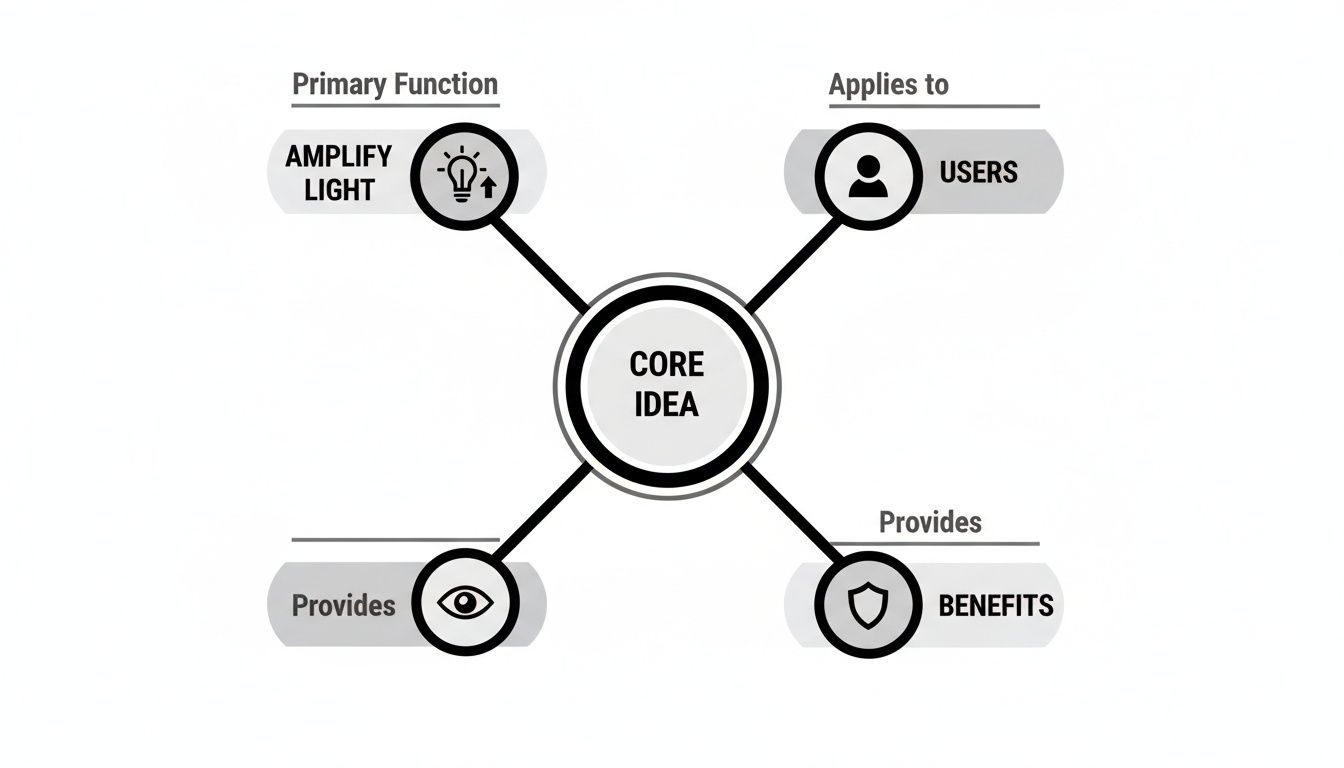
Because I² technology enhances an actual image, it's fantastic for recognizing details. You can make out faces, read signs, and navigate terrain because you're seeing a true, albeit amplified, version of the world. But here's the catch: it has to have some light to amplify. In a sealed room with zero light, an I² device is blind.
We go into much more detail in our comprehensive guide explaining night vision technologies if you want to take a deeper dive.
Thermal Imaging: Seeing The Heat
Thermal imaging is a whole different ballgame. Instead of amplifying light, it detects infrared energy—or what we all know as heat. Every single object, living or not, gives off a thermal signature. A thermal optic reads these signatures and builds a picture based on them, essentially creating a heat map of your surroundings. Hotter objects like people, animals, and recently-used engines glow brightly against cooler backgrounds like trees and rocks.
The game-changing advantage of thermal is that it needs zero ambient light. It sees perfectly in absolute, pitch-black darkness. Even better, it cuts right through things that stop I² cold, like smoke, fog, dust, or thick brush. This makes it an unbeatable tool for pure detection.
The rise of thermal night vision binoculars is fundamentally changing how professionals and serious enthusiasts operate after dark. It’s not just a niche product anymore; thermal imaging grabbed 39.72% of the market share in 2023 and is expected to grow by another 8.36% a year through 2031. That massive growth is happening for a reason—it’s incredibly effective for spotting targets from as far as 2km away, no matter the conditions.
Image Intensification (I²) vs Thermal Imaging
Let's put these two technologies head-to-head. It’s important to remember that one isn’t flat-out "better" than the other; they're designed for different missions. One excels at identification, the other at detection. Seeing their strengths and weaknesses side-by-side makes it much easier to decide which fits your needs.
| Feature | Image Intensification (e.g., Gen 3) | Thermal Imaging |
|---|---|---|
| How It Works | Amplifies existing ambient light | Detects differences in heat energy |
| Light Required | Needs some ambient light to work | Works in complete darkness (zero light) |
| Primary Use | Navigation and target identification | Detection of heat signatures |
| Image Quality | High detail, shows textures & depth | Shows heat contrast, less surface detail |
| Through Obscurants | Blocked by smoke, fog, and foliage | Can see through smoke, fog, and foliage |
So, what's the takeaway? It all boils down to your primary goal. Are you trying to figure out what something is, or are you just trying to find out if something is there in the first place? Answering that one question will put you on the right path to choosing the perfect binoculars with night vision.
Decoding the Key Specifications on a Spec Sheet
Stepping into the world of binoculars with night vision means you'll quickly run into a spec sheet loaded with technical terms. It can look a little intimidating at first, but cracking this code is the key to understanding how a device will actually perform out in the field. Think of it as the nutrition label for your gear—it tells you exactly what you're getting.
Let's translate the most critical specs into what they mean for you in the real world. By the end of this, you'll be able to glance at a product page and know not just what the numbers mean, but how they'll impact your ability to own the night.

Figure of Merit (FOM): The Overall Performance Score
The first term you'll probably see on high-end Gen 3 gear is Figure of Merit, or FOM. This isn't just some marketing buzzword; it's a calculated score that gives you a quick, at-a-glance measure of the image intensifier tube's overall quality.
FOM is figured out by multiplying two other key specs: Resolution and Signal-to-Noise Ratio (SNR). Generally, a higher FOM means a better tube that can paint a cleaner, sharper picture, especially when light is almost non-existent. For most serious users, a FOM of 1800 is a great starting point, while the units used by elite professionals can easily top 2400.
Think of FOM as the horsepower rating for your night vision. But just like with cars, two engines with the same horsepower can deliver it very differently. That's why we need to dig into the two numbers that actually make up the FOM score.
Resolution (lp/mm): The Sharpness of Your Image
Resolution, measured in line pairs per millimeter (lp/mm), is probably the easiest spec to wrap your head around. It directly translates to image sharpness and how much detail you can see.
It’s just like the resolution on a TV screen. More pixels mean a crisper, more defined picture. In night vision, a higher lp/mm value means the device is better at distinguishing fine details from a distance.
- A unit with 64 lp/mm resolution will give you a solid, very usable image.
- A top-tier device with 72 lp/mm or more lets you see textures, read signs, or pick out subtle features on a target with incredible clarity.
This is a huge deal in the field. When you need to tell the difference between a fallen log and a predator at 100 yards, higher resolution makes that job infinitely easier. Of course, the glass itself plays a massive role, and you can get a better sense of that by checking out our guide on the importance of the lens for night vision.
Signal-to-Noise Ratio (SNR): Clarity vs. Static
If resolution is about sharpness, Signal-to-Noise Ratio (SNR) is all about clarity. It’s a measure of the good stuff (the light signal) versus the bad stuff (the background "noise" or static).
Picture tuning an old analog radio. A high SNR is a perfectly clear station with zero static. A low SNR is a distant channel that’s buried in hissing and popping. In night vision, this "noise" looks like a grainy, sparkling effect that we call "scintillation."
A higher SNR is absolutely critical for seeing in the darkest conditions. It means the image you see is clean and free of distracting static, letting you pick out details in deep shadows or under a moonless, overcast sky. An SNR of 25 is considered good, while premium tubes push well past 30.
DRI: The Three Levels of Seeing
Finally, let's break down Detection, Recognition, and Identification (DRI) ranges. These aren't just one number but three distinct benchmarks that tell you what you can realistically see at various distances.
- Detection: This is the farthest range where you can tell something is there. You might not know what it is, but you can see a shape that doesn't belong in the background.
- Recognition: At this closer range, you can figure out the type of object. You can now tell that shape is a person, not a deer, or a truck instead of a small car.
- Identification: This is the closest and most detailed range. Here, you can make out specifics—like seeing if the person is carrying something, or even recognizing their face.
Understanding DRI is crucial for setting expectations. A manufacturer might advertise a "1,000-yard range," but that's almost always the detection range. The distance at which you can recognize or identify a target will be significantly shorter. Always look for the DRI specs to understand what a device is truly capable of at the distances that matter to you.
How Night Vision Binoculars Perform in the Real World
Specs on a page are one thing, but they only tell you half the story. The real proof is how binoculars with night vision perform when the pressure is on. Putting yourself in the boots of the professionals who depend on this gear is the best way to understand which device truly fits your needs.
Let's move beyond the data sheets and look at how this technology plays out in the field. These scenarios show how specific features translate directly into success—whether that means keeping an officer safe, securing a perimeter, or making an ethical harvest.
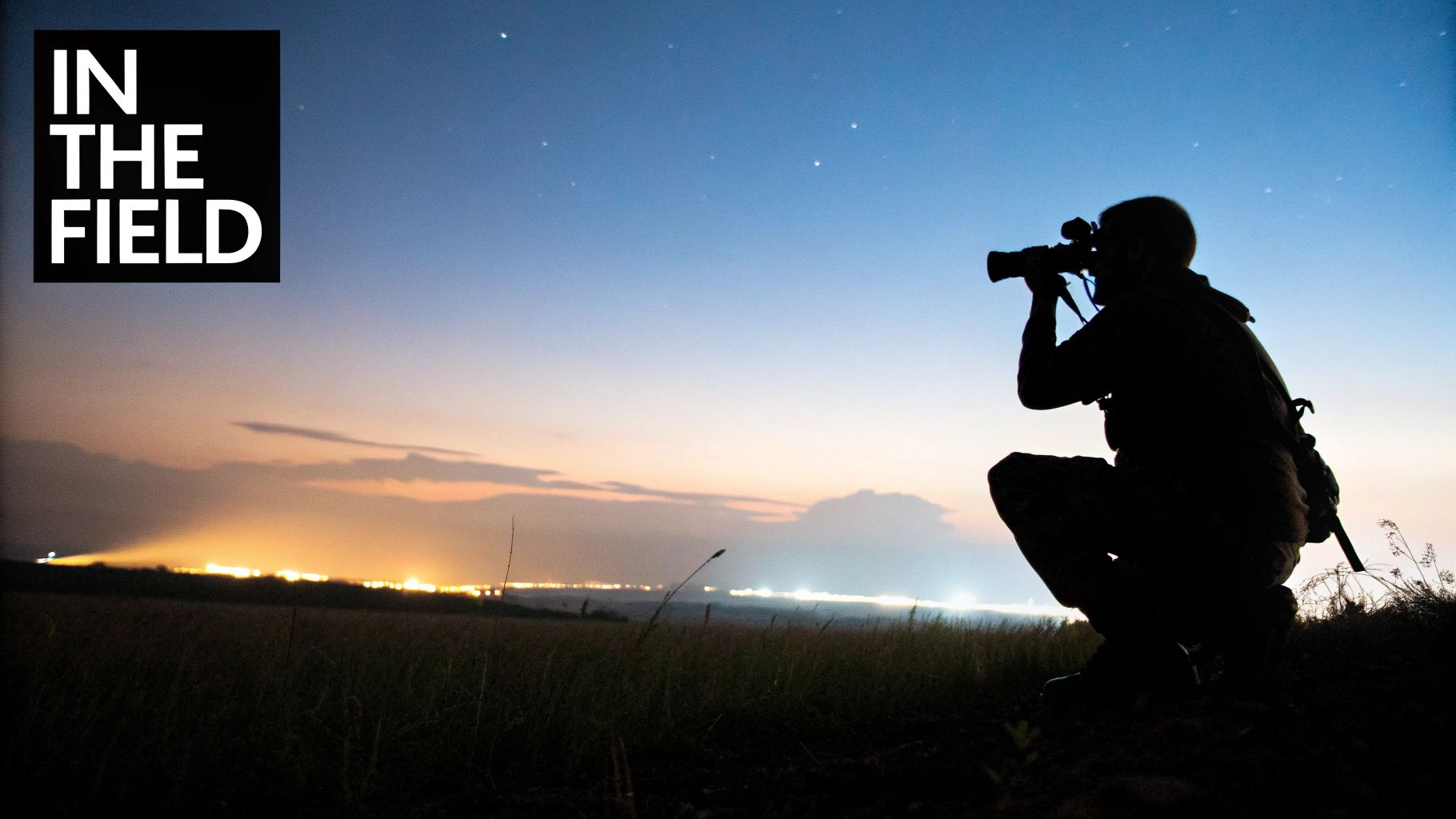
Law Enforcement Tactical Operations
Picture a SWAT team about to clear a dark, derelict warehouse. It's a maze of shadows, debris, and unknown threats. The team is running helmet-mounted, dual-tube Gen 3 night vision binoculars.
Why dual tubes? It’s a huge tactical advantage. A single-tube monocular can flatten your vision, but the stereoscopic view from binoculars preserves the operator's natural depth perception. This is critical for navigating cluttered hallways, judging the distance to a doorway, and moving smoothly as a unit. The crisp, clean image from the Gen 3 tubes lets them instantly distinguish a piece of trash from a potential threat, allowing for confident, split-second decisions.
The Modern Hunter in the Field
Now, imagine a hunter overlooking a vast field at night, targeting invasive feral hogs that are most active after sunset. The darkness is almost total, and the hogs are known for sticking to dense cover. This is a perfect scenario for a hybrid approach, using both thermal and image-intensified (I²) optics.
First, the hunter scans the entire area with thermal binoculars. This tech cuts right through the darkness and light brush, revealing several glowing heat signatures—a group of hogs moving along the treeline. Detection is instant. But thermal imaging alone often lacks the detail needed for positive ID and a safe, ethical shot.
That’s when the hunter switches to a weapon-mounted Gen 3 I² monocular. Now, the specific details of the animals pop. This second step is crucial for confirming the species, judging size, and making sure no other animals are in the line of fire. The thermal binoculars found the needle in the haystack; the I² optics let the hunter thread it.
Security and Perimeter Surveillance
Think about a security professional monitoring the sprawling fenceline of a power plant or data center. The mission is simple: detect any threat as early as possible, long before it gets close. Here, long-range observation is everything.
The security officer is using a tripod-mounted set of high-magnification thermal binoculars. From a hidden observation post, they can scan for hundreds of yards. Suddenly, a flicker of heat appears on the screen—a vehicle has stopped on a distant service road. Even at that range, the thermal signature is unmistakable against the cool background. This early warning buys the security team precious time to dispatch a patrol and assess the situation before it can escalate. In this role, thermal's ability to detect heat at extreme distances is its killer feature.
These real-world applications show that the best binoculars with night vision are not just about seeing in the dark—they are specialized tools designed to provide specific advantages for distinct challenges. The choice between thermal and image intensification often comes down to a simple question: is your primary goal detection, or is it identification?
What started as early military experiments has evolved into a cornerstone of modern nighttime operations. Valued at USD 8.06 billion in 2024, the market for these devices is projected to hit USD 19.41 billion by 2032, which shows just how essential they’ve become. It's reported that 80% of law enforcement night operations now rely on this tech, while hunters have seen success rates jump, spotting 65% more game after sunset. You can learn more about these trends from market analysis like this night vision device market report from 360iResearch.com.
Keeping Your Gear Field-Ready
A good set of night vision binoculars is a serious piece of equipment, and just like any other critical tool, it needs a little care to keep it running at its best. Think of it less as a chore and more as protecting a capability you rely on. A few simple habits will keep your optics clear and reliable for years.
The most vulnerable parts, by far, are the lenses. It's a simple rule, but an important one: if you're not looking through them, keep the lens caps on. This is your first line of defense against dust, smudges, and the kind of accidental scratch that can ruin a view.
The Do's and Don'ts of Care and Handling
When it comes time to clean the glass, treat it like you would an expensive camera lens. Never wipe a lens that has dust or grit on it—you’ll just grind those particles into the coating and create permanent scratches.
First, blow off any loose debris with a can of compressed air or gently whisk it away with a soft lens brush. Once the surface is clear, apply a dedicated lens cleaning solution to a microfiber cloth (never directly onto the lens) and wipe in a gentle, circular motion, starting from the center and working your way out.
Battery discipline is another huge factor. Stick with high-quality, reputable batteries. Cheap ones are notorious for leaking, and that acid can spell disaster for the sensitive electronics inside. If you're putting your gear away for more than a couple of weeks, always take the batteries out. It's a simple step that can save you from a very expensive and irreversible mistake.
The golden rule for any image intensifier (I²) device is this: never, ever expose it to bright light. Pointing it at a streetlight, a car's high beams, or—worst of all—the sun can permanently burn the image intensifier tube. You’ll be left with permanent black spots in your vision that can't be fixed.
The Legal Side: Understanding ITAR
Owning professional-grade night vision gear means you're also responsible for handling some serious technology. This is where the International Traffic in Arms Regulations (ITAR) come into play. Essentially, ITAR is a set of U.S. government rules that control military-grade technology to keep it out of the wrong hands.
Many high-performance night vision devices, especially those with Gen 3 tubes, are covered by ITAR. For the average American owner, this boils down to a few non-negotiable rules:
- You can't take ITAR-controlled night vision out of the country. That means no international hunting trips or overseas work with your device.
- You can't sell, give, or otherwise transfer your gear to a non-U.S. citizen, even if they live here in the States.
The penalties for breaking ITAR rules are steep, so it's something to take seriously. At Superior Tactical, we follow every regulation to the letter. We make sure every sale is compliant and that every customer knows exactly what their responsibilities are as an owner of this powerful technology.
Why a Good Night Vision Supplier Matters More Than You Think
When you're ready to buy a serious piece of kit like night vision binoculars, you're not just buying a product in a box. You're making a real investment. The supplier you choose is almost as critical as the gear itself.
Think of it this way: anyone can sell you a box. A truly dedicated supplier, however, becomes your partner. They’re there to make sure your equipment performs flawlessly for years to come, not just on day one. It's about building a relationship based on real-world know-how and a commitment to your success, whatever your mission is.
A specialist retailer doesn’t just throw a massive, confusing catalog at you. They offer a carefully chosen lineup of brands they trust—gear that's been proven to work when it counts. This kind of expert curation saves you the headache of sifting through endless options and wondering what’s actually reliable.
It's More Than Just a Sale
So, what really separates a great supplier from a simple online store? It’s the support you get after the purchase. A quality dealer is committed to keeping your gear in the fight.
- Real Repairs, Not Excuses: If something goes sideways, you need an expert, not a call center. At Superior Tactical, we handle diagnostics and repairs right here, in-house. That means less downtime for you.
- A Warranty That Means Something: We back our gear, plain and simple. Our Gen 3 systems, for example, come with a 10-year warranty. That’s a decade of confidence.
- Getting Gear in Your Hands, Fast: Waiting around isn't an option. We focus on fair pricing and same-day shipping to get you equipped and ready to go without delay.
Choosing the right supplier means you’re not just buying a tool; you’re gaining an ally. It’s the difference between being another customer and having a team in your corner that gets what's at stake.
At the end of the day, a reputable supplier doesn’t just move binoculars with night vision. They provide a complete support system. From helping you pick the right device to keeping it running down the road, the goal is simple: to make sure you own the night.
Your Top Questions About Night Vision Binoculars, Answered
When you're first getting into binoculars with night vision, a lot of questions pop up. It's totally normal. Getting the right answers is the first step toward choosing the right gear and, more importantly, knowing how to use it properly. Let's break down some of the most common things we get asked by newcomers and seasoned pros alike.
What's the Real Difference Between Digital and Gen 3 Night Vision?
At its core, the difference is analog versus digital. It's like comparing a high-end film camera to a top-tier digital one.
Think of Gen 3 night vision as the analog purist's choice. It uses a sophisticated piece of hardware called an image intensifier tube to take what little ambient light is available—starlight, moonlight—and physically multiply it thousands of times. The result is a stunningly crisp, clean, and detailed view, which is exactly why it's the trusted standard for military and law enforcement operations.
Digital night vision operates more like a camcorder built for the dark. It has an electronic sensor that gathers light and processes it into an image you see on a tiny screen inside the eyepiece. While digital units are generally less expensive and often let you record video, they usually need more ambient light or a boost from a built-in IR illuminator to keep up with a quality Gen 3 device when it gets truly dark.
Can I Use These During the Day?
That's a big one, and getting this wrong can be a costly mistake. The answer completely depends on what kind of night vision you have.
Image Intensifier (Gen 1, 2, 3): Absolutely not. Pointing traditional I² night vision at a bright light source, especially the sun, will scorch the image intensifier tube in an instant. It's permanent damage—think of it as a fatal sunburn for your optic's most critical component.
Thermal Imaging: Yep, no problem. Thermal devices see heat, not light, so they work just as well at high noon as they do at midnight. They are true 24/7 tools.
Digital Night Vision: Usually, yes. Most digital models can be used in daylight, essentially working like a regular digital camera. Just don't expect the image quality to compete with a dedicated daytime binocular.
How Far Can I Actually See?
This is where expectations meet reality. Your effective range depends on the device's generation and quality, the weather, and how much light you have to work with. With a high-end Gen 3 unit on a clear night with a bit of moonlight, you might be able to spot a person-sized figure from over 500 yards out.
But here’s a crucial concept to grasp: the difference between detection, recognition, and identification (DRI). You might detect a blob at 500 yards, recognize it's a person at 300 yards, but only be able to identify who it is at 100 yards. Each step requires more detail and a shorter distance. Thermal can often detect heat signatures from even further away, but for getting a positive ID, nothing beats the detail from a top-tier Gen 3 device.
Do I Really Need an IR Illuminator?
An IR illuminator is basically a flashlight that's invisible to the naked eye but lights up the world for your night vision. Whether you need one hinges on your gear and the environment.
A Gen 1 device pretty much always needs an IR illuminator to give you a clear picture. On the other hand, high-performance Gen 2 and Gen 3 units are so sensitive they can work beautifully with just a sliver of moon or some starlight.
But what if there's zero light? Think a windowless basement, a deep cave, or a building with no power. In those pitch-black scenarios, there’s no light to amplify. That's when even the best binoculars with night vision need an IR illuminator to see anything at all.
At Superior Tactical LLC, our job isn't just to sell you equipment. We're here to make sure you have the knowledge and support to be effective in any light condition. From our 10-year warranty on Gen 3 systems to our in-house repair services, we're your partner for the long haul. Take a look at our handpicked collection of night vision and thermal optics by visiting us at https://superiortac.com.
