A Complete Guide to Binocular Night Vision Technology
If you've ever tried navigating a dark room with one eye shut, you get a small sense of what it's like to use a single-tube night vision device. Now, open both eyes. That instant, natural sense of depth and space is exactly what binocular night vision brings to the table. It’s not just seeing in the dark; it's understanding the dark.
This is a system that uses two separate image intensifier tubes—one for each eye—to give you true, three-dimensional vision when the sun goes down.
Why Two Eyes Are Better Than One in the Dark
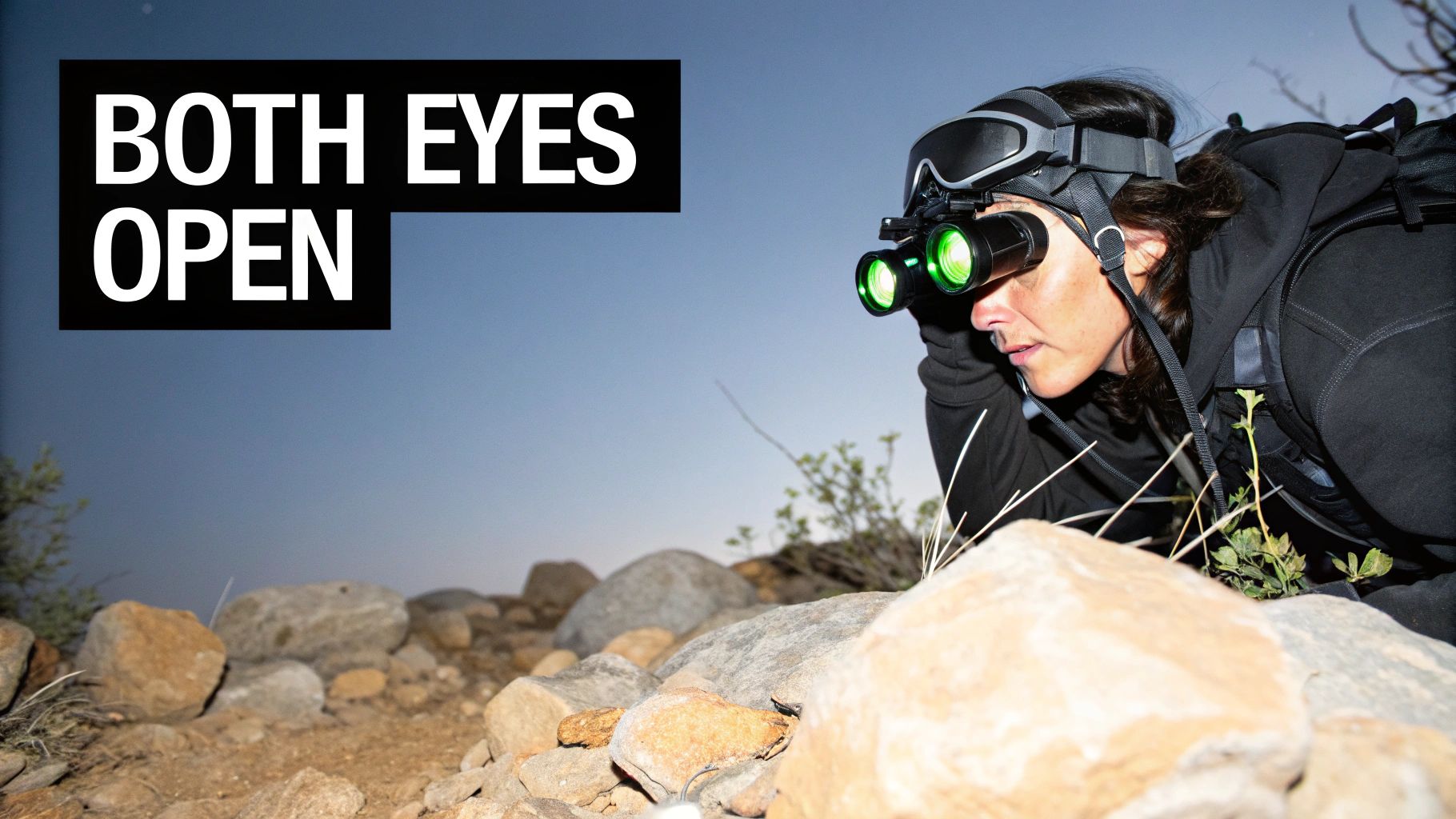
This guide is all about the tactical world of seeing with both eyes open after sunset. Your brain is hardwired for stereoscopic vision, using the slightly different perspectives from each eye to perceive depth. Binocular night vision taps directly into this natural ability, giving you a decisive edge that's about more than just comfort.
When you use a dual-tube system, judging the distance to a tree, a target, or a dip in the trail becomes second nature—just like it is during the day. This is a game-changer for anyone who needs to move fast or handle complex tasks in the dark.
The Advantage of True Stereoscopic Vision
A single-tube monocular can show you what's out there, but it presents a flattened, 2D image. Your brain has to work overtime to interpret it. With two tubes, you get immediate, tangible benefits:
- Improved Navigation: You can move confidently and quickly over rough terrain, through thick woods, or inside darkened buildings without second-guessing every step.
- Enhanced Situational Awareness: Your brain processes the scene more naturally, which cuts down on the mental fatigue that often comes from staring through a single eyepiece for hours.
- Greater Task Efficiency: Simple things like driving a vehicle, giving medical aid, or working with your gear suddenly become far less clumsy and much more intuitive.
For a more in-depth comparison, you can learn more about the differences between monocular and binocular night vision in our dedicated guide.
Binocular systems reduce the cognitive load required to interpret a flattened, single-tube image, freeing up mental bandwidth for critical decision-making. This is especially vital in high-stress scenarios.
Think of this as a practical field guide, not a dry technical manual. Whether you're a law enforcement officer, a serious hunter, or a security professional, knowing these core advantages is the first step toward a smart investment. We’re here to cut through the jargon and give you the real-world insights you need to choose the right dual-tube system for your mission.
How Image Intensifiers Turn Darkness into Daylight
At its heart, a binocular night vision device is a ridiculously powerful light amplifier. It’s not creating light out of thin air. Instead, it captures the tiniest, faintest bits of ambient light—moonlight, starlight, even the glow from a city miles away—and multiplies it thousands of times to give you a clear, usable image.
This whole process happens inside the image intensifier tube, which is essentially the engine of the device. Think of it as a three-step relay race, turning a few stray light particles into a bright, visible picture.
First, light particles, known as photons, travel through the objective lens and hit a special screen called a photocathode. The photocathode's only job is to convert those incoming photons into electrons, kicking off the amplification process.
The Microchannel Plate: The Real Magic
Now for the incredible part. Those new electrons are funneled into the microchannel plate (MCP). Imagine a wafer as thin as a piece of paper, but jam-packed with millions of microscopic glass tubes, all tilted at a slight angle. This is the MCP.
When a single electron enters one of these tiny tubes, it slams into the wall, which causes thousands more electrons to break free. This creates a massive chain reaction that cascades down the tube. This happens across millions of channels simultaneously, amplifying the original signal by tens of thousands of times. It’s this exponential multiplication that lets you see in what looks like total darkness.
This process is what makes true image intensification (I²) technology so special. It’s not just gathering light like a giant camera lens; it's actively multiplying it on a massive scale. This is why you can navigate a field on a moonless, overcast night.
Finally, this supercharged flood of electrons flies out of the MCP and smashes into a phosphor screen. When the electrons hit, the phosphors light up, turning the electronic signal back into the visible green (or white) image you see through the eyepiece.
I² vs. Thermal: Seeing in Different Ways
It’s really important to know that image intensification (I²) and thermal imaging are two completely different technologies. They both let you see in the dark, but they do it in ways that are worlds apart.
- Image Intensification (I²): This tech works by amplifying reflected light. It lets you see the world as it actually is, just much brighter. You can see details, read signs, recognize faces, and navigate your surroundings with ease.
- Thermal Imaging: This works by detecting heat signatures (infrared energy) that objects give off. It's fantastic for spotting a warm body against a cool background, but it gives you almost no environmental detail. You can't read a sign or tell a shovel from a rifle with thermal.
For anything that requires positive identification and true situational awareness—like law enforcement clearing a building or a hunter navigating rough terrain—binocular night vision based on image intensification is the only way to go.
Understanding the Generations
The technology inside image intensifier tubes has evolved over the years, and we track that progress in "Generations." Each new generation represents a huge leap forward in performance.
- Generation 1 (Gen 1): This is the original tech. It works, but usually needs an active infrared (IR) illuminator to be useful. The images are often a bit distorted around the edges, too.
- Generation 2 (Gen 2): A massive improvement over Gen 1. The image is much cleaner, brighter, and more capable in very low light conditions without all the distortion.
- Generation 3 (Gen 3): This is the current gold standard for military and professional users. Gen 3 tubes offer incredible sensitivity and resolution, letting you see clearly in even the darkest conditions. For a much deeper dive, you can learn more about how the image intensifier tube works.
This drive for better performance comes from all corners—military, law enforcement, and serious civilian users. The night vision market is exploding, with some analysts projecting it will grow from USD 7.02 billion in 2022 to USD 16.32 billion by 2030. That alone shows you just how valuable this technology has become. You can dig into more market trends on the growth of night vision technology.
Decoding the Specifications That Actually Matter
Stepping into the world of binocular night vision can feel like you're trying to learn a new language. You'll get hit with a dizzying list of acronyms and numbers on every spec sheet. But don't sweat it—you only need to get a handle on a handful of key metrics to really understand how a device will perform in the real world.
Think of it like shopping for a truck. You don't need to be a master mechanic, but you know that horsepower, torque, and towing capacity will tell you a lot about what it can actually do. It's the same idea here. We'll cut through the technical jargon and translate it into practical advantages you can actually use.
This simple flowchart shows you how the core technology works at a glance, turning nearly invisible ambient light into a clear, bright image.
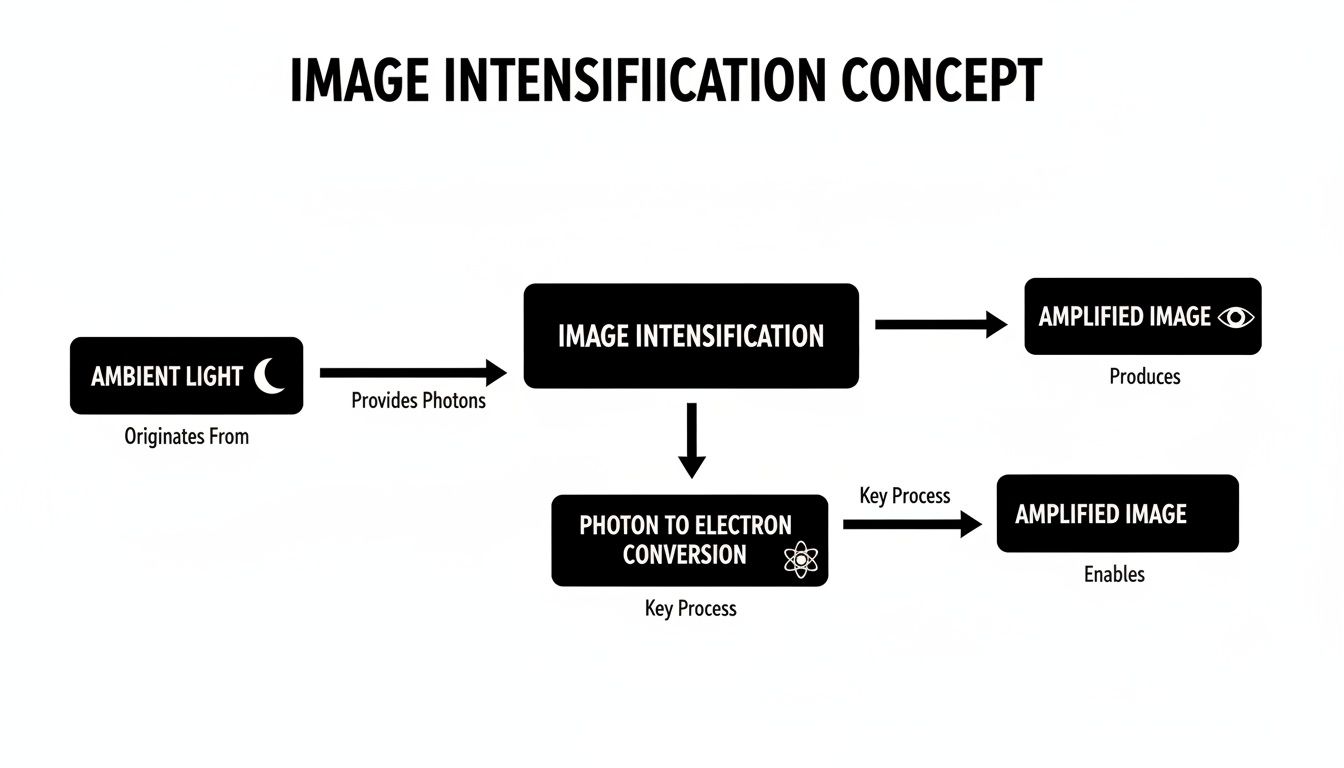
As you can see, the process boils down to collecting those tiny bits of light (photons), amplifying them thousands of times, and then delivering a usable picture right to your eye.
The King of All Specs: Figure of Merit (FOM)
If you only learn one term today, make it Figure of Merit (FOM). This single number is the most crucial indicator of an image intensifier tube's overall performance. You can think of it as the horsepower rating for your night vision.
FOM is calculated by multiplying two other key specs: the tube's resolution and its Signal-to-Noise Ratio. A higher FOM means the device is simply better at producing a clean, sharp image, especially when the lights are almost completely out. For a law enforcement officer trying to identify a threat in a pitch-black alley, a high FOM is absolutely non-negotiable.
Signal-to-Noise Ratio (SNR): The Clarity Factor
Imagine trying to listen to a quiet conversation in a noisy restaurant. The conversation is the "signal," and all the background chatter is the "noise." Signal-to-Noise Ratio (SNR) in night vision is the exact same concept, just for your eyes. It measures how much useful light information (the signal) you're seeing compared to the distracting, static-like graininess (the noise).
- High SNR: Gives you a clean, crisp, and stable image, almost like watching an HD broadcast. You can easily pick out fine details.
- Low SNR: Results in a grainy, "snowy" image that looks like an old analog TV with bad reception. Important details get lost in all that static.
A high SNR is what lets you see clearly in the darkest environments, like a moonless night out in the woods. It directly impacts your ability to spot subtle movements and identify what you're looking at from a distance.
Resolution: Seeing the Detail in the Darkness
While SNR determines the clarity of the image, Resolution determines how much detail you can see. It's measured in line pairs per millimeter (lp/mm). The higher this number, the sharper the image and the more fine detail you’ll be able to resolve.
For instance, a high-resolution device will help you distinguish between a tree branch and a rifle barrel from much farther away. It's the difference between seeing a vague shape and being able to positively identify a target. A device with 64-72 lp/mm is considered top-tier for most professional and tactical uses.
A classic rookie mistake is focusing only on resolution. A high-resolution tube with a low SNR will still look like a grainy, unusable mess. True performance comes from a strong balance of both, which is why FOM is such a great all-around number to look at.
Now, let's break down the most important specs in a simple table.
Key Night Vision Specifications at a Glance
This table sums up the specs we've covered and adds a few more. Think of it as your cheat sheet for evaluating any night vision device you're considering.
| Specification | What It Measures | Why It Matters for You |
|---|---|---|
| Figure of Merit (FOM) | Overall tube performance (Resolution x SNR) | The single best indicator of image quality. Higher is always better. |
| Signal-to-Noise (SNR) | The ratio of useful image data to static "noise" | Determines how clean and clear the image is, especially in very low light. |
| Resolution (lp/mm) | The tube's ability to show fine detail | Determines how sharp the image is. Crucial for identification at a distance. |
| Gain | The level of light amplification | How bright the image appears. Manual gain lets you adjust for different conditions. |
| Field of View (FOV) | The angular width of the visible scene (in degrees) | How much you can see at once. A wider FOV means better situational awareness. |
| EBI (Equivalent Background Illumination) | The amount of light seen in absolute darkness | A lower EBI means darker blacks and better contrast in low-light environments. |
| Halo | The ring of light around bright light sources | Measures how well the tube controls blooming. A smaller halo is better for urban settings. |
By keeping these metrics in mind, you can look at a spec sheet and get a real feel for how the unit will actually perform when you're out in the dark.
Gain and Field of View: Brightness and Awareness
Two other specs play a huge role in your actual user experience: Gain and Field of View (FOV). These control how bright the image is and how much of the world you can see at any given moment.
Gain is simply how much the device amplifies light. Think of it as the volume knob on a stereo. Most modern Gen 3 systems have massive gain, capable of multiplying available light by 50,000 times or more. Many high-end units feature manual gain control, which is a fantastic feature. It lets you dial the brightness up or down to find the perfect setting for your environment, preventing the image from getting washed out in brighter "dark" areas like a suburb with streetlights. To learn more about how this tech has evolved, check out our guide on the different night vision generations and their capabilities.
Field of View (FOV) is the width of the scene you can see, measured in degrees. The standard for most night vision binoculars is a 40-degree FOV. While that’s narrower than your natural vision, it provides an excellent balance for moving around and staying aware of your surroundings. For a hunter scanning a wide-open field, a wider FOV can be a huge advantage, as it means less head-panning to see everything.
By understanding these core concepts—FOM, SNR, Resolution, Gain, and FOV—you're no longer just staring at a list of numbers. You're equipped to evaluate any binocular night vision system and know exactly how it will perform when it counts.
Binoculars vs Monoculars: The Tactical Trade-Offs
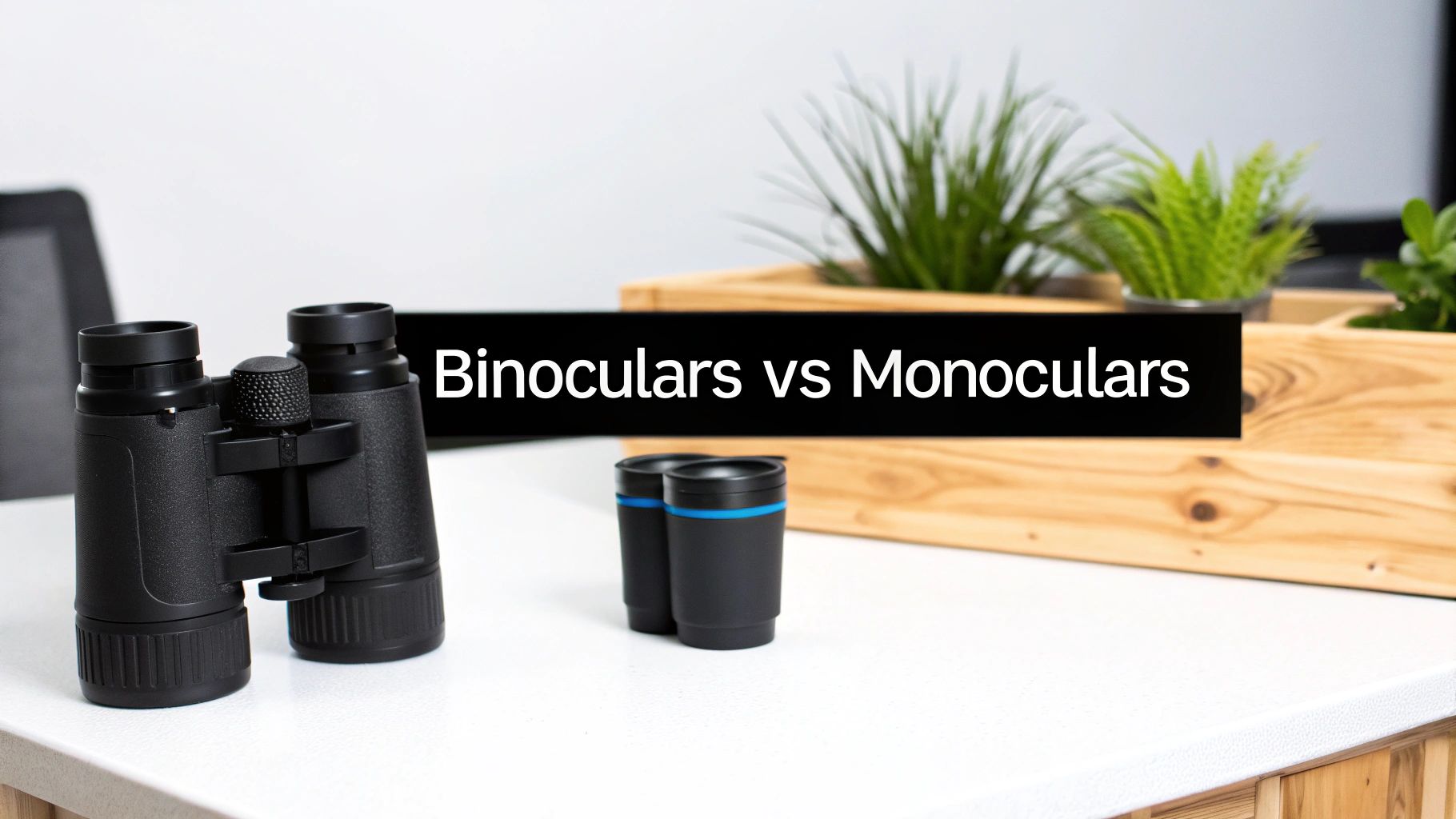
When you're gearing up for the dark, one of the first big decisions you'll face is whether to go with one tube or two. The choice between a monocular and a binocular night vision system isn't just about personal preference—it’s a fundamental tactical trade-off that will shape how you see and perform when the lights go out. Each setup has its own distinct advantages out in the field.
The killer feature of a true dual-tube binocular system is stereoscopic vision. By feeding a unique image to each eye, it lets your brain process depth perception just like it does in broad daylight. Suddenly, tasks like navigating rocky terrain, judging the distance to a target, or even driving a vehicle at night become far more intuitive.
This natural depth perception dramatically cuts down on the mental fatigue and eye strain that can build up over long nights. Staring through a single tube for hours on end is taxing; your brain is constantly working to make sense of a flat, 2D world. With binoculars, that fight is over, making them the hands-down winner for missions demanding long observation periods or constant movement.
The Case for Binocular Night Vision
For situations where peak performance and total awareness are absolute must-haves, binocular systems are the gold standard. They deliver a much more immersive and comfortable experience, which can make all the difference when the stakes are high.
- Superior Depth Perception: This is the real game-changer. Being able to instinctively judge distances and navigate your environment is priceless for anyone moving fast or needing to interact with their surroundings.
- Reduced Eye Strain: Using both eyes is just how we're built to see, so it's naturally less fatiguing. This helps you stay sharp and focused longer, whether you're on an extended security patrol or an all-night hunt.
- Enhanced Situational Awareness: Your brain processes the dual-image input more effectively, painting a more complete picture of what's around you. You can react quicker because you're spending less brainpower just trying to interpret what you see.
For operators performing complex tasks in the dark—from a medic working on a casualty to a pilot navigating a tricky landing zone—the intuitive feel of binocular vision is a mission-critical advantage. It bridges the performance gap between day and night.
This is exactly why military forces around the world are increasingly adopting dual-tube systems. The Global Military Night Vision Device Market, valued at USD 5.68 billion in 2025, is on track to hit USD 9.88 billion by 2031. You can dig deeper into the intensified military modernization initiatives worldwide that are fueling this growth.
The Versatility of Monoculars
While binoculars deliver unmatched performance, you can't discount the sheer versatility and practicality of a monocular. There's a reason single-tube devices like the legendary PVS-14 are still so popular, and it boils down to flexibility, weight, and cost.
The biggest tactical advantage of a monocular is that it leaves one eye free and adapted to the ambient darkness. This "unaided eye" keeps your natural peripheral vision intact and lets you transition between different lighting conditions without being totally dependent on the device. For a law enforcement officer moving from a pitch-black alley to a brightly lit street, that's a huge deal.
Here’s a quick rundown of where monoculars really excel:
- Lower Weight: With only one image intensifier tube and a smaller housing, monoculars are significantly lighter. This means less neck strain and no need for a clunky helmet counterweight.
- Cost-Effectiveness: A top-tier monocular can easily cost less than half of what you'd pay for a comparable binocular setup. This makes high-quality night vision accessible to a much broader range of people.
- Flexibility: You can mount a monocular on a helmet, wear it on a head-mount, attach it to a weapon, or simply use it as a handheld spotter. It's a do-it-all tool in a way that binoculars just can't be.
In the end, it all comes down to your mission. If your goal is maximum visual performance, depth perception, and comfort for long-haul use, then binocular night vision is the undeniable winner. But if you need a lightweight, adaptable, and more budget-friendly option that preserves your unaided vision, a monocular is still an excellent, field-proven choice.
Building Your Mission-Ready Night Vision Kit
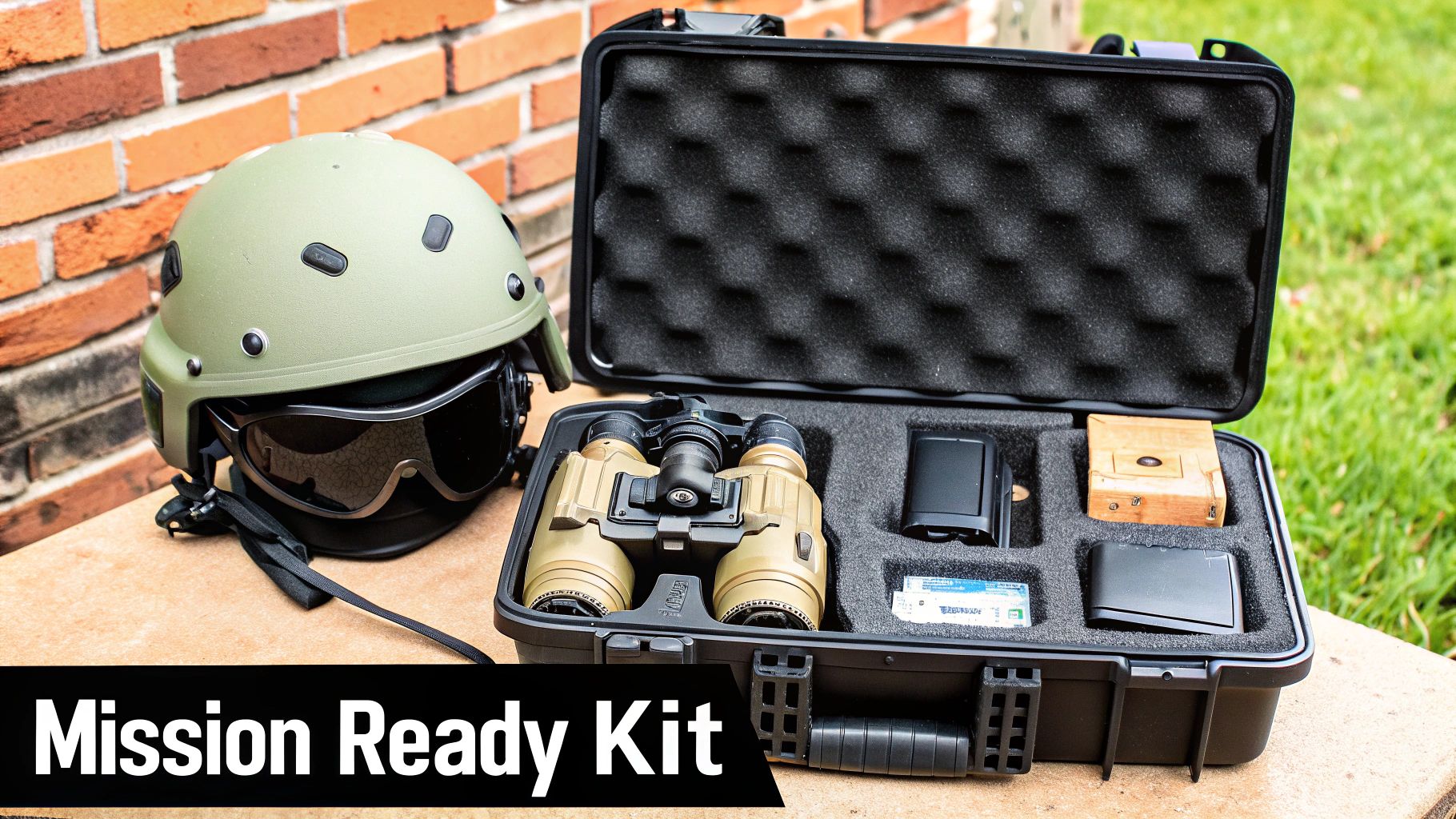
Getting your hands on a high-performance binocular night vision device is a huge step, but it's really just the beginning. The real magic happens when you pair those optics with the right accessories. This is where you transform a powerful viewing tool into a fully integrated system that gives you a genuine advantage in the dark.
Building out a complete kit isn’t just about buying cool gear and bolting it on. It’s about thoughtfully creating a loadout that’s perfectly matched to what you’ll be doing. A law enforcement officer about to clear a dark building will need a different setup than a hunter scanning a field from a treestand. The officer might need an infrared laser for aiming, while the hunter will prioritize a comfortable, hands-free rig for hours of patient observation.
It's this careful integration that unlocks the true potential of your night vision. Let's break down the essential pieces that take a setup from good to truly mission-ready.
Essential Helmet and Mounting Systems
For pretty much any situation where you need your hands free, a solid helmet and mount aren't just nice to have—they're non-negotiable. This combination creates a stable platform, letting you move, navigate, or operate a weapon without ever having to hold your device.
- Ballistic or Bump Helmet: Your mission dictates the helmet. A ballistic helmet offers life-saving protection from projectiles, while a non-ballistic "bump" helmet is a much lighter option, perfect for training or recreational use where the primary threat is bumping your head.
- Helmet Shroud: This is the attachment point on the front of the helmet. Most modern tactical helmets come with one already installed, but they're easy to add if yours doesn't have one.
- Mount Arm: This is the critical link between your binoculars and the shroud. Don’t cheap out here. Quality mounts from brands like Wilcox or G24 are built to last, offer fine-tuned adjustments, and have a "breakaway" feature that can save both your expensive gear and your neck from a bad snag.
- Counterweight System: Slapping a pound or two of gear on the front of your helmet makes it incredibly front-heavy. A counterweight pouch on the back, filled with purpose-built weights or even just spare batteries, is essential for balancing the load and preventing serious neck fatigue over long nights.
These components all work in harmony to make wearing your binocular night vision feel natural and balanced, so you can focus on the task at hand, not the gear on your head.
Think of your helmet setup as the chassis of a high-performance vehicle. A powerful engine (your NVGs) is useless without a solid frame and suspension (your helmet and mount) to properly deploy it.
The demand for this kind of equipment is exploding. The global day and night binocular market hit USD 8.57 billion in 2025 and is expected to climb at an 8.5% compound annual rate through 2033. This growth isn't just from military contracts; it's from an increasing number of professionals and civilians who see the value in building a complete system. You can read more insights on the expanding market for advanced optical systems.
Augmenting Your Vision with Essential Accessories
With your core mounting system sorted, a few other key accessories can dramatically boost performance and protect your investment.
- Sacrificial Lenses: These are cheap, clear covers that screw right onto your main objective lenses. They’re designed to take the hit from dirt, scratches, debris, or even an airsoft BB during a training scenario, "sacrificing" themselves to protect the expensive, precision-ground glass underneath.
- IR Illuminators and Lasers: In pitch-black conditions with zero ambient light, your night vision needs a little help. An external infrared (IR) illuminator works like an invisible flashlight, bathing the area in light only your NVGs can see. For tactical use, an IR laser provides a pin-point aiming dot that is completely invisible to the naked eye.
- Lens Filters and Demist Shields: A few small add-ons can make a big difference. Amber filters can help increase contrast and reduce eye strain. Demist shields are thin inserts that prevent your eyepiece lenses from fogging up from humidity or body heat, keeping your view crystal clear when it matters most.
Keeping Your Investment Safe: Maintenance and Care
A high-end set of binocular night vision isn't just a tool; it's a serious financial investment. The good news is that with the right care, a quality Gen 3 unit can last for decades. Taking care of it isn't complicated, but a few key habits are crucial for protecting its performance for the long haul.
Think of it like a custom-built rifle. You wouldn't just toss it in the back of your truck after a long hunt. Your night vision deserves that same level of respect to make sure it's ready to go whenever you are.
Routine Cleaning and Lens Care
The lenses on your device are coated with special materials that are absolutely essential for gathering light and giving you that crisp image. Scratching them is one of the easiest ways to permanently degrade your unit's performance.
Always start by getting rid of any loose dirt or grit. A little puff from a can of compressed air or a gentle sweep with a soft lens brush is the perfect first step. If you just take a cloth to a dusty lens, you're essentially grinding that grit right into the coating, leaving behind tiny scratches forever.
Once the loose stuff is gone, put a few drops of a good lens cleaning solution on a microfiber cloth—never squirt it directly on the lens. Wipe gently in a circular motion. This simple technique keeps those sensitive anti-reflective coatings in perfect shape.
Battery Smarts and Safe Storage
This is a big one. It's easy to forget about batteries, but a leaking one can completely wreck the electronics inside your device. We're talking about a repair that can run into the thousands.
- Batteries Out for Storage: If you're not going to use your unit for more than a couple of days, pop the batteries out. It's the single best thing you can do to prevent a catastrophic leak.
- Stick to Quality Batteries: Don't cheap out here. Use well-known brands like Energizer or Duracell. Off-brand batteries are notorious for leaking and just aren't worth the risk.
- Store It Right: When you're done for the night, your binocular night vision belongs in its hard case. This shields it from bumps, dust, and moisture. Find a cool, dry place to keep it, away from crazy temperature swings.
A quick note for new owners: you'll probably notice tiny black dots, sometimes called "blebs," in the image. Don't panic! These are just minor cosmetic blemishes from the manufacturing process and are completely normal in almost every image intensifier tube. They have zero impact on performance or the life of the unit.
Following these simple rules—clean lenses the right way, always pull your batteries, and use the hard case—is the absolute best insurance for your gear. And if you ever do need professional help, Superior Tactical provides free diagnostics and in-house repairs to get your equipment back in the fight.
Still Have Questions? Let's Cover the Big Ones
Even with all the technical details laid out, most people still have a few lingering questions before they're ready to pull the trigger on a serious investment like this. Let's tackle some of the most common things we get asked, so you can move forward with confidence.
Is Gen 3 Really Worth the Extra Money?
For anyone who relies on their gear professionally or for serious personal use, the answer is a hard yes. It's not just a minor jump in quality; it's a massive leap in performance. Think of Gen 2 as being able to see in the dark, while Gen 3 is like owning the dark.
The much higher Signal-to-Noise Ratio in Gen 3 tubes gives you a dramatically cleaner and brighter picture, especially when you're in near-total blackness. For a police officer, a security professional, or a serious hunter, that added clarity isn't a luxury—it can mean the difference between success and failure. Plus, with a typical lifespan of 10,000+ hours, a Gen 3 device is a long-term investment that pays for itself.
Can I Use These During the Day?
Absolutely not. You must never turn on traditional image intensifier (I²) night vision in bright light. The technology is designed to amplify tiny amounts of ambient light thousands of times over. Exposing it to daylight, car headlights, or even bright indoor lighting will overwhelm the tubes and cause permanent, costly damage in an instant.
Rule number one of night vision ownership: always keep the daylight caps on your device unless you are in a dark environment. If you need something that works day and night, you'll want to look at digital or thermal optics, which aren't sensitive to bright light.
What’s the Deal with Green vs. White Phosphor?
This choice comes down to the color of the image you see, and it has a real impact on how you use the device.
- Green Phosphor: This is the classic "military look" you've seen in movies for years. It’s the original standard and gets the job done.
- White Phosphor: A more modern option that creates a crisp black-and-white image. Most users find it provides better contrast and depth perception, making it easier to spot details.
While some of it is personal preference, the vast majority of professionals have switched to white phosphor. The general consensus is that it feels more natural to look at and causes significantly less eye strain, especially during long nights of observation.
Getting into night vision can feel overwhelming, but you don't have to figure it all out on your own. At Superior Tactical LLC, we've spent over a decade equipping professionals and dedicated enthusiasts with the right tools for the job. Whether you need a full binocular night vision system or just advice on the best mount, we're here to give you straight answers. We back our Gen 3 systems with a solid 10-year warranty because we believe in what we sell.
Ready to see what you've been missing? Check out our hand-picked selection of optics and gear over at https://superiortac.com.
