The Best Thermal Scope for Hog Hunting in 2026
When you’re looking for the best thermal scope for hog hunting, you need a unit that does three things exceptionally well: give you a crystal-clear image in pitch-black darkness, track a running hog without blurring, and be tough enough to handle the abuse of the field.
Your success boils down to matching the scope’s guts—its sensor resolution, magnification, and other core specs—to where and how you hunt. The right scope isn’t just a tool; it’s the key to owning the night.
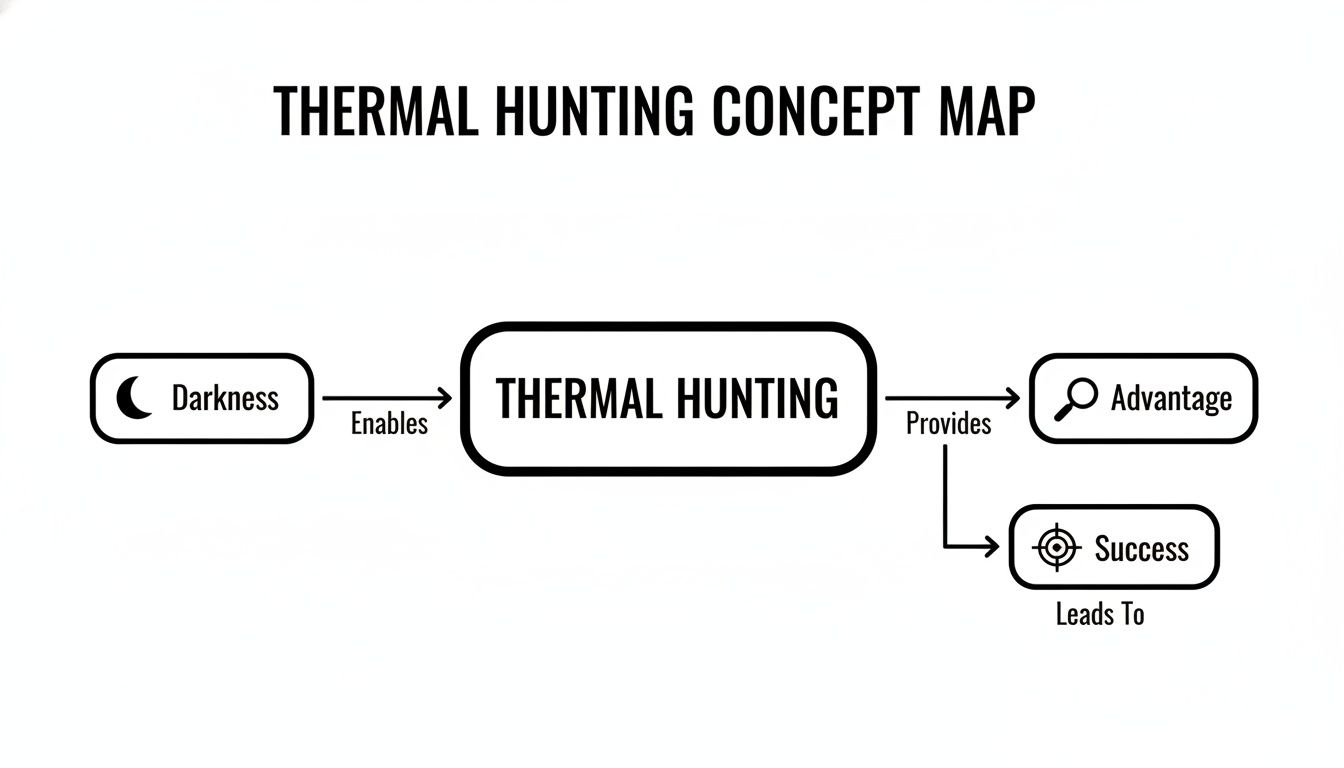
Why Thermal Vision Is Essential for Modern Hog Hunting
Anyone who has tried to hunt feral hogs at night knows it’s a whole different ballgame. These animals are smart, mostly nocturnal, and almost always travel in groups (or "sounders"). Once the sun sets, a traditional riflescope is practically useless. It’s like trying to pick one person out of a packed stadium in the dark—you might know they’re out there, but you can’t make a positive ID.
This is where thermal imaging flips the script entirely. A thermal scope couldn’t care less about visible light. It sees heat, detecting tiny temperature differences and painting a picture from the infrared energy all living things give off.
Think of a thermal scope like a magic spotlight that only lights up your target. It slices right through total darkness, fog, and even the thick brush where hogs love to hide, making their heat signature pop against the cooler background.
This isn't just a slight edge; for serious and ethical hog control, it's a flat-out necessity.
The Unseen Threat and the Technological Solution
Let’s be clear: feral hogs are far more than a simple nuisance. They're an incredibly destructive invasive species. As of 2024, the U.S. population has ballooned to an estimated 9 million hogs across 35 states, causing a staggering $2.5 billion in agricultural damage every single year.
This is why thermal scopes have become so crucial for nighttime control efforts. In a state like Texas, where hogs have infested over 99% of the counties, hunters using thermal optics have reported success rates jumping by as much as 300% compared to traditional night hunting methods. That’s the power of being able to spot heat signatures out to 1,000 yards in complete darkness. If you're interested in the data, you can learn more about the factors driving the thermal imaging market and its applications in hunting from industry analyses.
Key Advantages of Thermal Scopes for Hog Hunters
Picking the right thermal scope for hog hunting comes down to understanding the real-world advantages it gives you. It goes way beyond just "seeing in the dark."
-
Superior Detection at Night: Hogs move most from dusk till dawn. Thermal lets you see them during their primetime hours while they're out feeding and traveling.
-
Identification Through Obscurants: A hog's body heat shines right through things that stop light, like morning fog, light rain, or the thick vegetation they bed down in.
-
Improved Shot Placement and Ethics: A clear thermal image lets you place your shot precisely. This is vital for a quick, humane harvest, especially on a tough old boar.
-
Enhanced Situational Awareness: You can scan a field and instantly know what’s out there—how many hogs are in the sounder, which way they’re headed, and what other critters are around. This lets you plan your approach instead of just reacting.
Bottom line, adding a thermal scope to your rifle changes hog hunting from a game of luck to a calculated, and far more successful, operation. It strips away the darkness that hogs depend on, giving you the upper hand to manage their populations effectively and safely.
How to Decode Key Thermal Scope Specifications
Stepping into the world of thermal optics can feel like trying to read a foreign language. You’re hit with a barrage of numbers and jargon, but cracking this code is the key to making a smart buy instead of a costly mistake. When you're choosing the best thermal scope for hog hunting, what really matters is how those numbers translate to what you see in the field.
Think about it like this: you wouldn't pick out a new truck without checking the engine size and what it can tow. The same exact logic applies to your scope. Let's break down the specs that truly count.
Sensor Resolution: The Foundation of Image Clarity
The first spec you’ll always see is sensor resolution, which looks something like 384×288 or 640×480. This simply tells you how many pixels the thermal sensor has to build the image you see. More pixels, more detail. It’s that simple.
A good way to think about it is to compare it to your TV.
- A 384×288 sensor is like watching a standard-definition show. You can see what’s going on and follow the action, which is perfectly fine for hunting at closer ranges.
- A 640×480 sensor is a massive leap, like upgrading to a 4K screen. The picture is incredibly sharp and full of detail. This lets you confidently tell a big hog from a deer at a distance and even make out smaller features that help identify a specific animal in a group.
For hog hunting, that higher resolution gives you the confidence you need to take an ethical shot. You get a much clearer picture of your target and, just as importantly, what’s behind it.
Pixel Pitch: Packing in the Detail
If resolution is the total number of pixels, pixel pitch tells you how close together they are. It’s measured in microns (μm), and you'll typically see numbers like 17μm or 12μm. Here, a smaller number is better.
Imagine you have two mosaics of the same size. One is made with big, chunky tiles, while the other is crafted from tiny grains of sand. The sand version will have smoother edges and far more detail.
That’s exactly what a smaller pixel pitch does for a thermal image. A scope with a 12μm pitch packs its pixels tighter, creating a cleaner, less blocky image than a 17μm scope, even at the same resolution. This really shines when you use digital zoom, keeping the picture sharper.
Refresh Rate: Capturing Smooth Motion
The last of the big three specs is refresh rate, measured in Hertz (Hz). This number tells you how many times per second the image in your scope updates. The most common rates are 30Hz and 60Hz.
It’s the difference between a choppy video call and watching a live football game.
- A 30Hz refresh rate is fine for scanning a field or watching hogs that aren't moving much. The image updates 30 times a second.
- A 60Hz refresh rate, on the other hand, updates 60 times a second. This makes the image incredibly fluid and is a game-changer when you're tracking a running hog. That smooth motion makes it much easier for your brain to process what's happening and lead a moving target.
When a whole sounder of hogs suddenly bolts from cover, you’ll be glad you have a 60Hz refresh rate. It ensures the image doesn't stutter or blur right when you need it most. To get an even better handle on the technology, you can find a more in-depth discussion in our complete guide to thermal and night vision scopes.
Matching Your Scope to Your Hunting Environment
There’s no single "best" thermal scope, only the best one for your hunt. The ground you hunt determines the gear you need, and picking the right optic means balancing three things: its objective lens, magnification, and field of view.
Think of it like this: a high-powered scope with a massive lens lets you see incredible detail on a hog way out in a pasture. But that power comes at a cost. Your view narrows significantly, making it easy to lose a running boar or miss the rest of the sounder standing just out of frame.
On the other hand, a scope with a wider view is perfect for scanning thick woods or keeping track of a whole group of hogs. You get fantastic situational awareness, but you won't be able to positively identify a target at extreme distances. Success often comes down to finding the right compromise for where and how you hunt.
The Trade-Off Between Magnification and Field of View
A scope’s objective lens (the big one at the front, measured in millimeters) and its base magnification are a team. A larger objective lens can gather more heat information, which allows for higher native magnification and clearer long-range images. But there's always a trade-off: field of view (FOV).
Field of view is simply how much real estate you can see through the scope, usually measured in feet at 100 yards. A big, wide FOV is your best friend for scanning for heat signatures and getting on target quickly. A narrow FOV is what you need for threading the needle on a distant shot.
The core principle is this: As magnification increases, your field of view decreases. This means a high-magnification scope is like looking through a straw, making it difficult to track running hogs or scan broad areas. The key is to select a base magnification that aligns with your typical engagement distance.
Short-Range Engagements (Under 100 Yards)
If you're hunting in thick woods, tangled creek bottoms, or over small bait piles, your shots are up close and personal. Here, the action is fast, and you need to see the whole picture when a group of hogs suddenly appears.
- Objective Lens: Stick with a smaller lens in the 19mm to 35mm range. This keeps the scope lightweight, compact, and won't break the bank.
- Base Magnification: A low base magnification of 1.5x to 2.5x is what you want. It gives you a huge field of view, so you can easily track multiple hogs without losing them in the viewfinder.
- Performance Goal: Your priority is maximum situational awareness. You need to get on target fast, and high magnification just gets in the way.
Mid-Range Engagements (100-300 Yards)
This is the sweet spot for a lot of us. Think cut cornfields, open pastures, or long senderos cut through the brush. At these distances, you need a balance—enough FOV to find the hogs, but enough magnification to make a clean, ethical shot.
For scanning big areas, a thermal monocular is an invaluable tool. It saves you from swinging your rifle all night. You can check out our guide on the best thermal monocular for hunting to see how it fits into a complete system.
For your rifle scope, this is the all-around setup:
- Objective Lens: A versatile 35mm to 50mm lens is the ticket. It provides a serious jump in detection range over smaller lenses without feeling like you've bolted a telescope to your rifle.
- Base Magnification: Look for a base power around 2.5x to 4.5x. This is the jack-of-all-trades range—low enough to scan a field edge but with enough punch for confident identification out to 300 yards.
- Performance Goal: Versatility is the name of the game. You need an optic that lets you scan effectively but can still zoom in for a precise shot when the time comes.
Long-Range Engagements (300+ Yards)
Hunting wide-open spaces like Texas ranchland or western ag fields is a different ballgame. Here, everything is about long-distance performance. The ability to detect, positively identify, and make a precise shot on a hog at 300 yards or more is the entire point.
- Objective Lens: Go big or go home. A 50mm, 75mm, or even 100mm lens is what you need. These giants pull in the maximum amount of thermal data, which translates to clear images at extreme ranges.
- Base Magnification: You'll need a higher base magnification, starting at 4.5x or more. This gives you the fine detail required to confirm your target and account for bullet drop on a long shot.
- Performance Goal: Your single focus is long-range identification and image clarity. A narrow field of view is a perfectly acceptable price to pay for the confidence to make an ethical shot at distance.
Advanced Features That Give You an Edge
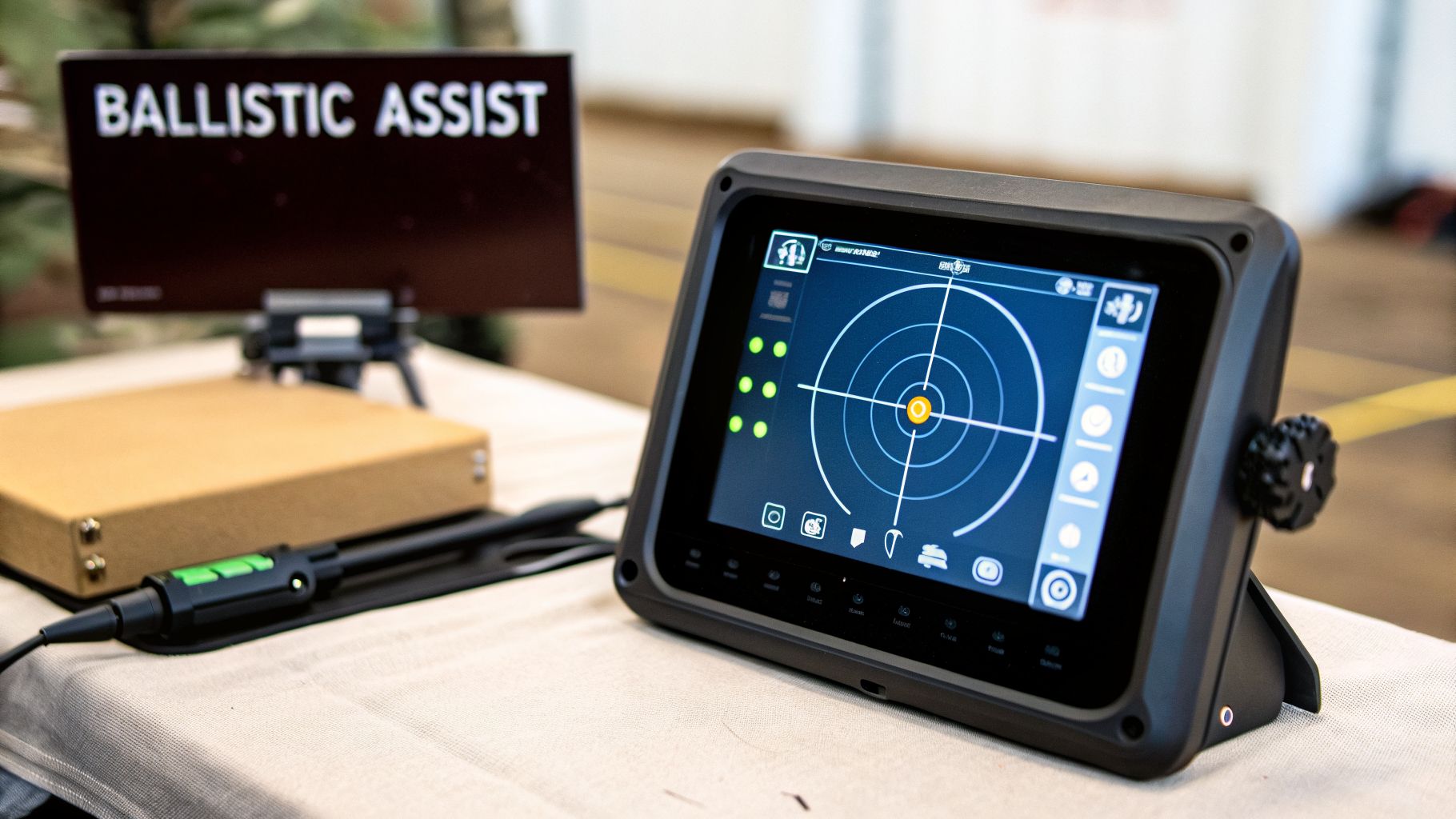
A modern thermal isn’t just a camera that sees heat; it's a complete shooting computer. Once you’ve nailed down the core specs like sensor quality and magnification, it's these advanced digital tools that really separate a good scope from a great one. They take the guesswork out of tough shots and, frankly, make every hunt more effective.
The first thing you’ll notice is the freedom of having multiple digital reticles. Forget being stuck with one etched crosshair. With a thermal, you get a whole menu of aiming points you can swap on the fly.
That means you can adapt your reticle to the job at hand. When a big boar is charging in close, a simple, heavy crosshair helps you get on target fast. For those more deliberate shots on a sounder way out in a field, you can switch to a more detailed reticle with hash marks for estimating bullet drop.
The Game-Changing Integrated Ballistic Calculator
As nice as multiple reticles are, the real magic happens when your scope has an integrated ballistic calculator. This is what truly changes night hunting, taking the complicated math and holdover guesswork out of making a long shot.
It’s like having an expert spotter and a ballistics whiz built right into your optic. Getting it set up is surprisingly simple. You just need to feed the scope some basic information about your rifle and ammo:
- Bullet Weight and Ballistic Coefficient (BC): These are the key numbers that define how your bullet cuts through the air.
- Muzzle Velocity: How fast the bullet is moving the instant it leaves your barrel.
- Zero Distance: The range you've sighted your rifle in for (e.g., 100 yards).
Once you've punched in that data, the scope’s brain takes over. Most of these scopes come with a built-in laser rangefinder (LRF). You just press a button, it zaps the hog to get the exact distance, and the internal computer instantly calculates your bullet’s drop. Then, it automatically moves the aiming point on your reticle.
Instead of holding your crosshairs high and hoping for the best, the scope tells you exactly where to aim for a precise hit. This transforms a long-range nighttime guess into a calculated, ethical shot.
This kind of technology is a massive advantage. Considering that nighttime hog removal accounts for up to 42% of all control efforts in hard-hit areas, making clean shots is critical. As this tech becomes more common—the hunting thermal market is expected to triple to $0.3 billion by 2033—ballistic calculators are becoming the new standard for anyone serious about taking shots on herds from 200 to 500 yards. You can see more on the thermal imager market for hunting and its drivers if you're interested in the trends.
Everyday Features That Make a Real Difference
Beyond the high-tech ballistics, a few other features add a ton of practical value. These are the tools that make the scope easier to live with, more versatile, and even help you improve your shooting.
One-Shot Zeroing
Sighting in a thermal can be a pain because you can't see bullet holes in a cold paper target. The "one-shot" zero feature makes this a breeze. You take one shot, then use the scope's controls to move a second reticle from your aiming point to where the bullet actually hit. Save it, and you're done. No more wasted ammo.
Multiple Firearm Profiles
If you run multiple hunting rifles, this is non-negotiable. It lets you create and save a separate zero for each gun. You can move the scope from your .308 bolt action to your 6.5 Creedmoor to your AR-15, just select the right profile, and you’re ready to go—no need to head back to the range.
Onboard Video and Audio Recording
Recording your hunts is far more than just getting bragging rights for your buddies. It's one of the best training aids you can have. Reviewing the footage lets you check your shot placement, see how the animals reacted, and learn from every encounter. Most scopes record right to an internal memory card and can even stream the view to your phone, which is perfect for a buddy who’s spotting with you.
Getting Your Scope Hunt-Ready: Power, Zero, and Care
Even the most advanced thermal scope on the market is useless if it isn't set up right or if the battery dies halfway through the night. The best thermal for hog hunting is one that's not only powerful but also practical and reliable in the field. Let's walk through the essential steps to get your scope mounted, zeroed, and powered up for a successful hunt.
A thermal scope is only as good as its mount. Seriously. Putting a cheap, wobbly mount on a high-end optic is the quickest way to waste your money and your time. Recoil, accidental bumps, and even shifts in temperature can make a bad mount lose its zero.
There's nothing more frustrating than chasing a zero in the field. Do yourself a favor and invest in a high-quality, robust quick-detach (QD) mount from a trusted manufacturer. This ensures your scope stays locked down tight and, just as importantly, returns to zero perfectly every time you take it off and put it back on your rifle.
Zeroing Your Thermal Scope
Sighting in a thermal isn't like your daytime scope. You can't just look for holes in paper because a standard target is invisible to the sensor. This means you need a target that generates heat.
Your best bet is a purpose-built thermal target. These usually have a reflective square that gets hot in the sun or use a small, battery-powered heating element to create a glowing bullseye. In a pinch, you can get creative—a hand warmer taped to a piece of cardboard or even a plastic bottle filled with hot water will work just fine.
Most modern thermals have a "one-shot" zero function that makes the whole process incredibly simple:
- Place your heat target at your preferred zeroing distance, typically 50 or 100 yards.
- Take one careful shot, aiming for the center of your heat source.
- Use the "freeze frame" function on your scope to capture the image right as the shot was taken.
- While the image is frozen, move the digital crosshairs from where you were aiming to where the bullet actually hit.
- Save the new coordinates. That's it. Your scope is now zeroed.
Managing Battery Life for All-Night Hunts
A dead battery has ended more hog hunts than bad weather ever has. You absolutely need to understand your scope's power consumption and have a solid backup plan. Generally, you'll run into two kinds of power systems.
A dead scope in a field full of hogs is just an expensive paperweight. Your power strategy is as important as your zero.
Many scopes feature an internal, rechargeable battery. This is convenient for shorter outings, but once it's dead, your hunt is over unless you can plug it in. The alternative is scopes that use replaceable CR123A batteries. They get the job done, but thermals burn through them fast, and the cost adds up quickly.
For any serious night hunter, the real solution is an external battery pack. A simple USB power bank connected to your scope with a cable can deliver 10+ hours of continuous power, easily lasting you from dusk till dawn. This method not only keeps you in the hunt all night but also preserves the life of your internal battery and saves you a small fortune on disposable CR123s.
Essential Maintenance for Long-Term Performance
A thermal scope is a major investment, and a little bit of care will keep it running like new for years. Thankfully, keeping it in top shape is easy and really only comes down to two things.
First, keep the germanium objective lens spotless. This big front lens is the eye of your scope, and it's what focuses heat signatures onto the sensor. Smudges, dust, and mud will drastically reduce your image quality. Never, ever wipe it with your shirt.
- Always start by using a can of compressed air to blow off larger particles like dust and grit.
- Then, gently clean the lens with a microfiber cloth made for optics or a dedicated lens pen.
Second, keep the firmware updated. Scope manufacturers are constantly refining their software. These updates can deliver better image processing, add new reticles and features, or patch bugs. Checking for a new firmware version every few months ensures you're always getting the best performance out of your optic. For more advice on getting the most from your equipment, see our guide on how to master the night with a hunting thermal monocular, as much of the same logic applies.
Frequently Asked Questions About Thermal Hog Hunting
Even after you've wrapped your head around the tech specs, a bunch of real-world questions always pop up. It happens to everyone, whether you're a seasoned hunter just getting into thermal or you're brand new to the game. Let's tackle some of the most common questions we get so you can head out with total confidence.
Can I Use a Thermal Scope During the Day?
Absolutely. In fact, you'll be surprised at how much of an advantage it gives you. Unlike traditional night vision, which can get fried by bright light, a thermal scope sees heat, not light. That means it works 24/7, rain or shine, day or night.
During the day, a thermal scope is a secret weapon for spotting hogs bedded down. Their body heat glows like a lightbulb against the cooler ground, giving them away in thick brush or tall grass where your eyes would pass right over them. Even on a hot day when the image contrast might dip a little, a good thermal still gives you a massive edge in detection.
What Is the Real Difference Between Thermal and Night Vision?
This is the big one, and for hog hunting, the difference is everything. The easiest way to think about it is that night vision amplifies light, while thermal sees heat signatures.
-
Traditional Night Vision: This tech takes tiny amounts of available light—from the moon, stars, or an IR illuminator—and magnifies it thousands of time to create that familiar green-tinted image. If there’s zero light, it’s completely blind.
-
Thermal Imaging: This tech couldn’t care less about light. It builds a picture purely from the temperature differences between objects. It’s reading the heat energy that everything in the environment naturally gives off.
For finding a warm-blooded hog against a cool treeline, thermal is the undisputed king. It lets you see in total darkness and punches right through fog, light brush, and smoke that would make standard night vision practically useless.
Should I Get a Dedicated Scope or a Clip-On System?
This really boils down to your budget and how you plan to use your rifle. Both are fantastic tools, but they fill slightly different needs.
A dedicated thermal scope is a self-contained unit built from the ground up for one purpose: thermal hunting. They're often lighter, more compact, and offer a more seamless experience with features like built-in ballistic calculators and video recording.
On the other hand, a thermal clip-on mounts in front of your favorite daytime scope. The versatility here is incredible. If you have one go-to rifle for everything, a clip-on lets you switch between day and night hunting without ever having to re-zero or get used to a new optic. For guys who hunt almost exclusively at night, however, a dedicated scope is usually the simpler and more powerful choice.
Are There Legal Restrictions on Thermal Hunting?
Yes, without a doubt. The laws can change dramatically from one state line to the next, and it’s 100% your responsibility to know and follow them.
Many states with major feral hog problems, like Texas and Oklahoma, have very permissive laws regarding thermal optics for hunting invasive species. But other states might restrict their use to specific animals, limit them to certain seasons, or ban them altogether for taking game.
Never assume the rules are the same everywhere. Before you even think about heading into the field, check the most current regulations published by your state’s official wildlife department. The best thermal scope is one you can use legally and ethically.
At Superior Tactical LLC, we believe that being properly equipped is the first step to a successful and ethical hunt. We offer a curated selection of field-tested thermal optics to ensure you have the advantage when it matters most. Explore our collection of advanced thermal imaging scopes today by visiting https://superiortac.com.
