Choosing the Best Thermal Imaging Monocular
Finding the best thermal imaging monocular isn't about picking a single "top" product. It's about matching the right piece of technology to your specific mission. A hunter tracking hogs through a field needs something different than a law enforcement officer clearing a building, and this guide will give you the knowledge to choose wisely.
How to Choose Your Best Thermal Imaging Monocular
Diving into thermal optics can feel like learning a new language, with a dizzying array of specs and price tags. This buyer's guide cuts through the noise and focuses on what actually matters in the real world. I'm not here to tell you which model is "the best"—I'm here to give you the tools to decide what’s best for you.
The market is exploding, and for good reason. These devices are becoming essential tools for countless professionals and enthusiasts. The global thermal imaging monocular market was valued at around $1.5 billion in 2023 and is on track to more than double to an estimated $3.2 billion by 2032. This growth comes from huge demand in hunting, law enforcement, and security, where seeing in the dark is a non-negotiable advantage. For a deeper dive into market trends, you can explore the data at archivemarketresearch.com.
Core Performance Metrics to Consider
To make a smart buy, you have to understand how the numbers on a spec sheet translate to what you see through the eyepiece. Let's break down the metrics that separate a budget unit from a professional-grade thermal monocular.
-
Sensor Resolution: This is all about image clarity. A higher resolution, like 640×512, gives you a much sharper, more detailed picture. That's what you need for positive target identification at any real distance.
-
Thermal Sensitivity (NETD): Measured in millikelvins (mK), NETD tells you how well the sensor can distinguish between tiny temperature differences. A lower number is better—something under 25 mK will produce a crisp, detailed image even when the target and background are nearly the same temperature.
-
Detection Range: This spec tells you how far out the monocular can pick up a heat signature. Your needs here are entirely application-dependent. Are you scanning a small property or glassing a canyon for wildlife? The answer dictates the range you need.
The name of the game is finding the right balance between these specs and what you're willing to spend. A top-tier device will knock it out of the park in every category, but a solid mid-range unit might just be the sweet spot of performance and value for what you actually do.
Understanding the Core Specs of a Thermal Monocular
To really pick the right thermal monocular, you have to learn to speak the language of the spec sheet. This is where you separate the marketing hype from real-world performance. Getting a handle on these core numbers is the single most important thing you can do to make a purchase you won't regret. We're going to translate the technical jargon into what it actually means for you out in the field.
This isn't just about memorizing definitions. It’s about understanding how all these parts work together to create the image you see. For instance, a top-tier sensor is practically wasted if it's paired with a cheap, low-quality lens. By the time you finish this section, you'll be able to look at a product page and know exactly what to expect from that device when you're in the dark.
Thermal Sensor Resolution
The thermal sensor is the heart and soul of the monocular. Its resolution is what dictates the raw detail and clarity of the image, measured in pixels just like your TV. In the thermal world, the two numbers you'll see most often are 384×288 and 640×512.
A 384×288 sensor gives you 110,592 pixels to work with. This is a respectable resolution that delivers solid performance, especially for detection at short to medium distances. You'll find it in a lot of great entry-level and mid-tier units.
But a 640×512 sensor is in another league entirely. It packs in 327,680 pixels—that's three times the data. This massive jump in pixel density translates to an image that is dramatically sharper and more detailed. With a 640 sensor, you don't just detect a heat signature; you can actually identify what it is.
Real-World Impact: Picture this: you spot a warm shape 300 yards out. With a 384 sensor, you’ll see a blob and know something’s there. With a 640 sensor, you have a much, much better shot at telling the difference between a coyote, a deer, or a person. For hunters and law enforcement, that's a critical difference.
Thermal Sensitivity (NETD)
If resolution tells you the quantity of detail, thermal sensitivity—or Noise Equivalent Temperature Difference (NETD)—tells you the quality of that detail. Measured in millikelvins (mK), NETD is all about the smallest temperature difference the sensor can pick up. Here's the key: a lower mK number is always better.
Think of it like this: a high NETD (like <50 mK) sees in black and white, only picking up big temperature differences and washing out the subtle stuff. But a monocular with a very low NETD (like <25 mK) can see in countless shades of gray, detecting tiny thermal variations that create a rich, crisp image. This becomes absolutely vital when there isn't much contrast between your target and the background, like on a humid night or in fog.
Refresh Rate
The refresh rate, measured in Hertz (Hz), is simply how many times per second the image on your screen gets updated. The two industry standards you'll see are 30Hz and 60Hz.
A 30Hz refresh rate is perfectly fine for watching things that aren't moving much. The image updates 30 times a second, which is okay for stationary observation. But the moment you start panning quickly or try to track a running animal, a 30Hz image can get choppy and laggy.
On the other hand, a 60Hz refresh rate updates twice as fast, delivering a buttery-smooth image. This is a must-have for tracking anything moving at speed, whether it's a vehicle under surveillance or a hog on the run. The fluid motion just feels more natural to your eye and significantly reduces eye strain over long periods of use.
Objective Lens and Field of View (FOV)
The objective lens is what gathers all the infrared energy and focuses it onto the sensor. The size of this lens (e.g., 35mm, 50mm) has a direct and opposite effect on two crucial specs: magnification and Field of View (FOV).
-
Bigger Lens (e.g., 50mm): Gives you more "reach" with higher base magnification, letting you identify targets from farther away. The trade-off is a narrow FOV, like looking through a straw. You see less of your immediate surroundings.
-
Smaller Lens (e.g., 25mm): Offers a much wider FOV, which is fantastic for scanning large, open areas quickly. Think of searching a field or a SAR grid. The downside is you sacrifice that long-range identification power.
Deciding between them is purely a tactical choice. Do you need to scan a wide-open space to find your target, or do you need to put eyes on a known target at a serious distance? Your answer points you to the right lens. If this is new territory for you, check out our guide on thermal imaging vs digital night vision to get a better feel for the technology.
This table breaks down the most important specs to help you compare units at a glance.
Key Thermal Monocular Specifications at a Glance
| Specification | What It Measures | Why It Matters | Good vs. Excellent |
|---|---|---|---|
| Resolution | The number of pixels on the thermal sensor (e.g., 384×288). | More pixels mean a sharper, clearer image and better identification at range. | Good: 384×288, Excellent: 640×512 |
| NETD | The smallest temperature difference the sensor can detect (in mK). | A lower number means better performance in low-contrast conditions (fog, rain). | Good: <40 mK, Excellent: <25 mK |
| Refresh Rate | How many times per second the image updates (in Hz). | Higher rates provide a smoother image for tracking moving targets. | Good: 30Hz, Excellent: 60Hz |
| Lens/FOV | The lens diameter (mm) and the resulting width of the viewing area. | Larger lenses offer more magnification but a narrower FOV; smaller lenses do the opposite. | Good: 35mm (Balanced), Excellent: 50mm+ (Long Range) |
Understanding these four pillars—Resolution, NETD, Refresh Rate, and Lens—is the foundation for making an informed choice. They work together to define the performance and limitations of any thermal monocular.
Comparing Thermal Monoculars Across Price Points
Let's be honest, when you're looking at thermal monoculars, your budget is usually the first filter. The price tag is a direct reflection of the performance and features packed inside, but making a smart buy isn't just about spending more. It’s about understanding the tradeoffs at each level and deciding which compromises you can live with for your specific needs.
This isn't a casual purchase. The technology is complex, and the financial commitment can be serious. Market analysis shows the night vision thermal imaging monocular space was valued around $475 million in 2023 and is expected to climb to nearly $739 million by 2030. With top-tier models running anywhere from $2,900 to $5,800, it's a market built on a serious demand for performance. You can dig into more of this data on valuates.com.
Here, we'll break down what you actually get for your money in each category—entry-level, mid-range, and high-end—so you can figure out which set of tradeoffs makes sense for your mission.
Entry-Level Thermal Monoculars: Under $1000
Think of these as your gateway into the world of thermal imaging. Entry-level units are almost always compact, light, and dead simple to use. They're perfect for scanning your property line, some casual wildlife spotting, or short-range scouting.
The main sacrifice you're making here is raw sensor performance. Most units under a grand will have a sensor with a 256×192 resolution, sometimes lower. That’s enough to see a heat signature at 100 to 300 yards, but it’s not giving you enough detail for a positive ID unless you’re up close. You'll know something is out there, but telling a coyote from a stray dog will be a challenge.
The other compromise is thermal sensitivity. NETD ratings are often <50 mK or even higher. In practical terms, this means the image can look a bit flat or "muddy," especially on humid or foggy nights when there's less temperature contrast in the environment.
But don't write them off. These models make thermal accessible and are more than enough for jobs where simple detection is the name of the game. For a homeowner checking on a noise in the backyard or a hiker wanting to see what’s rustling in the bushes, these devices give you a sense you just can't get with the naked eye.
Mid-Range Thermal Monoculars: $1000 to $3000
This is the sweet spot. For a huge number of people, from dedicated hunters to search and rescue teams, the mid-range category delivers a massive leap in performance without the sticker shock of professional-grade gear. The most immediate upgrade you'll notice is in the image itself.
In this bracket, you're looking at monoculars built around 384×288 sensors with much better NETD ratings, typically between <30 mK and <40 mK. That combination produces a far crisper, more detailed picture. That heat blob at 300 yards now resolves into a shape you can start to identify.
The Mid-Range Advantage: This is the tier where user-friendly features become standard. You can expect things like onboard video recording, Wi-Fi to stream the view to your phone, and a wider variety of color palettes to help you isolate targets against different backgrounds.
The whole user experience feels more polished, too. Menus are more intuitive, and startup times are faster. Battery life is generally improved, and many models feature swappable battery packs—a non-negotiable feature for anyone who spends serious time in the field. The main tradeoff? You’re still giving up the long-range identification power and premium extras like built-in laser rangefinders that are reserved for the top-shelf units.
This thermal image of a cat shows how different colors represent varying heat levels. The warmest parts, like its eyes and ears, pop in yellow and red, giving you clear contrast against the cooler blue and purple background—a key function in any monocular.
High-End Thermal Monoculars: Over $3000
When your job or passion demands zero compromise, you’re in the high-end category. These are the tools built for pros—law enforcement, military operators, and serious hunters who need to identify a target at extreme distances with 100% confidence.
The heart of a high-end monocular is its sensor, usually a 640×512 or even a massive 1024×768 core. This is paired with an incredibly low NETD, often <25 mK and sometimes even as low as <18 mK. The result is an image with stunning clarity. You can make out subtle details, like the antlers on a buck hundreds of yards away, that are simply invisible on lower-tier devices.
These units also feature premium germanium lenses with large objective diameters (50mm or more) that pull in more thermal radiation and provide higher base magnification for long-range work. Here’s what that investment really buys you:
-
Superior ID Range: You can positively identify targets at distances where mid-range units can only tell you something is there.
-
Advanced Features: It's common to find built-in laser rangefinders, ballistic calculators, and smooth integration with other digital scopes.
-
Bombproof Construction: High-end models are built to take a beating, with rugged housings and high waterproof and shock-resistance ratings.
-
Flawless User Experience: Expect instant startup, buttery-smooth 60Hz refresh rates, and controls designed to be used with gloves in the dark.
If there's a "compromise" here, it's the price and sometimes the bulk. But for the professionals who stake their safety and success on this gear, the performance leap is worth every penny. Finding the best thermal imaging monocular for you comes down to aligning these performance tiers with your wallet and your real-world needs.
Matching Your Monocular to Your Mission
All the technical specs in the world don't mean much if the device doesn't perform when you need it. The best thermal imaging monocular is the one that’s a perfect fit for your world. What works for a hunter scanning a bean field might be a terrible choice for a SAR operator clearing a collapsed building.
So, before you even look at a spec sheet, you need to answer one simple question: "What am I really going to use this for?" That single answer will immediately tell you which features are mission-critical and which are just nice-to-haves. It’s the difference between buying a tool that feels like a natural extension of your senses and ending up with an expensive paperweight.
For the Hunter Tracking Game
Hunters have a tough job. You don't just need to spot a heat signature from a long way off; you have to know, without a doubt, that it's the right animal before you even think about taking a shot. That demands a very specific mix of resolution and magnification.
This is where you need to focus on sensor resolution and the size of the lens. A 640×512 sensor is really the gold standard here, giving you enough pixel density to tell a hog from a deer at several hundred yards. To make that resolution count, you'll want to pair it with a larger objective lens—think 50mm or more—to get the base magnification needed for positive ID at those distances.
A hunter's worst nightmare is giving away their position. Look for monoculars with silent calibration modes so you don't hear that tell-tale "click" at the wrong moment. Buttons should be quiet but tactile. And since you'll be out in the elements, a tough, weatherproof housing isn't optional—it's essential.
For Law Enforcement and Search and Rescue
For first responders, the game changes completely. In high-stakes, fast-moving situations, the priority isn't identifying a target 500 yards away. It's all about situational awareness and clearing large areas as quickly and safely as possible. Every second counts.
For law enforcement (LE) and Search and Rescue (SAR) teams, a wide Field of View (FOV) is king. This means looking for a smaller objective lens, often in the 25mm to 35mm range, which opens up your perspective. It lets you scan an entire room, a dark alley, or a patch of woods without a ton of head-swiveling. While 640-res is always nice, a solid 384×288 unit often hits the sweet spot between image clarity and that crucial wide-angle view.
For professional teams, a few built-in tools are absolute force multipliers.
-
Laser Rangefinder (LRF): Being able to call out an exact distance to a suspect or a point of interest is invaluable for team coordination.
-
Onboard GPS: This allows officers or rescuers to tag the precise location of evidence or a victim, which makes reporting and recovery far more accurate.
-
High Refresh Rate (60Hz): When you're tracking a moving person or scanning from a vehicle, a 60Hz rate keeps the image perfectly smooth and eliminates lag.
The industry is constantly evolving to meet these needs. For instance, the upcoming TOPDON US TS005 professional thermal monocular is designed to offer clear vision out to 1200 meters with laser targeting up to 600 meters, even in bad weather. As noted in market analysis from precedenceresearch.com, this push for greater range and integrated features is a direct response to the growing demand from emergency services and law enforcement.
This visual breaks down how features and performance generally scale with price.
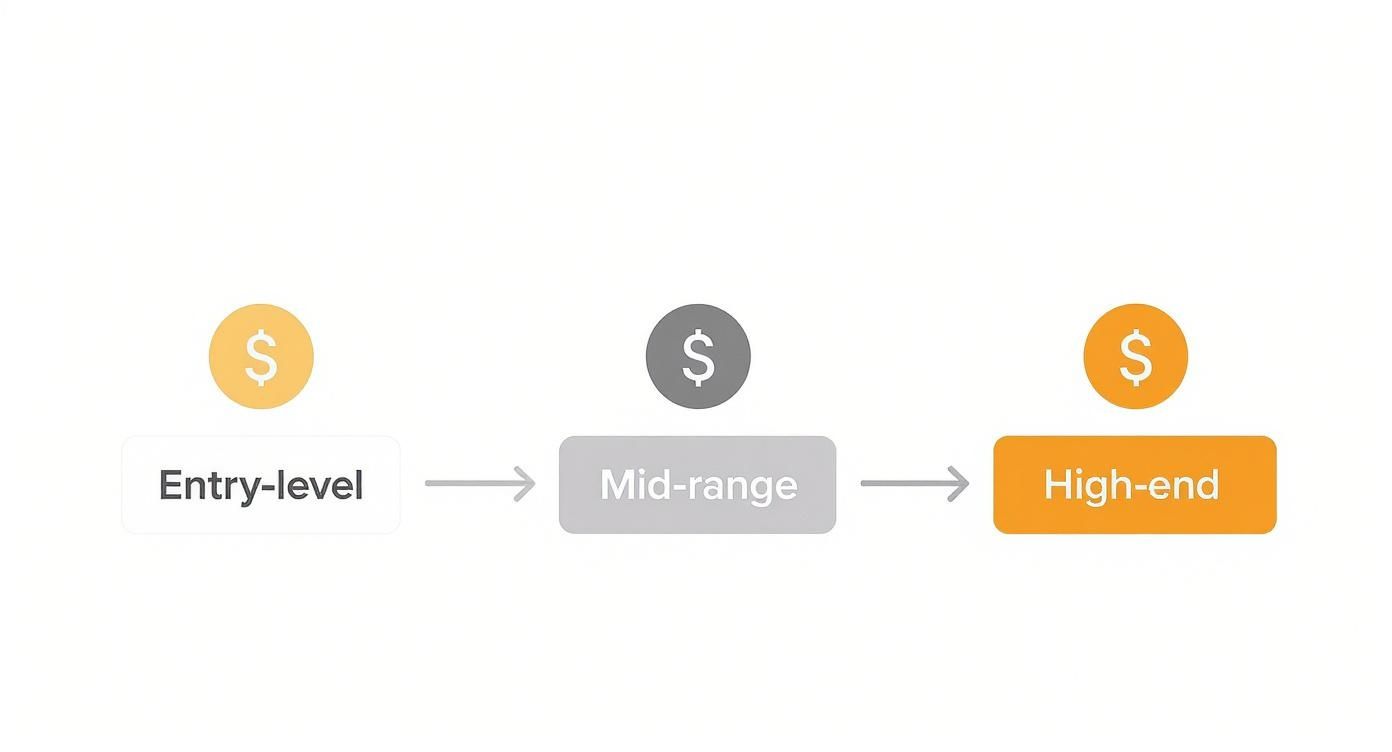
As you can see, jumping to a higher tier doesn't just get you a few bells and whistles; you're paying for significant gains in sensor quality and professional-grade capabilities.
For Outdoor Enthusiasts and Homeowners
What if your mission is a little less intense? Maybe you want to watch wildlife in your backyard, keep an eye on your campsite, or just figure out what's making that weird noise on the edge of your property. In that case, you can dial back the specs and focus more on portability, ease of use, and overall value.
For most casual users, the mid-range is the place to be. A monocular with a 384×288 sensor and a <40 mK NETD rating will give you a fantastic image for spotting people or animals out to a few hundred yards. Many also come with onboard recording, which is great for saving those cool wildlife moments.
Don't underestimate the importance of portability. A small, lightweight monocular is one you’ll actually grab for a hike or keep near the door. Simple controls are another big win—you want to be able to turn it on and see what's out there without having to navigate a complicated menu in the dark. These thermal spotters are a game-changer for seeing what goes on after sunset, and you can learn more about how thermal spotters can enhance your night vision in our detailed guide.
In the end, it all comes down to being honest about what you need and what you're willing to spend. By lining up the specs with your primary mission, you’ll end up with a tool that works for you, every single time.
Field Use and Maintenance: What the Spec Sheet Won't Tell You
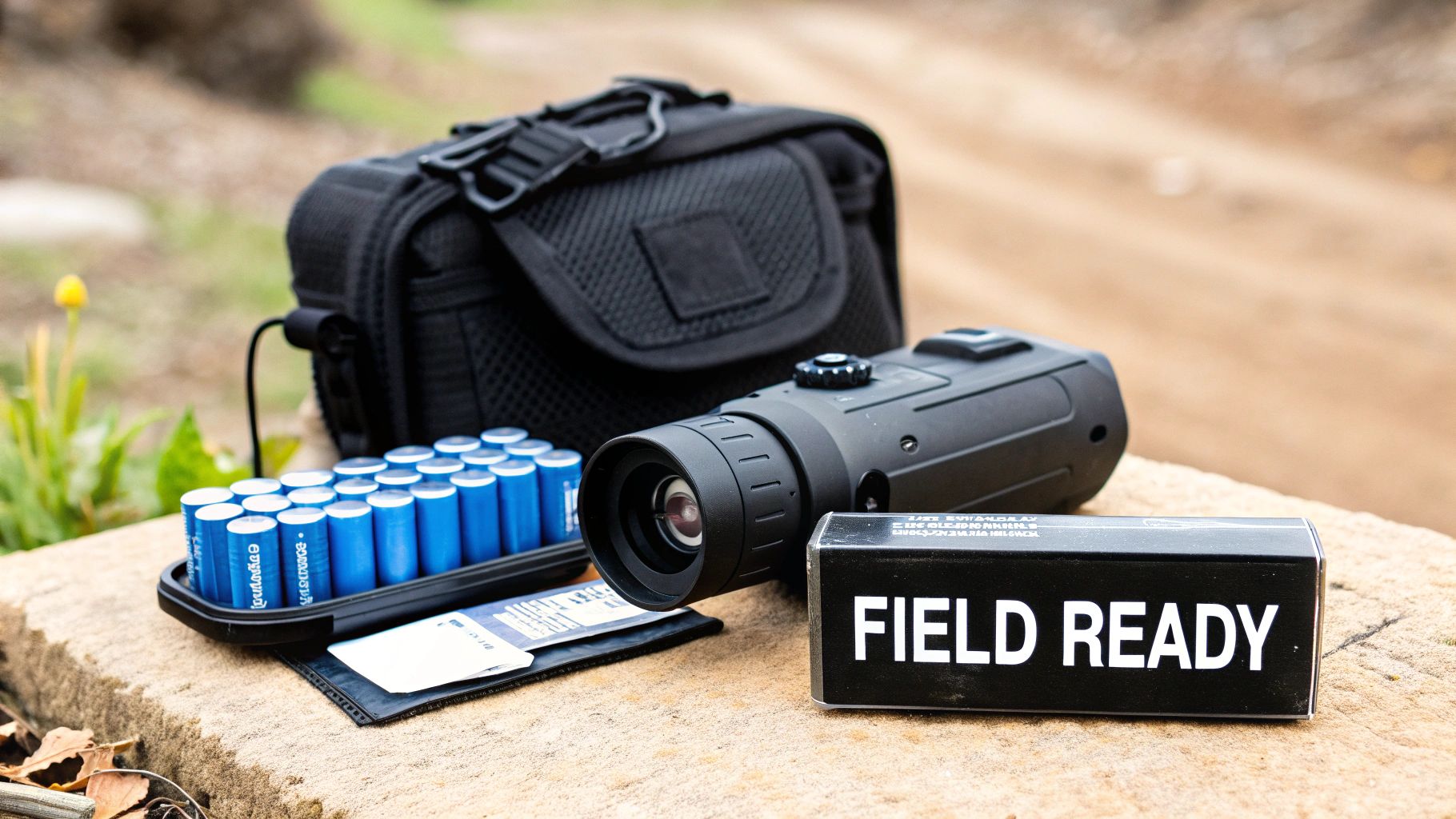
A world-class thermal sensor doesn't mean much if the device dies on you halfway through a hunt or a search mission. I've seen it happen. Beyond the core specs, the gritty details of power, handling, and upkeep are what separate a reliable tool from an expensive paperweight.
It's easy to get lost in resolution and refresh rates, but overlooking these operational details is a rookie mistake. Let’s talk about what actually matters when you're out there, depending on this gear to perform.
Powering Your Device Under Pressure
Battery life is your lifeline in the dark, and not all power sources are built for the job. You're generally looking at two camps: internal rechargeable batteries or swappable battery systems, and the difference is huge when you're miles from an outlet.
Internal batteries, usually charged with a USB-C cable, are tidy and convenient for casual use. The problem is, when that battery dies, your night is over. For any serious, extended operation, that’s a massive liability.
This is where swappable systems—whether they use common CR123A cells or proprietary rechargeable packs—really shine. Having a few spare batteries in your pocket means you have virtually unlimited runtime. You just pop in a fresh one and keep going. Simple.
Cold Weather Performance: Batteries hate the cold. Period. At freezing temperatures, a lithium-ion battery can easily lose over 20% of its charge. If you’re operating in the cold, do yourself a favor: keep your spare batteries in an inside pocket, close to your body heat. It makes a real difference.
Ergonomics and Mounting Options
How a monocular feels in your hand after three hours of scanning is just as important as the image it produces. Good ergonomics isn't just about a comfy grip; it’s about being able to find and use the controls in total darkness, even with gloves on.
The layout for focus, zoom, and menu buttons needs to be intuitive, with distinct shapes you can feel. The last thing you want is to pull the device away from your eye to see what button you're pressing, wrecking your natural night vision in the process.
Mounting options also open up a ton of possibilities.
-
Tripod Mounting: A standard 1/4"-20 tripod socket is a must-have for long-duration surveillance. It saves your arms and keeps the image rock-steady.
-
Helmet Mounting: For hands-free use in tactical or SAR situations, you need a unit compatible with standard helmet mounts. Just remember, weight is critical here—a heavy thermal will wear you out fast.
Legal and Regulatory Need-to-Knows
High-end thermal tech is serious business, and it comes with serious government oversight. The big one you need to know about is the International Traffic in Arms Regulations (ITAR).
Many of the best thermal imaging monocular models, especially those with fast 60Hz refresh rates or military-grade sensors, are ITAR-controlled. In plain English, that means you cannot legally ship them or take them outside the United States without a license. Always, always check the regulatory status of a device before you buy, particularly if you ever plan to travel with it.
Long-Term Care and Maintenance
This gear is an investment, and a little preventative care will protect it. The most fragile—and expensive—part is the germanium objective lens.
Germanium is soft and scratches easily. Never wipe a dusty or dirty lens with a dry cloth. You'll just grind the grit right into the coating. Always use a blower or a soft lens brush to get the loose stuff off first, then follow up with a dedicated lens cleaner and a microfiber cloth.
Also, keep your firmware updated. Manufacturers often release updates that improve image processing, squash bugs, or even add new features. Finally, know your warranty. A solid warranty with accessible repair services is your safety net. If you want to get ahead of potential problems, understanding how night vision repairs can help is a good place to start.
Common Questions About Thermal Monoculars
Once you get past the spec sheets, the real questions start to pop up. This is where we tackle the practical, real-world stuff that you're probably wondering about. Think of this as the conversation you'd have with an expert over the counter—just direct, honest answers to help you lock in your decision.
We'll cover the things that trip people up, from what these devices can actually see to how to interpret the numbers on the box.
Can a Thermal Monocular See Through Walls or Glass?
This is easily the most common myth we hear, thanks to movies and video games. The straight answer is no. Thermal imagers don't see "through" things like X-rays. They detect infrared energy, which is just a fancy way of saying they see heat.
Solid objects like walls are excellent at blocking that heat signature. Same goes for standard glass—it reflects thermal energy, so you can't see through a window into a house. What you might see is the heat from a window frame bleeding onto the wall or the surface temperature of the glass itself, but you won't see the person standing on the other side.
How Far Can a Thermal Monocular Actually See?
This is where marketing specs can get a little confusing. When a monocular boasts a detection range of 1800 yards, it doesn't mean you can identify a coyote at that distance. It means the sensor can pick up a few hot pixels that tell you something is out there.
To make sense of it, you need to think in three distinct stages:
-
Detection: This is the maximum range. You can see a heat blob, but you have no idea what it is. Is it a deer or a person? You can't tell.
-
Recognition: At this closer range, you can start making an educated guess. The size and shape suggest it's a four-legged animal, or maybe a vehicle.
-
Identification: This is the range where you have enough detail for a positive ID. You can clearly see it's a buck, not a doe, or identify a specific individual.
A high-end 640×512 sensor will give you a much better identification range than a 384×288 model, even if the spec sheets list similar detection ranges. For anyone who needs 100% positive ID before taking a shot or making a tactical decision, that higher resolution is non-negotiable.
Do I Need Different Color Palettes?
While classic "white hot" and "black hot" are the workhorses for most situations, having multiple color palettes is a massive advantage. Different palettes assign colors to different heat levels, which can make a target pop in a busy environment.
For example, a "sepia" or "red hot" palette is much easier on the eyes during a long night of scanning. A high-contrast "rainbow" palette can be a lifesaver when you're trying to find a blood trail or a downed animal in dense woods, as it highlights even the smallest temperature differences. The best thermal imaging monocular will give you a handful of options to match the tool to the environment.
At Superior Tactical LLC, we do more than just sell gear; we provide the expertise to make sure you're ready for whatever comes next. Check out our hand-picked selection of thermal and night vision optics to find the right tool for your mission.
https://superiortac.com
