Finding the Best Monocular for Hunting in 2026
Ask ten seasoned hunters what the best monocular is, and you’ll likely get ten different answers. That’s because the "best" optic isn't a specific model—it's the one that gives you the edge in your specific environment. For most daylight hunts, a solid 8×42 optical monocular hits the sweet spot between magnification and brightness. But when the sun goes down, that’s when thermal and night vision optics truly shine.
Why a Monocular Is a Hunter's Secret Weapon
Picture this: you're miles deep in the backcountry, and every single ounce in your pack matters. This is where the monocular proves its worth. It delivers serious magnification in a package so light and compact you can wear it on your chest rig for instant access. It’s the difference between fumbling with heavy, two-handed binoculars and seamlessly pulling up your optic to spot a flicker of movement.
That’s not to say binoculars don't have their place. But for the hunter who values speed and efficiency, the monocular is hard to beat. For a full breakdown of how they stack up, you can get into the weeds on the binocular vs. monocular vision debate in our detailed guide. The bottom line for most hunters is that a monocular gives you almost all the spotting power you need with none of the bulk.
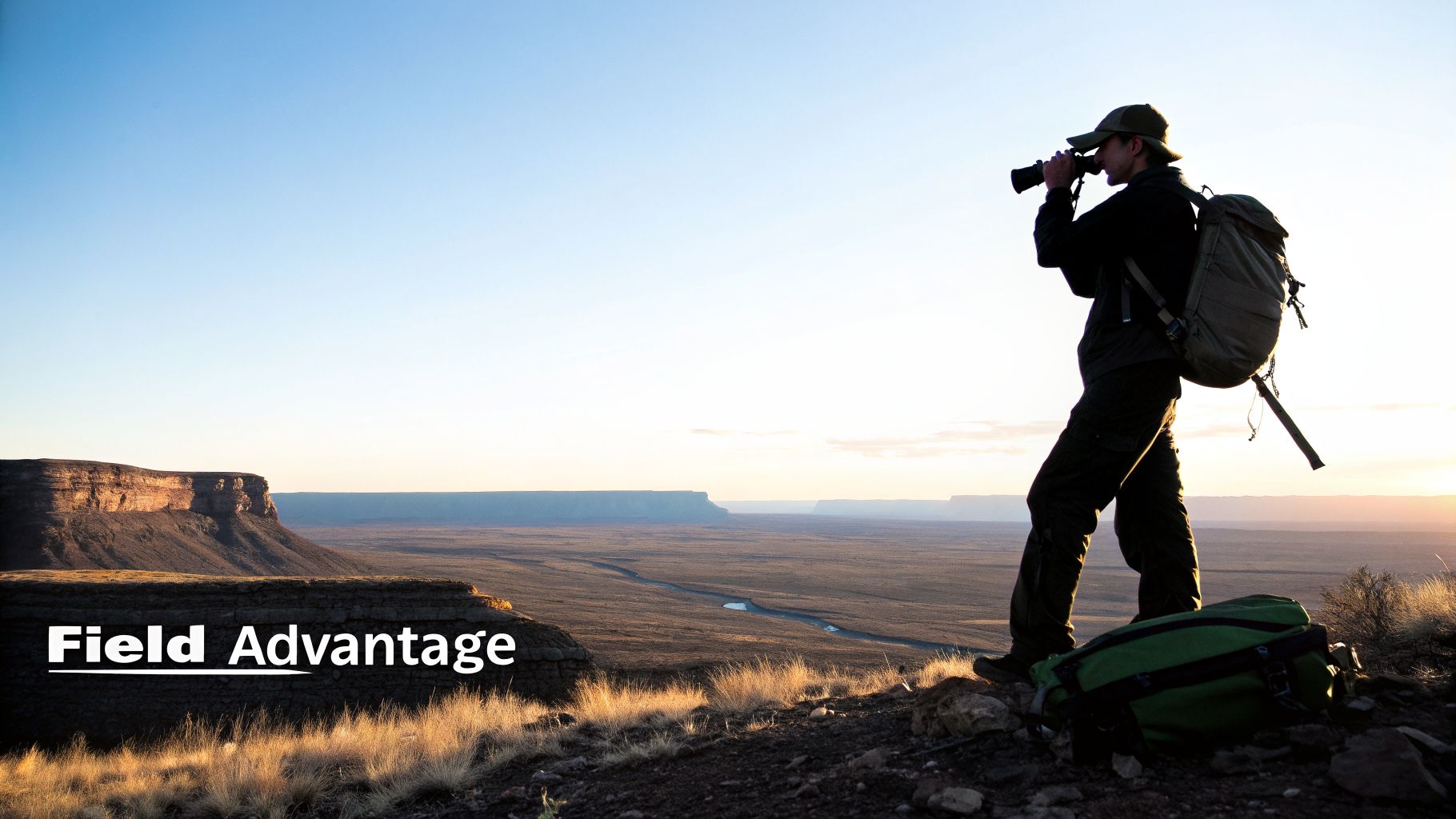
Three Tiers of Field Advantage
Choosing the right tool for the job means understanding the technology inside it. Each type of monocular offers a completely different way of seeing the world, and knowing which one to grab can make or break a hunt. We'll break down the three main categories so you can find the perfect fit.
Traditional Optical Monoculars: These are your workhorses for daylight glassing. Essentially a small, powerful telescope, they use glass lenses to gather light and bring distant targets into sharp focus. They're perfect for spotting deer on a far-off ridgeline or picking apart the brush for an elk.
Advanced Night Vision: When legal for your hunt, night vision gives you a powerful advantage after sunset. By amplifying tiny amounts of ambient light—from the moon or stars—it paints the world in a visible green hue. This lets you observe animal behavior in near-total darkness without spooking them.
Game-Changing Thermal: Thermal is a different beast altogether. It doesn't see light; it sees heat. This allows you to spot an animal’s body heat glowing through thick fog, dense foliage, and complete darkness. For predator and hog hunters, there is simply no substitute—it feels like a superpower.
Ultimately, you’re not just buying a piece of gear. You’re investing in a tool that can give you a decisive advantage. Understanding which technology works best for your specific hunt is the first and most important step. Let’s dig in and figure out which monocular belongs in your pack.
Optical vs. Night Vision vs. Thermal Monoculars
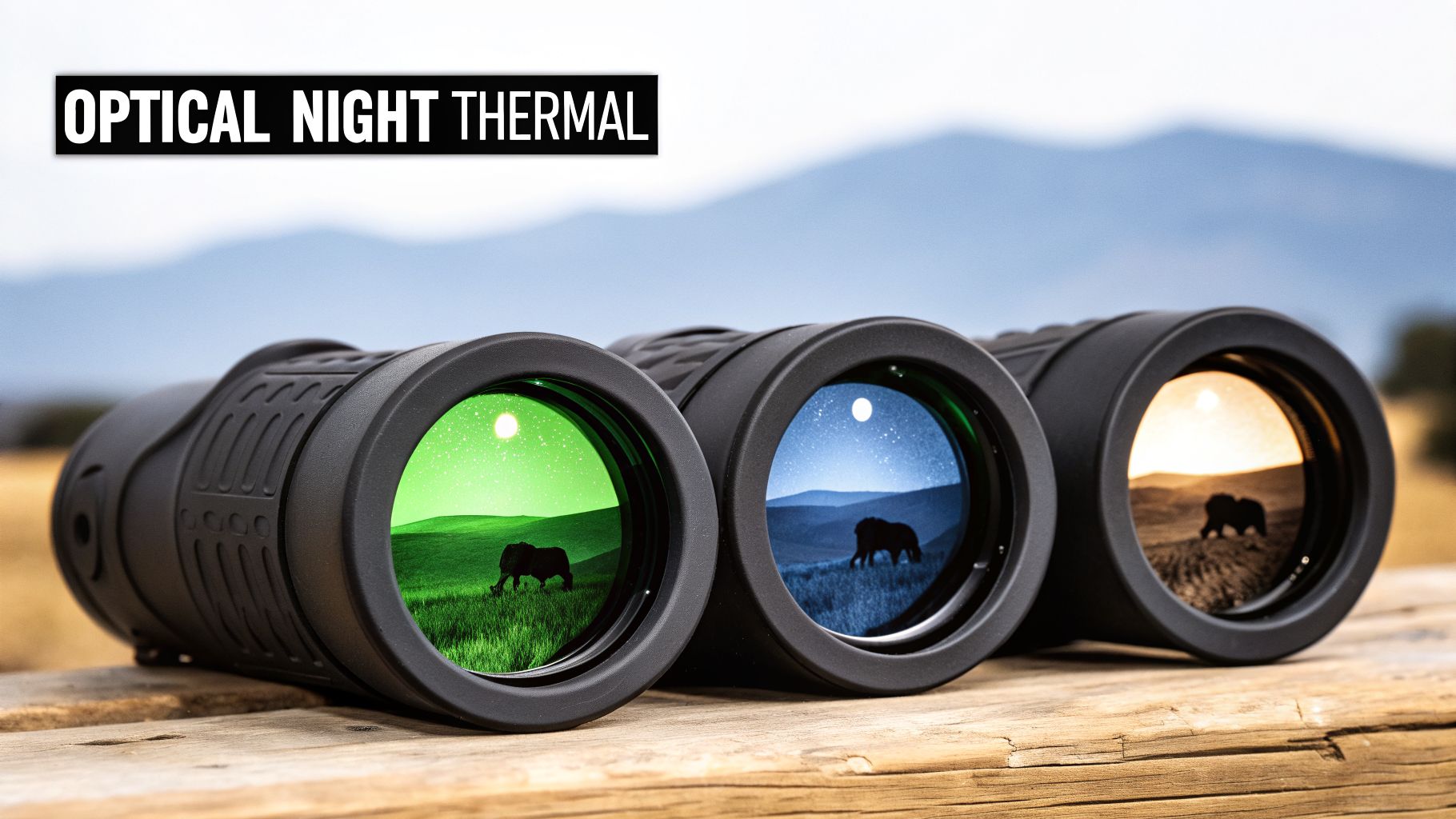
Before you can pick the right monocular for your hunt, you first have to understand the three core technologies at play. Each works on a completely different principle, and choosing the wrong one is like showing up to a duck hunt with a deer rifle.
The demand for these tools has absolutely exploded. The monocular market grew from $14.76 billion in 2024 to an expected $18.21 billion in 2025—that's a massive 23.4% jump in a single year. By 2030, it’s projected to hit $51.17 billion. Why the boom? More hunters are realizing that a compact, powerful optic gives them a serious edge for spotting game in all sorts of conditions. You can dig into the numbers yourself in this market report on openpr.com.
This surge in popularity isn't just about cool gear; it's about gaining a real advantage in the field. Let's break down how each type of monocular works and, more importantly, what it can do for you.
Optical Monoculars: The Daylight Workhorse
Think of an optical monocular as a small, handheld telescope. It uses glass lenses and prisms to gather the light that’s already there, making distant objects appear closer and clearer. It’s a tool for enhancing your own vision, pure and simple.
During daylight hours, it’s your best friend. An optical monocular lets you scan a faraway ridgeline for movement or pick apart a thicket to see if that brown shape is a log or a bedded-down buck. Its performance is tied directly to the amount of available light.
Key Strengths of Optical Monoculars:
- Daylight Clarity: Nothing beats the crisp, true-to-life color and detail of good glass in daylight.
- Affordability: They are typically the most budget-friendly option, offering fantastic performance for the money.
- Simplicity: No batteries, no screens, no menus. It just works.
The catch, of course, is that once the sun goes down, an optical monocular is pretty much useless. When legal shooting light ends, so does its utility.
Night Vision Monoculars: Piercing the Darkness
Night vision technology doesn't see in the dark—it works by amplifying it. A night vision monocular captures tiny amounts of ambient light from the moon or stars and multiplies that energy thousands of times. This amplified light is then displayed on a screen, creating that classic glowing-green image.
It can turn a field that looks pitch-black to your naked eye into a visible landscape. The key here is that it still needs some light to work. In a sealed room or a deep cave with zero ambient light, it won't be able to create an image without help from an infrared (IR) illuminator.
An IR illuminator is essentially a flashlight that projects a beam of light invisible to the human (and most animal) eyes. However, your night vision device sees it perfectly, allowing you to light up a target without giving away your position.
Night vision is excellent for watching animal behavior after dark. For a more detailed comparison of how it stacks up against thermal, you can read our full guide on thermal imaging vs. night vision.
Thermal Monoculars: Seeing Heat Signatures
Thermal imaging operates in a league of its own. It doesn't see light at all; it sees heat. A thermal monocular detects tiny differences in temperature and translates that data into a picture. Warm objects, like the body of an animal, glow brightly against the cooler background.
This is a game-changer. A thermal optic can spot a hog through thick fog, find a coyote hiding in dense brush, and see clearly in total, absolute darkness. It cuts right through camouflage and poor visibility because it's reading a heat signature, not reflected light. This is exactly why it has become the must-have tool for predator and hog hunters. It provides positive ID when every other optic would show you nothing but black.
To help you decide, here’s a quick-reference table comparing the three technologies head-to-head in a hunting context.
Hunting Monocular Technology Comparison
| Technology Type | Best For | Primary Advantage | Limitation | Example from Superior Tactical |
|---|---|---|---|---|
| Optical | Daylight scouting, glassing distant terrain | Highest clarity and true-to-life color images | Becomes ineffective in low light or darkness | Standard Daylight Monoculars |
| Night Vision | Post-sunset observation, identification | Amplifies ambient light to see in near-darkness | Requires some ambient light; can be damaged by bright light | Digital Night Vision Series |
| Thermal | Night hunting, tracking, recovery | Detects heat through darkness, fog, and light cover | Doesn't show detailed texture; identifies by shape/heat | ST Thermal Pro Scopes |
Ultimately, each of these technologies is a specialized tool. The best one for you depends entirely on when, where, and what you hunt.
Decoding the Specs That Matter for Hunting
Walking into the world of hunting optics can feel like trying to read a foreign language. You’re hit with a wall of numbers—8×42, 640×512, 50Hz—and it’s easy to feel overwhelmed. But those numbers are the key. They translate a monocular's technical guts into its real-world performance on a hunt. Let's cut through the jargon for optical, night vision, and thermal monoculars.
Optical Monocular Specs: The Numbers on the Box
When you see a monocular listed as 8×42, those two numbers tell you almost everything you need to know about how it will feel and perform in your hands.
Magnification (the "8x"): That first number is your power. An 8x monocular makes a deer standing 400 yards out look like it's only 50 yards away. It’s tempting to chase the highest magnification you can find, but that's a classic rookie mistake. Cranking up the power dramatically shrinks your field of view (FOV), which is the amount of landscape you can see at once. A tight FOV makes it incredibly frustrating to scan a wide basin or track a buck moving through the timber. High-power optics also amplify every tiny shake of your hand, turning a clear view into a jittery mess without a tripod. For most hunters, 8x or 10x is the sweet spot.
Objective Lens Diameter (the "42"): The second number, measured in millimeters, is the size of the big lens at the front. Think of it as the light-gathering window for your eye. A bigger window lets in more light. This is absolutely critical during the "golden hours" of dawn and dusk, right when game is on the move. A 42mm lens will pull in way more light than a smaller 32mm one, giving you a brighter, crisper image when you need it most.
For a hunter, it’s all about striking the right balance. An 8×42 monocular is a fantastic all-around choice, giving you a steady, wide view with great performance in low light. If you're hunting wide-open country out west, a 10×42 gives you that extra reach, but you'll trade it for a slightly dimmer image and a narrower view.
Night Vision Specs: Generations and Clarity
With night vision, we're moving from pure optics to advanced electronics. The single most important spec is the "Generation" of the image intensifier tube inside. This directly dictates the quality of the image you’ll see and, of course, the price.
Gen 2 vs. Gen 3:
- Generation 2 (Gen 2): This is a huge leap from older tech and a perfect starting point for most folks. Gen 2 tubes give you solid clarity and performance, easily letting you spot deer in a moonlit field or navigate a dark trail back to your truck. It's a reliable workhorse for hunters who need to own the night without breaking the bank.
- Generation 3 (Gen 3): This is the gold standard, plain and simple. Gen 3 tubes produce a noticeably brighter, sharper, and cleaner image, especially when the ambient light is almost non-existent. For predator hunters or anyone who needs absolute certainty in identifying a target in the dark, a Gen 3 device like a PVS-14 monocular is the only way to go. The fact that Superior Tactical backs its Gen 3 systems with a 10-year warranty tells you everything you need to know about their performance and ruggedness.
Thermal Monocular Specs: The Keys to Seeing Heat
Thermal doesn’t see light at all—it sees heat signatures. Its performance comes down to two key digital components: the sensor and the display.
Sensor Resolution:
Think of sensor resolution just like the pixels on your TV. More pixels mean a sharper, more detailed picture. A 640×512 sensor gives you a much clearer image than a lower-res 384×288 unit. That higher resolution is the difference between seeing a "hot blob" and clearly identifying the antlers on a buck or distinguishing a bedded coyote from a sun-baked rock. For positive ID at any real distance, higher resolution is king.
Refresh Rate (Hz):
The refresh rate, measured in Hertz (Hz), is how many times per second the image updates. This is what gives you smooth, fluid motion.
- A 30Hz rate is fine for spotting stationary animals or scanning slowly.
- A 50Hz or 60Hz rate delivers a seamless, real-time video feed. This is non-negotiable if you're trying to track a running coyote or a spooked hog. A lower refresh rate will get choppy and lag, making it nearly impossible to follow a fast-moving target.
Once you get a handle on these core specs, you can look at any monocular and know exactly how it’s going to perform when it counts—out in the field.
Matching the Right Monocular to Your Hunt
The best piece of gear is always the one that’s right for the job. You can know all the technical specs in the world, but what really counts is picking the right monocular for your specific hunt. After all, the perfect optic for glassing elk out west is a completely different beast than what you’d need for hunting hogs in a southern swamp.
Let's put all that technical talk into practice. By matching the right technology to your environment and target, you’ll be able to make a choice you can be confident in.
For the Western Big Game Hunter
Picture this: you're scanning for mule deer across the vast, open country of Wyoming or spotting for elk on a distant Colorado ridgeline. Your biggest challenges are the sheer distance and the unpredictable mountain weather. You need an optic that can reach out, deliver a crisp image in bright sun, and take a beating from the elements.
This is where a high-quality optical monocular really shines. It's your most dependable tool for the job.
- Magnification and Lens: A 10×42 setup is the absolute workhorse for this kind of hunting. The 10x magnification gives you the power to spot and identify game hundreds of yards away, and the 42mm objective lens drinks in enough light to stay effective in those critical first and last minutes of the day.
- Durability: Don't even consider a model that isn't waterproof and fog-proof. A nitrogen or argon-purged body is non-negotiable, as it stops the lenses from fogging up internally when you go from a warm truck to the cold mountain air—a daily occurrence out west.
- Portability: Even with that power, a monocular is still a featherweight compared to its binocular counterpart. That saved weight and space in your pack becomes a huge deal after a few miles on the trail.
For the Eastern Whitetail Hunter
Now, let's head east into the dense hardwoods and thickets where whitetails live. Here, shots are closer, and you often only get a fleeting moment to scan for movement. Long-range power isn't the priority; a wide view and quick, easy handling are what you need.
An 8×32 optical monocular is tailor-made for this world. The 8x power is plenty for woodland distances, and the wider field of view helps you pick up the flick of an ear or the flash of a tail as you scan through the timber. Its compact size means you can keep it on a chest harness, ready to go in an instant.
If your state regulations allow for it, knowing what deer are doing after sundown can be a game-changer. This is where night vision comes into play.
A Gen 2+ night vision monocular lets you watch deer on food plots or travel corridors well after legal shooting light has faded. You're not using it to hunt, but to gather intel that will make your daylight sits infinitely more productive.
For the Predator and Hog Hunter
For those of us who chase coyotes, hogs, and other predators, the hunt truly begins when the sun goes down. These animals are most active in total darkness, which makes traditional glassing completely useless. This is thermal territory.
Nothing—and I mean nothing—gives a predator hunter an edge like a thermal monocular. It doesn't need a single ray of light because it sees heat. A good thermal optic allows you to:
- Pick up an animal’s heat signature in pitch-black conditions.
- See right through fog, smoke, and light brush that would blind other optics.
- Instantly spot game that's perfectly camouflaged or holding dead still.
When choosing one, make sure it has a high refresh rate (50Hz or more). This is crucial for tracking fast-moving targets like running hogs or coyotes without the image turning into a blurry mess. To dig deeper into what makes a great thermal, check out our complete guide on finding the best thermal monocular for hunting.
To help you put it all together, the decision tree below walks you through the key questions about your hunt, budget, and typical ranges.
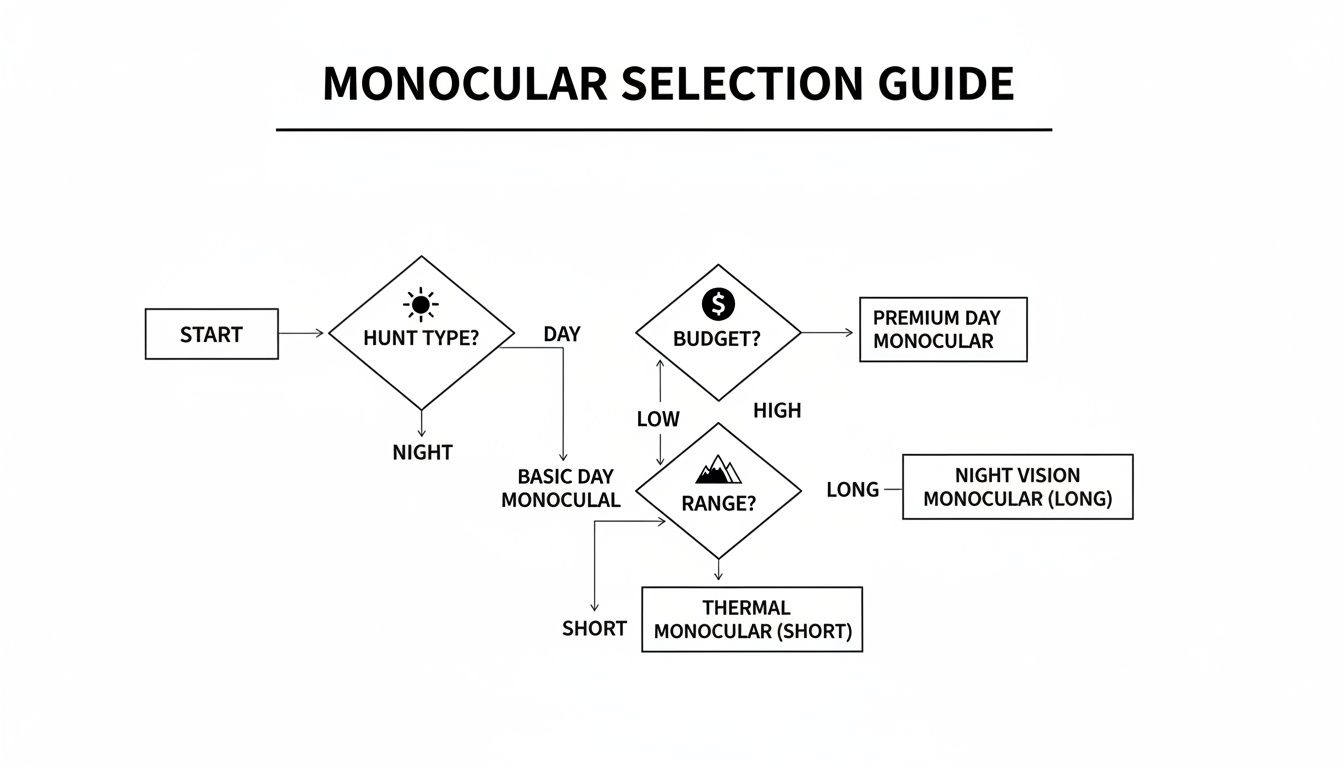
This flowchart makes it clear how your specific needs should point you toward an optical, night vision, or thermal solution. These compact optics are becoming more and more popular, with the entire market projected to grow from $23.4 million in 2024 to $41 million by 2032. This growth is fueled by their portability and lower manufacturing costs compared to binoculars and scopes. You can find more details on this trend in the full market analysis from intelmarketresearch.com.
Essential Accessories and Field Maintenance
Think of your new monocular like a custom rifle. The rifle itself is the core, but it's the scope, the bipod, and the time you spend cleaning it that truly make it a reliable tool in the field. Your optic is no different. The right accessories and a little bit of upkeep will transform it from a good piece of gear into a trusted partner you can count on for every single hunt.
A few smart additions to your kit can make all the difference. If you're planning on long glassing sessions, especially with a powerful monocular, stability is everything. A lightweight tripod or even a simple shooting stick with a monocular adapter will save your arms from burning out and prevent that shaky view that makes it impossible to spot distant game.
For anyone running night vision or thermal, going hands-free is a game-changer. A helmet mount lets you flip the optic down when you need it, keeping your hands on your rifle or calls. And it goes without saying, a tough, padded case isn't optional—it's cheap insurance to protect your investment from the inevitable bumps and tumbles that happen out in the wild.
Protecting Your Investment in the Field
When it comes to field maintenance, we’re not talking about taking the thing apart. It's all about forming good habits to keep your monocular ready to go. The most important, and most delicate, part of your optic is the lens. Wiping a dirty lens with your t-shirt is the fastest way to put permanent scratches on the coatings. Don't do it.
Pro Tip: Always start with an air blower or a soft lens brush to get rid of any grit or dust. Once the big stuff is gone, you can use a proper lens cloth or a lens pen to gently clean off smudges. Start in the center and work your way out in a circular motion.
Running a quick check before you head out the door can prevent a world of frustration later. It only takes a minute and ensures your gear is ready when that moment of truth arrives.
Pre-Hunt Maintenance Checklist:
- Lens Inspection: Give the lenses a once-over for dust, fingerprints, or moisture. Clean them the right way, as we just covered.
- Battery Check: If you're using a thermal or night vision unit, make sure your batteries have a full charge. Always pack spares in a waterproof case. It’s also wise to check the battery compartment for corrosion and clean the contacts if they look funky.
- Body and Housing: Do a quick visual inspection of the body for any cracks or damage. Make sure the lens caps and any rubber armor are snug and secure.
Taking care of your gear will dramatically extend its life. After a hunt, especially a wet one, let your monocular air out at room temperature before you pack it away. Sealing a damp optic in a case is asking for mold and fogging issues down the road.
These little habits are crucial. Data from field repairs shows that nearly 30% of advanced optics like night vision units need some type of service each year after seeing heavy use. This is exactly why a rock-solid warranty matters. For instance, many of the Gen 3 night vision systems in Superior Tactical's catalog are backed by a 10-year warranty, giving you confidence in your investment. You can learn more about why service and warranties are so critical in this detailed video overview.
Making a Confident Choice for Your Next Hunt
So, where does that leave us? We've covered a lot of ground—from breaking down the tech behind different monoculars to translating what all those specs actually mean when you’re out in the field. It should be clear by now that there’s no single best monocular for hunting. The right one for you is the one that fits your hunt, your budget, and your personal style.
Making the right choice here is a game-changer. It could be a simple optical monocular giving you that crystal-clear view you need for a western big game hunt. Or maybe it's the critical low-light advantage of a night vision unit for watching deer at dusk, or the undeniable power of a thermal for recovering an animal or managing predators. Whatever it is, think of this optic as a core part of your hunting system.
Partner with Expertise
But there’s one more piece to the puzzle, and it's one a lot of guys overlook: where you buy your gear. When you’re investing in a serious piece of equipment—especially something as advanced as night vision or thermal—the retailer you choose is almost as important as the optic itself.
I can't stress this enough: find a retailer who has actually spent time in the field. You want a team that offers straightforward warranties and has a support line answered by people who know what they're talking about. This way, you’re not just buying a tool; you're getting a reliable piece of gear backed by people who can help you if things go sideways.
Final Checklist Before You Buy:
- Your Hunt: What are the light conditions? Are you spotting at dawn and dusk, or tracking in total darkness?
- Your Budget: Where's the sweet spot between the features you absolutely need and what you're willing to spend?
- Your Retailer: Does this company stand behind their products with a solid warranty and expert support you can actually reach?
When you can answer those three questions with confidence, you're no longer just buying another gadget. You're making a smart investment in a tool that will give you a real advantage for years to come. Working with a knowledgeable partner like Superior Tactical ensures you have peace of mind, knowing your gear is ready for whatever your hunt throws at you.
Frequently Asked Questions About Hunting Monoculars
Even after digging into the specs, you probably still have a few questions rolling around in your head. That's a good thing. Choosing the right monocular is a big decision, and you need to have total confidence in the gear you take to the field.
Let's cut through the noise and tackle some of the most common questions we get from hunters. These are the practical, real-world details that separate a good buy from a great one.
Can You Use a Night Vision Monocular During the Day?
The short answer here is a hard no—you absolutely should not. Traditional analog night vision, especially units with Gen 2 or Gen 3 image intensifier tubes, is incredibly sensitive to light.
Using one in daylight, or even accidentally pointing it at a bright headlight, can permanently scorch the tube. This damage shows up as ugly black "burn" spots in your view and, importantly, is never covered by the warranty. Think of it like staring at the sun; the tube gets overwhelmed and can be permanently damaged.
Digital night vision is a bit more forgiving and won't get fried by bright light. However, it’s not built for daytime viewing and the image quality will be a major step down from even a basic optical monocular.
Key Takeaway: Protect your investment. Analog night vision is for the dark, period. For daytime scouting, a standard optical monocular is the right tool for the job.
What Budget Should I Set for a Good Hunting Monocular?
This is a huge question, and the honest answer is: it depends entirely on what you need it to do. Monocular prices are all over the map, driven by the technology packed inside.
Optical Monoculars: You can get a tough, clear, and very capable optical monocular for $150 to $400. In this range, you're getting waterproof models with quality glass that will serve you well for years of daylight hunting.
Digital & Gen 1 Night Vision: For basic after-dark observation, entry-level night vision runs from $300 to $800. These are solid for spotting at closer ranges but won't have the clarity of more advanced units.
Gen 2+ Night Vision & Entry-Level Thermal: This is where things get serious. For a quality Gen 2+ night vision unit or a solid entry-level thermal, expect to invest $1,200 to $3,000. This is the sweet spot for many dedicated night hunters.
Gen 3 Night Vision & High-End Thermal: For the absolute best performance, top-tier Gen 3 night vision and high-resolution thermal optics start around $3,000 and can go way up from there. This is professional-grade gear that offers the best detection range, image clarity, and durability.
For Hog Hunting Is Thermal or Night Vision Better?
When it comes to hog hunting, thermal is the undisputed king. It’s not even a close competition.
While night vision amplifies ambient light and is a massive advantage over the naked eye, hogs are masters of using cover. They stick to deep shadows and thick brush where almost no light gets through, making them tough to spot even with a good night vision device.
Thermal, on the other hand, doesn’t care about light. It sees heat. A hog's warm body glows like a lightbulb against the cool ground, making it pop out from thickets, fog, and complete darkness. This means faster detection and more reliable identification—which is exactly why almost every serious hog hunter eventually invests in thermal.
Choosing the right optic is one of the most important steps in preparing for a successful hunt. At Superior Tactical LLC, we live and breathe this stuff, and we’re here to provide the field-tested gear and expert advice you need to make a confident choice. Explore our hand-picked selection to find the perfect advantage for your next hunt.
Browse Our Full Collection of Hunting Monoculars at superiortac.com
