The Best Cameras with Night Vision 2026 Ultimate Guide
If you’re looking for the absolute best in professional-grade night vision, nothing beats a Gen 3 Image Intensification (I²) device for sheer clarity and performance in near-total darkness. For pure detection, however—especially through fog or against camouflage—thermal imaging is in a league of its own. Digital night vision then rounds out the options as a solid, budget-friendly choice that works well in mixed lighting.
Understanding the Guide to Night Vision Cameras
The first step in choosing the right optic is understanding the fundamental technology driving it. We're going to break down the critical differences between thermal, digital, and traditional image intensification. This isn't just about specs on a sheet; it's about matching the right tool to your specific mission, whether you're in law enforcement, private security, or out on a serious hunt.
My goal here is to give you clear, practical insights drawn from years of field experience. Making the right investment in low-light gear can give you a serious operational edge. To get us started, the table below gives a quick overview of the core technologies and what they're truly good for.
Quick Guide to Night Vision Technologies
Before we get into the weeds, let's clear up the most important question: do you need to detect a heat signature from a distance, or do you need to identify a target up close? Your answer will point you to the right technology. This table lays out the fundamentals.
| Technology Type | How It Works | Best For | Key Advantage |
|---|---|---|---|
| Image Intensification (I²) | Gathers and amplifies faint ambient light (from the moon or stars) to produce a visible green-hued image. | Navigation, target identification, and maintaining situational awareness in low-light environments. | Renders a detailed, recognizable image with natural depth perception. |
| Thermal Imaging | Detects minute differences in temperature and translates that heat data into a visible picture. | Detecting living targets, seeing through smoke or heavy fog, and surveillance in absolute darkness. | It needs zero light to function and easily cuts through visual clutter and obscurants. |
| Digital Night Vision | Employs a digital camera sensor, often paired with an active infrared (IR) illuminator, to capture an image in the dark. | General-purpose use, recording evidence or hunt footage, and operating in mixed or daylight conditions. | Highly versatile and more affordable, with the built-in ability to capture high-quality photos and video. |
It's no surprise that the market for these optics is booming. The night vision sector was valued at $8.9 billion in 2025 and is projected to hit $13.58 billion by 2030, largely driven by massive investments in military and defense. North America is at the forefront of this trend, with heavy spending on the advanced Gen 3 and Gen 4 systems essential for modern nocturnal operations.
Expert Insight: For most tactical jobs, a high-quality Gen 3 I² system is still the gold standard. Its ability to create a detailed, natural-looking scene is absolutely critical for making split-second identification decisions—a task where thermal imaging, for all its detection power, often struggles.
Ultimately, getting a firm grip on these core technologies is the most important step you can take before buying. For a much deeper look, you can explore our full analysis of various night vision cameras. This foundation will prepare you to evaluate the finer details and specific scenarios we'll cover next.
Decoding Night Vision Technology Types
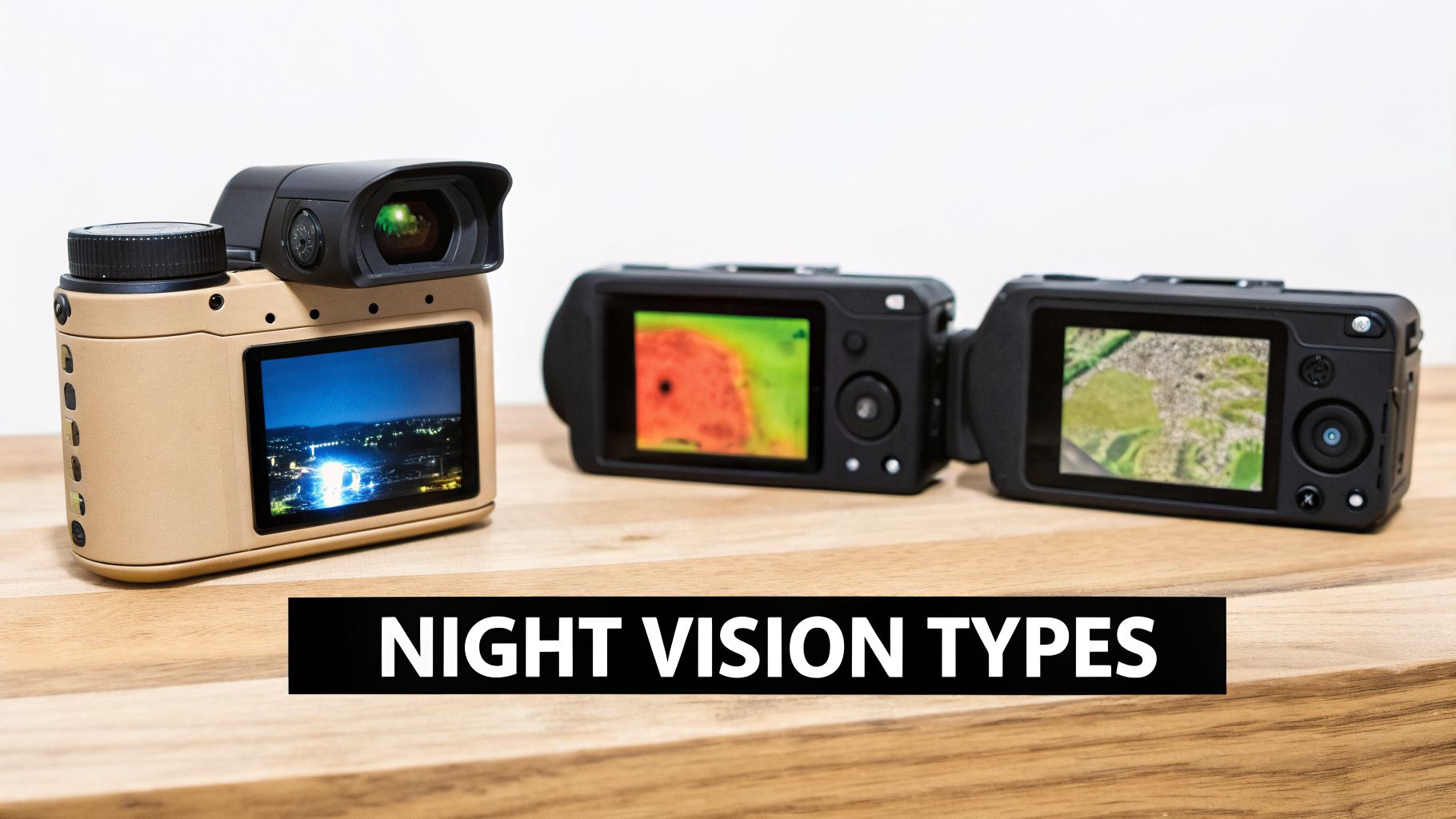
Before you can pick the right camera, you need to know what’s going on under the hood. When we talk about "night vision," we're really talking about three entirely different technologies, each with its own way of turning a pitch-black scene into something you can actually see.
Your mission will always dictate the gear. The three main players are Image Intensification (I²), Digital Night Vision, and Thermal Imaging. While they all cut through the darkness, how they do it couldn't be more different. One acts like a massive light amplifier, another is essentially a highly specialized digital camera, and the third sees a world of heat that's completely invisible to our eyes.
Image Intensification: The Analog Standard
Image Intensification, or I², is the classic "green screen" night vision you’ve seen in movies. This is analog tech, refined over decades. It works by gathering what little ambient light is available—from the moon, starlight, or even distant city glow—and amplifying it thousands of times.
Here’s the rundown: photons (light particles) enter the lens and hit a photocathode, which converts them into electrons. These electrons are then shot through a microchannel plate (MCP), a wafer-thin disc riddled with millions of tiny glass tubes. As one electron enters a tube, it bounces off the walls, releasing a cascade of thousands more. This supercharged stream of electrons then slams into a phosphor screen, lighting it up to create the bright, recognizable image you see.
Field Insight: I² gives you an incredibly detailed, almost natural-looking image with fantastic depth perception. This is why it’s the gold standard for navigating on foot and positively identifying a target. Its one limitation? It needs some light to amplify. In a sealed room with zero light, it can't see a thing.
Digital Night Vision: The Versatile All-Rounder
Digital night vision works a lot like the camera in your phone, but its sensor is built to be extremely sensitive to the infrared (IR) spectrum. In most low-light situations, there isn't enough natural light for the sensor, so these devices lean on a built-in or accessory IR illuminator. Think of it as an invisible flashlight that floods an area with infrared light that only the camera can see.
The camera's sensor, usually a CCD or a more modern CMOS chip, captures the reflected IR light. An onboard processor instantly translates that data into a black-and-white image on a tiny LCD or OLED screen inside the viewfinder. The digital nature of this process opens the door to features that analog can't offer, like recording video, snapping photos, and even being used in broad daylight without damaging the unit.
Because they create their own "light" with an IR illuminator, they can work in total darkness. However, their range and clarity are directly tied to the power of that illuminator. For the price, their flexibility makes them a solid choice for many users, especially those just getting into night vision.
Thermal Imaging: Seeing Heat Signatures
Thermal is the real outlier of the group because it doesn't see light at all—it sees heat. Every single object, living or not, gives off thermal energy as long as its temperature is above absolute zero. A thermal imager uses a special germanium lens to focus this invisible infrared energy onto a detector array called a microbolometer.
The microbolometer creates a detailed heat map of the scene, called a thermogram. The device's processor then assigns colors or shades of gray to different temperature values. The result is an image where warm bodies like people and animals glow brightly against their cooler surroundings.
This makes thermal unbeatable for one thing: detection.
- No Light Needed: It works in zero-light environments where I² and digital are blind.
- Cuts Through Obscurants: It can see right through smoke, fog, dust, and light foliage that would stop other optics cold.
- Defeats Camouflage: A ghillie suit can’t hide body heat. Thermal spots a warm target no matter how well it’s concealed.
The trade-off is detail. While you can spot a heat signature from a mile away, identifying whether it's a person, a deer, or a coyote can be tough without more visual information. Thermal is a game-changer for finding hidden targets, but it's not what you'd want to use for navigating tricky terrain or identifying facial features.
Key Specifications That Define Performance
When you're trying to compare night vision cameras, the marketing jargon can get overwhelming fast. To cut through the noise, you need to know which specs actually translate to performance in the field. These numbers aren't just for show; they're the real metrics that dictate image quality, how far you can see, and whether the device is truly effective.
For analog Image Intensification (I²) gear, it's all about the tube. No two tubes are created equal, and the spec sheet tells the whole story. If you learn to focus on these core numbers, you'll be able to judge a device's true capability, regardless of the brand name on the housing.
Understanding Image Intensifier Tube Specs
The one number that matters most for an I² tube is its Figure of Merit (FOM). It’s a straightforward calculation: the tube's Resolution (in lp/mm) multiplied by its Signal-to-Noise Ratio (SNR). FOM gives you a quick, standardized way to gauge the overall performance of a tube.
Resolution (lp/mm): Measured in line pairs per millimeter, this tells you how well the tube can resolve fine details. A higher number means a sharper, cleaner image. For good Gen 3 tubes, you're looking for 64 lp/mm or better. This is what lets you tell the difference between a branch and a rifle barrel at a distance.
Signal-to-Noise Ratio (SNR): Think of this as the "cleanliness" of the image. The signal is the light you’re trying to see, and the noise is that distracting, sparkling effect—known as scintillation—you get in extremely dark environments. A higher SNR means a much cleaner picture with less of that static, which is absolutely critical for peering into deep shadows. You'll want to see an SNR above 30 for any professional-grade unit.
A high FOM score, typically 2000 or more, is the hallmark of a top-tier tube that delivers on both clarity and performance in near-total darkness. It's the same benchmark the military and law enforcement agencies use to source gear that won't fail them.
"Don't get lost in brand names; focus on the tube specs. A high FOM from a reputable source is the best guarantee of performance. It’s the difference between seeing a blob in the dark and clearly identifying a threat."
Key Metrics for Thermal Imaging Optics
Thermal operates on a completely different set of principles, so the important specs are all about how well the sensor can detect and display heat signatures. Get these wrong, and you could end up with a thermal that can’t spot a coyote in a field on a humid night.
For thermal, there are three specs that are non-negotiable: Sensor Resolution, NETD, and Refresh Rate.
Sensor Resolution: Just like with your digital camera, this is the number of pixels the sensor has (e.g., 320×240 or 640×480). More pixels on target means a sharper image and more detail, especially at longer ranges. A 640×480 sensor has four times the pixel density of a 320×240 sensor, which is a massive jump in your ability to positively identify what you're looking at.
NETD (Noise Equivalent Temperature Difference): This might be the single most important spec for a thermal imager. Measured in millikelvins (mK), it defines the sensor's sensitivity—how well it can pick up on tiny temperature variations. A lower NETD value (look for <40 mK or less) means the sensor is more sensitive. This translates to a more detailed image and far better performance in tough conditions like fog, rain, or high humidity.
Refresh Rate: Measured in Hertz (Hz), this is simply how many times per second the image updates on your screen. A fast refresh rate like 50Hz or 60Hz gives you a smooth, fluid picture, which is essential when you're scanning an area or tracking a moving target. Cheaper units with lower rates (30Hz or less) can produce a choppy, lagging video that makes it hard to keep your bearings.
By zeroing in on these specific numbers—FOM, Resolution, and SNR for I² tubes, and Sensor Resolution, NETD, and Refresh Rate for thermal—you can make a smart decision based on hard data, not just flashy marketing.
Thermal vs. Image Intensification in Real Scenarios
Choosing between thermal and image intensification (I²) isn't about which technology is "better." It's about which tool is right for the job. The best night vision camera for one operation can be a massive liability in another. This is where we move past the spec sheets and get into what actually happens when your boots are on the ground.
Instead of a generic pros-and-cons list, let's run through a few head-to-head scenarios. This will show you exactly where each technology shines—and where it falls short—so you can make your decision based on mission needs, not marketing hype.
Scenario 1: Tracking a Target in a Dense Forest
Picture this: you're tracking a subject through a thick, damp forest. It’s a moonless night, the air is cool, and fog is rolling in between the trees. This is a classic detection challenge, and it's where thermal absolutely dominates.
An image intensification device, even a good one, is going to have a hard time here. The heavy canopy blocks the starlight, and the fog scatters what little light does get through. You’ll be staring at a screen full of grainy noise, struggling to make out shapes. Positive ID? Forget about it.
A thermal imager, on the other hand, cuts right through that mess. It doesn't care about light; it sees heat. Your target’s body heat will pop, glowing bright white or black against the cool background of the trees and damp ground. Foliage that would completely hide someone from an I² device is basically semi-transparent to a thermal sensor, letting you see the heat signature behind it.
Key Takeaway: For pure detection, especially in bad weather or through concealment, nothing beats thermal. It answers the question, "Is something there?" with a simple yes or no, even when traditional night vision is completely blind.
Scenario 2: Clearing a Building Room by Room
Now, let's switch gears to a close-quarters battle (CQB) environment. You and your team are clearing an unfamiliar building. The power's out, and you're navigating a maze of furniture, open doorways, and shadowy corners.
This is where a high-quality I² device, particularly a Gen 3 unit, really proves its worth. It gives you a detailed, high-resolution picture with fantastic depth perception. You can tell the difference between a jacket slung over a chair and a person crouched in the corner. You can navigate around clutter on the floor and even read the subtle body language of someone you encounter.
A thermal imager would show you hot spots, but it lacks the detail you need for navigation and identification up close. Is that warm rectangle on the wall a TV power brick or something else? Trying to move quickly through a cluttered room is tough when every object at the same temperature blends into a flat, confusing blob. Thermal tells you that a person is in the room; I² tells you what they're doing and what they're holding.
This critical difference in capability is something every operator needs to understand. For a deeper dive into the science, our complete guide on thermal imaging vs. night vision breaks down the technology even further.
Scenario 3: Long-Range Surveillance and Identification
For our final scenario, your mission is to watch a vehicle from a hidden position 500 meters away. You need to know if a specific person gets out. This job demands a mix of both detection and identification.
Here's how it plays out. A powerful thermal scope will spot the heat from the vehicle's engine and the moment a person gets out. No question. You’ll see the activity instantly. The problem is, at that range, the thermal image will just be a blob. You’ll have no chance of making a positive facial ID.
An I² device with good magnification gives you the opposite. It has the resolution to potentially identify a face or distinctive clothing, but only if you have enough ambient light and a clear line of sight. Camouflage, smoke, or even deep shadows could render it useless. The real solution here is often a fusion of both: using thermal to detect the activity and then switching to I² to get the details needed for identification.
This push for better detection is driving major investment in the field. The AI-powered night vision camera market is set to explode from $651 million in 2025 to $1,524 million by 2032. This growth, detailed in this market analysis of AI night vision camera trends, is fueled by military and security needs for smarter systems that can automatically detect and classify objects in complete darkness.
Choosing the Best Night Vision for Your Mission
The right night vision setup isn't about the latest tech or the highest specs on paper. It's about matching the tool to the mission. A device that’s perfect for one job can be a serious handicap in another. So, let’s set the spec sheets aside and talk about what really works in the field.
This isn't about which brand is "best," but about which system gives you a real-world advantage. Whether you’re on patrol, stalking game, or running a high-stakes security detail, the mission dictates the gear.
For the Law Enforcement Officer
Patrol officers face a constantly shifting environment. One minute you’re in a pitch-black alley, the next you’re dealing with the blinding glare of streetlights or oncoming headlights. For this kind of dynamic work, nothing beats the flexibility of a helmet-mounted Gen 3 monocular.
A quality Gen 3 tube delivers the clarity and depth perception you need to navigate obstacles, spot a threat, and, just as importantly, read someone's body language. Running a monocular is key here—it keeps one eye free and adapted to ambient light. This prevents the tunnel vision you can get from duals and helps you maintain total situational awareness. Pair it with an IR laser on your duty weapon, and you have a potent system for engaging threats accurately.
The Bottom Line: A monocular's lightweight design and the crisp, high-resolution image from image intensification (I²) are built for fast-paced movement and split-second decisions. Thermal is a great tool for detection, but when it comes to active patrol and direct engagement, the navigational clarity of a Gen 3 monocular is essential.
For the Dedicated Hunter
The hunter's world is one of patience, concealment, and positive identification. You’re often up against dense foliage, fog, or the deep dark of pre-dawn hours, looking for an animal that’s naturally camouflaged and perfectly still. This is where a thermal weapon sight truly shines.
Thermal cuts right through visual camouflage, fog, and darkness by detecting an animal's body heat. It transforms the hunting experience; you can scan a dark woodline and instantly see a heat signature that would be completely invisible to the naked eye or even a top-tier I² device. Today’s thermal scopes, especially those with high-resolution sensors (640×480) and sensitive NETD ratings (<40mK), provide enough detail for positive ID at ethical distances.
This simple decision tree breaks down the core choice between thermal for finding and image intensification for navigating and identifying.
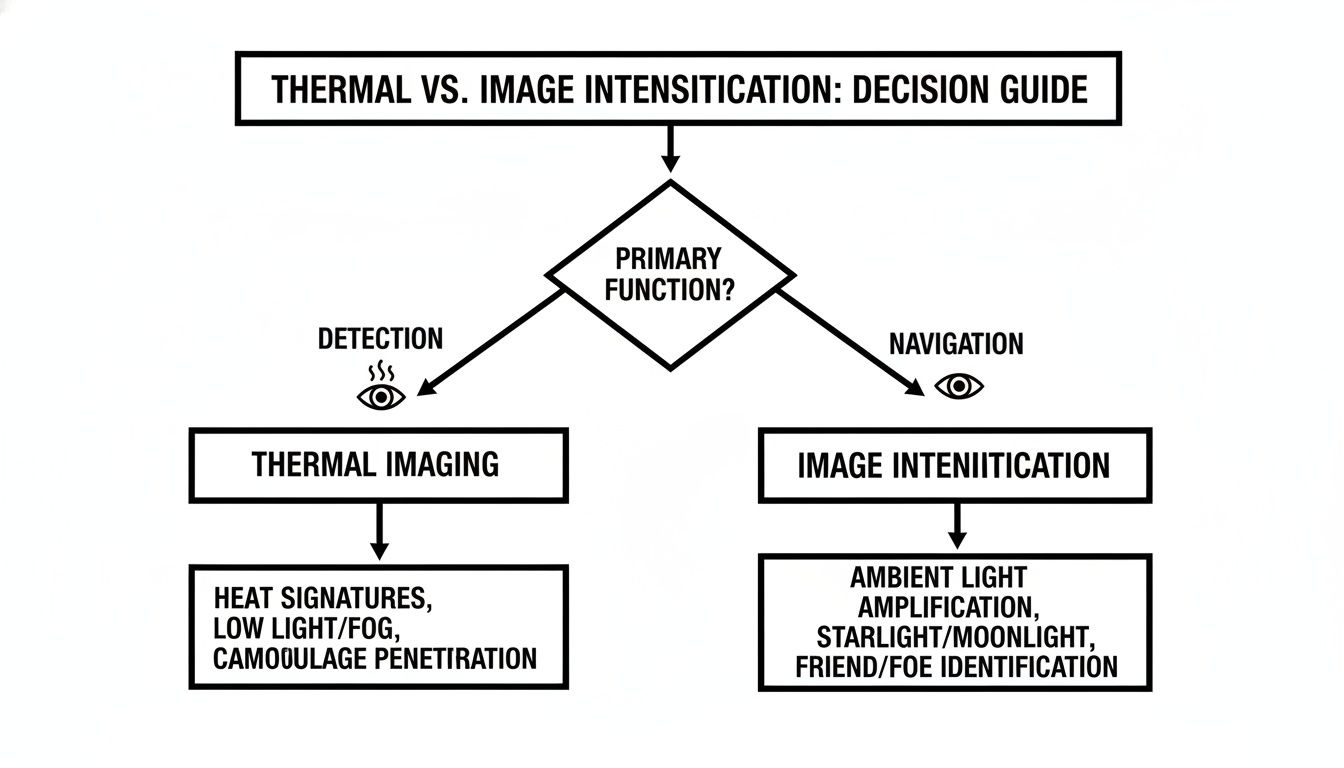
As the flowchart shows, the two technologies serve fundamentally different purposes. Thermal is your detection superpower, while I² gives you the detail needed to safely move and identify your target.
For High-Stakes Security Operations
When you're a security contractor or part of a tactical team, the stakes are as high as they get. Missions can involve clearing unfamiliar buildings, operating from vehicles, and staying alert for hours on end. In this arena, dual-tube goggles (bino-NVGs) are the undisputed professional standard.
Using two image intensifier tubes gives you true stereoscopic vision. This is a game-changer. It restores your natural depth perception, which is absolutely critical for moving quickly through complex spaces, judging distances, and avoiding the eye strain that builds up over long nights. That enhanced awareness can make all the difference when things go sideways.
The demand for this level of capability is driving huge growth in the market. Security needs helped push the night vision camera market to $6.34 billion in 2024, with forecasts suggesting it could hit $13.5 billion by 2035. The wider night vision device sector, valued at $7.02 billion in 2022, is projected to climb to $16.32 billion by 2030, with security applications making up a massive 26.9% of that. You can find more details in the night vision market analysis from Market Research Future.
To bring it all together, the following table summarizes our recommendations based on primary mission profiles.
Mission-Specific Night Vision Recommendations
| Primary Mission | Recommended System | Core Technology | Key Advantage for Mission |
|---|---|---|---|
| Law Enforcement Patrol | Helmet-Mounted Monocular | Gen 3 Image Intensification (I²) | Balances situational awareness (unaided eye) with high-detail night vision for navigation and threat ID. |
| Hunting | Weapon-Mounted Scope | Thermal Imaging | Superior detection of heat signatures, cutting through camouflage, foliage, and poor weather. |
| Tactical/Security Ops | Helmet-Mounted Binoculars | Dual-Tube Image Intensification (I²) | Provides true depth perception for rapid movement, reduced eye strain, and maximum environmental awareness. |
By tailoring your choice—whether it's a monocular, a thermal sight, or dual-tube goggles—to the specific challenges you face, you’re not just buying a piece of gear. You’re building a system that delivers a decisive operational advantage when you need it most.
Maintaining Your Tactical Night Vision Gear
Think of your night vision device as a high-performance engine—it's a serious investment that requires proper upkeep to stay in the fight. Whether you're a law enforcement officer relying on it for officer safety or a hunter on a multi-day trip, taking care of your gear ensures it works when you need it most. The heart of the unit, the image intensifier tube, is incredibly sensitive, and a little preventative maintenance goes a long way.
The single most important rule is to protect the image intensifier tube from bright light. This is non-negotiable. Never, ever power on a traditional I² device in daylight unless the protective day cap filter is screwed on tight. A sudden blast from a headlight or accidental exposure to direct sun can leave permanent blemishes or, even worse, completely burn out the tube. That’s a costly mistake.
Essential Cleaning and Care
Keeping your lenses clean is about more than just a clear picture; it’s about protecting the special anti-reflective coatings. Those coatings are what give you a crisp image, but they can be scratched or worn down with the wrong cleaning technique.
- Get the Grit Off First: Before you wipe anything, use a can of compressed air or a soft lens brush to blow away any loose dust, sand, or dirt. Wiping a gritty lens is like taking sandpaper to it, and you'll cause permanent scratches.
- Use the Right Stuff: Put a couple of drops of a dedicated lens cleaning solution onto a clean microfiber cloth or a fresh lens tissue. Never spray the cleaner directly on the lens.
- Wipe Smart, Not Hard: Start in the center of the lens and gently wipe in a circular, outward spiral. This motion pushes any leftover particles away from the middle of your field of view instead of just smearing them around.
Battery Management and Storage
Great gear is useless if the batteries are dead. This seems obvious, but it's a detail that can trip up even seasoned users at the worst possible moment.
Pro Tip: Stick with high-quality lithium batteries. They perform much better in the cold and hold their charge longer in storage. When you're putting your gear away for a while, always take the batteries out. This prevents them from corroding inside the housing and ruining the electronics.
For storage, a hard, padded case is your best friend. Keep it somewhere cool and dry, away from places with big temperature swings or high humidity. If you've cleaned the lenses and swapped in fresh batteries but still see persistent dark spots, flickering, or a major drop in performance, it's a sign that you need professional service. To get a better idea of what might be going on, check out our guide on common night vision gear issues and professional repairs.
Common Questions About Night Vision
When you're investing in professional-grade optics, you're bound to have questions. Getting the right answers is critical before you put your money down. Let's clear up some of the most common things we hear from operators and serious users.
Green vs. White Phosphor
This is one of the biggest debates in the night vision world. So, what's the real difference between green and white phosphor in an image intensifier tube?
With high-quality Gen 3 tubes, both will give you outstanding performance. The choice really boils down to your personal preference and how long you'll be behind the device. Many experienced users find that white phosphor offers a grayscale image with higher contrast, which can feel more natural to the human eye and reduce strain during long-term use.
That said, modern green phosphor is the tried-and-true standard for a reason. It remains a highly effective—and often more budget-friendly—option for professional applications.
Daylight Use and Safety
Can I use my image intensification (I²) device during the day? The answer is a definitive no. You should never expose an I² tube to bright light without a protective day cap on the lens.
Doing so can cause permanent damage almost instantly, burning blemishes into the tube or destroying it completely.
While modern features like autogating can protect the tube from sudden, brief flashes of light (like a muzzle flash or streetlight), they are not a substitute for proper light discipline. These systems are not designed for daytime use. Thermal and digital night vision, on the other hand, are generally safe to operate in any light condition.
The Cost of Professional Night Vision
How much should I expect to spend on a professional night vision setup? There's no getting around it: a professional-grade Gen 3 system is a significant investment, often running into several thousand dollars.
That price tag reflects the incredible low-light performance, ruggedness, and life-or-death reliability you're paying for. While you can find much cheaper digital options, they simply can't compete in terms of light amplification and image clarity. For most professional use cases, the performance trade-offs of lower-cost devices are just too steep.
Ready to get equipped with mission-critical gear? Explore our curated selection of professional-grade night vision and thermal optics at Superior Tactical LLC. All Gen 3 systems come with a 10-year warranty and expert support. Find your tactical advantage today at superiortac.com.
