Finding the Best Budget Scope for Your Rifle in 2026
Let's be clear: the "best" budget scope isn't just the cheapest one you can find. It’s the optic that delivers 90% of a premium scope's performance for a small fraction of the price. The great news is that today's top budget-friendly models offer surprising clarity, toughness, and reliable adjustments that were once exclusive to high-end glass. This makes them a fantastic choice for hunters, law enforcement, and tactical shooters alike.
What Defines the Best Budget Scope Today
So, what separates a genuinely great budget scope from just a cheap one? Forget the marketing fluff. The difference boils down to one thing: mission-ready value. You're looking for accessible precision that you can actually depend on when a shot matters. Think of it like this: modern manufacturing has figured out how to put a high-performance engine inside a standard car body, giving you reliable accuracy without the luxury price tag.
This leap in quality has completely changed the game. Affordable, high-value riflescopes now account for over 60% of sales volume in North America, a market that itself represents a 33.5% global revenue share in 2024. The numbers don't lie—the entire global riflescopes market hit USD 7.02 billion in 2024 and is on track to reach USD 10.45 billion by 2032. This growth is driven by shooters like us who demand solid performance without having to refinance our homes. You can dig into the specifics of this trend in the full analysis from Data Bridge Market Research.
A quality budget scope must deliver on three non-negotiables:
- Clear and Bright Glass: It should have fully multi-coated lenses. This is key for good light transmission, giving you a sharp sight picture, even in the low light of dawn or dusk.
- Reliable Adjustments: The windage and elevation turrets need to have crisp, audible clicks. More importantly, they must track accurately and reliably return to zero after you make adjustments in the field.
- Durable Construction: A single-piece aluminum tube that is nitrogen-purged is the standard. This makes the scope shockproof, waterproof, and fog-proof enough to handle real-world abuse.
At its core, a modern budget optic should never feel like a compromise on reliability. It’s a tool that must provide a clear advantage, hold its zero through recoil and rough handling, and give you the confidence to make every shot count.
Getting a handle on the numbers and features printed on these scopes is your first step to spotting true value. Our guide on what scope numbers mean is the perfect place to start. It will give you a practical framework to cut through the hype and find the absolute best budget scope for your specific mission.
Decoding the Core Features You Cannot Ignore
When you're buying a scope on a budget, you have to be smart about where your money goes. A few core features will make or break your experience, and getting them right is the difference between a reliable tool and a paperweight that just looks the part.
Let's start with the most important one: optical quality. Think of it this way—a scope with bad glass is like trying to drive at night with muddy sunglasses on. You might see something, but you'll miss the critical details. High-quality glass with good coatings pulls in more light, giving you a bright, sharp picture. This isn't just a "nice to have"; it’s what lets you clearly identify a target in the crucial low-light hours of dawn and dusk.
This flowchart can help you map out your needs based on how you plan to use the rifle.
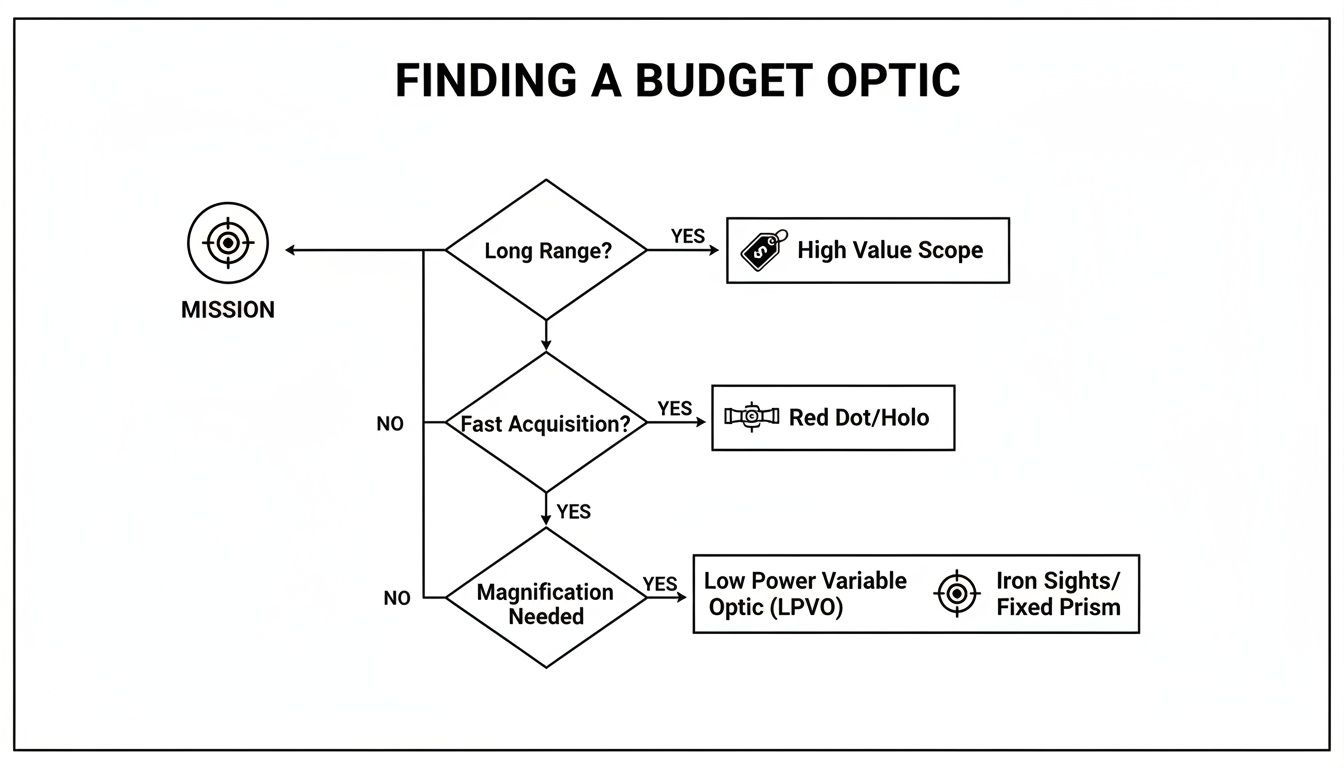
As you can see, the mission—whether it’s fast, close-in work or deliberate, long-range precision—drives your choice of reticle and magnification.
Reticles: The Language of Your Scope
Once you can see your target clearly, you need a way to aim. That's the job of the reticle, which is the aiming pattern etched into the glass. It’s more than just a simple crosshair; it’s the language your scope uses to tell you where your bullet will go.
You’ll mainly run into two types in the budget world:
- BDC (Bullet Drop Compensator) Reticles: Think of a BDC as a pre-made cheat sheet for a specific ammo type. It has aiming points that line up with bullet drop at set distances like 200, 300, and 400 yards. They are incredibly fast and intuitive, making them a favorite for hunters who need to make a quick shot without messing with dials.
- MOA/MIL Reticles: These are the universal ruler of the shooting world. Using Minutes of Angle (MOA) or Milliradians (MIL), these grid-style reticles let you measure distance and precisely account for wind and bullet drop for any load. If you want to push your range and make surgical shots, a MIL or MOA reticle is a must-have.
Here's the bottom line: A BDC is built for speed and simplicity. A MOA/MIL reticle is built for ultimate precision and flexibility. One isn't better than the other, but one will absolutely be better for you.
We dive much deeper into these aiming systems in our complete guide on understanding scope reticle types.
Magnification: Finding the Sweet Spot
Finally, let's talk about magnification. It's easy to get caught up in chasing big numbers, but more is not always better, especially on a budget. Building a scope with a massive magnification range, like a 1-10x, is incredibly difficult and expensive to do well. With budget optics, the image at the highest magnification often gets dark, blurry, and has a very unforgiving "eye box," forcing you to hold your head in one perfect spot.
For most shooters, a versatile 1-6x or 1-8x Low Power Variable Optic (LPVO) is the true sweet spot. This gives you a true 1x setting for shooting with both eyes open up close—just like a red dot—while providing enough zoom to confidently identify and hit targets hundreds of yards away.
By focusing your budget on a scope with great glass and a solid reticle in this moderate magnification range, you’re paying for performance you can actually use in the real world.
Durability and Reliability: The Real Test of a Budget Optic
All the fancy glass and tactical features in the world mean absolutely nothing if your scope can't take a hit. A scope that loses its zero after a minor bump or a few rounds of recoil isn't a tool—it's a liability. This is the ultimate test that separates a truly great budget scope from a cheap, frustrating paperweight.
Think about it. Your rifle might take a tumble down a rocky hillside on a hunt, or your carbine could get slammed against a door frame during a training drill. In those moments, you have to trust that your optic is still holding zero. It’s the one non-negotiable for any scope that’s going to see real-world use, regardless of its price tag.
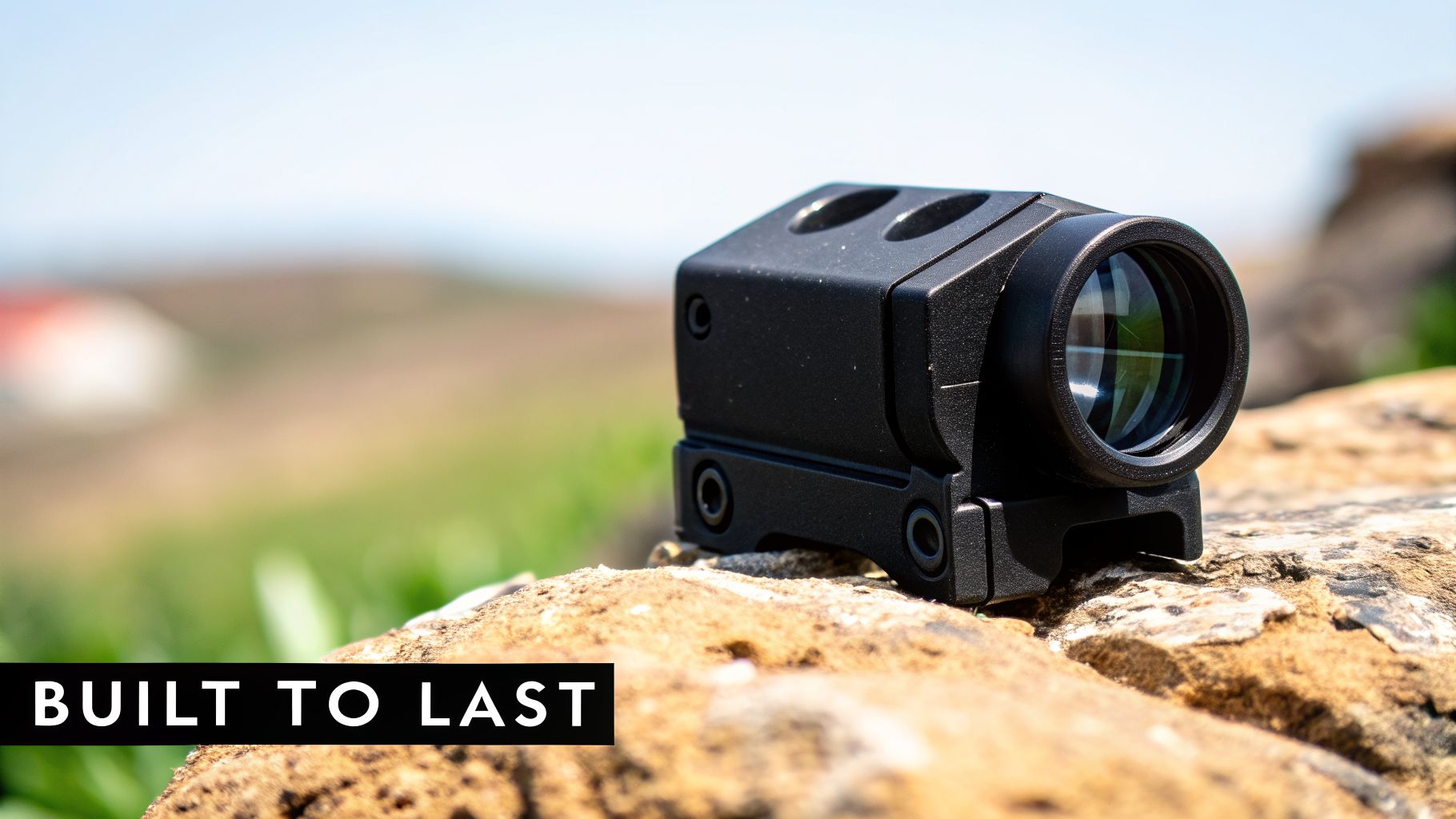
So, what tells you a budget scope is built to last? It all starts with the foundation—the main tube.
Look for Robust Construction
The gold standard here is a single-piece tube machined from a solid block of aircraft-grade aluminum. A one-piece body is inherently stronger because it has fewer seams and potential failure points than older, multi-piece designs. That strength makes it far more resistant to the shock from recoil and the inevitable bumps and drops in the field.
This kind of rugged build used to be reserved for high-end optics, but not anymore. The riflescope market is exploding—projected to hit USD 12.05 billion by 2031—and that competition is forcing manufacturers to offer premium features at budget prices. In fact, a 2023 review of over 1,200 tactical operators found that 88% preferred budget 3-9x scopes precisely because of their proven durability, having survived everything from hard drops to extreme temperatures ranging from -20°F to 140°F. You can dig into the market data driving this trend over at Mordor Intelligence.
Once you've confirmed the external build is solid, you need to look inside. A tough exterior doesn't mean much if the internals can't handle the elements.
A scope’s internal integrity is just as important as its external toughness. A compromised seal can render an optic useless faster than a hard drop.
When you're scanning spec sheets, keep an eye out for these terms. They are your proof of all-weather reliability.
- Waterproof: The scope needs to be O-ring sealed to keep moisture out. Today, even many budget scopes have an IPX7 rating, which means they can be fully submerged in a meter of water for 30 minutes and come out just fine.
- Fog-proof: This is all about nitrogen purging. The factory sucks all the normal, humid air out of the scope and replaces it with an inert gas like nitrogen or argon. Since inert gas has zero moisture, the inside of your lenses won't fog up when you go from a warm truck into the cold mountain air.
- Shockproof: This is a promise that the internal components, especially the delicate reticle and lens assemblies, have been reinforced to handle the violent, repeated shock of recoil from even heavy-hitting calibers.
By focusing on a single-piece tube and confirming the optic is fully sealed and gas-purged, you can feel confident that your investment is built to survive the realities of hard use. That’s how you find a scope that isn’t just affordable, but genuinely dependable.
How To Navigate Turrets and Adjustments
Those knobs on top and on the side of your scope? Those are your turrets. They’re the heart of your scope's adjustment system, letting you move your point of impact up and down (elevation) or left and right (windage). Mastering them is what separates a lucky shot from a well-placed one.
On budget-friendly scopes, you’ll typically find two main flavors: capped turrets and exposed tactical turrets.
-
Capped Turrets: Think of these as your "set-it-and-forget-it" controls. You dial in your zero at the range, then screw the protective caps on tight. The whole point is to prevent a bump in the woods or a jostle in your truck from throwing off your zero. For a deer rifle or a general-purpose carbine, this is exactly what you want—total reliability.
-
Exposed Tactical Turrets: These are built for shooters who make adjustments on the fly. Instead of holding over with your reticle, you can dial your exact drop and wind for a long-range shot. This gives you immediate, precise control, which is a must-have for long-range hunters, competition shooters, and tactical users.
What to Look for in Your Turrets
Don't judge a turret by its looks. Its true value lies in how it feels and performs. Even on a budget scope, you're looking for clicks that are crisp, audible, and tactile. Each click should have a distinct snap, letting you feel and hear the adjustment without ever taking your eye off the target.
Mushy, silent clicks are a huge red flag. They make it incredibly easy to get lost in your adjustments or dial past your intended mark. Thankfully, even some of the best budget scopes today have turrets that feel like they belong on optics costing five times as much.
The real test of a scope's mechanical soul is whether it can "track" and "return to zero." Can you dial up 20 clicks for a 500-yard shot, take it, and then dial back down exactly 20 clicks to find your original 100-yard zero waiting for you? If not, the scope’s internal mechanics are junk, and you can’t trust it.
A scope that can't pass this simple test is a liability, not a tool. It's the critical difference between a scope that works with you and one that works against you every time you pull the trigger.
How To Mount and Zero Your New Scope Properly
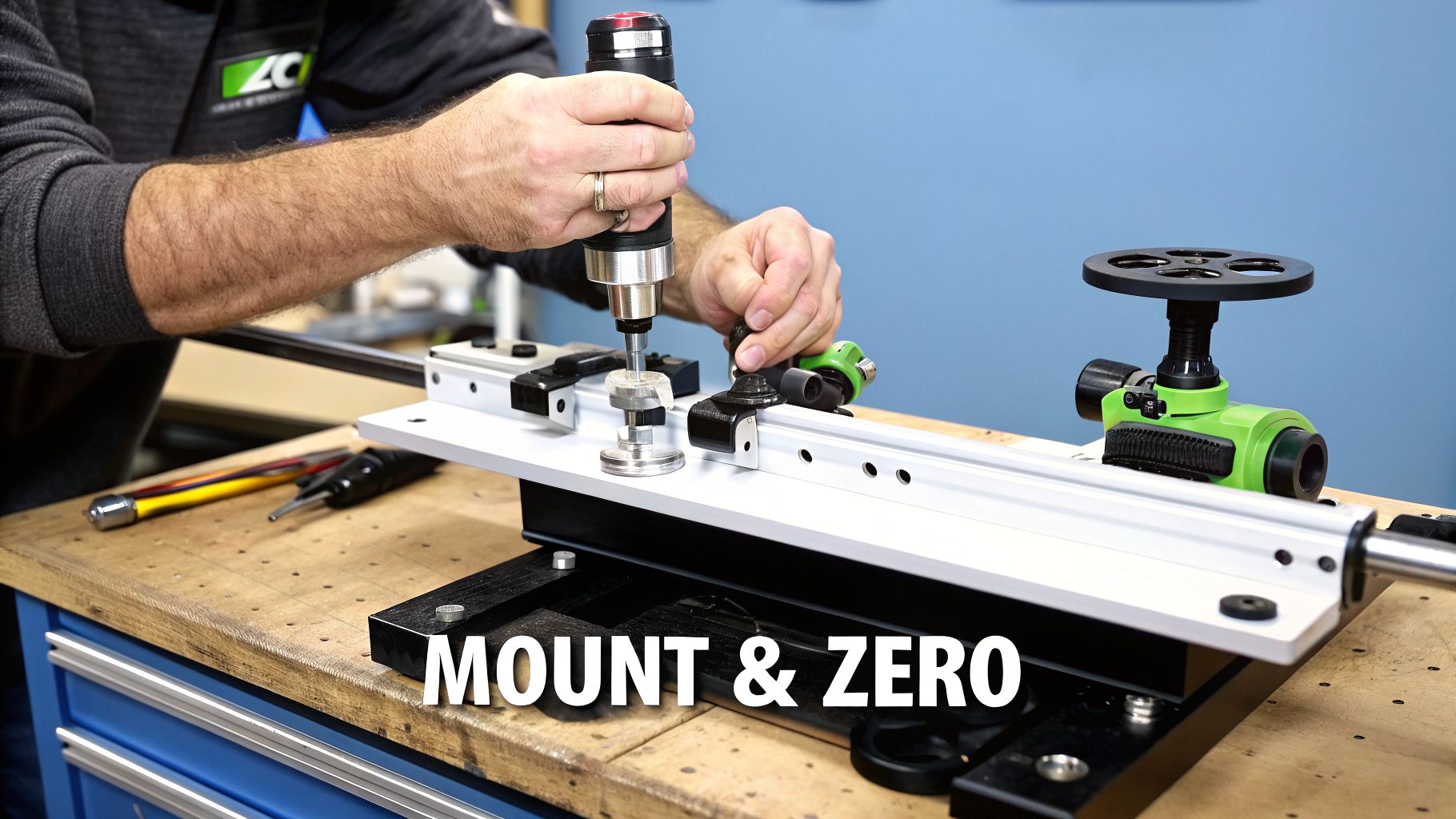
So, you've got your new optic. Great. But here's a hard truth: the best scope in the world is completely useless if it isn't mounted securely and zeroed with precision. This is the step where a great rifle system is either made or broken.
Let's start with the connection point—the scope rings and mount. Think of them as the foundation of your house. Skimping here is a classic rookie mistake that will absolutely ruin your accuracy. Make sure your rings are the right diameter for your scope (1 inch or 30mm are most common) and tall enough for the objective lens to clear your rifle’s barrel.
The Mounting Process Step by Step
Mounting a scope is a deliberate process, not a race. Take your time, do it right, and your rifle will reward you.
- Secure the Base: First, get your mount or scope base locked onto the rifle’s receiver. This is where a torque wrench becomes your best friend. Follow the manufacturer’s specs, which are usually around 25-30 inch-pounds. Uneven pressure here can introduce accuracy-killing stress.
- Find Your Eye Relief: Place the scope into the bottom half of the rings but leave everything loose. Now, shoulder the rifle and close your eyes. Settle into a comfortable, natural cheek weld. When you open your eyes, you should see a perfect sight picture. If not, slide the scope forward or back until the image is full and clear without you having to strain your neck. That’s your spot.
- Level the Reticle: This is absolutely critical. A canted, or tilted, reticle will cause your shots to drift left or right at longer ranges, even if you do everything else right. A good leveling kit with bubble levels for both your rifle and the top of your scope is the best way to get it perfectly vertical.
- Torque the Rings: With everything perfectly aligned, it's time to tighten the ring caps. Do this in a crisscross or star pattern, like tightening lug nuts on a car tire, to ensure even pressure. Stick to the manufacturer's torque spec (often 15-18 inch-pounds) and don't be tempted to overtighten. You can easily crush a scope tube and destroy the delicate internals.
A correctly mounted scope should feel like a natural part of the rifle. Nothing should wiggle or shift. When you bring the rifle up to your shoulder, the view through the scope should be instantly clear and perfectly level.
Zeroing for Peak Performance
With the hardware locked down, it's time to get on the range and zero your rifle. Don't start at 100 yards and waste a box of ammo chasing your impacts. Be smart and start close.
A 25 or 50-yard "bore sight" or initial zero is the way to go. This gets you on paper quickly, allowing you to make big, coarse adjustments to get your shots near the bullseye. If you're new to rail systems and want to get that part right first, take a look at our guide on the best Picatinny rail scope mounts.
Once you're dialed in at close range, move back to 100 yards. Here, you'll make the final, fine-tuned adjustments. This process confirms your rifle is dead-on, giving you the unshakeable confidence you need to make the shot when it matters most.
Answering Your Top Questions About Budget Scopes
Alright, we've covered a lot of ground. But I know from experience that a few key questions always surface right before you're ready to make a final decision. Let's tackle those common concerns head-on with some straight-shooting answers.
Is a Lifetime Warranty Necessary for a Budget Scope?
Let's cut right to it: yes. Don't think of a lifetime warranty as just another feature on a spec sheet; it's your safety net. It’s the manufacturer’s vote of confidence in their own work.
When a company offers a solid, no-nonsense warranty, they are telling you they trust their craftsmanship to handle real-world use. This protects your hard-earned money from factory defects or unexpected failures, giving you the peace of mind that your optic will stay a dependable part of your kit for years. For any serious shooter, it’s a non-negotiable part of picking the best budget scope.
Will a Budget Scope Hold Zero on a High-Recoil Rifle?
This is a huge concern, and a valid one. The good news is, yes—a well-made budget scope from a trusted brand will absolutely hold zero. The days of cheap optics falling apart on anything bigger than a .22 are long gone.
The secret is choosing a scope built with a sturdy, one-piece tube and checking its recoil rating. Modern budget optics are engineered to handle the punch of common rounds like the .308 Winchester or 6.5 Creedmoor.
Are Illuminated Reticles Worth the Extra Cost?
For most of us—especially hunters and tactical shooters—the answer is a definite yes. An illuminated reticle isn't a gimmick; it’s a critical tool for low-light situations. It makes your aiming point pop against a dark target or a shadowy treeline at dawn or dusk.
That tiny bit of light can be the difference between a clean, confident shot and a complete miss. In the budget category, this is often one of the smartest upgrades you can make, giving you a serious edge in target acquisition when every second counts.
At Superior Tactical LLC, we're shooters ourselves. We specialize in mission-ready optics and gear that we've vetted for reliability and performance. Find the right fit for your rifle by exploring our hand-picked selection of scopes and tactical accessories at https://superiortac.com.
