The Best Budget Night Vision Monocular A Complete Buyer’s Guide
When you're searching for the best budget night vision monocular, you'll quickly realize it’s a game of trade-offs. The main players are digital, Gen 1, and occasionally, refurbished Gen 2 units. For those keeping the budget under $500, the top-tier digital options often deliver the most bang for your buck. Your perfect match really boils down to how you weigh cost against practical performance—things like image clarity, how far you can see, and whether the device needs an IR illuminator to work well.
Your Guide to Affordable Night Vision
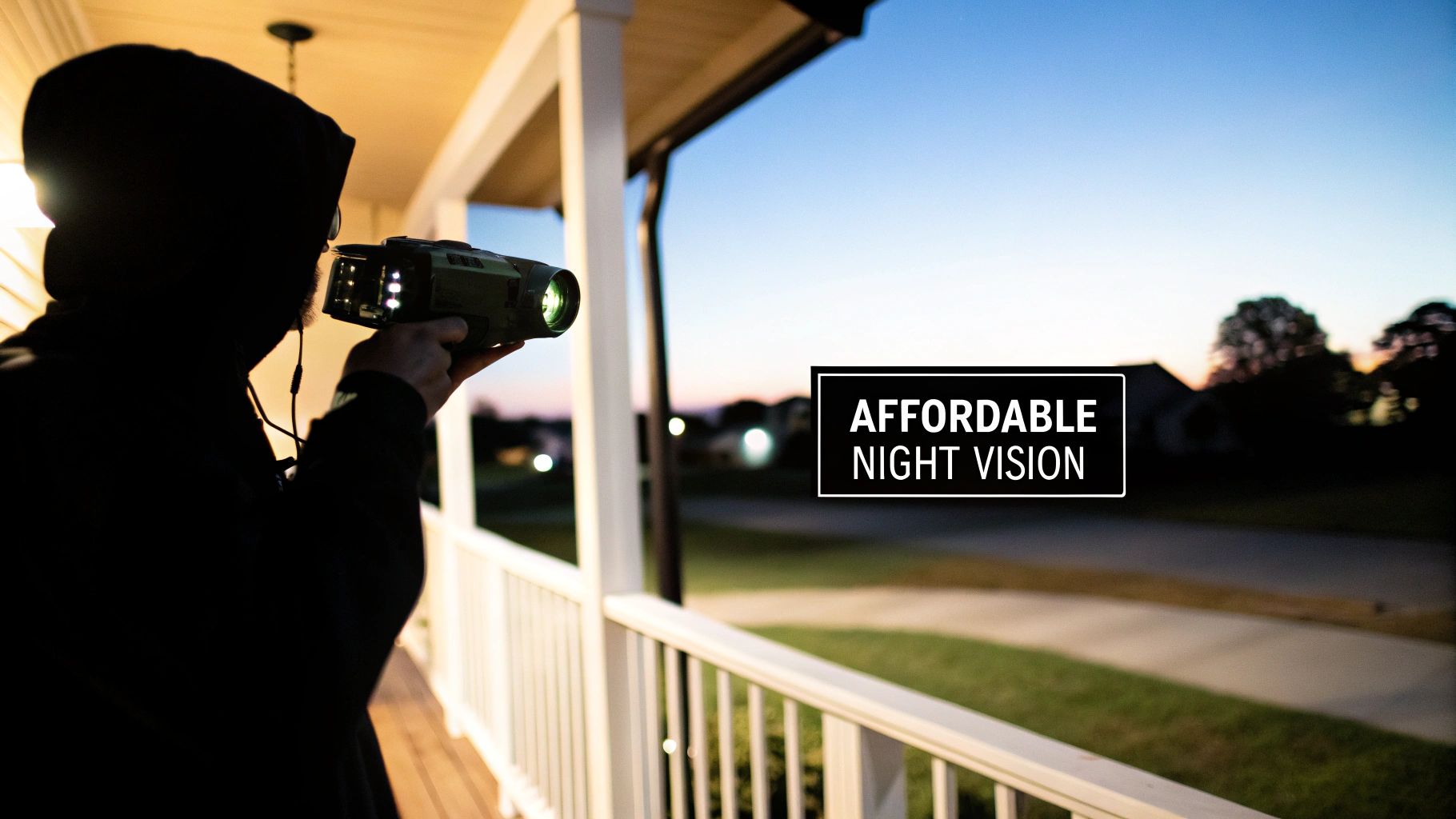
Dipping your toes into the night vision world can feel overwhelming, especially when you're trying to find quality gear without breaking the bank. A lot of people assume "affordable" is just another word for "junk," but that couldn't be further from the truth. The real secret is knowing what you're actually getting for your money at different price points.
The goal is to match the technology to your mission, whether that’s keeping an eye on your property, watching for wildlife, or finding your way down a trail after sunset. This guide is here to help you cut through the marketing noise and confusing specs. We’ll focus on the real-world trade-offs you’ll have to consider when picking an entry-level monocular.
Defining Your Night Vision Needs
Before you even start looking at specs, you have to figure out what you really need. A monocular for spotting raccoons in the backyard has totally different requirements than one for serious predator hunting or land navigation. Knowing your goals is step one. For a deeper dive, our guide on budgeting for night vision and finding the right balance can help you set some realistic expectations.
In the budget-friendly arena, you're primarily looking at three types of technology:
- Digital Night Vision: Think of these as highly sensitive, low-light cameras. They often come with cool features like video recording and can even be used during the day. Their one major crutch is a heavy reliance on an IR illuminator when it gets truly dark.
- Generation 1 (Gen 1): This is the classic, old-school analog tech. It actually amplifies ambient light, but it’s known for having some "fisheye" distortion around the edges and a much lower resolution than newer gear.
- Refurbished Generation 2 (Gen 2): Here’s where you get a serious jump in performance. A refurbished Gen 2 unit offers a dramatically clearer, brighter image that's worlds away from Gen 1. Going refurbished can put this higher-end performance within a manageable budget.
The most critical choice you'll make isn't just about the price tag—it's about the core technology. A top-of-the-line digital monocular can easily outperform a cheap Gen 1, but a good refurbished Gen 2 unit will likely blow them both out of the water.
Here’s a quick breakdown to get you started.
| Technology | Typical Price Point | Strengths | Weaknesses |
|---|---|---|---|
| Digital | $100 – $600 | Recording, daytime use, clear image with IR | Heavy IR reliance, potential screen lag |
| Gen 1 Analog | $200 – $500 | True light amplification, no screen lag | Image distortion (fisheye), lower resolution |
| Refurbished Gen 2 | $700 – $1,500+ | Superior clarity & brightness, low-light performance | Higher cost, potential for minor tube blemishes |
Once you get a handle on these fundamental differences, you'll be in a much better position to judge which device offers the best return on your investment. We’ll walk you through everything you need to know to make sure the monocular you choose is the right one for the job.
Getting a Handle on Night Vision Generations and Key Specs
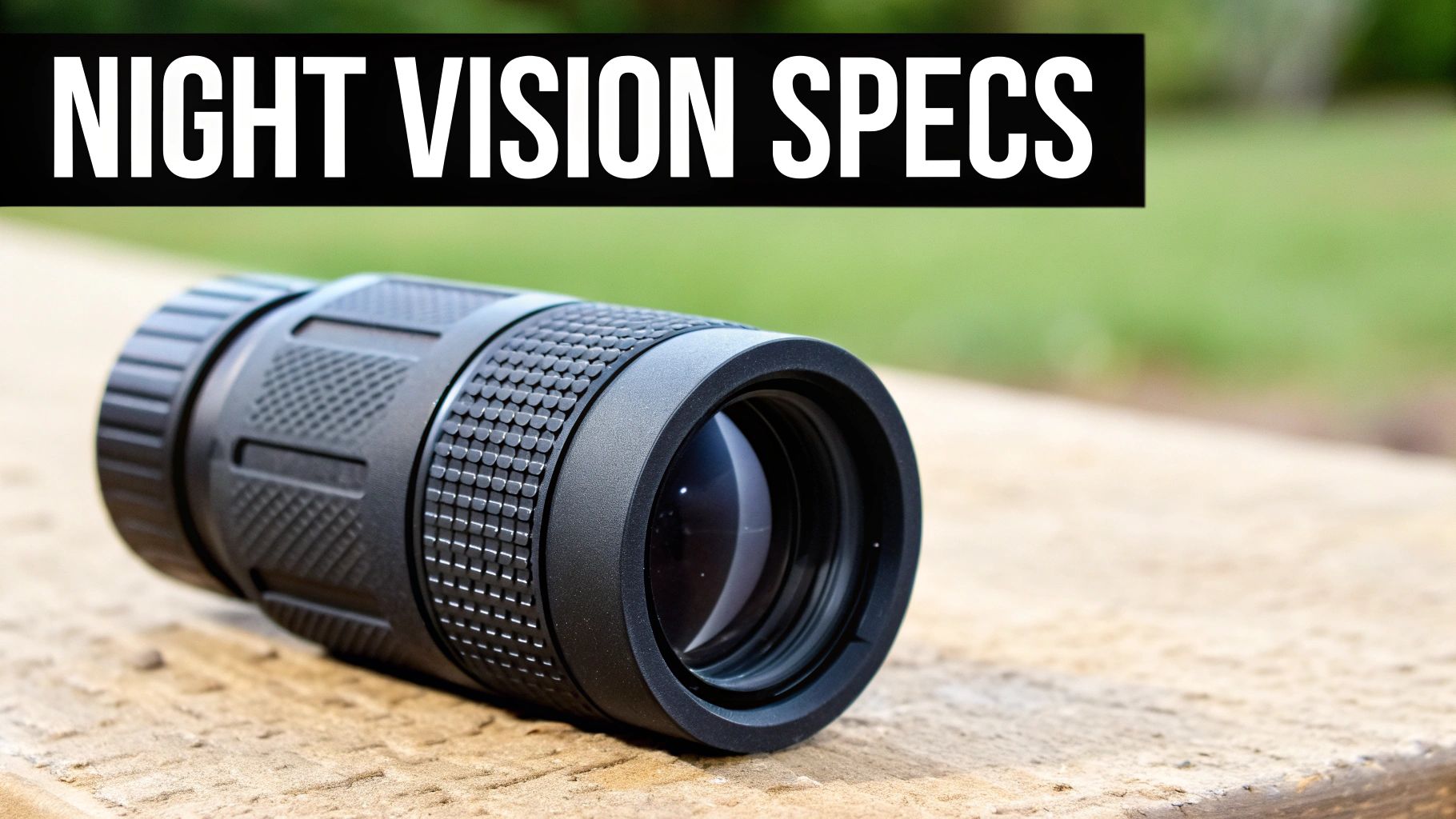
To find the right budget night vision monocular, you have to know what’s going on under the hood. The performance, limitations, and price tag are all directly tied to the core technology inside the unit. So, let’s get you speaking the language of night vision—specifically, "generations" and key specs.
Knowing this stuff is what separates a smart purchase from a disappointing one. It lets you see past the marketing jargon and understand what you’re really getting for your money. In the budget world, you'll mainly run into three types: Digital, Generation 1 (Gen 1), and sometimes, refurbished Generation 2 (Gen 2). Each has its own way of working and its own set of real-world trade-offs.
It's a good time to be in the market. The global night-vision device market was valued at around USD 7.02 billion in 2022 and is expected to hit USD 16.32 billion by 2030. Much of that growth is in compact monoculars, which means more affordable options are hitting the shelves. You can easily find new digital or Gen 1 units in the $100–$400 range. For more on these trends, you can read the full industry analysis on Grand View Research.
The Core Technologies: Digital vs. Analog
First things first, digital and analog (Gen 1, Gen 2) night vision are two completely different animals. Digital units are essentially highly sensitive cameras. They capture light on a sensor and then display the image for you on a tiny internal screen, like a camcorder's viewfinder.
Analog units, on the other hand, are the "real deal." They use an image intensifier tube to take the tiny amount of ambient light available and amplify it thousands of times. This fundamental difference creates a totally distinct user experience. For example, a digital monocular might have a barely noticeable screen lag when you pan your head quickly, but it can also record video. A Gen 1 analog unit gives you a true, "live" feed with zero lag, but the image will almost always have some "fisheye" distortion around the edges.
The Bottom Line: Digital night vision processes an electronic image to let you see in the dark. Analog night vision amplifies existing light. This is the single most important distinction you need to grasp when evaluating how a budget device will actually perform in the field.
Comparing the Generations
Each "generation" marks a major leap in technology and performance. While Gen 3 is the gold standard for military use, you won't find it in the budget category unless it's extremely well-used.
- Digital: This is your entry point. The biggest advantage is versatility—you can often use them in daylight without causing damage. The downside? Their performance in true darkness depends entirely on a built-in IR illuminator. Without it, they're mostly blind.
- Generation 1: The original analog technology. Gen 1 provides genuine light amplification, but it comes with classic limitations like lower resolution, visual "snow" (scintillation), and that edge distortion I mentioned. It's a great, affordable way to experience how true analog systems work.
- Generation 2: A huge step up. Gen 2 tubes produce a much clearer, brighter, and more detailed image with way less distortion. While new Gen 2 units are pricey, a refurbished one can be a smart buy. It often delivers optical performance that blows a new Gen 1 out of the water, giving you more bang for your buck.
To really dig into the nitty-gritty of these technologies, we've put together a more in-depth guide. You can learn more about the differences between night vision generations and see how they stack up in the real world.
What the Specs Actually Mean for Performance
Beyond the generation, a few key numbers on the spec sheet will tell you what a monocular is truly capable of. Understanding these helps you cut through the noise and compare apples to apples.
| Specification | What It Measures | Real-World Impact |
|---|---|---|
| Resolution (lp/mm) | Line Pairs per Millimeter | Think of this as image sharpness. A higher number, like 64 lp/mm, means you can make out finer details from farther away—telling the difference between a coyote and a stump, for example. |
| Signal-to-Noise (SNR) | Ratio of light signal to background noise | This is all about image clarity in very low light. A high SNR gives you a clean, less "grainy" picture, making it easier to see what's out there on a moonless night. |
| Figure of Merit (FOM) | Resolution x SNR | This is a single score that sums up the overall performance of an intensifier tube (mostly for Gen 2 and Gen 3). A higher FOM simply means a better-performing tube. |
You won't see FOM listed for most budget digital or Gen 1 units, but paying attention to resolution and SNR is critical. A digital device might claim a high-resolution sensor, but if it needs a powerful IR illuminator to see anything, its functional SNR is terrible. On the flip side, a good Gen 2 tube will have a high native SNR, letting it pull in a clear image using just the faintest starlight.
Putting Budget Monoculars to the Test: Real-World Scenarios
Specs on a page are one thing, but how a budget night vision monocular performs in the field is what truly matters. To really get a feel for the practical differences, let's step away from the spec sheet and drop these devices into a few real-world situations. This is where the trade-offs really come to light.
We'll look at three common scenarios to highlight the strengths and weaknesses of Digital, Generation 1, and refurbished Generation 2 monoculars. Each use case has different demands, proving that the "best" choice is always about matching the tool to the job.
Scenario 1: Backyard and Property Surveillance
Let’s say you need to keep an eye on your backyard or a small property. The goal is simple: spot potential threats, maybe document what’s been getting into the chicken coop, and do it all from a fixed spot like your back porch. We're talking relatively short distances here, typically under 100 yards.
For this kind of static security, a quality Digital Night Vision monocular is tough to beat. Its killer feature? The ability to record video. If you spot something suspicious, having that footage is invaluable evidence.
Here, the built-in IR illuminator—often a liability in other situations—becomes a huge advantage. You aren't worried about being seen by someone else with night vision, so you can blast the IR on full power and light up the entire area. This gives you a surprisingly crisp digital image that’s easy to see and record.
A Gen 1 unit would get the job done, but the image would be fuzzier, and you'd lose the recording capability. A refurbished Gen 2 would offer a fantastic view, but it's probably overkill, and you'd still need extra gear to capture any footage. For simple, short-range security, the practical features of a digital unit offer the most bang for your buck.
Scenario 2: Casual Wildlife Observation
Now, let's switch gears. Imagine you’re a nature lover who wants to watch nocturnal animals. Maybe you’re hiking a familiar trail at dusk or sitting quietly, hoping to see deer, owls, or foxes. Your main goal is simple observation at moderate distances, without disturbing the wildlife.
This is the classic scenario where a Generation 1 monocular truly comes into its own. It provides genuine light amplification, letting you see in the dark without projecting an IR beam that could spook a wary animal. That iconic "green glow" and the slight fisheye effect are all part of the authentic analog experience.
A Gen 1 device also forces you to learn how to work with the available ambient light from the moon and stars—a crucial skill for using any night vision device effectively. While its range and clarity are modest, it’s often more than enough to spot movement and identify animals within 50 to 75 yards on a moonlit night.
The real difference here is the viewing experience itself. A digital monocular shows you an image on a tiny screen, which can feel a bit disconnected. A Gen 1 analog unit offers a direct, amplified view through the tube, creating a much more immersive and natural feel, even with its optical imperfections.
A digital unit's need for IR is a major drawback here, as the faint red glow from the illuminator is visible to some animals. While a refurbished Gen 2 would perform beautifully, the higher price might be hard to justify for casual wildlife watching. Gen 1 hits that perfect sweet spot between affordability and core analog performance.
Scenario 3: Nighttime Navigation and Hunting
Finally, let's look at a much more demanding situation: moving across uneven terrain in the dark or stalking predators. In this case, your safety and success hinge on having clear, reliable vision. You need to spot trip hazards, move silently, and positively identify a target against a cluttered background.
This is where a refurbished Generation 2 unit proves its worth. The jump in performance from Gen 1 to Gen 2 is massive. A Gen 2 image intensifier tube delivers a view that is dramatically brighter, sharper, and flatter, with very little of the distortion you see in Gen 1. This level of optical quality isn't a luxury; it's a necessity.
When you're on the move, the clean image from a Gen 2 device significantly reduces eye strain and helps you maintain situational awareness. For hunting, its higher resolution (often 45-54 lp/mm) and superior signal-to-noise ratio allow for positive target ID at ranges well beyond 150 yards. That clarity is absolutely critical for making a safe, ethical shot. Our guide on the top features to look for in a quality night vision monocular dives deeper into why these specs are so important for serious tasks.
A Gen 1 unit would be a source of constant frustration here, held back by its poor range and distorted view. A digital unit would be a non-starter; the screen lag can be disorienting when you're moving, and firing up its powerful IR illuminator would announce your position to every animal in the county. For any serious application where performance is non-negotiable, a refurbished Gen 2 is the smartest investment.
To make things even clearer, let's boil down the strengths of each technology for these scenarios.
Budget Night Vision Technology Comparison
This table gives a quick overview of how Digital, Gen 1, and entry-level Gen 2 stack up for someone just getting into night vision. Think of it as a starting point to help you figure out which technology aligns best with your needs and budget.
| Technology | Typical Price Range | Best Use Case | Key Advantage | Primary Limitation |
|---|---|---|---|---|
| Digital | $100 – $500 | Short-range property surveillance | Video recording & low cost | Heavy reliance on IR illuminator |
| Gen 1 | $200 – $600 | Casual wildlife observation | True passive night vision, affordable | Image distortion & limited range |
| Refurbished Gen 2 | $1,000 – $1,800 | Navigation, hunting, serious use | Excellent clarity and performance | Higher entry cost |
Ultimately, this comparison shows there's no single "best" budget option. The right choice depends entirely on how you plan to use it. A digital unit excels at static observation with its recording features, Gen 1 offers an affordable entry into true analog night vision for hobbyists, and a refurbished Gen 2 unit provides the serious performance needed for more demanding activities.
Matching Your Monocular to Your Mission
Let's get one thing straight: there's no single "best" budget night vision monocular. The real goal is to find the right tool for your specific job. The device that's perfect for scanning your property line is going to be completely different from the one you'd use for hiking a dark trail or tracking a coyote.
If you can clearly define your main reason for wanting night vision, you can cut through all the confusing specs and focus on what actually matters. We'll break it down into three common scenarios to help you find the most effective and affordable solution for what you need to do.
This little decision tree can help you figure out where to start.
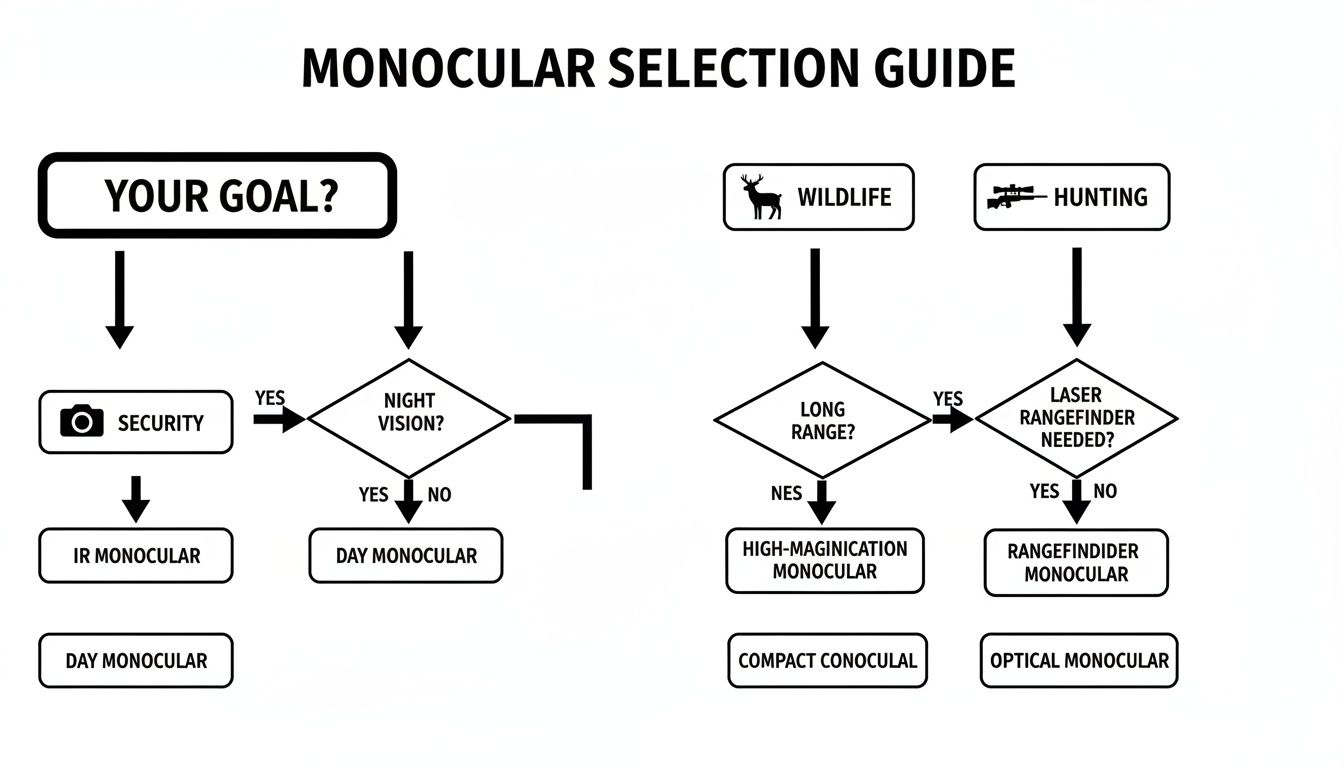
As you can see, your primary objective points you toward a specific type of technology. Let's dig into why.
The Homesteader and Prepper
When you’re focused on security and preparedness, your mission is simple: reliable perimeter monitoring and, if needed, evidence collection. You need to know what's going bump in the night on your land, whether it’s a raccoon in the trash or something more serious. Your engagement distances are usually fixed and relatively close, often under 100 yards.
For this job, a quality Digital Night Vision monocular is tough to beat. Its biggest advantage is the ability to record video and snap photos. Sometimes, documenting an incident is just as important as seeing it happen. Digital units lean heavily on their built-in IR illuminators, which is actually a plus here. You can blast an area with invisible infrared light for a super clear image without alerting anyone who isn't equipped with night vision.
- Recommended Technology: Digital
- Why It Works: Recording capability is huge for documentation. The powerful IR light is perfect for a fixed area like a backyard, and the fact that you can use it during the day adds a ton of value.
- Key Takeaway: For static surveillance where evidence is a priority, digital gives you the most practical bang for your buck.
The Outdoor Adventurer and Wildlife Observer
If you're more interested in hiking, camping, or watching nocturnal animals, your needs change completely. You're looking for something lightweight, simple to operate, and that lets you see without disturbing the very nature you came to enjoy. It's about the experience, not just looking at a screen.
This is where a Generation 1 analog monocular really shines. It offers true light amplification, taking what little ambient light is available from the moon and stars and making it visible. This passive approach means you aren't sending out a beam of IR light that will send every animal for miles running. Gen 1 has its quirks, like some distortion around the edges, but it's an authentic and affordable gateway into the world of analog night vision.
The feel of using a Gen 1 unit is just more organic than staring at a digital display. You're seeing a directly amplified version of the world, which makes you feel more connected to your surroundings.
- Recommended Technology: Generation 1
- Why It Works: It works passively without a spook-prone IR illuminator, is usually light, and is an inexpensive way to get into real light amplification.
- Key Takeaway: For casual observation and finding your way in the dark, Gen 1 is the best balance of price and core performance.
The Night Hunter
For the serious night hunter, performance is everything. Your needs are the most demanding of all: positive target identification at range, a clear image while you're on the move, and the ability to tell an animal apart from a tree stump. An ethical hunt and your safety depend on absolute clarity.
In the budget-friendly space, a refurbished Generation 2 monocular is the only logical move. The jump in image quality from Gen 1 to Gen 2 is massive. A Gen 2 tube gives you a significantly brighter, sharper, and cleaner image with far less distortion, letting you see critical details from 150 yards out and beyond.
That level of clarity is non-negotiable for identifying your target and making sure you have a safe backstop. A Gen 1 unit is dangerously insufficient for this task, and a digital monocular’s screen lag and total reliance on IR make it a poor choice for stalking live game. Putting your money into a refurbished Gen 2 device is an investment in the performance you need for a safe and successful hunt.
- Recommended Technology: Refurbished Generation 2
- Why It Works: It delivers the superior image clarity, resolution, and low-light performance needed for positive target ID at a distance.
- Key Takeaway: When performance is directly tied to safety and success, the optical horsepower of a Gen 2 tube is a necessary investment.
Thinking Beyond the Price Tag: Warranty and Long-Term Support
The sticker price on a budget night vision monocular is just the beginning of the story. To figure out the real cost, you have to think about the total cost of ownership over the life of the device. That means looking past the initial price and seriously considering the warranty, repair options, and customer support.
This might seem like a concern for high-end gear, but it's arguably even more crucial when you're buying on a budget. When every dollar counts, an unexpected failure can turn a good deal into a very expensive paperweight. A solid warranty is your first line of defense, protecting your investment from the get-go.
This is how the pros think. For a lot of them, a solid warranty and the ability to get a unit fixed quickly matters more than the initial cost. In North America, which accounts for about 40% of the night vision market, warranties can be all over the place—from a single year on consumer digital units to a full ten years for top-tier Gen 3 tubes. Having access to in-house repairs and free diagnostics can cut the total cost of ownership by 10–25% over five years, mostly by keeping your gear in the field and out of the repair shop. For a deeper dive into these industry standards, check out this market analysis on night vision devices.
Why a Strong Warranty Is So Critical
A warranty isn't just a document; it's a direct statement from a company about how much they believe in their own product. For a budget monocular, a good warranty that covers the important stuff—especially the image intensifier tube or digital sensor—adds a ton of value.
When you're comparing your options, get into the details of the warranty terms.
- Duration: How long are you covered? One year is pretty standard for budget electronics, but you'll find that reputable sellers often offer more.
- Coverage Scope: What, exactly, is covered? Is it just manufacturing defects, or does it include some level of wear and tear? Pay close attention to what's excluded.
- Process: If something does go wrong, how much of a headache is it to file a claim? A convoluted process is the last thing you want to deal with when your gear is down.
A strong warranty from a U.S.-based company like Superior Tactical just makes life easier. If you run into an issue, you’re talking to a team right here in the States that knows the product inside and out. That means faster resolutions without the logistical nightmare of international shipping and communication.
The Value of In-House Repair and Diagnostics
What happens after the warranty runs out? This is where the real separation happens. Many overseas sellers or big-box retailers offer zero support once that warranty period is over. If your device breaks, your only choice is to buy a new one, which instantly doubles what you spent.
This is exactly why choosing a specialized retailer with its own technicians is such a smart move for long-term value.
Benefits of In-House Support:
- Free Diagnostics: A good shop can look at your device without charging you, tell you what's wrong, and give you a quote for the fix. That lets you make an informed decision instead of just guessing.
- Less Downtime: Sending a unit back to an overseas manufacturer can literally take months. A U.S.-based repair center can often turn it around in a fraction of that time.
- Real Expertise: You're dealing with technicians who work on this gear every single day. They know the common issues, have the right tools, and have the parts to do the job right.
At Superior Tactical, for example, we offer free, no-obligation diagnostics on any night vision device. Our in-house experts can quickly figure out what's going on, whether it's a simple power supply problem or a more serious tube issue, and give you a clear path to getting it fixed or even upgraded. This kind of service turns your purchase from a disposable gadget into a piece of equipment you can actually maintain.
At the end of the day, the best budget night vision isn't just the one that works out of the box—it's the one that keeps working for years. By making a strong warranty and expert support a priority, you're not just buying a tool; you're making a lasting investment.
Common Questions About Budget Night Vision
It's natural to have a few lingering questions when you're about to invest in night vision, even on a budget. Getting these last details sorted out is what gives you the confidence to pull the trigger on the right device. Let's walk through some of the most common things people ask before they buy their first monocular.
Think of this as your final pre-flight check. We'll cover everything from how to avoid accidentally frying your new gear to performance differences that really matter in the field.
Can I Use a Budget Night Vision Monocular During the Day?
This is probably the most important question for a new owner, and the answer is a hard "it depends" on what's inside the monocular.
For analog tubes—that means any Gen 1 or Gen 2 device—the answer is a firm no. The image intensifier tube is incredibly sensitive. Pointing it at a bright light source, especially daylight, will permanently burn the tube in seconds. You'll see black spots in your view forever, or worse, completely destroy it. The little pinhole cap they come with is only for a quick function test in a lit room, not for actual daytime use.
Digital night vision, on the other hand, is a different story. It operates more like a high-tech camera, and its sensor generally isn't harmed by bright light. Most digital units are perfectly safe to use during the day and will even show you a full-color image. Just be sure to double-check the manual for your specific model, but this versatility is a huge advantage for digital systems.
What Is an IR Illuminator and Do I Need One?
An IR (infrared) illuminator is basically a flashlight that emits light invisible to the human eye. Your night vision device, however, sees this light perfectly. This lets you light up a scene in total darkness without giving away your position.
Think of an IR illuminator as a stealthy spotlight. When there's zero ambient light—like inside a pitch-black building or out in the woods on a cloudy, moonless night—it's not just a nice-to-have. It's the only way you're going to see anything with most budget units.
Almost every digital and Gen 1 monocular has a built-in IR illuminator. They're handy for close-up tasks, but most are only effective out to about 75 yards. If you need to see farther, adding a more powerful, external IR illuminator is a game-changer. It can dramatically boost the range and brightness of what you can see.
Are There Legal Restrictions on Owning Night Vision?
Good news for most folks in the United States: owning night vision gear like Gen 1 and Gen 2 monoculars is perfectly legal. You can buy and use them for all sorts of things, from watching wildlife in your backyard to general security and navigation.
There are, however, two big rules to know. First, night vision falls under ITAR (International Traffic in Arms Regulations). This means taking or shipping a device outside the U.S. without a government license is a serious federal crime.
Second, many states have laws restricting or outright banning the use of night vision for hunting. These rules are all over the map, so it's on you to check your local and state hunting regulations before you ever think about using a device in the field.
How Much Better Is a Refurbished Gen 2 Than a New Gen 1?
The jump from Gen 1 to Gen 2 isn't just a small step—it's a massive leap in performance. While a brand new Gen 1 is a great way to get your feet wet with analog night vision, a good-quality refurbished Gen 2 unit is playing a completely different ballgame.
Here's what that difference looks like in the real world:
- Image Clarity: Gen 2 gives you a much sharper, cleaner image with way less of the "fisheye" distortion you see around the edges of a Gen 1 tube.
- Brightness and Range: A Gen 2 tube is way more efficient at gathering and amplifying existing light. You'll see a brighter picture in darker conditions and be able to spot things much farther away.
- Overall Value: A refurbished Gen 2 will cost more upfront than a new Gen 1, but the performance you get for your money is exponentially better. If you need gear you can truly rely on for more serious applications, it's the smarter buy.
At Superior Tactical, we know that choosing the right gear is a mission-critical decision. Our team is here to provide expert guidance and long-term support to ensure your equipment is always ready. Explore our curated selection of night vision and tactical optics to find the perfect solution for your needs at https://superiortac.com.
