Finding the Best Budget Night Vision in 2026
If you're looking for affordable night vision, your best bet is to focus on modern digital units and some of the more accessible Gen 2 devices. For under $1,000, you can get into a capable system like the Good Nite Gear NVG50 or a Sightmark Wraith. These are fantastic entry points for hunting, securing your property, or just navigating the outdoors after dark, all without the steep investment of high-end analog systems.
Finding Quality Night Vision Without Breaking the Bank

It’s easy to get sticker shock when you see the price of top-tier night vision. But the old idea that "budget" automatically means "useless" is completely outdated. Today's market has some seriously impressive gear that gives you a major advantage in the dark.
This guide is all about helping you find that sweet spot. We'll show you how to get your hands on a reliable night vision system for hunting, security, or preparedness without having to drain your bank account. You’ll see just how far the technology in digital and even some Gen 2 systems has come.
Navigating the Budget NVG Landscape
The key to finding the best budget night vision is matching the gear to your specific mission. There's no single "best" unit. A digital scope that’s perfect for stationary hog hunting from a blind isn't necessarily the right tool for moving through the woods on foot, where a monocular with a wide field of view is far more important.
To get started, let’s break down the two main technologies you'll encounter in the budget-friendly space.
| Feature | Digital Night Vision | Generation 2 (Analog) |
|---|---|---|
| Technology | CMOS sensor and digital screen | Image intensifier tube |
| Light Conditions | Excellent with an IR illuminator | Better in passive (no IR) use |
| Key Advantage | Recording, multiple color modes | A more organic, lag-free image |
| Durability | Not damaged by bright light | Can be damaged by bright light |
| Typical Cost | $400 – $1,200 | $1,500 – $3,000+ |
As you can see, digital devices pack in a ton of features for the money. The ability to record video and use the device during the day without fear of damage is a huge plus, especially for beginners. On the other hand, an entry-level Gen 2 unit delivers a much cleaner image in near-total darkness without needing a built-in infrared (IR) illuminator—which is a big deal if you don't want to be seen by others using night vision.
Expert Insight: For most people just getting into night vision, a good digital monocular or scope is the most practical choice. The versatility is hard to beat. Being able to record what you see and not having to worry about accidentally pointing it at a bright light makes it a very forgiving tool.
Getting a handle on these differences is the first real step. From here, you can start digging into the specs that actually matter, compare a few top models side-by-side, and make a choice you'll be happy with. If you need more help planning the financial side of things, our article on budgeting for night vision and finding the right balance is a great resource.
Consider this your guide to owning the night without going broke. We'll give you the practical advice you need to get the most performance for your dollar.
Understanding Night Vision Generations and Technology
Jumping into the world of night vision can feel overwhelming. You’re hit with terms like "Gen 1," "Gen 2," and "Digital," and it's not always clear what the real-world differences are. Let's cut through the jargon and focus on what these technologies actually mean for what you'll see in the dark.
It’s a bit like buying a vehicle. You can get a simple, reliable daily driver that gets you from A to B, or you can spring for a high-performance machine built for the racetrack. Each has its place. Night vision generations work the same way, with every step up in "Gen" bringing a serious boost in clarity, low-light performance, and, of course, price.
Generation 1: The Starting Point
Generation 1 (Gen 1) is where it all begins and is by far the most affordable entry into analog night vision. These units use a basic image intensifier tube that amplifies available light. However, they're incredibly light-hungry, needing either a bright moon or a powerful built-in infrared (IR) illuminator to give you a decent picture.
You'll know a Gen 1 unit when you see through one. They typically have a "fish-eye" distortion around the edges of the image and often produce a faint, constant humming noise. While the price is tempting, their effective range is very short. Worse, they're almost useless in true darkness without an active IR beam, which instantly gives away your position to anyone else using night vision.
Generation 2: The Budget Sweet Spot
This is where things get serious. Generation 2 (Gen 2) was a massive technological leap, introducing a micro-channel plate (MCP) that multiplies the amount of light amplification. The result is a dramatically brighter, sharper image with far less of the distortion you see in Gen 1.
The most crucial difference? Gen 2 devices are excellent for passive use. They can gather enough ambient light from stars alone to function effectively without an IR illuminator. This is a game-changer for anyone who needs to stay hidden.
For anyone looking for legitimate, tactical-grade performance without spending a fortune, a quality Gen 2 unit is the perfect middle ground. It delivers the clarity and passive capability you need for serious applications, bridging the gap to the high-end professional gear.
Generation 3 and Beyond: The Professional Standard
Generation 3 (Gen 3) is what the pros use—the current standard for military and elite law enforcement units. These tubes deliver stunning image quality, incredible performance in near-total darkness, and an extremely long service life of 10,000+ hours. The difference between a good Gen 2 and a Gen 3 on a moonless night is night and day.
Of course, that top-tier capability comes with a price tag to match, putting it well outside what most people would consider "budget." For that reason, we’ll focus on the more attainable options.
Digital Night Vision: The Modern Alternative
Digital night vision is a completely different animal. Instead of an analog tube, it uses a highly sensitive CMOS sensor (like in a digital camera) to capture light, then displays that image on a tiny screen inside the eyepiece. This approach comes with some huge perks, especially for budget-conscious buyers.
- Use It Day or Night: You can damage or destroy an analog tube by exposing it to daylight. Digital units don't have this problem and can be used 24/7 without worry.
- Recording and Extra Features: Most digital scopes can record video, take pictures, and even offer different color palettes (green, white, full-color, etc.).
- Rock-Bottom Prices: Digital technology has made night vision accessible to everyone, with solid entry-level units often starting under $500.
The main compromise with digital is its dependence on IR light. Even the best sensors today can't passively gather light like a Gen 2 analog tube can. In real darkness, you'll need to use the built-in illuminator. For many uses like hunting, pest control, or just checking out your property, this is a perfectly acceptable trade-off.
Driven by lower component costs, the night vision market is booming and projected to hit USD 14.43 billion by 2031. This growth means powerful Gen 2+ and digital systems from brands like Sightmark are more affordable than ever.
Getting a handle on these core differences is the first step to making a smart buy. For a deeper, more technical comparison, check out our guide on the nuances of night vision generations. It'll help you lock in whether the versatility of digital or the pure passive performance of Gen 2 is the right fit for you.
What to Look for When Comparing Budget Night Vision
Alright, you know the basics of digital versus analog. Now comes the hard part: making sense of the spec sheets. Product pages are loaded with numbers and acronyms that look like a foreign language if you're new to the game.
To actually pick the right unit, you need to know how those specs translate to what you’ll see in the dark. We're going to break down the four most important metrics—Resolution, Figure of Merit (FOM), Detection Range, and Field of View (FOV)—and explain what they really mean for you out in the field. This is how you cut through the marketing fluff and focus on what counts.
Resolution and Figure of Merit
In the world of analog tubes, resolution is measured in line pairs per millimeter (lp/mm). Think of it like the pixel density on a TV screen—a higher number means a crisper, more detailed picture. For budget-friendly Gen 2 devices, you’ll usually see specs between 45-64 lp/mm. Any tube in that range will give you a massive leap in clarity over old Gen 1 tech.
But resolution is only half the story. The real gold-standard metric that experienced users look at is Figure of Merit (FOM). This is a single number that gives you a much better snapshot of a tube's overall performance. It's calculated by multiplying the resolution (lp/mm) by the tube's signal-to-noise ratio (SNR). A higher FOM means the device gives you both a sharp image and performs well when there's almost no light.
- FOM below 1400: This is the lower end for Gen 2. It’s definitely usable, but you'll likely be reaching for your IR illuminator on moonless nights.
- FOM 1600-1800: This is the sweet spot for most people on a budget. It delivers great performance for hunting, navigating, or just checking out what’s going bump in the night, with a clean image that doesn't have a lot of static or "scintillation."
- FOM 2000+: Now you're getting into high-performance territory. Tubes with this level of performance start to rival Gen 3 units, and they usually come with a price tag to match.
Digital night vision is different. It uses pixel resolution, just like a camera or a monitor (e.g., 1080p, 1440p). While more pixels are generally better, the quality of the internal CMOS sensor and the image processor matter just as much. A well-built 1080p device with a great sensor can easily look better than a cheap 1440p unit.
Detection Range and Field of View
Detection Range is probably the most inflated spec in budget night vision. It’s the absolute maximum distance at which you can see something. But "detection" just means you can see a blob. What you really care about are Recognition Range (knowing that blob is a person) and Identification Range (recognizing a specific person), which are always much, much shorter.
Take those huge range claims on cheap digital units with a grain of salt. Their effective identification range is often under 200 yards, and that's usually only with a good IR illuminator cranked up.
Field of View (FOV) tells you how wide your sight picture is, measured in degrees. For most monoculars and goggles, the industry standard is a 40-degree FOV. It’s a great jack-of-all-trades angle that’s comfortable for both scanning an area and moving around.
A wider FOV, like 50 degrees, is a game-changer for walking around, as it gives you much better peripheral awareness and feels less like looking through a tube. On the flip side, a narrow FOV is better for magnified scopes where you're parked in one spot and need to pick out details on a faraway target.
Form Factor and Mounting Options
Finally, think about the physical device itself and how you plan to use it. The shape and design of a night vision unit dictate what it’s good at—and what it’s not.
| Form Factor | Primary Advantage | Ideal Use Case | Key Consideration |
|---|---|---|---|
| Monocular | Lightweight and versatile | Hands-free navigation, scanning | Preserves natural night vision in one eye |
| Goggles (Dual) | Superior depth perception | Driving, high-speed movement | Heavier and significantly more expensive |
| Binoculars | Comfortable for long observation | Stationary surveillance, stargazing | Too bulky for helmet mounting or walking |
| Weapon Scope | Designed for aiming | Hunting, target shooting | Not suitable for navigation or general use |
For most people starting out on a budget, a helmet-mounted monocular is the way to go. It keeps your hands free, gives you solid capability, and lets you quickly flip the unit out of your way. To dive deeper into this popular setup, check out our guide on the top features of a quality night vision monocular. And if you're really looking to maximize value, DIY build kits can be a fantastic option, letting you assemble your own high-quality monocular and save a ton of cash.
Top Budget Night Vision Models Compared
Diving into affordable night vision can feel like wading through a sea of confusing specs and competing claims. To find the best budget night vision, you have to look past the marketing and see how these units actually perform out in the field. Here, we're going to put a few of the most popular models side-by-side, focusing on what they do best, where they fall short, and who should buy them.
This isn't about finding a single "best" device. It's about matching the right tool to your specific mission. We’ll break down what makes each of these a smart purchase for different people—from the hog hunter who wants to record every shot to the homeowner focused on quiet perimeter security. Understanding these trade-offs is the key to investing in gear you'll actually be happy with.
The Digital Sharpshooter: Sightmark Wraith Mini 2-16×35
The Sightmark Wraith series has really set the standard for digital night vision scopes, and the Wraith Mini is a compact and potent version of that formula. It's built from the ground up as a dedicated weapon sight, blending solid day-and-night performance with simple recording features. For hunters and pest controllers, this thing is a game-changer.
Its biggest selling point is how effective it is for static shooting. The 1080p HD sensor delivers a surprisingly clear picture, especially once you fire up the included 850nm IR illuminator. Out to 200 yards, identifying targets like coyotes or hogs is straightforward, allowing for confident, ethical shots.
The Sightmark Wraith Mini is all about short-to-mid-range clarity and dead-simple video recording. It’s the obvious choice for YouTubers, hog hunters, and anyone who wants to document their nighttime adventures without a complicated camera setup.
But being a dedicated weapon sight is also its biggest weakness. This is not a tool for navigation. The field of view is narrow and the magnification makes it disorienting to try and scan your surroundings or walk through the woods. Think of it as a specialized aiming device, not a general-purpose observation tool.
The Versatile Newcomer: Good Nite Gear NVG50
The Good Nite Gear NVG50 represents a whole new category of affordable digital monoculars designed to be mounted on a helmet. Coming in at a price that's often under $600, it gives you a complete hands-free setup for a tiny fraction of what a traditional analog system costs. This makes it a really interesting option for airsoft, home preparedness, or just basic land navigation.
Its form factor is its greatest strength. Being a helmet-mounted monocular frees up both of your hands for other things. It comes packed with features, too, like a high-resolution 1440p screen, multiple color palettes (green or black-and-white), and onboard video recording to a microSD card. You get a lot of functionality for a very low cost of entry.
Of course, like any digital device, its performance hinges on its IR illuminator. On a dark, moonless night, you absolutely need the built-in IR to get a usable image. For casual use, that's fine, but for anyone who needs to remain unseen, that IR light is a beacon to anyone else with night vision.
The Analog Workhorse: A Custom Gen 2 Monocular
For anyone who values pure low-light performance over digital extras, a custom-built Gen 2 monocular is the best way to go on a budget. By getting your hands on a quality image intensifier tube and building it into a PVS-14 style housing, you can get performance that truly punches above its price class. This is exactly where Superior Tactical's DIY kits come in.
This route gives you incredible passive performance for under $2,500. A decent Gen 2 tube can operate on starlight alone, letting you see clearly without broadcasting an IR signature. The image you get is organic and instant—no lag, no digital artifacts—which provides far better situational awareness for moving around or spotting threats.
The entire market for night vision goggles is growing fast, valued at USD 240.5 million globally in 2024 and expected to hit USD 347.6 million by 2033. This boom is fueled by affordable Gen 2 and digital options, some now dipping below $1,500. At Superior Tactical, we tap into this by offering DIY kits and key components like Unity Tactical mounts, letting you build a custom dual-tube setup for up to 30% less than a pre-built system. You can dig into these market trends in the full report from Custom Market Insights.
The trade-off? You get zero bells and whistles. There's no recording and no color modes, and you have to be extremely careful not to expose the tube to bright light, which can permanently burn it. Building your own unit also takes a bit of technical know-how, though our kits are designed to make the process as straightforward as possible.
Budget Night Vision Model Showdown
To help you visualize the trade-offs, we've put together a simple table comparing these three distinct approaches. Each one excels in a different area, so the "best" option really depends on your primary goal.
| Model | Type (Digital/Gen 2) | Resolution (Typical) | Effective Range | Ideal Use Case | Price Tier |
|---|---|---|---|---|---|
| Sightmark Wraith Mini | Digital Scope | 1080p HD Sensor | 200 Yards (w/ IR) | Hunting, Content Creation | Budget |
| Good Nite Gear NVG50 | Digital Monocular | 1440p Display | 100-150 Yards (w/ IR) | Airsoft, Entry-Level Navigation | Budget |
| Custom Gen 2 Build | Analog Monocular | 57-64 lp/mm | 250+ Yards (Passive) | Stealthy Navigation, Security | Mid-Range |
This table shows the fundamental choice you're making: do you want the features and recording capabilities of a digital unit, or the raw, passive low-light performance of an analog tube?
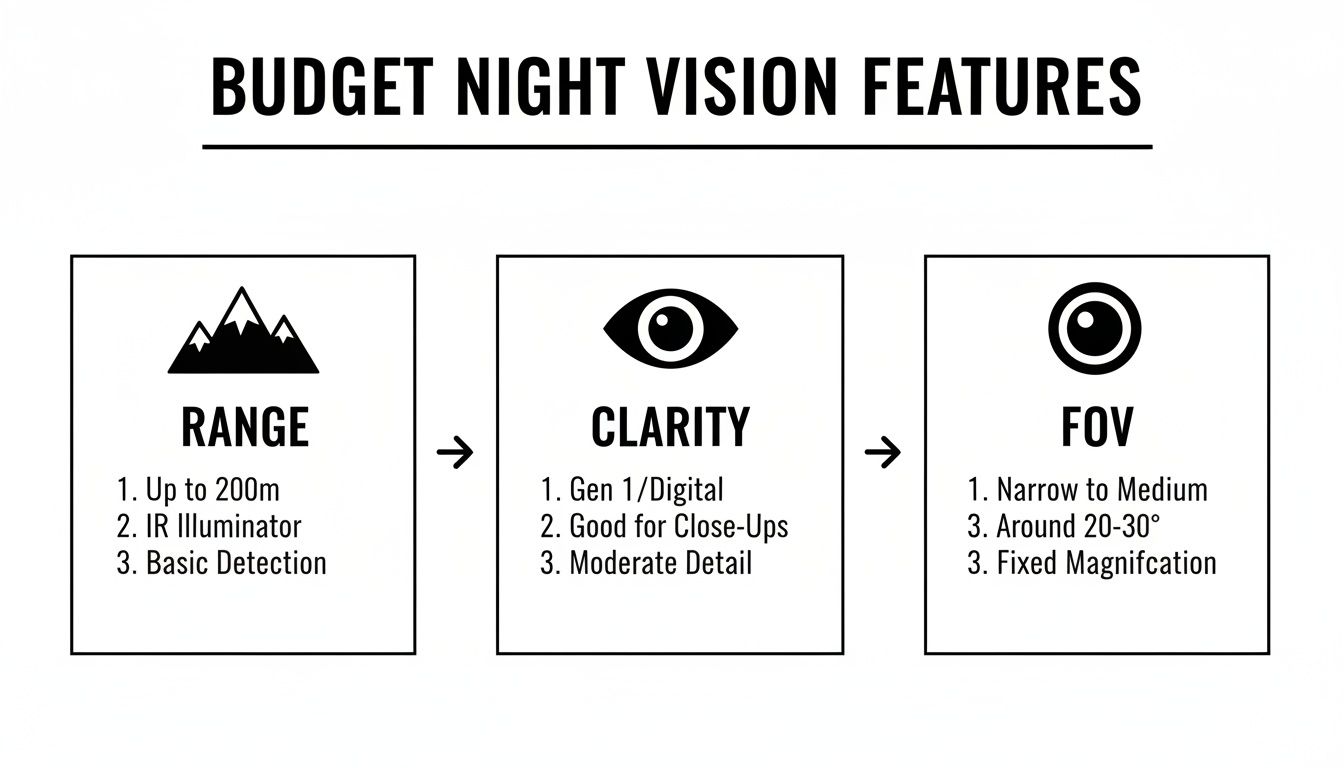
Ultimately, your decision comes down to balancing these factors. Digital is fantastic for recording and shooting from a fixed position, while analog remains the king of stealthy movement and pure situational awareness.
Matching Your Budget NVG to Your Mission

There’s no single “best” budget night vision device. The right unit for you is the one that’s tailor-made for what you actually plan to do with it. A powerful digital scope might be an incredible tool for one person and the completely wrong choice for another. Before you even look at a spec sheet, the most important thing is to get really honest about your primary mission.
This means thinking less about features and more about real-world situations. A hog hunter’s needs are a world away from a homeowner checking on a strange noise, which is different again from a hiker trying to navigate a trail after dark. Let’s walk through these common scenarios to see how technical specs translate into practical performance.
For the Nocturnal Hunter
If you're out there trying to identify and engage targets like coyotes or hogs, your world revolves around three things: magnification, clarity at a distance, and a usable reticle. You're most likely shooting from a fixed position—a blind, a truck, or a tripod—so things like a super-wide field of view and low weight aren't your top concerns.
- Top Recommendation: A digital night vision weapon scope.
- Why It Works: These scopes are built for this exact job, combining magnification and aiming reticles in one package. Their biggest strength is how well they perform with a powerful IR illuminator, which can easily light up targets out to 150-200 yards. Handy features like one-shot zeroing and onboard video recording are huge bonuses for any hunter.
- Key Trade-off: You’re giving up mobility. These are not tools for walking around with; the narrow, magnified view can be disorienting and is not meant for navigation.
For the Landowner Securing a Perimeter
When you’re a landowner, your job is all about observation and awareness. You need to scan a large, dark property quickly to spot movement or figure out what that sound was. You’re not trying to aim, you’re just trying to see.
For property security, nothing beats a wide field of view. The ability to scan your surroundings without feeling like you’re looking through a straw is what gives you real situational awareness and helps you spot things at the edges.
This mission demands a completely different kind of device.
- Top Recommendation: A handheld digital or Gen 2 monocular.
- Why It Works: A monocular is light, compact, and perfect for quick scans from the back porch. A good Gen 2 unit is especially useful here, as it lets you see without using an IR illuminator, meaning you don't give away your position. It's the ultimate grab-and-go tool for checking on a disturbance.
- Key Trade-off: Holding a monocular steady for a long time gets tiring. For extended, hands-free observation, you’d need to step up to a helmet and mount setup.
While security has traditionally dominated the night vision market, the segment for wildlife observation and hunting is exploding, growing at a 12.8% CAGR. This boom is largely thanks to affordable digital units under $500 that now deliver clear 1080p resolution out to 200 meters. This trend is expected to push night vision use among U.S. hunters to an estimated 65% by 2025. You can dig into more of the data on these market trends from Grand View Research.
For the Hiker or Backpacker
When you're on a trail after sunset, your priorities do a complete 180. Everything is about hands-free operation, a wide field of view for situational awareness, and keeping weight to an absolute minimum. Good depth perception is also a massive plus for not tripping over every root and rock.
- Top Recommendation: A helmet-mounted Gen 2 monocular or a solid entry-level digital monocular.
- Why It Works: Mounting a monocular to a helmet frees up your hands for trekking poles or just for balance. A Gen 2 unit is perfect here because its passive performance lets you see the trail with nothing more than starlight. This also preserves the natural night vision in your unaided eye, which is a huge safety advantage.
- Key Trade-off: You won't have the magnification needed for identifying things far away, but that’s not the mission. The entire goal is safe, up-close navigation.
Choosing the Right Partner for Your Night Vision Purchase
Let's be honest. After all the time you've spent researching tubes, specs, and housings, it’s easy to think the hard part is over. But where you decide to buy your gear is just as critical as what you buy, especially when you're working with a budget.
A random seller on a huge online marketplace or a big-box store just can’t provide the kind of specialized support you need. When you're spending this kind of money, you need a partner, not just a checkout button. You need to know that the people you're buying from actually understand the gear and will have your back if something goes wrong.
The Superior Tactical Advantage
This is where we come in. We don't just move boxes; our entire goal is to make sure you get the right device and that it serves you well for years to come. Here’s what that actually looks like:
- Industry-Leading Warranties: We stand behind our Gen 3 systems with a 10-year warranty. That’s a decade of knowing your investment is protected from the unexpected.
- Expert In-House Services: Things can happen in the field. If they do, we offer free diagnostics and have expert technicians on-site to handle repairs. You won't be stuck waiting weeks for your unit to be shipped off to some unknown third party.
- Same-Day Shipping: When you finally pull the trigger on a purchase, the last thing you want is a long wait. We work hard to get orders out the door the same day, getting your gear into your hands as quickly as possible.
Your relationship with your gear supplier shouldn't end at checkout. It should be an ongoing partnership built on expertise, reliable support, and a shared commitment to keeping you operational in any condition.
We also know that for many buyers, getting the most performance for every dollar is the name of the game. That's why we stock a huge inventory of parts and DIY build kits. This gives you the option to assemble your own high-performance PVS-14 or binos for a fraction of the cost of a pre-built unit. We’re not just a store; we’re a resource to help you succeed.
Frequently Asked Questions About Budget Night Vision
Even after you've done your research, a few practical questions always pop up right before you pull the trigger on a purchase. That's completely normal. Getting these last few details ironed out is what separates a good buy from a great one.
We've heard them all over the years. Here are straightforward answers to the most common questions we get from folks just getting into affordable night vision.
Digital vs. Analog for a Beginner?
For someone new to the game, is it better to go digital or stick with an entry-level analog unit? The best way to think about it is comparing a modern smartphone camera to a classic film camera.
Digital units, like a Sightmark Wraith, are incredibly easy to use right out of the box. You can run them in broad daylight without worrying about damage, record your hunts, and even cycle through different color palettes. The trade-off is that in near-total darkness, they are completely dependent on an IR illuminator to see anything.
An analog Gen 2 device, on the other hand, gives you that classic, lag-free "green screen" view and truly shines when used passively (without an active IR light). This is a massive advantage for staying undetected. Just remember, you have to be vigilant about protecting it from bright light, as a direct hit can burn the tube permanently.
How Durable Is a Budget Unit, Really?
People often wonder if "budget" means "fragile." Not necessarily. Most well-made digital devices and polymer-housed analog monoculars are built to take a beating. They'll handle the bumps, rain, and general abuse that comes with being in the field. The Good Nite Gear NVG50, for instance, has an IPX7 waterproof rating, so it can be submerged in a meter of water for 30 minutes and live to tell the tale.
The real point of failure isn't usually the housing—it's what's inside. With analog, your main job is to protect the image intensifier tube from bright light. For digital gear, it's all about making sure the seals on battery compartments and data ports are tight to keep water out.
Is It Legal to Hunt with Night Vision?
This is a big one, and the answer is: it depends entirely on where you live and what you're hunting. For controlling populations of invasive species like feral hogs or coyotes, many states have very relaxed laws and welcome the use of night vision.
However, when it comes to regulated game animals like deer, using night vision is almost always heavily restricted or outright illegal.
You must check your local and state wildlife regulations before every single season. Laws are constantly updated, and claiming you "didn't know" will not get you out of a hefty fine and a confiscated device.
When Is a Monocular a Better Choice Than Goggles?
For anyone on a budget, a monocular is almost always the smarter play. Using a single intensifier tube makes a monocular lighter, far less expensive, and it lets you keep one eye adapted to the ambient darkness. That last part is a huge benefit for your overall situational awareness as you move through different lighting conditions.
Dual-tube goggles give you incredible depth perception, which is essential for things like driving a vehicle or moving quickly over rough terrain. But that capability comes with a significant penalty in both cost and weight. For general observation, navigation, and most shooting scenarios, a monocular gives you the best blend of performance and value.
Ready to find the right gear for your needs? The team at Superior Tactical LLC brings over a decade of real-world experience to help you choose the right optics. We offer a curated selection of reliable night vision devices and DIY kits, all backed by our expert support and an industry-leading warranty. Check out our offerings at https://superiortac.com to get started.
