AGM StingIR 640 Ultimate Thermal Monocular Guide
The AGM StingIR 640 isn't just another thermal monocular; it's a compact powerhouse that punches well above its weight class. We're talking about a true multi-role tool that gives you high-end 640-resolution thermal imaging whether you're running it handheld, on a helmet, or even as a clip-on in front of your day optic.
What Makes the AGM StingIR 640 a Top-Tier Thermal
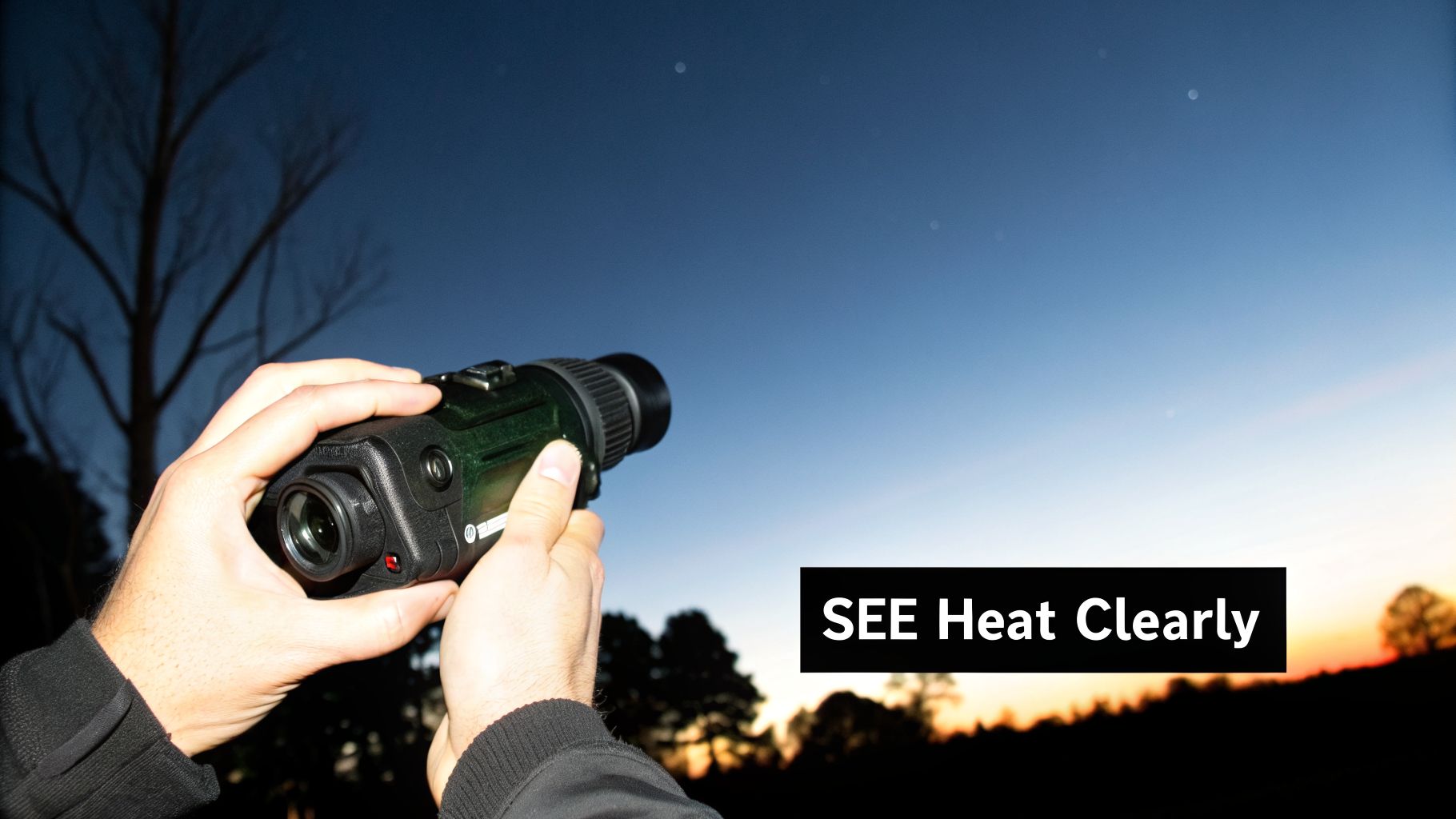
When you get your hands on a lot of different thermal optics, you start to see where each one fits. The StingIR 640 has quickly found its niche with professionals—from law enforcement to serious hog and coyote hunters—who need serious performance without being weighed down. At its core, it does one thing exceptionally well: it turns the unseen world of heat into a crisp, usable image, letting you cut right through pitch-black darkness, smoke, and even light foliage.
What really makes this unit stand out is how AGM managed to combine a legitimately powerful sensor with such a small, lightweight design. This isn’t some big, clunky, dedicated thermal scope. It's a highly flexible piece of gear built to enhance the way you already operate.
Power in a Small Package
The real magic inside the StingIR 640 is its high-resolution 640×512 thermal sensor. The best way to think about thermal resolution is like the pixel count on a 4K TV versus an old standard-def model. More pixels give you a much cleaner, sharper picture with far more detail. This is what separates simple detection from positive identification. With a lower-resolution thermal, you might see a warm shape out in the field. With the StingIR 640, you can actually see the details that tell you it’s a coyote and not a neighbor’s dog.
Somehow, AGM crammed all of that imaging power into a body that weighs less than eight ounces. This incredible power-to-weight ratio is what makes it so versatile for so many jobs.
- Handheld Scanning: You can glass an entire field for hours without your arm getting tired.
- Helmet-Mounted Awareness: Go hands-free to navigate a structure or trail, keeping your head on a swivel.
- Clip-On Sight: Snap it in front of your red dot or holo sight for a fast, no-nonsense nighttime aiming solution.
The whole point of the StingIR 640 is to give you maximum thermal capability in the smallest, most adaptable unit available. It’s built to give you an edge, not force you into a new, cumbersome system.
This balance of clarity and adaptability is the foundation of the StingIR 640. As we go on, we’ll dig into the specific tech, performance specs, and real-world uses that make this such a solid choice for anyone who takes their gear seriously.
The Tech That Makes All The Difference
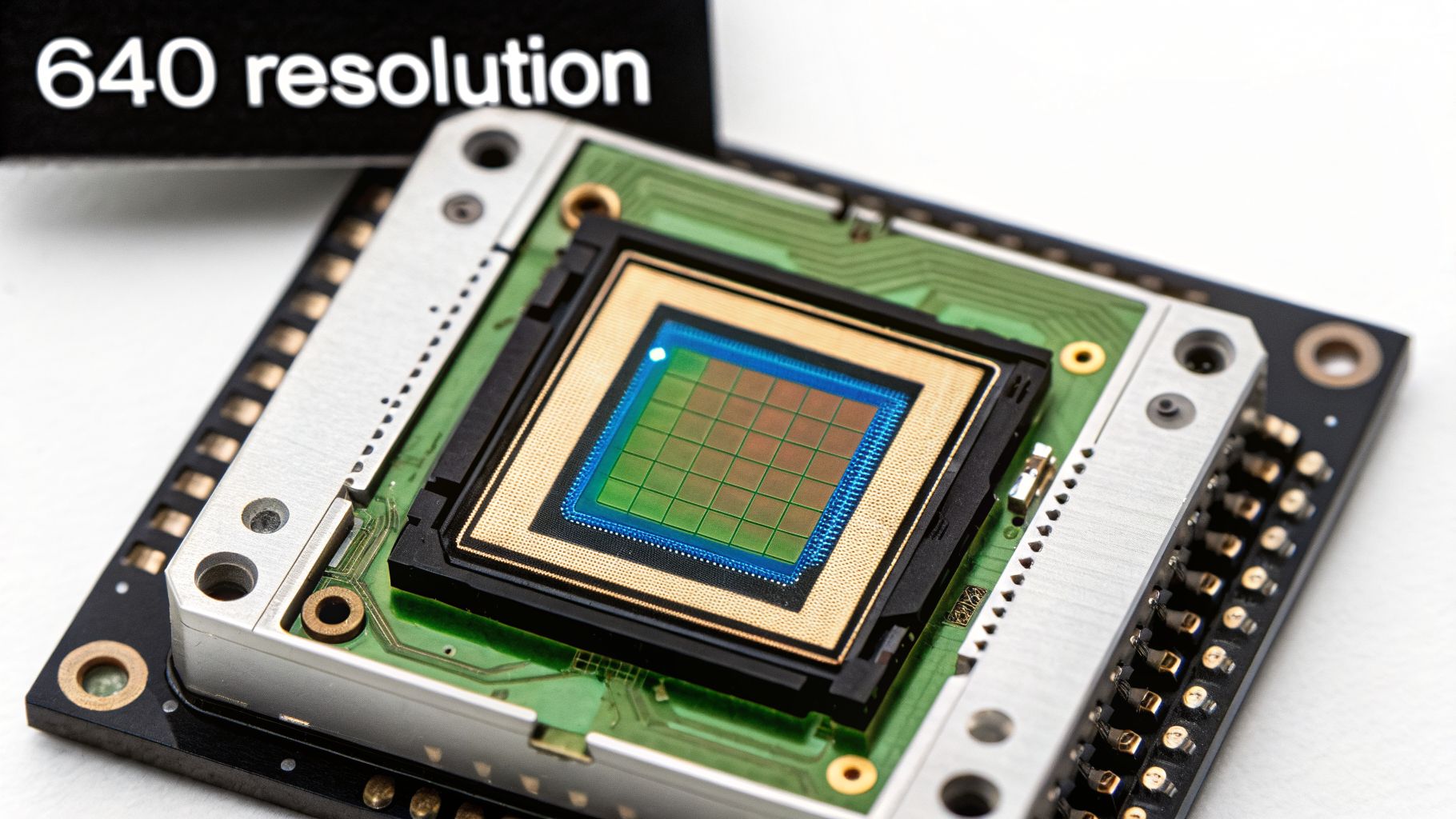
Ever look through a thermal and wonder how it pulls a clear, detailed picture out of complete darkness? It’s all about the technology packed inside, and with the AGM StingIR 640, that tech is top-notch. The magic really happens in the thermal detector, the core of the entire unit.
Think of it less like a camera lens and more like an array of thousands of tiny, hyper-sensitive thermometers. Instead of seeing visible light, it sees heat. This allows it to paint a vivid picture based on the thermal energy everything gives off, letting you spot a warm target hiding in cool vegetation when your own eyes would see nothing.
Why 640 Resolution and 12 Microns Matter
The "640" in the StingIR's name refers to its high-end 640×480 resolution thermal sensor. More pixels simply give you more information. It's the difference between seeing a "hot blob" in the distance and being able to confidently identify it as a coyote on the prowl. If you've ever used a lower-res 384 unit, the jump in clarity is something you'll notice immediately.
Paired with that high resolution is a 12-micron (μm) pixel pitch. This spec tells you how small and tightly packed those "thermometers" on the sensor are. A smaller number is better, as it crams more detail into the same area, giving you a sharper image and a serious advantage in identifying targets at longer ranges.
The combination of high resolution and a small pixel pitch is what truly separates premium thermals from the rest. It translates directly to seeing finer details—like antlers on a deer or the difference between a fox and a housecat—at distances where lesser optics would leave you guessing.
The Real-World Impact of NETD and Refresh Rate
But resolution is only part of the story. Two other specs have a massive impact on what you actually see in the field. The first is the sub-25 millikelvin (mK) NETD rating. In simple terms, NETD is a measure of thermal sensitivity. The lower the number, the better the sensor is at picking up minuscule differences in temperature.
A sub-25mK rating is exceptional, and it’s what allows the AGM StingIR 640 to make a target pop even when its heat signature is extremely close to the background temperature. Think of trying to spot a bedded-down hog against warm, damp ground on a humid night—the StingIR’s low NETD makes that subtle heat difference stand out clearly.
The second crucial spec is the 50Hz refresh rate. This is how many times per second the image on your screen updates. A 50Hz rate delivers a smooth, fluid picture without any of the lag or choppiness you get from slower rates. That fluid motion is absolutely critical when you're tracking a running animal or quickly scanning a field.
When you bring all these elements together—a high-res 12μm VOx detector, a sensitive sub-25mK NETD, and a fast 50Hz refresh rate—you get an optic with incredible performance. It gives the monocular a practical detection range of 1200 meters for a human-sized target, a game-changing advantage in the open country of Texas or the rolling hills of the Midwest.
If you’re still getting up to speed on the fundamentals, our guide comparing thermal imaging vs night vision is a great place to start.
Built for the Demands of the Field
Specs on a datasheet are one thing, but how a thermal feels in your hand and holds up to abuse is what really counts out in the field. With the AGM StingIR 640, it’s immediately obvious this unit was designed by people who actually use their gear, not just design it. It’s built to be an extension of you, not some clunky piece of equipment you have to fight with.
On a long stalk or an extended operation, every single ounce counts. The StingIR is an absolute featherweight, tipping the scales at just under 8 ounces—about what your smartphone weighs. This makes a huge difference, whether it's mounted on a helmet for hours or carried in a chest rig. You simply forget it's there, which is exactly what you want.
Engineered for Tough Environments
Of course, a lightweight optic is worthless if it can't take a beating. The StingIR 640 is built around a high-performance composite housing that feels incredibly solid. It's designed to shrug off the bumps, drops, and scrapes that are just a part of running gear hard.
On top of its rugged frame, the unit boasts a full IP67 waterproof rating. This isn't just for marketing fluff; it's a guarantee. It means the optic is completely sealed from dust and can survive being submerged in a meter of water for up to 30 minutes.
In practice, this gives you total confidence in your equipment. Get caught in a sudden downpour, take a spill crossing a creek, or operate in a gritty, dusty environment—the StingIR is built to keep running no matter what.
Designed Around the User Experience
Beyond its tough exterior, the StingIR is remarkably easy to operate. You can tell a lot of thought went into the user interface. A simple, tactile three-button control system is easy to learn and use, even in total darkness or while wearing gloves. You're not going to be fumbling with confusing menus when you should be focused on the target.
This focus on the user carries over to what you see. The eyepiece features a sharp 1024×768 OLED display. This high-resolution screen delivers a crisp, high-contrast image, ensuring all the valuable thermal data gathered by the sensor is presented with outstanding clarity. It makes spotting and identifying targets much easier on the eyes.
An adjustable diopter also lets you perfectly focus the display for your own eyesight, which is a critical feature for getting a razor-sharp image, with or without glasses. At just 5.5 inches long and 7.8 ounces, the AGM StingIR 640 packs this durability into a tiny footprint, making it a go-to choice for everything from rescue missions in the rainy Pacific Northwest to coyote hunts in the Southwest. For a full breakdown of every spec, you can check out the complete technical datasheet from AGM.
How to Use the StingIR 640 Handheld, Helmet, and Weapon Mounted
The real measure of any piece of kit isn't just its specs on paper—it's how it works for you in the field. The AGM StingIR 640 was clearly built by people who get that. It's designed from the ground up to be a true force multiplier.
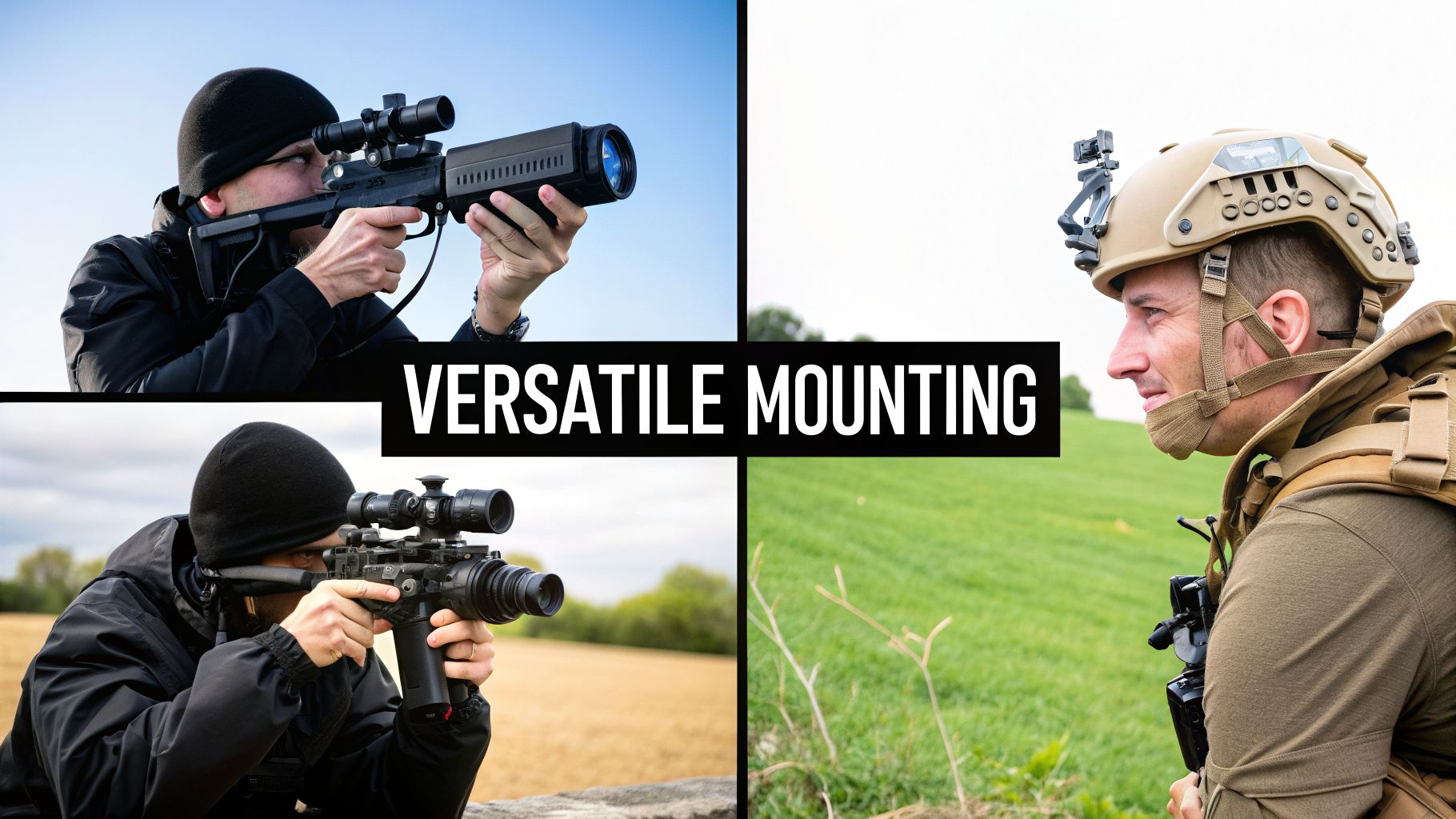
What makes it so effective is its ability to seamlessly switch between three key roles. This means you can adapt on the fly without bogging yourself down with extra gear. Whether you're using it as a handheld scanner, a helmet-mounted monocular, or a weapon-mounted clip-on, the StingIR 640 proves itself as one of the most adaptable thermals out there.
As a Handheld Monocular
Right out of the box, the StingIR 640 is a phenomenal handheld observation tool. It’s incredibly light, weighing in at sub-8-ounces, so you can scan a ridgeline or field for hours without your arm getting tired. This is your go-to mode for quick, on-the-move situational awareness.
- Real-World Use: Think about setting up for a coyote hunt at dusk. Instead of sweeping your rifle everywhere, you can use the StingIR as a handheld to quietly glass the tree line. You'll spot heat signatures from approaching predators long before you can see or hear them, all while keeping a low profile.
As a Helmet-Mounted Optic
This is where the StingIR 640 really changes the game. Slap on a standard dovetail adapter, and the unit clicks right into your helmet shroud for hands-free thermal vision. For navigating in total darkness, this capability is nothing short of revolutionary.
When you run the AGM StingIR 640 on a helmet, your ability to move through tricky environments—think thick woods at night or unlit buildings—goes to a whole new level. You get a constant thermal overlay, letting you spot obstacles or threats with your head up and hands free. It’s a massive leg up for anyone from tactical operators to serious outdoorsmen.
To get the most out of this setup, it's worth diving deeper into choosing the right thermal monocular for your helmet and integrating it with your other gear.
As a Weapon-Mounted Clip-On
Finally, the StingIR 640’s clip-on function lets it work with your primary day optic. You simply mount it on the rail in front of a 1x red dot or holographic sight—like an EOTech or Aimpoint. Because it’s a true clip-on, it uses your existing optic's zero. No re-sighting, no hassle.
- Real-World Use: Imagine a hog hunter who spots a sounder with the StingIR in handheld mode. In seconds, they can snap it onto their rifle, line it up with their red dot, and be ready to make an accurate shot. This fluid transition from observation to engagement is what makes the clip-on mode so incredibly powerful.
Beyond the Spec Sheet: How the StingIR 640 Performs in the Field
Specs on a product page are one thing, but they don't tell you how a thermal optic will actually perform when the pressure is on. The real measure of a unit like the AGM StingIR 640 is how it handles the unpredictable variables of the real world. Let’s get past the numbers and talk about what this monocular can do for you when it really counts.
Think about a law enforcement officer clearing a dark industrial park after a suspect has fled on foot. From a safe position, the officer can scan a long, shadow-filled alleyway with the StingIR 640. The high-resolution 640 sensor punches through the pitch-black darkness, instantly painting a clear heat signature of the suspect hiding behind a dumpster hundreds of feet away. What was a dangerous, high-risk search just became a controlled, tactical situation.
From Detection to Positive ID
Now, let's switch gears to a hunter's perspective. The mission is different, but the need for absolute clarity is just as critical. You're in a stand overlooking a field on a moonless night when you hear rustling in the brush. Using the StingIR 640 as a handheld scanner, you pick up a group of hogs breaking from the tree line over 200 yards out.
With the detail provided by the 640-resolution core, you’re not just seeing blobs. You can clearly count the animals, identify a mature boar in the sounder, and confirm your backdrop is safe before even thinking about shouldering your rifle. This is the difference-maker. The AGM StingIR 640 gives you the crucial information needed to make a sound decision, a massive leap beyond what lower-resolution thermals can offer.
The true advantage of the StingIR 640 isn’t just seeing something out there; it’s knowing what you are seeing. That ability to positively identify a target at distance is the foundation of safety, ethics, and effectiveness.
Making the Most of Your Color Palettes
Getting the most out of the StingIR means knowing how and when to use its different color palettes. Think of them as different filters, each designed to pull specific information out of the environment for you.
White Hot: This is the workhorse. It shows the hottest objects in the scene as bright white, offering maximum contrast against the darker, cooler background. It’s the fastest way to spot a heat signature.
Black Hot: This simply inverts the image, displaying heat as black. Many seasoned users prefer this mode because it’s often less strenuous on the eyes during long scanning sessions and can sometimes help define the edges of a target more clearly.
Fusion/Rainbow: These multi-color palettes assign different colors to different temperature ranges. While they can look a bit busy at first, they are incredibly powerful for dissecting a complex scene. Fusion mode, for example, can make a recently driven engine or a downed animal stand out even as it begins to cool.
The right palette always depends on the job at hand and the environment you’re in. Learning to switch between them effectively turns the AGM StingIR 640 from a simple viewer into a sophisticated analysis tool, giving you an edge whether you're securing a perimeter, conducting a search, or ensuring a successful night hunt.
Comparing The StingIR 640 Against The Competition
When you're trying to make a smart buy, you need to understand the trade-offs. The AGM StingIR 640 really carves out its own niche in the thermal market, and putting it side-by-side with other options shows you exactly where the value is. We’re not just talking about numbers on a spec sheet; we’re talking about how those specs actually help you in the field with better image quality, mobility, and pure versatility.
Let's stack it up against two of the most common alternatives you'll see out there: a standard 384-resolution thermal monocular and a bigger, dedicated thermal rifle scope.
StingIR 640 vs. 384-Resolution Monoculars
Right off the bat, the most dramatic difference is image clarity. The easiest way to think about it is like comparing an old standard-definition TV to a 4K one. The 640 sensor in the StingIR has four times the pixels of a 384 unit, and that makes a world of difference.
A 384 thermal is perfectly fine for basic detection—letting you know something is out there. But the AGM StingIR 640 is all about positive identification. That massive boost in resolution is what allows you to clearly distinguish a coyote from the neighbor's lost dog at distances where a 384 optic would just give you a fuzzy, ambiguous blob.
This infographic breaks down a few situations where that level of positive ID is not just nice to have, but absolutely essential.
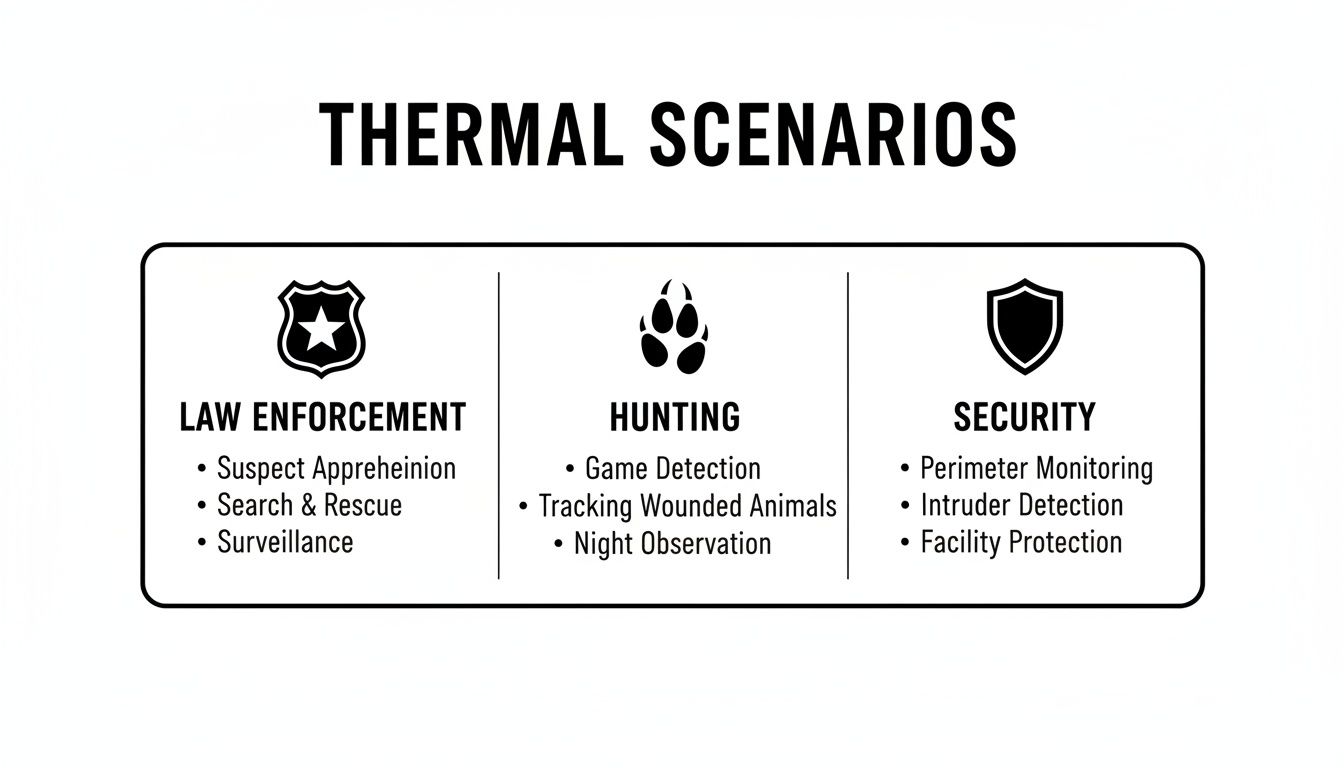
Whether you’re a professional on duty or a hunter concerned with ethics, being able to know for sure what you're looking at is a non-negotiable advantage. That's the power 640 resolution gives you.
StingIR 640 vs. Dedicated Thermal Scopes
Now let's talk about dedicated thermal rifle scopes. These units are purpose-built for one job and one job only: sitting on top of a rifle. They often have big, heavy lenses and more complex internal software for holding zero, but that single-minded focus comes with major downsides in weight and flexibility. It’s not uncommon for a traditional thermal scope to weigh two or even three pounds, and it's basically bolted to your gun.
This is exactly where the StingIR’s design philosophy pulls ahead. Tipping the scales at under 8 ounces, it’s a true featherweight. You can use it as a handheld scanner, pop it on a helmet for hands-free navigation, or clip it onto your rifle when it's time to take a shot.
Think about it—you can't comfortably glass a field for hours holding a heavy rifle up to your eye, and you certainly can't wear a full-size scope on your head.
The AGM StingIR 640 is the answer for the user who just refuses to be stuck with one option. It delivers the top-tier image quality you'd expect from a dedicated scope, but in a compact, multi-role package that a traditional scope simply can't touch.
So, while a dedicated scope might be the perfect tool for a rifle that only gets used for night hunting, the StingIR is the clear winner for anyone who needs to adapt to the situation. It’s the solution for the operator, hunter, or prepared citizen who demands both elite thermal performance and ultimate mobility.
AGM StingIR 640 vs The Competition
To put it all into perspective, here's a quick table breaking down the key differences between the StingIR 640 and other common thermal options. This helps visualize where the StingIR truly shines.
| Feature | AGM StingIR 640 | Typical 384-Res Monocular | Traditional Thermal Scope |
|---|---|---|---|
| Image Resolution | 640×512 (Excellent for ID) | 384×288 (Good for Detection) | Varies (640 or 384) |
| Primary Use | Multi-Role: Handheld, Helmet, Weapon | Handheld Scanning | Weapon-Mounted Only |
| Weight | < 8 oz | ~12-16 oz | ~2-3 lbs |
| Versatility | Very High | Moderate | Low |
| Cost | Mid-High | Low-Mid | Mid-High |
| Best For | Users needing max flexibility & clarity | Budget-conscious detection | Dedicated night hunting rifle |
As you can see, the StingIR isn't trying to be the cheapest or the most specialized; it’s built to be the most versatile. It bridges the gap, offering premium performance in a package you can use in almost any scenario.
If you're still working through what features matter most for your specific needs, be sure to check out our detailed guide on choosing the best thermal imaging monocular.
Common Questions About the AGM StingIR 640
When you're looking at a serious piece of gear like the AGM StingIR 640, you're going to have some questions. It’s a big decision. Here are the answers to the questions we get asked the most, based on our own experience with the unit.
What's the Real-World Effective Range?
The spec sheet says the StingIR can detect a human-sized target out to 1200 meters, and that’s true. But in the real world, detection is only half the battle. What really matters is identification.
Thanks to its powerful 640×512 thermal sensor, you can actually tell what you're looking at from several hundred yards away. That’s the key difference between the StingIR and a lower-resolution 384 unit, where a heat signature at that same distance is often just an ambiguous blob. That extra clarity is what gives you the confidence to make a safe and positive ID.
Can I Use It as a Standalone Scope?
Straight up, no. The AGM StingIR 640 is not designed to be a standalone thermal scope. It's built from the ground up to be a clip-on system, meaning it mounts directly in front of your existing 1x day optic, like a red dot or a holographic sight.
Think of it this way: the StingIR doesn't have its own adjustable reticle, so you can't zero it like a regular scope. Its job is to add thermal capability to your already zeroed daytime setup, instantly giving you night vision without having to re-zero or swap optics.
How's the Battery Life in the Field?
You’ve got great options here. A single CR123A battery will give you up to 5 hours of continuous runtime, which is more than enough for a lot of situations. If you know you'll be out longer, the included battery extender lets you use a rechargeable 18650 battery for even more juice.
Best of all, the StingIR has a built-in USB-C port. You can hook it up to an external battery pack and run the unit pretty much indefinitely. You'll never have to worry about your thermal dying at the wrong moment.
Is This Thing Tough Enough to Handle Recoil?
Absolutely. The AGM StingIR 640 is built like a tank and is officially rated to handle the recoil of rifles chambered up to 5.56/.223 caliber. The housing is incredibly durable, and its internal components are specifically engineered for the shock and vibration of being mounted on a weapon. It’s designed to perform reliably as a clip-on, plain and simple.
Ready to see what the clarity and power of the AGM StingIR 640 can do for you? At Superior Tactical LLC, we don't just sell gear—we use it. We’ve got the expertise to get you set up and ready to own the night.
Explore the AGM StingIR 640 and get mission-ready today at superiortac.com
